S1 · Object detection · FrameworkFixed main-conference versionA Dual Weighting Label Assignment Scheme for Object Detection
Venue: CVPR 2022 · Main-conference paper
Figure 2 · PDF page 4 · P66
300 dpi PNG · Caption · Source PDF
Original caption, source, and provenance
Fixed source version: CVPR 2022 fixed official PDF
Earliest verified matching figure date (temporal proxy): 2022-03-18
arXiv v1 date: 2022-03-18
Actual drawing date: unknown. See the source record for version checks and temporal-evidence limitations.
Historical PDF · Download citation snapshot · Date evidence · Paper page · Complete screening and version record (Chinese)
Citation threshold evidence: Lei Zhang; 137335 citations; snapshot 2026-10-21.
Recorded drawing-tool disclosure: unknown. No tool attribution is inferred from appearance; see the archival disclosure evidence for scope and wording.
Crop bounding box: [75, 70, 523, 191] (PDF points; top-left origin; x0, y0, x1, y1).
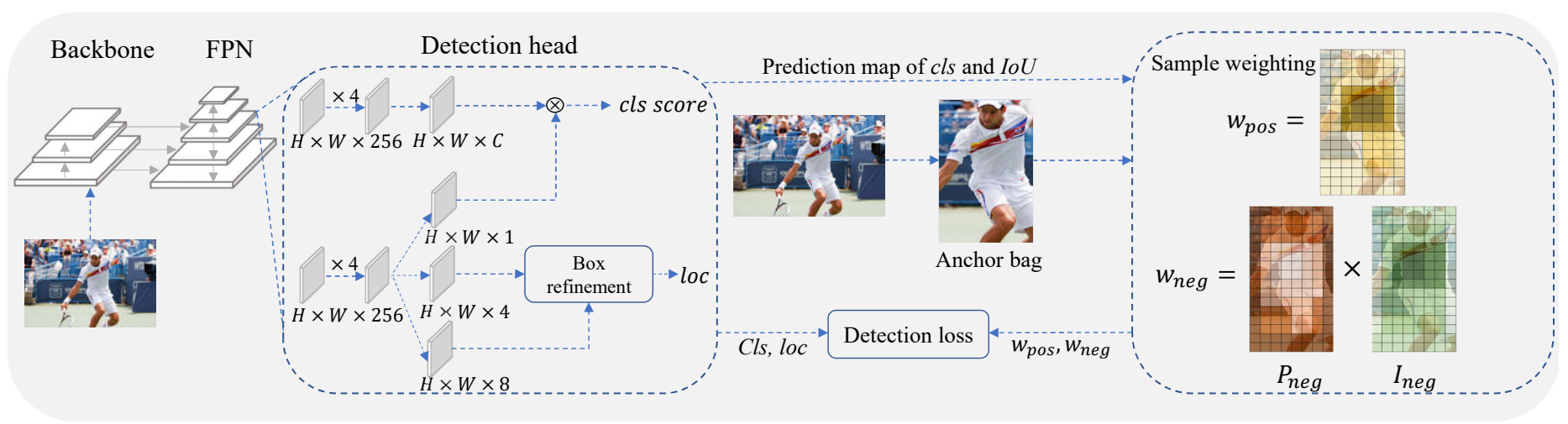
Figure 2. Pipeline of DW. The left part shows the overall detection model which consists of backbone, FPN and detection head. The
outputs from the classification branch (H × W × C) and the centerness branch (H × W × 1) are multiplied as the final cls score. The
box refinement module utilizes the four predicted boundary points (H × W × 8) to adjust the coarse prediction (H × W × 4) to finer
locations.The right part shows the weighting process. Given an object, a candidate anchor bag is first constructed by selecting the anchor
points near the object center. Each anchor will then be assigned a pos weight and neg weight from different aspects.
A Dual Weighting Label Assignment Scheme for Object Detection
Venue: CVPR 2022 · Main-conference paper
Figure 1 · PDF page 1 · P65
300 dpi PNG · Caption · Source PDF
Original caption, source, and provenance
Fixed source version: CVPR 2022 fixed official PDF
Earliest verified matching figure date (temporal proxy): 2022-03-18
arXiv v1 date: 2022-03-18
Actual drawing date: unknown. See the source record for version checks and temporal-evidence limitations.
Historical PDF · Download citation snapshot · Date evidence · Paper page · Complete screening and version record (Chinese)
Citation threshold evidence: Lei Zhang; 137335 citations; snapshot 2026-10-21.
Recorded drawing-tool disclosure: unknown. No tool attribution is inferred from appearance; see the archival disclosure evidence for scope and wording.
Crop bounding box: [314, 215, 540, 357] (PDF points; top-left origin; x0, y0, x1, y1).
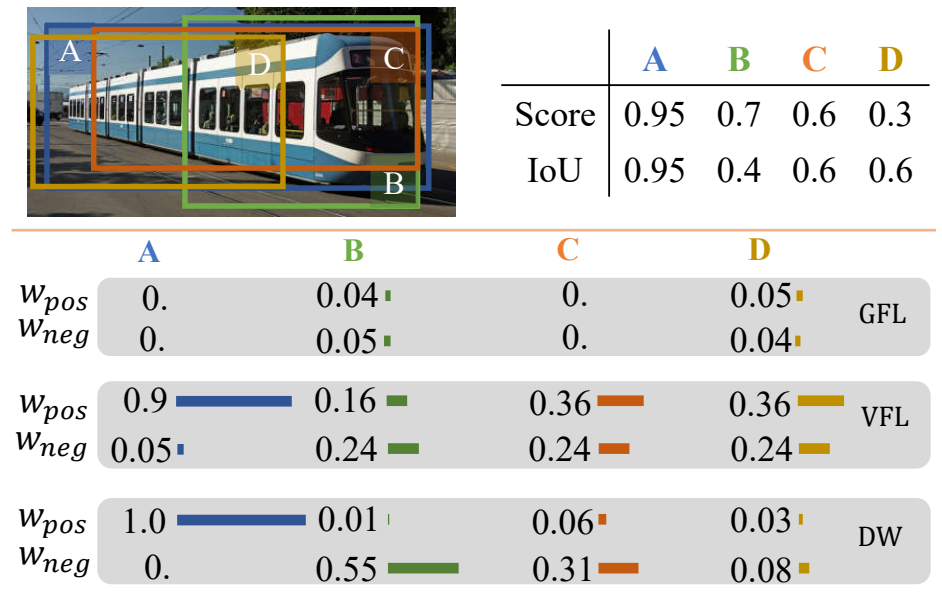
Figure 1. An illustration of the difference between the proposed
DWmethodandexistinglabelassignmentmethods,e.g.,GFL[21]
and VFL [43]. For ambiguous anchors B, C and D, GFL and VFL
willassignnearlythesameposandnegweightsto{B,D}and{C,
D}, respectively. In contrast, our DW assigns a distinct (pos, neg)
pair for each anchor.Cross Domain Object Detection by Target-Perceived Dual Branch Distillation
Venue: CVPR 2022 · Main-conference paper
Figure 2 · PDF page 3 · P226
300 dpi PNG · Caption · Source PDF
Original caption, source, and provenance
Fixed source version: CVPR 2022 fixed official PDF
Earliest verified matching figure date (temporal proxy): 2022-05-03
arXiv v1 date: 2022-05-03
Actual drawing date: unknown. See the source record for version checks and temporal-evidence limitations.
Historical PDF · Download citation snapshot · Date evidence · Paper page · Complete screening and version record (Chinese)
Citation threshold evidence: Yali Wang; 17994 citations; snapshot 2026-10-21.
Recorded drawing-tool disclosure: unknown. No tool attribution is inferred from appearance; see the archival disclosure evidence for scope and wording.
Crop bounding box: [98, 71, 497, 238] (PDF points; top-left origin; x0, y0, x1, y1).
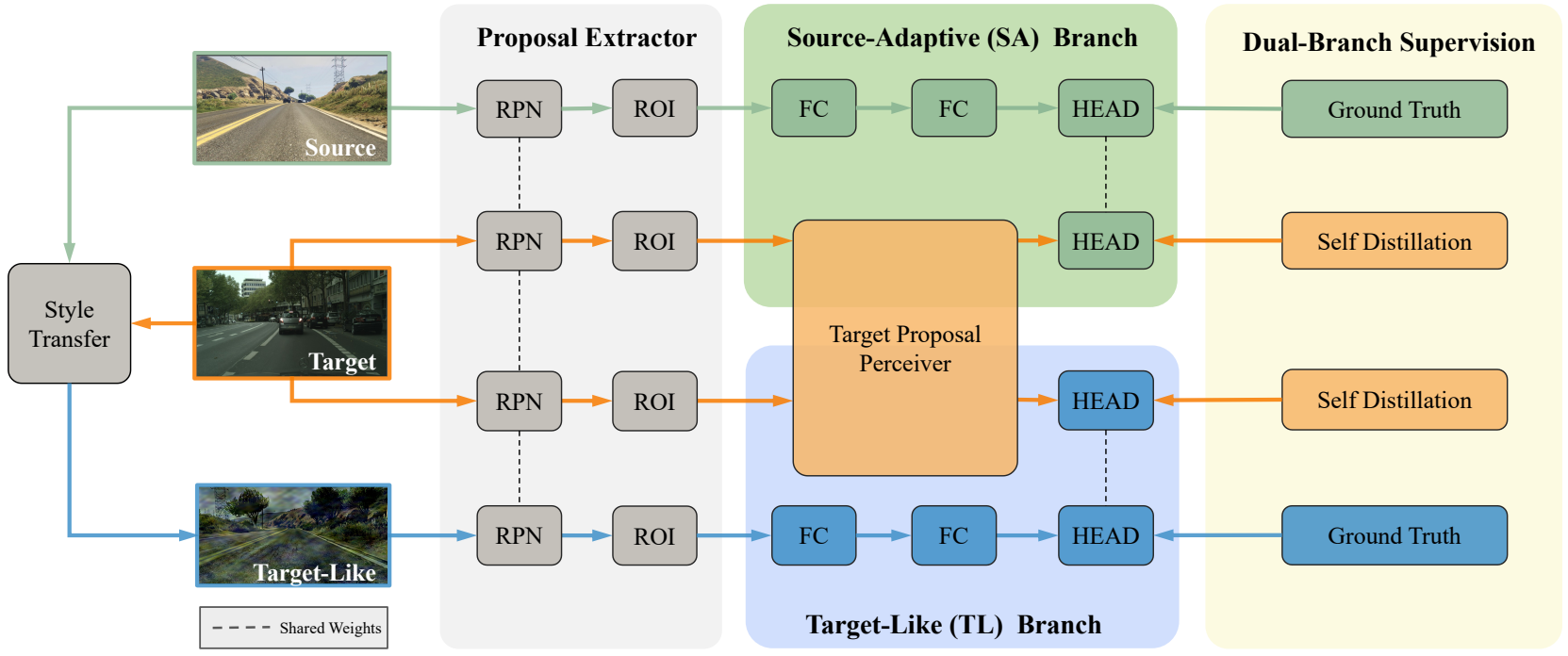
Figure 2. An overview of Target-perceived Dual-branch Distillation framework. To simplify the description, ROI refers to the operation
to get proposal features of each image. First, a source domain image is transferred into target-like domain. All of the images from three
domains are fed to a shared proposal extractor to get proposals and proposal features. Then, the proposal features of source and target-like
images are used to train corresponding branches with supervision of ground truth. Moreover, we feed the proposal features of a real target
domain image into both branches, for learning object knowledge from both source and target-like domains. As the images from target
domain are not annotated, the model is optimized by self-distillation.
Cross Domain Object Detection by Target-Perceived Dual Branch Distillation
Venue: CVPR 2022 · Main-conference paper
Figure 1 · PDF page 1 · P225
300 dpi PNG · Caption · Source PDF
Original caption, source, and provenance
Fixed source version: CVPR 2022 fixed official PDF
Earliest verified matching figure date (temporal proxy): 2022-06
arXiv v1 date: 2022-05-03
Actual drawing date: unknown. See the source record for version checks and temporal-evidence limitations.
Historical PDF · Download citation snapshot · Date evidence · Paper page · Complete screening and version record (Chinese)
Citation threshold evidence: Yali Wang; 17994 citations; snapshot 2026-10-21.
Recorded drawing-tool disclosure: unknown. No tool attribution is inferred from appearance; see the archival disclosure evidence for scope and wording.
Crop bounding box: [309, 275, 546, 383] (PDF points; top-left origin; x0, y0, x1, y1).
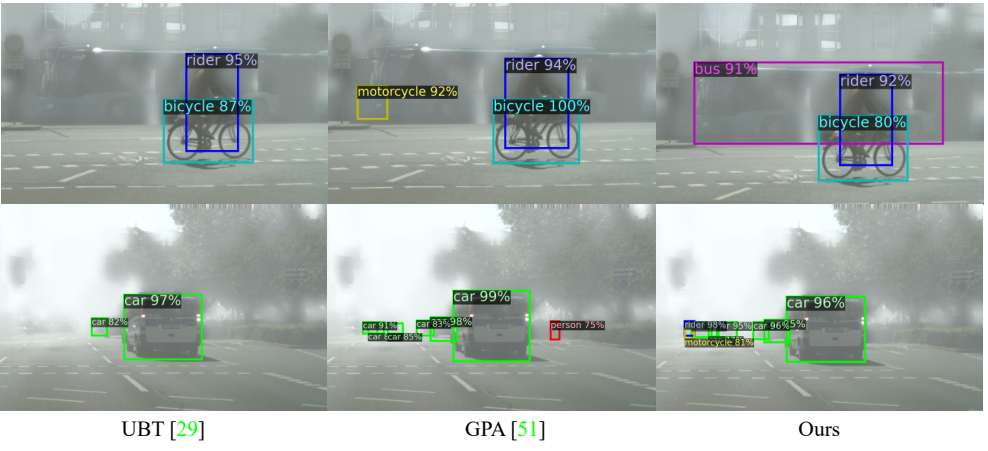
Figure 1. Two typical examples of detection results on the adverse
weather conditions adaptation experiments with different methods.
Semi-supervised method UBT [27] lacks awareness of objects in
the fog. Adversarial based GPA [49] attempts to exploit the objects
in the fog but gives some wrong predictions, such as the motorcy-
cle in the first row and the person in the second row. Our methods
can predict the boxes and categories more accurately.
Dense Learning based Semi-Supervised Object Detection
Venue: CVPR 2022 · Main-conference paper
Figure 2 · PDF page 3 · P96
300 dpi PNG · Caption · Source PDF
Original caption, source, and provenance
Fixed source version: CVPR 2022 fixed official PDF
Earliest verified matching figure date (temporal proxy): 2022-04-15
arXiv v1 date: 2022-04-15
Actual drawing date: unknown. See the source record for version checks and temporal-evidence limitations.
Historical PDF · Download citation snapshot · Date evidence · Paper page · Complete screening and version record (Chinese)
Citation threshold evidence: Lei Zhang; 137335 citations; snapshot 2026-10-21.
Recorded drawing-tool disclosure: unknown. No tool attribution is inferred from appearance; see the archival disclosure evidence for scope and wording.
Crop bounding box: [49, 70, 552, 237] (PDF points; top-left origin; x0, y0, x1, y1).
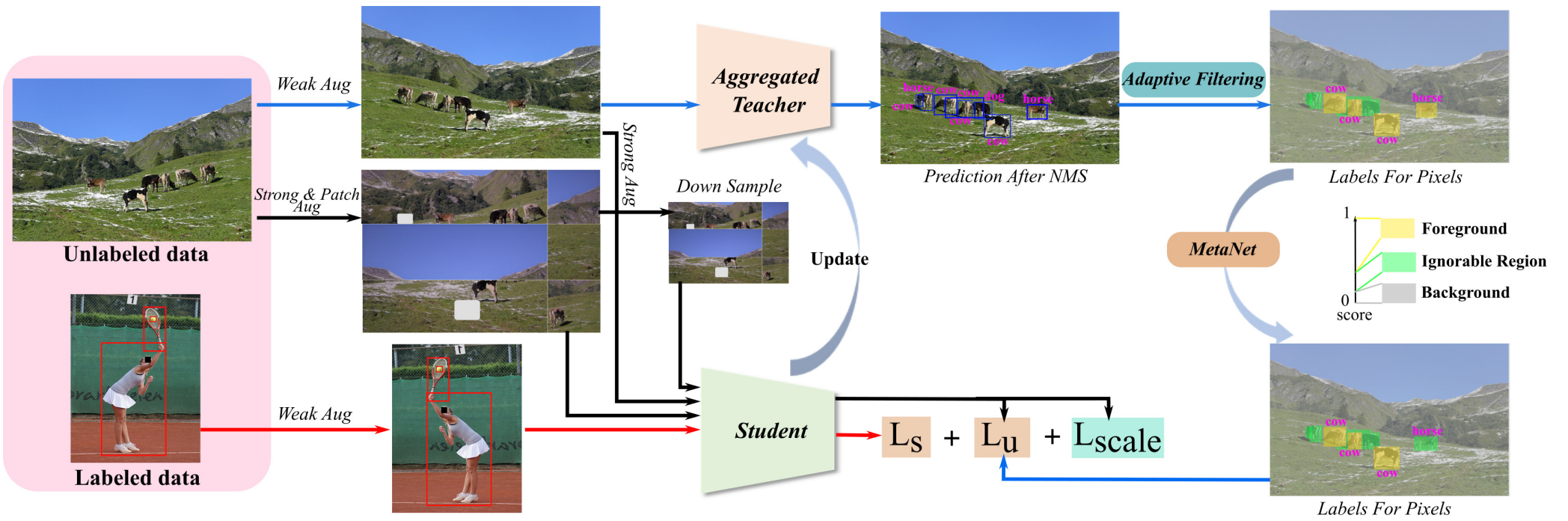
Figure 2. The pipeline of our proposed DenSe Learning (DSL) based SSOD method. The training data contain both labeled and unlabeled
images. During each training iteration, a teacher model is employed to produce pseudo-labels for weakly augmented unlabeled images.
In anchor-free based detectors like FCOS [44], each spatial location of the dense predictions will be assigned with one label, and the
model performance is sensitive to noisy pseudo-labels. To alleviate this problem, an Adaptive Filtering strategy is proposed to split the
pseudo-labels into three types, including background, foreground and ignorable regions. Moreover, there exist some false positive cases,
which have higher scores but are obviously wrong predictions. Thus, a MetaNet is proposed to refine these cases. To improve the model
generalization capability, unlabeled images are patch-shuffled and consistency regularizations are applied on these images with different
scales. For improving the stability and quality of pseudo-labels, the teacher model is updated by the student models via aggregation, called
Aggregated Teacher. After obtaining the fine-grained pixel-wise pseudo-labels, the detector can be optimized by the final loss, which is the
sum of L ,L and L .
s u scale
Dense Learning based Semi-Supervised Object Detection
Venue: CVPR 2022 · Main-conference paper
Figure 3 · PDF page 4 · P95
300 dpi PNG · Caption · Source PDF
Original caption, source, and provenance
Fixed source version: CVPR 2022 fixed official PDF
Earliest verified matching figure date (temporal proxy): 2022-04-15
arXiv v1 date: 2022-04-15
Actual drawing date: unknown. See the source record for version checks and temporal-evidence limitations.
Historical PDF · Download citation snapshot · Date evidence · Paper page · Complete screening and version record (Chinese)
Citation threshold evidence: Lei Zhang; 137335 citations; snapshot 2026-10-21.
Recorded drawing-tool disclosure: unknown. No tool attribution is inferred from appearance; see the archival disclosure evidence for scope and wording.
Crop bounding box: [84, 78, 239, 193] (PDF points; top-left origin; x0, y0, x1, y1).
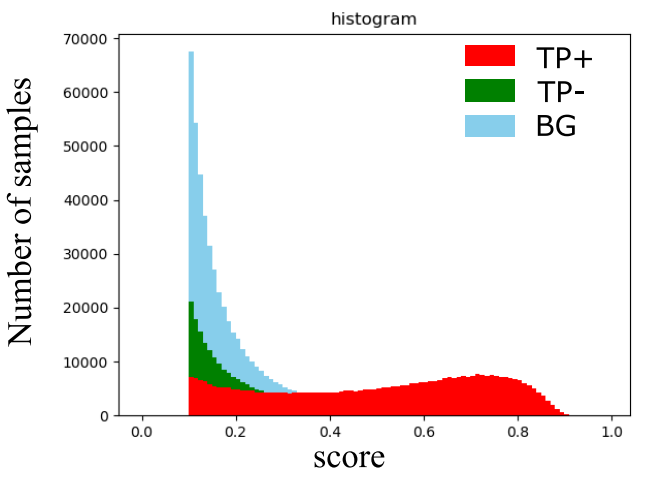
Figure 3. The distributions of TP+, TP- and BG when using 10%
labeled data on COCO. ‘TP+’ means that the estimated instance
has the same class ID as the ground-truth (GT) and the IOU of
BBox is above 0.5. ‘TP-’ means that the estimated instance has
the same class ID as GT but the IOU of BBox is below 0.5. ‘BG’
means that the estimated instance belongs to the background or
has wrong class ID.
Localization Distillation for Dense Object Detection
Venue: CVPR 2022 · Main-conference paper
Figure 3 · PDF page 3 · P214
300 dpi PNG · Caption · Source PDF
Original caption, source, and provenance
Fixed source version: CVPR 2022 fixed official PDF
Earliest verified matching figure date (temporal proxy): 2021-11-25
arXiv v1 date: 2021-02-24
Actual drawing date: unknown. See the source record for version checks and temporal-evidence limitations.
Historical PDF · Download citation snapshot · Date evidence · Paper page · Complete screening and version record (Chinese)
Citation threshold evidence: Ming-Ming Cheng; 85763 citations; snapshot 2026-10-21.
Recorded drawing-tool disclosure: unknown. No tool attribution is inferred from appearance; see the archival disclosure evidence for scope and wording.
Crop bounding box: [49, 70, 548, 212] (PDF points; top-left origin; x0, y0, x1, y1).
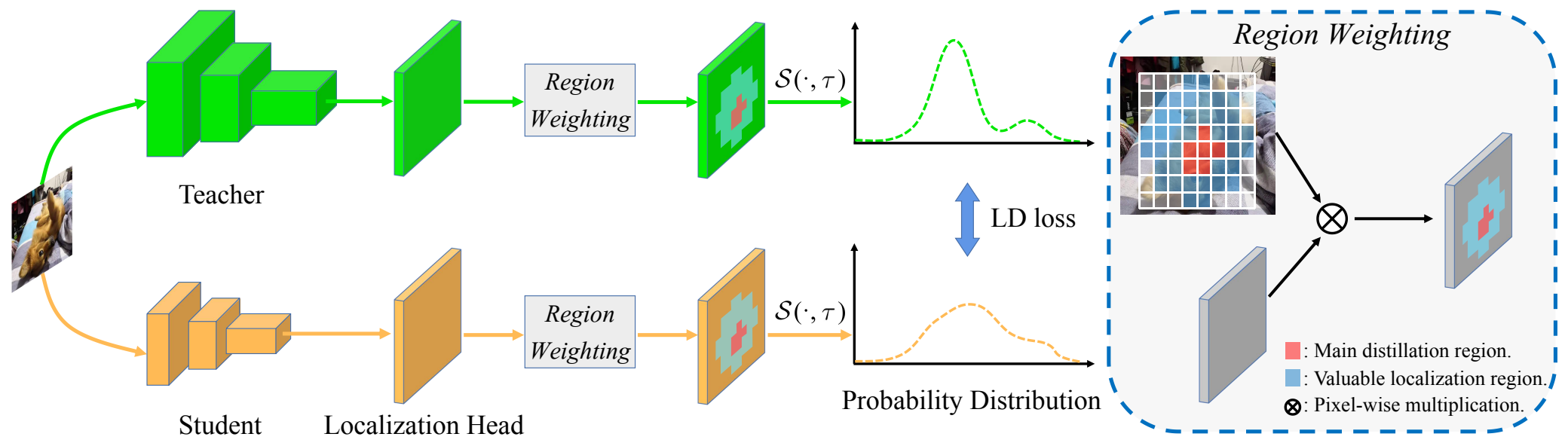
Figure 3. Illustration of localization distillation (LD) for an edge e ∈ B = {t, b, l, r}. Only the localization branch is visualized here.
S (·, τ ) is the generalized SoftMax function with temperature τ . For a given detector, we first switch the bounding box representation
to probability distribution. Then, we determine where to distill via region weighting on the main distillation region and the valuable
localization region. Finally, we calculate the LD loss between two probability distributions predicted by the teacher and the student.Localization Distillation for Dense Object Detection
Venue: CVPR 2022 · Main-conference paper
Figure 1 · PDF page 1 · P213
300 dpi PNG · Caption · Source PDF
Original caption, source, and provenance
Fixed source version: CVPR 2022 fixed official PDF
Earliest verified matching figure date (temporal proxy): 2021-02-24
arXiv v1 date: 2021-02-24
Actual drawing date: unknown. See the source record for version checks and temporal-evidence limitations.
Historical PDF · Download citation snapshot · Date evidence · Paper page · Complete screening and version record (Chinese)
Citation threshold evidence: Ming-Ming Cheng; 85763 citations; snapshot 2026-10-21.
Recorded drawing-tool disclosure: unknown. No tool attribution is inferred from appearance; see the archival disclosure evidence for scope and wording.
Crop bounding box: [320, 226, 536, 321] (PDF points; top-left origin; x0, y0, x1, y1).
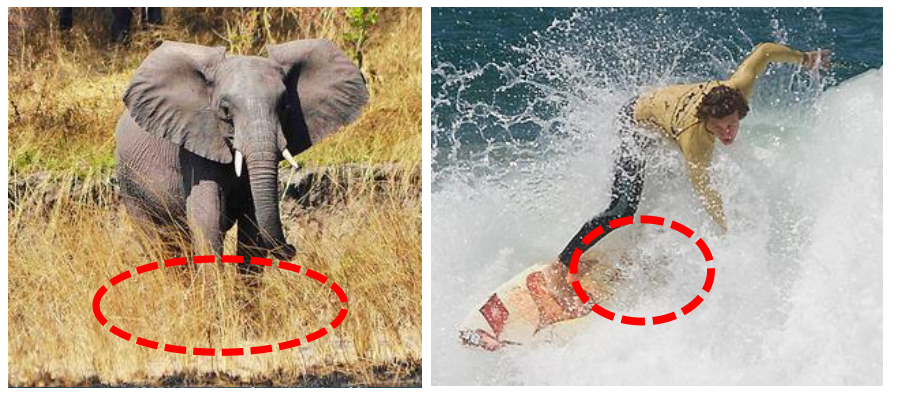
Figure 1. Bottom edge for “elephant” and right edge for “surfboard” are ambiguous.
Not All Labels Are Equal: Rationalizing The Labeling Costs for Training Object Detection
Venue: CVPR 2022 · Main-conference paper
Figure 2 · PDF page 3 · P108
300 dpi PNG · Caption · Source PDF
Original caption, source, and provenance
Fixed source version: CVPR 2022 fixed official PDF
Earliest verified matching figure date (temporal proxy): 2021-11-29
arXiv v1 date: 2021-06-22
Actual drawing date: unknown. See the source record for version checks and temporal-evidence limitations.
Historical PDF · Download citation snapshot · Date evidence · Paper page · Complete screening and version record (Chinese)
Citation threshold evidence: Laura Leal-Taixé; 26825 citations; snapshot 2026-10-21.
Recorded drawing-tool disclosure: unknown. No tool attribution is inferred from appearance; see the archival disclosure evidence for scope and wording.
Crop bounding box: [53, 75, 407, 172] (PDF points; top-left origin; x0, y0, x1, y1).
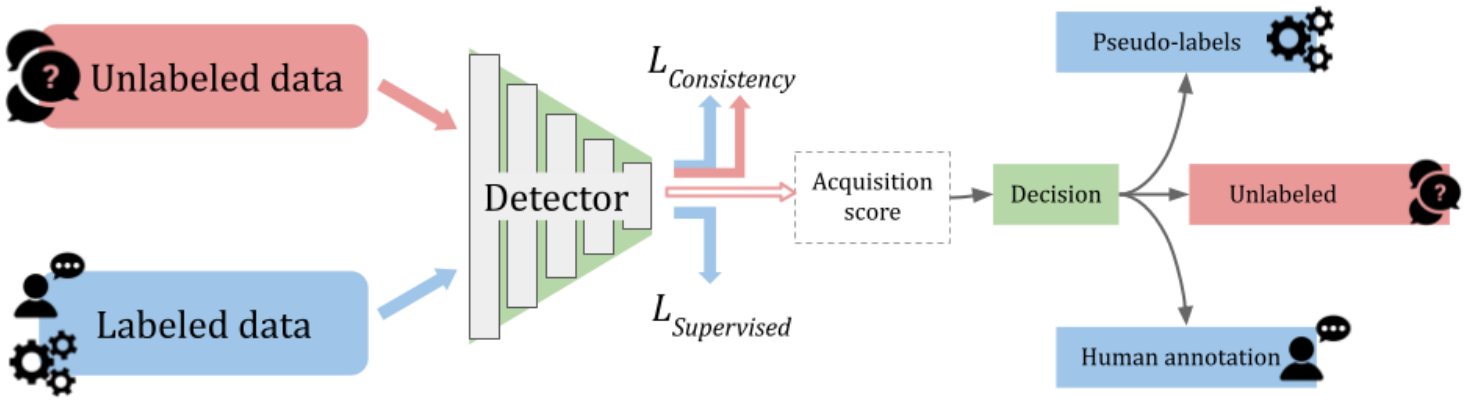
Figure 2. Overview of our method.
Wefirsttrainthenetworkinasemi-
supervised manner. During active
learning, for each image, we use
the network to compute the acqui-
sition function and based on it de-
cide if we actively label the image,
if we pseudo-label it, or if we only
use it as part of the unlabeled data
for the next training cycle.
Not All Labels Are Equal: Rationalizing The Labeling Costs for Training Object Detection
Venue: CVPR 2022 · Main-conference paper
Figure 1 · PDF page 1 · P107
300 dpi PNG · Caption · Source PDF
Original caption, source, and provenance
Fixed source version: CVPR 2022 fixed official PDF
Earliest verified matching figure date (temporal proxy): 2021-11-29
arXiv v1 date: 2021-06-22
Actual drawing date: unknown. See the source record for version checks and temporal-evidence limitations.
Historical PDF · Download citation snapshot · Date evidence · Paper page · Complete screening and version record (Chinese)
Citation threshold evidence: Laura Leal-Taixé; 26825 citations; snapshot 2026-10-21.
Recorded drawing-tool disclosure: unknown. No tool attribution is inferred from appearance; see the archival disclosure evidence for scope and wording.
Crop bounding box: [309, 216, 547, 342] (PDF points; top-left origin; x0, y0, x1, y1).
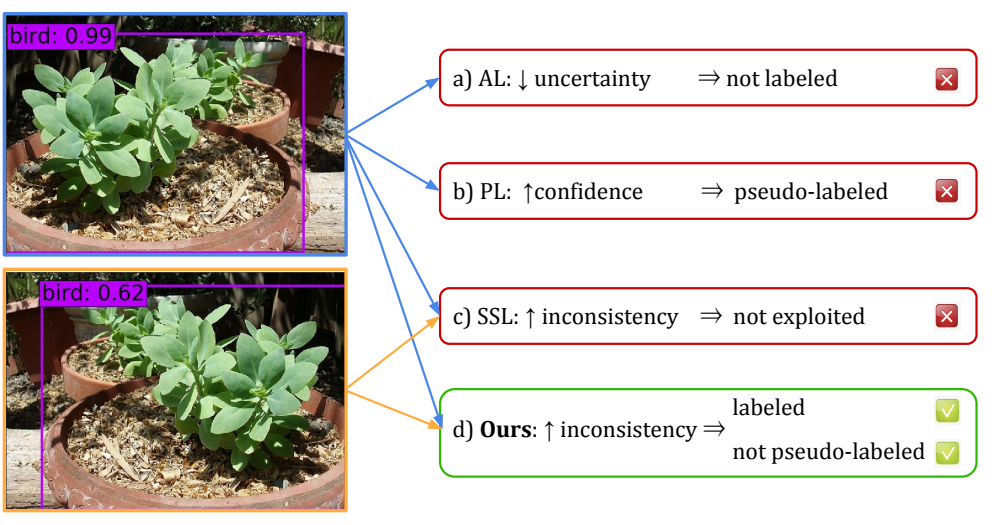
Figure 1. An object from a low-performing class (Pottedplant),
original image in blue, augmented version in orange. a) Because
of its low-entropy, uncertainty-based AL methods do not label the
image. b) Because of its high confidence, pseudo-label SSL meth-
ods wrongly pseudo-label the image and thus harm the training. c)
Because of its high-inconsistency, consistency-based SSL meth-
ods cannot learn from it. d) Our method selects the image for
labeling and prevents it from getting pseudo-labeled.
Progressive End-to-End Object Detection in Crowded Scenes
Venue: CVPR 2022 · Main-conference paper
Figure 3 · PDF page 4 · P140
300 dpi PNG · Caption · Source PDF
Original caption, source, and provenance
Fixed source version: CVPR 2022 fixed official PDF
Earliest verified matching figure date (temporal proxy): 2022-03-15
arXiv v1 date: 2022-03-15
Actual drawing date: unknown. See the source record for version checks and temporal-evidence limitations.
Historical PDF · Download citation snapshot · Date evidence · Paper page · Complete screening and version record (Chinese)
Citation threshold evidence: Xiangyu Zhang; 481440 citations; snapshot 2026-10-21.
Recorded drawing-tool disclosure: unknown. No tool attribution is inferred from appearance; see the archival disclosure evidence for scope and wording.
Crop bounding box: [49, 70, 548, 191] (PDF points; top-left origin; x0, y0, x1, y1).
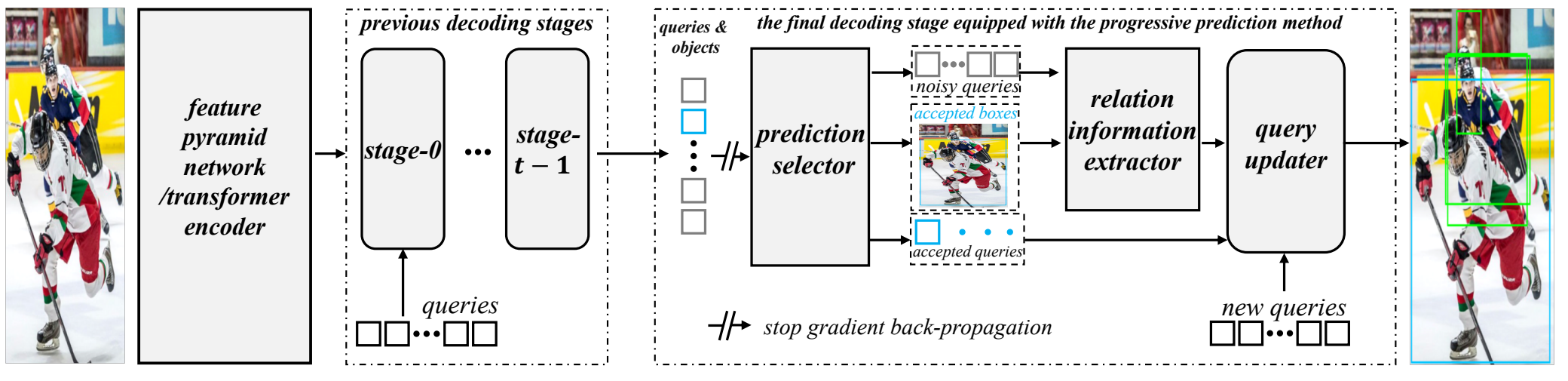
Figure 3: The diagram of the proposed progressive end-to-end object detection framework. First, the prediction selector
select queries associated with high confidence scores as accepted queries, leaving the rest as noisy queries. Then Relation
information extractor models the relations between noisy queries and their neighbors from accepted predictions. Next, the
queries are fed into the queries updater to be further refined by performing a new local self-attention.
Progressive End-to-End Object Detection in Crowded Scenes
Venue: CVPR 2022 · Main-conference paper
Figure 1 · PDF page 1 · P139
300 dpi PNG · Caption · Source PDF
Original caption, source, and provenance
Fixed source version: CVPR 2022 fixed official PDF
Earliest verified matching figure date (temporal proxy): 2022-03-15
arXiv v1 date: 2022-03-15
Actual drawing date: unknown. See the source record for version checks and temporal-evidence limitations.
Historical PDF · Download citation snapshot · Date evidence · Paper page · Complete screening and version record (Chinese)
Citation threshold evidence: Xiangyu Zhang; 481440 citations; snapshot 2026-10-21.
Recorded drawing-tool disclosure: unknown. No tool attribution is inferred from appearance; see the archival disclosure evidence for scope and wording.
Crop bounding box: [308, 219, 547, 353] (PDF points; top-left origin; x0, y0, x1, y1).
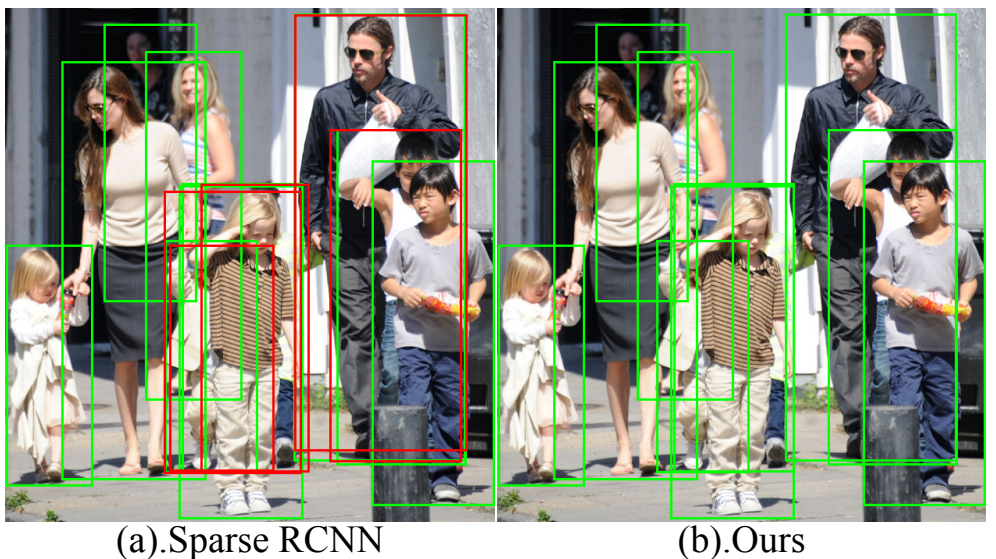
Figure 1: 1a. Sparse RCNN [37] introduces false positives
in crowded scenes. 1b. Our approach can remove those
false positives and ensure each object can be detected only
once. Green boxes indicate true positives while red ones
represent false positives.
SIOD: Single Instance Annotated Per Category Per Image for Object Detection
Venue: CVPR 2022 · Main-conference paper
Figure 2 · PDF page 3 · P94
300 dpi PNG · Caption · Source PDF
Original caption, source, and provenance
Fixed source version: CVPR 2022 fixed official PDF
Earliest verified matching figure date (temporal proxy): 2022-03-30
arXiv v1 date: 2022-03-29
Actual drawing date: unknown. See the source record for version checks and temporal-evidence limitations.
Historical PDF · Download citation snapshot · Date evidence · Paper page · Complete screening and version record (Chinese)
Citation threshold evidence: Wei-Shi Zheng; 31913 citations; snapshot 2026-10-21.
Recorded drawing-tool disclosure: unknown. No tool attribution is inferred from appearance; see the archival disclosure evidence for scope and wording.
Crop bounding box: [58, 73, 545, 282] (PDF points; top-left origin; x0, y0, x1, y1).
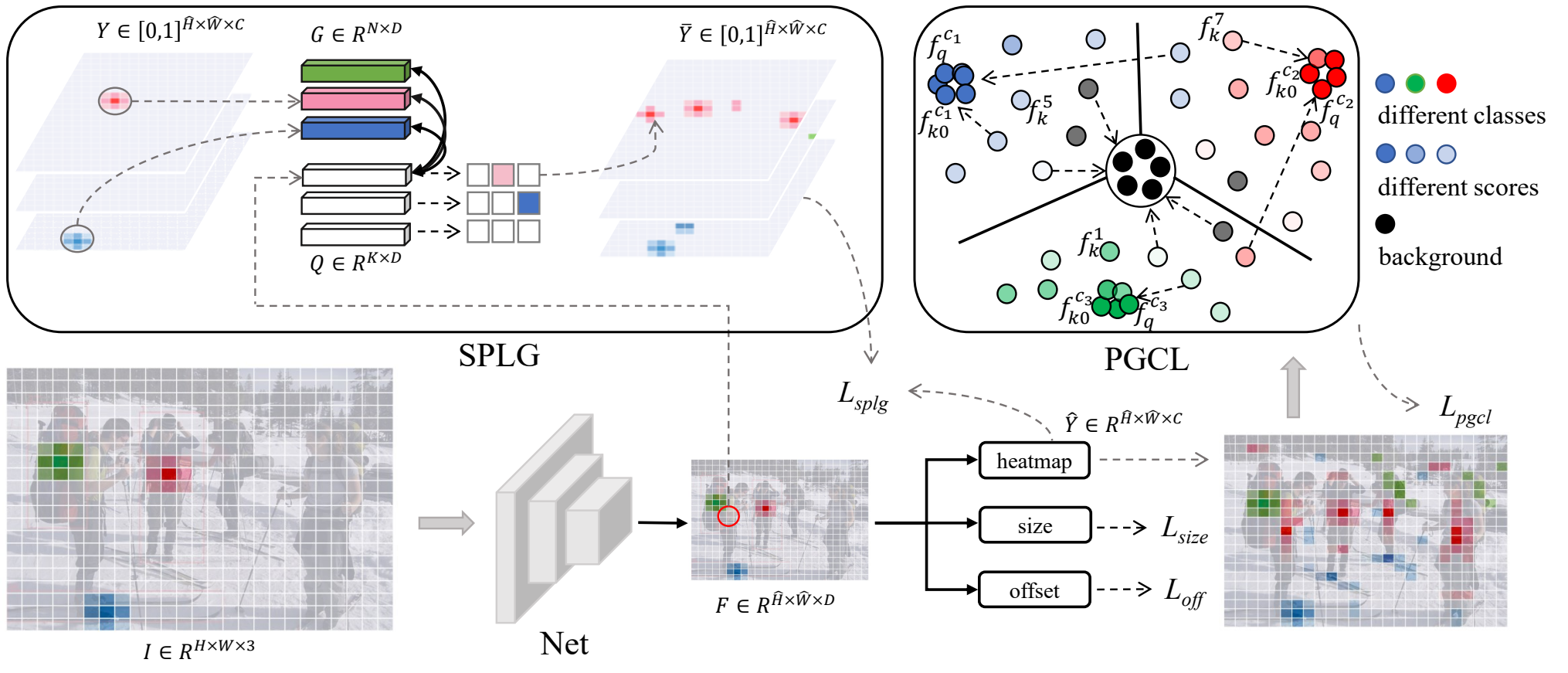
Figure 2. The overview of proposed DMiner, which consists of a Similarity-based Pseudo Label Generating module (SPLG) and a Pixel-
level Group Contrastive Learning module (PGCL). Let M ,M ,M =1 and refer to Eq. (6) to understand the meaning of M.
15 27 31
SIOD: Single Instance Annotated Per Category Per Image for Object Detection
Venue: CVPR 2022 · Main-conference paper
Figure 1 · PDF page 1 · P93
300 dpi PNG · Caption · Source PDF
Original caption, source, and provenance
Fixed source version: CVPR 2022 fixed official PDF
Earliest verified matching figure date (temporal proxy): 2022-03-30
arXiv v1 date: 2022-03-29
Actual drawing date: unknown. See the source record for version checks and temporal-evidence limitations.
Historical PDF · Download citation snapshot · Date evidence · Paper page · Complete screening and version record (Chinese)
Citation threshold evidence: Wei-Shi Zheng; 31913 citations; snapshot 2026-10-21.
Recorded drawing-tool disclosure: unknown. No tool attribution is inferred from appearance; see the archival disclosure evidence for scope and wording.
Crop bounding box: [309, 240, 545, 345] (PDF points; top-left origin; x0, y0, x1, y1).
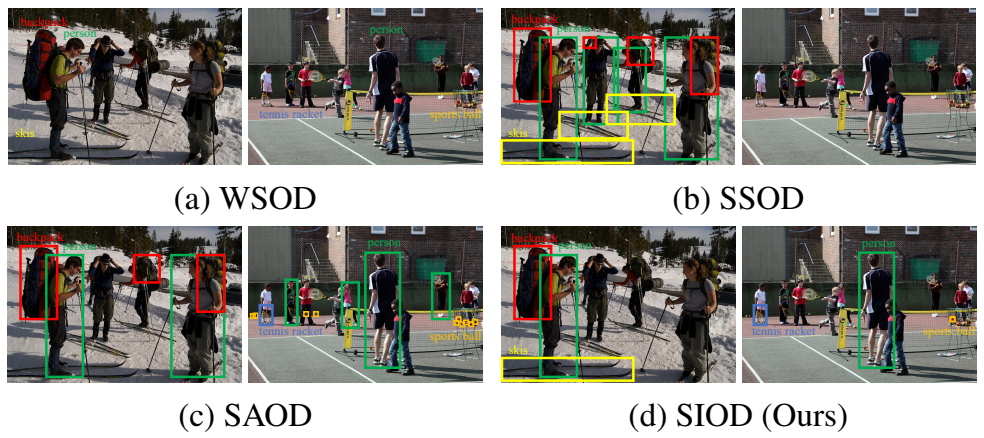
Figure 1. Different annotation setup for (a) WSOD, (b) SSOD, (c)
SAOD and (d) SIOD (Ours).
Scale-Equivalent Distillation for Semi-Supervised Object Detection
Venue: CVPR 2022 · Main-conference paper
Figure 1 · PDF page 1 · P98
300 dpi PNG · Caption · Source PDF
Original caption, source, and provenance
Fixed source version: CVPR 2022 fixed official PDF
Earliest verified matching figure date (temporal proxy): 2022-03-23
arXiv v1 date: 2022-03-23
Actual drawing date: unknown. See the source record for version checks and temporal-evidence limitations.
Historical PDF · Download citation snapshot · Date evidence · Paper page · Complete screening and version record (Chinese)
Citation threshold evidence: Yizhou Yu; 35607 citations; snapshot 2026-10-21.
Recorded drawing-tool disclosure: unknown. No tool attribution is inferred from appearance; see the archival disclosure evidence for scope and wording.
Crop bounding box: [309, 213, 547, 428] (PDF points; top-left origin; x0, y0, x1, y1).
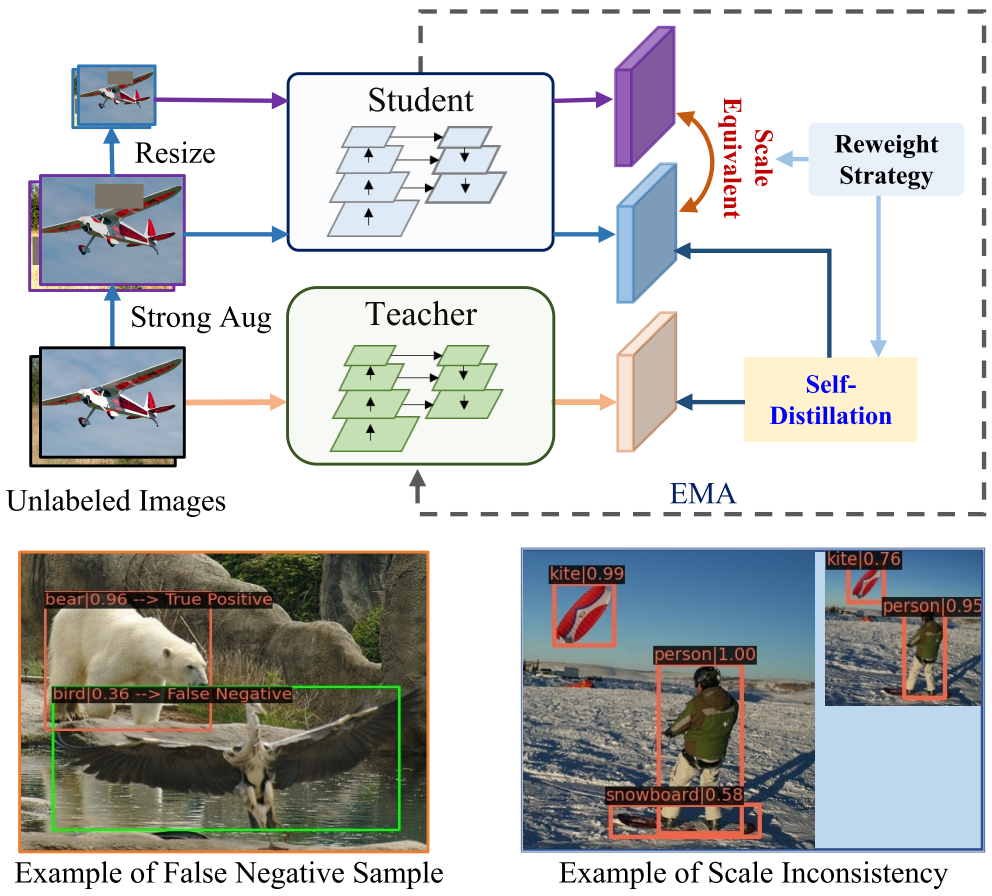
Figure 1. The overall framework of SED. Our model improves the
scale equivalence, which is critical for object detectors, by regu-
larizing the consistency between different-sized images. Further-
more, the inherent False Negative sample noise is alleviated by
self-distillation. A re-weighting strategy is adopted to solve the
severe class imbalance problem. The bird in the left example is a
False Negative sample when the threshold is set to 0.7. The right
example shows the scale inconsistency of different-sized images.
Scale-Equivalent Distillation for Semi-Supervised Object Detection
Venue: CVPR 2022 · Main-conference paper
Figure 2 · PDF page 3 · P97
300 dpi PNG · Caption · Source PDF
Original caption, source, and provenance
Fixed source version: CVPR 2022 fixed official PDF
Earliest verified matching figure date (temporal proxy): 2022-03-23
arXiv v1 date: 2022-03-23
Actual drawing date: unknown. See the source record for version checks and temporal-evidence limitations.
Historical PDF · Download citation snapshot · Date evidence · Paper page · Complete screening and version record (Chinese)
Citation threshold evidence: Yizhou Yu; 35607 citations; snapshot 2026-10-21.
Recorded drawing-tool disclosure: unknown. No tool attribution is inferred from appearance; see the archival disclosure evidence for scope and wording.
Crop bounding box: [48, 49, 553, 174] (PDF points; top-left origin; x0, y0, x1, y1).
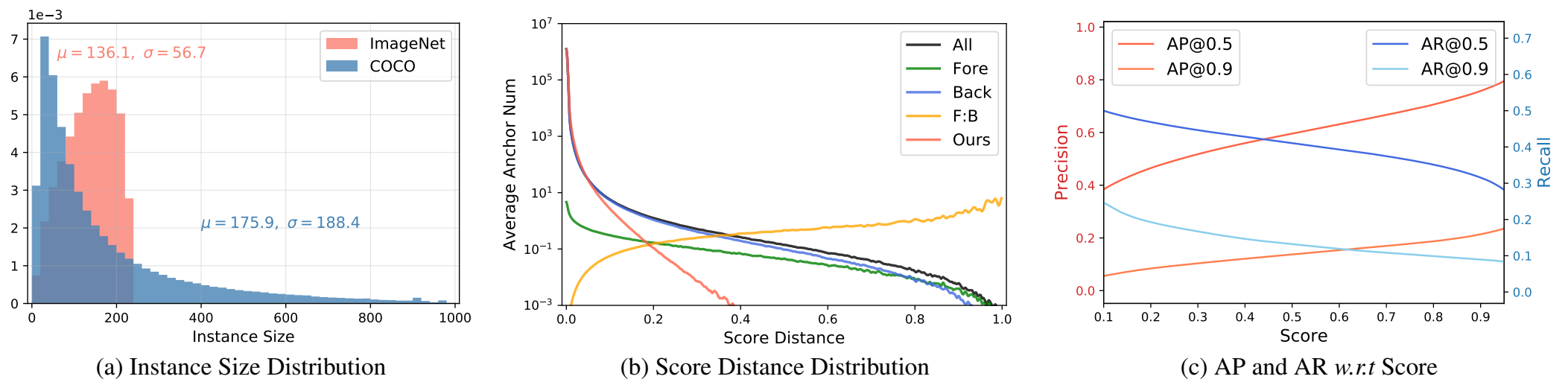
Figure 2. (a) For the COCO dataset, all the images are resized such that the short edge has 800 pixels while the long edge has less than
1333 pixels. For the ImageNet dataset, all the images are resized to 224×224 to calculate the statistics. The scale of object is represented
as the square root of the area. We discuss the typical training input size for ImageNet classification and COCO detection tasks. (b) All the
scores are predicted on COCO minival dataset by the RetinaNet detector with FPN and ResNet 50 backbone, which is trained with 10%
COCO data. The score distance is the absolute difference between the predictions of the image in different sizes. The Y-axis is the average
numberofanchorsperimage. (c)Wepredictpseudo-labelontherestofCOCOtrainingdatawithaconvergedFaster-RCNNdetector(with
FPNandResNet50backbone), trainedwith10%COCOdata. Thelowaveragerecallandprecisionshowthathardpseudo-labelincurmore
noise with False Negative samples.
Task-specific Inconsistency Alignment for Domain Adaptive Object Detection
Venue: CVPR 2022 · Main-conference paper
Figure 2 · PDF page 3 · P160
300 dpi PNG · Caption · Source PDF
Original caption, source, and provenance
Fixed source version: CVPR 2022 fixed official PDF
Earliest verified matching figure date (temporal proxy): 2022-03-29
arXiv v1 date: 2022-03-29
Actual drawing date: unknown. See the source record for version checks and temporal-evidence limitations.
Historical PDF · Download citation snapshot · Date evidence · Paper page · Complete screening and version record (Chinese)
Citation threshold evidence: Limin Wang; 57767 citations; snapshot 2026-10-21.
Recorded drawing-tool disclosure: unknown. No tool attribution is inferred from appearance; see the archival disclosure evidence for scope and wording.
Crop bounding box: [49, 70, 548, 275] (PDF points; top-left origin; x0, y0, x1, y1).
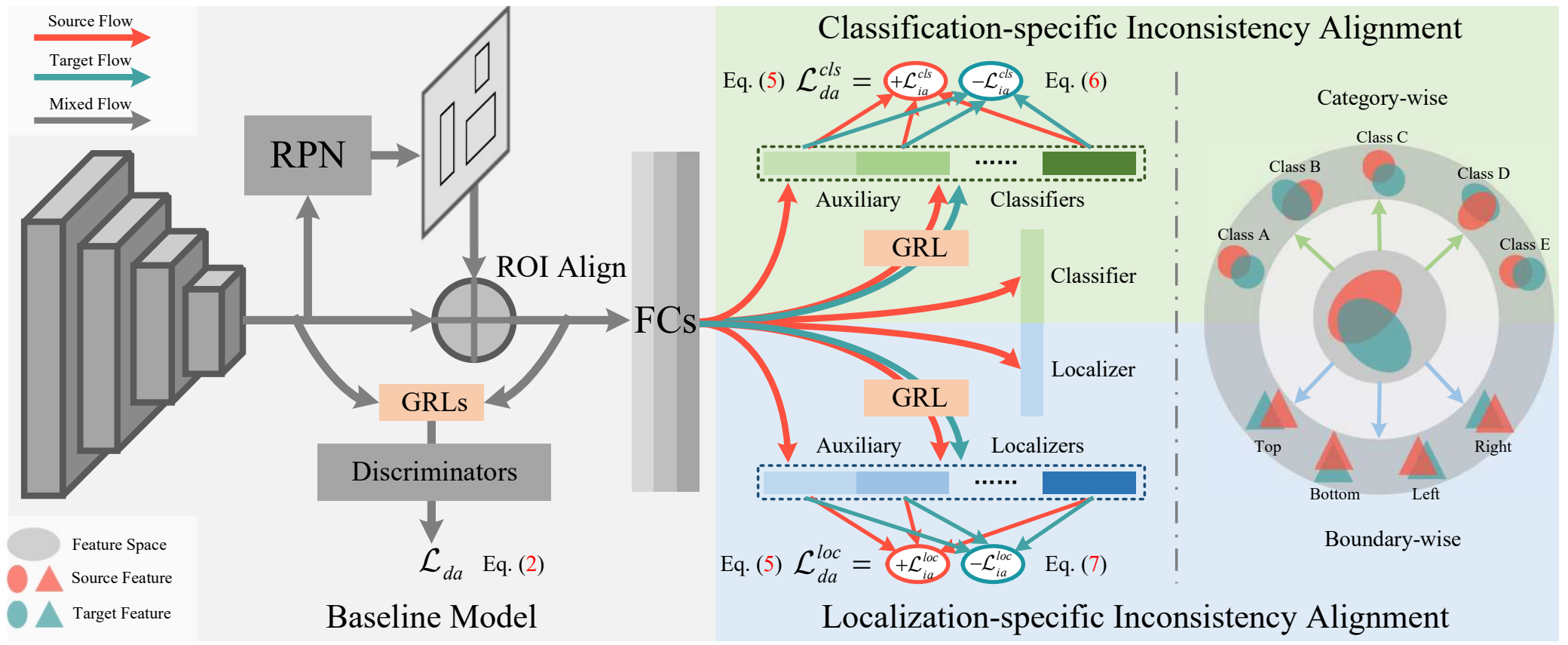
Figure 2. Framework overview. Best viewed in color. We develop the high-level feature alignment into separate task spaces, by applying
the proposed Task-specific Inconsistency Alignment module to both the classification (green part) and localization (blue part) branches
of the baseline detector (gray part). In each branch, the behavioral inconsistency of multiple auxiliary predictors is optimized via the
corresponding inconsistency-aware loss, for essentially bridging the category-wise or boundary-wise margins between domains.
Task-specific Inconsistency Alignment for Domain Adaptive Object Detection
Venue: CVPR 2022 · Main-conference paper
Figure 1 · PDF page 1 · P159
300 dpi PNG · Caption · Source PDF
Original caption, source, and provenance
Fixed source version: CVPR 2022 fixed official PDF
Earliest verified matching figure date (temporal proxy): 2022-03-29
arXiv v1 date: 2022-03-29
Actual drawing date: unknown. See the source record for version checks and temporal-evidence limitations.
Historical PDF · Download citation snapshot · Date evidence · Paper page · Complete screening and version record (Chinese)
Citation threshold evidence: Limin Wang; 57767 citations; snapshot 2026-10-21.
Recorded drawing-tool disclosure: unknown. No tool attribution is inferred from appearance; see the archival disclosure evidence for scope and wording.
Crop bounding box: [309, 211, 546, 337] (PDF points; top-left origin; x0, y0, x1, y1).
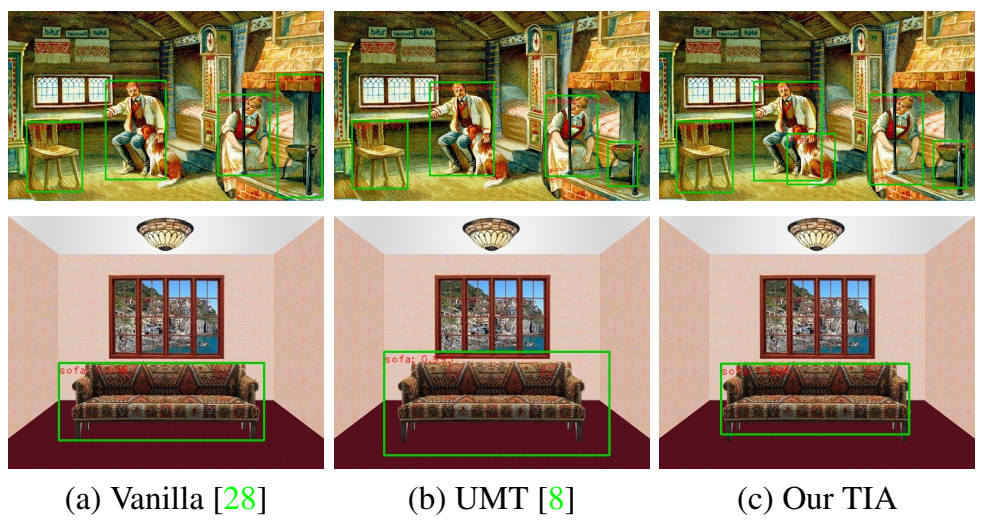
Figure 1. Exampled images from PASCAL VOC [10] → Cli-
part [18]. Compared with vanilla detector [28], both UMT [8] and
TIA identify more foreground objects (Row 1), yet deliver lower
as well as higher quality bounding boxes (Row 2), respectively.
Towards Robust Adaptive Object Detection under Noisy Annotations
Venue: CVPR 2022 · Main-conference paper
Figure 3 · PDF page 4 · P142
300 dpi PNG · Caption · Source PDF
Original caption, source, and provenance
Fixed source version: CVPR 2022 fixed official PDF
Earliest verified matching figure date (temporal proxy): 2022-04-06
arXiv v1 date: 2022-04-06
Actual drawing date: unknown. See the source record for version checks and temporal-evidence limitations.
Historical PDF · Download citation snapshot · Date evidence · Paper page · Complete screening and version record (Chinese)
Citation threshold evidence: Yixuan Yuan; 16227 citations; snapshot 2026-10-21.
Recorded drawing-tool disclosure: unknown. No tool attribution is inferred from appearance; see the archival disclosure evidence for scope and wording.
Crop bounding box: [68, 72, 521, 313] (PDF points; top-left origin; x0, y0, x1, y1).
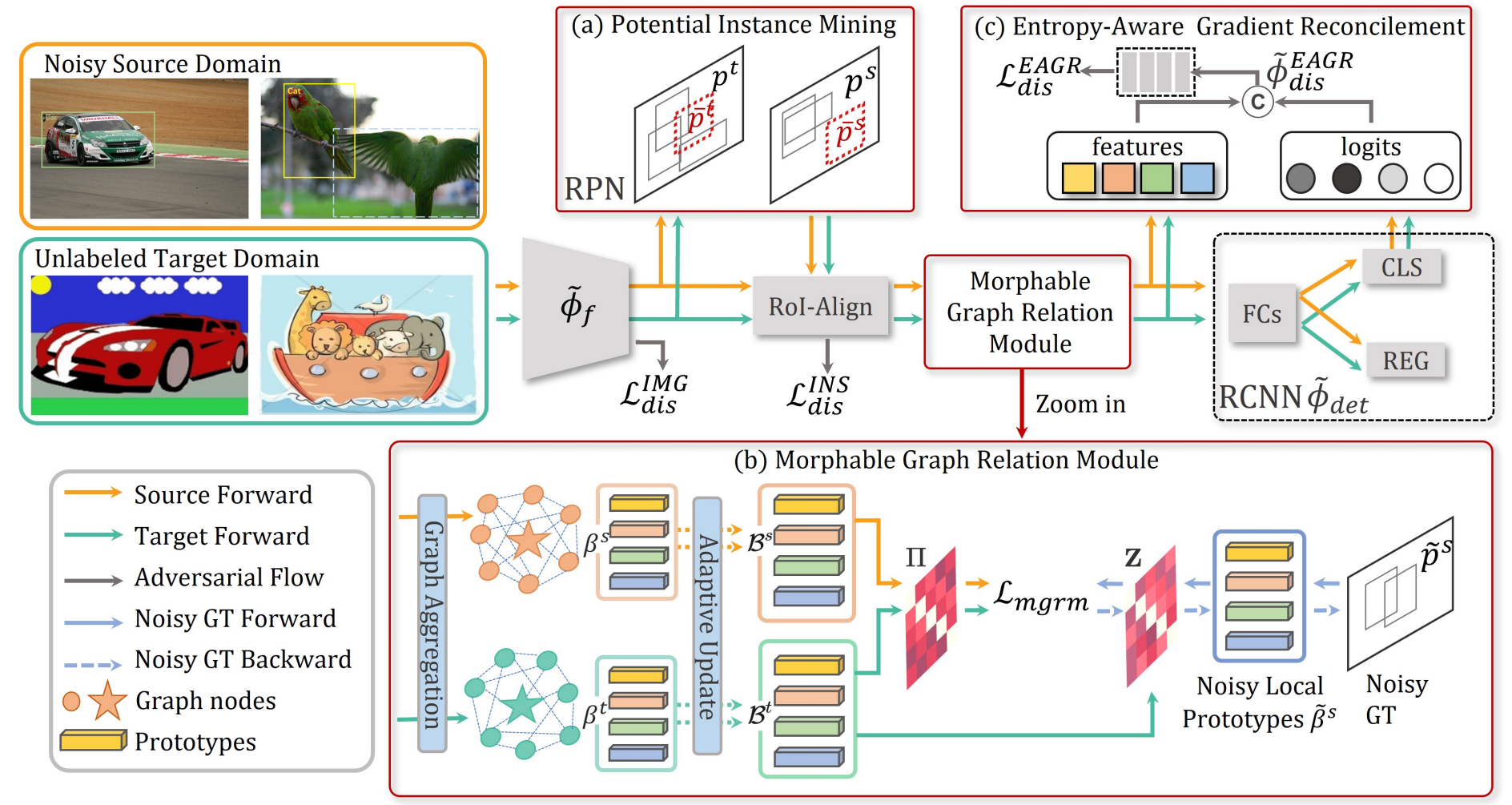
Figure 3. Overview of our NLTE framework, which includes PIM, MGRM and EAGR. ⃝c is the concatenation operation.
Towards Robust Adaptive Object Detection under Noisy Annotations
Venue: CVPR 2022 · Main-conference paper
Figure 1 · PDF page 1 · P141
300 dpi PNG · Caption · Source PDF
Original caption, source, and provenance
Fixed source version: CVPR 2022 fixed official PDF
Earliest verified matching figure date (temporal proxy): 2022-06
arXiv v1 date: 2022-04-06
Actual drawing date: unknown. See the source record for version checks and temporal-evidence limitations.
Historical PDF · Download citation snapshot · Date evidence · Paper page · Complete screening and version record (Chinese)
Citation threshold evidence: Yixuan Yuan; 16227 citations; snapshot 2026-10-21.
Recorded drawing-tool disclosure: unknown. No tool attribution is inferred from appearance; see the archival disclosure evidence for scope and wording.
Crop bounding box: [313, 225, 544, 286] (PDF points; top-left origin; x0, y0, x1, y1).
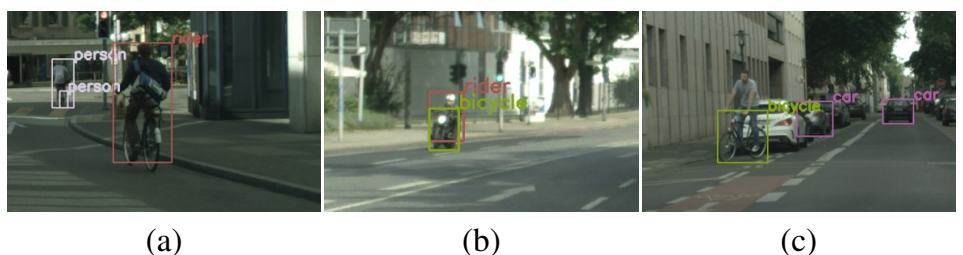
Figure 1. Examples of noisy annotations in Cityscapes dataset.
Miss-annotated samples: The bicycle in (a); the rider and car in
(c). Class-corrupted samples: The rider and bicycle are labeled
as person in (a); the motorcycle is labeled as bicycle in (b).
Class-Balanced Pixel-Level Self-Labeling for Domain Adaptive Semantic Segmentation
Venue: CVPR 2022 · Main-conference paper
Figure 1 · PDF page 3 · P100
300 dpi PNG · Caption · Source PDF
Original caption, source, and provenance
Fixed source version: CVPR 2022 fixed official PDF
Earliest verified matching figure date (temporal proxy): 2022-03-18
arXiv v1 date: 2022-03-18
Actual drawing date: unknown. See the source record for version checks and temporal-evidence limitations.
Historical PDF · Download citation snapshot · Date evidence · Paper page · Complete screening and version record (Chinese)
Citation threshold evidence: Lei Zhang; 137335 citations; snapshot 2026-10-21.
Recorded drawing-tool disclosure: unknown. No tool attribution is inferred from appearance; see the archival disclosure evidence for scope and wording.
Crop bounding box: [68, 69, 533, 249] (PDF points; top-left origin; x0, y0, x1, y1).
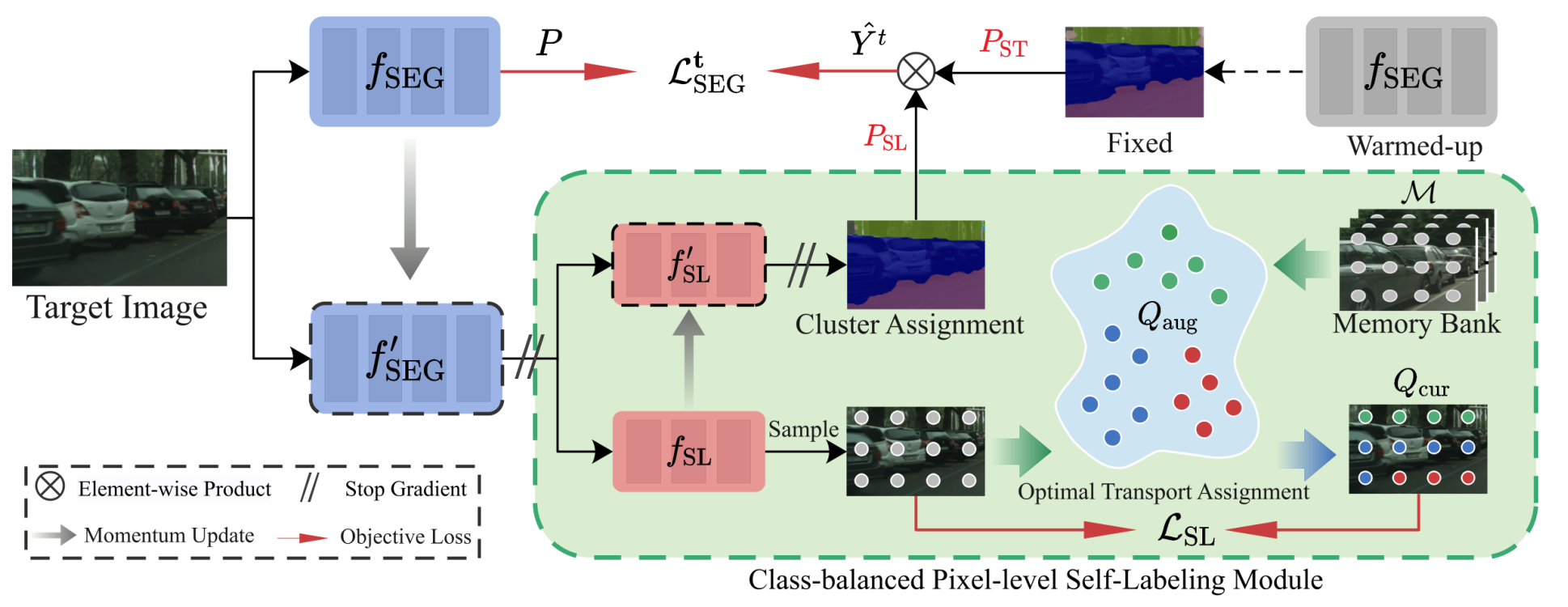
Figure 1. The framework of Class-balanced Pixel-level Self-Labeling (CPSL). The model contains a main segmentation network f and
SEG
its momentum-updated version f′ . The f′ is followed by a self-labeling head f and its momentum version f′ , which projects
SEG SEG SL SL
pixel-wise feature embedding into a class probability vector. The pixel-level self-labeling module produces soft cluster assignment P to
SL
gradually rectify soft pseudo label P . Then the segmentation loss Lt is computed between the prediction map P and the rectified
ST SEG
pseudo label Yˆt. To train the self-labeling head, we randomly sample pixels from each image, and use the memory bank M, which
contains previous batches of pixel features, to augment the current batch. Then we compute the optimal transport assignment Q over
aug
the augmented data by enforcing class balance, and use the assignment of current batch Q to compute the self-labeling loss L .
cur SL
Class-Balanced Pixel-Level Self-Labeling for Domain Adaptive Semantic Segmentation
Venue: CVPR 2022 · Main-conference paper
Figure 2 · PDF page 4 · P99
300 dpi PNG · Caption · Source PDF
Original caption, source, and provenance
Fixed source version: CVPR 2022 fixed official PDF
Earliest verified matching figure date (temporal proxy): 2022-03-18
arXiv v1 date: 2022-03-18
Actual drawing date: unknown. See the source record for version checks and temporal-evidence limitations.
Historical PDF · Download citation snapshot · Date evidence · Paper page · Complete screening and version record (Chinese)
Citation threshold evidence: Lei Zhang; 137335 citations; snapshot 2026-10-21.
Recorded drawing-tool disclosure: unknown. No tool attribution is inferred from appearance; see the archival disclosure evidence for scope and wording.
Crop bounding box: [48, 70, 290, 226] (PDF points; top-left origin; x0, y0, x1, y1).
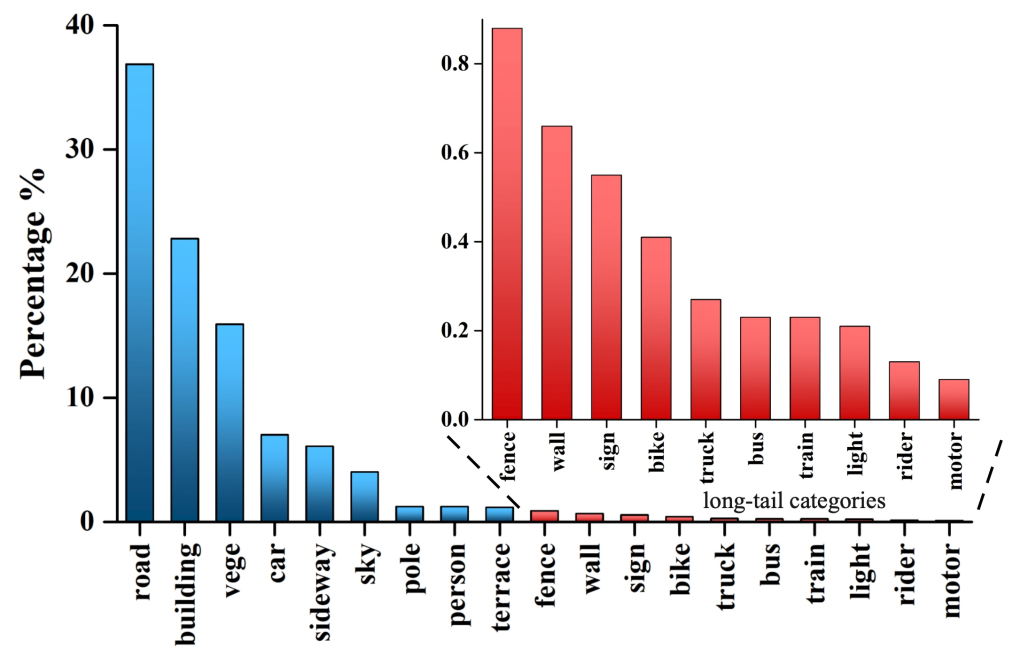
Figure 2. The class distribution of the Cityscapes dataset.
Decoupling Zero-Shot Semantic Segmentation
Venue: CVPR 2022 · Main-conference paper
Figure 2 · PDF page 4 · P126
300 dpi PNG · Caption · Source PDF
Original caption, source, and provenance
Fixed source version: CVPR 2022 fixed official PDF
Earliest verified matching figure date (temporal proxy): 2022-04-15
arXiv v1 date: 2021-12-15
Actual drawing date: unknown. See the source record for version checks and temporal-evidence limitations.
Historical PDF · Download citation snapshot · Date evidence · Paper page · Complete screening and version record (Chinese)
Citation threshold evidence: Dengxin Dai; 23615 citations; snapshot 2026-10-21.
Recorded drawing-tool disclosure: unknown. No tool attribution is inferred from appearance; see the archival disclosure evidence for scope and wording.
Crop bounding box: [75, 65, 519, 264] (PDF points; top-left origin; x0, y0, x1, y1).
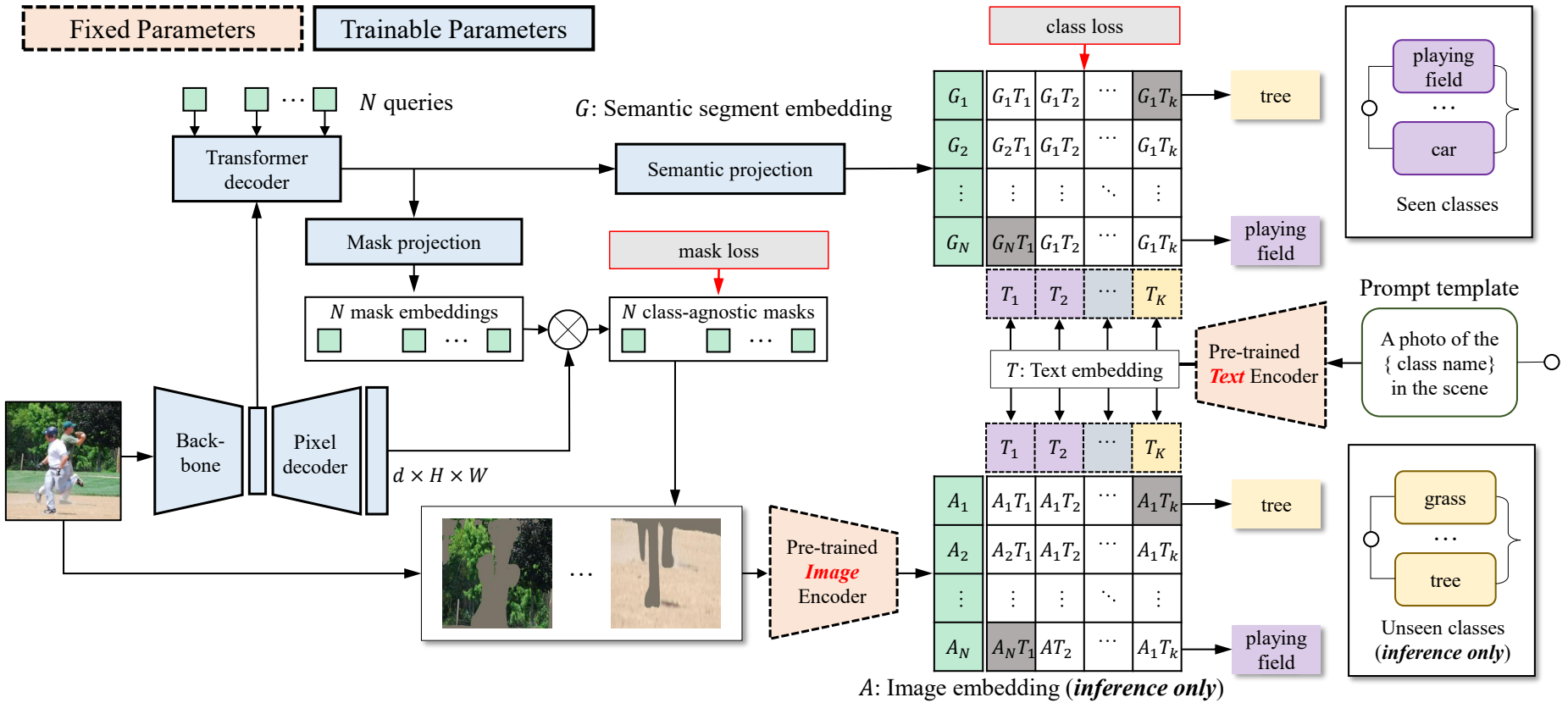
Figure 2. The pipeline of our proposed ZegFormer for zero-shot semantic segmentation. We first feed N queries and feature maps to a
transformer decoder to generate N segment embeddings. We then feed each segment embedding to a mask projection layer and a semantic
projection layer to obtain a mask embedding and a semantic embedding. Mask embedding is multiplied with the output of pixel decoder
to generate a class-agnostic binary mask, while The semantic embedding is classified by the text embeddings. The text embeddings are
generated by putting the class names into a prompt template and then feeding them to a text encoder of a vision-language model. During
training, only the seen classes are used to train the segment-level classification head. During inference, both the text embeddings of seen
and unseen classes are used for segment-level classification. We can obtain two segment-level classification scores with semantic segment
embeddings and image embeddings. Finally, we fuse the these two classification scores as our final class prediction of segments.
Decoupling Zero-Shot Semantic Segmentation
Venue: CVPR 2022 · Main-conference paper
Figure 1 · PDF page 1 · P125
300 dpi PNG · Caption · Source PDF
Original caption, source, and provenance
Fixed source version: CVPR 2022 fixed official PDF
Earliest verified matching figure date (temporal proxy): 2022-04-15
arXiv v1 date: 2021-12-15
Actual drawing date: unknown. See the source record for version checks and temporal-evidence limitations.
Historical PDF · Download citation snapshot · Date evidence · Paper page · Complete screening and version record (Chinese)
Citation threshold evidence: Dengxin Dai; 23615 citations; snapshot 2026-10-21.
Recorded drawing-tool disclosure: unknown. No tool attribution is inferred from appearance; see the archival disclosure evidence for scope and wording.
Crop bounding box: [310, 208, 541, 447] (PDF points; top-left origin; x0, y0, x1, y1).
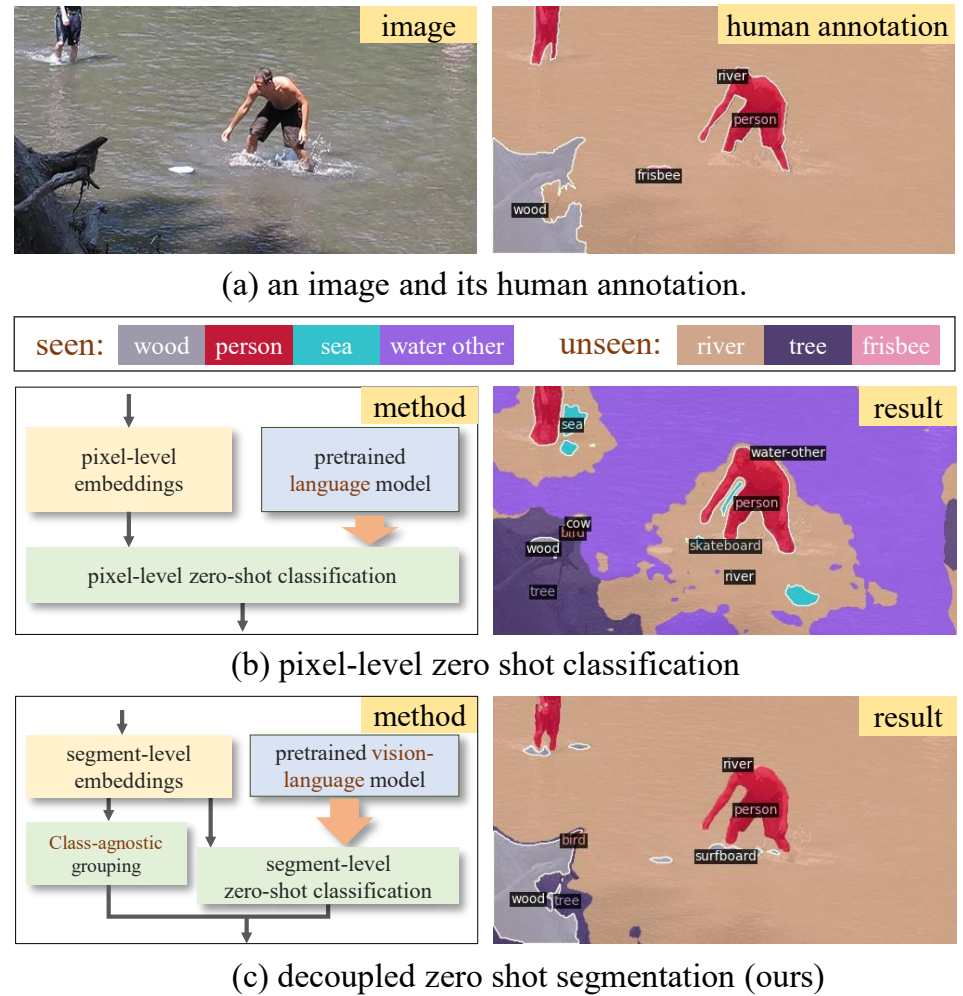
Figure 1. ZS3 aims to train a model merely on seen classes and
generalize it to classes that have not been seen in the training (un-
seen classes). Existing methods formulate it as a pixel-level zero-
shot classification problem (b), and use semantic features from a
language model to transfer the knowledge from seen classes to
unseen ones. In contrast, as in (c), we decouple ZS3 into two
sub-tasks: 1) A class-agnostic grouping and 2) A segment-level
zero-shot classification, which enables us to take full advantage of
the pre-trained vision-language model.
Learning Affinity from Attention: End-to-End Weakly-Supervised Semantic Segmentation with Transformers
Venue: CVPR 2022 · Main-conference paper
Figure 3 · PDF page 3 · P136
300 dpi PNG · Caption · Source PDF
Original caption, source, and provenance
Fixed source version: CVPR 2022 fixed official PDF
Earliest verified matching figure date (temporal proxy): 2022-06
arXiv v1 date: 2022-03-05
Actual drawing date: unknown. See the source record for version checks and temporal-evidence limitations.
Historical PDF · Download citation snapshot · Date evidence · Paper page · Complete screening and version record (Chinese)
Citation threshold evidence: Bo Du; 50901 citations; snapshot 2026-10-21.
Recorded drawing-tool disclosure: unknown. No tool attribution is inferred from appearance; see the archival disclosure evidence for scope and wording.
Crop bounding box: [49, 70, 548, 261] (PDF points; top-left origin; x0, y0, x1, y1).
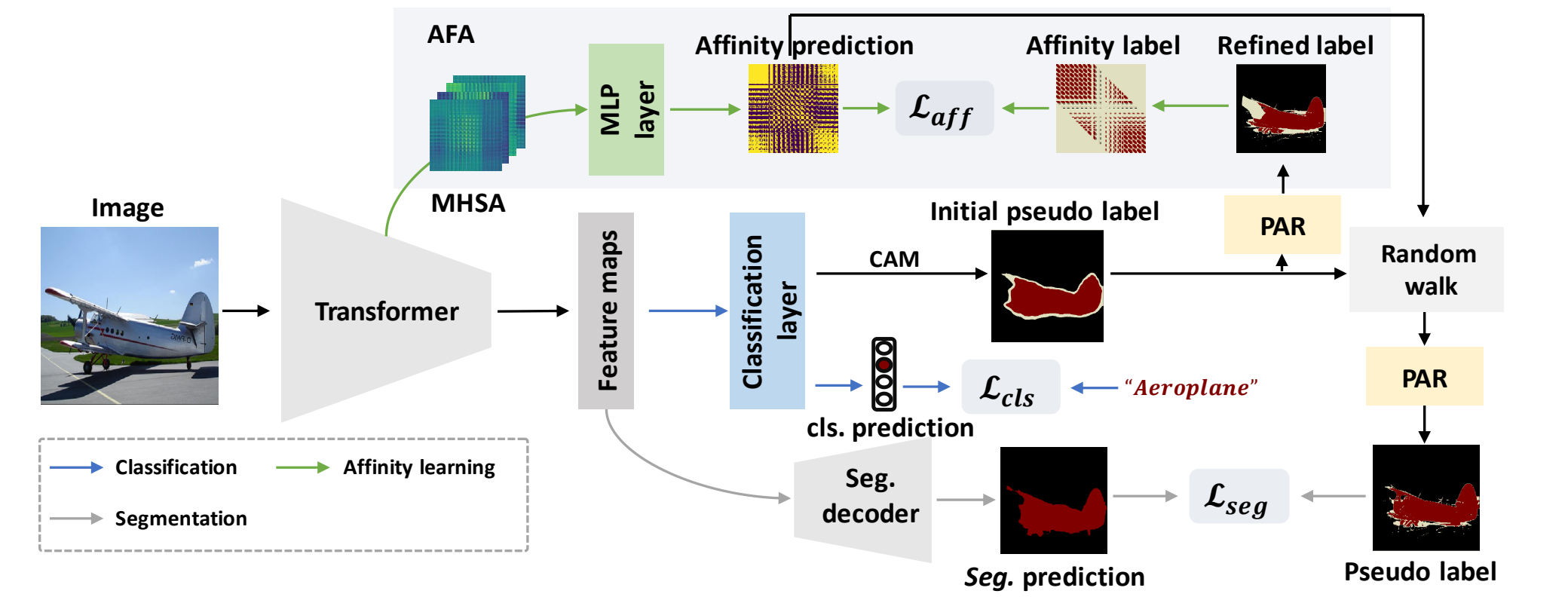
Figure 3. The proposed end-to-end framework for WSSS. We use a Transformer backbone as the encoder to extract feature maps. The
initial pseudo labels are generated with CAM [59] and then refined with the proposed PAR. In the AFA module, we derive the semantic
affinity from MHSA in Transformer blocks. AFA is supervised with the pseudo affinity labels derived from the refined label. Next, we
employ the learned affinity to revise the pseudo labels via random walk propagation [2, 1]. The propagated labels are finally refined with
PAR as the pseudo labels for the segmentation branch.
Learning Affinity from Attention: End-to-End Weakly-Supervised Semantic Segmentation with Transformers
Venue: CVPR 2022 · Main-conference paper
Figure 1 · PDF page 1 · P135
300 dpi PNG · Caption · Source PDF
Original caption, source, and provenance
Fixed source version: CVPR 2022 fixed official PDF
Earliest verified matching figure date (temporal proxy): 2022-03-05
arXiv v1 date: 2022-03-05
Actual drawing date: unknown. See the source record for version checks and temporal-evidence limitations.
Historical PDF · Download citation snapshot · Date evidence · Paper page · Complete screening and version record (Chinese)
Citation threshold evidence: Bo Du; 50901 citations; snapshot 2026-10-21.
Recorded drawing-tool disclosure: unknown. No tool attribution is inferred from appearance; see the archival disclosure evidence for scope and wording.
Crop bounding box: [313, 271, 540, 456] (PDF points; top-left origin; x0, y0, x1, y1).
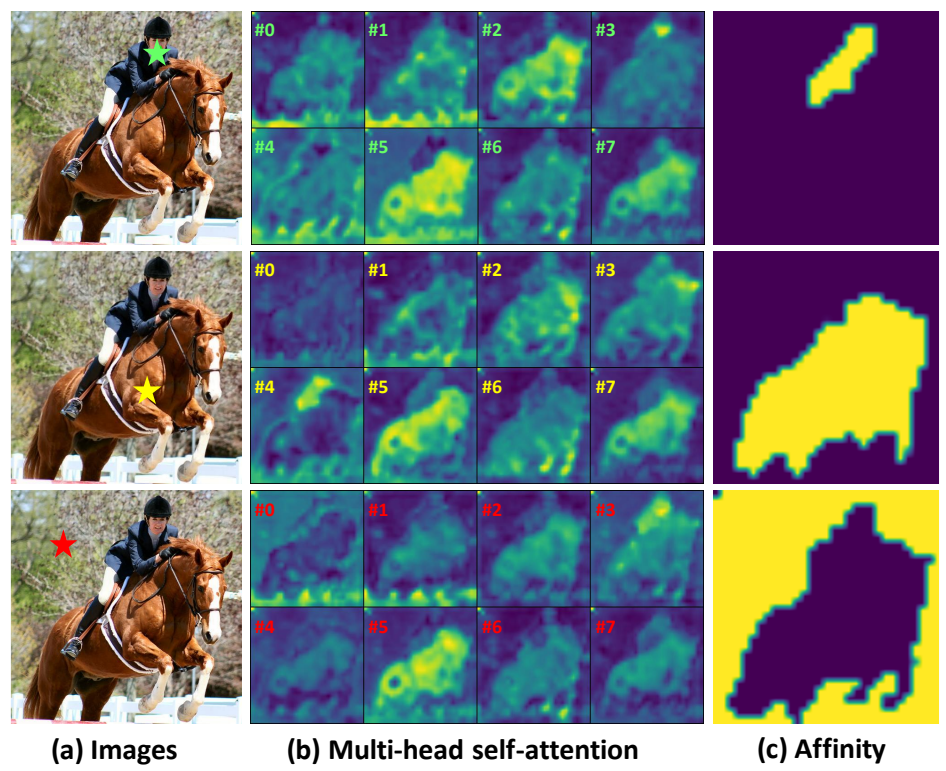
Figure 1. (a) Image and the query points (denote with ”⋆”) to vi-
sualize the attention and affinity maps; (b) the self-attention maps
in Transformer blocks only capture coarse semantic-level affin-
ity relations; (c) the learned reliable semantic affinity from self-
attention with our proposed method.
Multi-Class Token Transformer for Weakly Supervised Semantic Segmentation
Venue: CVPR 2022 · Main-conference paper
Figure 2 · PDF page 3 · P48
300 dpi PNG · Caption · Source PDF
Original caption, source, and provenance
Fixed source version: CVPR 2022 fixed official PDF
Earliest verified matching figure date (temporal proxy): 2022-03-06
arXiv v1 date: 2022-03-06
Actual drawing date: unknown. See the source record for version checks and temporal-evidence limitations.
Historical PDF · Download citation snapshot · Date evidence · Complete screening and version record (Chinese)
Citation threshold evidence: Wanli Ouyang; 81844 citations; snapshot 2026-10-21.
Recorded drawing-tool disclosure: unknown. No tool attribution is inferred from appearance; see the archival disclosure evidence for scope and wording.
Crop bounding box: [60, 71, 534, 242] (PDF points; top-left origin; x0, y0, x1, y1).
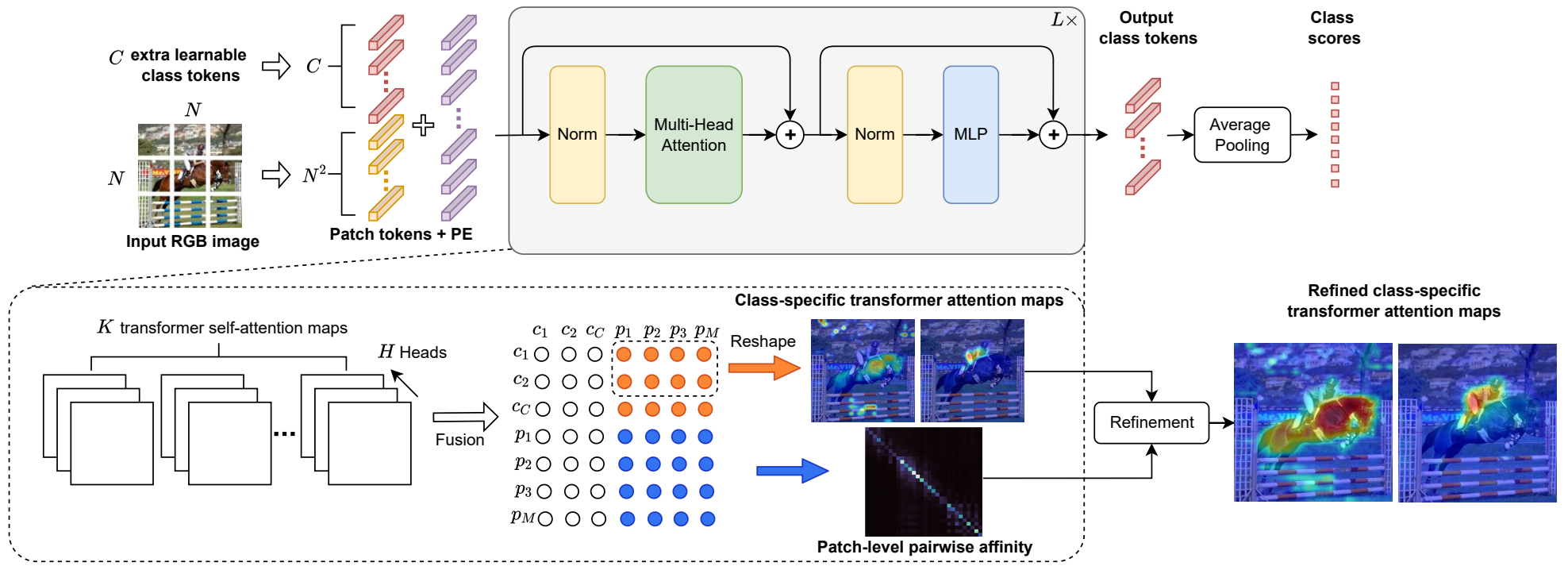
Figure 2. An overview of the proposed multi-class token transformer (MCTformer-V1). It first splits and transforms an input RGB image
into a sequence of patch tokens. We propose to learn C extra class tokens, where C is the number of classes. The C class tokens are
concatenated with patch tokens, with added position embeddings (PE), which then go through consecutive L transformer encoding layers.
Finally, the output C class tokens are used to produce class scores via average pooling. We aggregate the transformer attentions from the
last K layers and multiple heads to generate a final attention map, from which we can extract class-specific object localization maps and a
patch-level pairwise affinity map from the class-to-patch and the patch-to-patch attentions, respectively. The patch-level pairwise affinity
can be used to refine the class-specific transformer attention maps to produce improved object localization maps.
Multi-Class Token Transformer for Weakly Supervised Semantic Segmentation
Venue: CVPR 2022 · Main-conference paper
Figure 1 · PDF page 1 · P47
300 dpi PNG · Caption · Source PDF
Original caption, source, and provenance
Fixed source version: CVPR 2022 fixed official PDF
Earliest verified matching figure date (temporal proxy): 2022-03-06
arXiv v1 date: 2022-03-06
Actual drawing date: unknown. See the source record for version checks and temporal-evidence limitations.
Historical PDF · Download citation snapshot · Date evidence · Complete screening and version record (Chinese)
Citation threshold evidence: Wanli Ouyang; 81844 citations; snapshot 2026-10-21.
Recorded drawing-tool disclosure: unknown. No tool attribution is inferred from appearance; see the archival disclosure evidence for scope and wording.
Crop bounding box: [307, 240, 546, 357] (PDF points; top-left origin; x0, y0, x1, y1).
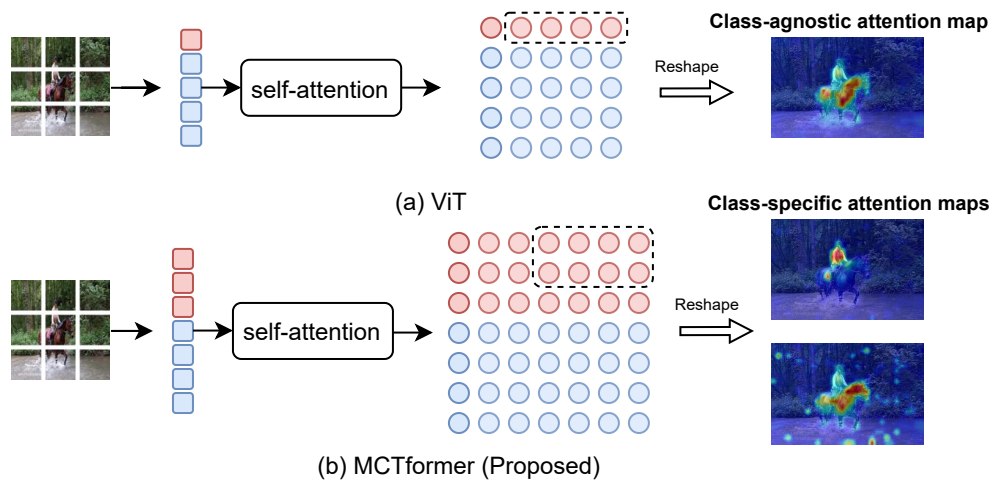
Figure 1. (a) In previous vision transformers [10], only one class
token (red square) is used to aggregate information from patch to-
kens (blue square). The learned patch attentions corresponding
to the class token generate a class-agnostic localization map. (b)
In contrast, the proposed MCTformer uses multiple class tokens
to learn interactions between class tokens and patch tokens. The
learned class-to-patch attentions of different class tokens can pro-
duce class-specific object localization maps.
Novel Class Discovery in Semantic Segmentation
Venue: CVPR 2022 · Main-conference paper
Figure 2 · PDF page 3 · P74
300 dpi PNG · Caption · Source PDF
Original caption, source, and provenance
Fixed source version: CVPR 2022 fixed official PDF
Earliest verified matching figure date (temporal proxy): 2021-12-03
arXiv v1 date: 2021-12-03
Actual drawing date: unknown. See the source record for version checks and temporal-evidence limitations.
Historical PDF · Download citation snapshot · Date evidence · Paper page · Complete screening and version record (Chinese)
Citation threshold evidence: Nicu Sebe; 59898 citations; snapshot 2026-10-21.
Recorded drawing-tool disclosure: unknown. No tool attribution is inferred from appearance; see the archival disclosure evidence for scope and wording.
Crop bounding box: [65, 69, 529, 309] (PDF points; top-left origin; x0, y0, x1, y1).
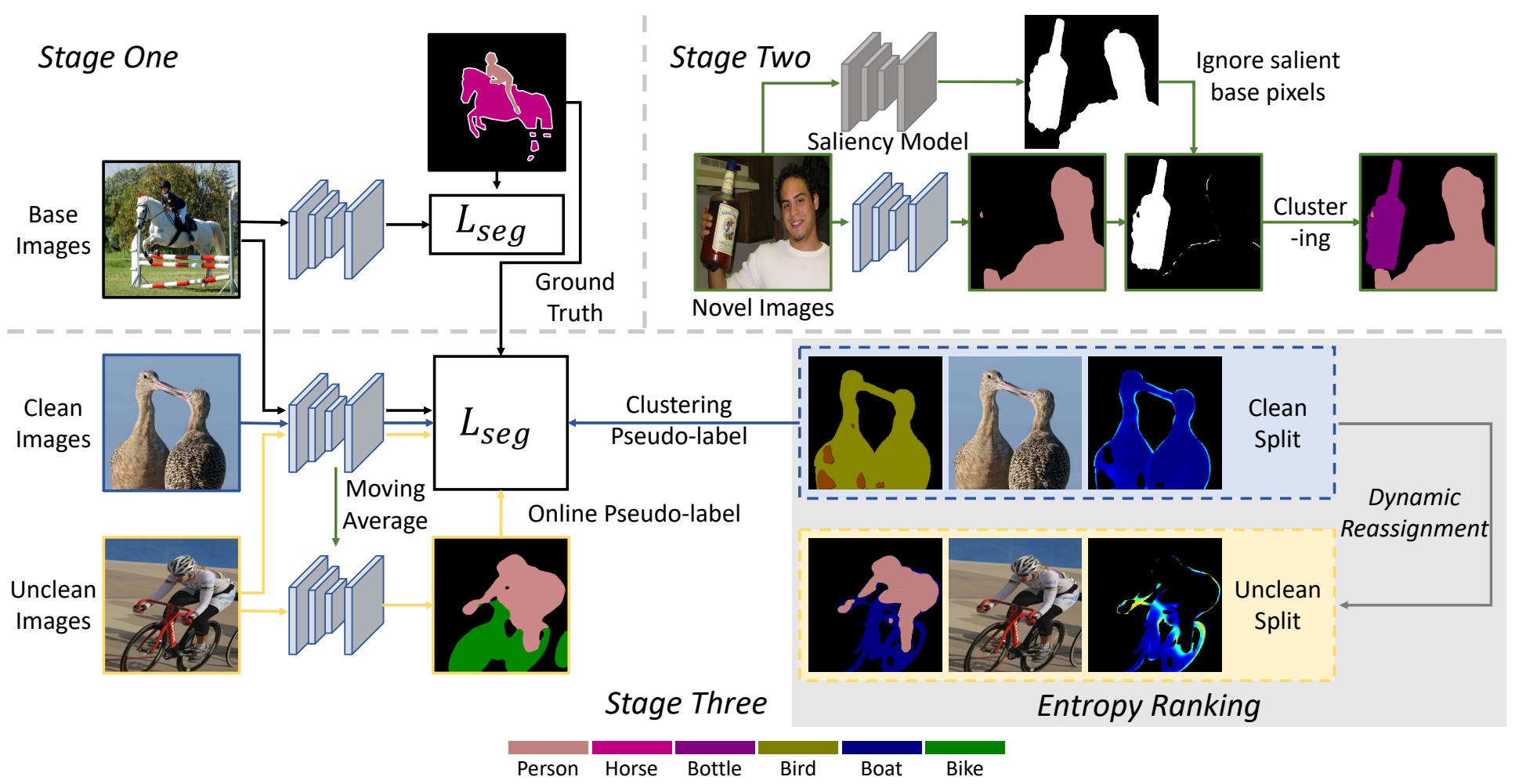
Figure 2. The overview of Entropy-based Uncertainty Modeling and Self-training framework. 1) The model is first trained on the labeled
base set. 2) For the novel images, the saliency maps are generated from a saliency model and high confidence base pixels are ignored. We
then apply clustering to the novel salient part to obtain clustering pseudo-labels. 3) We apply entropy ranking and dynamic reassignment
to split clean and unclean novel images and utilize them to optimize the model with clustering labels and online labels, respectively.
Novel Class Discovery in Semantic Segmentation
Venue: CVPR 2022 · Main-conference paper
Figure 1 · PDF page 1 · P73
300 dpi PNG · Caption · Source PDF
Original caption, source, and provenance
Fixed source version: CVPR 2022 fixed official PDF
Earliest verified matching figure date (temporal proxy): 2021-12-03
arXiv v1 date: 2021-12-03
Actual drawing date: unknown. See the source record for version checks and temporal-evidence limitations.
Historical PDF · Download citation snapshot · Date evidence · Paper page · Complete screening and version record (Chinese)
Citation threshold evidence: Nicu Sebe; 59898 citations; snapshot 2026-10-21.
Recorded drawing-tool disclosure: unknown. No tool attribution is inferred from appearance; see the archival disclosure evidence for scope and wording.
Crop bounding box: [317, 226, 535, 474] (PDF points; top-left origin; x0, y0, x1, y1).
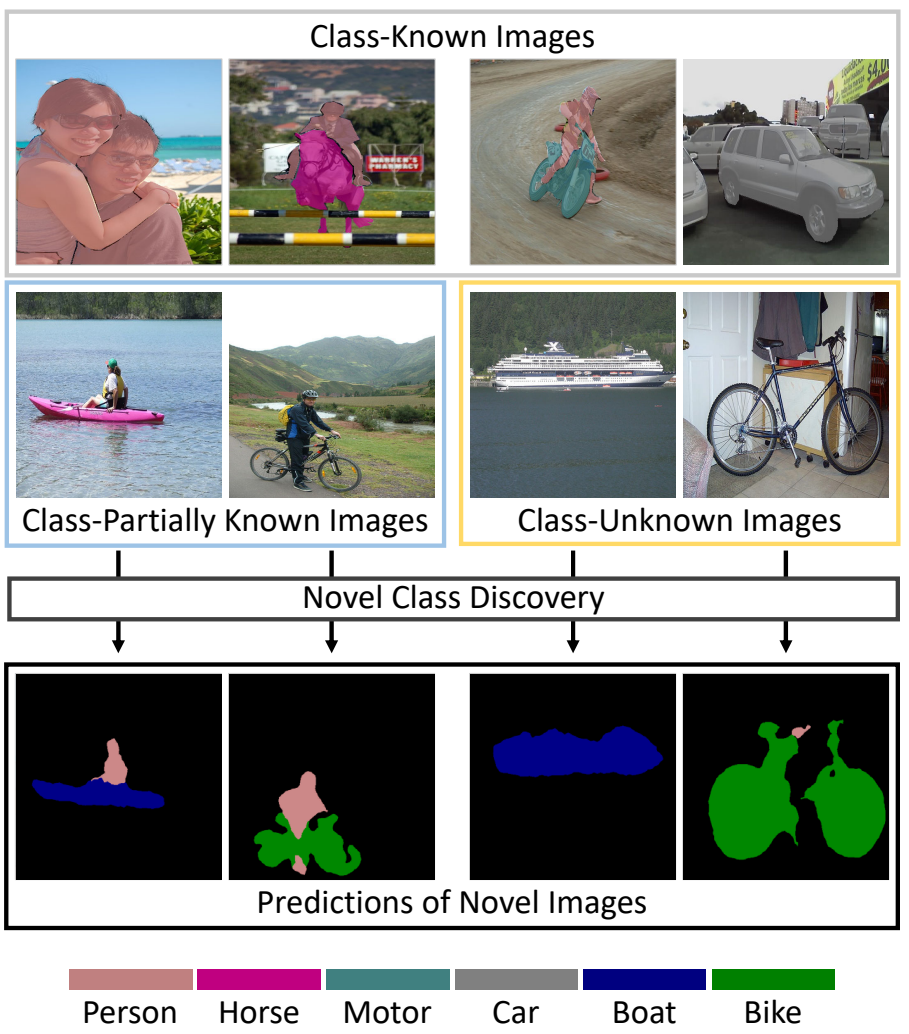
Figure 1. Illustration of Novel Class Discovery in Semantic Seg-
mentation(NCDSS).Givenalabeledset(person,horse,motorbike
and car) and a class disjoint unlabeled set (bike and boat), NCDSS
aims at leveraging all the data to segment novel images.
Open-World Instance Segmentation: Exploiting Pseudo Ground Truth From Learned Pairwise Affinity
Venue: CVPR 2022 · Main-conference paper
Figure 2 · PDF page 3 · P50
300 dpi PNG · Caption · Source PDF
Original caption, source, and provenance
Fixed source version: CVPR 2022 fixed official PDF
Earliest verified matching figure date (temporal proxy): 2022-04-12
arXiv v1 date: 2022-04-12
Actual drawing date: unknown. See the source record for version checks and temporal-evidence limitations.
Historical PDF · Download citation snapshot · Date evidence · Complete screening and version record (Chinese)
Citation threshold evidence: Jitendra Malik; 374128 citations; snapshot 2026-10-21.
Recorded drawing-tool disclosure: unknown. No tool attribution is inferred from appearance; see the archival disclosure evidence for scope and wording.
Crop bounding box: [60, 71, 534, 184] (PDF points; top-left origin; x0, y0, x1, y1).
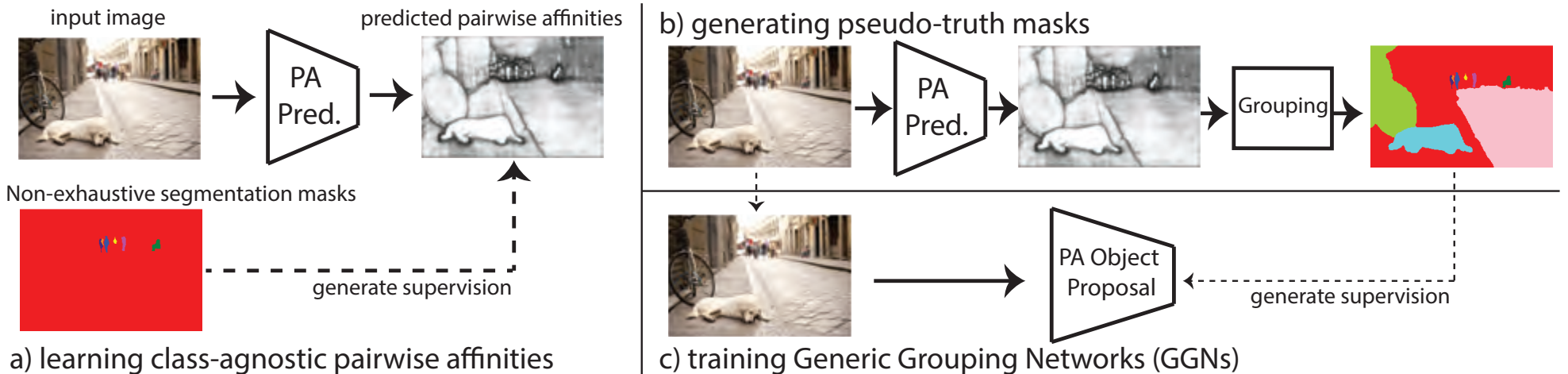
Figure 2. Overview of our approach. (a) First, a Pairwise-Affinity Predictor (PA Pred.) is trained to predict pairwise affinities using non-
exhaustive segmentation masks as supervision. (b) Once trained, PA Pred. is used to predict pairwise affinities of the images. A grouping
module is then applied on the predicted pairwise affinity maps to generate pseudo-ground-truth masks. (c) A class-agnostic generic object
proposal network (e.g., class-agnostic Mask R-CNN) is trained end-to-end using a combination of GT and generated pseudo-GT masks.
Open-World Instance Segmentation: Exploiting Pseudo Ground Truth From Learned Pairwise Affinity
Venue: CVPR 2022 · Main-conference paper
Figure 1 · PDF page 1 · P49
300 dpi PNG · Caption · Source PDF
Original caption, source, and provenance
Fixed source version: CVPR 2022 fixed official PDF
Earliest verified matching figure date (temporal proxy): 2022-04-12
arXiv v1 date: 2022-04-12
Actual drawing date: unknown. See the source record for version checks and temporal-evidence limitations.
Historical PDF · Download citation snapshot · Date evidence · Complete screening and version record (Chinese)
Citation threshold evidence: Jitendra Malik; 374128 citations; snapshot 2026-10-21.
Recorded drawing-tool disclosure: unknown. No tool attribution is inferred from appearance; see the archival disclosure evidence for scope and wording.
Crop bounding box: [49, 231, 546, 413] (PDF points; top-left origin; x0, y0, x1, y1).
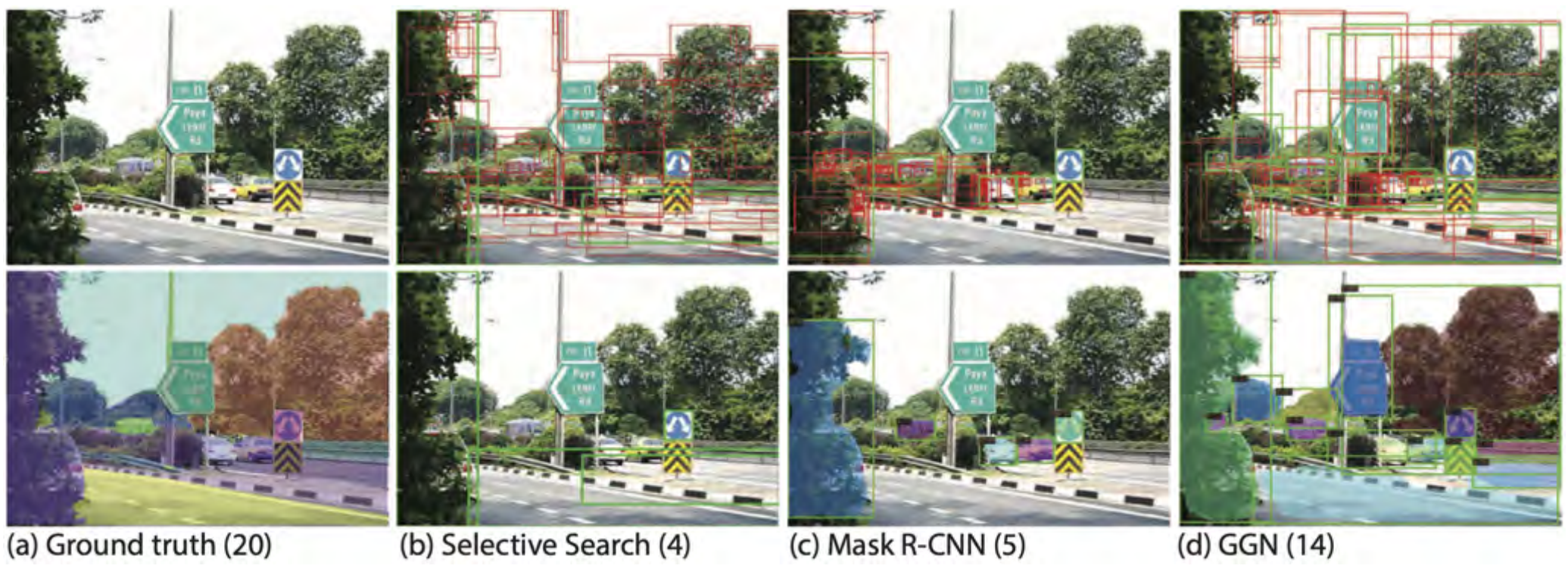
Figure 1. Comparison of GGN with different baselines. (a) an input image from ADE20K [61] (upper row) with the ground truth
object masks overlaid (lower row). Three different approaches: (b) Selective Search (SS) [51], (c) Mask R-CNN [22], and (d) our Generic
Grouping Network (GGN) are applied on the same image to predict the top 100 proposals. The upper images provide all top-100 proposals
predicted by three approaches with false and true positive proposals visualized in red and green boxes, respectively. The lower images
provide only true positive proposals. The number of true positive proposals or ground truth objects are denoted in parentheses. Among 20
ground truth objects, SS recalls only 4, Mask R-CNN detects 5, and GGN retrieves 14. SS is a bottom-up non-parametric approach, thus
has no notion of objectness. Mask R-CNN can make whole object proposals; however it still fails to detect objects that are not seen during
training. Our GGN can predict whole object proposals and generalize to unseen categories.
Representation Compensation Networks for Continual Semantic Segmentation
Venue: CVPR 2022 · Main-conference paper
Figure 1 · PDF page 1 · P144
300 dpi PNG · Caption · Source PDF
Original caption, source, and provenance
Fixed source version: CVPR 2022 fixed official PDF
Earliest verified matching figure date (temporal proxy): 2022-03-10
arXiv v1 date: 2022-03-10
Actual drawing date: unknown. See the source record for version checks and temporal-evidence limitations.
Historical PDF · Download citation snapshot · Date evidence · Paper page · Complete screening and version record (Chinese)
Citation threshold evidence: Ming-Ming Cheng; 85763 citations; snapshot 2026-10-21.
Recorded drawing-tool disclosure: unknown. No tool attribution is inferred from appearance; see the archival disclosure evidence for scope and wording.
Crop bounding box: [314, 207, 541, 357] (PDF points; top-left origin; x0, y0, x1, y1).
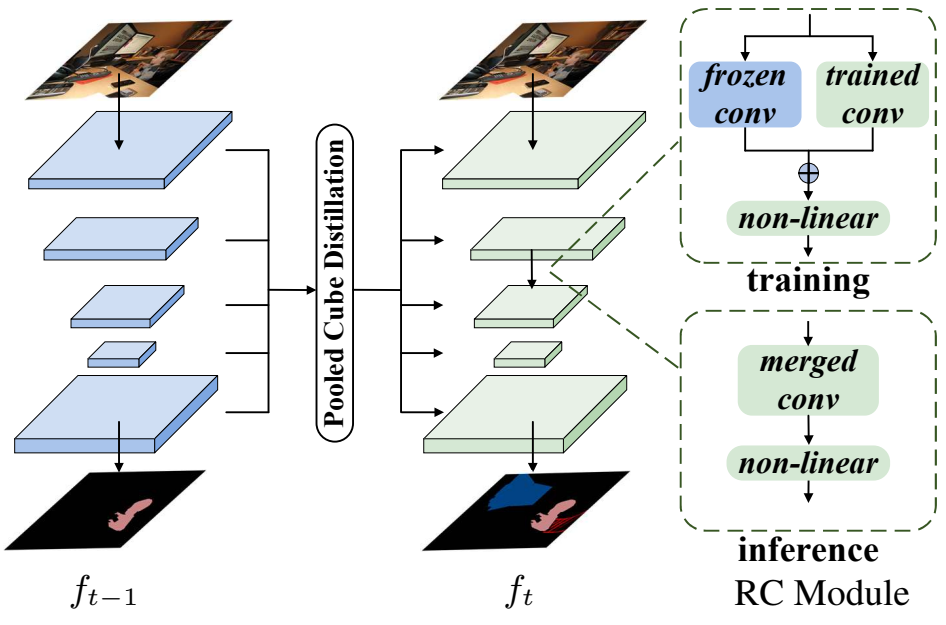
Figure 1. Illustration of our proposed training framework for con-
tinual semantic segmentation to avoid catastrophic forgetting. We
design two mechanisms in our method, representation compensa-
tion (RC) module and pooled cube distillation (PCD).
Representation Compensation Networks for Continual Semantic Segmentation
Venue: CVPR 2022 · Main-conference paper
Figure 5 · PDF page 5 · P143
300 dpi PNG · Caption · Source PDF
Original caption, source, and provenance
Fixed source version: CVPR 2022 fixed official PDF
Earliest verified matching figure date (temporal proxy): 2022-03-10
arXiv v1 date: 2022-03-10
Actual drawing date: unknown. See the source record for version checks and temporal-evidence limitations.
Historical PDF · Download citation snapshot · Date evidence · Paper page · Complete screening and version record (Chinese)
Citation threshold evidence: Ming-Ming Cheng; 85763 citations; snapshot 2026-10-21.
Recorded drawing-tool disclosure: unknown. No tool attribution is inferred from appearance; see the archival disclosure evidence for scope and wording.
Crop bounding box: [49, 69, 286, 194] (PDF points; top-left origin; x0, y0, x1, y1).
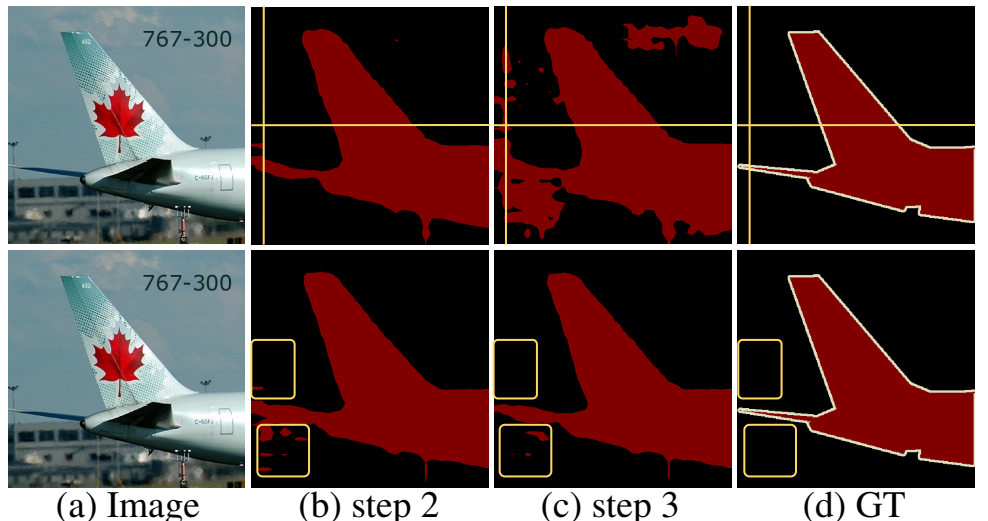
Figure 5. The impact of the strip pooling (top row) used in
PLOP [27] and the average pooling (bottom row) in our method.
Rethinking Semantic Segmentation: A Prototype View
Venue: CVPR 2022 · Main-conference paper
Figure 2 · PDF page 3 · P124
300 dpi PNG · Caption · Source PDF
Original caption, source, and provenance
Fixed source version: CVPR 2022 fixed official PDF
Earliest verified matching figure date (temporal proxy): 2022-03-28
arXiv v1 date: 2022-03-28
Actual drawing date: unknown. See the source record for version checks and temporal-evidence limitations.
Historical PDF · Download citation snapshot · Date evidence · Paper page · Complete screening and version record (Chinese)
Citation threshold evidence: Luc Van Gool; 309926 citations; snapshot 2026-10-21.
Recorded drawing-tool disclosure: unknown. No tool attribution is inferred from appearance; see the archival disclosure evidence for scope and wording.
Crop bounding box: [49, 66, 548, 183] (PDF points; top-left origin; x0, y0, x1, y1).
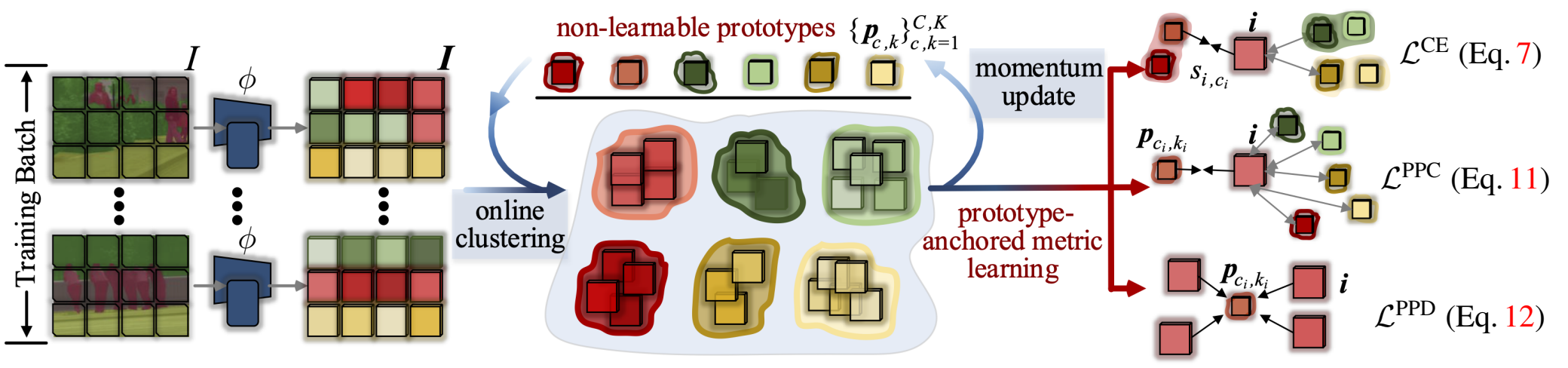
Figure 2. Architecture illustration of our non-learnable prototype based nonparametric segmentation model during the training phase.
Rethinking Semantic Segmentation: A Prototype View
Venue: CVPR 2022 · Main-conference paper
Figure 1 · PDF page 1 · P123
300 dpi PNG · Caption · Source PDF
Original caption, source, and provenance
Fixed source version: CVPR 2022 fixed official PDF
Earliest verified matching figure date (temporal proxy): 2022-03-28
arXiv v1 date: 2022-03-28
Actual drawing date: unknown. See the source record for version checks and temporal-evidence limitations.
Historical PDF · Download citation snapshot · Date evidence · Paper page · Complete screening and version record (Chinese)
Citation threshold evidence: Luc Van Gool; 309926 citations; snapshot 2026-10-21.
Recorded drawing-tool disclosure: unknown. No tool attribution is inferred from appearance; see the archival disclosure evidence for scope and wording.
Crop bounding box: [308, 201, 548, 368] (PDF points; top-left origin; x0, y0, x1, y1).
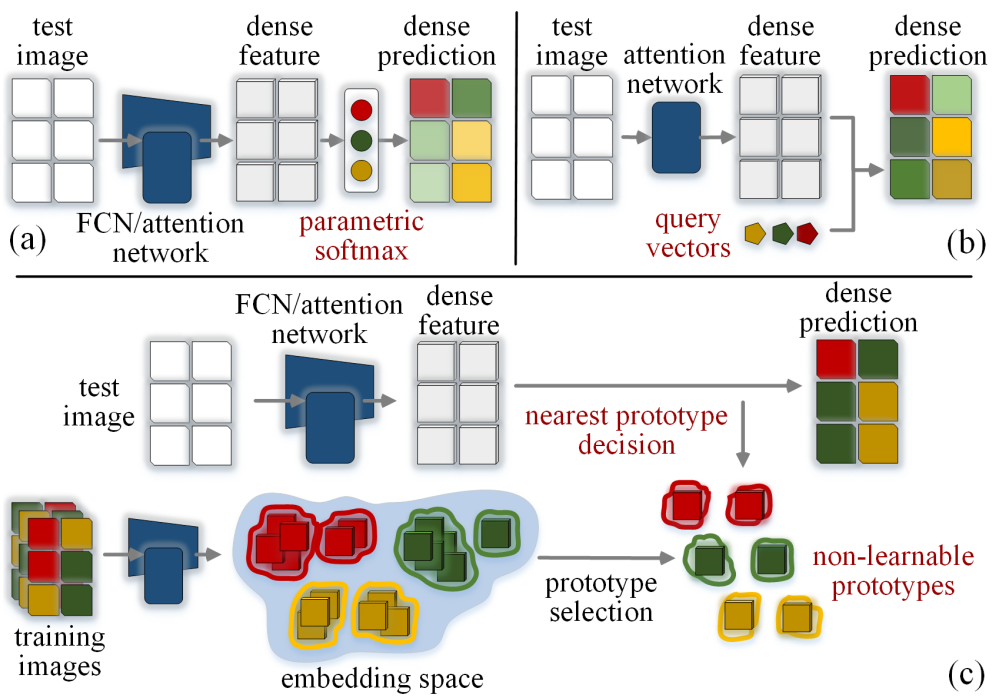
Figure 1. Different sematic segmentation paradigms: (a-b) para-
metric vs (c) nonparametric. Modern segmentation solutions, no
matter using (a) parametric softmax or (b) query vectors for mask
decoding,canbeviewedaslearnableprototypebasedmethodsthat
learn class-wise prototypes in a fully parametric manner. We in-
steadproposeanonparametricscheme(c)thatdirectlyselectssub-
clustercentersofembeddedpixelsasprototypes,andachievesper-
pixel prediction via nonparametric nearest prototype retrieving.
SimT: Handling Open-set Noise for Domain Adaptive Semantic Segmentation
Venue: CVPR 2022 · Main-conference paper
Figure 2 · PDF page 4 · P138
300 dpi PNG · Caption · Source PDF
Original caption, source, and provenance
Fixed source version: CVPR 2022 fixed official PDF
Earliest verified matching figure date (temporal proxy): 2022-06
arXiv v1 date: 2022-03-29
Actual drawing date: unknown. See the source record for version checks and temporal-evidence limitations.
Historical PDF · Download citation snapshot · Date evidence · Paper page · Complete screening and version record (Chinese)
Citation threshold evidence: Yixuan Yuan; 16227 citations; snapshot 2026-10-21.
Recorded drawing-tool disclosure: unknown. No tool attribution is inferred from appearance; see the archival disclosure evidence for scope and wording.
Crop bounding box: [49, 57, 548, 198] (PDF points; top-left origin; x0, y0, x1, y1).
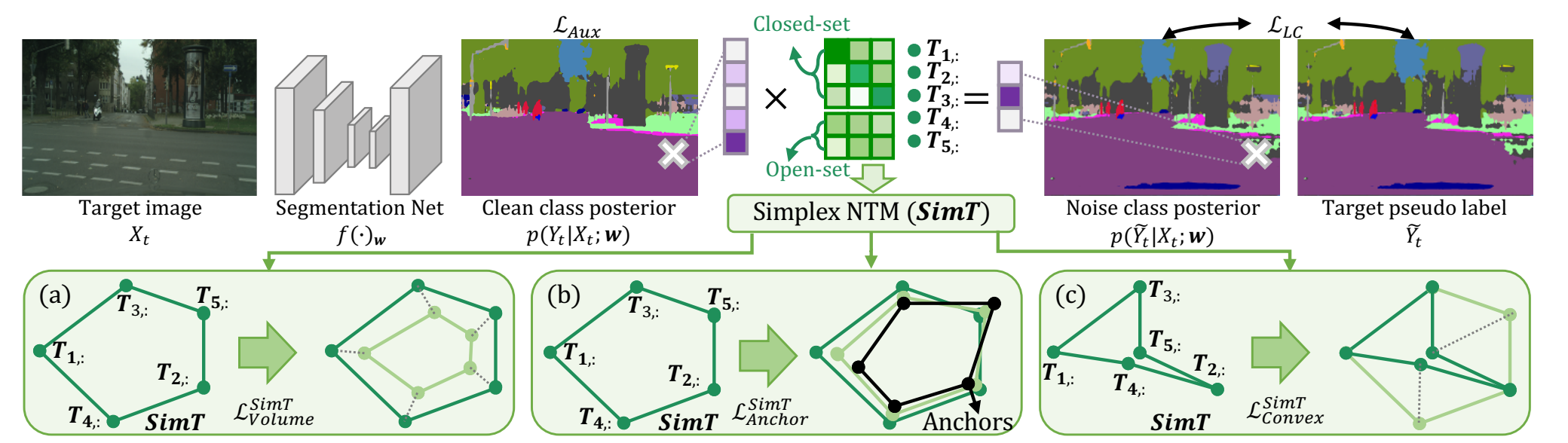
Figure 2. The proposed domain adaption framework contains a segmentation net and a SimT. Target images are passed through the
segmentation net f(·) to perform semantic segmentation, and supervision signals are corrected by the learnable SimT. SimT is estimated
w
through the proposed (a) volume regularization, (b) anchor guidance and (c) convex guarantee.
SimT: Handling Open-set Noise for Domain Adaptive Semantic Segmentation
Venue: CVPR 2022 · Main-conference paper
Figure 1 · PDF page 2 · P137
300 dpi PNG · Caption · Source PDF
Original caption, source, and provenance
Fixed source version: CVPR 2022 fixed official PDF
Earliest verified matching figure date (temporal proxy): 2022-06
arXiv v1 date: 2022-03-29
Actual drawing date: unknown. See the source record for version checks and temporal-evidence limitations.
Historical PDF · Download citation snapshot · Date evidence · Paper page · Complete screening and version record (Chinese)
Citation threshold evidence: Yixuan Yuan; 16227 citations; snapshot 2026-10-21.
Recorded drawing-tool disclosure: unknown. No tool attribution is inferred from appearance; see the archival disclosure evidence for scope and wording.
Crop bounding box: [48, 64, 289, 161] (PDF points; top-left origin; x0, y0, x1, y1).
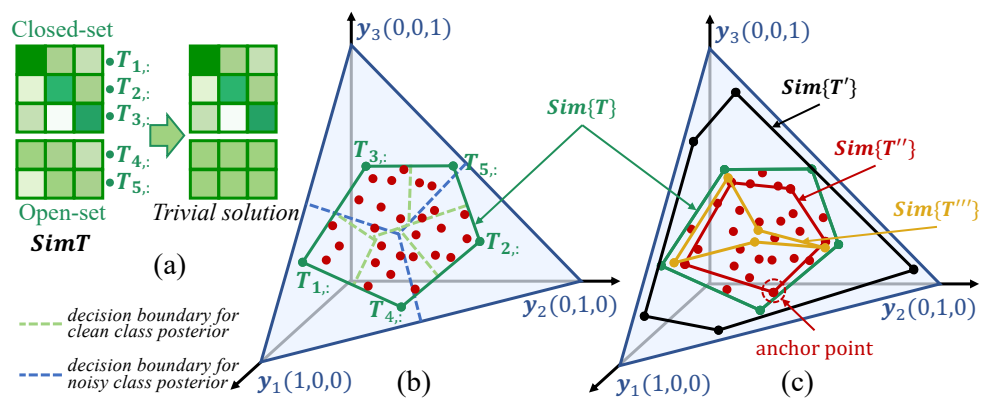
Figure 1. Geometric illustration of SimT with the setting of 3
pseudo label classes and 5 ground truth label classes. Note that
coordinates (x,y,z) of any points in blue triangle satisfy condi-
tions of x + y + z = 1 and 0 < x,y,z < 1.
Tree Energy Loss: Towards Sparsely Annotated Semantic Segmentation
Venue: CVPR 2022 · Main-conference paper
Figure 3 · PDF page 3 · P134
300 dpi PNG · Caption · Source PDF
Original caption, source, and provenance
Fixed source version: CVPR 2022 fixed official PDF
Earliest verified matching figure date (temporal proxy): 2022-06
arXiv v1 date: 2022-03-21
Actual drawing date: unknown. See the source record for version checks and temporal-evidence limitations.
Historical PDF · Download citation snapshot · Date evidence · Paper page · Complete screening and version record (Chinese)
Citation threshold evidence: Xiangyu Zhang; 481440 citations; snapshot 2026-10-21.
Recorded drawing-tool disclosure: unknown. No tool attribution is inferred from appearance; see the archival disclosure evidence for scope and wording.
Crop bounding box: [72, 70, 523, 207] (PDF points; top-left origin; x0, y0, x1, y1).
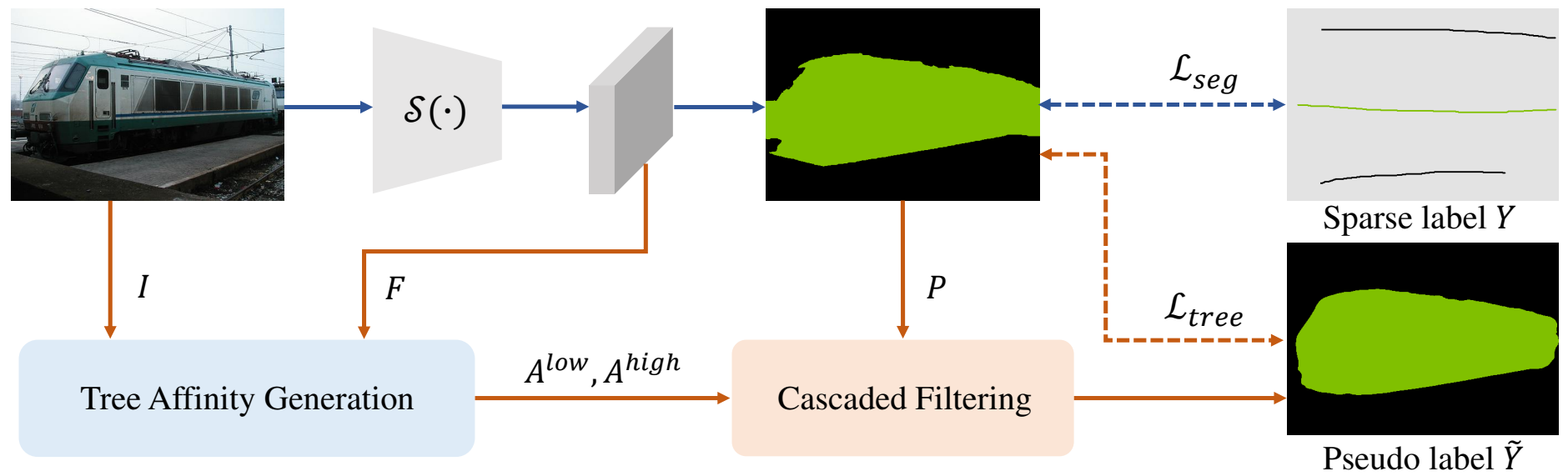
Figure 3. Flowchart of the proposed single-stage SASS method, which is realized by incorporating an auxiliary branch into the traditional
segmentation model S(·). During training, the predicted masks P are split into the labeled and unlabeled parts, which are supervised by
the segmentation loss L and the tree energy loss L , respectively. To obtain pseudo labels for unlabeled pixels, the Tree Affinity
seg tree
Generation procedure (Eqs. 3-5) first utilizes the color information I and semantic features F to generate the low-level and high-level
affinity matrices Alow,Ahigh. Then the Cascaded Filtering operation (Eqs. 6-7) converts the network predictions P into soft pseudo labels
Y˜. During testing, the auxiliary branch is removed to avoid extra computational costs.
Tree Energy Loss: Towards Sparsely Annotated Semantic Segmentation
Venue: CVPR 2022 · Main-conference paper
Figure 1 · PDF page 1 · P133
300 dpi PNG · Caption · Source PDF
Original caption, source, and provenance
Fixed source version: CVPR 2022 fixed official PDF
Earliest verified matching figure date (temporal proxy): 2022-06
arXiv v1 date: 2022-03-21
Actual drawing date: unknown. See the source record for version checks and temporal-evidence limitations.
Historical PDF · Download citation snapshot · Date evidence · Paper page · Complete screening and version record (Chinese)
Citation threshold evidence: Xiangyu Zhang; 481440 citations; snapshot 2026-10-21.
Recorded drawing-tool disclosure: unknown. No tool attribution is inferred from appearance; see the archival disclosure evidence for scope and wording.
Crop bounding box: [320, 214, 535, 516] (PDF points; top-left origin; x0, y0, x1, y1).
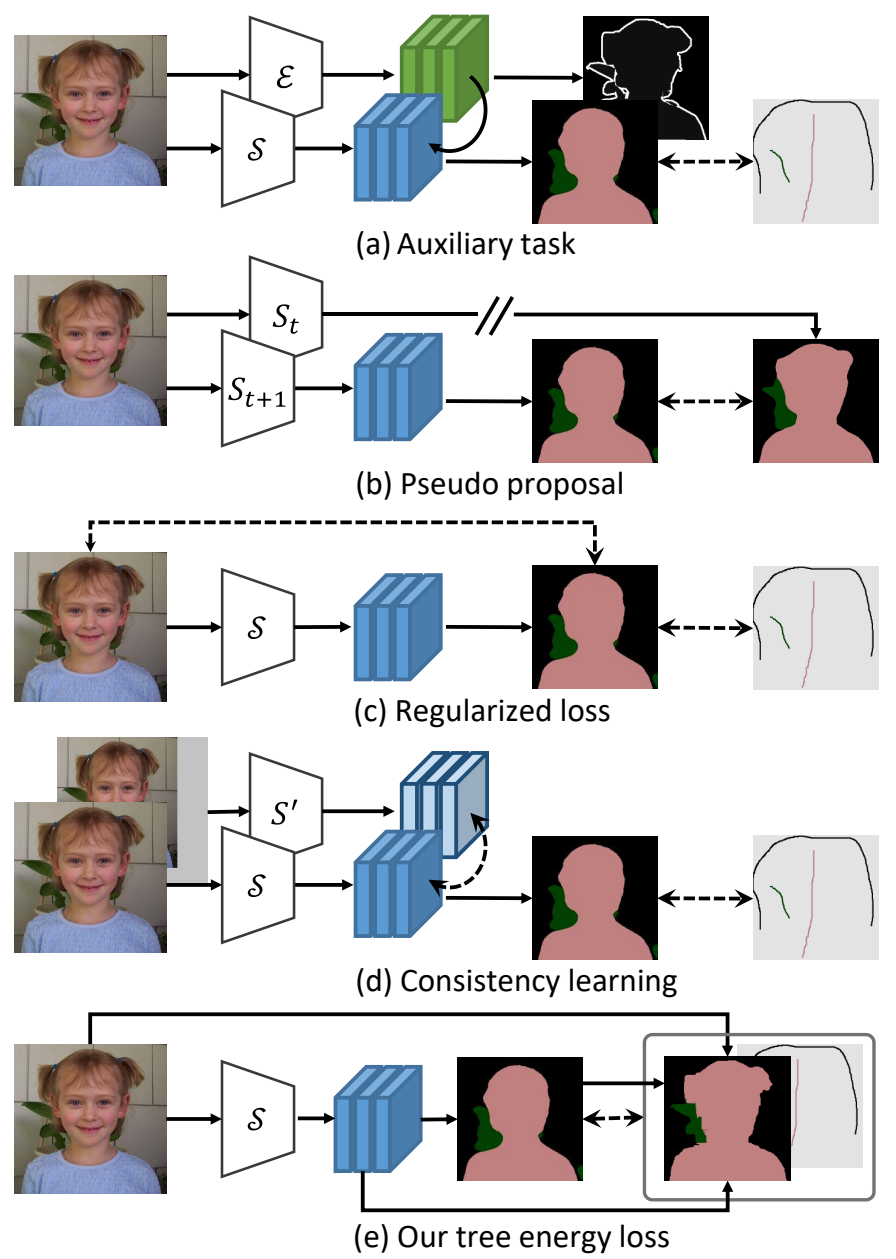
Figure1. IllustrationofcurrentSASSapproaches. S andE denote
the segmentation and auxiliary models, respectively. Our method
leverages the minimum spanning trees (MSTs) to capture both
low-level and high-level affinities to generate soft pseudo labels,
performing online self-training.
A Text Attention Network for Spatial Deformation Robust Scene Text Image Super-resolution
Venue: CVPR 2022 · Main-conference paper
Figure 2 · PDF page 3 · P72
300 dpi PNG · Caption · Source PDF
Original caption, source, and provenance
Fixed source version: CVPR 2022 fixed official PDF
Earliest verified matching figure date (temporal proxy): 2022-03-17
arXiv v1 date: 2022-03-17
Actual drawing date: unknown. See the source record for version checks and temporal-evidence limitations.
Historical PDF · Download citation snapshot · Date evidence · Paper page · Complete screening and version record (Chinese)
Citation threshold evidence: Lei Zhang; 137335 citations; snapshot 2026-10-21.
Recorded drawing-tool disclosure: unknown. No tool attribution is inferred from appearance; see the archival disclosure evidence for scope and wording.
Crop bounding box: [72, 69, 525, 219] (PDF points; top-left origin; x0, y0, x1, y1).
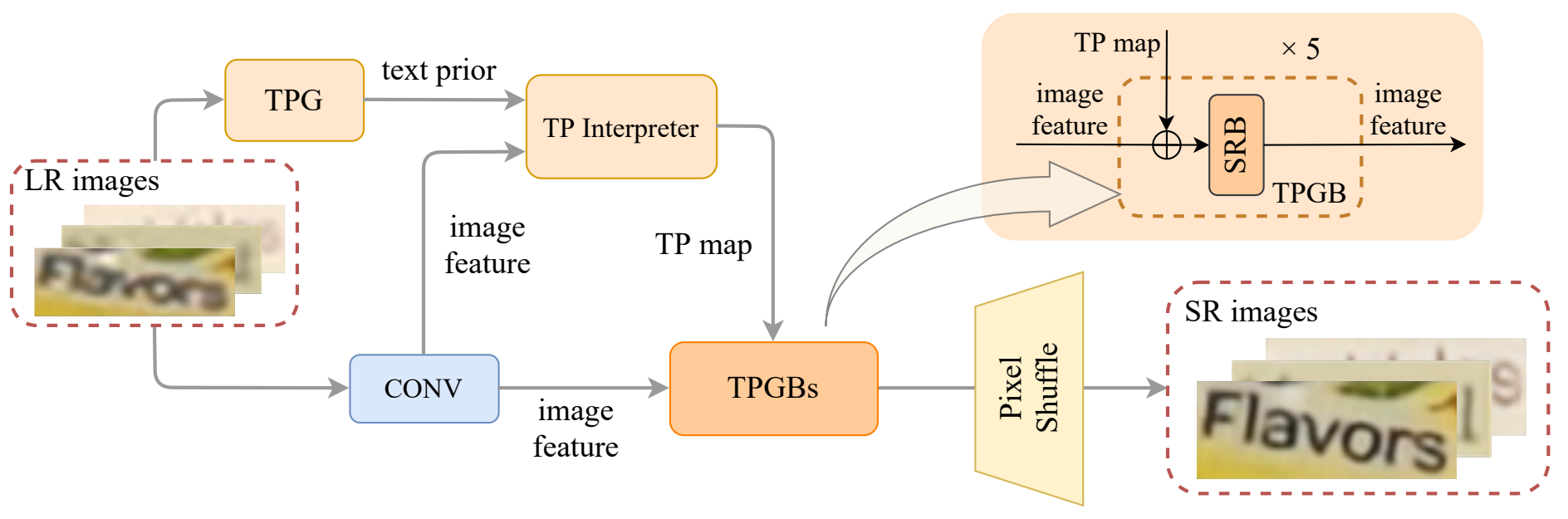
Figure2. ArchitectureofourproposedTATTnetworkforSTISR.TPGB,TPGandSRBareshortfortextpriorguidedblocks,TPGenerator
and Sequential-Recurrent Blocks, respectively, while ⊕ means the element-wise addition.
A Text Attention Network for Spatial Deformation Robust Scene Text Image Super-resolution
Venue: CVPR 2022 · Main-conference paper
Figure 1 · PDF page 1 · P71
300 dpi PNG · Caption · Source PDF
Original caption, source, and provenance
Fixed source version: CVPR 2022 fixed official PDF
Earliest verified matching figure date (temporal proxy): 2022-03-17
arXiv v1 date: 2022-03-17
Actual drawing date: unknown. See the source record for version checks and temporal-evidence limitations.
Historical PDF · Download citation snapshot · Date evidence · Paper page · Complete screening and version record (Chinese)
Citation threshold evidence: Lei Zhang; 137335 citations; snapshot 2026-10-21.
Recorded drawing-tool disclosure: unknown. No tool attribution is inferred from appearance; see the archival disclosure evidence for scope and wording.
Crop bounding box: [309, 230, 546, 390] (PDF points; top-left origin; x0, y0, x1, y1).
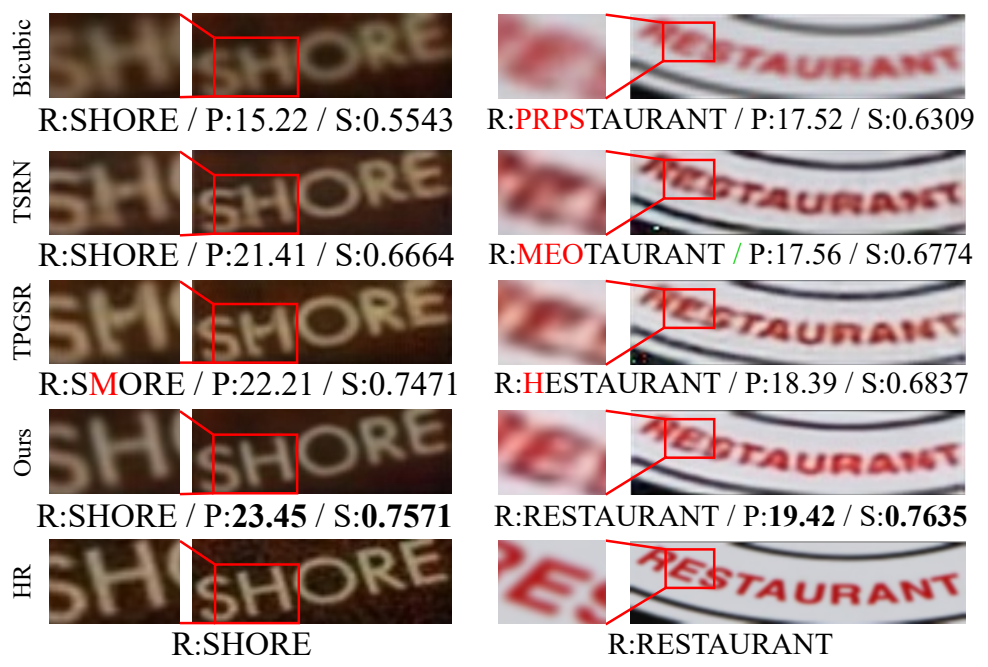
Figure 1. SR recovery of different models on rotated and curve-
shaped text images. ‘R’, ‘P’ and ‘S’ stand for recognition, PSNR
and SSIM results. Characters in red are missing or wrong.
Blind Image Super-resolution with Elaborate Degradation Modeling on Noise and Kernel
Venue: CVPR 2022 · Main-conference paper
Figure 1 · PDF page 2 · P130
300 dpi PNG · Caption · Source PDF
Original caption, source, and provenance
Fixed source version: CVPR 2022 fixed official PDF
Earliest verified matching figure date (temporal proxy): 2021-11-11
arXiv v1 date: 2021-07-02
Actual drawing date: unknown. See the source record for version checks and temporal-evidence limitations.
Historical PDF · Download citation snapshot · Date evidence · Paper page · Complete screening and version record (Chinese)
Citation threshold evidence: Lei Zhang; 137335 citations; snapshot 2026-10-21.
Recorded drawing-tool disclosure: unknown. No tool attribution is inferred from appearance; see the archival disclosure evidence for scope and wording.
Crop bounding box: [91, 71, 502, 243] (PDF points; top-left origin; x0, y0, x1, y1).
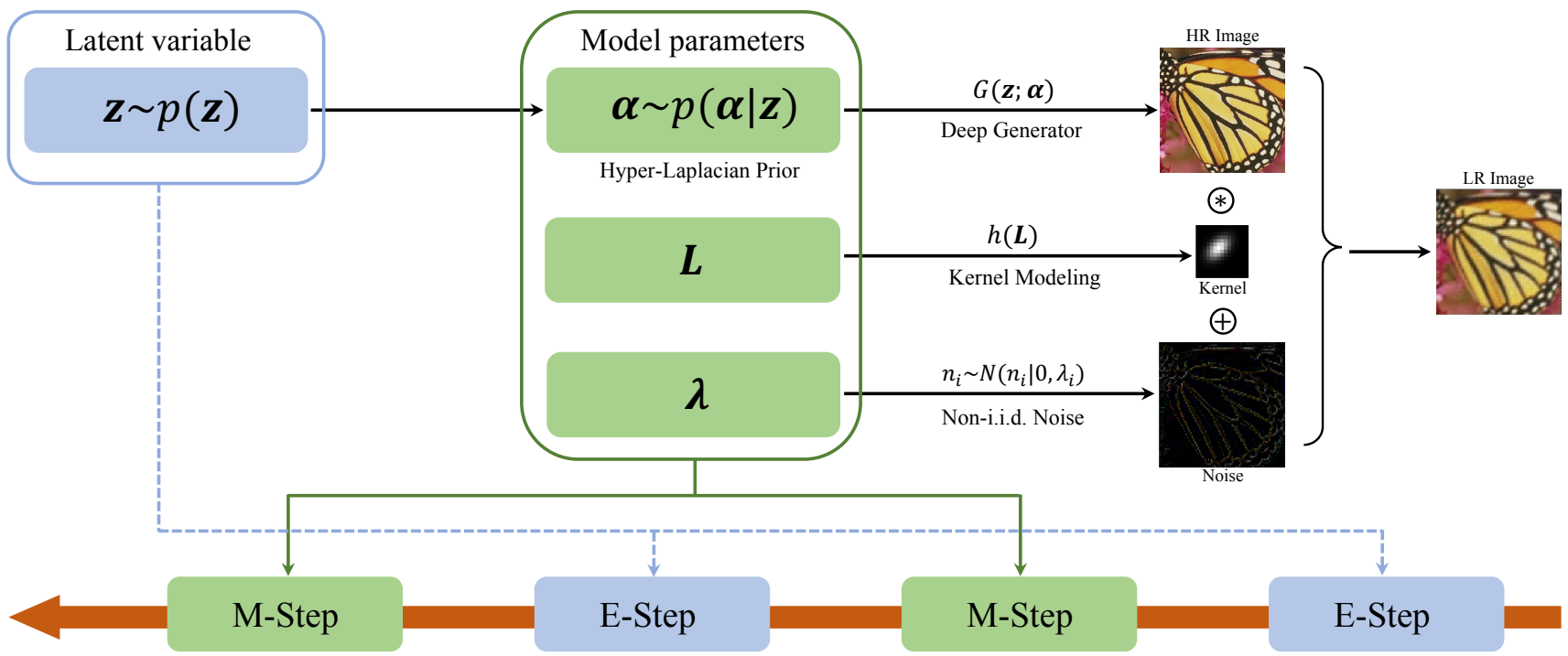
Figure 1. An overview of the proposed SISR method and the corresponding EM algorithm. A probabilistic model is constructed to depict the generation
process of the observed LR image, which mainly involves two groups of parameters, including the latent variable z and the model parameters {α,L,λ}.
AMonteCarloEMalgorithmisdesignedtoalternatelyupdatethemintheE-StepandM-Step,respectively.Blind Image Super-resolution with Elaborate Degradation Modeling on Noise and Kernel
Venue: CVPR 2022 · Main-conference paper
Figure 3 · PDF page 6 · P129
300 dpi PNG · Caption · Source PDF
Original caption, source, and provenance
Fixed source version: CVPR 2022 fixed official PDF
Earliest verified matching figure date (temporal proxy): 2021-11-11
arXiv v1 date: 2021-07-02
Actual drawing date: unknown. See the source record for version checks and temporal-evidence limitations.
Historical PDF · Download citation snapshot · Date evidence · Paper page · Complete screening and version record (Chinese)
Citation threshold evidence: Lei Zhang; 137335 citations; snapshot 2026-10-21.
Recorded drawing-tool disclosure: unknown. No tool attribution is inferred from appearance; see the archival disclosure evidence for scope and wording.
Crop bounding box: [308, 271, 546, 358] (PDF points; top-left origin; x0, y0, x1, y1).
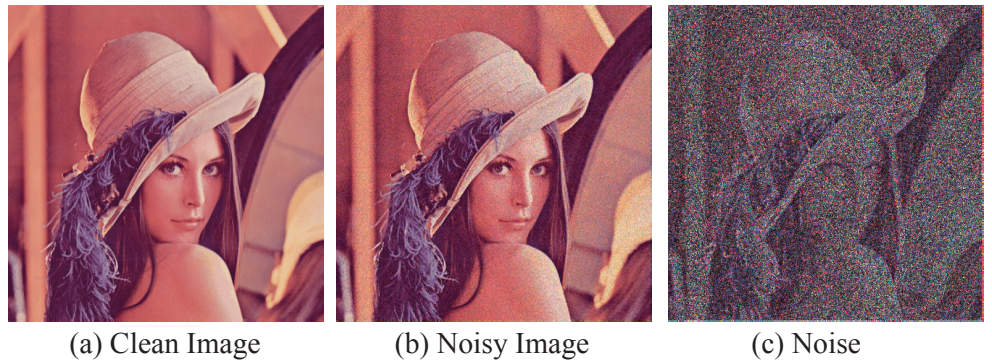
Figure3. IllustrationofcamerasensornoiseofCase2. Fromlefttoright:
(a) clean image; (b) simulated noisy image with camera sensor noise; (c)
absoluteresidual(ornoise)between(a)and(b).
Deblurring via Stochastic Refinement
Venue: CVPR 2022 · Main-conference paper
Figure 2 · PDF page 2 · P232
300 dpi PNG · Caption · Source PDF
Original caption, source, and provenance
Fixed source version: CVPR 2022 fixed official PDF
Earliest verified matching figure date (temporal proxy): 2021-12-05
arXiv v1 date: 2021-12-05
Actual drawing date: unknown. See the source record for version checks and temporal-evidence limitations.
Historical PDF · Download citation snapshot · Date evidence · Paper page · Complete screening and version record (Chinese)
Citation threshold evidence: Peyman Milanfar; 37874 citations; snapshot 2026-10-22.
Recorded drawing-tool disclosure: unknown. No tool attribution is inferred from appearance; see the archival disclosure evidence for scope and wording.
Crop bounding box: [308, 75, 547, 180] (PDF points; top-left origin; x0, y0, x1, y1).
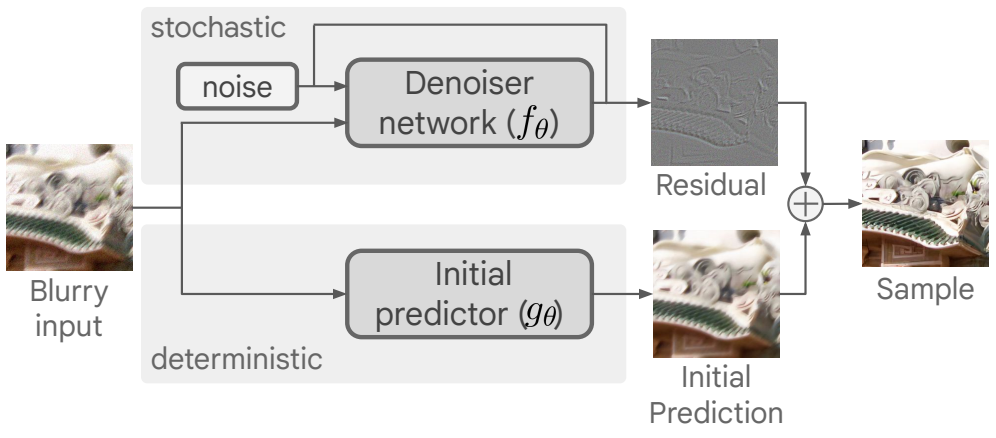
Figure 2. Diagram describing our dual-network architecture. The
initial predictor produces the deterministic candidate for the de-
noiser network, which then models the residual.
Deblurring via Stochastic Refinement
Venue: CVPR 2022 · Main-conference paper
Figure 3 · PDF page 4 · P231
300 dpi PNG · Caption · Source PDF
Original caption, source, and provenance
Fixed source version: CVPR 2022 fixed official PDF
Earliest verified matching figure date (temporal proxy): 2021-12-05
arXiv v1 date: 2021-12-05
Actual drawing date: unknown. See the source record for version checks and temporal-evidence limitations.
Historical PDF · Download citation snapshot · Date evidence · Paper page · Complete screening and version record (Chinese)
Citation threshold evidence: Peyman Milanfar; 37874 citations; snapshot 2026-10-22.
Recorded drawing-tool disclosure: unknown. No tool attribution is inferred from appearance; see the archival disclosure evidence for scope and wording.
Crop bounding box: [51, 73, 286, 204] (PDF points; top-left origin; x0, y0, x1, y1).
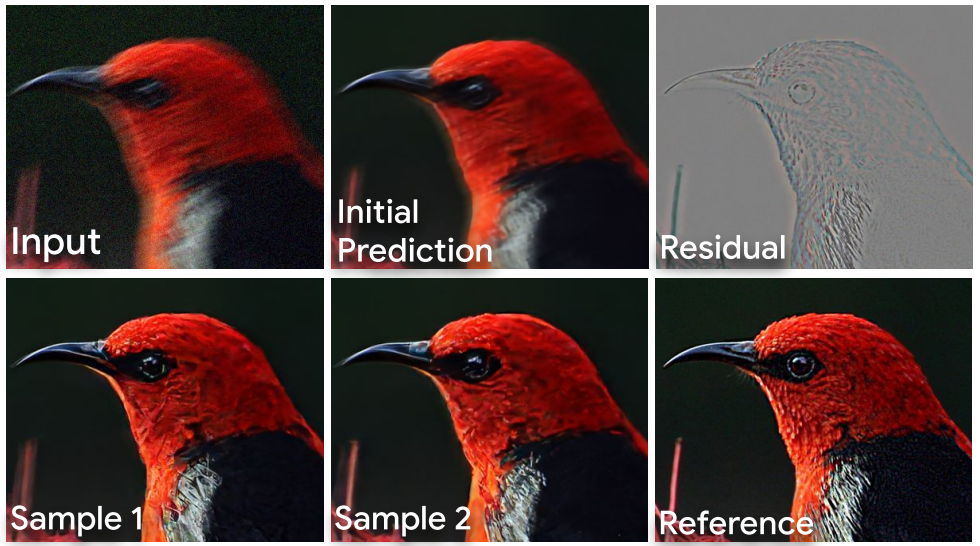
Figure 3. Output of the initial predictor and multiple samples
generated from it. We see that the over-smoothed initial prediction
lacking texture is “corrected” by the stochastic sampler, producing
crisp and diverse final reconstructions. The residual (top right)
shows the the difference between reference and initial prediction.
Deep Constrained Least Squares for Blind Image Super-Resolution
Venue: CVPR 2022 · Main-conference paper
Figure 4 · PDF page 4 · P216
300 dpi PNG · Caption · Source PDF
Original caption, source, and provenance
Fixed source version: CVPR 2022 fixed official PDF
Earliest verified matching figure date (temporal proxy): 2022-02-15
arXiv v1 date: 2022-02-15
Actual drawing date: unknown. See the source record for version checks and temporal-evidence limitations.
Historical PDF · Download citation snapshot · Date evidence · Paper page · Complete screening and version record (Chinese)
Citation threshold evidence: Haoqiang Fan; 13604 citations; snapshot 2026-10-21.
Recorded drawing-tool disclosure: unknown. No tool attribution is inferred from appearance; see the archival disclosure evidence for scope and wording.
Crop bounding box: [49, 70, 548, 203] (PDF points; top-left origin; x0, y0, x1, y1).
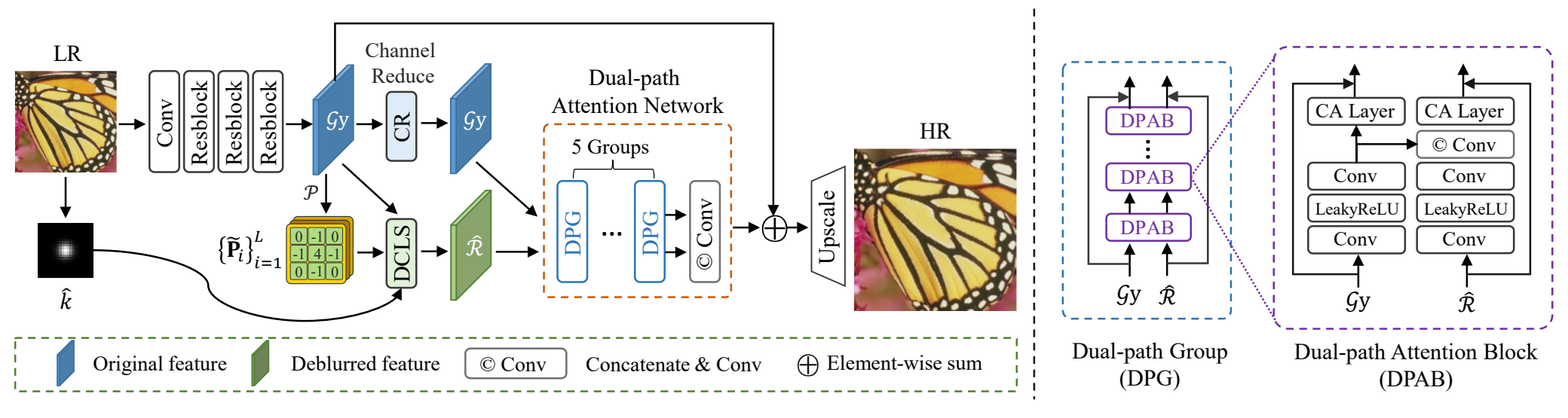
Figure 4. The overview architecture of the proposed method. Given an LR image y, we first estimate the degradation kernel kˆ , and involve
it in the deep constrained least squares (DCLS) convolution in the feature domain. The deblurred features R(cid:98) are then concatenated with
primitive features G y to restore the clean HR image x through a dual-path attention network (DPAN).
Deep Constrained Least Squares for Blind Image Super-Resolution
Venue: CVPR 2022 · Main-conference paper
Figure 2 · PDF page 2 · P215
300 dpi PNG · Caption · Source PDF
Original caption, source, and provenance
Fixed source version: CVPR 2022 fixed official PDF
Earliest verified matching figure date (temporal proxy): 2022-02-15
arXiv v1 date: 2022-02-15
Actual drawing date: unknown. See the source record for version checks and temporal-evidence limitations.
Historical PDF · Download citation snapshot · Date evidence · Paper page · Complete screening and version record (Chinese)
Citation threshold evidence: Haoqiang Fan; 13604 citations; snapshot 2026-10-21.
Recorded drawing-tool disclosure: unknown. No tool attribution is inferred from appearance; see the archival disclosure evidence for scope and wording.
Crop bounding box: [310, 72, 545, 163] (PDF points; top-left origin; x0, y0, x1, y1).
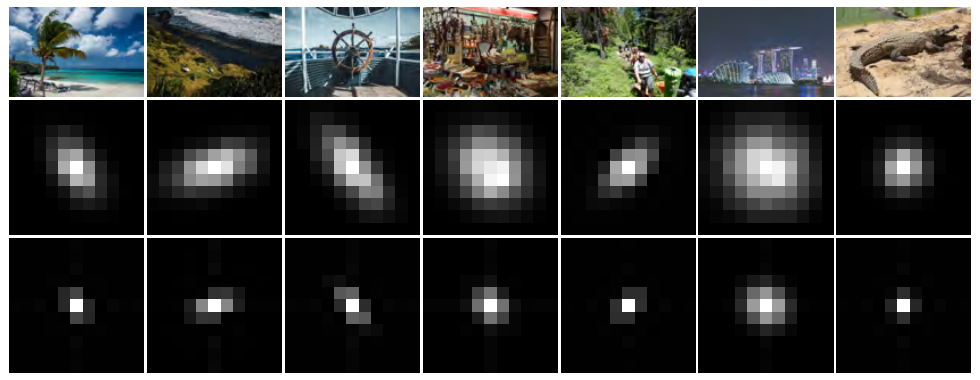
Figure 2. Kernel reformulation examples. The top row and middle
row are the LR images and the corresponding primitive kernels.
The bottom row is the reformulated kernels.
Details or Artifacts: A Locally Discriminative Learning Approach to Realistic Image Super-Resolution
Venue: CVPR 2022 · Main-conference paper
Figure 6 · PDF page 5 · P122
300 dpi PNG · Caption · Source PDF
Original caption, source, and provenance
Fixed source version: CVPR 2022 fixed official PDF
Earliest verified matching figure date (temporal proxy): 2022-03-17
arXiv v1 date: 2022-03-17
Actual drawing date: unknown. See the source record for version checks and temporal-evidence limitations.
Historical PDF · Download citation snapshot · Date evidence · Paper page · Complete screening and version record (Chinese)
Citation threshold evidence: Lei Zhang; 137335 citations; snapshot 2026-10-21.
Recorded drawing-tool disclosure: unknown. No tool attribution is inferred from appearance; see the archival disclosure evidence for scope and wording.
Crop bounding box: [329, 341, 509, 435] (PDF points; top-left origin; x0, y0, x1, y1).
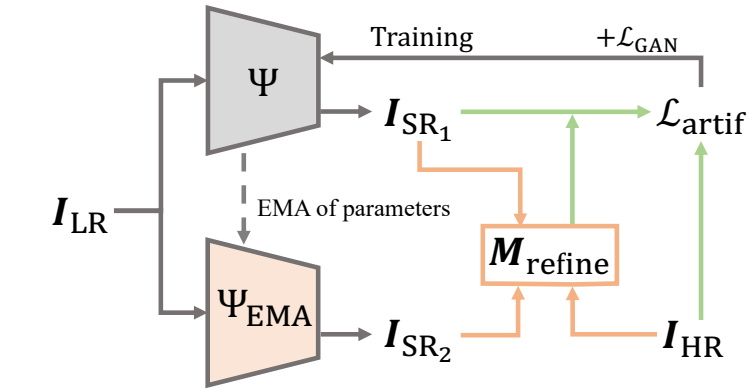
Figure 6. Overall learning pipeline of the proposed LDL method.
Details or Artifacts: A Locally Discriminative Learning Approach to Realistic Image Super-Resolution
Venue: CVPR 2022 · Main-conference paper
Figure 1 · PDF page 1 · P121
300 dpi PNG · Caption · Source PDF
Original caption, source, and provenance
Fixed source version: CVPR 2022 fixed official PDF
Earliest verified matching figure date (temporal proxy): 2022-03-17
arXiv v1 date: 2022-03-17
Actual drawing date: unknown. See the source record for version checks and temporal-evidence limitations.
Historical PDF · Download citation snapshot · Date evidence · Paper page · Complete screening and version record (Chinese)
Citation threshold evidence: Lei Zhang; 137335 citations; snapshot 2026-10-21.
Recorded drawing-tool disclosure: unknown. No tool attribution is inferred from appearance; see the archival disclosure evidence for scope and wording.
Crop bounding box: [309, 231, 547, 435] (PDF points; top-left origin; x0, y0, x1, y1).
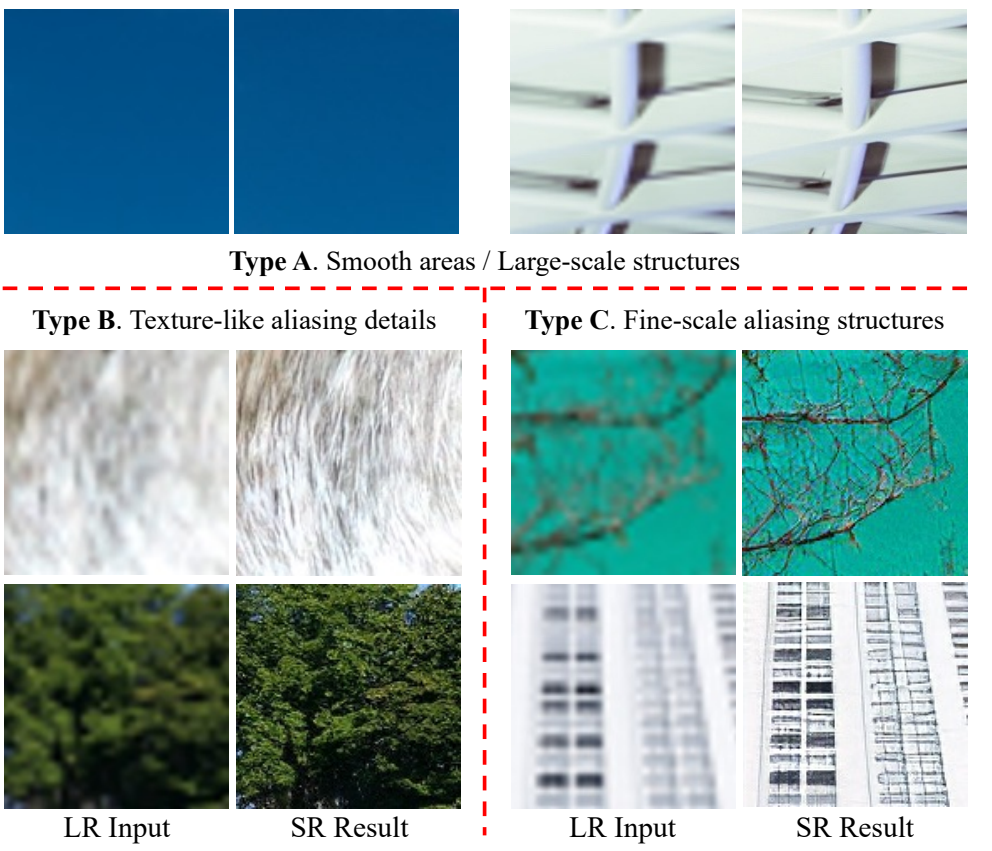
Figure 1. Three representative types of SISR regions generated by
ESRGAN [40]. For each example, the left is an LR patch and the
right is its GAN-SR result. Type A patches represent regions that
are easy to super-resolve, e.g., smooth and large-scale structural
areas, where the main structures are preserved in the LR input. In
contrast, patches of type B and type C are with fine-scale details,
which are hard to be faithfully restored due to the signal alias-
ing in the LR inputs. The results of texture-like type B patches
are perceptually realistic despite the pixel-wise differences to the
ground-truth, since the patterns are naturally irregular with weak
priorsforobservers. However,theresultsoftypeCpatchesexhibit
perceptually unpleasant visual artifacts since the overshoot pixels
and distorted structures are sensitive to human perception.
Dual Adversarial Adaptation for Cross-Device Real-World Image Super-Resolution
Venue: CVPR 2022 · Main-conference paper
Figure 5 · PDF page 4 · P210
300 dpi PNG · Caption · Source PDF
Original caption, source, and provenance
Fixed source version: CVPR 2022 fixed official PDF
Earliest verified matching figure date (temporal proxy): 2022-05-07
arXiv v1 date: 2022-05-07
Actual drawing date: unknown. See the source record for version checks and temporal-evidence limitations.
Historical PDF · Download citation snapshot · Date evidence · Paper page · Complete screening and version record (Chinese)
Citation threshold evidence: Liang Lin; 51769 citations; snapshot 2026-10-21.
Recorded drawing-tool disclosure: unknown. No tool attribution is inferred from appearance; see the archival disclosure evidence for scope and wording.
Crop bounding box: [50, 70, 548, 299] (PDF points; top-left origin; x0, y0, x1, y1).
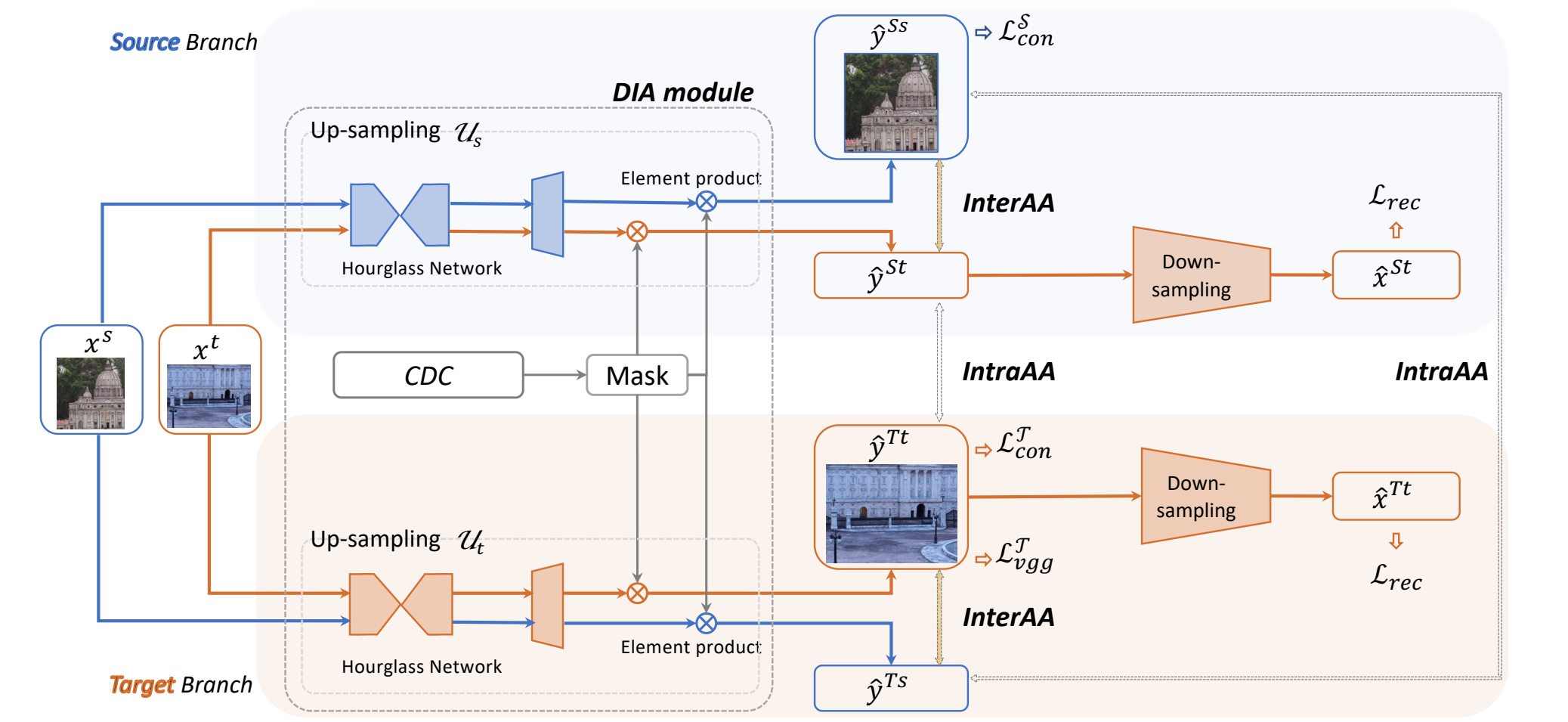
Figure 5. The proposed framework of our DADA. It includes a source branch and a target branch, both of which have an LR-HR-LR
reconstruction structure. In their up-sampling networks, a Domain-Invariant Attention (DIA) module provides component attentive masks
by a pre-trained CDC model. For InterAA, two LR images from different domains are fed into the up-sampling network for adversarial
adaptation in one branch. For IntraAA, one LR image is respectively fed into up-sampling networks in source and target branches for the
adversarial adaptation. For testing, the trained up-sampling network in target branch is utilized for inference.
Dual Adversarial Adaptation for Cross-Device Real-World Image Super-Resolution
Venue: CVPR 2022 · Main-conference paper
Figure 1 · PDF page 1 · P209
300 dpi PNG · Caption · Source PDF
Original caption, source, and provenance
Fixed source version: CVPR 2022 fixed official PDF
Earliest verified matching figure date (temporal proxy): 2022-05-07
arXiv v1 date: 2022-05-07
Actual drawing date: unknown. See the source record for version checks and temporal-evidence limitations.
Historical PDF · Download citation snapshot · Date evidence · Paper page · Complete screening and version record (Chinese)
Citation threshold evidence: Liang Lin; 51769 citations; snapshot 2026-10-21.
Recorded drawing-tool disclosure: unknown. No tool attribution is inferred from appearance; see the archival disclosure evidence for scope and wording.
Crop bounding box: [309, 219, 555, 415] (PDF points; top-left origin; x0, y0, x1, y1).
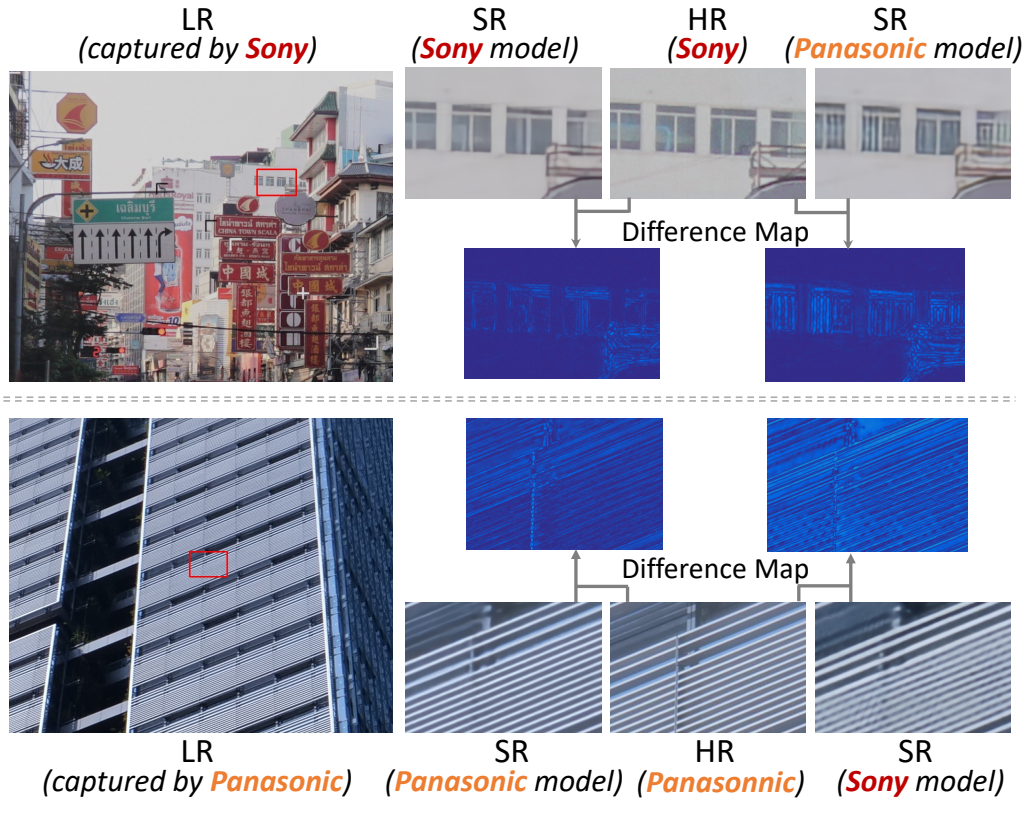
Figure 1. Comparison of real SR results across different trained
models from different camera data in the DRealSR dataset [18].
The Difference Map denotes the absolute difference between
ground-truth HR and SR image (The brightness in the map reflects
the magnitude of the difference).
Dual Pixel Exploration: Simultaneous Depth Estimation and Image Restoration
Venue: CVPR 2021 · Main-conference paper
Figure 5 · PDF page 5 · P328
300 dpi PNG · Caption · Source PDF
Original caption, source, and provenance
Fixed source version: CVPR 2021 fixed official PDF
Earliest verified matching figure date (temporal proxy): 2021-06
arXiv v1 date: 2020-12-01
Actual drawing date: unknown. See the source record for version checks and temporal-evidence limitations.
Historical PDF · Download citation snapshot · Date evidence · Paper page · Complete screening and version record (Chinese)
Citation threshold evidence: Hongdong Li; 33685 citations; snapshot 2026-10-21.
Recorded drawing-tool disclosure: unknown. No tool attribution is inferred from appearance; see the archival disclosure evidence for scope and wording.
Crop bounding box: [75, 55, 521, 172] (PDF points; top-left origin; x0, y0, x1, y1).
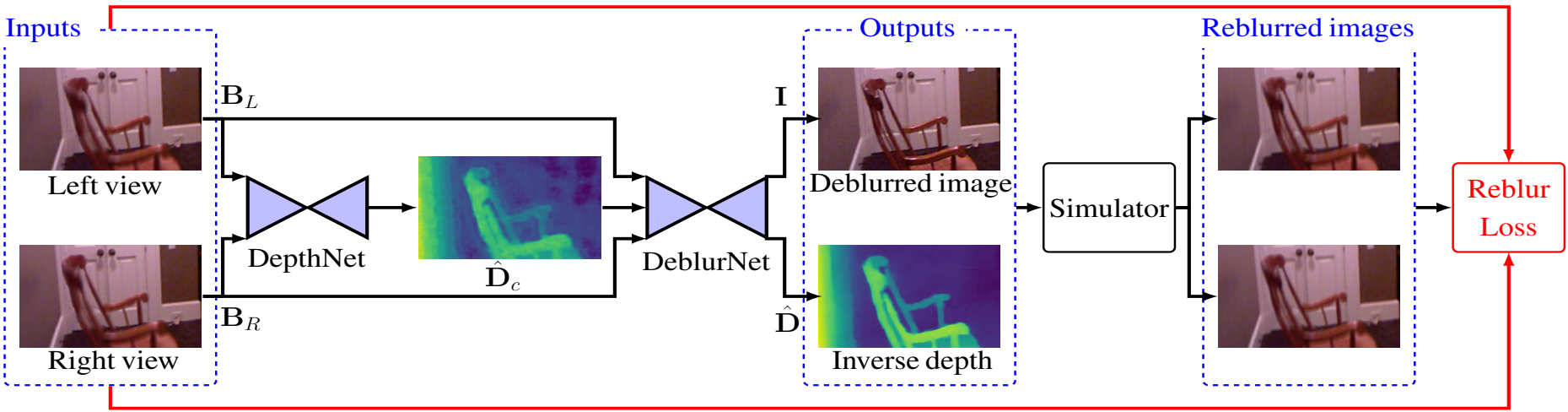
Figure 5. The architecture of the proposed DDDNet. With the input DP image pair, the DepthNet first estimates a coarse inverse depth map
Dˆ . Then, we combine the coarse and blurred inverse depth map with B , and feed them to the DeblurNet. The deblurred image and
c {L,R}
estimated inverse depth map are fed to our DP simulator to synthesize a DP image pair. The synthesized DP images are compared to the
inputs using our reblur loss (Eq. (11)), to regularise the DDDNet in training. Note that, the ground truth inverse depth maps and sharp
images are used as supervision signals in training. (Best viewed in colour on screen.)Dual Pixel Exploration: Simultaneous Depth Estimation and Image Restoration
Venue: CVPR 2021 · Main-conference paper
Figure 2 · PDF page 3 · P327
300 dpi PNG · Caption · Source PDF
Original caption, source, and provenance
Fixed source version: CVPR 2021 fixed official PDF
Earliest verified matching figure date (temporal proxy): 2021-06
arXiv v1 date: 2020-12-01
Actual drawing date: unknown. See the source record for version checks and temporal-evidence limitations.
Historical PDF · Download citation snapshot · Date evidence · Paper page · Complete screening and version record (Chinese)
Citation threshold evidence: Hongdong Li; 33685 citations; snapshot 2026-10-21.
Recorded drawing-tool disclosure: unknown. No tool attribution is inferred from appearance; see the archival disclosure evidence for scope and wording.
Crop bounding box: [64, 73, 269, 154] (PDF points; top-left origin; x0, y0, x1, y1).
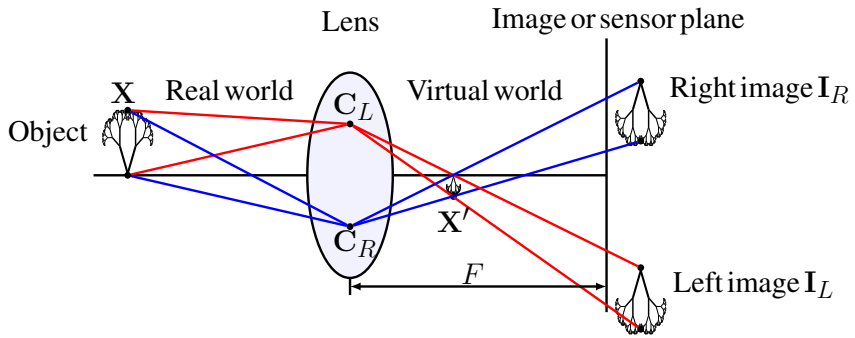
Figure 2. Formation of the two image I and I from two points
L R
C and C on the lens plane may be thought of as pin-hole pro-
L R
jections (with centres C L and C R and focal-length F ) of the vir-
tual image formed by the lens.
Exploring and Evaluating Image Restoration Potential in Dynamic Scenes
Venue: CVPR 2022 · Main-conference paper
Figure 5 · PDF page 5 · P208
300 dpi PNG · Caption · Source PDF
Original caption, source, and provenance
Fixed source version: CVPR 2022 fixed official PDF
Earliest verified matching figure date (temporal proxy): 2022-03-22
arXiv v1 date: 2022-03-22
Actual drawing date: unknown. See the source record for version checks and temporal-evidence limitations.
Historical PDF · Download citation snapshot · Date evidence · Paper page · Complete screening and version record (Chinese)
Citation threshold evidence: Yanning Zhang; 20703 citations; snapshot 2026-10-21.
Recorded drawing-tool disclosure: unknown. No tool attribution is inferred from appearance; see the archival disclosure evidence for scope and wording.
Crop bounding box: [308, 72, 557, 194] (PDF points; top-left origin; x0, y0, x1, y1).
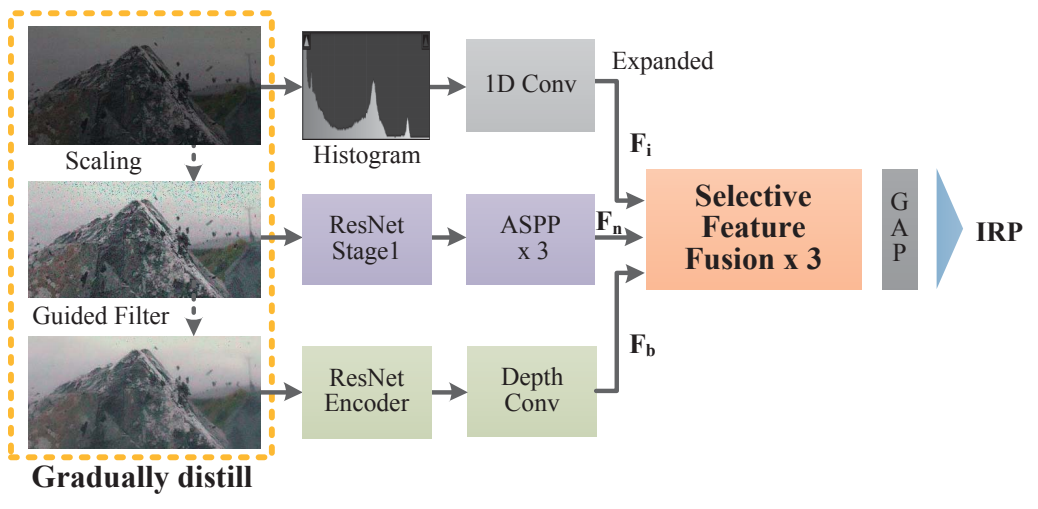
Figure 5. The proposed model architecture for IRP prediction.
Exploring and Evaluating Image Restoration Potential in Dynamic Scenes
Venue: CVPR 2022 · Main-conference paper
Figure 1 · PDF page 1 · P207
300 dpi PNG · Caption · Source PDF
Original caption, source, and provenance
Fixed source version: CVPR 2022 fixed official PDF
Earliest verified matching figure date (temporal proxy): 2022-03-22
arXiv v1 date: 2022-03-22
Actual drawing date: unknown. See the source record for version checks and temporal-evidence limitations.
Historical PDF · Download citation snapshot · Date evidence · Paper page · Complete screening and version record (Chinese)
Citation threshold evidence: Yanning Zhang; 20703 citations; snapshot 2026-10-21.
Recorded drawing-tool disclosure: unknown. No tool attribution is inferred from appearance; see the archival disclosure evidence for scope and wording.
Crop bounding box: [308, 230, 557, 398] (PDF points; top-left origin; x0, y0, x1, y1).
Figure 1. We show how the proposed concept IRP differs from
the traditional image metric visual quality. Given a sequence of
images captured under varying exposures in dynamic scenes (first
row), both IQA metric NIQE [23] and human observers favorite
either (a) or (b) as relatively good shots, but they do not neces-
sarily lead to better restored results (second row). As a compari-
son, a perceptually poor image (c) leads to the best restored image
quality. The result indicates the necessity of developing the IRP
metric which predicts if the restored image quality will be good
even before it is processed. All images are processed by the same
restoration model MPR [40] to ensure fairness.
SRWarp: Generalized Image Super-Resolution under Arbitrary Transformation
Venue: CVPR 2021 · Main-conference paper
Figure 4 · PDF page 5 · P266
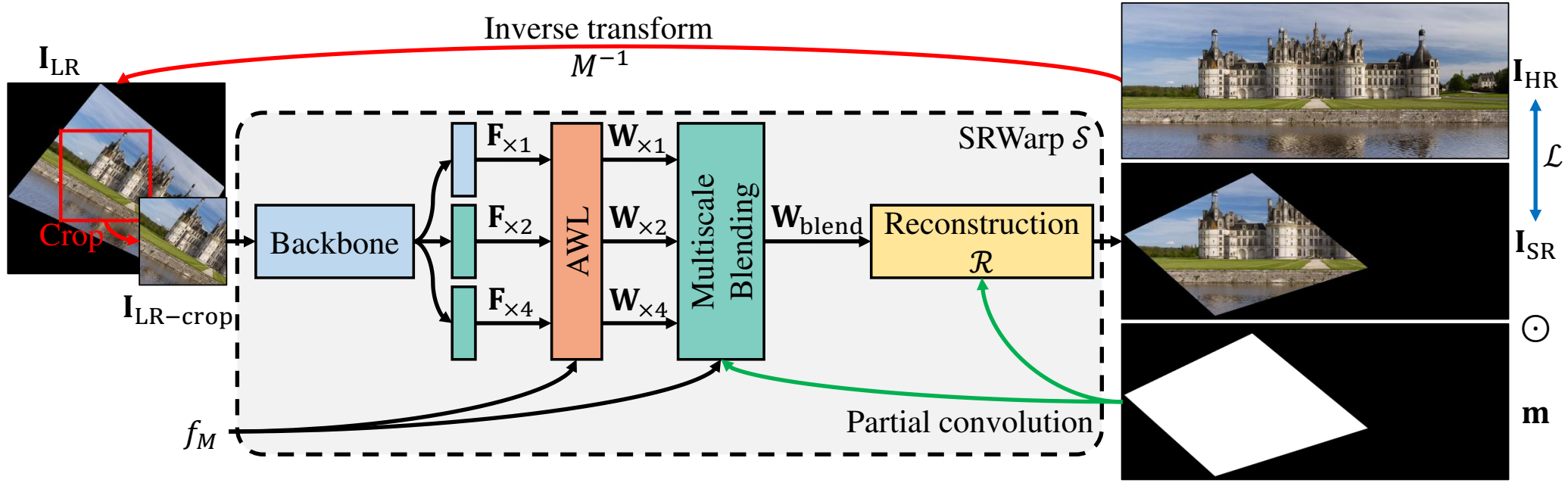
300 dpi PNG · Caption · Source PDF
Original caption, source, and provenance
Fixed source version: CVPR 2021 fixed official PDF
Earliest verified matching figure date (temporal proxy): 2021-04-21
arXiv v1 date: 2021-04-21
Actual drawing date: unknown. See the source record for version checks and temporal-evidence limitations.
Historical PDF · Download citation snapshot · Date evidence · Paper page · Complete screening and version record (Chinese)
Citation threshold evidence: Kyoung Mu Lee; 57875 citations; snapshot 2026-10-21.
Recorded drawing-tool disclosure: unknown. No tool attribution is inferred from appearance; see the archival disclosure evidence for scope and wording.
Crop bounding box: [49, 72, 546, 226] (PDF points; top-left origin; x0, y0, x1, y1).
Figure 4: Overall organization of the proposed SRWarp model. More detailed architectures are described in our supplementary material. Black regions outside the warped image I_SR represent void pixels that are ignored.
SRWarp: Generalized Image Super-Resolution under Arbitrary Transformation
Venue: CVPR 2021 · Main-conference paper
Figure 2 · PDF page 3 · P265
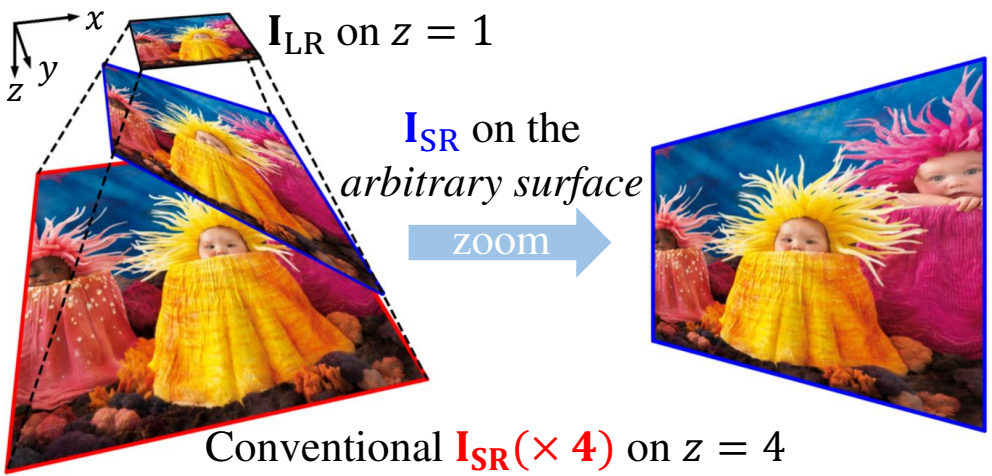
300 dpi PNG · Caption · Source PDF
Original caption, source, and provenance
Fixed source version: CVPR 2021 fixed official PDF
Earliest verified matching figure date (temporal proxy): 2021-04-21
arXiv v1 date: 2021-04-21
Actual drawing date: unknown. See the source record for version checks and temporal-evidence limitations.
Historical PDF · Download citation snapshot · Date evidence · Paper page · Complete screening and version record (Chinese)
Citation threshold evidence: Kyoung Mu Lee; 57875 citations; snapshot 2026-10-21.
Recorded drawing-tool disclosure: unknown. No tool attribution is inferred from appearance; see the archival disclosure evidence for scope and wording.
Crop bounding box: [308, 70, 546, 184] (PDF points; top-left origin; x0, y0, x1, y1).
Figure 2: Concept of the generalized SR. Dotted lines represent the upscale image pyramid in xyz-coordinate. While ×s super-resolved images from conventional methods (red) exist on the plane z = s only, our results (blue) exists on any arbitrary cutting surfaces of the pyramid. Note that the aspect ratio on the plane can be varied as well.
Unsupervised Real-world Image Super Resolution via Domain-distance Aware Training
Venue: CVPR 2021 · Main-conference paper
Figure 2 · PDF page 3 · P326
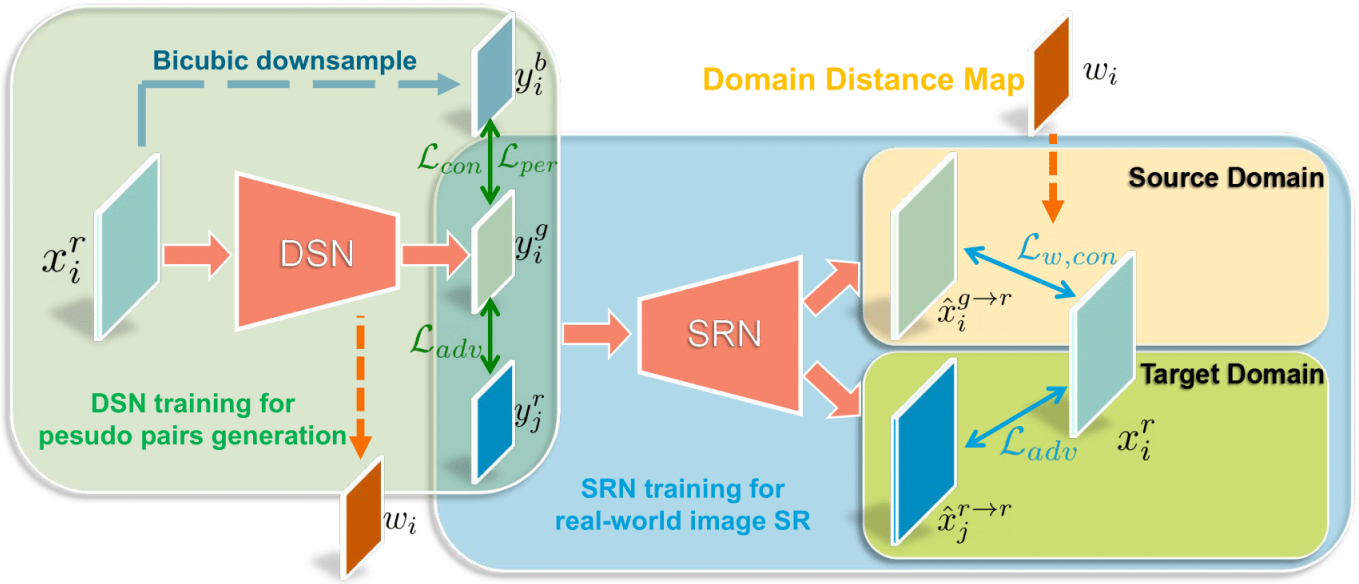
300 dpi PNG · Caption · Source PDF
Original caption, source, and provenance
Fixed source version: CVPR 2021 fixed official PDF
Earliest verified matching figure date (temporal proxy): 2021-06
arXiv v1 date: 2020-04-02
Actual drawing date: unknown. See the source record for version checks and temporal-evidence limitations.
Historical PDF · Download citation snapshot · Date evidence · Paper page · Complete screening and version record (Chinese)
Citation threshold evidence: Shuhang Gu; 21404 citations; snapshot 2026-10-21.
Recorded drawing-tool disclosure: unknown. No tool attribution is inferred from appearance; see the archival disclosure evidence for scope and wording.
Crop bounding box: [133, 73, 459, 213] (PDF points; top-left origin; x0, y0, x1, y1).
Figure 2: Illustration of our DASR framework. DASR firstly trains a down-sampling network (DSN) which aims to generate
LR images y g in the real LR domain y r from HR images xr : y g = DS N (xr ). Then, DASR take the domain-gap between
generated LR images y g and real-world LR images y r into consideration, utilize the generated LR-HR pairs {y g , xr }, domain
distance maps w and real-world LR images y r to train super-resolution network (SRN).Unsupervised Real-world Image Super Resolution via Domain-distance Aware Training
Venue: CVPR 2021 · Main-conference paper
Figure 1 · PDF page 1 · P325
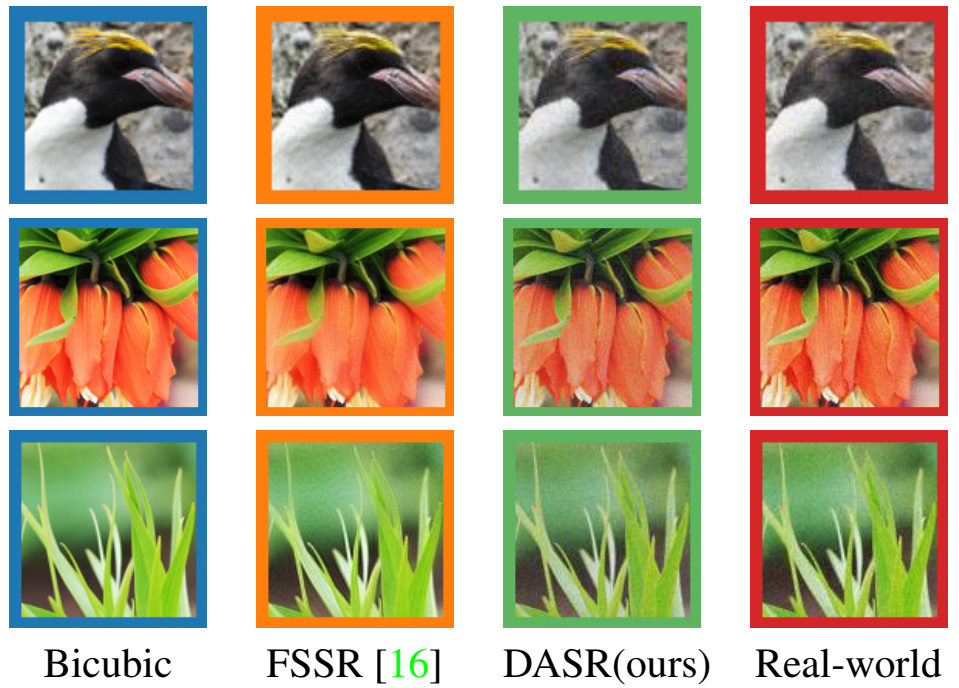
300 dpi PNG · Caption · Source PDF
Original caption, source, and provenance
Fixed source version: CVPR 2021 fixed official PDF
Earliest verified matching figure date (temporal proxy): 2021-06
arXiv v1 date: 2020-04-02
Actual drawing date: unknown. See the source record for version checks and temporal-evidence limitations.
Historical PDF · Download citation snapshot · Date evidence · Paper page · Complete screening and version record (Chinese)
Citation threshold evidence: Shuhang Gu; 21404 citations; snapshot 2026-10-21.
Recorded drawing-tool disclosure: unknown. No tool attribution is inferred from appearance; see the archival disclosure evidence for scope and wording.
Crop bounding box: [312, 258, 542, 423] (PDF points; top-left origin; x0, y0, x1, y1).
Figure 1: Visualization of the domain-gap between the gen-
erated LR images by different methods and LR images in
the AIM [40] dataset. More details can be found in our
main text.
Fostering Generalization in Single-view 3D Reconstruction by Learning a Hierarchy of Local and Global Shape Priors
Venue: CVPR 2021 · Main-conference paper
Figure 3 · PDF page 4 · P164
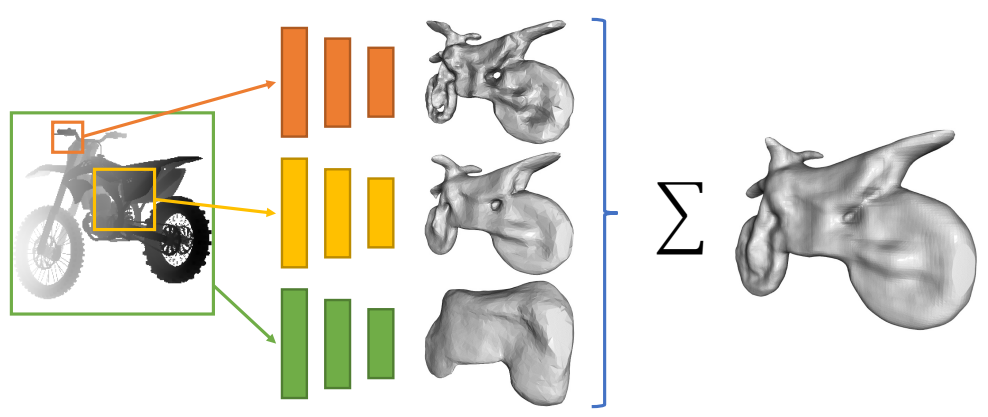
300 dpi PNG · Caption · Source PDF
Original caption, source, and provenance
Fixed source version: CVPR 2021 fixed official PDF
Earliest verified matching figure date (temporal proxy): 2021-04-01
arXiv v1 date: 2021-04-01
Actual drawing date: unknown. See the source record for version checks and temporal-evidence limitations.
Historical PDF · Download citation snapshot · Date evidence · Paper page · Complete screening and version record (Chinese)
Citation threshold evidence: Thomas Brox; 249461 citations; snapshot 2026-10-21.
Recorded drawing-tool disclosure: unknown. No tool attribution is inferred from appearance; see the archival disclosure evidence for scope and wording.
Crop bounding box: [50, 70, 287, 170] (PDF points; top-left origin; x0, y0, x1, y1).
Figure 3. We use a hierarchy of networks operating on input
patches of different resolutions (including the global one) to pro-
duce multiple shape reconstruction variants. Those are fused by
simple averaging to yield the final reconstruction.
Fostering Generalization in Single-view 3D Reconstruction by Learning a Hierarchy of Local and Global Shape Priors
Venue: CVPR 2021 · Main-conference paper
Figure 1 · PDF page 1 · P163
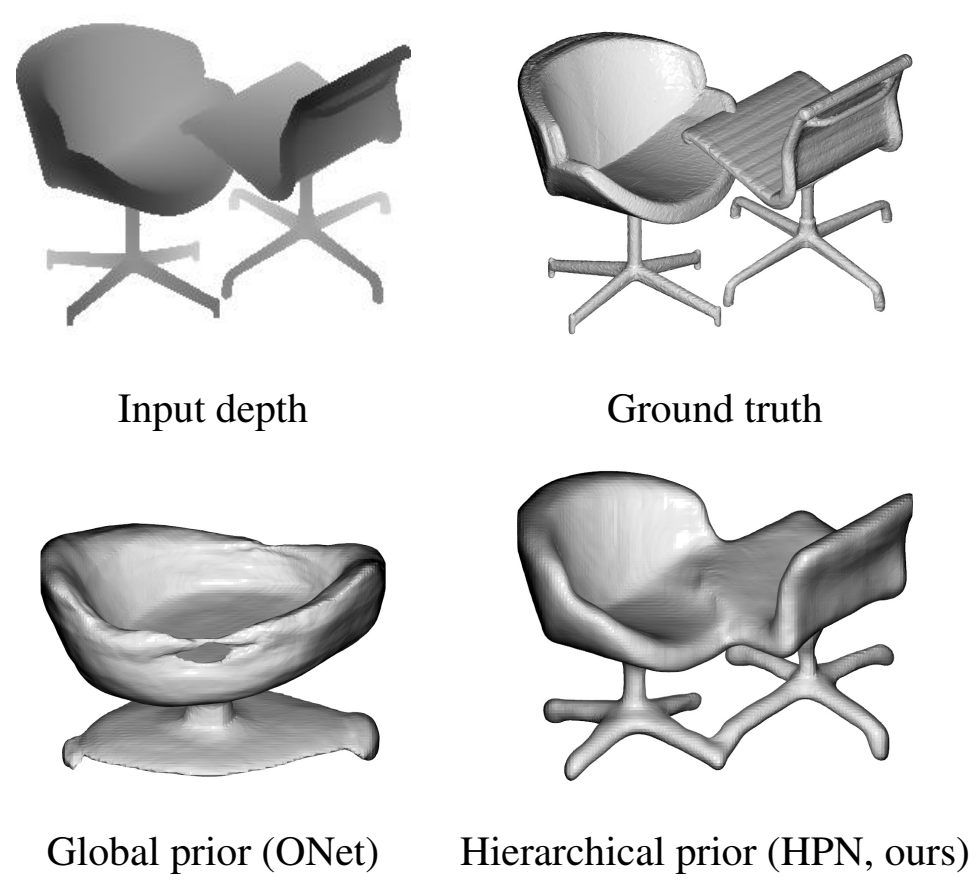
300 dpi PNG · Caption · Source PDF
Original caption, source, and provenance
Fixed source version: CVPR 2021 fixed official PDF
Earliest verified matching figure date (temporal proxy): 2021-04-01
arXiv v1 date: 2021-04-01
Actual drawing date: unknown. See the source record for version checks and temporal-evidence limitations.
Historical PDF · Download citation snapshot · Date evidence · Paper page · Complete screening and version record (Chinese)
Citation threshold evidence: Thomas Brox; 249461 citations; snapshot 2026-10-21.
Recorded drawing-tool disclosure: unknown. No tool attribution is inferred from appearance; see the archival disclosure evidence for scope and wording.
Crop bounding box: [311, 244, 545, 455] (PDF points; top-left origin; x0, y0, x1, y1).
Figure 1. We employ a hierarchical shape prior to enable recom-
bination of partial shapes observed during training. This signif-
icantly improves generalization compared to conventional global
shape priors.
From Points to Multi-Object 3D Reconstruction
Venue: CVPR 2021 · Main-conference paper
Figure 2 · PDF page 2 · P230
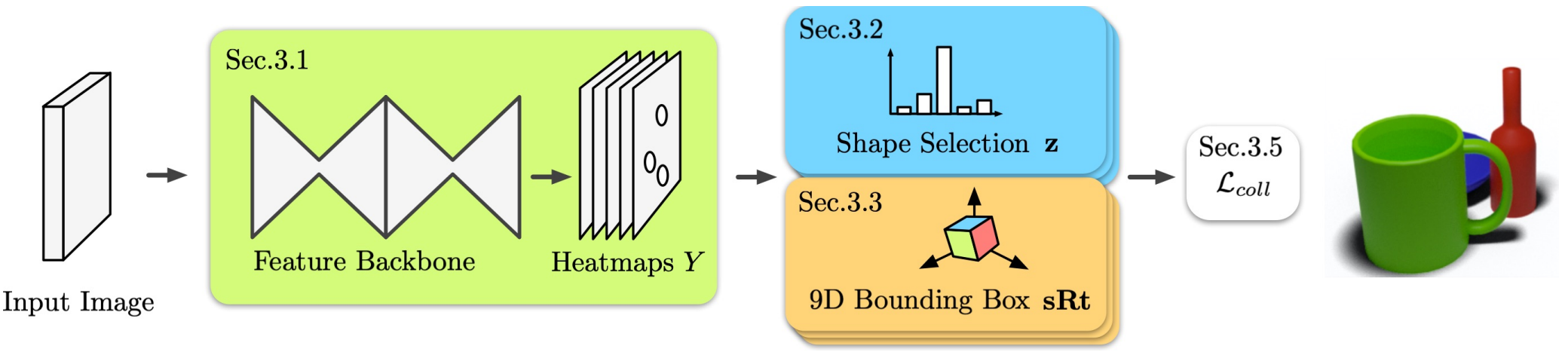
300 dpi PNG · Caption · Source PDF
Original caption, source, and provenance
Fixed source version: CVPR 2021 fixed official PDF
Earliest verified matching figure date (temporal proxy): 2020-12-21
arXiv v1 date: 2020-12-21
Actual drawing date: unknown. See the source record for version checks and temporal-evidence limitations.
Historical PDF · Download citation snapshot · Date evidence · Paper page · Complete screening and version record (Chinese)
Citation threshold evidence: Bastian Leibe; 44197 citations; snapshot 2026-10-21.
Recorded drawing-tool disclosure: unknown. No tool attribution is inferred from appearance; see the archival disclosure evidence for scope and wording.
Crop bounding box: [49, 70, 548, 182] (PDF points; top-left origin; x0, y0, x1, y1).
Figure 2: Overview of the proposed approach. Given a single RGB image, our model detects object centers as key-points in a heatmap Y .
The network directly predicts shape exemplars z and 9-DoF bounding boxes jointly for all objects in the scene. The collision loss L
coll
favors non-intersecting reconstructions. Our method predicts lightweight, realistic and physically plausible reconstructions in a single pass.
From Points to Multi-Object 3D Reconstruction
Venue: CVPR 2021 · Main-conference paper
Figure 4 · PDF page 4 · P229
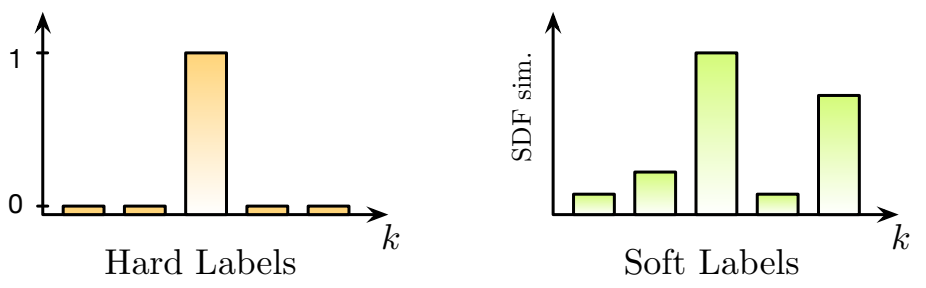
300 dpi PNG · Caption · Source PDF
Original caption, source, and provenance
Fixed source version: CVPR 2021 fixed official PDF
Earliest verified matching figure date (temporal proxy): 2021-06
arXiv v1 date: 2020-12-21
Actual drawing date: unknown. See the source record for version checks and temporal-evidence limitations.
Historical PDF · Download citation snapshot · Date evidence · Paper page · Complete screening and version record (Chinese)
Citation threshold evidence: Bastian Leibe; 44197 citations; snapshot 2026-10-21.
Recorded drawing-tool disclosure: unknown. No tool attribution is inferred from appearance; see the archival disclosure evidence for scope and wording.
Crop bounding box: [58, 73, 280, 142] (PDF points; top-left origin; x0, y0, x1, y1).
Figure 4: Shape selection. We compare one-hot encoding (hard
labels, left) for supervising the shape selection problem with soft
labels (right) which allow for multiple shape predictions at the
same time and are based on geometric similarity, specifically the
Euclidian distance between SDF shape representations.
Learning View Priors for Single-view 3D Reconstruction
Venue: CVPR 2019 · Main-conference paper
Figure 2 · PDF page 3 · P162
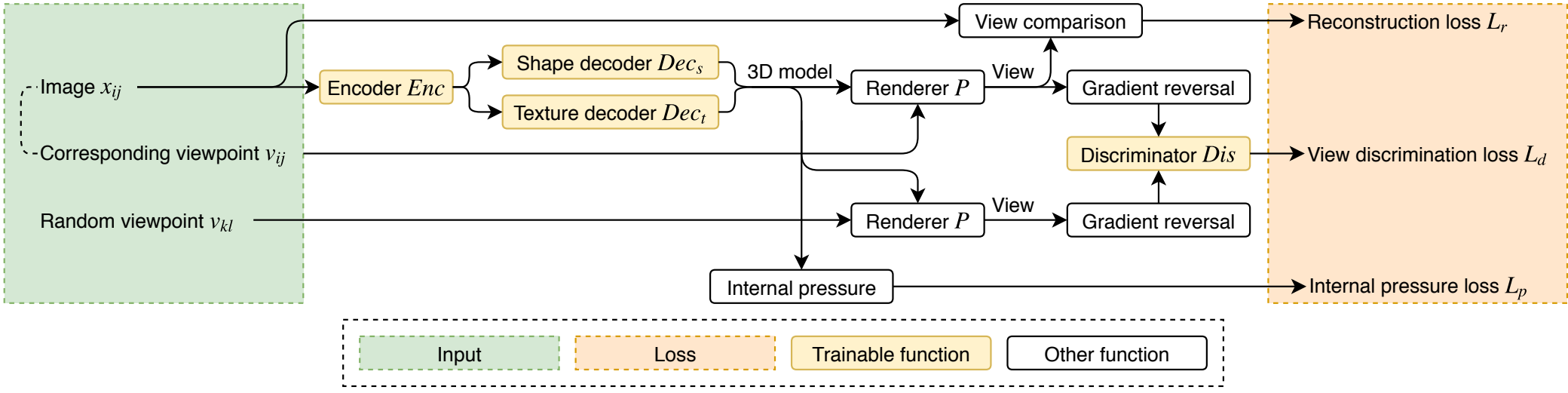
300 dpi PNG · Caption · Source PDF
Original caption, source, and provenance
Fixed source version: CVPR 2019 fixed official PDF
Earliest verified matching figure date (temporal proxy): 2018-11-26
arXiv v1 date: 2018-11-26
Actual drawing date: unknown. See the source record for version checks and temporal-evidence limitations.
Historical PDF · Download citation snapshot · Date evidence · Paper page · Complete screening and version record (Chinese)
Citation threshold evidence: Tatsuya Harada; 24085 citations; snapshot 2026-10-21.
Recorded drawing-tool disclosure: unknown. No tool attribution is inferred from appearance; see the archival disclosure evidence for scope and wording.
Crop bounding box: [49, 72, 548, 197] (PDF points; top-left origin; x0, y0, x1, y1).
Figure 2. Architecture of the proposed method. The main point of our method is the use of discrimination loss to learn priors of views.
While the discriminator aims to minimize discrimination loss, the encoder and decoders try to maximize it using a gradient reversal layer.
Learning View Priors for Single-view 3D Reconstruction
Venue: CVPR 2019 · Main-conference paper
Figure 1 · PDF page 1 · P161
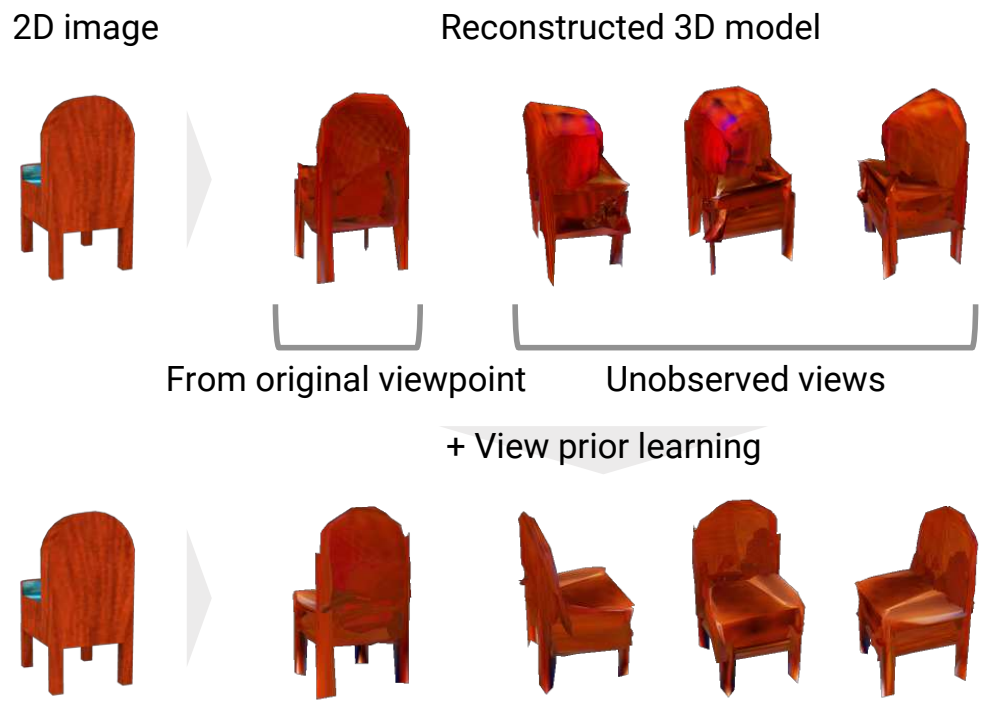
300 dpi PNG · Caption · Source PDF
Original caption, source, and provenance
Fixed source version: CVPR 2019 fixed official PDF
Earliest verified matching figure date (temporal proxy): 2018-11-26
arXiv v1 date: 2018-11-26
Actual drawing date: unknown. See the source record for version checks and temporal-evidence limitations.
Historical PDF · Download citation snapshot · Date evidence · Paper page · Complete screening and version record (Chinese)
Citation threshold evidence: Tatsuya Harada; 24085 citations; snapshot 2026-10-21.
Recorded drawing-tool disclosure: unknown. No tool attribution is inferred from appearance; see the archival disclosure evidence for scope and wording.
Crop bounding box: [309, 214, 546, 384] (PDF points; top-left origin; x0, y0, x1, y1).
Figure 1. When a 3D reconstructor is trained using only a single
viewperobject,becauseofambiguityinthe3Dshapeofanobject,
itreconstructsashape whichonly fitsthe observedview andlooks
incorrect from unobserved viewpoints (upper). By introducing a
discriminator that learns prior knowledge of correct views, the re-
constructor is able to generate a shape that is viewed as reasonable
from any viewpoint (lower).
NeuralRecon: Real-Time Coherent 3D Reconstruction from Monocular Video
Venue: CVPR 2021 · Main-conference paper
Figure 2 · PDF page 3 · P166
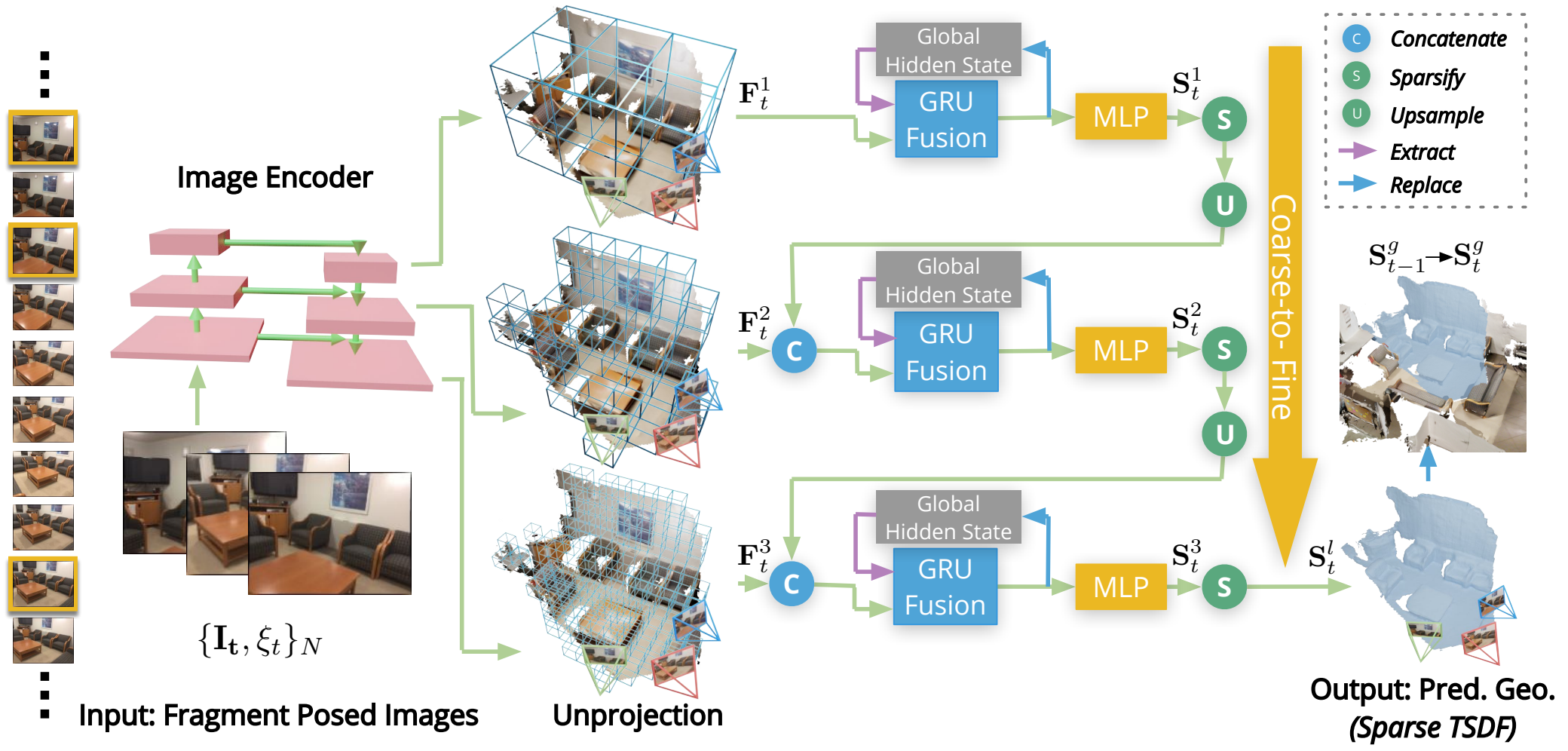
300 dpi PNG · Caption · Source PDF
Original caption, source, and provenance
Fixed source version: CVPR 2021 fixed official PDF
Earliest verified matching figure date (temporal proxy): 2021-04-01
arXiv v1 date: 2021-04-01
Actual drawing date: unknown. See the source record for version checks and temporal-evidence limitations.
Historical PDF · Download citation snapshot · Date evidence · Paper page · Complete screening and version record (Chinese)
Citation threshold evidence: Xiaowei Zhou; 25061 citations; snapshot 2026-10-21.
Recorded drawing-tool disclosure: unknown. No tool attribution is inferred from appearance; see the archival disclosure evidence for scope and wording.
Crop bounding box: [49, 41, 548, 280] (PDF points; top-left origin; x0, y0, x1, y1).
Figure 2. NeuralRecon architecture. NeuralRecon predicts TSDF with a three-level coarse-to-fine approach that gradually increases the
density of sparse voxels. Key-frame images in the local fragment are first passed through the image backbone to extract the multi-level
features. These image features are later back-projected along each ray and aggregated into a 3D feature volume Fl, where l represents the
t
level index. At the first level (l = 1), a dense TSDF volume S1 is predicted. At the second and third levels, the upsampled Sl−1 from the
t t
last level is concatenated with Fl and used as the input for the GRU Fusion and MLP modules. A feature volume defined in the world
t
frame is maintained at each level as the global hidden state of the GRU. At the last level, the output Sl is used to replace corresponding
t
voxels in the global TSDF volume Sg, yielding the final reconstruction at time t.
t
NeuralRecon: Real-Time Coherent 3D Reconstruction from Monocular Video
Venue: CVPR 2021 · Main-conference paper
Figure 1 · PDF page 1 · P165
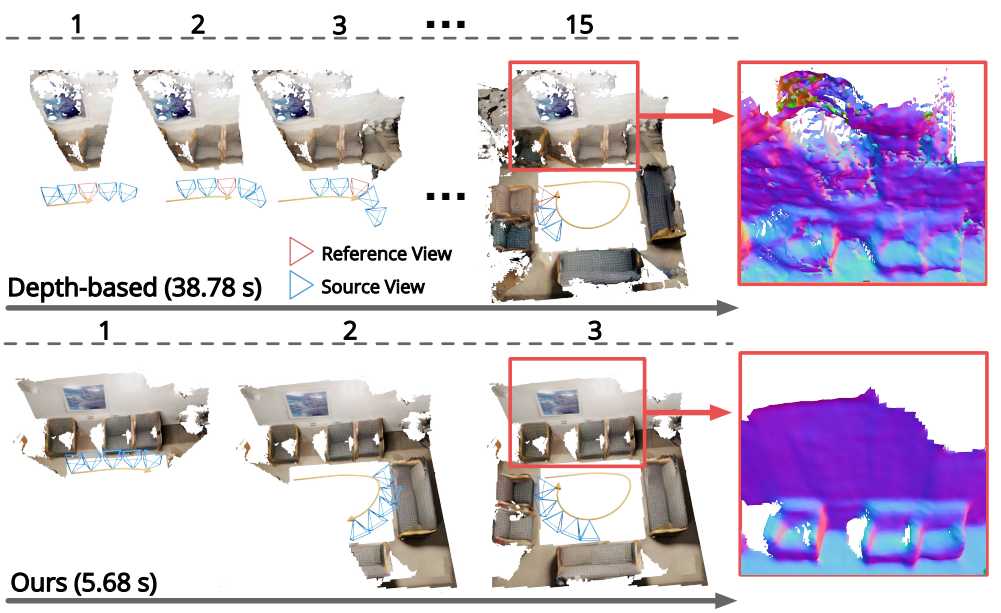
300 dpi PNG · Caption · Source PDF
Original caption, source, and provenance
Fixed source version: CVPR 2021 fixed official PDF
Earliest verified matching figure date (temporal proxy): 2021-04-01
arXiv v1 date: 2021-04-01
Actual drawing date: unknown. See the source record for version checks and temporal-evidence limitations.
Historical PDF · Download citation snapshot · Date evidence · Paper page · Complete screening and version record (Chinese)
Citation threshold evidence: Xiaowei Zhou; 25061 citations; snapshot 2026-10-21.
Recorded drawing-tool disclosure: unknown. No tool attribution is inferred from appearance; see the archival disclosure evidence for scope and wording.
Crop bounding box: [308, 204, 548, 351] (PDF points; top-left origin; x0, y0, x1, y1).
Figure1. Comparisonbetweendepth-based3Dreconstruction
methods and the proposed method. In depth-based methods,
key-frame depths are estimated separately from each key frame,
and later fused into a TSDF volume. In the proposed method, the
TSDF volume is directly predicted with all the key frames in a
local window. This design leads to a much more coherent recon-
struction and real-time speed.
Occupancy Networks: Learning 3D Reconstruction in Function Space
Venue: CVPR 2019 · Main-conference paper
Figure 2 · PDF page 4 · P168
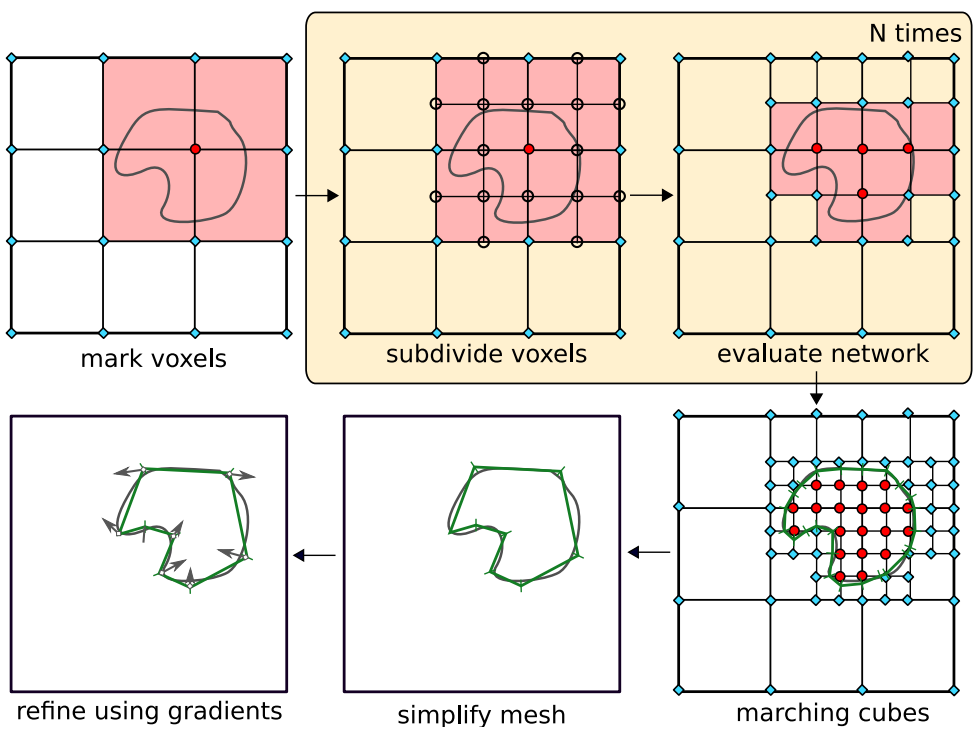
300 dpi PNG · Caption · Source PDF
Original caption, source, and provenance
Fixed source version: CVPR 2019 fixed official PDF
Earliest verified matching figure date (temporal proxy): 2018-12-10
arXiv v1 date: 2018-12-10
Actual drawing date: unknown. See the source record for version checks and temporal-evidence limitations.
Historical PDF · Download citation snapshot · Date evidence · Paper page · Complete screening and version record (Chinese)
Citation threshold evidence: Andreas Geiger; 110140 citations; snapshot 2026-10-21.
Recorded drawing-tool disclosure: unknown. No tool attribution is inferred from appearance; see the archival disclosure evidence for scope and wording.
Crop bounding box: [52, 75, 287, 250] (PDF points; top-left origin; x0, y0, x1, y1).
Figure2: MultiresolutionIsoSurfaceExtraction: Wefirst
mark all points at a given resolution which have already
been evaluated as either occupied (red circles) or unoccu-
pied (cyan diamonds). We then determine all voxels that
have both occupied and unoccupied corners and mark them
as active (light red) and subdivide them into 8 subvoxels
each. Next, we evaluate all new grid points (empty circles)
that have been introduced by the subdivision. The previous
two steps are repeated until the desired output resolution is
reached. Finally we extract the mesh using the marching
cubes algorithm [44], simplify and refine the output mesh
using first and second order gradient information.
Occupancy Networks: Learning 3D Reconstruction in Function Space
Venue: CVPR 2019 · Main-conference paper
Figure 1 · PDF page 1 · P167
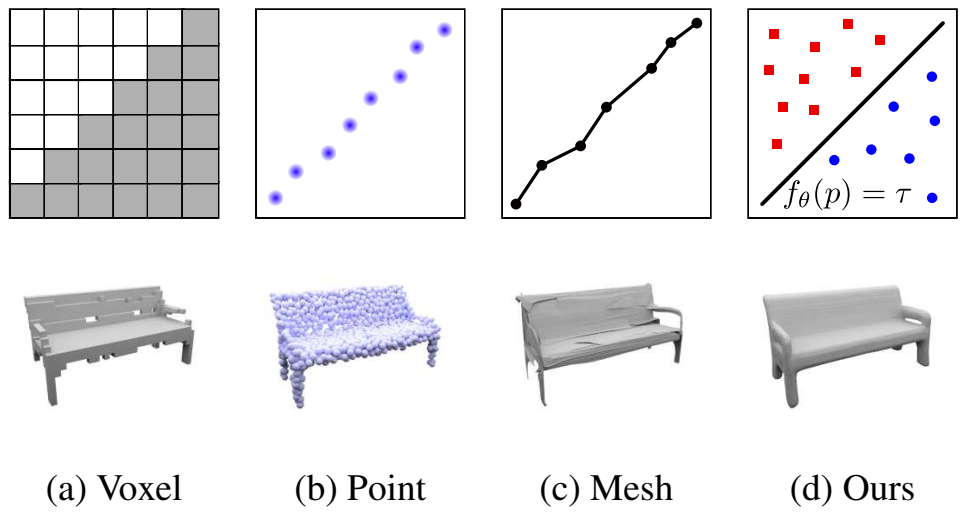
300 dpi PNG · Caption · Source PDF
Original caption, source, and provenance
Fixed source version: CVPR 2019 fixed official PDF
Earliest verified matching figure date (temporal proxy): 2019-04-30
arXiv v1 date: 2018-12-10
Actual drawing date: unknown. See the source record for version checks and temporal-evidence limitations.
Historical PDF · Download citation snapshot · Date evidence · Paper page · Complete screening and version record (Chinese)
Citation threshold evidence: Andreas Geiger; 110140 citations; snapshot 2026-10-21.
Recorded drawing-tool disclosure: unknown. No tool attribution is inferred from appearance; see the archival disclosure evidence for scope and wording.
Crop bounding box: [311, 241, 544, 364] (PDF points; top-left origin; x0, y0, x1, y1).
Figure 1: Overview: Existing 3D representations discretize
the output space differently: (a) spatially in voxel represen-
tations, (b) in terms of predicted points, and (c) in terms of
vertices for mesh representations. In contrast, (d) we pro-
pose to consider the continuous decision boundary of a clas-
sifier f (e.g., a deep neural network) as a 3D surface which
θ
allows to extract 3D meshes at any resolution.
Photorealistic Monocular 3D Reconstruction of Humans Wearing Clothing
Venue: CVPR 2022 · Main-conference paper
Figure 2 · PDF page 3 · P242
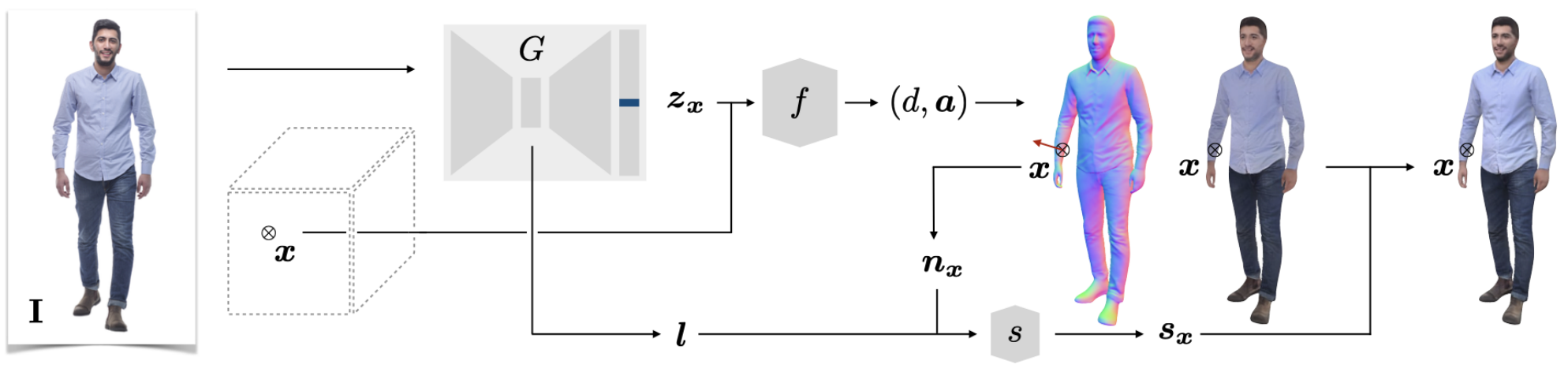
300 dpi PNG · Caption · Source PDF
Original caption, source, and provenance
Fixed source version: CVPR 2022 fixed official PDF
Earliest verified matching figure date (temporal proxy): 2022-04-19
arXiv v1 date: 2022-04-19
Actual drawing date: unknown. See the source record for version checks and temporal-evidence limitations.
Historical PDF · Download citation snapshot · Date evidence · Paper page · Complete screening and version record (Chinese)
Citation threshold evidence: Cristian Sminchisescu; 24653 citations; snapshot 2026-10-22.
Recorded drawing-tool disclosure: unknown. No tool attribution is inferred from appearance; see the archival disclosure evidence for scope and wording.
Crop bounding box: [58, 70, 535, 182] (PDF points; top-left origin; x0, y0, x1, y1).
Figure 2. Overview of our method. The feature extractor network G produces pixel-aligned features z from an input image I for all points
x
in space x. The implicit signed distance function network f computes the distance d to the closest surface given a point and its feature.
Additionally f returns albedo colors a defined for surface points. The shading network s predicts the shading for surface points given its
surface normal n , as well as illumination l. On the right we show the reconstruction of geometry and albedo colors, and the shaded 3D
x
geometry.
Photorealistic Monocular 3D Reconstruction of Humans Wearing Clothing
Venue: CVPR 2022 · Main-conference paper
Figure 8 · PDF page 8 · P241
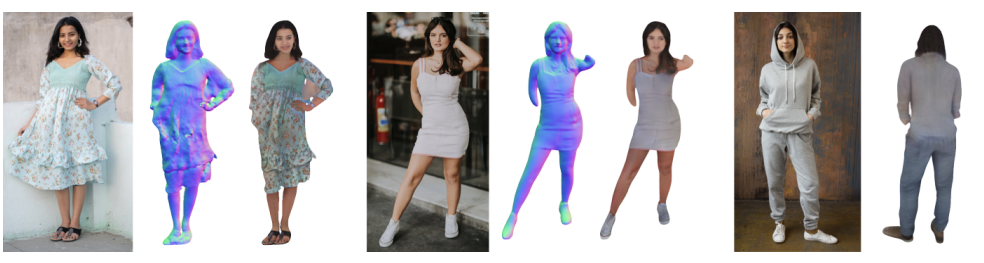
300 dpi PNG · Caption · Source PDF
Original caption, source, and provenance
Fixed source version: CVPR 2022 fixed official PDF
Earliest verified matching figure date (temporal proxy): 2022-04-19
arXiv v1 date: 2022-04-19
Actual drawing date: unknown. See the source record for version checks and temporal-evidence limitations.
Historical PDF · Download citation snapshot · Date evidence · Paper page · Complete screening and version record (Chinese)
Citation threshold evidence: Cristian Sminchisescu; 24653 citations; snapshot 2026-10-22.
Recorded drawing-tool disclosure: unknown. No tool attribution is inferred from appearance; see the archival disclosure evidence for scope and wording.
Crop bounding box: [308, 332, 544, 395] (PDF points; top-left origin; x0, y0, x1, y1).
Figure 8. Failure cases. Wide clothing is under-represented in
our dataset and this can be addressed with more diverse training.
Complex poses can lead to missing body parts. The back-side
sometimes mismatches the front (subject is wearing a hood).
Pre-train, Self-train, Distill: A simple recipe for Supersizing 3D Reconstruction
Venue: CVPR 2022 · Main-conference paper
Figure 2 · PDF page 2 · P228
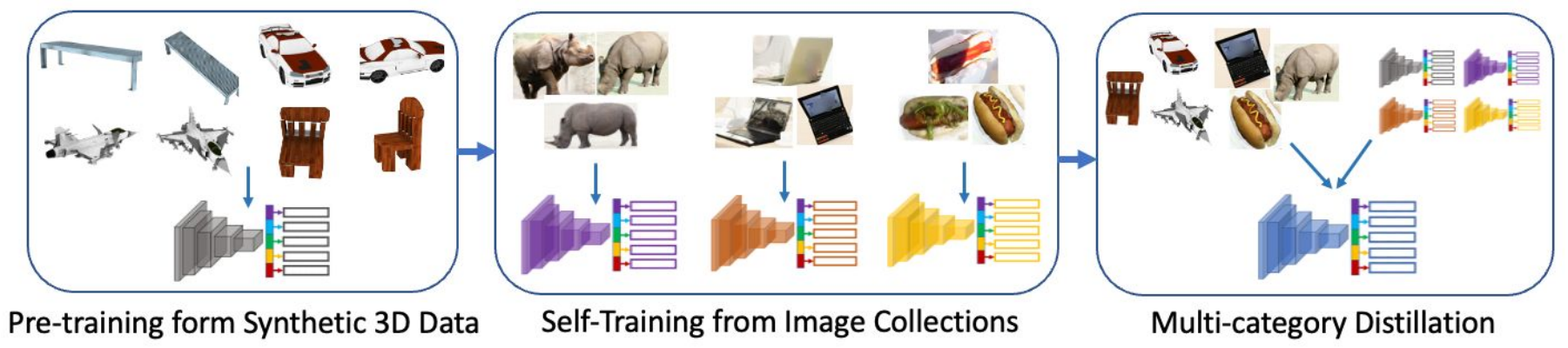
300 dpi PNG · Caption · Source PDF
Original caption, source, and provenance
Fixed source version: CVPR 2022 fixed official PDF
Earliest verified matching figure date (temporal proxy): 2022-04-07
arXiv v1 date: 2022-04-07
Actual drawing date: unknown. See the source record for version checks and temporal-evidence limitations.
Historical PDF · Download citation snapshot · Date evidence · Paper page · Complete screening and version record (Chinese)
Citation threshold evidence: Shubham Tulsiani; 13507 citations; snapshot 2026-10-21.
Recorded drawing-tool disclosure: unknown. No tool attribution is inferred from appearance; see the archival disclosure evidence for scope and wording.
Crop bounding box: [78, 72, 510, 168] (PDF points; top-left origin; x0, y0, x1, y1).
Figure 2. Approach Overview. We first pre-train a reconstruction model using multi-view renderings of synthetic data. We then self-train
category-specific models on diverse image collections in-the-wild with only foreground mask annotations. We finally distill the learned
models from prior training stages into a unified reconstruction model.
Pre-train, Self-train, Distill: A simple recipe for Supersizing 3D Reconstruction
Venue: CVPR 2022 · Main-conference paper
Figure 8 · PDF page 7 · P227
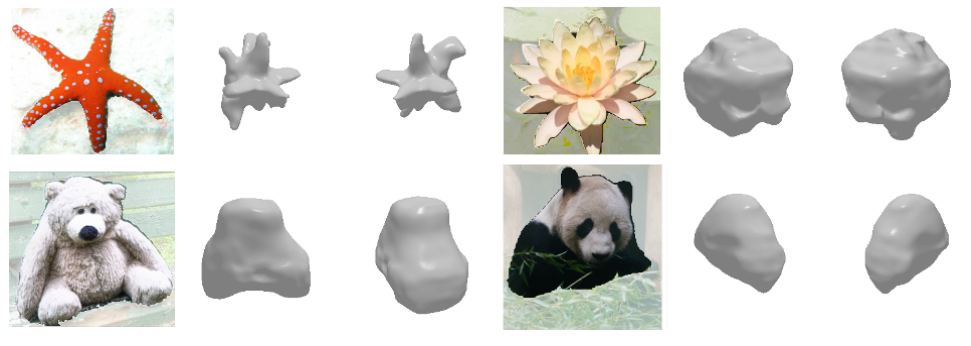
300 dpi PNG · Caption · Source PDF
Original caption, source, and provenance
Fixed source version: CVPR 2022 fixed official PDF
Earliest verified matching figure date (temporal proxy): 2022-04-07
arXiv v1 date: 2022-04-07
Actual drawing date: unknown. See the source record for version checks and temporal-evidence limitations.
Historical PDF · Download citation snapshot · Date evidence · Paper page · Complete screening and version record (Chinese)
Citation threshold evidence: Shubham Tulsiani; 13507 citations; snapshot 2026-10-21.
Recorded drawing-tool disclosure: unknown. No tool attribution is inferred from appearance; see the archival disclosure evidence for scope and wording.
Crop bounding box: [310, 72, 543, 155] (PDF points; top-left origin; x0, y0, x1, y1).
Figure 8. Failure modes. Our model is not robust to occlusion
and does not perform well on some difficult categories.
Single-Image Piece-wise Planar 3D Reconstruction via Associative Embedding
Venue: CVPR 2019 · Main-conference paper
Figure 2 · PDF page 3 · P182
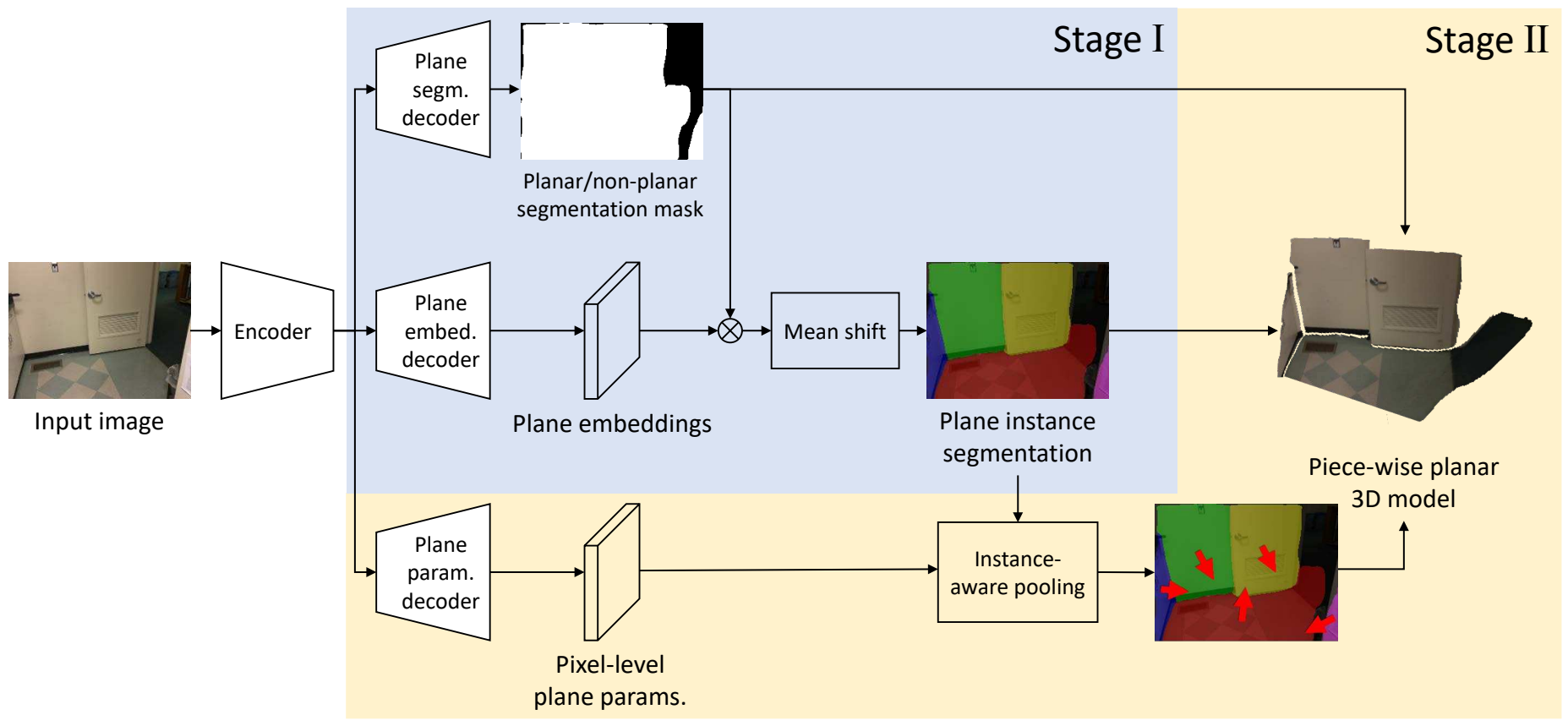
300 dpi PNG · Caption · Source PDF
Original caption, source, and provenance
Fixed source version: CVPR 2019 fixed official PDF
Earliest verified matching figure date (temporal proxy): 2019-02-26
arXiv v1 date: 2019-02-26
Actual drawing date: unknown. See the source record for version checks and temporal-evidence limitations.
Historical PDF · Download citation snapshot · Date evidence · Paper page · Complete screening and version record (Chinese)
Citation threshold evidence: Shenghua Gao; 29917 citations; snapshot 2026-10-21.
Recorded drawing-tool disclosure: unknown. No tool attribution is inferred from appearance; see the archival disclosure evidence for scope and wording.
Crop bounding box: [75, 72, 520, 278] (PDF points; top-left origin; x0, y0, x1, y1).
Figure 2: Network architecture. In the first stage, the network takes a single RGB image as input, and predicts a planar/non-
planar segmentation mask and pixel-level embeddings. Then, an efficient mean shift clustering algorithm is applied to
generate plane instances. In the second stage, we estimate parameter of each plane by considering both pixel-level and
instance-level geometric consistencies.
Single-Image Piece-wise Planar 3D Reconstruction via Associative Embedding
Venue: CVPR 2019 · Main-conference paper
Figure 7 · PDF page 8 · P181
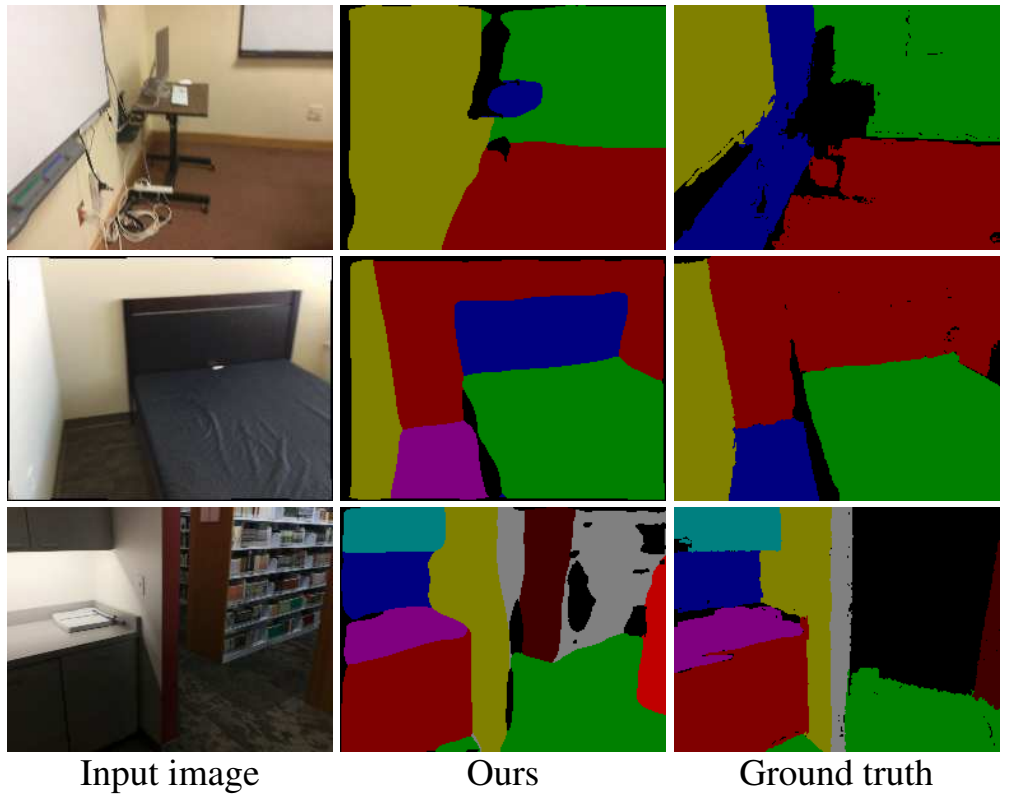
300 dpi PNG · Caption · Source PDF
Original caption, source, and provenance
Fixed source version: CVPR 2019 fixed official PDF
Earliest verified matching figure date (temporal proxy): 2019-04-24
arXiv v1 date: 2019-02-26
Actual drawing date: unknown. See the source record for version checks and temporal-evidence limitations.
Historical PDF · Download citation snapshot · Date evidence · Paper page · Complete screening and version record (Chinese)
Citation threshold evidence: Shenghua Gao; 29917 citations; snapshot 2026-10-21.
Recorded drawing-tool disclosure: unknown. No tool attribution is inferred from appearance; see the archival disclosure evidence for scope and wording.
Crop bounding box: [305, 186, 548, 377] (PDF points; top-left origin; x0, y0, x1, y1).
Figure 7: Failure cases.
Surface Reconstruction from Point Clouds by Learning Predictive Context Priors
Venue: CVPR 2022 · Main-conference paper
Figure 2 · PDF page 3 · P86
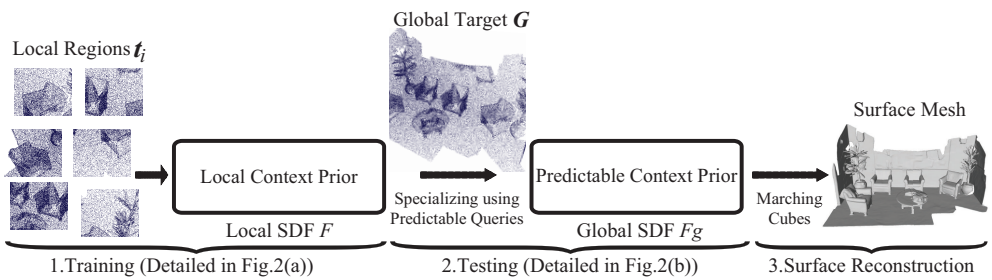
300 dpi PNG · Caption · Source PDF
Original caption, source, and provenance
Fixed source version: CVPR 2022 fixed official PDF
Earliest verified matching figure date (temporal proxy): 2022-04-23
arXiv v1 date: 2022-04-23
Actual drawing date: unknown. See the source record for version checks and temporal-evidence limitations.
Historical PDF · Download citation snapshot · Date evidence · Paper page · Complete screening and version record (Chinese)
Citation threshold evidence: Matthias Zwicker; 17011 citations; snapshot 2026-10-21.
Recorded drawing-tool disclosure: unknown. No tool attribution is inferred from appearance; see the archival disclosure evidence for scope and wording.
Crop bounding box: [49, 70, 287, 137] (PDF points; top-left origin; x0, y0, x1, y1).
Figure 2. Overview of our method.
Surface Reconstruction from Point Clouds by Learning Predictive Context Priors
Venue: CVPR 2022 · Main-conference paper
Figure 4 · PDF page 4 · P85
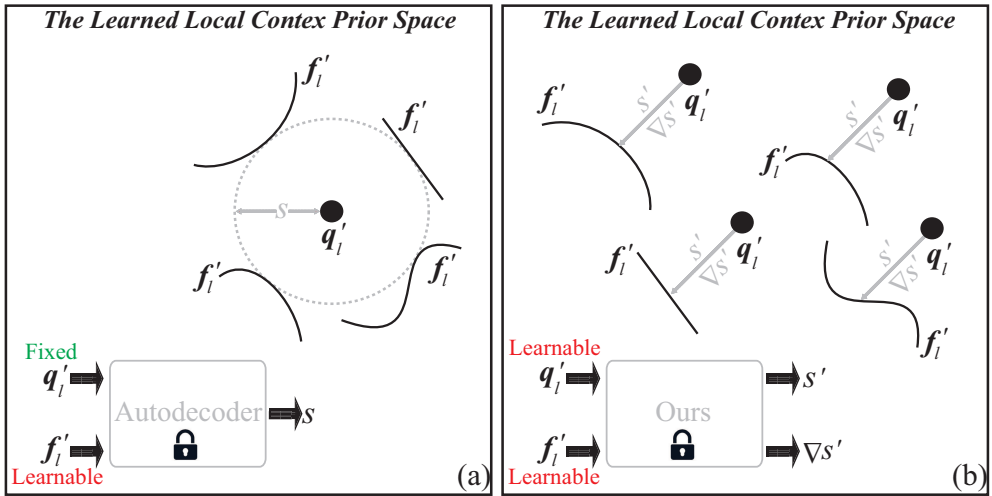
300 dpi PNG · Caption · Source PDF
Original caption, source, and provenance
Fixed source version: CVPR 2022 fixed official PDF
Earliest verified matching figure date (temporal proxy): 2022-04-23
arXiv v1 date: 2022-04-23
Actual drawing date: unknown. See the source record for version checks and temporal-evidence limitations.
Historical PDF · Download citation snapshot · Date evidence · Paper page · Complete screening and version record (Chinese)
Citation threshold evidence: Matthias Zwicker; 17011 citations; snapshot 2026-10-21.
Recorded drawing-tool disclosure: unknown. No tool attribution is inferred from appearance; see the archival disclosure evidence for scope and wording.
Crop bounding box: [49, 71, 287, 190] (PDF points; top-left origin; x0, y0, x1, y1).
Figure 4. Current methods can merely search similar regions at a
specific location q(cid:48) in the learned prior space by optimizing con-
l
dition f(cid:48). While we can search over the whole prior space by
l
simultaneously optimizing q(cid:48) and f(cid:48).
l l
Topologically-Aware Deformation Fields for Single-View 3D Reconstruction
Venue: CVPR 2022 · Figure source: archived arXiv v1
Figure 2 · PDF page 2 · P20
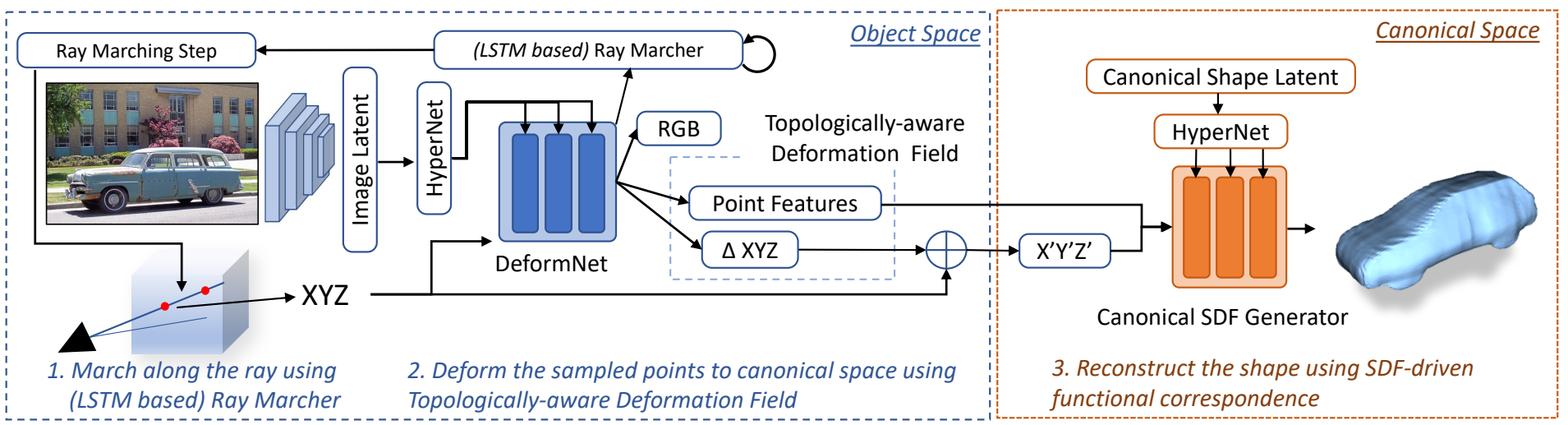
300 dpi PNG · Caption · Source PDF
Original caption, source, and provenance
Fixed source version: arXiv v1 fixed source
Earliest verified matching figure date (temporal proxy): 2022-05-12
arXiv v1 date: 2022-05-12
Actual drawing date: unknown. See the source record for version checks and temporal-evidence limitations.
Historical PDF · Download citation snapshot · Date evidence · Complete screening and version record (Chinese)
Citation threshold evidence: Deepak Pathak; 37267 citations; snapshot 2026-10-21.
Recorded drawing-tool disclosure: unknown. No tool attribution is inferred from appearance; see the archival disclosure evidence for scope and wording.
Crop bounding box: [68, 70, 526, 194] (PDF points; top-left origin; x0, y0, x1, y1).
Figure 2. Overview of TARS: Given a single image, we first map a 3D point in object space to a higher-dimensional canonical space using
our learned topologically-aware deformation field. The canonical point is then mapped to its SDF value using the Canonical Shape Generator
module. We leverage an LSTM-based differentiable renderer to guide the learning of deformation and signed distance fields.
Topologically-Aware Deformation Fields for Single-View 3D Reconstruction
Venue: CVPR 2022 · Figure source: archived arXiv v1
Figure 1 · PDF page 1 · P19
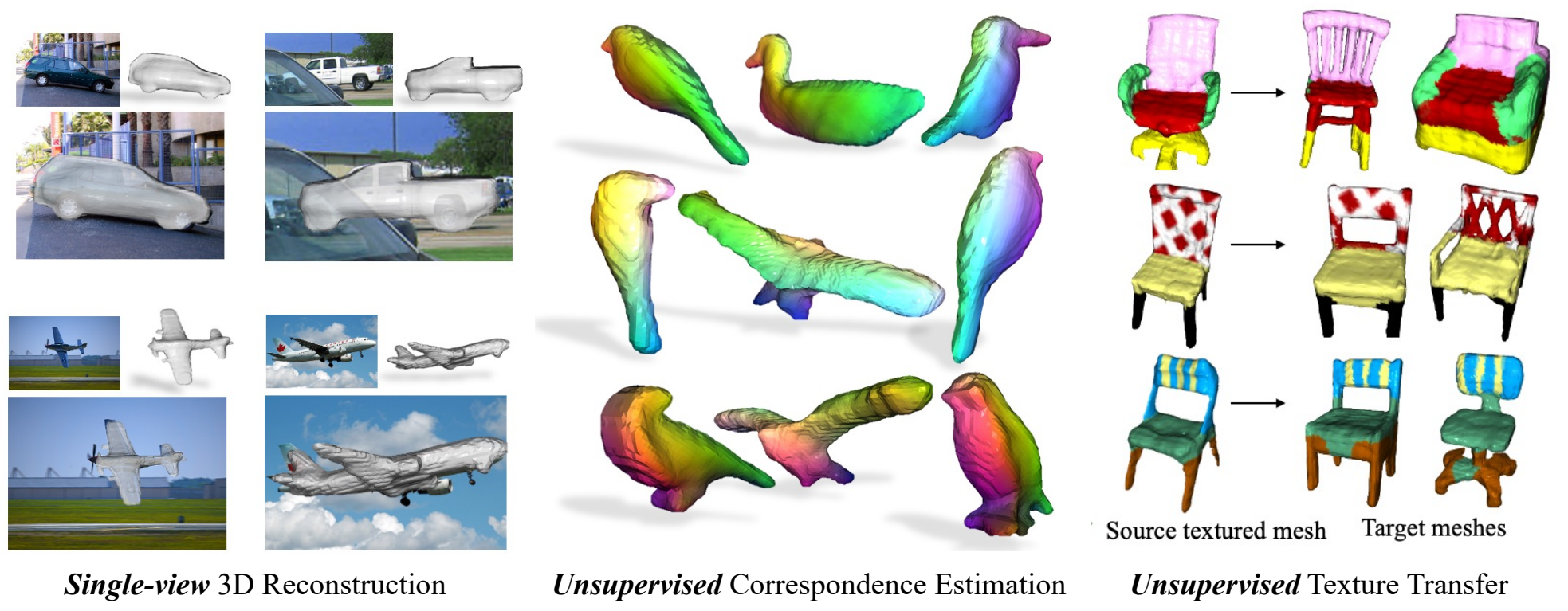
300 dpi PNG · Caption · Source PDF
Original caption, source, and provenance
Fixed source version: arXiv v1 fixed source
Earliest verified matching figure date (temporal proxy): 2022-05-12
arXiv v1 date: 2022-05-12
Actual drawing date: unknown. See the source record for version checks and temporal-evidence limitations.
Historical PDF · Download citation snapshot · Date evidence · Complete screening and version record (Chinese)
Citation threshold evidence: Deepak Pathak; 37267 citations; snapshot 2026-10-21.
Recorded drawing-tool disclosure: unknown. No tool attribution is inferred from appearance; see the archival disclosure evidence for scope and wording.
Crop bounding box: [61, 139, 533, 323] (PDF points; top-left origin; x0, y0, x1, y1).
Figure 1. Given an unpaired image collection (with known camera poses) of an object category at training time, our approach learns to: (a)
reconstruct the underlying 3D given only a single image at test time, and (b) model dense 3D correspondences across category instances.
The learned correspondence field is articulation-aware, topologically-aware and inherently captures structural properties of the category,
enabling the task of unsupervised texture transfer. Videos and code at https://shivamduggal4.github.io/tars-3D/
CAT: Exploiting Inter-Class Dynamics for Domain Adaptive Object Detection
Venue: CVPR 2024 · Main-conference paper
Figure 2 · PDF page 3 · P268
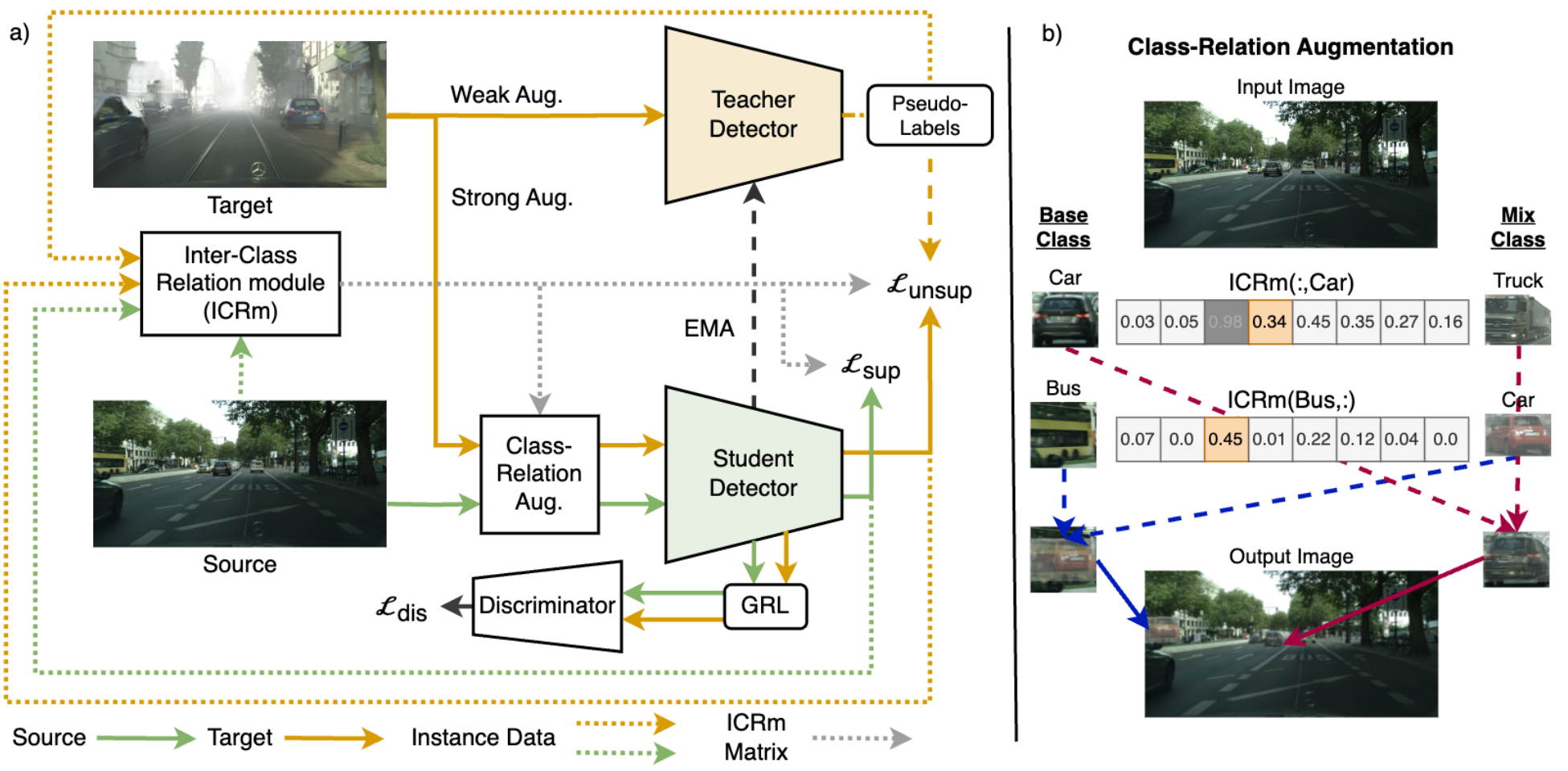
300 dpi PNG · Caption · Source PDF
Original caption, source, and provenance
Fixed source version: CVPR 2024 fixed official PDF
Earliest verified matching figure date (temporal proxy): 2024-03-28
arXiv v1 date: 2024-03-28
Actual drawing date: unknown. See the source record for version checks and temporal-evidence limitations.
Historical PDF · Download citation snapshot · Date evidence · Paper page · Complete screening and version record (Chinese)
Citation threshold evidence: Robby T. Tan; 18517 citations; snapshot 2026-10-21.
Recorded drawing-tool disclosure: unknown. No tool attribution is inferred from appearance; see the archival disclosure evidence for scope and wording.
Crop bounding box: [67, 72, 535, 302] (PDF points; top-left origin; x0, y0, x1, y1).
Figure 2. (a) Class-Aware Teacher (CAT) consists of: a student-teacher network; Inter-Class Relation module (ICRm), which estimates
inter-class biases; Class-Relation Augmentation, which augments images to reduce the inter-class biases by mixing the cropped instances of
related classes; and Inter-Class Loss, which emphasises the loss on highly misclassified minority classes. (b) Class-Relation Augmentation
demonstrated on majority (Car) and minority (Bus) classes.
CAT: Exploiting Inter-Class Dynamics for Domain Adaptive Object Detection
Venue: CVPR 2024 · Main-conference paper
Figure 1 · PDF page 1 · P267
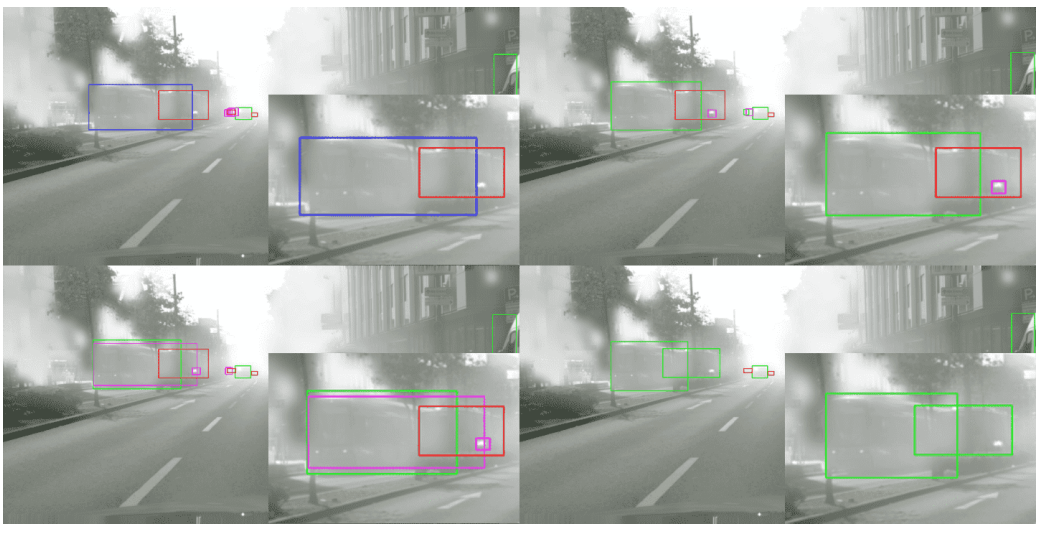
300 dpi PNG · Caption · Source PDF
Original caption, source, and provenance
Fixed source version: CVPR 2024 fixed official PDF
Earliest verified matching figure date (temporal proxy): 2024-03-28
arXiv v1 date: 2024-03-28
Actual drawing date: unknown. See the source record for version checks and temporal-evidence limitations.
Historical PDF · Download citation snapshot · Date evidence · Paper page · Complete screening and version record (Chinese)
Citation threshold evidence: Robby T. Tan; 18517 citations; snapshot 2026-10-21.
Recorded drawing-tool disclosure: unknown. No tool attribution is inferred from appearance; see the archival disclosure evidence for scope and wording.
Crop bounding box: [308, 254, 558, 382] (PDF points; top-left origin; x0, y0, x1, y1).
Figure 1. Performance of Class-Aware Teacher (CAT). AT [29]
(top left), with Inter-Class Loss, ICL, (top-right), with Class Rela-
tion Augmentation, CRA, (bottom-left), and CAT (bottom-right).
CAT is able to address misclassification and false positives, blue
and red boxes, respectively, in minority classes such as ’train’. The
combination of ICL and CRA further boosts performance by re-
ducing the number of false positives shown as pink boxes.
Efficient Test-time Adaptive Object Detection via Sensitivity-Guided Pruning
Venue: CVPR 2025 · Main-conference paper
Figure 4 · PDF page 3 · P84
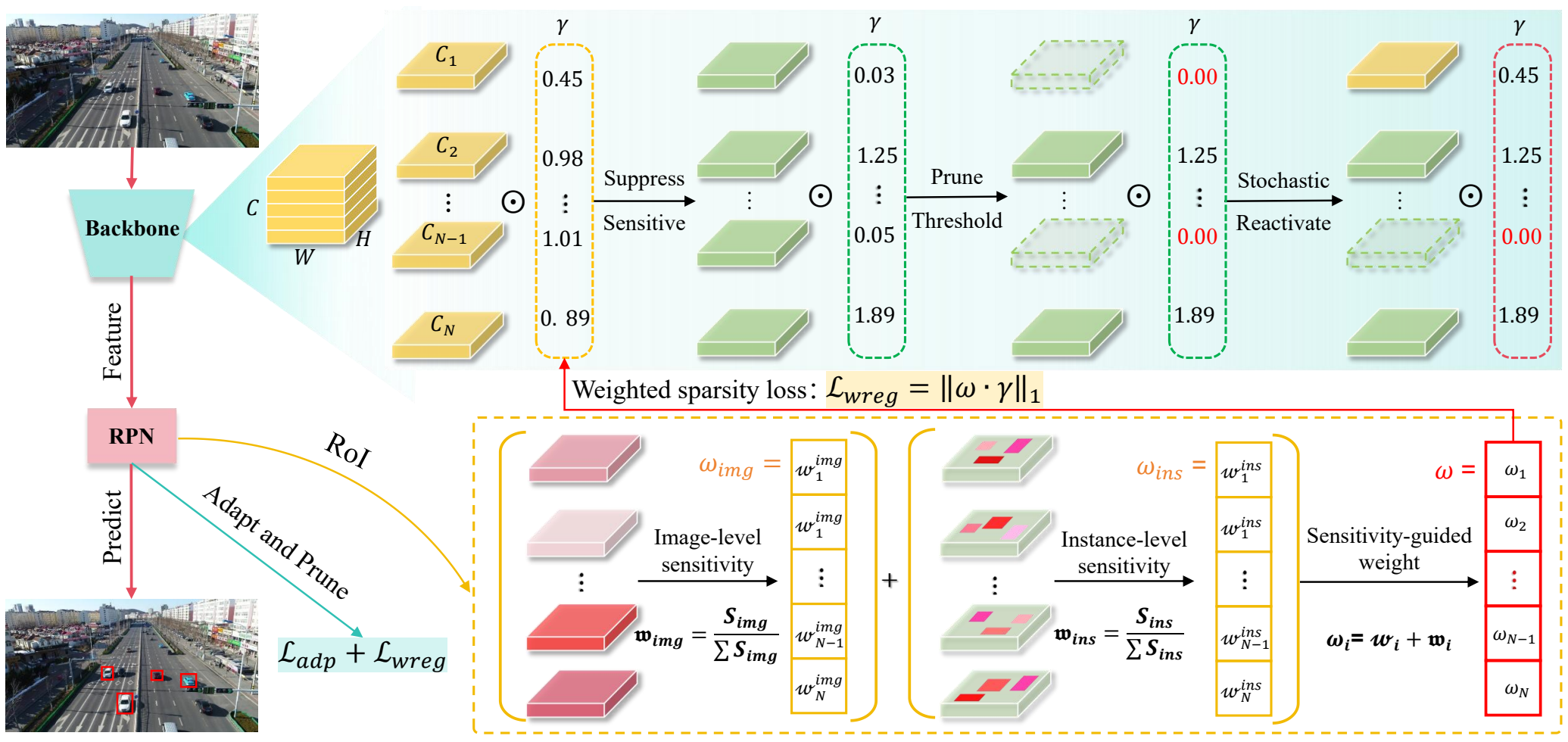
300 dpi PNG · Caption · Source PDF
Original caption, source, and provenance
Fixed source version: CVPR 2025 fixed official PDF
Earliest verified matching figure date (temporal proxy): 2025-06-03
arXiv v1 date: 2025-06-03
Actual drawing date: unknown. See the source record for version checks and temporal-evidence limitations.
Historical PDF · Download citation snapshot · Date evidence · Paper page · Complete screening and version record (Chinese)
Citation threshold evidence: Zheng-Jun Zha; 30479 citations; snapshot 2026-10-21.
Recorded drawing-tool disclosure: unknown. No tool attribution is inferred from appearance; see the archival disclosure evidence for scope and wording.
Crop bounding box: [58, 70, 555, 305] (PDF points; top-left origin; x0, y0, x1, y1).
Figure 4. Overview of our method. Motivated by the observation that certain feature channels learned from the source domain negatively
impact cross-domain performance, we propose suppressing and pruning sensitive channels while adapting invariant ones. We introduce
sensitivity-guided channel pruning, which quantifies the importance of each feature channel based on its image-level and instance-level
sensitivity to domain discrepancies. We then apply a weighted sparsity loss to the learnable parameters, promoting the pruning of channels
with higher sensitivity based on the predefined threshold and ratio. To prevent the loss of potentially useful channels from early pruning,
we introduce a stochastic channel reactivation mechanism.
Efficient Test-time Adaptive Object Detection via Sensitivity-Guided Pruning
Venue: CVPR 2025 · Main-conference paper
Figure 1 · PDF page 1 · P83
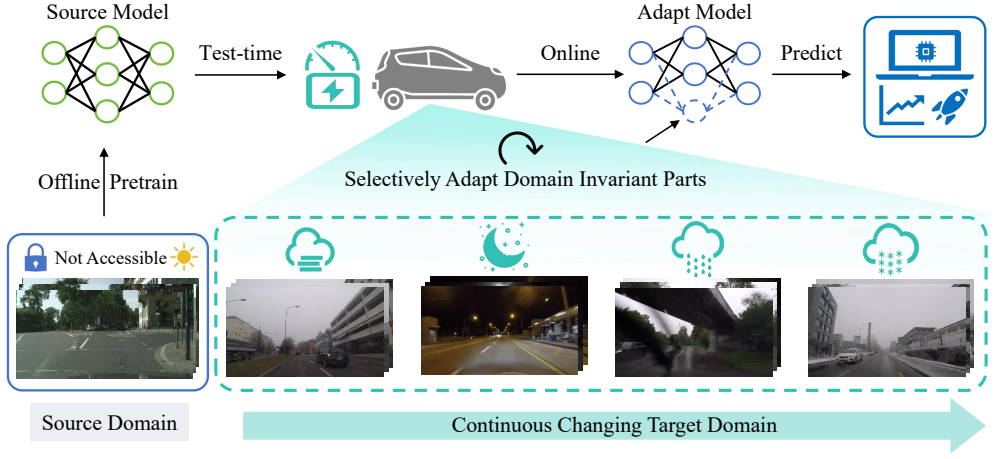
300 dpi PNG · Caption · Source PDF
Original caption, source, and provenance
Fixed source version: CVPR 2025 fixed official PDF
Earliest verified matching figure date (temporal proxy): 2025-06-03
arXiv v1 date: 2025-06-03
Actual drawing date: unknown. See the source record for version checks and temporal-evidence limitations.
Historical PDF · Download citation snapshot · Date evidence · Paper page · Complete screening and version record (Chinese)
Citation threshold evidence: Zheng-Jun Zha; 30479 citations; snapshot 2026-10-21.
Recorded drawing-tool disclosure: unknown. No tool attribution is inferred from appearance; see the archival disclosure evidence for scope and wording.
Crop bounding box: [316, 258, 555, 368] (PDF points; top-left origin; x0, y0, x1, y1).
Figure 1. We consider continual test-time adaptive object detec-
tion, which adapts a source detector to changing environments
during inference. By focusing adaptation efforts on invariant
parts while pruning sensitive parts, we improve computational ef-
ficiency, which is crucial for resource-constrained scenarios like
autonomous driving or UAV.
Fractal Calibration for long-tailed object detection
Venue: CVPR 2025 · Main-conference paper
Figure 2 · PDF page 3 · P234
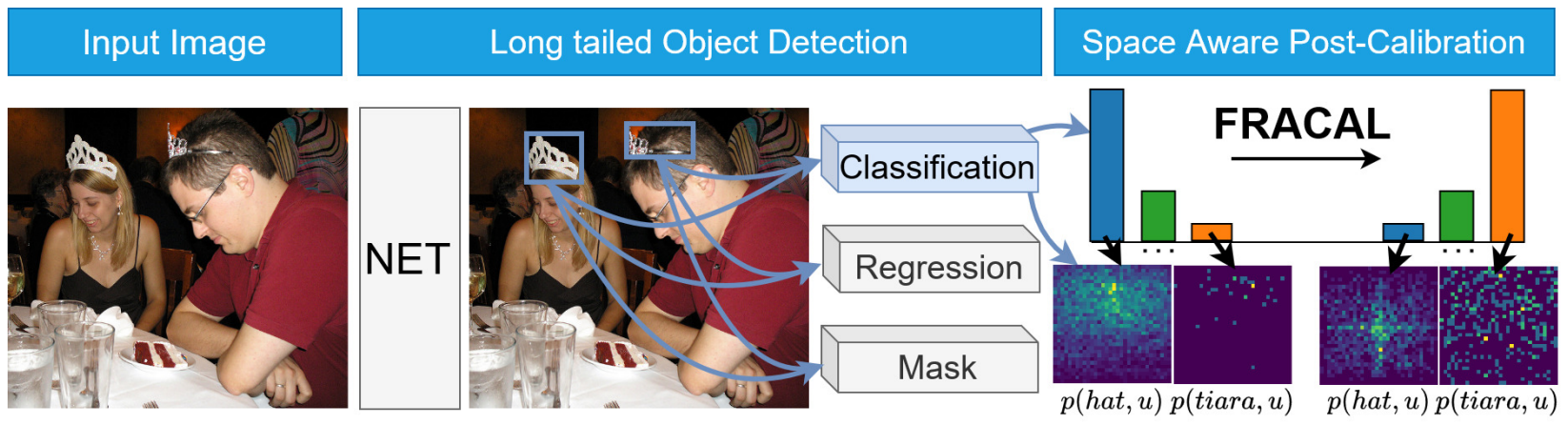
300 dpi PNG · Caption · Source PDF
Original caption, source, and provenance
Fixed source version: CVPR 2025 fixed official PDF
Earliest verified matching figure date (temporal proxy): 2024-10-15
arXiv v1 date: 2024-10-15
Actual drawing date: unknown. See the source record for version checks and temporal-evidence limitations.
Historical PDF · Download citation snapshot · Date evidence · Paper page · Complete screening and version record (Chinese)
Citation threshold evidence: Jiankang Deng; 26964 citations; snapshot 2026-10-22.
Recorded drawing-tool disclosure: unknown. No tool attribution is inferred from appearance; see the archival disclosure evidence for scope and wording.
Crop bounding box: [106, 70, 501, 177] (PDF points; top-left origin; x0, y0, x1, y1).
Figure 2. During imbalanced object detection, the model makes more frequent class detections like hat and less rare class detections like
tiara both of which have strong upper location bias. FRACAL utilises fractal dimension and debiases the logits both in the frequency and
space axes, making fewer hat detections and more tiara detections that are both evenly spread in image space.
Fractal Calibration for long-tailed object detection
Venue: CVPR 2025 · Main-conference paper
Figure 1 · PDF page 1 · P233
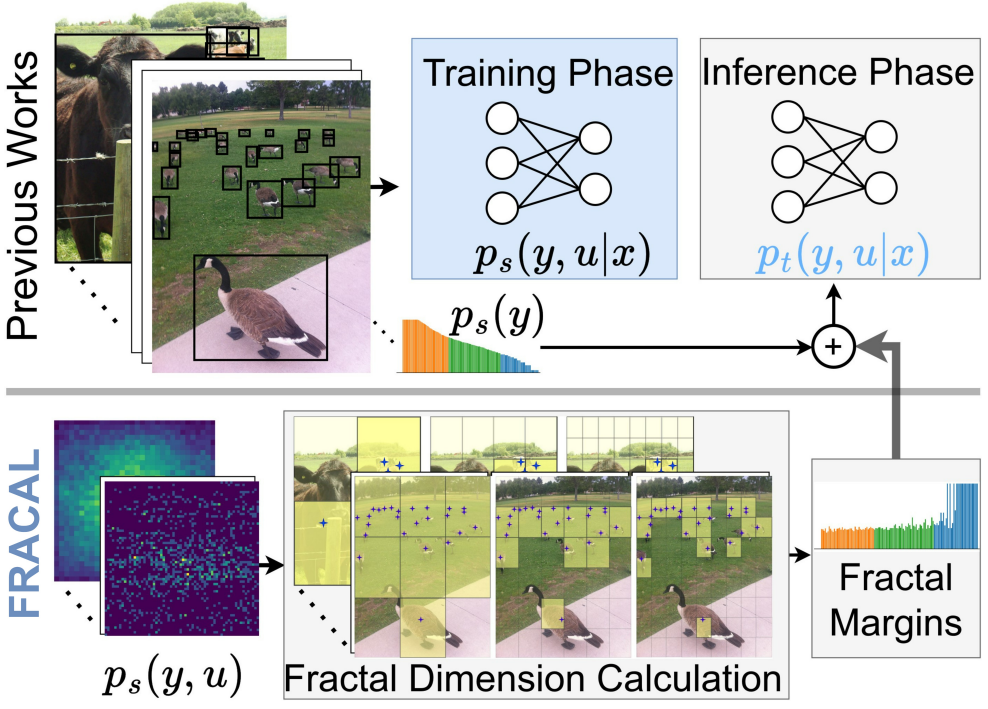
300 dpi PNG · Caption · Source PDF
Original caption, source, and provenance
Fixed source version: CVPR 2025 fixed official PDF
Earliest verified matching figure date (temporal proxy): 2025-03-05
arXiv v1 date: 2024-10-15
Actual drawing date: unknown. See the source record for version checks and temporal-evidence limitations.
Historical PDF · Download citation snapshot · Date evidence · Paper page · Complete screening and version record (Chinese)
Citation threshold evidence: Jiankang Deng; 26964 citations; snapshot 2026-10-22.
Recorded drawing-tool disclosure: unknown. No tool attribution is inferred from appearance; see the archival disclosure evidence for scope and wording.
Crop bounding box: [318, 214, 555, 384] (PDF points; top-left origin; x0, y0, x1, y1).
Figure 1. Previous works used class information p (y ) to align
s
the learned source distribution p (y , u|x) with the balanced target
s
distribution p (y , u|x), without considering the space u and class
t
y relationship i.e. p (y , u). FRACAL captures p (y , u), using
s s
the fractal dimension, and embeds fractal margins during infer-
ence, aligning the learned distribution p (y , u|x) with the target
s
p (y , u|x) better than previous works.
t
Generative Region-Language Pretraining for Open-Ended Object Detection
Venue: CVPR 2024 · Main-conference paper
Figure 2 · PDF page 4 · P270
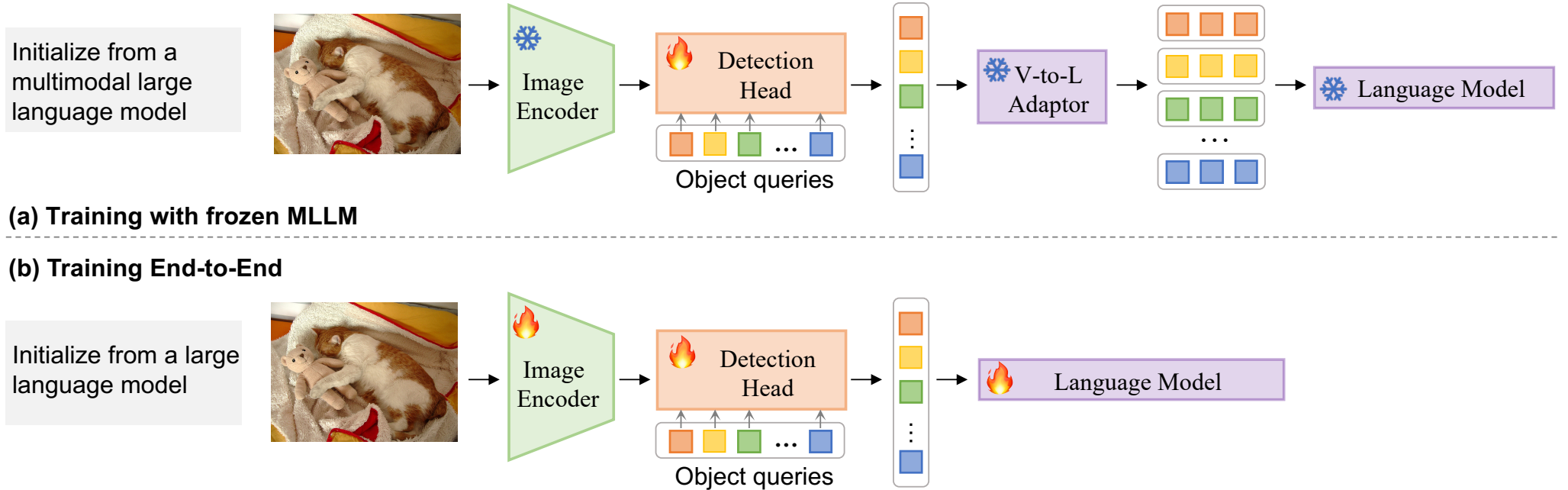
300 dpi PNG · Caption · Source PDF
Original caption, source, and provenance
Fixed source version: CVPR 2024 fixed official PDF
Earliest verified matching figure date (temporal proxy): 2024-03-15
arXiv v1 date: 2024-03-15
Actual drawing date: unknown. See the source record for version checks and temporal-evidence limitations.
Historical PDF · Download citation snapshot · Date evidence · Paper page · Complete screening and version record (Chinese)
Citation threshold evidence: Jianfei Cai; 40906 citations; snapshot 2026-10-21.
Recorded drawing-tool disclosure: unknown. No tool attribution is inferred from appearance; see the archival disclosure evidence for scope and wording.
Crop bounding box: [54, 72, 547, 226] (PDF points; top-left origin; x0, y0, x1, y1).
Figure 2. Overview of our proposed open-ended object detection model, GenerateU, which comprises two major components: an object
detector and a language model. We compare two training strategies: (Top) We incorporate the class-agnostic DETR (with frozen image
encoder) into a pre-trained and frozen Multimodal Large Language Model (including Adaptor and Language Model), to facilitate a smooth
transfer of knowledge from the language domain to object detection; (Bottom) We activate the image encoder and language model as
trainable components, taking an end-to-end approach to seamlessly integrate region-level understanding into the language model.
Generative Region-Language Pretraining for Open-Ended Object Detection
Venue: CVPR 2024 · Main-conference paper
Figure 1 · PDF page 1 · P269
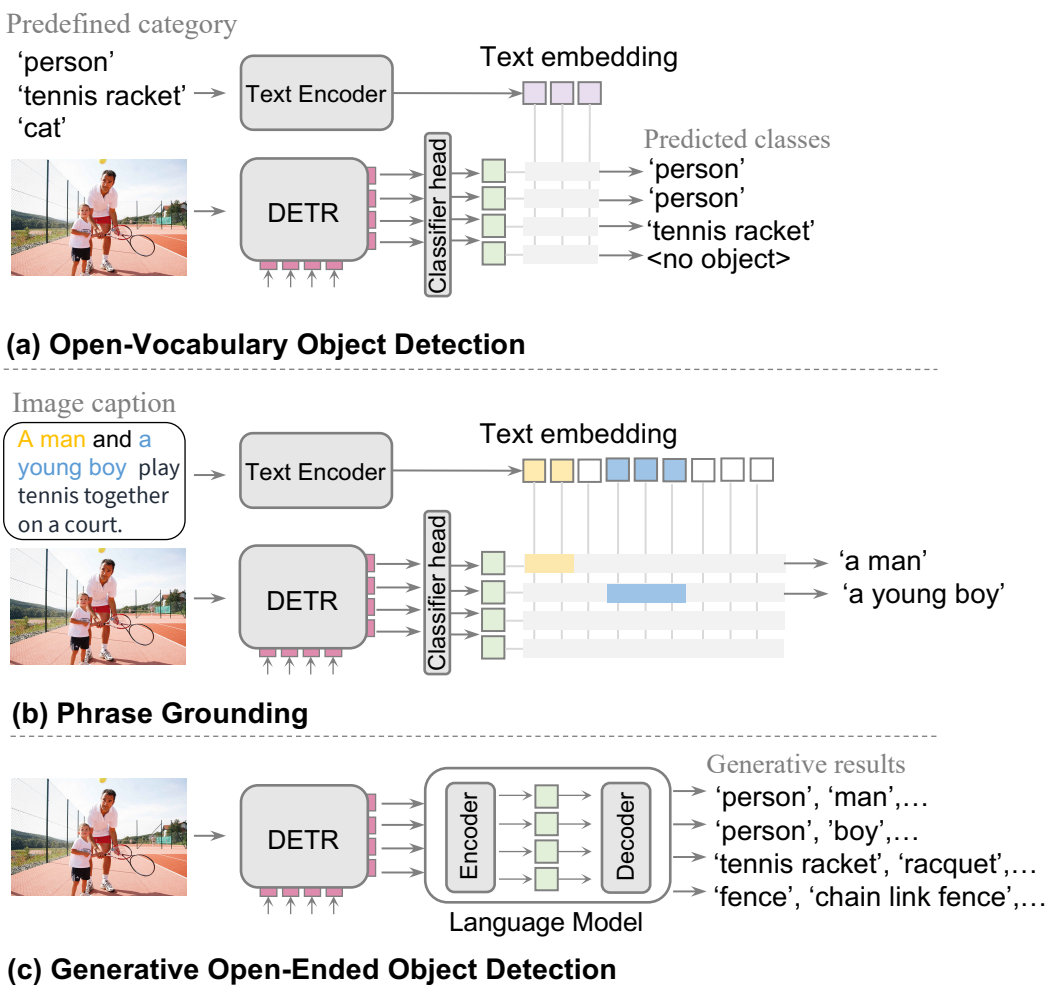
300 dpi PNG · Caption · Source PDF
Original caption, source, and provenance
Fixed source version: CVPR 2024 fixed official PDF
Earliest verified matching figure date (temporal proxy): 2024-03-15
arXiv v1 date: 2024-03-15
Actual drawing date: unknown. See the source record for version checks and temporal-evidence limitations.
Historical PDF · Download citation snapshot · Date evidence · Paper page · Complete screening and version record (Chinese)
Citation threshold evidence: Jianfei Cai; 40906 citations; snapshot 2026-10-21.
Recorded drawing-tool disclosure: unknown. No tool attribution is inferred from appearance; see the archival disclosure evidence for scope and wording.
Crop bounding box: [312, 201, 565, 440] (PDF points; top-left origin; x0, y0, x1, y1).
Figure 1. Comparing generative open-ended object detection with
other open-set object detection tasks. Open-vocabulary object de-
tection and phrase grounding typically require predefined cate-
gories or phrases in text prompts to align with image regions. In
contrast, our introduced generative open-ended object detection is
a more general and practical setting where categorical information
is not explicitly defined. Such a setting is especially meaningful
for scenarios where users lack precise knowledge of object cate-
gories during inference.
InstaGen: Enhancing Object Detection by Training on Synthetic Dataset
Venue: CVPR 2024 · Main-conference paper
Figure 2 · PDF page 3 · P274
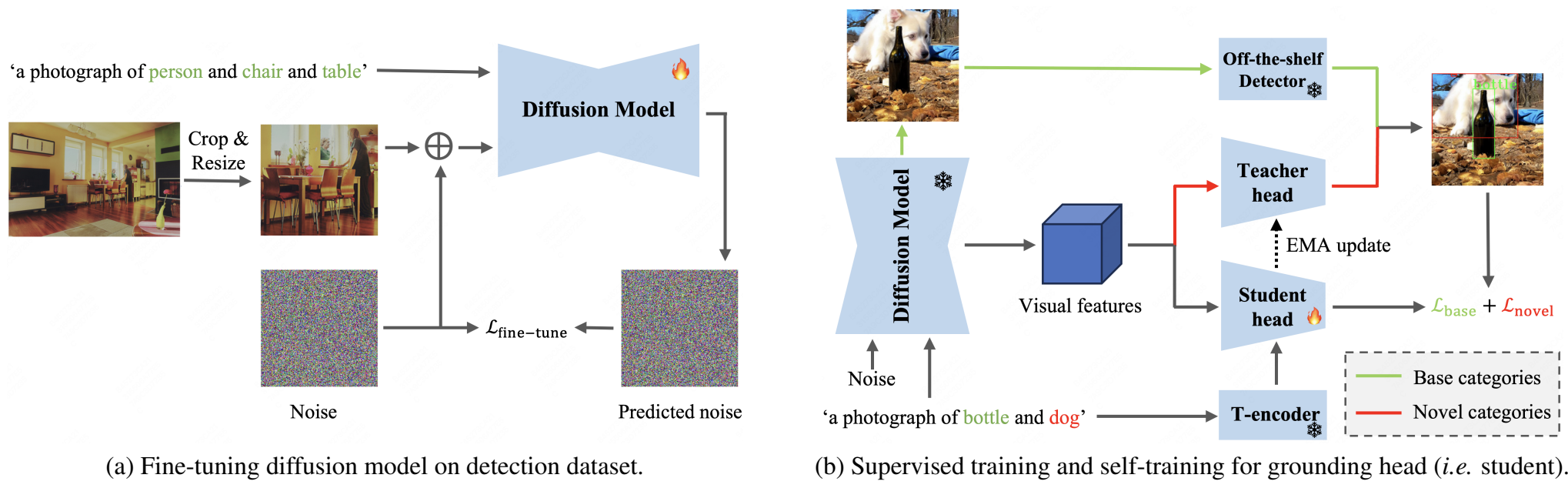
300 dpi PNG · Caption · Source PDF
Original caption, source, and provenance
Fixed source version: CVPR 2024 fixed official PDF
Earliest verified matching figure date (temporal proxy): 2024-02-20
arXiv v1 date: 2024-02-08
Actual drawing date: unknown. See the source record for version checks and temporal-evidence limitations.
Historical PDF · Download citation snapshot · Date evidence · Paper page · Complete screening and version record (Chinese)
Citation threshold evidence: Weidi Xie; 25742 citations; snapshot 2026-10-21.
Recorded drawing-tool disclosure: unknown. No tool attribution is inferred from appearance; see the archival disclosure evidence for scope and wording.
Crop bounding box: [52, 70, 541, 222] (PDF points; top-left origin; x0, y0, x1, y1).
Figure 2. Illustration of the process for finetuning diffusion model and training the grounding head: (a) stable diffusion model is fine-tuned
on the detection dataset on base categories. (b) The grounding head is trained on synthetic images, with supervised learning on base
categories and self-training on novel categories.
InstaGen: Enhancing Object Detection by Training on Synthetic Dataset
Venue: CVPR 2024 · Main-conference paper
Figure 1 · PDF page 1 · P273
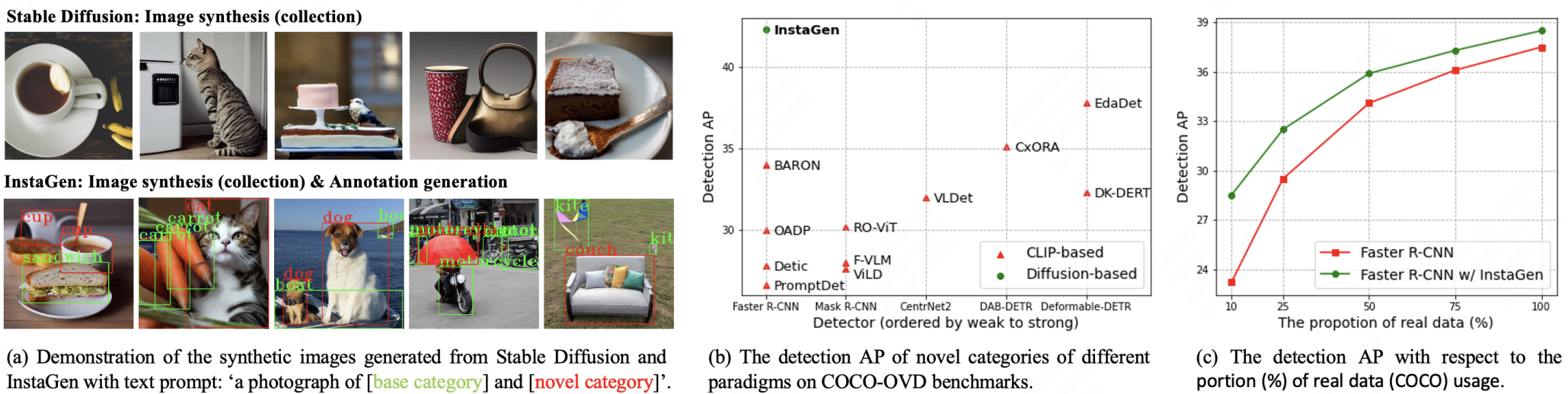
300 dpi PNG · Caption · Source PDF
Original caption, source, and provenance
Fixed source version: CVPR 2024 fixed official PDF
Earliest verified matching figure date (temporal proxy): 2024-02-08
arXiv v1 date: 2024-02-08
Actual drawing date: unknown. See the source record for version checks and temporal-evidence limitations.
Historical PDF · Download citation snapshot · Date evidence · Paper page · Complete screening and version record (Chinese)
Citation threshold evidence: Weidi Xie; 25742 citations; snapshot 2026-10-21.
Recorded drawing-tool disclosure: unknown. No tool attribution is inferred from appearance; see the archival disclosure evidence for scope and wording.
Crop bounding box: [51, 190, 545, 314] (PDF points; top-left origin; x0, y0, x1, y1).
Figure 1. (a) The synthetic images generated from Stable Diffusion and our proposed InstaGen, which can serve as a dataset synthesizer
for sourcing photo-realistic images and instance bounding boxes at scale. (b) On open-vocabulary detection, training on synthetic images
demonstrates significant improvement over CLIP-based methods on novel categories. (c) Training on the synthetic images generated from
InstaGen also enhances the detection performance in close-set scenario, particularly in data-sparse circumstances.
LLMDet: Learning Strong Open-Vocabulary Object Detectors under the Supervision of Large Language Models
Venue: CVPR 2025 · Main-conference paper
Figure 4 · PDF page 5 · P88
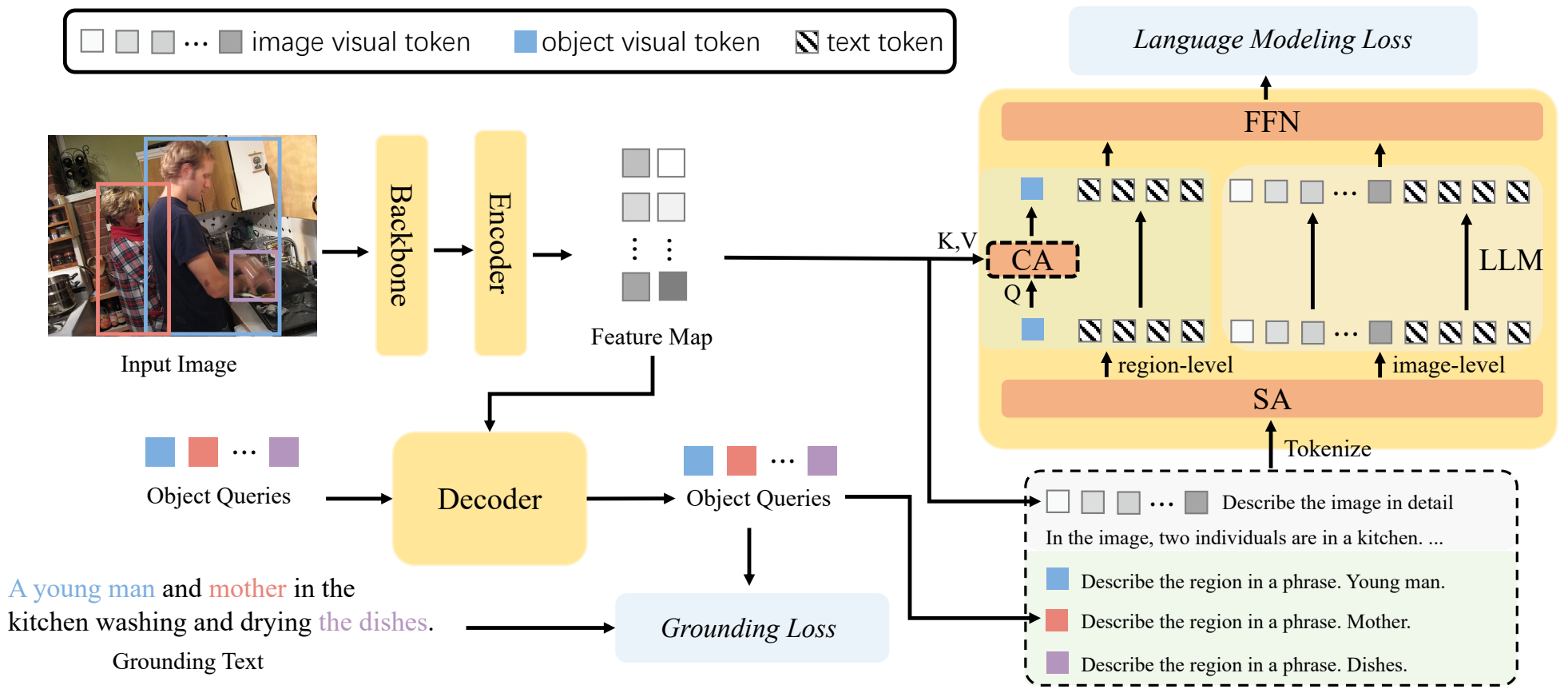
300 dpi PNG · Caption · Source PDF
Original caption, source, and provenance
Fixed source version: CVPR 2025 fixed official PDF
Earliest verified matching figure date (temporal proxy): 2025-01-31
arXiv v1 date: 2025-01-31
Actual drawing date: unknown. See the source record for version checks and temporal-evidence limitations.
Historical PDF · Download citation snapshot · Date evidence · Paper page · Complete screening and version record (Chinese)
Citation threshold evidence: Wei-Shi Zheng; 31913 citations; snapshot 2026-10-21.
Recorded drawing-tool disclosure: unknown. No tool attribution is inferred from appearance; see the archival disclosure evidence for scope and wording.
Crop bounding box: [71, 72, 542, 280] (PDF points; top-left origin; x0, y0, x1, y1).
Figure 4. The overview of LLMDet. LLMDet contains a standard open-vocabulary detector and a large language model (LLM) and is
trained under both grounding loss and language modeling loss. The LLM is designed to generate both image-level captions using feature
maps as visual input and region-level captions using a single object query as visual input, which are separated by different prompts.
Only vision tokens in region-level generation pass through the cross-attention (CA) modules in LLM, which is highlighted by a dashed
boundary. Since the number of tokens in image-level and region-level generation varies greatly, we forward the LLM twice separately to
save memory and computation. The LLM can be discarded in the inference time so that there is no extra cost.
LLMDet: Learning Strong Open-Vocabulary Object Detectors under the Supervision of Large Language Models
Venue: CVPR 2025 · Main-conference paper
Figure 2 · PDF page 3 · P87
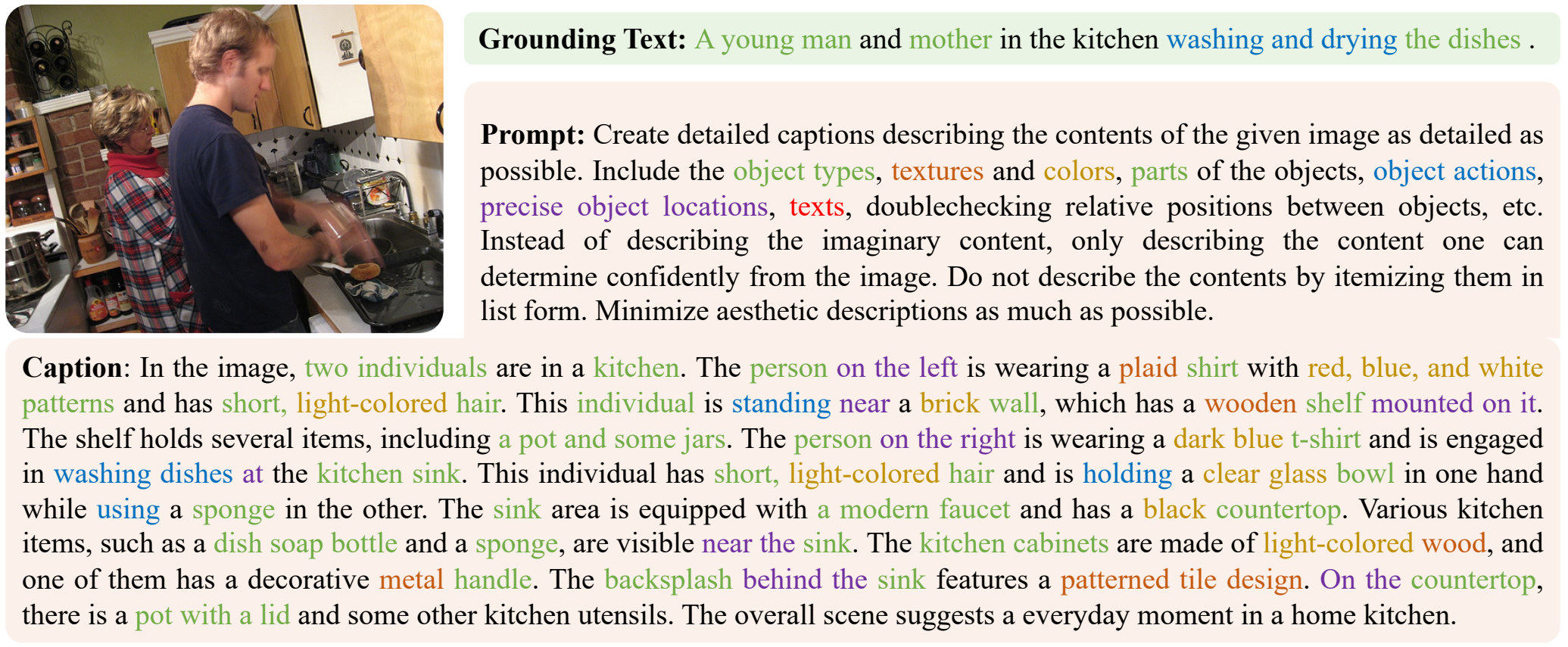
300 dpi PNG · Caption · Source PDF
Original caption, source, and provenance
Fixed source version: CVPR 2025 fixed official PDF
Earliest verified matching figure date (temporal proxy): 2025-01-31
arXiv v1 date: 2025-01-31
Actual drawing date: unknown. See the source record for version checks and temporal-evidence limitations.
Historical PDF · Download citation snapshot · Date evidence · Paper page · Complete screening and version record (Chinese)
Citation threshold evidence: Wei-Shi Zheng; 31913 citations; snapshot 2026-10-21.
Recorded drawing-tool disclosure: unknown. No tool attribution is inferred from appearance; see the archival disclosure evidence for scope and wording.
Crop bounding box: [58, 66, 555, 271] (PDF points; top-left origin; x0, y0, x1, y1).
Figure 2. An example of GroundingCap-1M. Bounding box annotations are discarded for clarity. Compared with original short grounding
texts, the detailed captions in GroundingCap-1M are rich in object types, textures, colors, parts of the objects, object actions, precise object
locations and texts. Each caption in GroundingCap-1M has around 115 words on average.
Large Self-Supervised Models Bridge the Gap in Domain Adaptive Object Detection
Venue: CVPR 2025 · Main-conference paper
Figure 2 · PDF page 4 · P250
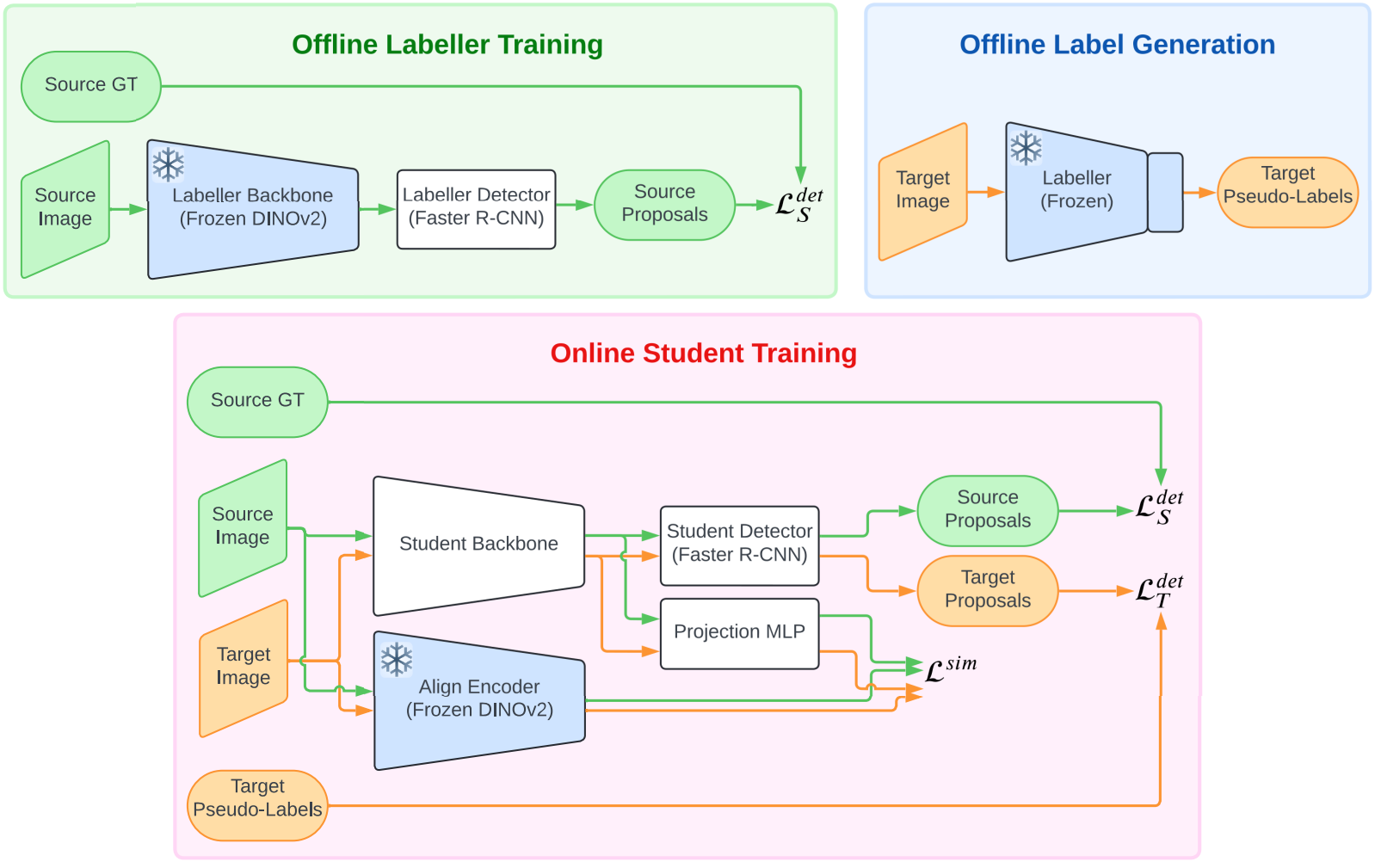
300 dpi PNG · Caption · Source PDF
Original caption, source, and provenance
Fixed source version: CVPR 2025 fixed official PDF
Earliest verified matching figure date (temporal proxy): 2025-03-29
arXiv v1 date: 2025-03-29
Actual drawing date: unknown. See the source record for version checks and temporal-evidence limitations.
Historical PDF · Download citation snapshot · Date evidence · Paper page · Complete screening and version record (Chinese)
Citation threshold evidence: Steven L. Waslander; 18395 citations; snapshot 2026-10-22.
Recorded drawing-tool disclosure: unknown. No tool attribution is inferred from appearance; see the archival disclosure evidence for scope and wording.
Crop bounding box: [115, 72, 500, 314] (PDF points; top-left origin; x0, y0, x1, y1).
Figure 2. Diagram of our proposed method. Offline Labeller Training: we add a detector head to a frozen DINOv2 encoder and train
it with source images only. Offline Label Generation: we combine and freeze the labeller backbone and detector, and generate target
pseudo-labels. Online Student Training: We train a student network using source ground truth boxes and target pseudo-labels, and align
patch features to a frozen DINOv2 encoder. During inference, the alignment encoder and projection MLP are not used.
Large Self-Supervised Models Bridge the Gap in Domain Adaptive Object Detection
Venue: CVPR 2025 · Main-conference paper
Figure 1 · PDF page 1 · P249
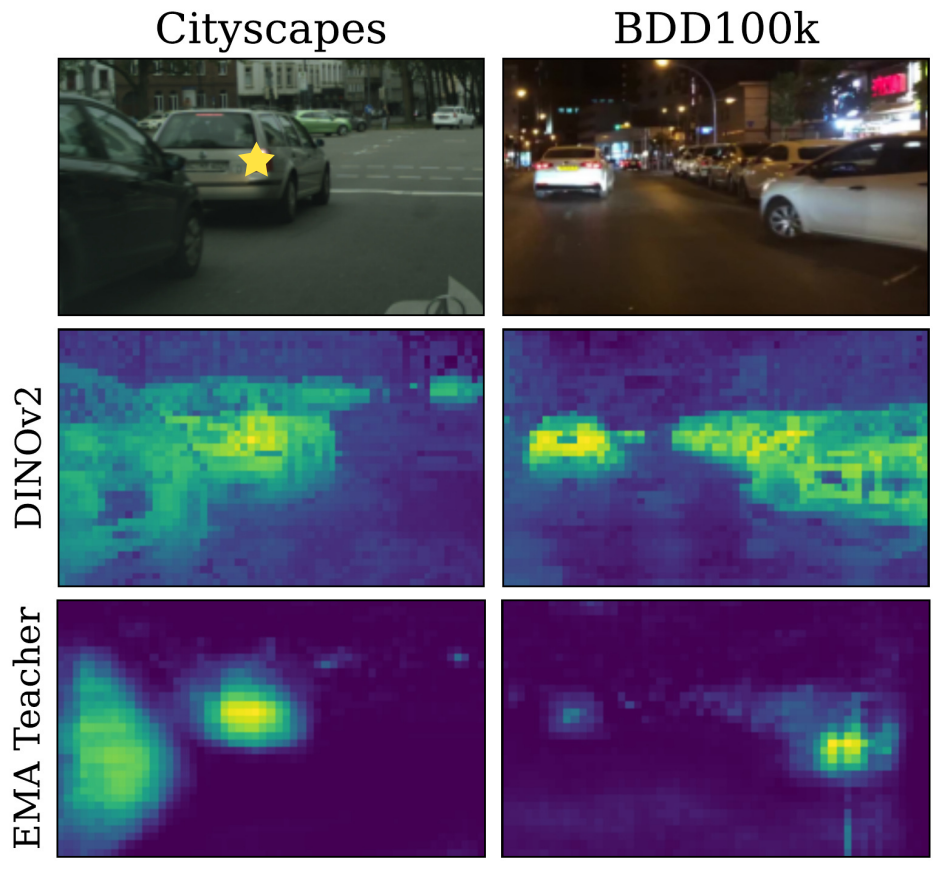
300 dpi PNG · Caption · Source PDF
Original caption, source, and provenance
Fixed source version: CVPR 2025 fixed official PDF
Earliest verified matching figure date (temporal proxy): 2025-03-29
arXiv v1 date: 2025-03-29
Actual drawing date: unknown. See the source record for version checks and temporal-evidence limitations.
Historical PDF · Download citation snapshot · Date evidence · Paper page · Complete screening and version record (Chinese)
Citation threshold evidence: Steven L. Waslander; 18395 citations; snapshot 2026-10-22.
Recorded drawing-tool disclosure: unknown. No tool attribution is inferred from appearance; see the archival disclosure evidence for scope and wording.
Crop bounding box: [322, 234, 548, 443] (PDF points; top-left origin; x0, y0, x1, y1).
Figure 1. Cosine similarity of patch feature from Cityscapes to
BDD100k.. We evaluate the similarity between the yellow star re-
gion in the Cityscapes image and all other regions in both images.
Compared to the EMA Teacher, DINOv2 generates semantically
stable features across domains, justifying the choice to use it for
feature alignment and as a frozen backbone for our labeller.
Partial Weakly-Supervised Oriented Object Detection
Source: arXiv 2025 · Figure source: archived arXiv v1 · CVPR 2026 — submission also recorded
Figure 2 · PDF page 3 · P240
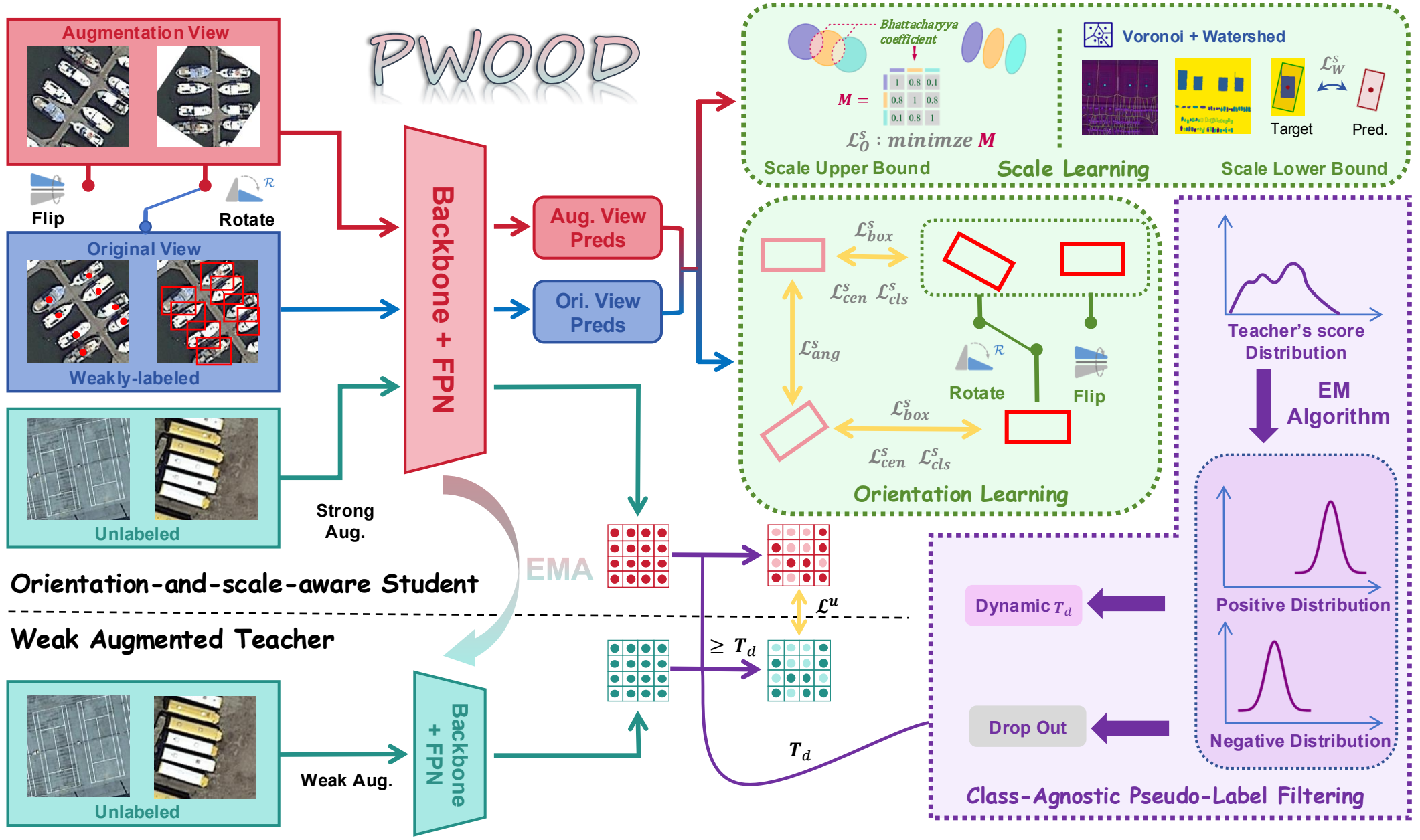
300 dpi PNG · Caption · Source PDF
Original caption, source, and provenance
Fixed source version: arXiv v1 fixed
Earliest verified matching figure date (temporal proxy): 2025-07-03
arXiv v1 date: 2025-07-03
Actual drawing date: unknown. See the source record for version checks and temporal-evidence limitations.
Historical PDF · Download citation snapshot · Date evidence · Complete screening and version record (Chinese)
Citation threshold evidence: Xue Yang; 14880 citations; snapshot 2026-10-22.
Recorded drawing-tool disclosure: unknown. No tool attribution is inferred from appearance; see the archival disclosure evidence for scope and wording.
Crop bounding box: [52, 52, 561, 353] (PDF points; top-left origin; x0, y0, x1, y1).
Fig. 2. The overview of the proposed PWOOD framework. Orientation Learning and Scale Learning modules enables the Orientation-and-Scale-aware Student
to learn both scale and orientation information from weakly annotated data, as well as Class-Agnostic Pseudo-Label Filtering mechanism enhances pseudo-label
quality by leveraging dynamic thresholds.
Partial Weakly-Supervised Oriented Object Detection
Source: arXiv 2025 · Figure source: archived arXiv v1 · CVPR 2026 — submission also recorded
Figure 1 · PDF page 1 · P239
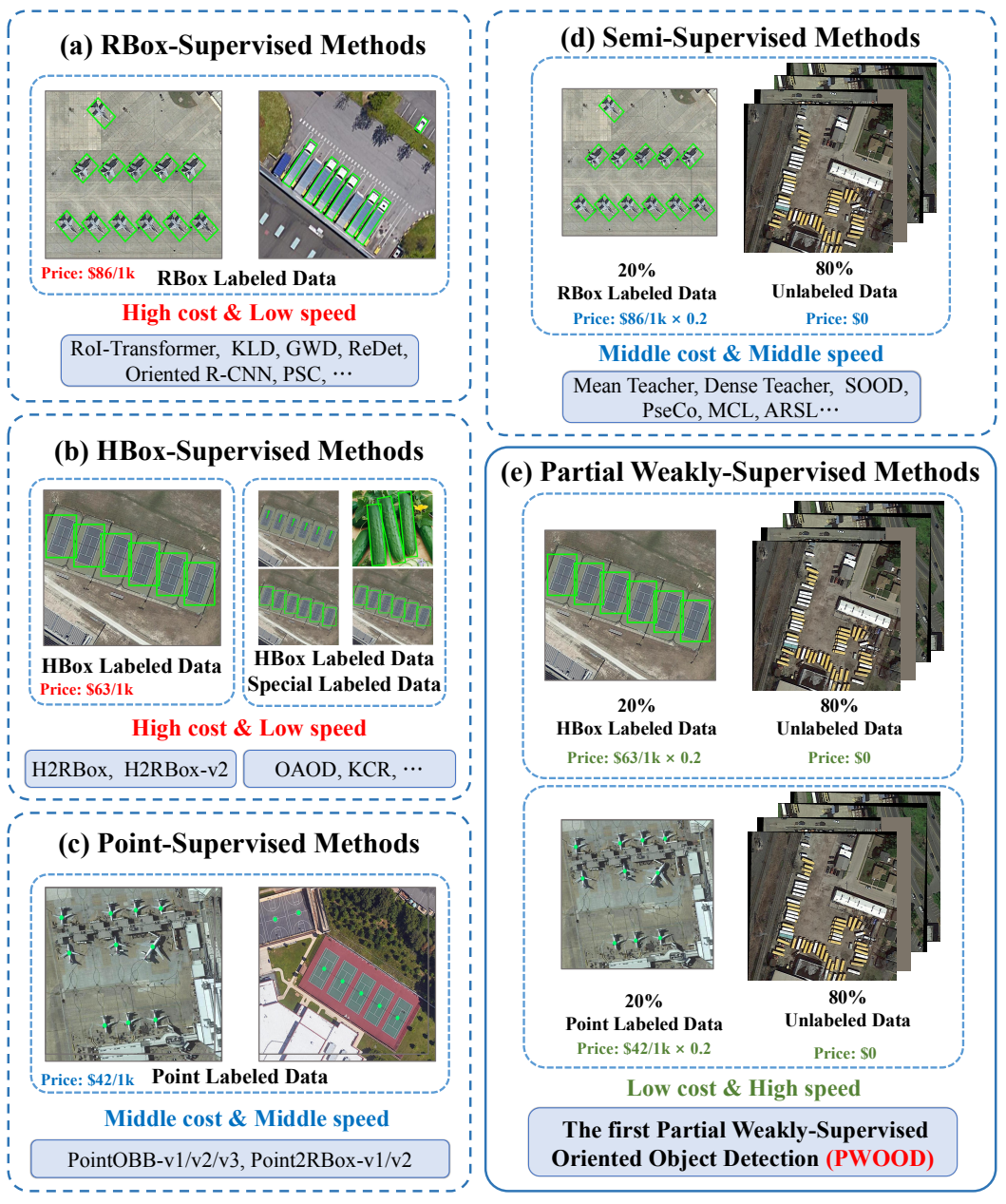
300 dpi PNG · Caption · Source PDF
Original caption, source, and provenance
Fixed source version: arXiv v1 fixed
Earliest verified matching figure date (temporal proxy): 2025-07-03
arXiv v1 date: 2025-07-03
Actual drawing date: unknown. See the source record for version checks and temporal-evidence limitations.
Historical PDF · Download citation snapshot · Date evidence · Complete screening and version record (Chinese)
Citation threshold evidence: Xue Yang; 14880 citations; snapshot 2026-10-22.
Recorded drawing-tool disclosure: unknown. No tool attribution is inferred from appearance; see the archival disclosure evidence for scope and wording.
Crop bounding box: [311, 193, 565, 497] (PDF points; top-left origin; x0, y0, x1, y1).
Fig. 1. The main paradigmatic types of existing oriented object detec-
tion. Existing methods are primarily divided into rotated boxes (RBox)-
supervised, horizontal boxes (HBox)-supervised, Point-supervised, and Semi-
Supervised approaches. Compared to these settings, our proposed Partial
Weakly-supervised methods have high annotation speed and low costs.
PointOBB: Learning Oriented Object Detection via Single Point Supervision
Venue: CVPR 2024 · Main-conference paper
Figure 2 · PDF page 3 · P272
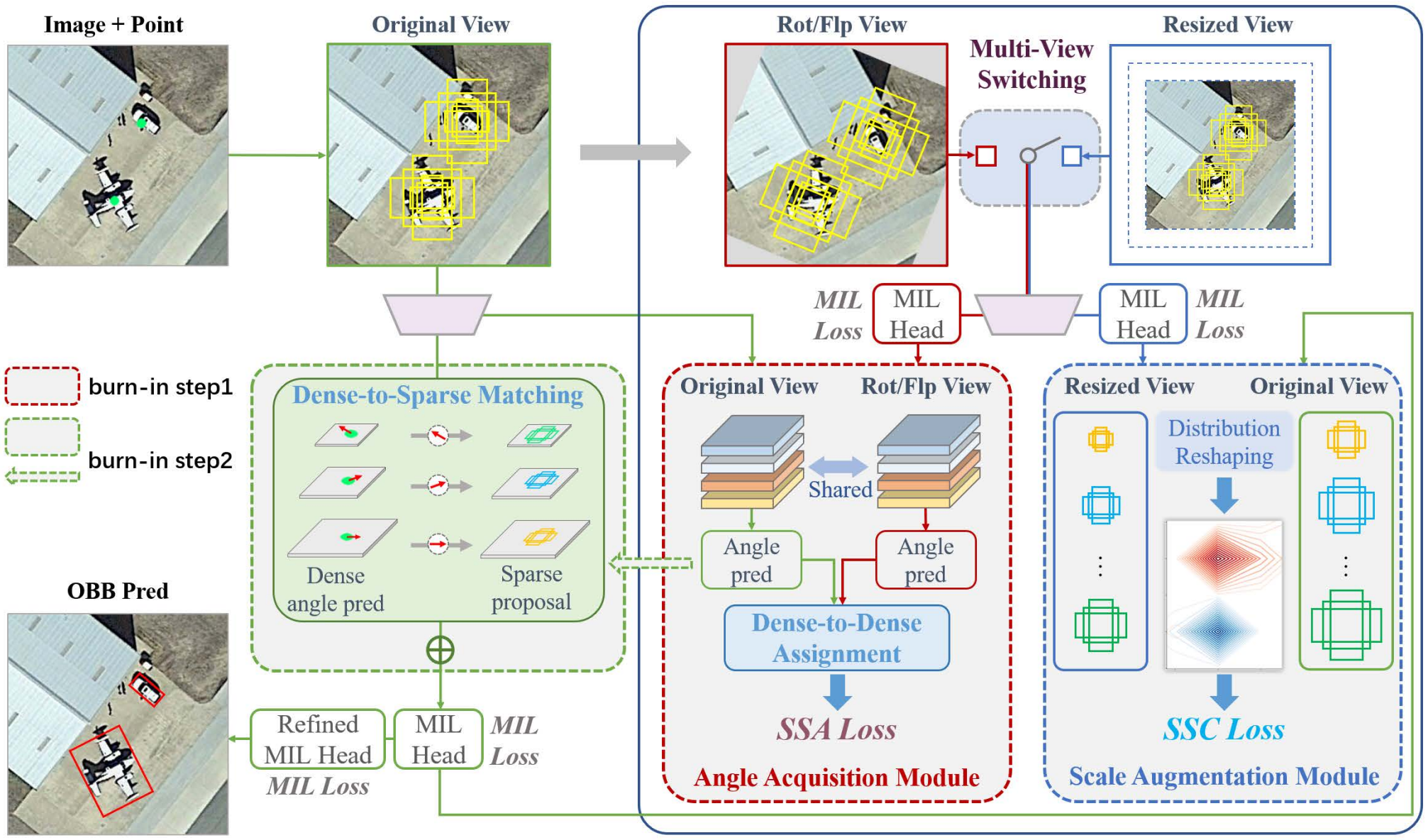
300 dpi PNG · Caption · Source PDF
Original caption, source, and provenance
Fixed source version: CVPR 2024 fixed official PDF
Earliest verified matching figure date (temporal proxy): 2023-11-23
arXiv v1 date: 2023-11-23
Actual drawing date: unknown. See the source record for version checks and temporal-evidence limitations.
Historical PDF · Download citation snapshot · Date evidence · Paper page · Complete screening and version record (Chinese)
Citation threshold evidence: Junchi Yan; 47501 citations; snapshot 2026-10-22.
Recorded drawing-tool disclosure: unknown. No tool attribution is inferred from appearance; see the archival disclosure evidence for scope and wording.
Crop bounding box: [56, 74, 539, 358] (PDF points; top-left origin; x0, y0, x1, y1).
Figure 2. The pipeline of the PointOBB. PointOBB contains three views in total. From these views, an angle acquisition module and
a scale augmentation module are constructed. The scale augmentation module incorporates a Scale-Sensitive Consistency (SSC) loss to
enhance scale perception ability. Within the angle acquisition module, a Dense-to-Dense sample assignment is designed for angle learning,
optimized using the Self-Supervised Angle (SSA) loss. Additionally, a Dense-to-Sparse (DS) matching strategy is proposed to obtain more
precise object angles. During the training, a progressive multi-view switching strategy is designed to switch the resized and rot/flp views,
along with their corresponding modules.
PointOBB: Learning Oriented Object Detection via Single Point Supervision
Venue: CVPR 2024 · Main-conference paper
Figure 1 · PDF page 1 · P271
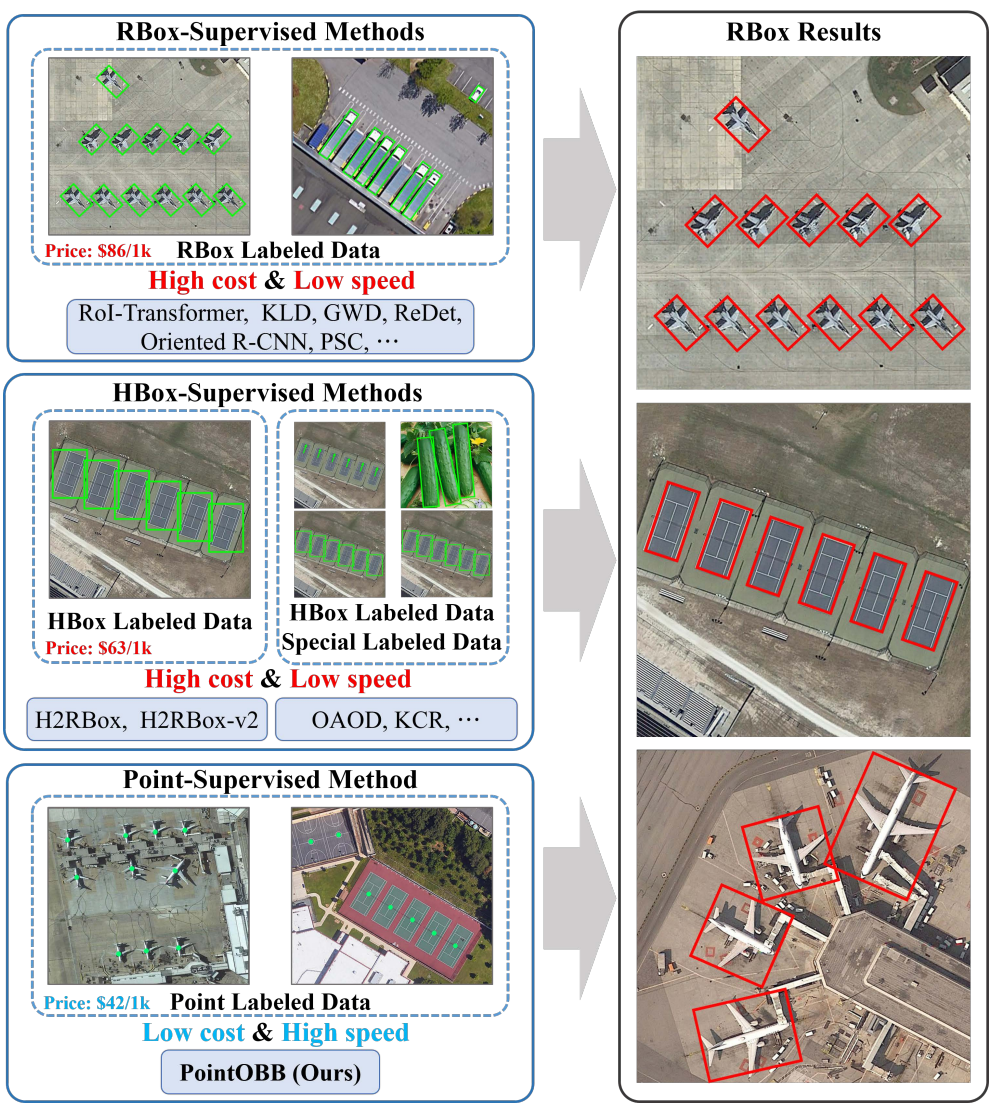
300 dpi PNG · Caption · Source PDF
Original caption, source, and provenance
Fixed source version: CVPR 2024 fixed official PDF
Earliest verified matching figure date (temporal proxy): 2023-11-23
arXiv v1 date: 2023-11-23
Actual drawing date: unknown. See the source record for version checks and temporal-evidence limitations.
Historical PDF · Download citation snapshot · Date evidence · Paper page · Complete screening and version record (Chinese)
Citation threshold evidence: Junchi Yan; 47501 citations; snapshot 2026-10-22.
Recorded drawing-tool disclosure: unknown. No tool attribution is inferred from appearance; see the archival disclosure evidence for scope and wording.
Crop bounding box: [308, 250, 547, 516] (PDF points; top-left origin; x0, y0, x1, y1).
Figure 1. The main paradigmatic types of existing oriented ob-
ject detection. Existing methods are primarily divided into rotated
boxes (RBox)-supervised, horizontal boxes (HBox)-supervised,
and Point-supervised approaches. Compared to RBox and HBox
labels, point labels have lower costs and higher efficiency.
Search and Detect: Training-Free Long Tail Object Detection via Web-Image Retrieval
Venue: CVPR 2025 · Main-conference paper
Figure 2 · PDF page 3 · P212
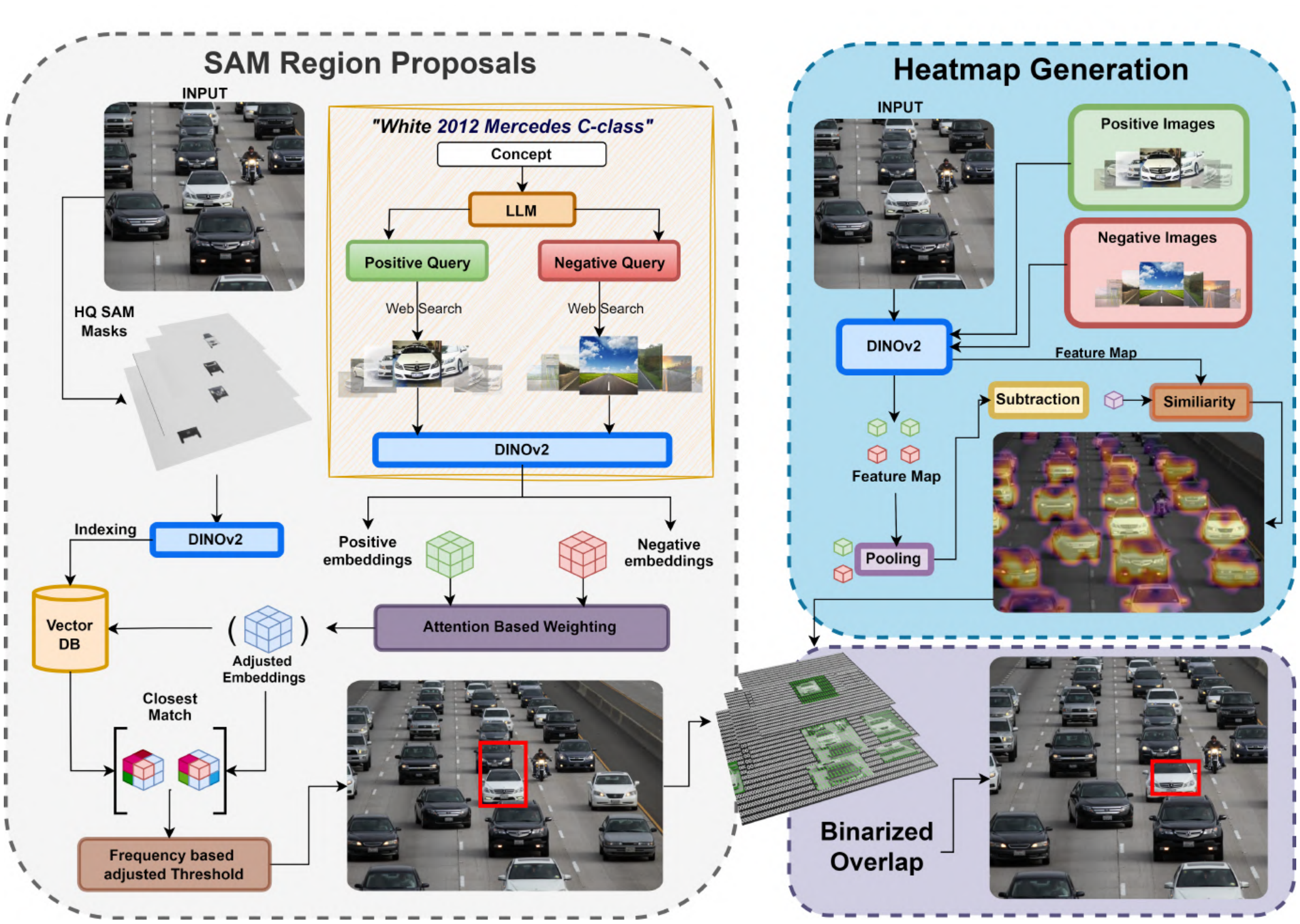
300 dpi PNG · Caption · Source PDF
Original caption, source, and provenance
Fixed source version: CVPR 2025 fixed official PDF
Earliest verified matching figure date (temporal proxy): 2025-06
arXiv v1 date: 2024-09-26
Actual drawing date: unknown. See the source record for version checks and temporal-evidence limitations.
Historical PDF · Download citation snapshot · Date evidence · Paper page · Complete screening and version record (Chinese)
Citation threshold evidence: Heng Ji; 43364 citations; snapshot 2026-10-21.
Recorded drawing-tool disclosure: unknown. No tool attribution is inferred from appearance; see the archival disclosure evidence for scope and wording.
Crop bounding box: [57, 70, 555, 424] (PDF points; top-left origin; x0, y0, x1, y1).
Figure 2. The entire architecture of our method. We compare the adjusted embeddings, produced by the DINOv2 model, of the positive
and negative support images, with the relevant masks extracted using the SAM model to provide an initial estimate of our segmentation
BBox. We again use DINOv2 for generating pixel-precise heatmaps which provide another estimate for the segmentation. We combine
both these estimates using a binarized overlap to get the final segmentation mask.
Search and Detect: Training-Free Long Tail Object Detection via Web-Image Retrieval
Venue: CVPR 2025 · Main-conference paper
Figure 1 · PDF page 1 · P211
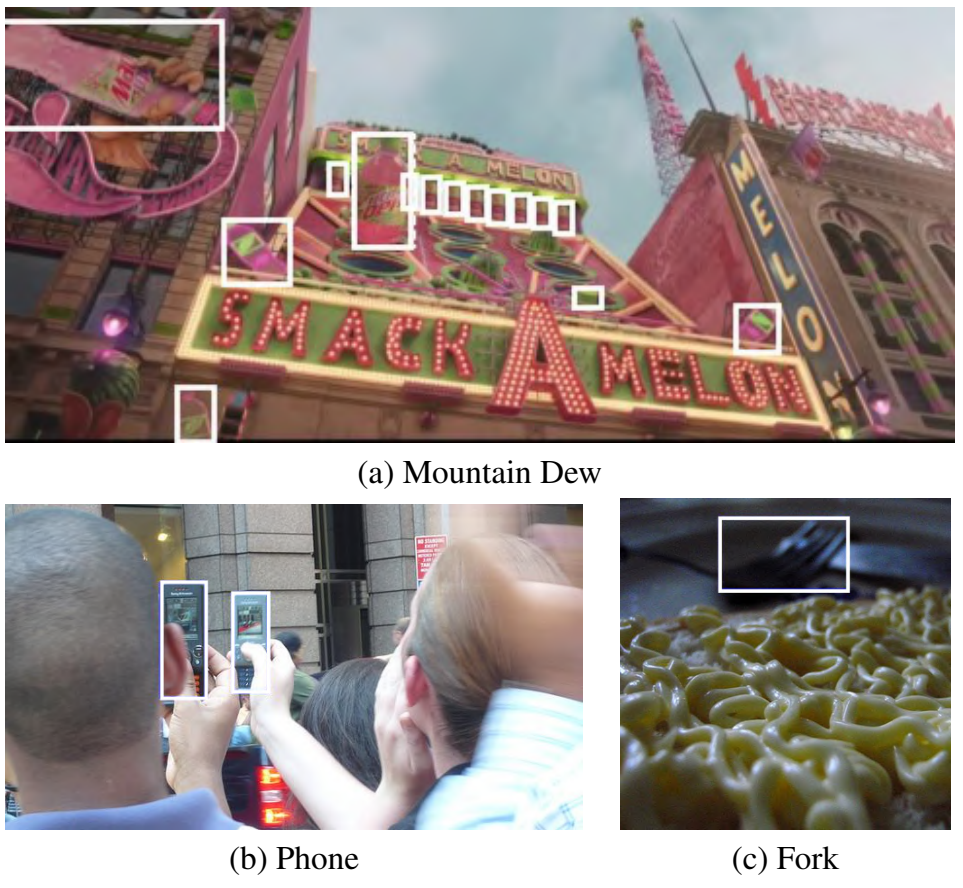
300 dpi PNG · Caption · Source PDF
Original caption, source, and provenance
Fixed source version: CVPR 2025 fixed official PDF
Earliest verified matching figure date (temporal proxy): 2025-06
arXiv v1 date: 2024-09-26
Actual drawing date: unknown. See the source record for version checks and temporal-evidence limitations.
Historical PDF · Download citation snapshot · Date evidence · Paper page · Complete screening and version record (Chinese)
Citation threshold evidence: Heng Ji; 43364 citations; snapshot 2026-10-21.
Recorded drawing-tool disclosure: unknown. No tool attribution is inferred from appearance; see the archival disclosure evidence for scope and wording.
Crop bounding box: [316, 230, 547, 443] (PDF points; top-left origin; x0, y0, x1, y1).
Figure 1. Detection results for label “Mountain Dew”. While the
GroundingDINO, one of the state-of-the-art grounded object de-
tection methods, fails to capture the Mountain Dew bottles in the
image displayed in the figure, SearchDet manages to ground every
instance of Mountain Dew that appears in the image. Detection
results for other classes “Phone” and “Fork”.
Beyond Background Shift: Rethinking Instance Replay in Continual Semantic Segmentation
Venue: CVPR 2025 · Main-conference paper
Figure 4 · PDF page 5 · P246
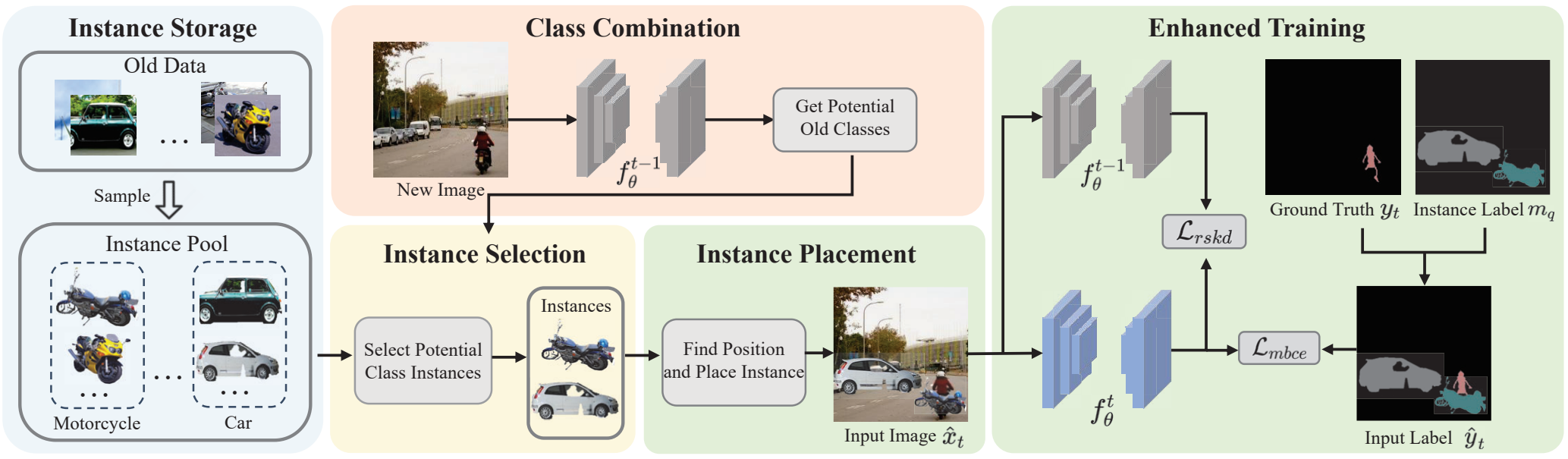
300 dpi PNG · Caption · Source PDF
Original caption, source, and provenance
Fixed source version: CVPR 2025 fixed official PDF
Earliest verified matching figure date (temporal proxy): 2025-03-28
arXiv v1 date: 2025-03-28
Actual drawing date: unknown. See the source record for version checks and temporal-evidence limitations.
Historical PDF · Download citation snapshot · Date evidence · Paper page · Complete screening and version record (Chinese)
Citation threshold evidence: Wei Feng; 11058 citations; snapshot 2026-10-22.
Recorded drawing-tool disclosure: unknown. No tool attribution is inferred from appearance; see the archival disclosure evidence for scope and wording.
Crop bounding box: [58, 61, 554, 206] (PDF points; top-left origin; x0, y0, x1, y1).
Figure 4. The detailed architecture of our method. Initially, we sample instances from the old data according to their classes. Subsequently,
during the class combination, we identify the potential old classes through the old model. In the instance selection, we select the instances
of potential classes from the instance pool. After that, we calculate the position in new image to replay the instance and fuse them with the
new image to create a fused image. Finally, the fused image is trained in an enhanced way.
Beyond Background Shift: Rethinking Instance Replay in Continual Semantic Segmentation
Venue: CVPR 2025 · Main-conference paper
Figure 1 · PDF page 1 · P245
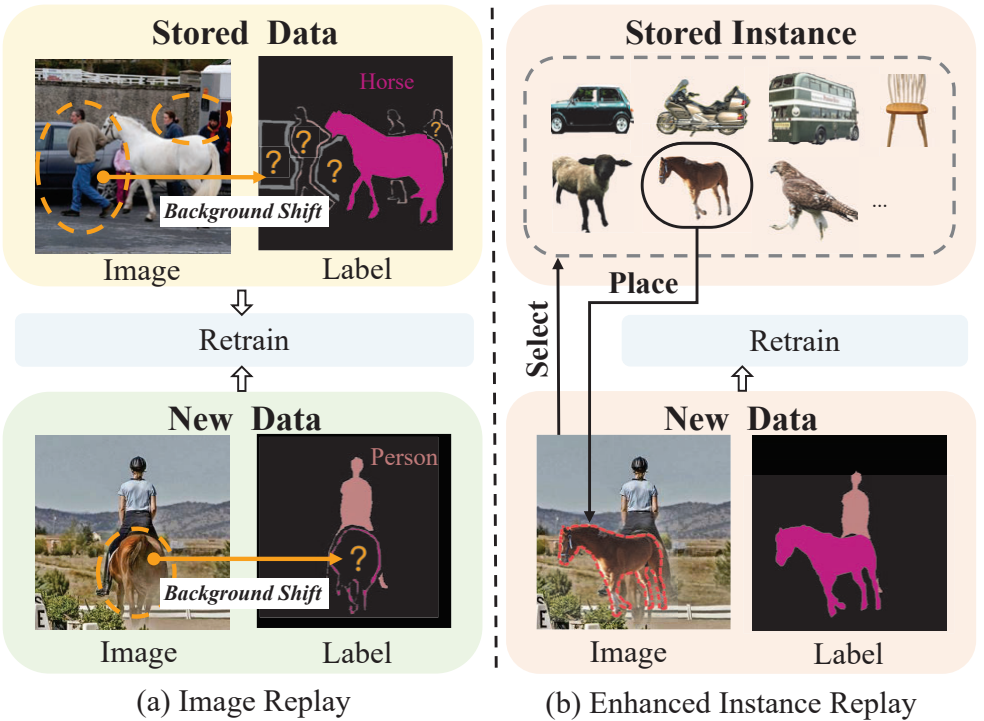
300 dpi PNG · Caption · Source PDF
Original caption, source, and provenance
Fixed source version: CVPR 2025 fixed official PDF
Earliest verified matching figure date (temporal proxy): 2025-03-28
arXiv v1 date: 2025-03-28
Actual drawing date: unknown. See the source record for version checks and temporal-evidence limitations.
Historical PDF · Download citation snapshot · Date evidence · Paper page · Complete screening and version record (Chinese)
Citation threshold evidence: Wei Feng; 11058 citations; snapshot 2026-10-22.
Recorded drawing-tool disclosure: unknown. No tool attribution is inferred from appearance; see the archival disclosure evidence for scope and wording.
Crop bounding box: [318, 263, 554, 436] (PDF points; top-left origin; x0, y0, x1, y1).
Figure 1. Comparison of traditional image replay (a) and our re-
play methods (b). (a) shows that only the old class “horse” is la-
beled in stored image, while other classes (new class “person” and
old class “car”) are labeled as background. Both old (“horse”) and
future classes in new images are labeled as background. (b) Our
method avoids confusing information in stored image by retaining
instances and alleviates background shift by fusing these instances
in the new image.
DFormerv2: Geometry Self-Attention for RGBD Semantic Segmentation
Venue: CVPR 2025 · Main-conference paper
Figure 4 · PDF page 4 · P180
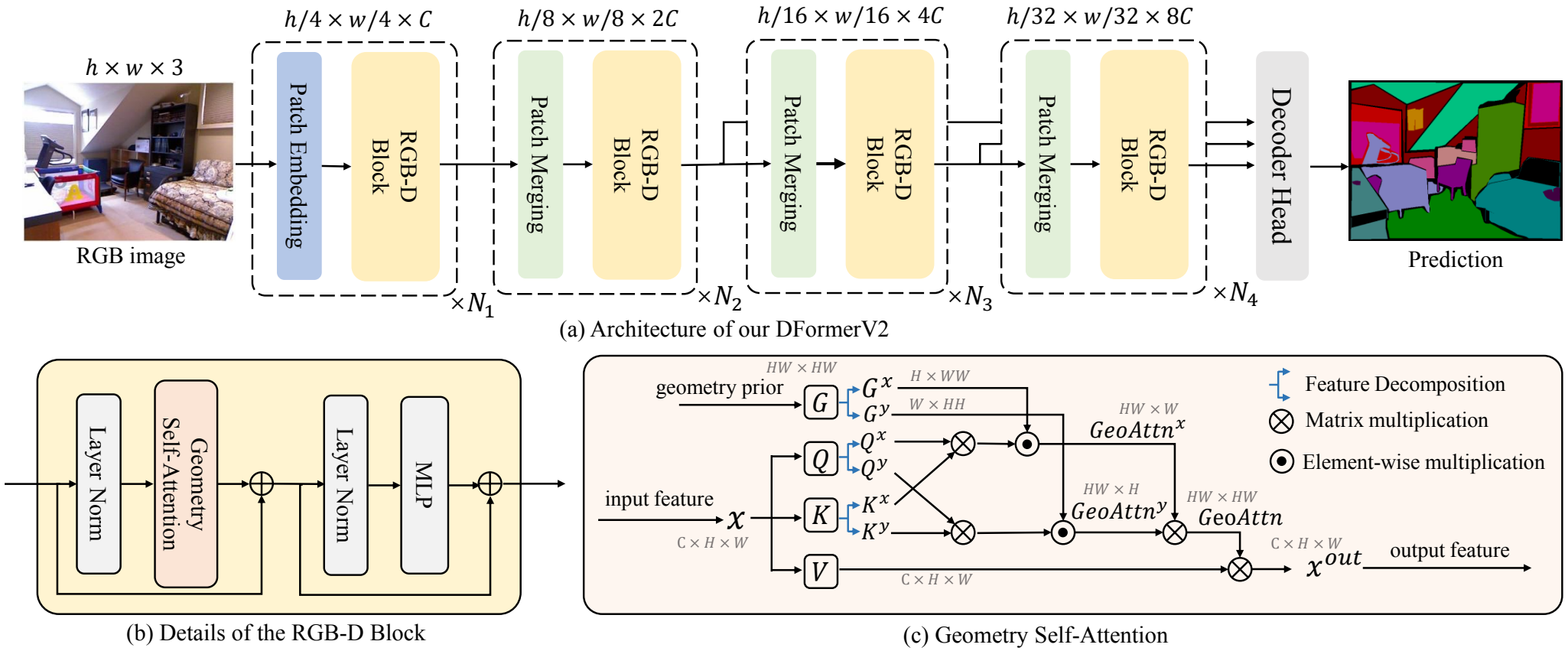
300 dpi PNG · Caption · Source PDF
Original caption, source, and provenance
Fixed source version: CVPR 2025 fixed official PDF
Earliest verified matching figure date (temporal proxy): 2025-04-07
arXiv v1 date: 2025-04-07
Actual drawing date: unknown. See the source record for version checks and temporal-evidence limitations.
Historical PDF · Download citation snapshot · Date evidence · Paper page · Complete screening and version record (Chinese)
Citation threshold evidence: Ming-Ming Cheng; 85763 citations; snapshot 2026-10-21.
Recorded drawing-tool disclosure: unknown. No tool attribution is inferred from appearance; see the archival disclosure evidence for scope and wording.
Crop bounding box: [60, 70, 552, 274] (PDF points; top-left origin; x0, y0, x1, y1).
Figure 4. Illustration of our DFormerv2. (a) Overall architecture of our DFormerv2, which contains an encoder with pyramid structure
and a decoder head that receives input from the last three stage features. (b) Detailed structure of the basic building block. (c) Detailed
illustration of the proposed geometry self-attention mechanism.
DFormerv2: Geometry Self-Attention for RGBD Semantic Segmentation
Venue: CVPR 2025 · Main-conference paper
Figure 1 · PDF page 1 · P179
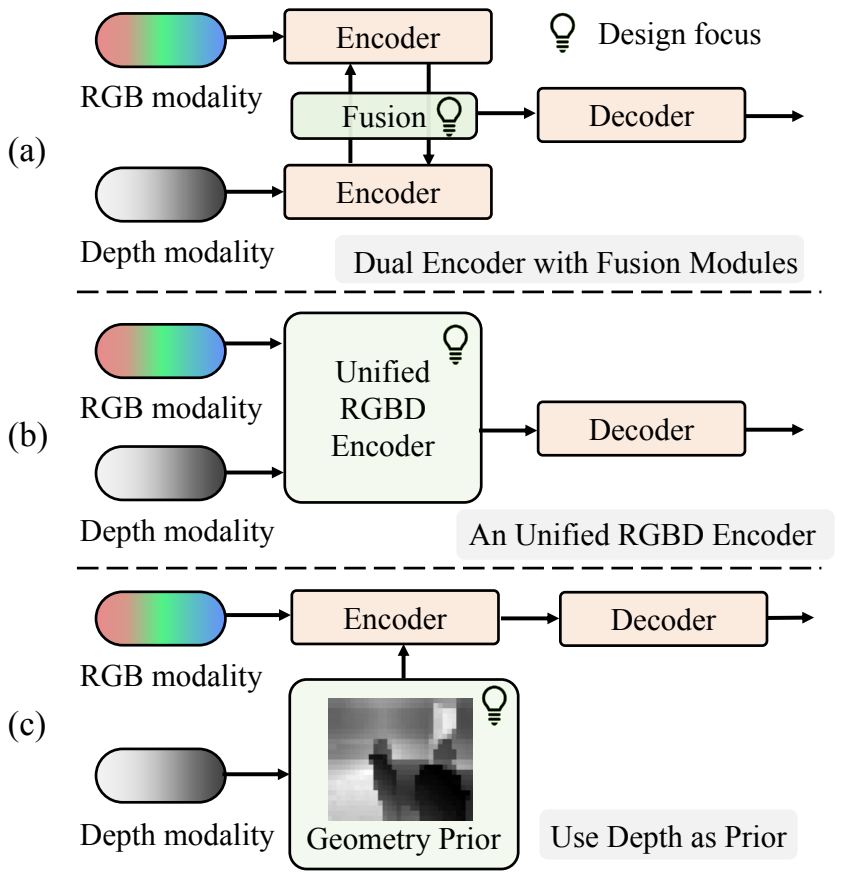
300 dpi PNG · Caption · Source PDF
Original caption, source, and provenance
Fixed source version: CVPR 2025 fixed official PDF
Earliest verified matching figure date (temporal proxy): 2025-04-07
arXiv v1 date: 2025-04-07
Actual drawing date: unknown. See the source record for version checks and temporal-evidence limitations.
Historical PDF · Download citation snapshot · Date evidence · Paper page · Complete screening and version record (Chinese)
Citation threshold evidence: Ming-Ming Cheng; 85763 citations; snapshot 2026-10-21.
Recorded drawing-tool disclosure: unknown. No tool attribution is inferred from appearance; see the archival disclosure evidence for scope and wording.
Crop bounding box: [333, 212, 535, 422] (PDF points; top-left origin; x0, y0, x1, y1).
Figure 1. Comparisons among the main RGBD segmentation
pipelines and our approach. (a) Use dual encoders to encode
RGB and depth respectively and design fusion modules to fusion
them [28, 61]; (b) Adopt an unified RGBD encoder to extract and
fuseRGBDfeatures[1,59]; (c)OurDFormerv2usedepthtoform
ageometrypriorofthesceneandthenenhancethevisualfeatures.
DPSeg: Dual-Prompt Cost Volume Learning for Open-Vocabulary Semantic Segmentation
Venue: CVPR 2025 · Main-conference paper
Figure 4 · PDF page 4 · P238
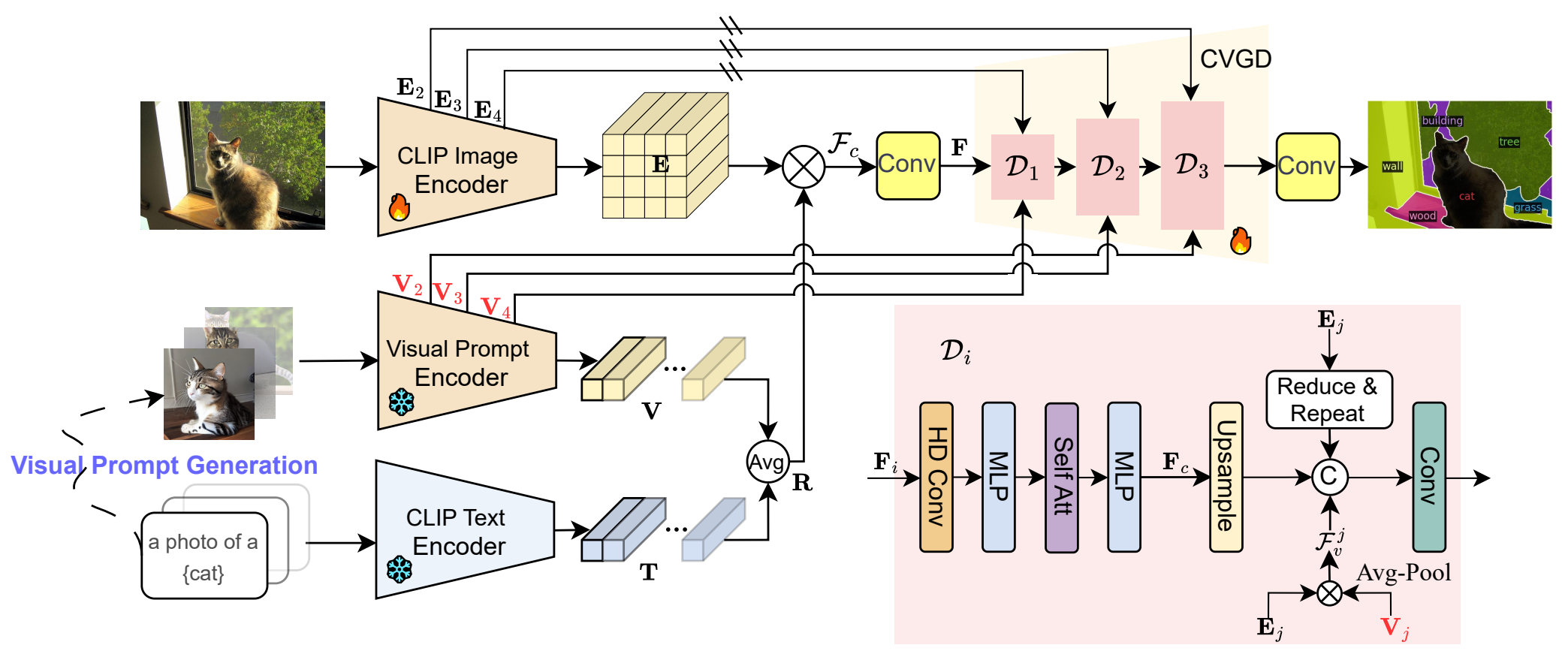
300 dpi PNG · Caption · Source PDF
Original caption, source, and provenance
Fixed source version: CVPR 2025 fixed official PDF
Earliest verified matching figure date (temporal proxy): 2025-05-16
arXiv v1 date: 2025-05-16
Actual drawing date: unknown. See the source record for version checks and temporal-evidence limitations.
Historical PDF · Download citation snapshot · Date evidence · Paper page · Complete screening and version record (Chinese)
Citation threshold evidence: Song Wang; 16213 citations; snapshot 2026-10-22.
Recorded drawing-tool disclosure: unknown. No tool attribution is inferred from appearance; see the archival disclosure evidence for scope and wording.
Crop bounding box: [56, 68, 557, 277] (PDF points; top-left origin; x0, y0, x1, y1).
Figure 4. Architecture of our DPSeg network. We begin by generating visual prompts based on text prompt templates, which are then
combined with text prompts to create the dual-prompt cost volume. Subsequently, we incorporate multi-scale image features and corre-
sponding visual prompt embeddings into the cost volume-guided decoder (CVGD) in a progressive manner.
DPSeg: Dual-Prompt Cost Volume Learning for Open-Vocabulary Semantic Segmentation
Venue: CVPR 2025 · Main-conference paper
Figure 1 · PDF page 1 · P237
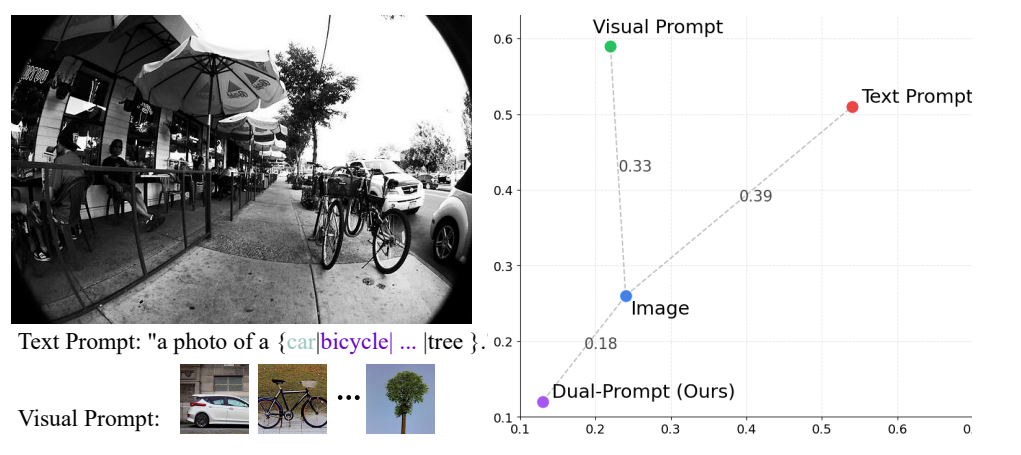
300 dpi PNG · Caption · Source PDF
Original caption, source, and provenance
Fixed source version: CVPR 2025 fixed official PDF
Earliest verified matching figure date (temporal proxy): 2025-05-16
arXiv v1 date: 2025-05-16
Actual drawing date: unknown. See the source record for version checks and temporal-evidence limitations.
Historical PDF · Download citation snapshot · Date evidence · Paper page · Complete screening and version record (Chinese)
Citation threshold evidence: Song Wang; 16213 citations; snapshot 2026-10-22.
Recorded drawing-tool disclosure: unknown. No tool attribution is inferred from appearance; see the archival disclosure evidence for scope and wording.
Crop bounding box: [315, 230, 560, 339] (PDF points; top-left origin; x0, y0, x1, y1).
Figure 1. T-SNE visualization of embeddings in CLIP feature
space, showing text prompt, visual prompt, target image, and
our dual-prompt for a street scene image. Numbers indicate dis-
tance to image feature, where our dual-prompt approach achieves
closest proximity (0.18).
Distilling Spectral Graph for Object-Context Aware Open-Vocabulary Semantic Segmentation
Venue: CVPR 2025 · Main-conference paper
Figure 1 · PDF page 1 · P128
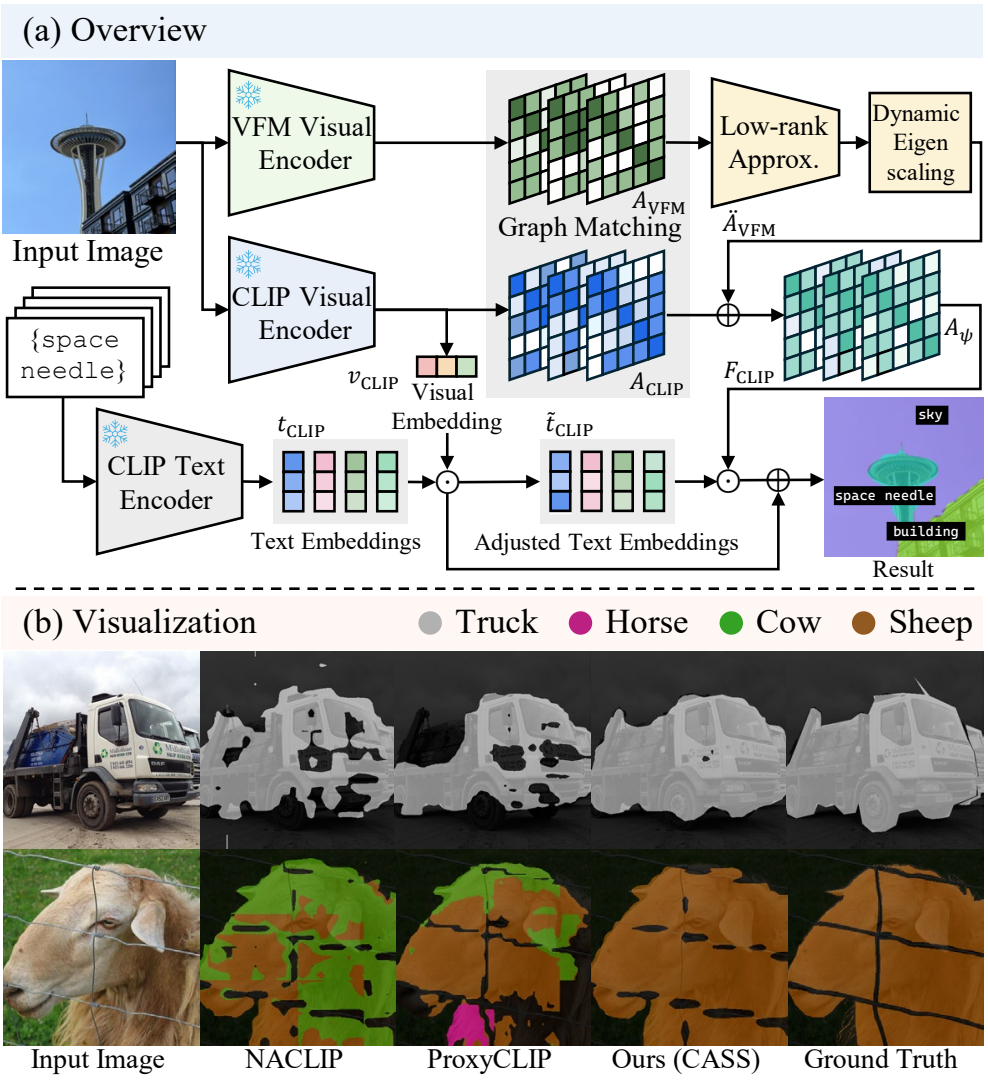
300 dpi PNG · Caption · Source PDF
Original caption, source, and provenance
Fixed source version: CVPR 2025 fixed official PDF
Earliest verified matching figure date (temporal proxy): 2025-03-16
arXiv v1 date: 2024-11-26
Actual drawing date: unknown. See the source record for version checks and temporal-evidence limitations.
Historical PDF · Download citation snapshot · Date evidence · Paper page · Complete screening and version record (Chinese)
Citation threshold evidence: Ming-Hsuan Yang; 189781 citations; snapshot 2026-10-21.
Recorded drawing-tool disclosure: unknown. No tool attribution is inferred from appearance; see the archival disclosure evidence for scope and wording.
Crop bounding box: [317, 245, 554, 505] (PDF points; top-left origin; x0, y0, x1, y1).
Figure 1. We present CASS, object-level Context-Aware
training-free open-vocabulary Semantic Segmentation model. (a)
Overview: Our method distills the vision foundation model’s
(VFM)object-levelcontextualspectralgraphintoCLIP’sattention
and refines query text embeddings towards object-specific seman-
tics. (b) Object-Level Context: This result illustrates how incor-
porating object-level context improves segmentation accuracy by
unifying object-wise components into a user-defined object class;
forexample,(toprow)ourapproachpreciselysegmentsthetruck’s
body, wheels, and cargo area and (bottom row) accurately groups
elements into a single object, such as the sheep, whereas base-
lines [16, 29] often fail to achieve this unified segmentation.
Distilling Spectral Graph for Object-Context Aware Open-Vocabulary Semantic Segmentation
Venue: CVPR 2025 · Main-conference paper
Figure 3 · PDF page 4 · P127
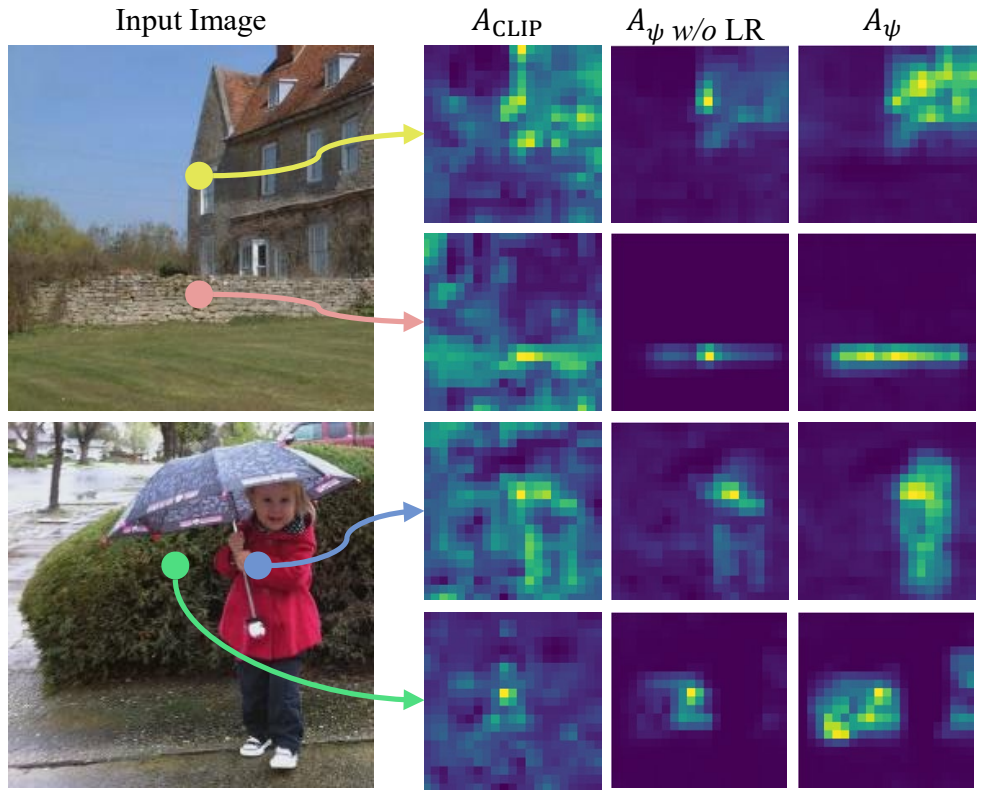
300 dpi PNG · Caption · Source PDF
Original caption, source, and provenance
Fixed source version: CVPR 2025 fixed official PDF
Earliest verified matching figure date (temporal proxy): 2024-11-26
arXiv v1 date: 2024-11-26
Actual drawing date: unknown. See the source record for version checks and temporal-evidence limitations.
Historical PDF · Download citation snapshot · Date evidence · Paper page · Complete screening and version record (Chinese)
Citation threshold evidence: Ming-Hsuan Yang; 189781 citations; snapshot 2026-10-21.
Recorded drawing-tool disclosure: unknown. No tool attribution is inferred from appearance; see the archival disclosure evidence for scope and wording.
Crop bounding box: [58, 71, 294, 262] (PDF points; top-left origin; x0, y0, x1, y1).
Figure 3. Attention score visualization for various query points.
Left: Vanilla CLIP (A ) shows noisy, unfocused attention.
CLIP
Center: VFM-to-CLIP distillation without low-rank eigenscaling
shows partial object grouping with limited detail. Right: Incor-
porating our low-rank eigenscaling (Eq. (7)) captures object-level
context, improving grouping within a single object.
Frozen CLIP: A Strong Backbone for Weakly Supervised Semantic Segmentation
Venue: CVPR 2024 · Main-conference paper
Figure 2 · PDF page 3 · P280
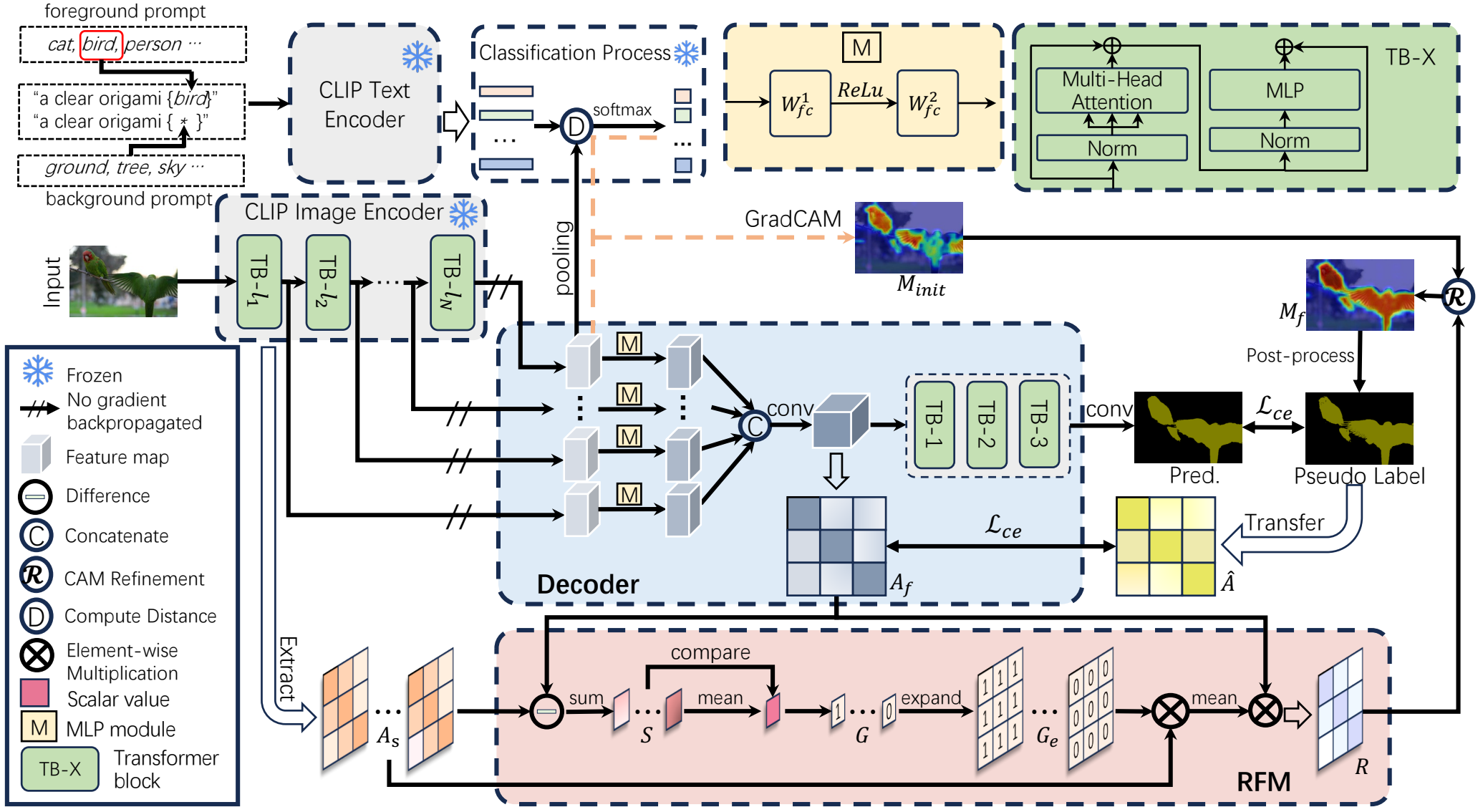
300 dpi PNG · Caption · Source PDF
Original caption, source, and provenance
Fixed source version: CVPR 2024 fixed official PDF
Earliest verified matching figure date (temporal proxy): 2024-06-17
arXiv v1 date: 2024-06-17
Actual drawing date: unknown. See the source record for version checks and temporal-evidence limitations.
Historical PDF · Download citation snapshot · Date evidence · Paper page · Complete screening and version record (Chinese)
Citation threshold evidence: Yunchao Wei; 37025 citations; snapshot 2026-10-21.
Recorded drawing-tool disclosure: unknown. No tool attribution is inferred from appearance; see the archival disclosure evidence for scope and wording.
Crop bounding box: [50, 72, 547, 344] (PDF points; top-left origin; x0, y0, x1, y1).
Figure 2. Framework of our WeCLIP. The image is input to the Frozen CLIP image encoder to generate the image features, and class
labels are used to build text prompts and then input to the Frozen CLIP text encoder to generate the text features. The classification scores
are generated based on the distance between the pooled image and text features. Using GradCAM, we can generate the initial CAM
M . Then, the frozen image features from the last layer of each transformer block are input to our decoder to generate the final semantic
init
segmentation predictions. Meanwhile, the affinity map A from our decoder and the multi-head attention maps A from CLIP are input to
f s
our RFM to establish refining maps R to refine M as M . After post-processing, it will be used as the supervision to train our decoder.
init f
Frozen CLIP: A Strong Backbone for Weakly Supervised Semantic Segmentation
Venue: CVPR 2024 · Main-conference paper
Figure 1 · PDF page 1 · P279
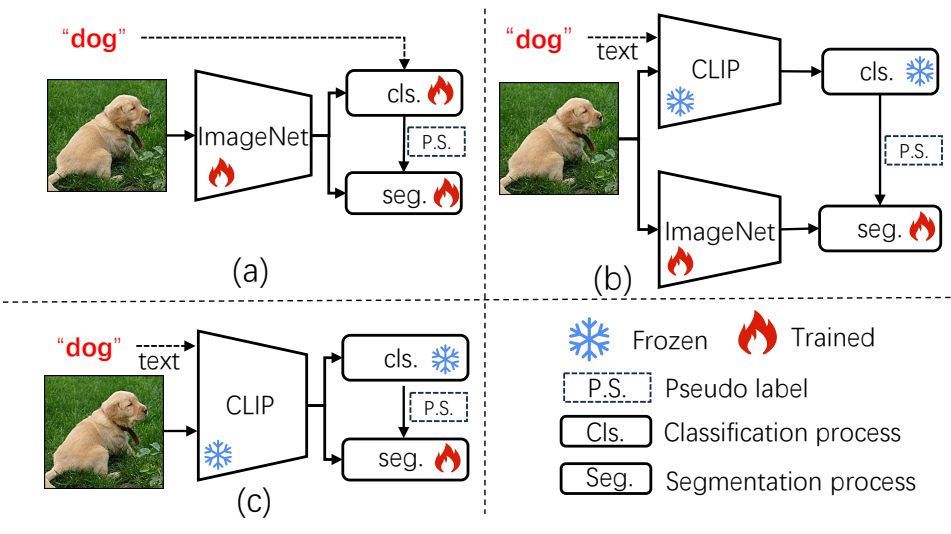
300 dpi PNG · Caption · Source PDF
Original caption, source, and provenance
Fixed source version: CVPR 2024 fixed official PDF
Earliest verified matching figure date (temporal proxy): 2024-06-17
arXiv v1 date: 2024-06-17
Actual drawing date: unknown. See the source record for version checks and temporal-evidence limitations.
Historical PDF · Download citation snapshot · Date evidence · Paper page · Complete screening and version record (Chinese)
Citation threshold evidence: Yunchao Wei; 37025 citations; snapshot 2026-10-21.
Recorded drawing-tool disclosure: unknown. No tool attribution is inferred from appearance; see the archival disclosure evidence for scope and wording.
Crop bounding box: [308, 230, 536, 358] (PDF points; top-left origin; x0, y0, x1, y1).
Figure 1. Comparisons between our approach and other single-
stage or CLIP-based approaches. (a) Previous single-stage ap-
proach, which uses a trainable ImageNet [11] pre-trained back-
bone with trainable classification and segmentation process. (b)
Previous CLIP-based approach, which is a multi-stage approach
that uses the Frozen CLIP model to produce pseudo labels and
trains an individual ImageNet pre-trained segmentation model. (c)
Our approach. Our approach is a single-stage approach that uses
a frozen CLIP model as the backbone with a trainable segmenta-
tion process, significantly reducing the training cost.
Hunting Attributes: Context Prototype-Aware Learning for Weakly Supervised Semantic Segmentation
Venue: CVPR 2024 · Main-conference paper
Figure 2 · PDF page 4 · P278
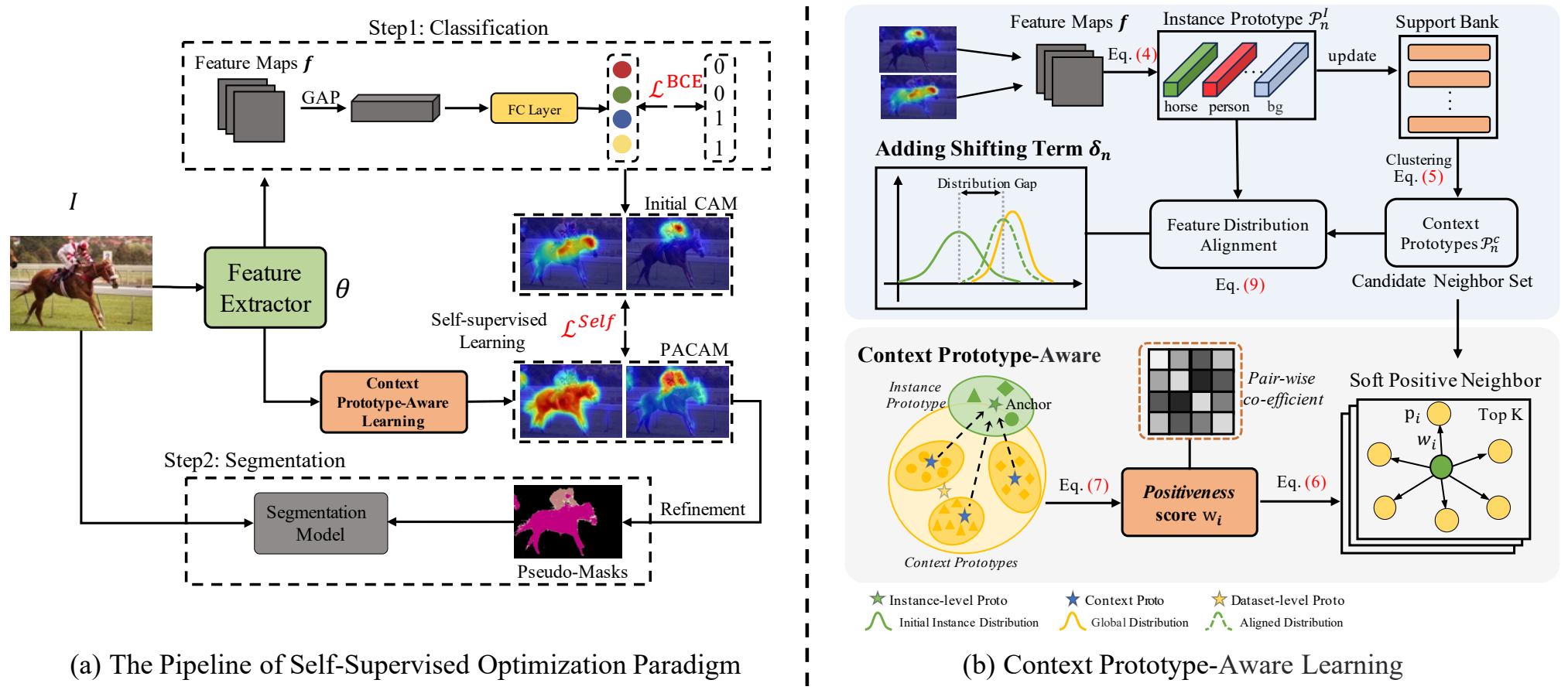
300 dpi PNG · Caption · Source PDF
Original caption, source, and provenance
Fixed source version: CVPR 2024 fixed official PDF
Earliest verified matching figure date (temporal proxy): 2024-03-12
arXiv v1 date: 2024-03-12
Actual drawing date: unknown. See the source record for version checks and temporal-evidence limitations.
Historical PDF · Download citation snapshot · Date evidence · Paper page · Complete screening and version record (Chinese)
Citation threshold evidence: Zongyuan Ge; 23901 citations; snapshot 2026-10-21.
Recorded drawing-tool disclosure: unknown. No tool attribution is inferred from appearance; see the archival disclosure evidence for scope and wording.
Crop bounding box: [53, 72, 539, 286] (PDF points; top-left origin; x0, y0, x1, y1).
Figure 2. Overview of the proposed unified learning framework. (a) shows image label-guided WSSS (from classification to segmentation).
The upper branch describes the classification network θ identifying object regions corresponding to each category to minimize LBC E .
Introduce a self-supervised learning paradigm using context prototype-aware learning to provide a more complete CAM, supervising the
initial CAM and minimizing LS elf . The lower branch refines these CAMs (e.g., DenceCRF [26]) to form pseudo-labels for supervising the
semantic segmentation network. (b) outlines our strategy based on context prototype-aware learning. In mini-batches, instance prototypes
P I are generated using CAM and extracted features f , updating the support bank. Then, the bank is used to construct a context prototype
n
set P c . Feature distribution alignment is then applied to the current instance features, adding a shift term δ to guide them toward clusters of
n n
dense features in the bank. Next, soft neighbors are softly measured for P I based on P c , with P I serving as anchors. Finally, positiveness
n n n
value w can be computed between two specific attributes. This mechanism selects K soft positive neighbors P˜ c to generate PACAM.
i n
Hunting Attributes: Context Prototype-Aware Learning for Weakly Supervised Semantic Segmentation
Venue: CVPR 2024 · Main-conference paper
Figure 1 · PDF page 1 · P277
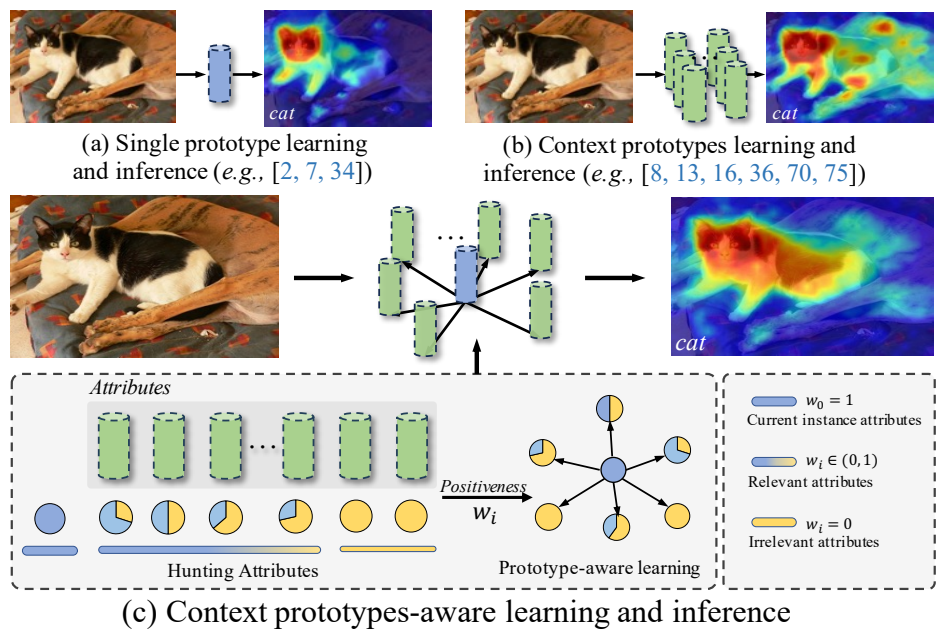
300 dpi PNG · Caption · Source PDF
Original caption, source, and provenance
Fixed source version: CVPR 2024 fixed official PDF
Earliest verified matching figure date (temporal proxy): 2024-03-12
arXiv v1 date: 2024-03-12
Actual drawing date: unknown. See the source record for version checks and temporal-evidence limitations.
Historical PDF · Download citation snapshot · Date evidence · Paper page · Complete screening and version record (Chinese)
Citation threshold evidence: Zongyuan Ge; 23901 citations; snapshot 2026-10-21.
Recorded drawing-tool disclosure: unknown. No tool attribution is inferred from appearance; see the archival disclosure evidence for scope and wording.
Crop bounding box: [313, 285, 540, 436] (PDF points; top-left origin; x0, y0, x1, y1).
Figure 1. The main idea promoted throughout the paper is that
semantic context prototype-aware underpins localization of indi-
vidual objects in WSSS. Our CPAL performs adaptive perception
of diverse attributes (e.g., cat) with attribute hunting (c) rather
than from single prototype (a) and plain context prototypes (b).
This attribute-specific adaptation not only mitigates the risk of er-
rors where (b) mistakenly identifies similar categories (e.g., dog)
but also ensures accurate activation of the complete object region.
Image-to-Image Matching via Foundation Models: A New Perspective for Open-Vocabulary Semantic Segmentation
Venue: CVPR 2024 · Main-conference paper
Figure 2 · PDF page 4 · P276
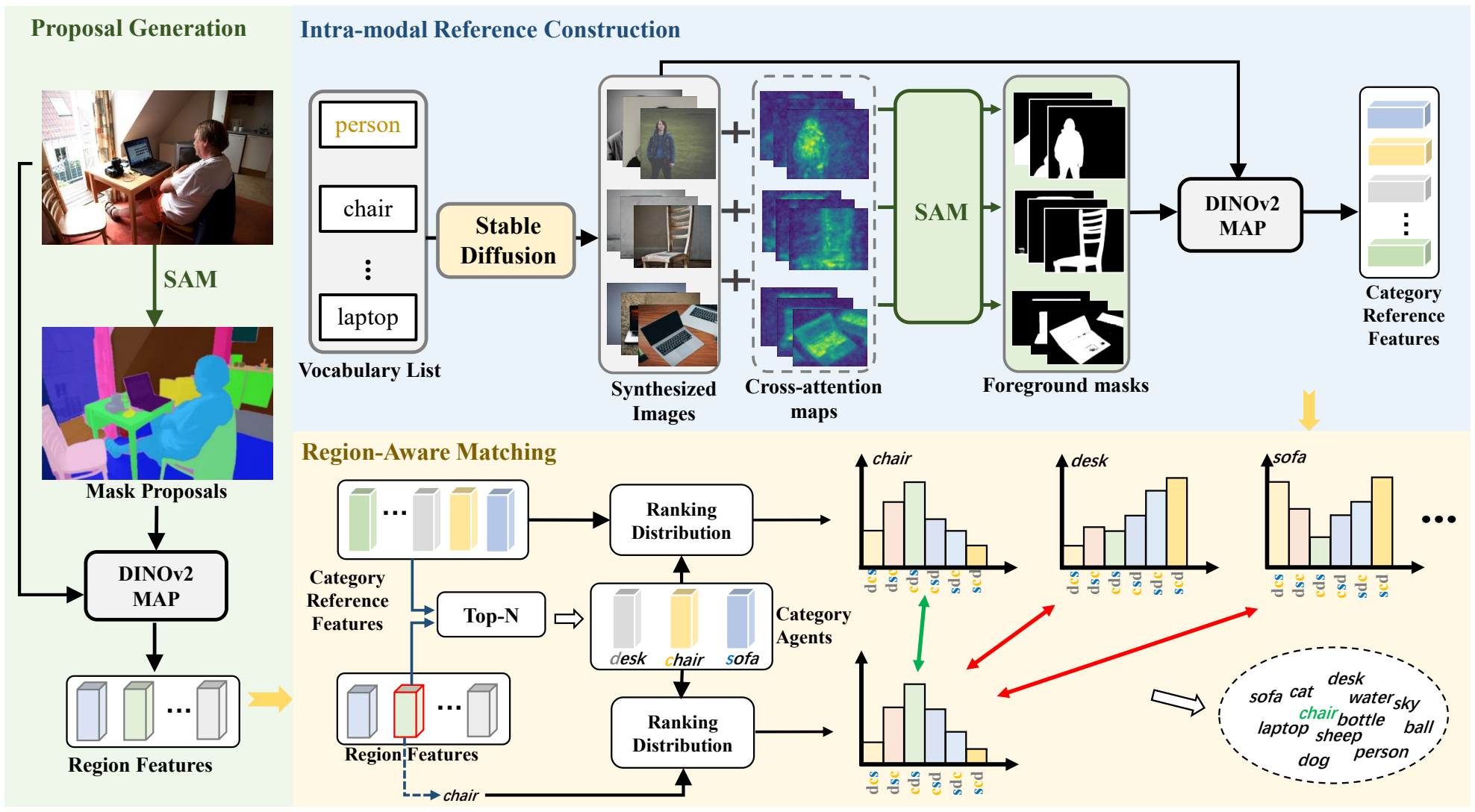
300 dpi PNG · Caption · Source PDF
Original caption, source, and provenance
Fixed source version: CVPR 2024 fixed official PDF
Earliest verified matching figure date (temporal proxy): 2024-03-30
arXiv v1 date: 2024-03-30
Actual drawing date: unknown. See the source record for version checks and temporal-evidence limitations.
Historical PDF · Download citation snapshot · Date evidence · Paper page · Complete screening and version record (Chinese)
Citation threshold evidence: Tianzhu Zhang; 23149 citations; snapshot 2026-10-21.
Recorded drawing-tool disclosure: unknown. No tool attribution is inferred from appearance; see the archival disclosure evidence for scope and wording.
Crop bounding box: [60, 75, 534, 336] (PDF points; top-left origin; x0, y0, x1, y1).
Figure 2. Framework of our proposed Relation-aware Intra-modal Matching (RIM) Network. We first explore Stable Diffusion model and
SAM to construct image-modal reference features, then we conduct relation-aware matching between region features and reference features
based on ranking distribution. The matching is established in the all-purpose feature spaces of DINOv2.
Image-to-Image Matching via Foundation Models: A New Perspective for Open-Vocabulary Semantic Segmentation
Venue: CVPR 2024 · Main-conference paper
Figure 1 · PDF page 1 · P275
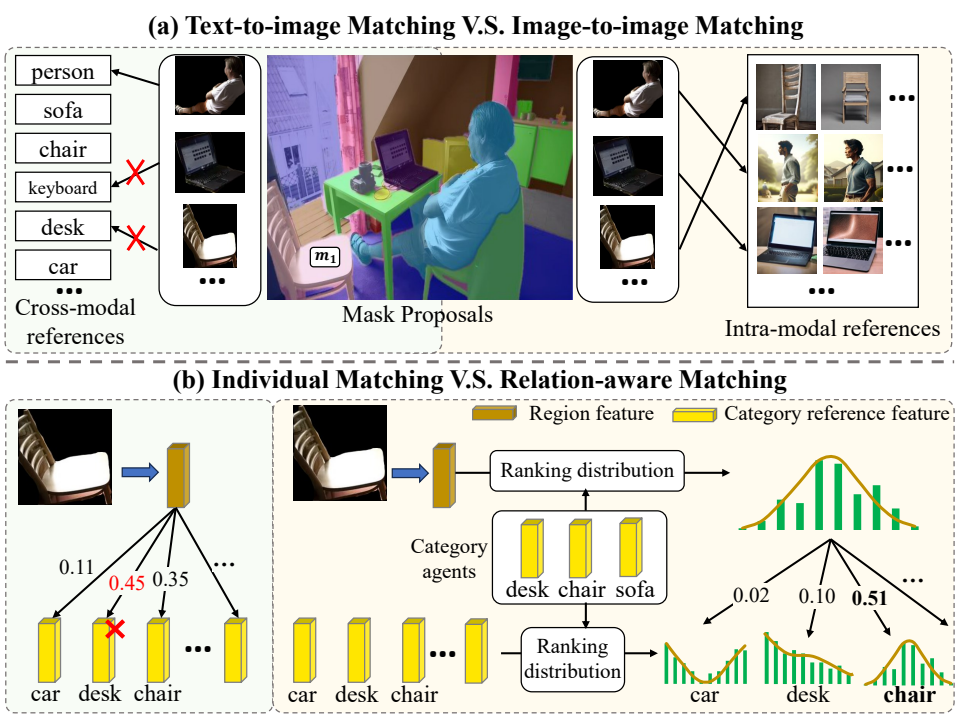
300 dpi PNG · Caption · Source PDF
Original caption, source, and provenance
Fixed source version: CVPR 2024 fixed official PDF
Earliest verified matching figure date (temporal proxy): 2024-03-30
arXiv v1 date: 2024-03-30
Actual drawing date: unknown. See the source record for version checks and temporal-evidence limitations.
Historical PDF · Download citation snapshot · Date evidence · Paper page · Complete screening and version record (Chinese)
Citation threshold evidence: Tianzhu Zhang; 23149 citations; snapshot 2026-10-21.
Recorded drawing-tool disclosure: unknown. No tool attribution is inferred from appearance; see the archival disclosure evidence for scope and wording.
Crop bounding box: [314, 245, 545, 418] (PDF points; top-left origin; x0, y0, x1, y1).
Figure 1. Motivation of our method. (a) False matches tend to
occur in cross-modal features. We establish well-aligned image-
modal reference features thus transit the text-to-image matching to
image-to-image matching. (b) Indivdual matching tends to suffer
from disturbances. We propose a novel relation-aware matching
strategy for more robust region classification.
MaSS13K: A Matting-level Semantic Segmentation Benchmark
Venue: CVPR 2025 · Main-conference paper
Figure 3 · PDF page 5 · P52
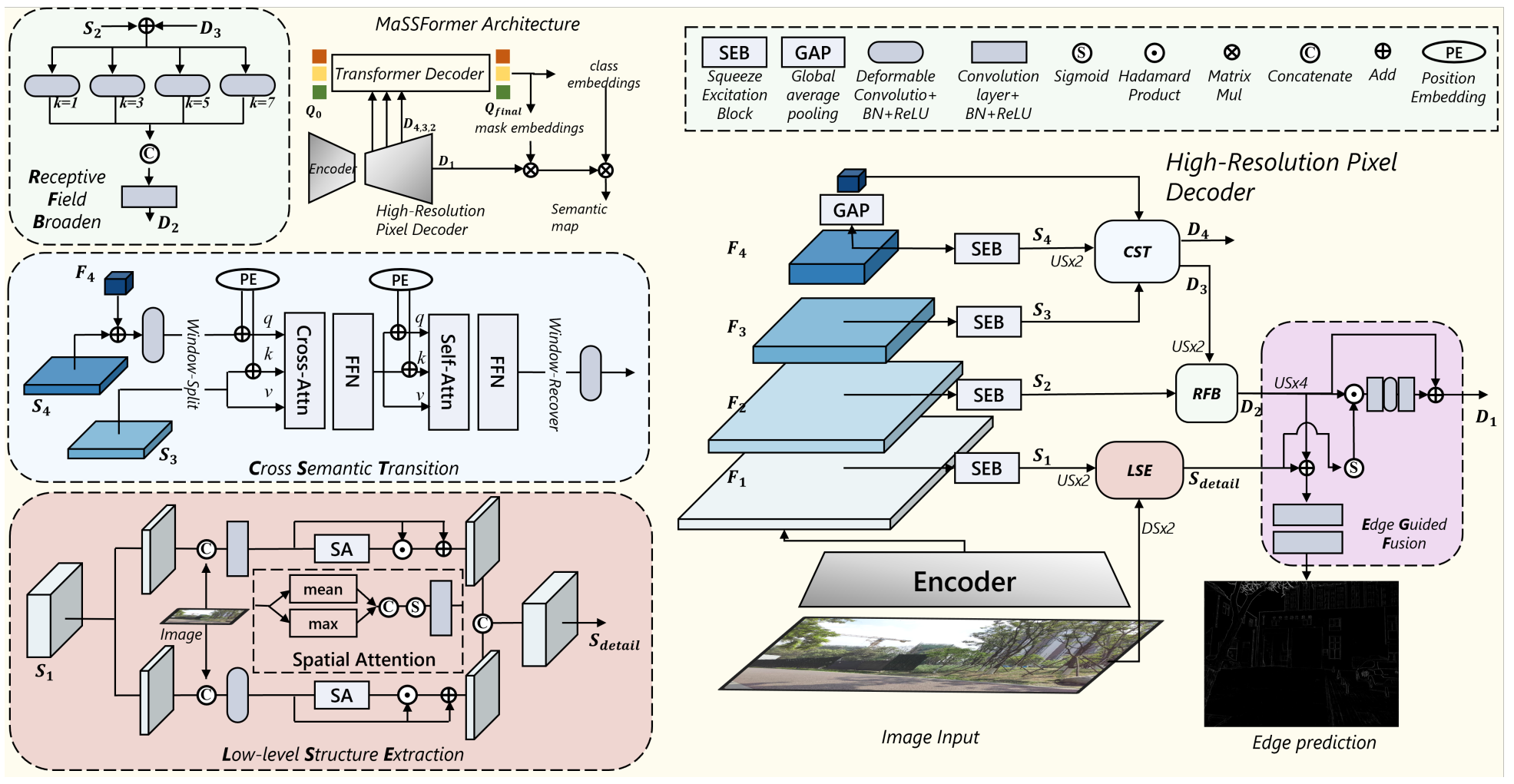
300 dpi PNG · Caption · Source PDF
Original caption, source, and provenance
Fixed source version: CVPR 2025 fixed official PDF
Earliest verified matching figure date (temporal proxy): 2025-03-24
arXiv v1 date: 2025-03-24
Actual drawing date: unknown. See the source record for version checks and temporal-evidence limitations.
Historical PDF · Download citation snapshot · Date evidence · Complete screening and version record (Chinese)
Citation threshold evidence: Lei Zhang; 137335 citations; snapshot 2026-10-21.
Recorded drawing-tool disclosure: unknown. No tool attribution is inferred from appearance; see the archival disclosure evidence for scope and wording.
Crop bounding box: [61, 70, 534, 315] (PDF points; top-left origin; x0, y0, x1, y1).
Figure 3. Architecture of MaSSFormer. The model architecture is shown on the top left corner, including the image encoder, pixel decoder
and transformer decoder. The detailed structure of the high-resolution pixel decoder is shown on the right of this figure.
MaSS13K: A Matting-level Semantic Segmentation Benchmark
Venue: CVPR 2025 · Main-conference paper
Figure 1 · PDF page 1 · P51
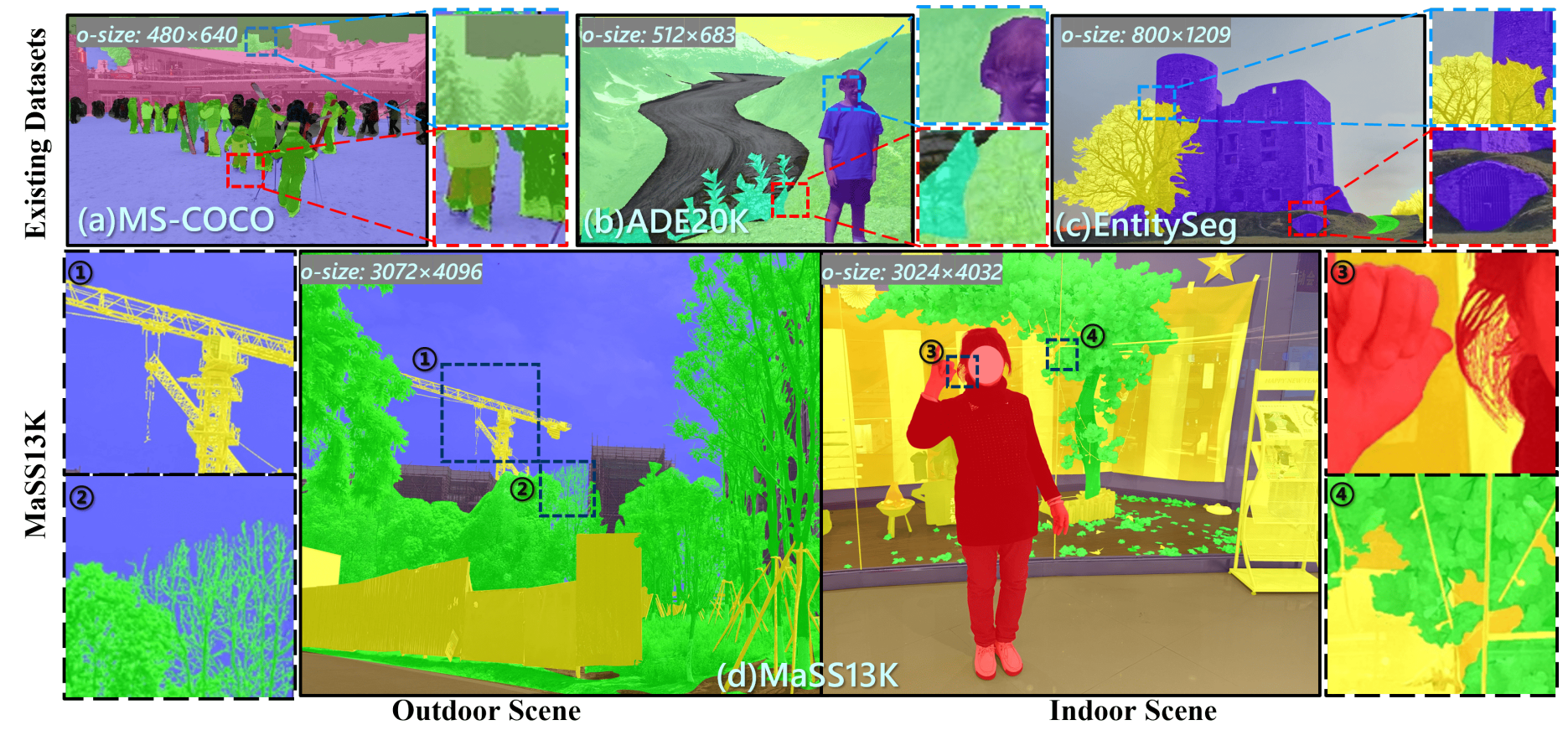
300 dpi PNG · Caption · Source PDF
Original caption, source, and provenance
Fixed source version: CVPR 2025 fixed official PDF
Earliest verified matching figure date (temporal proxy): 2025-03-24
arXiv v1 date: 2025-03-24
Actual drawing date: unknown. See the source record for version checks and temporal-evidence limitations.
Historical PDF · Download citation snapshot · Date evidence · Complete screening and version record (Chinese)
Citation threshold evidence: Lei Zhang; 137335 citations; snapshot 2026-10-21.
Recorded drawing-tool disclosure: unknown. No tool attribution is inferred from appearance; see the archival disclosure evidence for scope and wording.
Crop bounding box: [73, 191, 522, 400] (PDF points; top-left origin; x0, y0, x1, y1).
Figure 1. Comparisons on the resolution and annotation quality between existing semantic segmentation datasets (a) COCO, (b) ADE20K,
(c) EntitySeg and (d) our established dataset MaSS13K. Note that the ‘others’ category, which is highlighted in yellow, in our MaSS13K
actually contains a group of well-segmented objects without specific class names. Please zoom-in for a better view.
Mamba as a Bridge: Where Vision Foundation Models Meet Vision Language Models for Domain-Generalized Semantic Segmentation
Venue: CVPR 2025 · Main-conference paper
Figure 2 · PDF page 4 · P56
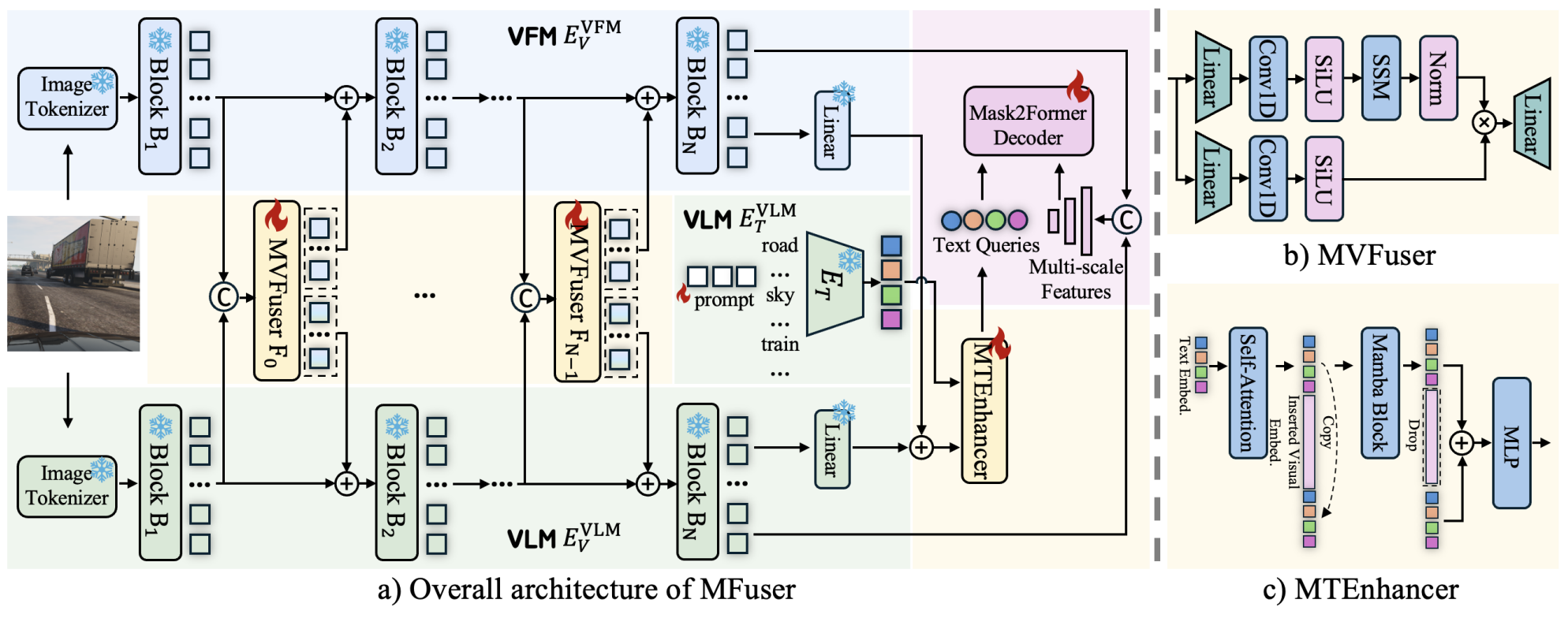
300 dpi PNG · Caption · Source PDF
Original caption, source, and provenance
Fixed source version: CVPR 2025 fixed official PDF
Earliest verified matching figure date (temporal proxy): 2025-04-04
arXiv v1 date: 2025-04-04
Actual drawing date: unknown. See the source record for version checks and temporal-evidence limitations.
Historical PDF · Download citation snapshot · Date evidence · Complete screening and version record (Chinese)
Citation threshold evidence: Robby T. Tan; 18517 citations; snapshot 2026-10-21.
Recorded drawing-tool disclosure: unknown. No tool attribution is inferred from appearance; see the archival disclosure evidence for scope and wording.
Crop bounding box: [68, 71, 545, 259] (PDF points; top-left origin; x0, y0, x1, y1).
Figure 2. Overall architecture of MFuser. MFuser takes inputs through both VFM and VLM visual encoders. Features from each encoder
layer are concatenated and refined in MVFuser, which captures sequential and spatial dependencies in parallel. The refined features are
then added back to the original features and passed to the next layer. MTEnhancer strengthens text embeddings of each class by integrating
visualfeaturesthroughahybridattention-Mambamechanism. TheenhancedtextembeddingsserveasobjectqueriesfortheMask2Former
decoder, alongside multi-scale visual features. During training, only MVFusers, MTEnhancers, and the segmentation decoder are trainable
while the VFM and VLM remain frozen, preserving their generalization ability and enabling efficient training. Note that skip connections
between each block of MTEnhancer are omitted for clarity.
Mamba as a Bridge: Where Vision Foundation Models Meet Vision Language Models for Domain-Generalized Semantic Segmentation
Venue: CVPR 2025 · Main-conference paper
Figure 1 · PDF page 1 · P55
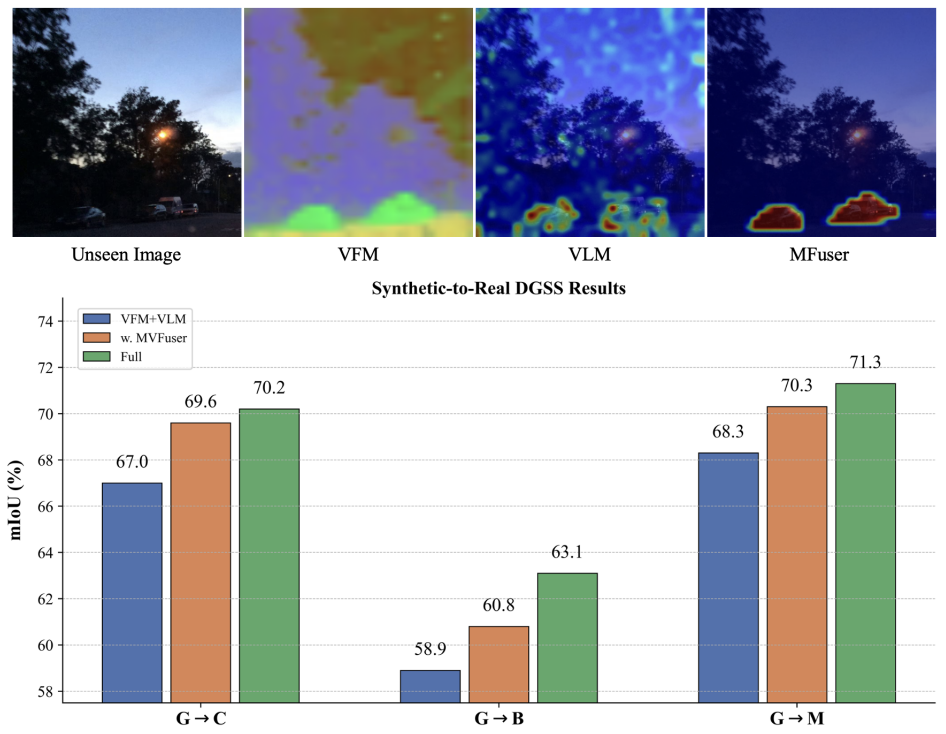
300 dpi PNG · Caption · Source PDF
Original caption, source, and provenance
Fixed source version: CVPR 2025 fixed official PDF
Earliest verified matching figure date (temporal proxy): 2025-04-04
arXiv v1 date: 2025-04-04
Actual drawing date: unknown. See the source record for version checks and temporal-evidence limitations.
Historical PDF · Download citation snapshot · Date evidence · Complete screening and version record (Chinese)
Citation threshold evidence: Robby T. Tan; 18517 citations; snapshot 2026-10-21.
Recorded drawing-tool disclosure: unknown. No tool attribution is inferred from appearance; see the archival disclosure evidence for scope and wording.
Crop bounding box: [322, 231, 549, 407] (PDF points; top-left origin; x0, y0, x1, y1).
Figure 1. Comparative analysis of the VFM and the VLM fea-
tures. VFM: Visualization of PCA-computed features from DI-
NOv2 (the first three components of PCA, computed on the image
features, serve as color channels), displaying fine-grained details
but lacking text alignment. VLM: Image-text similarity map from
EVA02-CLIPusingthequery‘car’,demonstratinggoodalignment
with text but insufficient localization of queried objects. MFuser:
OurproposedfusionframeworkintegratesVFMandVLM,result-
ing in unified features that exhibit both precise locality and robust
text alignment. Quantitative results on synthetic-to-real DGSS
benchmarks further validate our approach, with MFuser consis-
tently achieving the highest mIoU scores across all tasks.
SegMAN: Omni-scale Context Modeling with State Space Models and Local Attention for Semantic Segmentation
Venue: CVPR 2025 · Main-conference paper
Figure 3 · PDF page 4 · P54
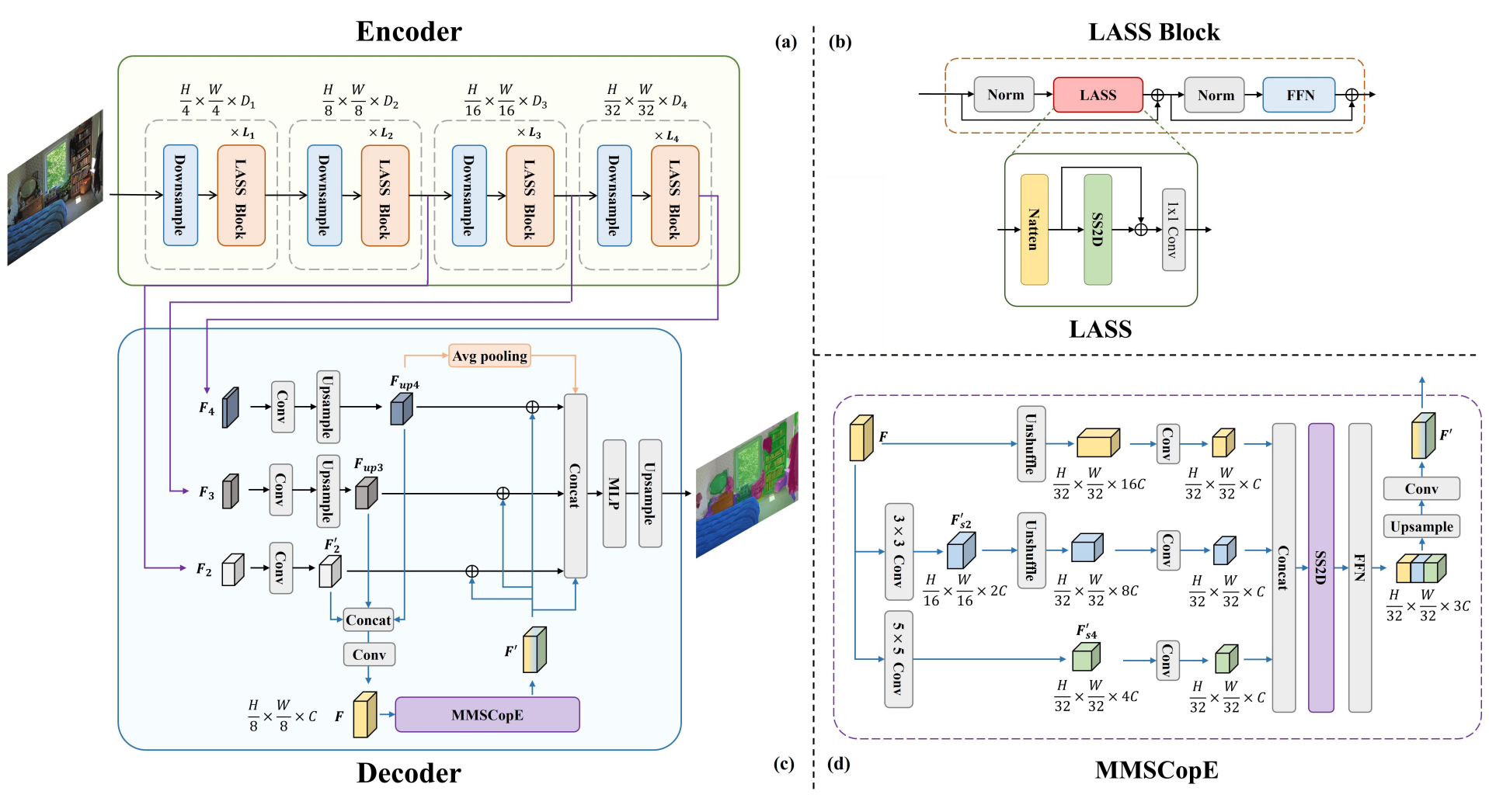
300 dpi PNG · Caption · Source PDF
Original caption, source, and provenance
Fixed source version: CVPR 2025 fixed official PDF
Earliest verified matching figure date (temporal proxy): 2025-03-27
arXiv v1 date: 2024-12-16
Actual drawing date: unknown. See the source record for version checks and temporal-evidence limitations.
Historical PDF · Download citation snapshot · Date evidence · Complete screening and version record (Chinese)
Citation threshold evidence: Yizhou Yu; 35607 citations; snapshot 2026-10-21.
Recorded drawing-tool disclosure: unknown. No tool attribution is inferred from appearance; see the archival disclosure evidence for scope and wording.
Crop bounding box: [76, 71, 536, 322] (PDF points; top-left origin; x0, y0, x1, y1).
Figure 3. Overall Architecture of SegMAN. (a) Hierarchical SegMAN Encoder. (b) LASS for modeling global contexts and local details
with linear complexity. (c) The SegMAN Decoder. (d) The MMSCopE module for multi-scale contexts extraction.
SegMAN: Omni-scale Context Modeling with State Space Models and Local Attention for Semantic Segmentation
Venue: CVPR 2025 · Main-conference paper
Figure 2 · PDF page 2 · P53
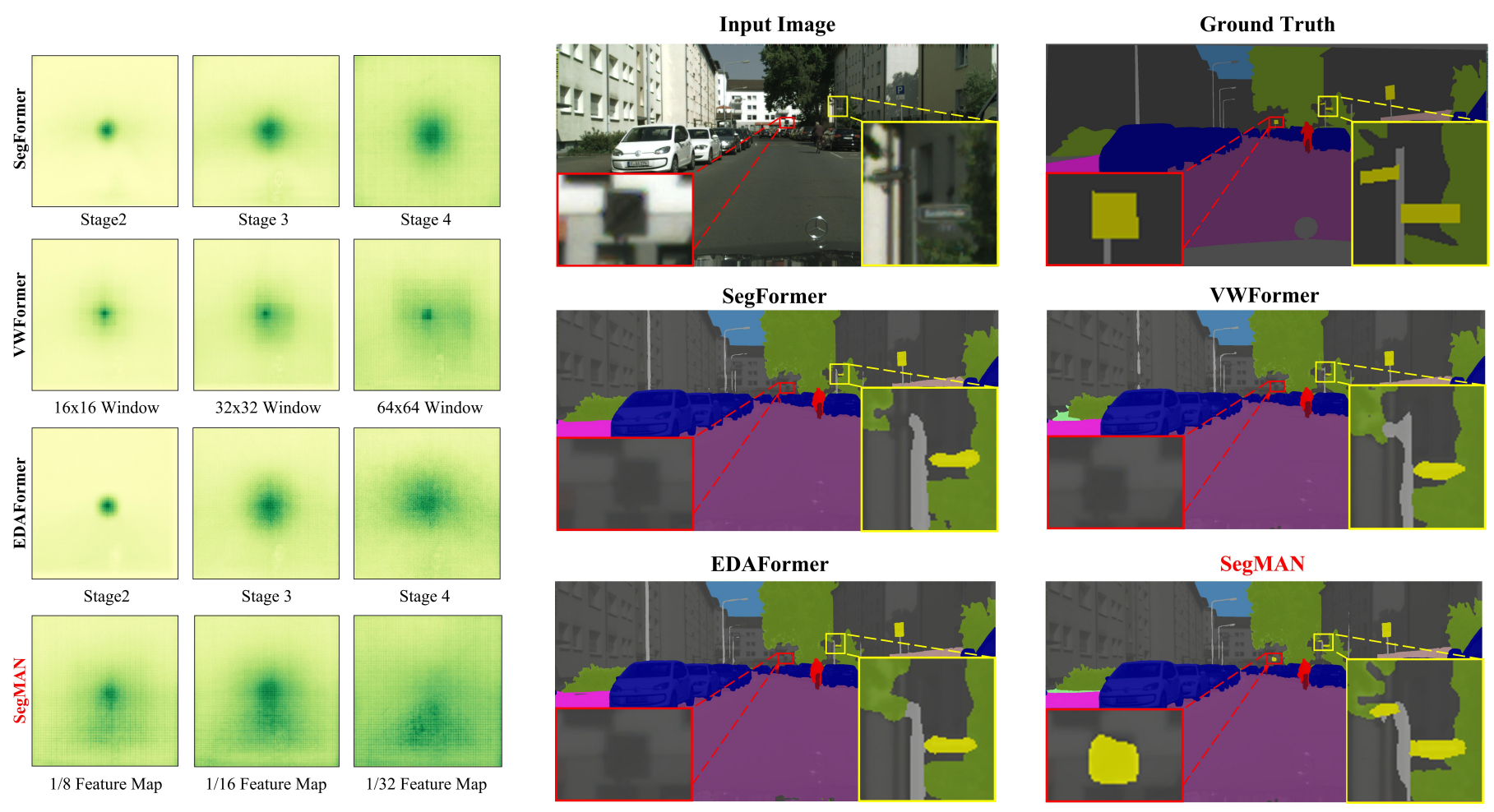
300 dpi PNG · Caption · Source PDF
Original caption, source, and provenance
Fixed source version: CVPR 2025 fixed official PDF
Earliest verified matching figure date (temporal proxy): 2024-12-16
arXiv v1 date: 2024-12-16
Actual drawing date: unknown. See the source record for version checks and temporal-evidence limitations.
Historical PDF · Download citation snapshot · Date evidence · Complete screening and version record (Chinese)
Citation threshold evidence: Yizhou Yu; 35607 citations; snapshot 2026-10-21.
Recorded drawing-tool disclosure: unknown. No tool attribution is inferred from appearance; see the archival disclosure evidence for scope and wording.
Crop bounding box: [87, 71, 523, 308] (PDF points; top-left origin; x0, y0, x1, y1).
Figure 2. Qualitative analysis of receptive field patterns and segmentation performance for small-sized models (27M-29M parameters).
Left: Visualization of effective receptive fields (ERF) on the Cityscapes validation set at 1024×1024 resolution, illustrating SegMAN’s
stronger global context modeling capacity in comparison to existing state-of-the-art models. Right: Segmentation maps highlighting
SegMAN’s superior capacity to encode fine-grained local details that are often missed by existing approaches.
Adversarial Diffusion Compression for Real-World Image Super-Resolution
Venue: CVPR 2025 · Main-conference paper
Figure 3 · PDF page 4 · P102
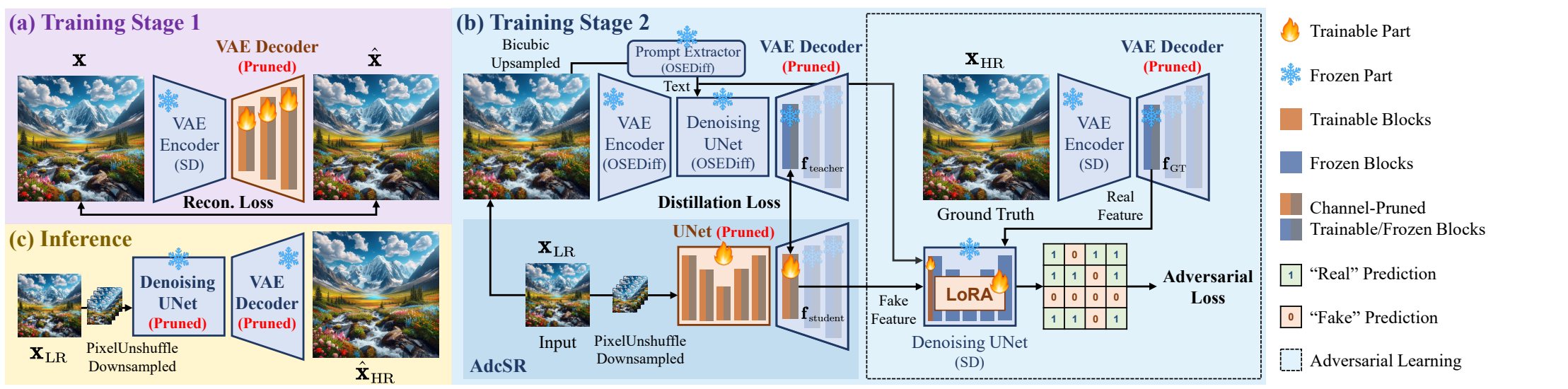
300 dpi PNG · Caption · Source PDF
Original caption, source, and provenance
Fixed source version: CVPR 2025 fixed official PDF
Earliest verified matching figure date (temporal proxy): 2024-11-20
arXiv v1 date: 2024-11-20
Actual drawing date: unknown. See the source record for version checks and temporal-evidence limitations.
Historical PDF · Download citation snapshot · Date evidence · Paper page · Complete screening and version record (Chinese)
Citation threshold evidence: Lei Zhang; 137335 citations; snapshot 2026-10-21.
Recorded drawing-tool disclosure: unknown. No tool attribution is inferred from appearance; see the archival disclosure evidence for scope and wording.
Crop bounding box: [58, 65, 590, 197] (PDF points; top-left origin; x0, y0, x1, y1).
Figure3. IllustrationofthetrainingandinferenceprocessesofAdcSR,aninstantiationofourADCframeworkappliedtoOSEDiff.
(a)InStage1,wepretrainaprunedVAEdecoderthatsharesthelatentspacewithSDandOSEDiff. (b)InStage2,wedistilltheknowledge
from OSEDiff (ADC-teacher) into AdcSR (ADC-student) by aligning features in the pretrained decoder. An adversarial loss encourages
the student to generate features that can fool a LoRA-finetuned SD UNet (ADC-discriminator), utilizing the corresponding real features
of GT images. Since all supervisions perform in the feature space, there is no need to decode images as in previous approaches [96, 112].
(c) During inference, the LR image is directly fed into our trained compressed UNet and VAE decoder to obtain the super-resolution result.
Adversarial Diffusion Compression for Real-World Image Super-Resolution
Venue: CVPR 2025 · Main-conference paper
Figure 1 · PDF page 1 · P101
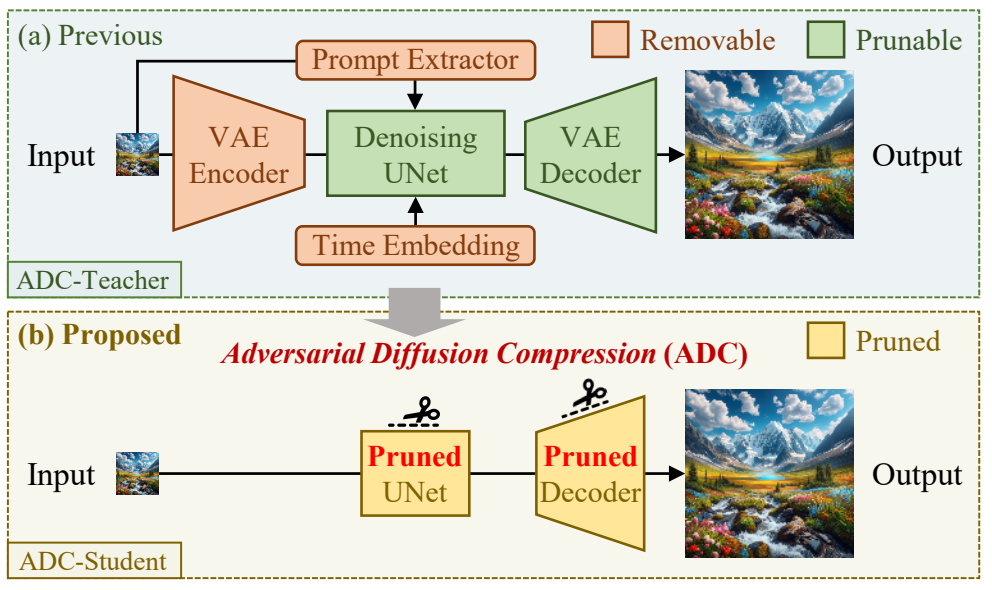
300 dpi PNG · Caption · Source PDF
Original caption, source, and provenance
Fixed source version: CVPR 2025 fixed official PDF
Earliest verified matching figure date (temporal proxy): 2024-11-20
arXiv v1 date: 2024-11-20
Actual drawing date: unknown. See the source record for version checks and temporal-evidence limitations.
Historical PDF · Download citation snapshot · Date evidence · Paper page · Complete screening and version record (Chinese)
Citation threshold evidence: Lei Zhang; 137335 citations; snapshot 2026-10-21.
Recorded drawing-tool disclosure: unknown. No tool attribution is inferred from appearance; see the archival disclosure evidence for scope and wording.
Crop bounding box: [317, 260, 555, 401.5] (PDF points; top-left origin; x0, y0, x1, y1).
Figure 1. Comparison between our proposed AdcSR and typ-
ical one-step diffusion-based Real-ISR methods. (a) The state-
of-the-art one-step diffusion network OSEDiff [96] employs com-
plete SD [80] models for Real-ISR, suffering from high computa-
tional costs. (b) We distill OSEDiff (ADC-teacher) into a smaller
diffusion-GAN hybrid model, AdcSR (ADC-student), under the
proposed ADC framework, achieving significantly improved effi-
ciency while maintaining competitive recovery performance.
Complexity Experts are Task-Discriminative Learners for Any Image Restoration
Venue: CVPR 2025 · Main-conference paper
Figure 2 · PDF page 3 · P68
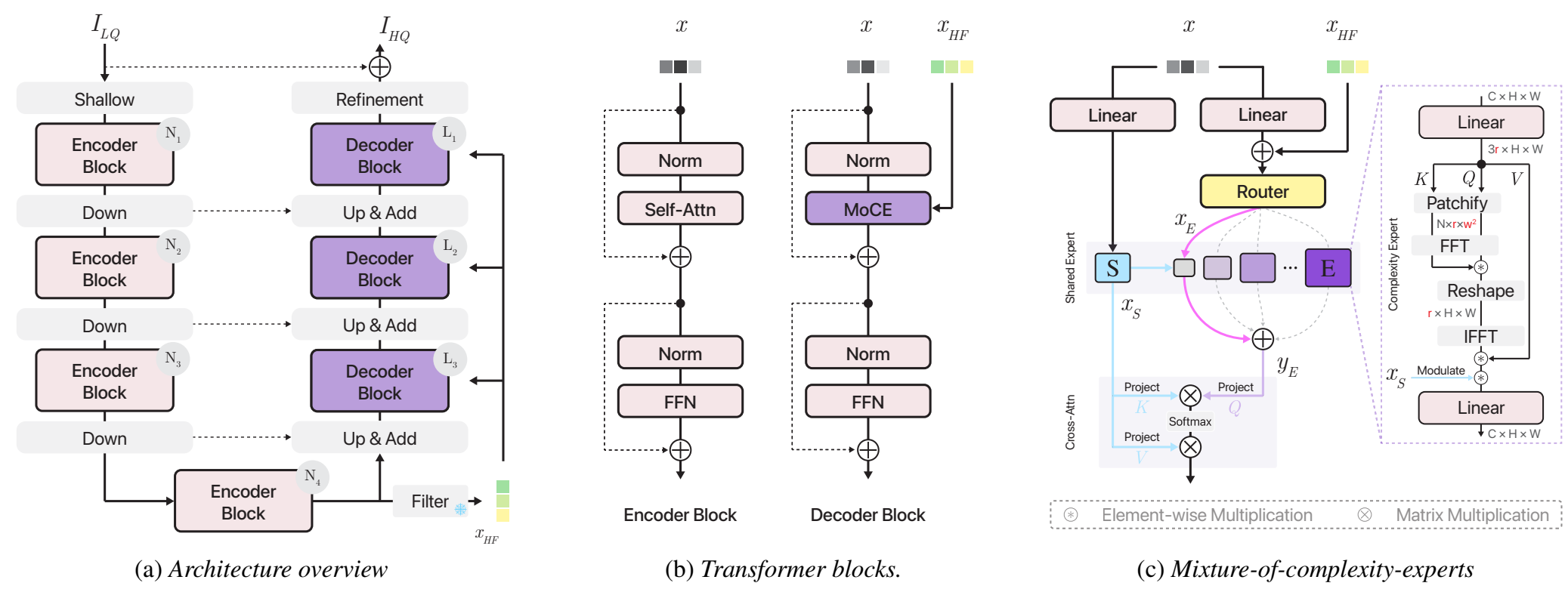
300 dpi PNG · Caption · Source PDF
Original caption, source, and provenance
Fixed source version: CVPR 2025 fixed official PDF
Earliest verified matching figure date (temporal proxy): 2025-03-13
arXiv v1 date: 2024-11-27
Actual drawing date: unknown. See the source record for version checks and temporal-evidence limitations.
Historical PDF · Download citation snapshot · Date evidence · Paper page · Complete screening and version record (Chinese)
Citation threshold evidence: Yulun Zhang; 40552 citations; snapshot 2026-10-21.
Recorded drawing-tool disclosure: unknown. No tool attribution is inferred from appearance; see the archival disclosure evidence for scope and wording.
Crop bounding box: [57, 70, 555, 257] (PDF points; top-left origin; x0, y0, x1, y1).
Figure 2. Proposed MoCE-IR framework. Despite recent advances in MoE-based image restoration [57, 62, 63], inconsistent expert
behavior—where some experts over-generalize while others underperform—limits their computational efficiency. We address this through
complexity experts: flexible blocks with varying computational capacity and receptive fields. Our MoCE-IR employs an asymmetric
encoder-decoder architecture where each decoder block contains a mixture-of-complexity-experts layer for adaptive capacity routing.
Complexity Experts are Task-Discriminative Learners for Any Image Restoration
Venue: CVPR 2025 · Main-conference paper
Figure 1 · PDF page 1 · P67
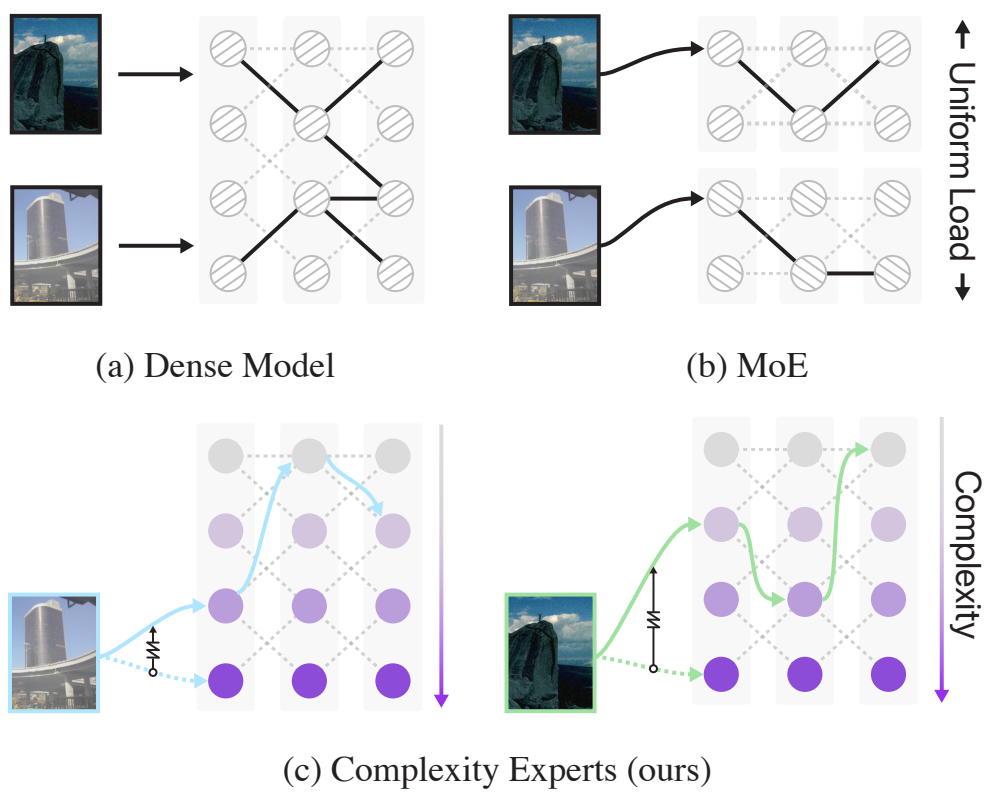
300 dpi PNG · Caption · Source PDF
Original caption, source, and provenance
Fixed source version: CVPR 2025 fixed official PDF
Earliest verified matching figure date (temporal proxy): 2024-11-27
arXiv v1 date: 2024-11-27
Actual drawing date: unknown. See the source record for version checks and temporal-evidence limitations.
Historical PDF · Download citation snapshot · Date evidence · Paper page · Complete screening and version record (Chinese)
Citation threshold evidence: Yulun Zhang; 40552 citations; snapshot 2026-10-21.
Recorded drawing-tool disclosure: unknown. No tool attribution is inferred from appearance; see the archival disclosure evidence for scope and wording.
Crop bounding box: [316, 225, 555, 416] (PDF points; top-left origin; x0, y0, x1, y1).
Figure 1. Motivation. (a) Dense all-in-one restoration meth-
ods [24, 57] often inefficiently allocate parameters when handling
multiple degradation types. (b) While recent Mixture-of-Experts
(MoE) approaches [61, 62] address this through sparse computa-
tion, their rigid routing mechanisms uniformly distribute inputs
across experts without considering the natural relationships be-
tween degradations. (c) To overcome these limitations, we intro-
duce Complexity Experts - adaptive processing blocks with size-
varying computational units. Our framework dynamically allocates
model capacity using a spring-inspired force mechanism that con-
tinuously guides routing decisions toward simpler experts when
possible, with the force proportional to the complexity of the input
degradation. While initially designed for computational efficiency,
this approach naturally emerges as a task-discriminative learning
framework, assigning degradations to the most suitable experts.
This makes it particularly effective for all-in-one restoration meth-
ods, where both task-specific processing and cross-degradation
knowledge sharing are crucial.
DORNet: A Degradation Oriented and Regularized Network for Blind Depth Super-Resolution
Venue: CVPR 2025 · Main-conference paper
Figure 3 · PDF page 3 · P174
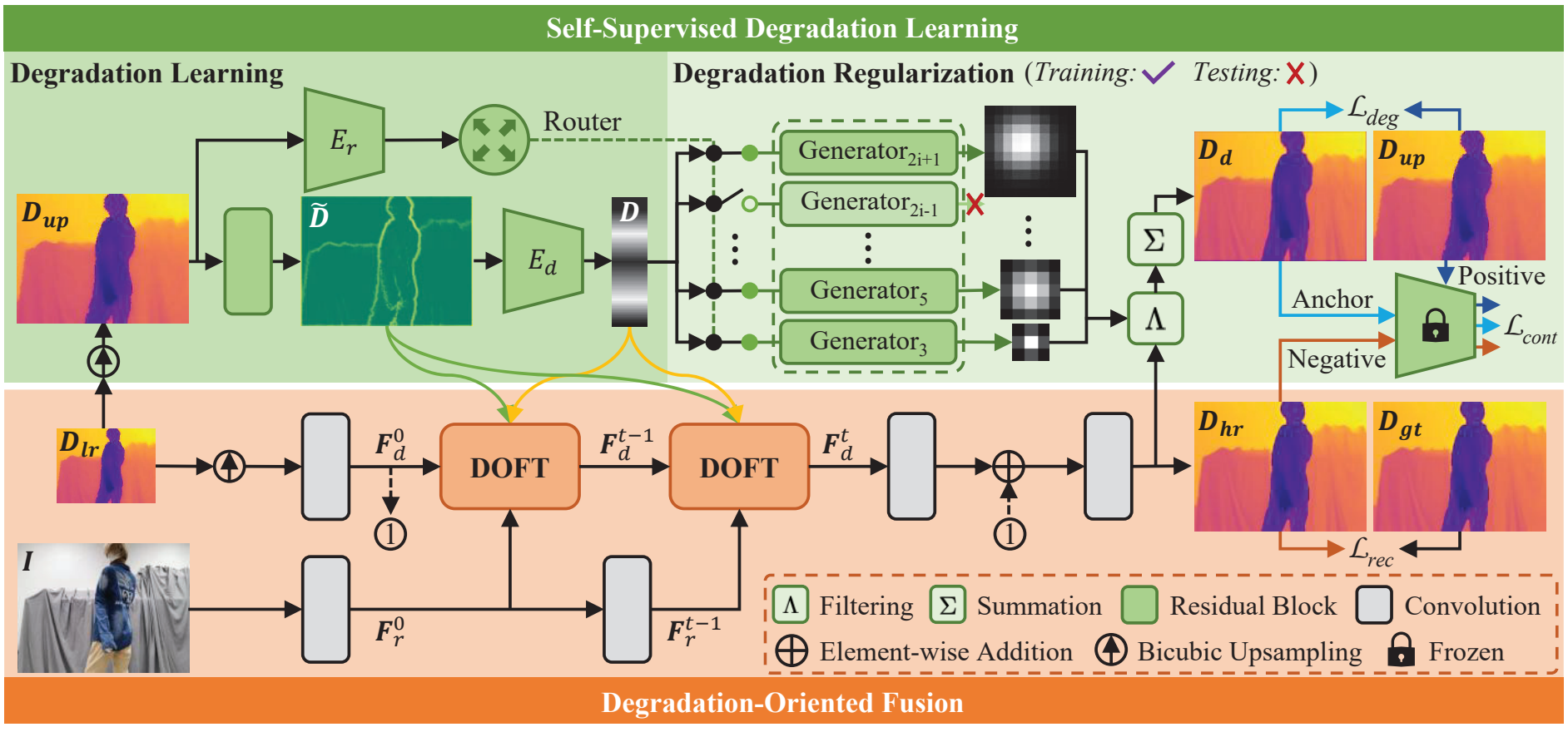
300 dpi PNG · Caption · Source PDF
Original caption, source, and provenance
Fixed source version: CVPR 2025 fixed official PDF
Earliest verified matching figure date (temporal proxy): 2025-03-19
arXiv v1 date: 2024-10-15
Actual drawing date: unknown. See the source record for version checks and temporal-evidence limitations.
Historical PDF · Download citation snapshot · Date evidence · Paper page · Complete screening and version record (Chinese)
Citation threshold evidence: Jinshan Pan; 26700 citations; snapshot 2026-10-21.
Recorded drawing-tool disclosure: unknown. No tool attribution is inferred from appearance; see the archival disclosure evidence for scope and wording.
Crop bounding box: [80, 73, 532, 284] (PDF points; top-left origin; x0, y0, x1, y1).
Figure 3. Overview of DORNet. Given D as input, the degradation learning first encodes it to produce degradation representations D˜
up
and D. Then, D˜, D, D , and I are fed into multiple degradation-oriented feature transformation (DOFT) modules, generating the HR
lr
depth D . Finally, D and D are sent to the degradation regularization to obtain D , which is used as input for the degradation loss
hr hr d
L and the contrastive loss L . The degradation regularization only applies during training and adds no extra overhead in testing.
deg cont
DORNet: A Degradation Oriented and Regularized Network for Blind Depth Super-Resolution
Venue: CVPR 2025 · Main-conference paper
Figure 1 · PDF page 1 · P173
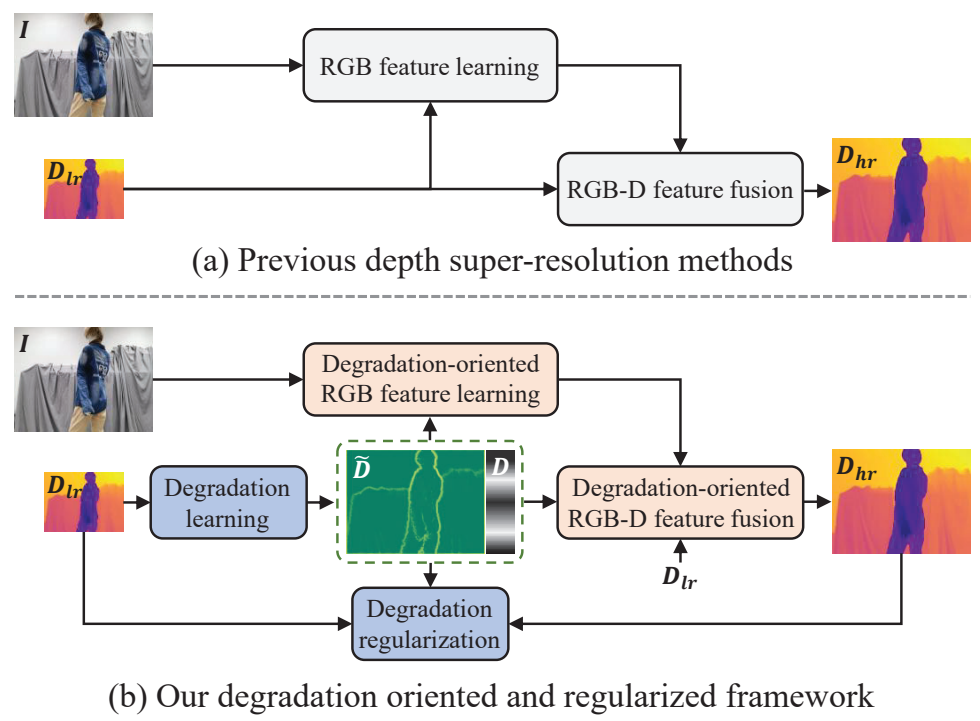
300 dpi PNG · Caption · Source PDF
Original caption, source, and provenance
Fixed source version: CVPR 2025 fixed official PDF
Earliest verified matching figure date (temporal proxy): 2025-03-19
arXiv v1 date: 2024-10-15
Actual drawing date: unknown. See the source record for version checks and temporal-evidence limitations.
Historical PDF · Download citation snapshot · Date evidence · Paper page · Complete screening and version record (Chinese)
Citation threshold evidence: Jinshan Pan; 26700 citations; snapshot 2026-10-21.
Recorded drawing-tool disclosure: unknown. No tool attribution is inferred from appearance; see the archival disclosure evidence for scope and wording.
Crop bounding box: [317, 244, 552, 417] (PDF points; top-left origin; x0, y0, x1, y1).
Figure 1. Previous methods (a) directly fuse the RGB information
aligned with the LR depth, while our method (b) focuses more on
modeling the degradation representation of the LR depth to pro-
vide targeted guidance for HR depth recovery.
FaithDiff: Unleashing Diffusion Priors for Faithful Image Super-resolution
Venue: CVPR 2025 · Main-conference paper
Figure 2 · PDF page 3 · P172
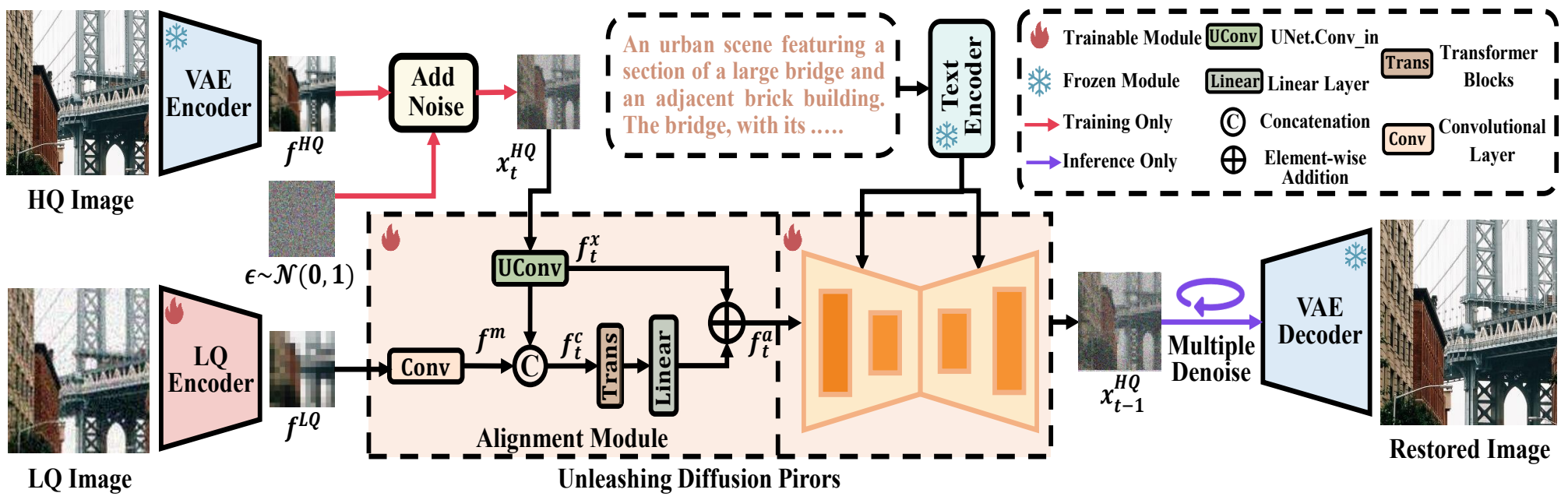
300 dpi PNG · Caption · Source PDF
Original caption, source, and provenance
Fixed source version: CVPR 2025 fixed official PDF
Earliest verified matching figure date (temporal proxy): 2025-06
arXiv v1 date: 2024-11-27
Actual drawing date: unknown. See the source record for version checks and temporal-evidence limitations.
Historical PDF · Download citation snapshot · Date evidence · Paper page · Complete screening and version record (Chinese)
Citation threshold evidence: Jinshan Pan; 26700 citations; snapshot 2026-10-21.
Recorded drawing-tool disclosure: unknown. No tool attribution is inferred from appearance; see the archival disclosure evidence for scope and wording.
Crop bounding box: [65, 72, 548, 226] (PDF points; top-left origin; x0, y0, x1, y1).
Figure 2. An overview of the FaithDiff, which takes LQ images and image descriptions as inputs and restores HQ images via diffusion
process. To fully leverage the power of LDMs, we propose to unleash diffusion priors. An alignment module is developed to effectively
incorporate the features extracted from LQ images with the noisy latent of the diffusion model. We jointly optimize the encoder, the
alignment module, and the diffusion model, which can benefit from their interplay and lead to faithful SR images with high visual quality.
FaithDiff: Unleashing Diffusion Priors for Faithful Image Super-resolution
Venue: CVPR 2025 · Main-conference paper
Figure 1 · PDF page 2 · P171
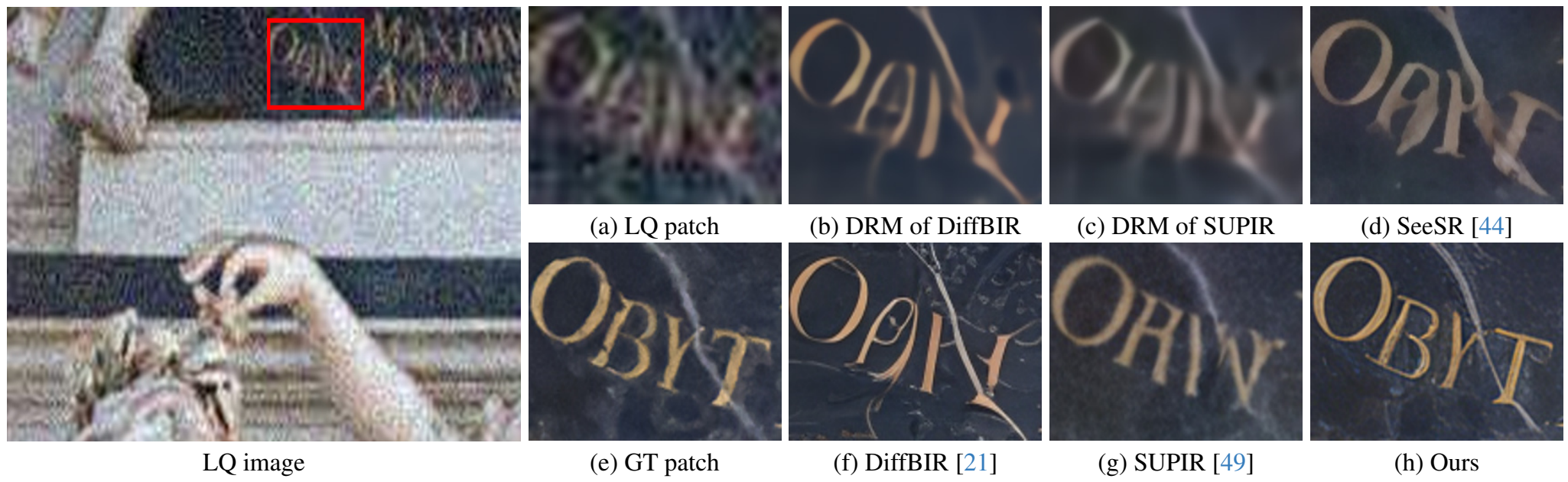
300 dpi PNG · Caption · Source PDF
Original caption, source, and provenance
Fixed source version: CVPR 2025 fixed official PDF
Earliest verified matching figure date (temporal proxy): 2025-06
arXiv v1 date: 2024-11-27
Actual drawing date: unknown. See the source record for version checks and temporal-evidence limitations.
Historical PDF · Download citation snapshot · Date evidence · Paper page · Complete screening and version record (Chinese)
Citation threshold evidence: Jinshan Pan; 26700 citations; snapshot 2026-10-21.
Recorded drawing-tool disclosure: unknown. No tool attribution is inferred from appearance; see the archival disclosure evidence for scope and wording.
Crop bounding box: [59, 70, 551, 221] (PDF points; top-left origin; x0, y0, x1, y1).
Figure 1. Visual comparison with state-of-the-art SR methods. (b) and (c) are the intermediate results of the degradation removal module
(DRM) by DiffBIR [21] and SUPIR [49]. The competing methods [21, 49] do not effectively restore faithful structures based on the
degradation removal results in (b)-(c). In contrast to the results in (d) and (f)-(g), our approach can recover more realistic high-quality
results with faithful contents (e.g., the characters in (h)).
From Zero to Detail: Deconstructing Ultra-High-Definition Image Restoration from Progressive Spectral Perspective
Venue: CVPR 2025 · Main-conference paper
Figure 3 · PDF page 3 · P170
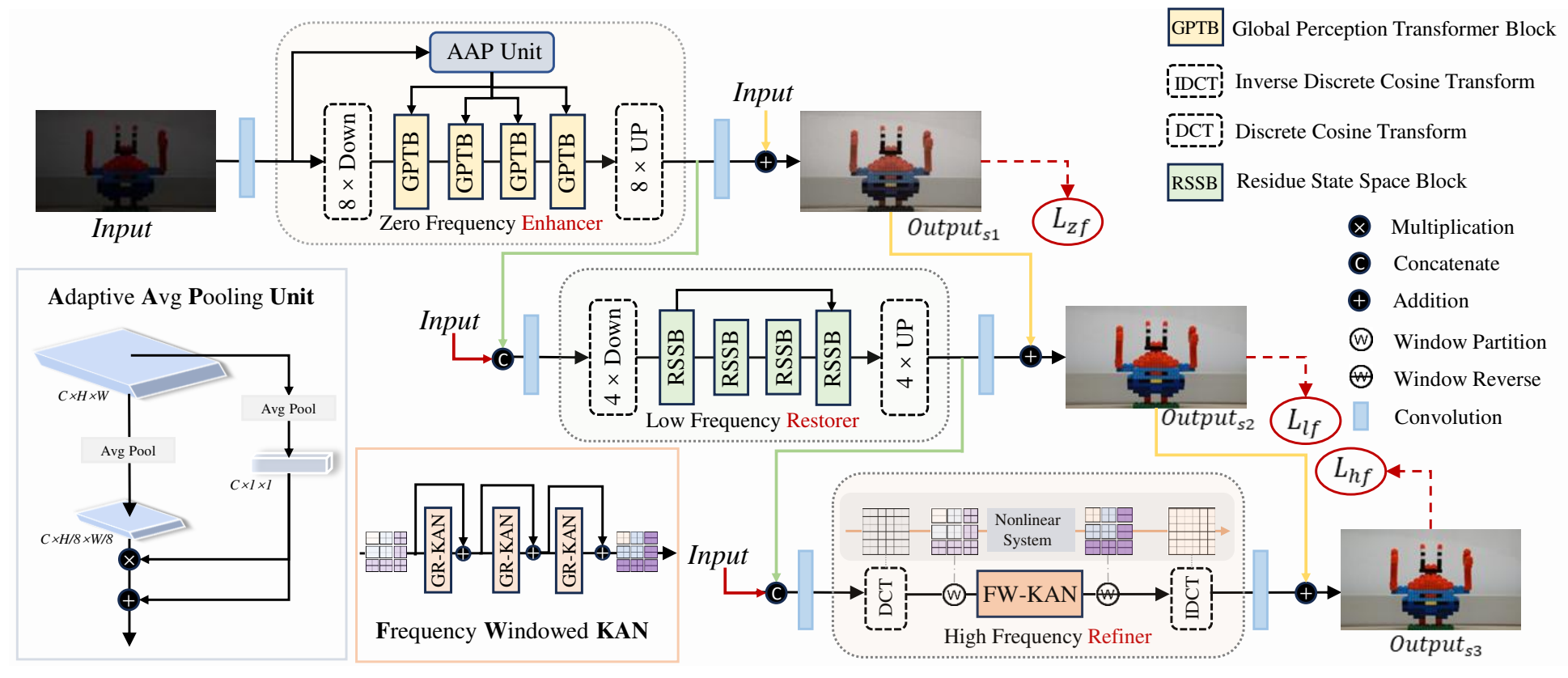
300 dpi PNG · Caption · Source PDF
Original caption, source, and provenance
Fixed source version: CVPR 2025 fixed official PDF
Earliest verified matching figure date (temporal proxy): 2025-03-17
arXiv v1 date: 2025-03-17
Actual drawing date: unknown. See the source record for version checks and temporal-evidence limitations.
Historical PDF · Download citation snapshot · Date evidence · Paper page · Complete screening and version record (Chinese)
Citation threshold evidence: Ying Tai; 19268 citations; snapshot 2026-10-21.
Recorded drawing-tool disclosure: unknown. No tool attribution is inferred from appearance; see the archival disclosure evidence for scope and wording.
Crop bounding box: [70, 72, 535, 273] (PDF points; top-left origin; x0, y0, x1, y1).
Figure 3. Overall framework of our proposed ERR. Building on the insight from progressive spectral perspective, ERR consists of three
collaborative sub-networks: the zero-frequency enhancer (ZFE), the low-frequency restorer (LFR), and the high-frequency refiner (HFR).
From Zero to Detail: Deconstructing Ultra-High-Definition Image Restoration from Progressive Spectral Perspective
Venue: CVPR 2025 · Main-conference paper
Figure 2 · PDF page 2 · P169
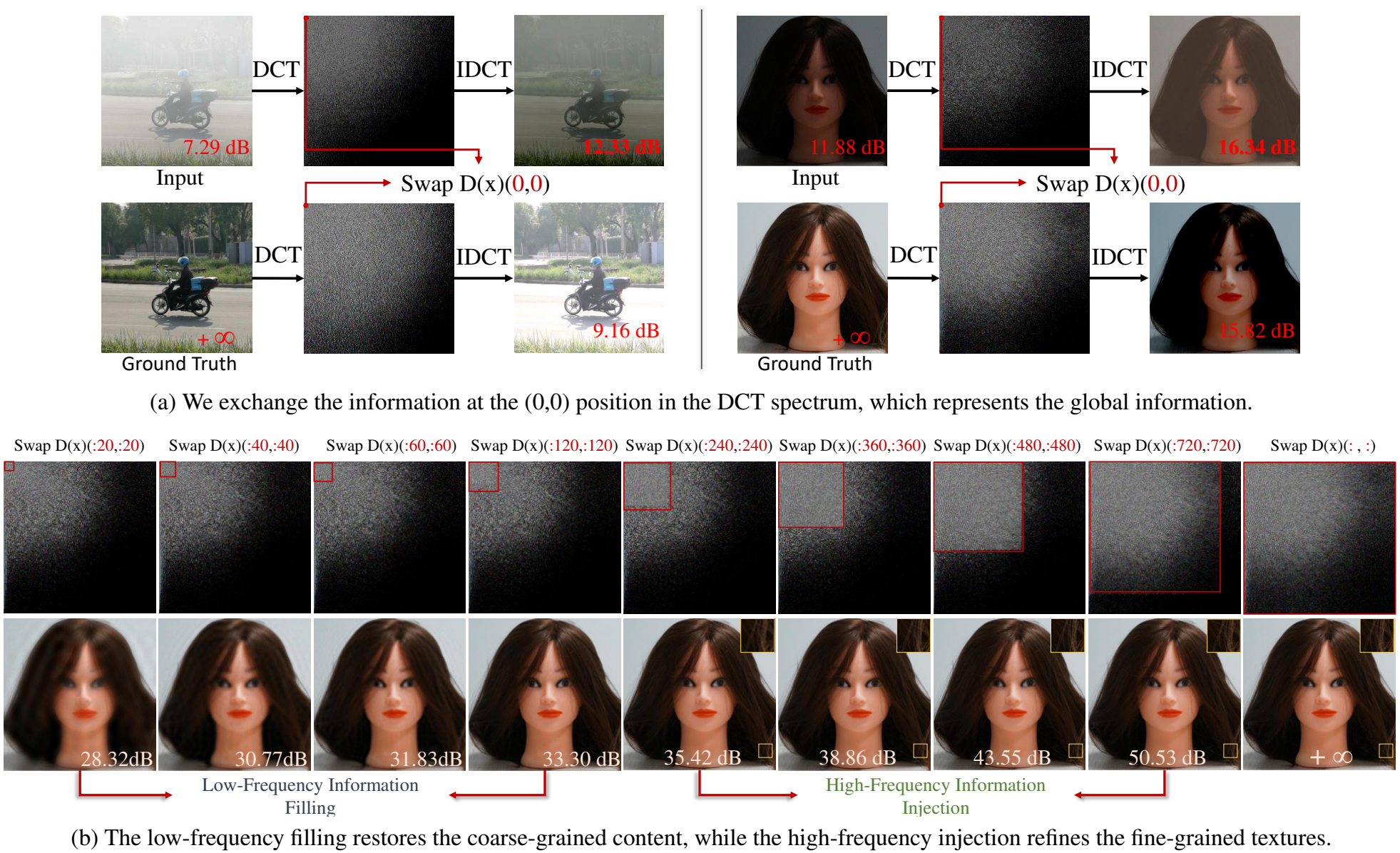
300 dpi PNG · Caption · Source PDF
Original caption, source, and provenance
Fixed source version: CVPR 2025 fixed official PDF
Earliest verified matching figure date (temporal proxy): 2025-03-17
arXiv v1 date: 2025-03-17
Actual drawing date: unknown. See the source record for version checks and temporal-evidence limitations.
Historical PDF · Download citation snapshot · Date evidence · Paper page · Complete screening and version record (Chinese)
Citation threshold evidence: Ying Tai; 19268 citations; snapshot 2026-10-21.
Recorded drawing-tool disclosure: unknown. No tool attribution is inferred from appearance; see the archival disclosure evidence for scope and wording.
Crop bounding box: [70, 70, 541, 357] (PDF points; top-left origin; x0, y0, x1, y1).
Figure 2. Our core motivation. Based on the observations in (a) and (b), we deconstruct the complex UHD restoration problem into three
progressive stages: zero-frequency enhancement, low-frequency restoration, and high-frequency refinement.
GenDeg: Diffusion-based Degradation Synthesis for Generalizable All-In-One Image Restoration
Venue: CVPR 2025 · Main-conference paper
Figure 4 · PDF page 4 · P104
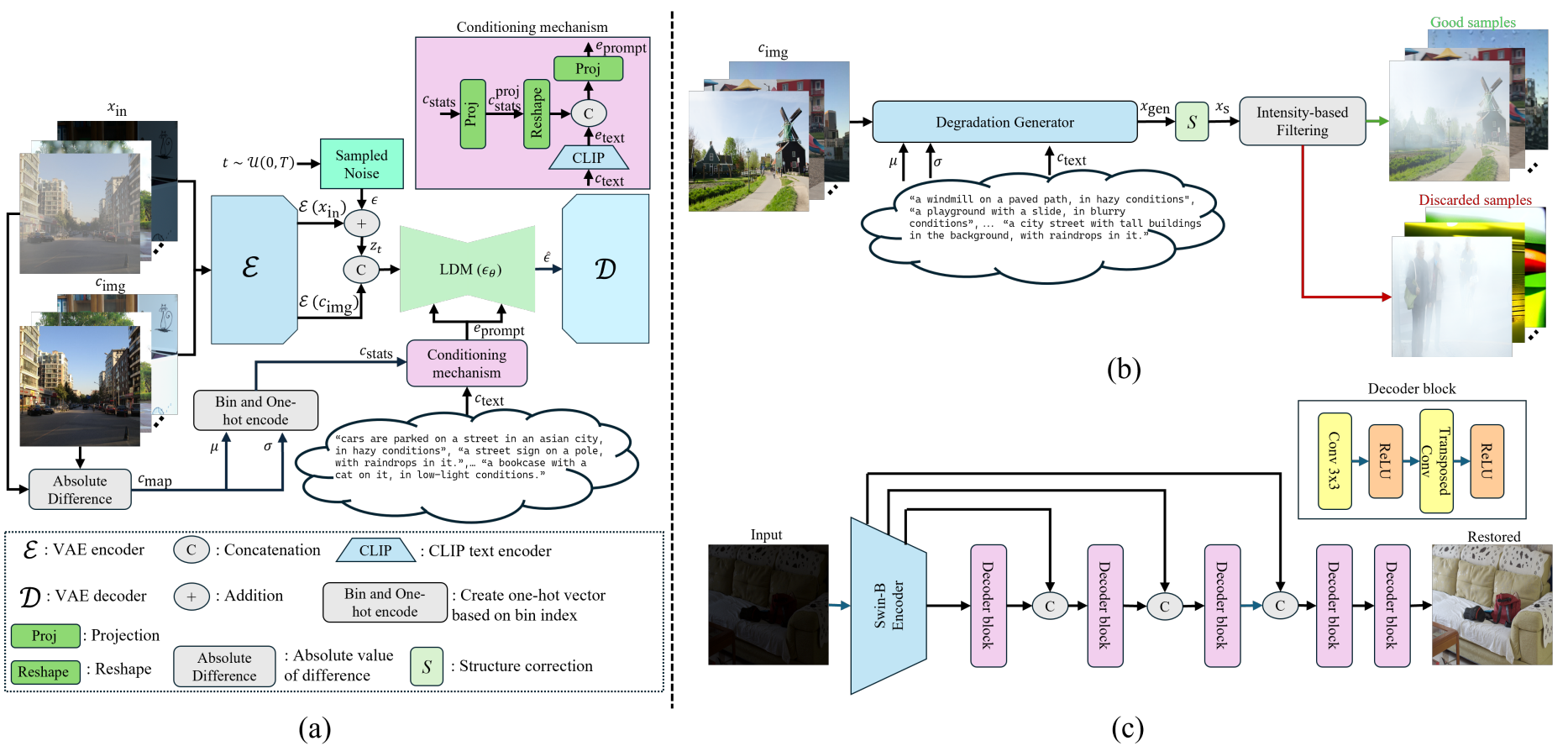
300 dpi PNG · Caption · Source PDF
Original caption, source, and provenance
Fixed source version: CVPR 2025 fixed official PDF
Earliest verified matching figure date (temporal proxy): 2024-11-26
arXiv v1 date: 2024-11-26
Actual drawing date: unknown. See the source record for version checks and temporal-evidence limitations.
Historical PDF · Download citation snapshot · Date evidence · Paper page · Complete screening and version record (Chinese)
Citation threshold evidence: Vishal M. Patel; 48975 citations; snapshot 2026-10-21.
Recorded drawing-tool disclosure: unknown. No tool attribution is inferred from appearance; see the archival disclosure evidence for scope and wording.
Crop bounding box: [82, 70, 530, 283] (PDF points; top-left origin; x0, y0, x1, y1).
Figure 4. (a) Illustrates the training stage of the GenDeg model where it is trained to condition on the clean image, text prompt and mean
intensity (µ) and variation (σ) of the degradation pattern. (b) Shows the inference stage where the model generates a degraded image based
on these conditions; and (c) Depicts the architecture of the Swin-transformer-based restoration network.
GenDeg: Diffusion-based Degradation Synthesis for Generalizable All-In-One Image Restoration
Venue: CVPR 2025 · Main-conference paper
Figure 2 · PDF page 2 · P103
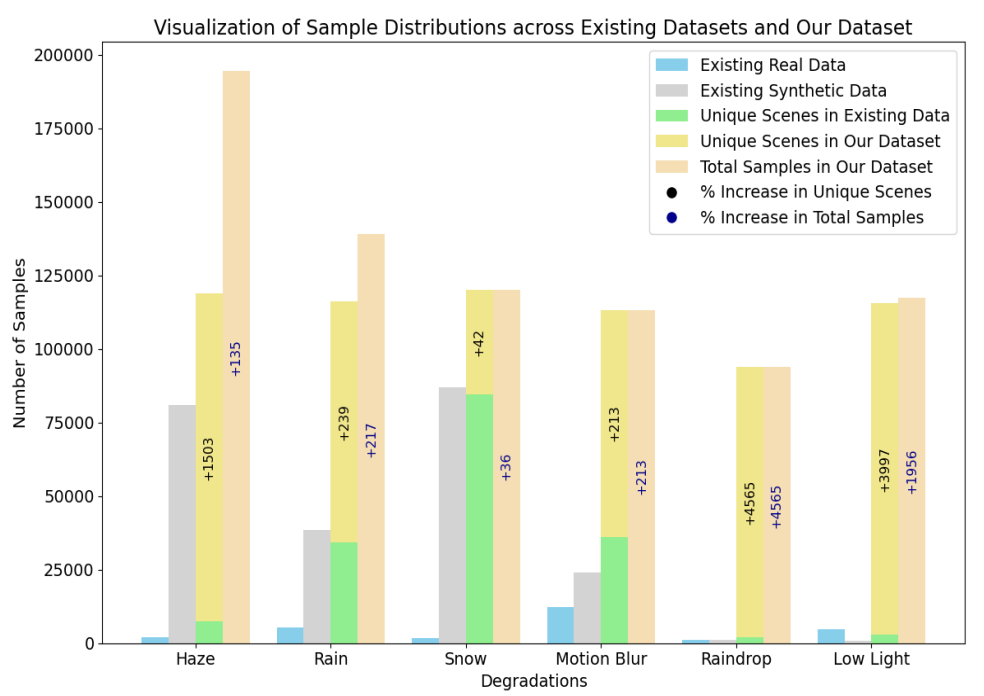
300 dpi PNG · Caption · Source PDF
Original caption, source, and provenance
Fixed source version: CVPR 2025 fixed official PDF
Earliest verified matching figure date (temporal proxy): 2025-03-22
arXiv v1 date: 2024-11-26
Actual drawing date: unknown. See the source record for version checks and temporal-evidence limitations.
Historical PDF · Download citation snapshot · Date evidence · Paper page · Complete screening and version record (Chinese)
Citation threshold evidence: Vishal M. Patel; 48975 citations; snapshot 2026-10-21.
Recorded drawing-tool disclosure: unknown. No tool attribution is inferred from appearance; see the archival disclosure evidence for scope and wording.
Crop bounding box: [318, 72, 554, 239] (PDF points; top-left origin; x0, y0, x1, y1).
Figure 2. Analysis of real and synthetic image restoration datasets
for various degradations. Existing datasets are small and less di-
verse, especially for haze, low-light, and raindrop. Our diffusion-
generated synthetic data substantially increases the number of
samples as well as scene diversity.
PassionSR: Post-Training Quantization with Adaptive Scale in One-Step Diffusion based Image Super-Resolution
Venue: CVPR 2025 · Figure source: archived arXiv v1
Figure 4 · PDF page 4 · P22
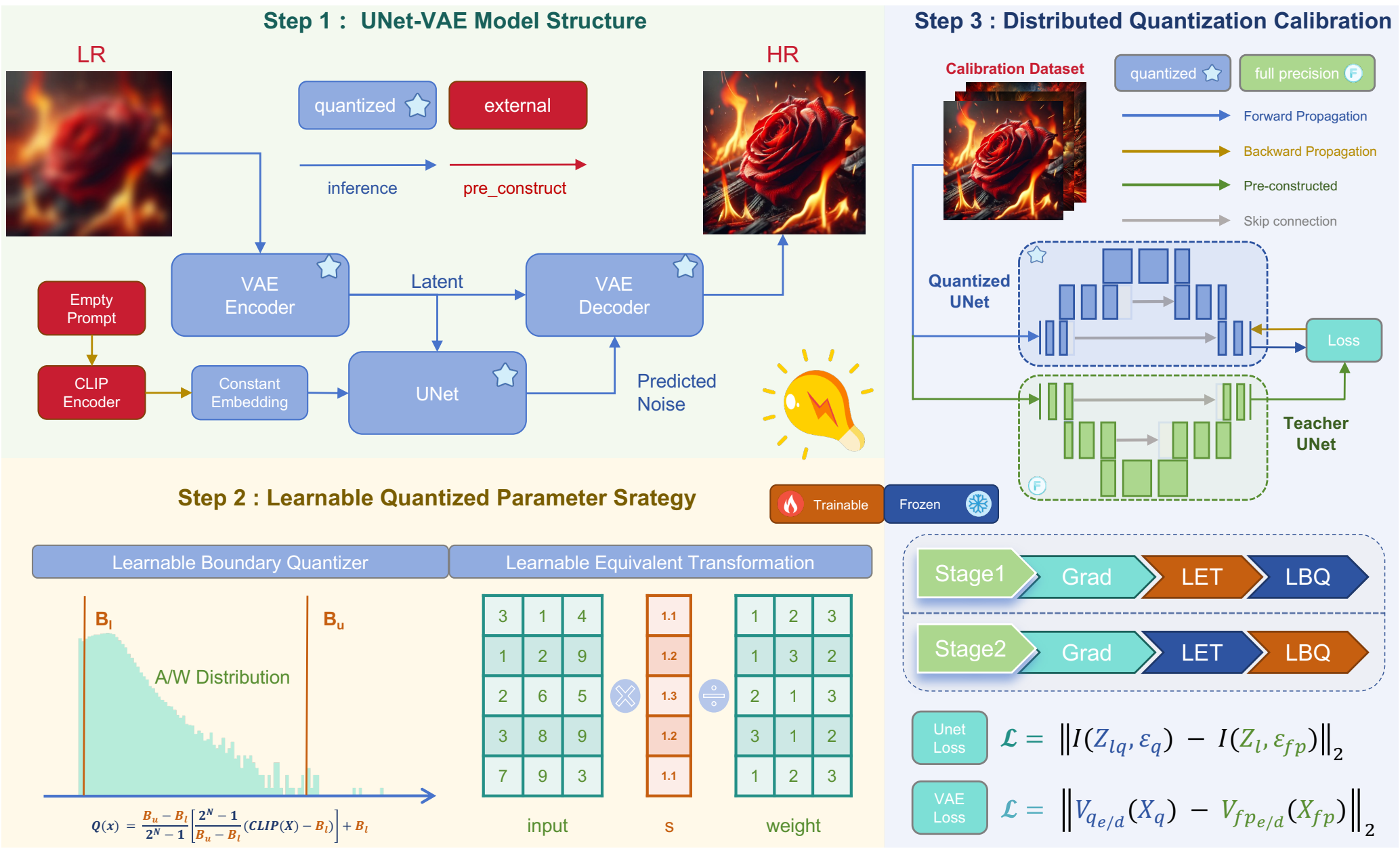
300 dpi PNG · Caption · Source PDF
Original caption, source, and provenance
Fixed source version: arXiv v1 fixed source
Earliest verified matching figure date (temporal proxy): 2024-11-26
arXiv v1 date: 2024-11-26
Actual drawing date: unknown. See the source record for version checks and temporal-evidence limitations.
Historical PDF · Download citation snapshot · Date evidence · Complete screening and version record (Chinese)
Citation threshold evidence: Yulun Zhang; 40552 citations; snapshot 2026-10-21.
Recorded drawing-tool disclosure: unknown. No tool attribution is inferred from appearance; see the archival disclosure evidence for scope and wording.
Crop bounding box: [58, 70, 554, 372] (PDF points; top-left origin; x0, y0, x1, y1).
Figure 4. Overview of our PassionSR. Step 1: we simplify OSEDiff [42] by removing DAPE and CLIP Encoder, obtaining PassionSR-
FP. Step 2: the quantizer we use has two key trainable parts, consisting of the Learnable Boundary Quantizer and Learnable Equivalent
Transformation. Step 3: we design a distributed calibration strategy and special loss function to accelerate convergence of calibration.
PassionSR: Post-Training Quantization with Adaptive Scale in One-Step Diffusion based Image Super-Resolution
Venue: CVPR 2025 · Figure source: archived arXiv v1
Figure 2 · PDF page 2 · P21
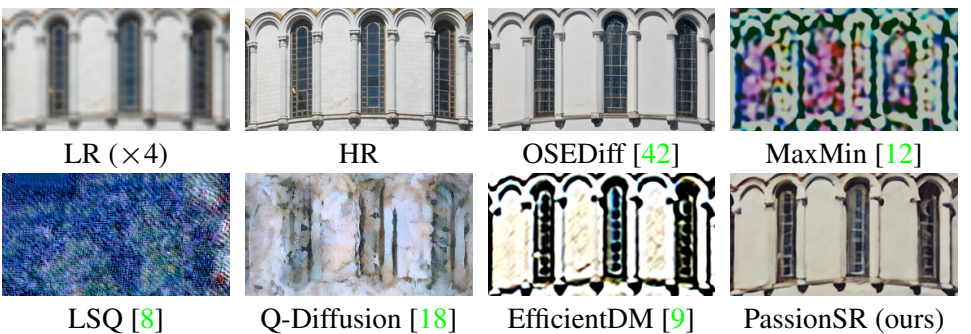
300 dpi PNG · Caption · Source PDF
Original caption, source, and provenance
Fixed source version: arXiv v1 fixed source
Earliest verified matching figure date (temporal proxy): 2024-11-26
arXiv v1 date: 2024-11-26
Actual drawing date: unknown. See the source record for version checks and temporal-evidence limitations.
Historical PDF · Download citation snapshot · Date evidence · Complete screening and version record (Chinese)
Citation threshold evidence: Yulun Zhang; 40552 citations; snapshot 2026-10-21.
Recorded drawing-tool disclosure: unknown. No tool attribution is inferred from appearance; see the archival disclosure evidence for scope and wording.
Crop bounding box: [318, 70, 551, 150] (PDF points; top-left origin; x0, y0, x1, y1).
Figure 2. Visual comparison (×4) of one-step diffusion SR models. We use OSEDiff as a 32-bit full-precision (FP) reference and provide 6-bit quantized version with different methods.
QMambaBSR: Burst Image Super-Resolution with Query State Space Model
Venue: CVPR 2025 · Main-conference paper
Figure 2 · PDF page 4 · P178
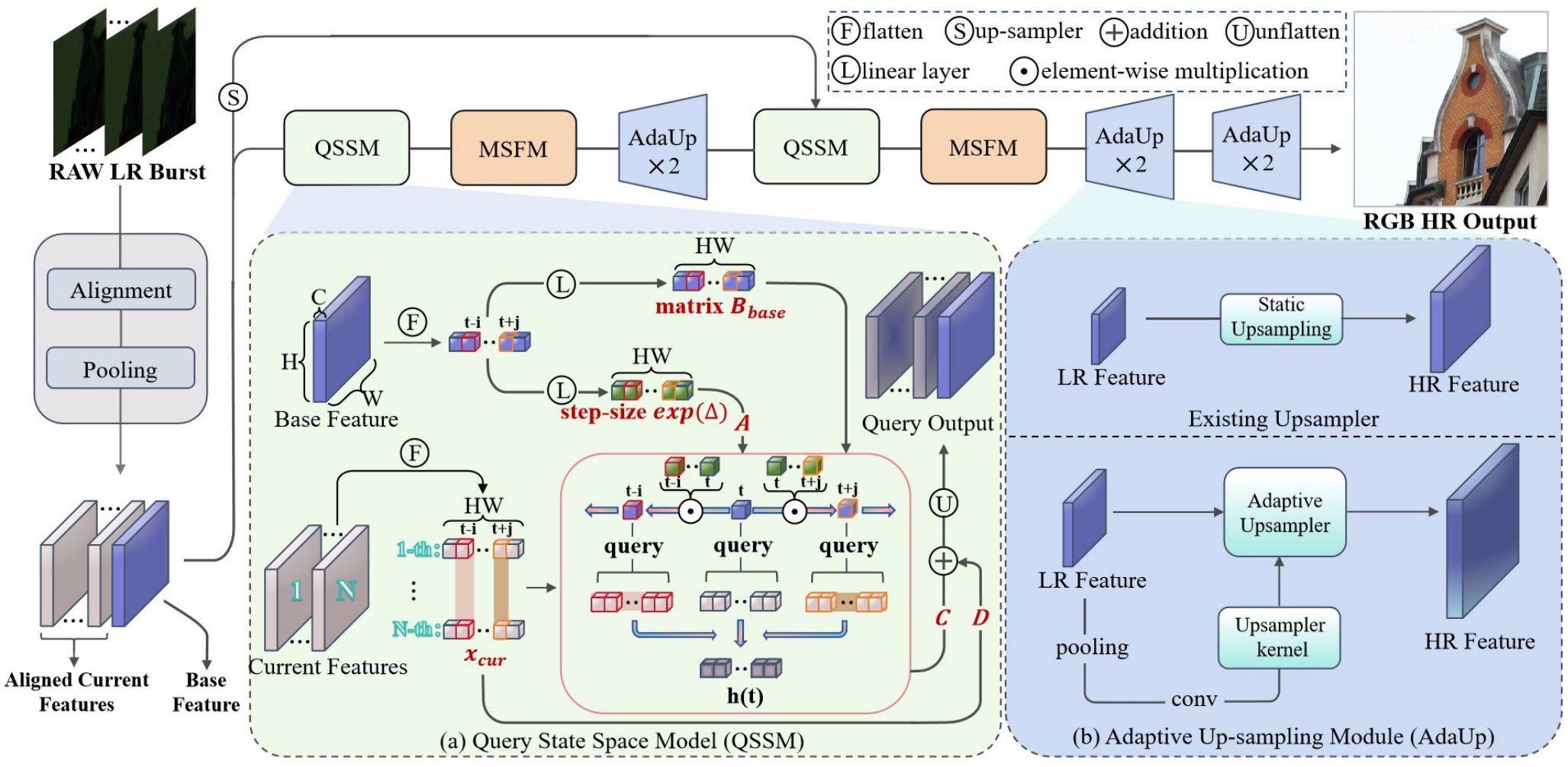
300 dpi PNG · Caption · Source PDF
Original caption, source, and provenance
Fixed source version: CVPR 2025 fixed official PDF
Earliest verified matching figure date (temporal proxy): 2025-03-10
arXiv v1 date: 2024-08-16
Actual drawing date: unknown. See the source record for version checks and temporal-evidence limitations.
Historical PDF · Download citation snapshot · Date evidence · Paper page · Complete screening and version record (Chinese)
Citation threshold evidence: Zheng-Jun Zha; 30479 citations; snapshot 2026-10-21.
Recorded drawing-tool disclosure: unknown. No tool attribution is inferred from appearance; see the archival disclosure evidence for scope and wording.
Crop bounding box: [62, 73, 555, 314] (PDF points; top-left origin; x0, y0, x1, y1).
Figure 2. The overall framework of our proposed QMambaBSR, primarily includes the novel Query State Space Model (QSSM), Multi-
scale Fusion Module (MSFM), and the Adaptive Up-sampling Module (AdaUp).
QMambaBSR: Burst Image Super-Resolution with Query State Space Model
Venue: CVPR 2025 · Main-conference paper
Figure 1 · PDF page 1 · P177
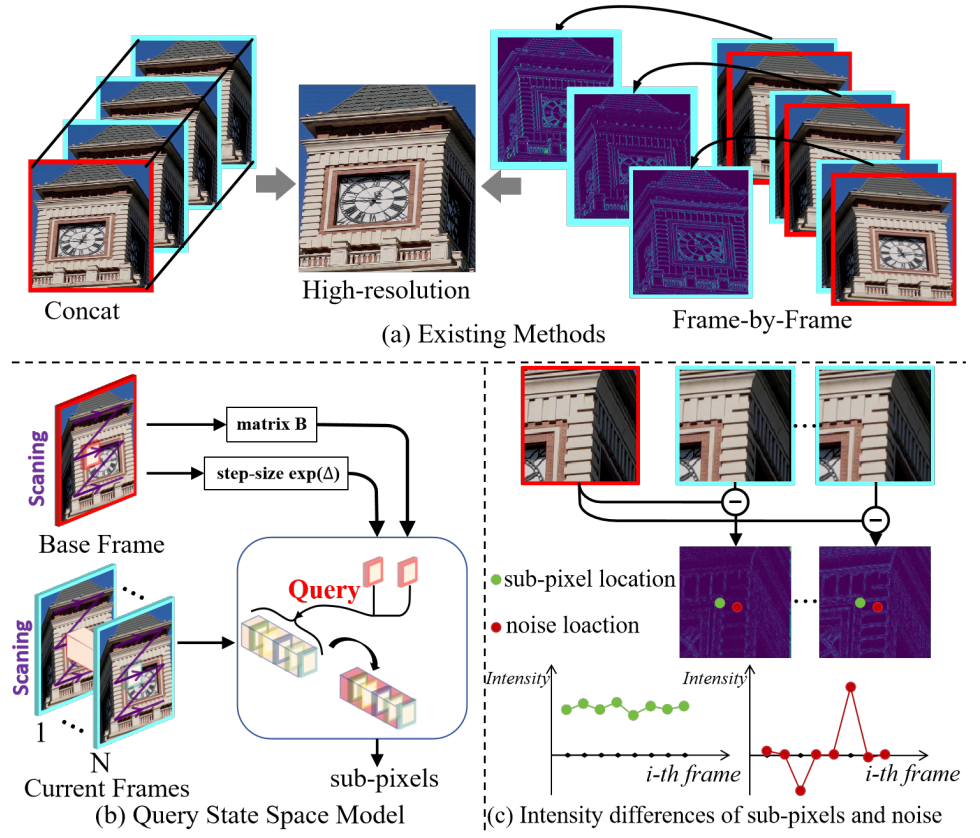
300 dpi PNG · Caption · Source PDF
Original caption, source, and provenance
Fixed source version: CVPR 2025 fixed official PDF
Earliest verified matching figure date (temporal proxy): 2025-03-10
arXiv v1 date: 2024-08-16
Actual drawing date: unknown. See the source record for version checks and temporal-evidence limitations.
Historical PDF · Download citation snapshot · Date evidence · Paper page · Complete screening and version record (Chinese)
Citation threshold evidence: Zheng-Jun Zha; 30479 citations; snapshot 2026-10-21.
Recorded drawing-tool disclosure: unknown. No tool attribution is inferred from appearance; see the archival disclosure evidence for scope and wording.
Crop bounding box: [317, 213, 552, 414] (PDF points; top-left origin; x0, y0, x1, y1).
Figure 1. The concat and frame-by-frame operations in exist-
ing methods struggle to efficiently extract sub-pixels and suppress
noise, leading to remaining artifacts and over-smoothed details, as
shown in (a). We observe that noise randomly appears on several
frames, while effective sub-pixels have consistent intensity at cor-
responding positions in all frames, as shown in (c). Based on this,
a novel inter-frame query and intra-frame scanning-based QMam-
baBSR is proposed to extract more accurate sub-pixels while mit-
igating noise interference simultaneously, as shown in (b).
Rotation-Equivariant Self-Supervised Method in Image Denoising
Venue: CVPR 2025 · Main-conference paper
Figure 3 · PDF page 6 · P176
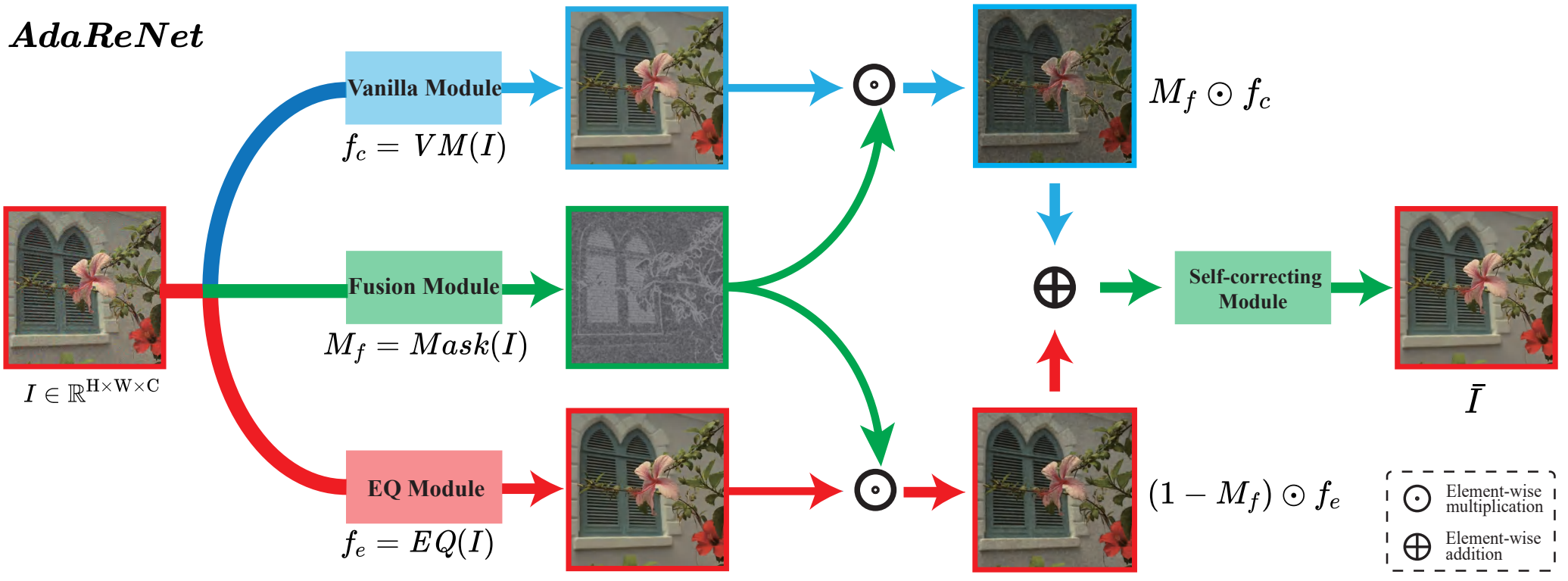
300 dpi PNG · Caption · Source PDF
Original caption, source, and provenance
Fixed source version: CVPR 2025 fixed official PDF
Earliest verified matching figure date (temporal proxy): 2025-05-26
arXiv v1 date: 2025-05-26
Actual drawing date: unknown. See the source record for version checks and temporal-evidence limitations.
Historical PDF · Download citation snapshot · Date evidence · Paper page · Complete screening and version record (Chinese)
Citation threshold evidence: Deyu Meng; 49595 citations; snapshot 2026-10-21.
Recorded drawing-tool disclosure: unknown. No tool attribution is inferred from appearance; see the archival disclosure evidence for scope and wording.
Crop bounding box: [58, 71, 555, 255] (PDF points; top-left origin; x0, y0, x1, y1).
Figure3. IllustrationsofourproposedadaptivenetworkAdaReNet. Specifically, I ∈ RH×W×C representsanoisyimage, whereH andW
represent the spatial dimensions, and C denotes the channel dimension. The Vanilla Module and EQ Module each produce their respective
preliminary denoising results, denoted as f and f . The Fusion Module Mask(·) automatically decides which areas of the image to use
c e
moreEQModulewouldgainmorebenefit. AfteradaptivefusionbyMask(·)andcorrectionbytheSelf-correctingModuleS (·), thefinal
c
denoised image I¯is output.
Rotation-Equivariant Self-Supervised Method in Image Denoising
Venue: CVPR 2025 · Main-conference paper
Figure 1 · PDF page 1 · P175
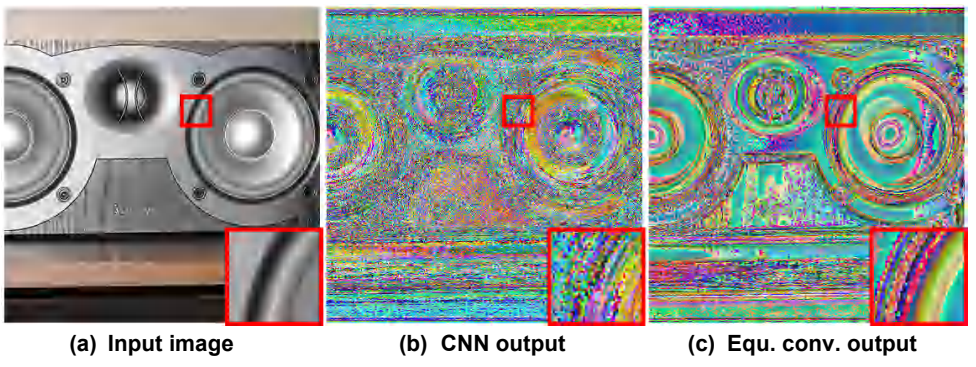
300 dpi PNG · Caption · Source PDF
Original caption, source, and provenance
Fixed source version: CVPR 2025 fixed official PDF
Earliest verified matching figure date (temporal proxy): 2025-05-26
arXiv v1 date: 2025-05-26
Actual drawing date: unknown. See the source record for version checks and temporal-evidence limitations.
Historical PDF · Download citation snapshot · Date evidence · Paper page · Complete screening and version record (Chinese)
Citation threshold evidence: Deyu Meng; 49595 citations; snapshot 2026-10-21.
Recorded drawing-tool disclosure: unknown. No tool attribution is inferred from appearance; see the archival disclosure evidence for scope and wording.
Crop bounding box: [319, 229, 553, 317] (PDF points; top-left origin; x0, y0, x1, y1).
Figure 1. Illustration of the output feature map of a typical image
obtained by standard CNN and our used rotation equivariant con-
volution neural network. Both networks are initialized randomly.
The Power of Context: How Multimodality Improves Image Super-Resolution
Venue: CVPR 2025 · Main-conference paper
Figure 3 · PDF page 3 · P70
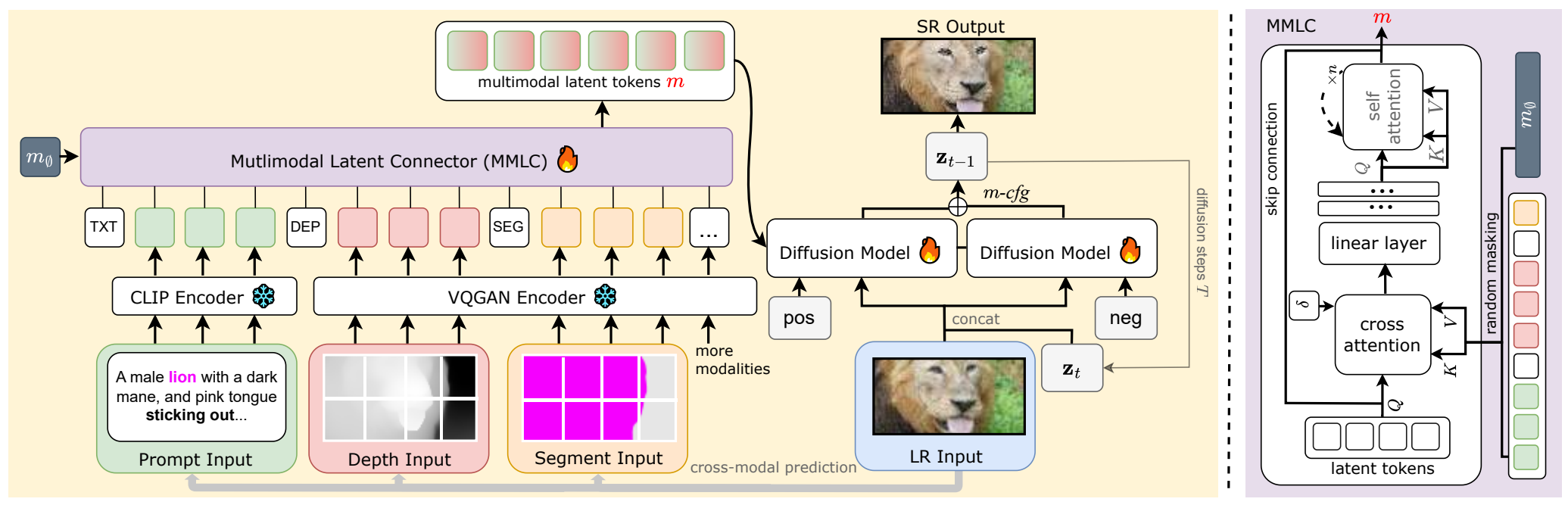
300 dpi PNG · Caption · Source PDF
Original caption, source, and provenance
Fixed source version: CVPR 2025 fixed official PDF
Earliest verified matching figure date (temporal proxy): 2025-03-18
arXiv v1 date: 2025-03-18
Actual drawing date: unknown. See the source record for version checks and temporal-evidence limitations.
Historical PDF · Download citation snapshot · Date evidence · Paper page · Complete screening and version record (Chinese)
Citation threshold evidence: Vishal M. Patel; 48975 citations; snapshot 2026-10-21.
Recorded drawing-tool disclosure: unknown. No tool attribution is inferred from appearance; see the archival disclosure evidence for scope and wording.
Crop bounding box: [58, 70, 555, 230] (PDF points; top-left origin; x0, y0, x1, y1).
Figure 3. This diagram illustrates our multimodal super-resolution pipeline. Starting with a low-resolution (LR) image, we extract modalities
like depth and semantic segmentation maps. These modalities are encoded into tokens and transformed into multimodal latent tokens (m).
Our diffusion model uses these tokens and the LR input to generate a high-resolution (SR) output. A multimodal classifier-free guidance
(m-cfg) refines the SR image for enhanced quality.
The Power of Context: How Multimodality Improves Image Super-Resolution
Venue: CVPR 2025 · Main-conference paper
Figure 2 · PDF page 2 · P69
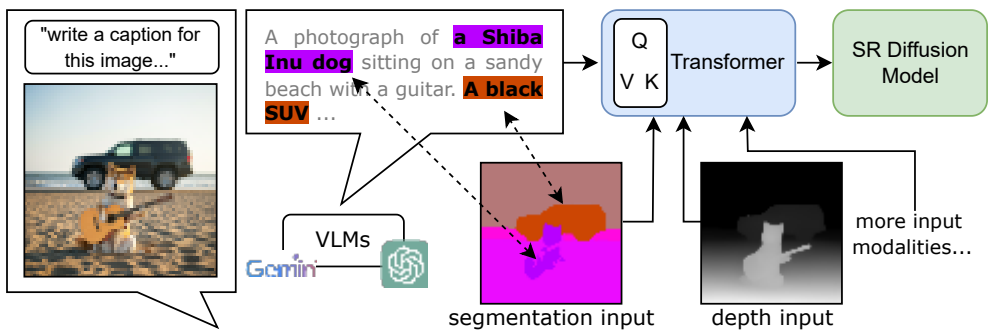
300 dpi PNG · Caption · Source PDF
Original caption, source, and provenance
Fixed source version: CVPR 2025 fixed official PDF
Earliest verified matching figure date (temporal proxy): 2025-03-18
arXiv v1 date: 2025-03-18
Actual drawing date: unknown. See the source record for version checks and temporal-evidence limitations.
Historical PDF · Download citation snapshot · Date evidence · Paper page · Complete screening and version record (Chinese)
Citation threshold evidence: Vishal M. Patel; 48975 citations; snapshot 2026-10-21.
Recorded drawing-tool disclosure: unknown. No tool attribution is inferred from appearance; see the archival disclosure evidence for scope and wording.
Crop bounding box: [316, 70, 555, 150] (PDF points; top-left origin; x0, y0, x1, y1).
Figure 2. Language models struggle to accurately represent spa-
tial information, leading to coarse and imprecise image super-
resolution. To overcome this limitation, we incorporate additional
spatialmodalitieslikedepthmapsandsemanticsegmentationmaps.
These modalities provide detailed spatial context, allowing our
model to implicitly align language descriptions with individual pix-
els through a transformer network. This enriched understanding of
theimagesignificantlyenhancestherealismofoursuper-resolution
results and minimizes distortion.
A Lightweight UDF Learning Framework for 3D Reconstruction Based on Local Shape Functions
Venue: CVPR 2025 · Main-conference paper
Figure 1 · PDF page 3 · P218
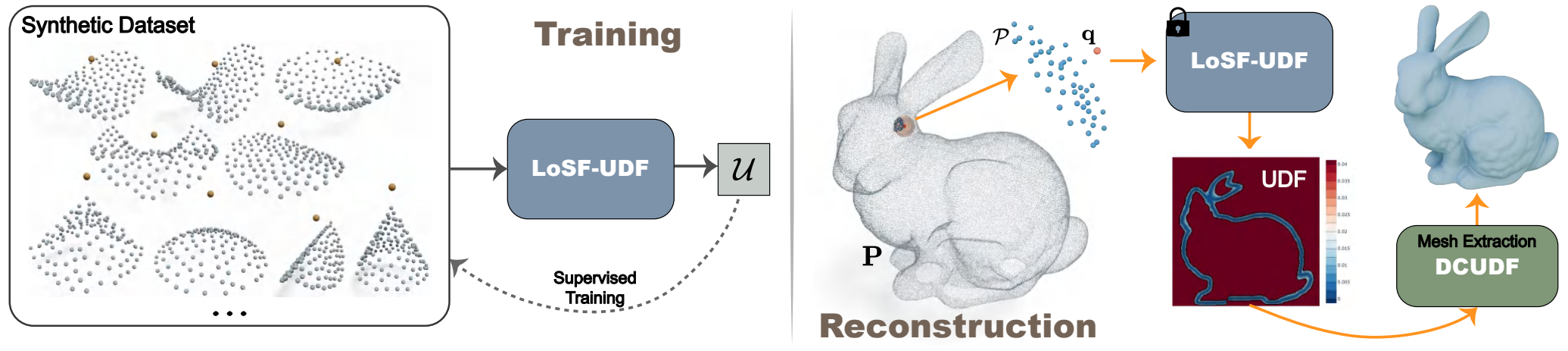
300 dpi PNG · Caption · Source PDF
Original caption, source, and provenance
Fixed source version: CVPR 2025 fixed official PDF
Earliest verified matching figure date (temporal proxy): 2024-07-01
arXiv v1 date: 2024-07-01
Actual drawing date: unknown. See the source record for version checks and temporal-evidence limitations.
Historical PDF · Download citation snapshot · Date evidence · Paper page · Complete screening and version record (Chinese)
Citation threshold evidence: Junhui Hou; 21404 citations; snapshot 2026-10-21.
Recorded drawing-tool disclosure: unknown. No tool attribution is inferred from appearance; see the archival disclosure evidence for scope and wording.
Crop bounding box: [58, 73, 555, 184] (PDF points; top-left origin; x0, y0, x1, y1).
Figure 1. Pipeline. First, we train a UDF prediction network U on a synthetic dataset, which contains a series of local point cloud patches
Θ
that are independent of specific shapes. Given a global point cloud P, we then extract a local patch P assigned to each query point q within
a specified radius, and obtain the corresponding UDF values U (P , q). Finally, we extract the mesh corresponding to the input point cloud
Θˆ
by incorporating the DCUDF [18] framework.
A Lightweight UDF Learning Framework for 3D Reconstruction Based on Local Shape Functions
Venue: CVPR 2025 · Main-conference paper
Figure 2 · PDF page 3 · P217
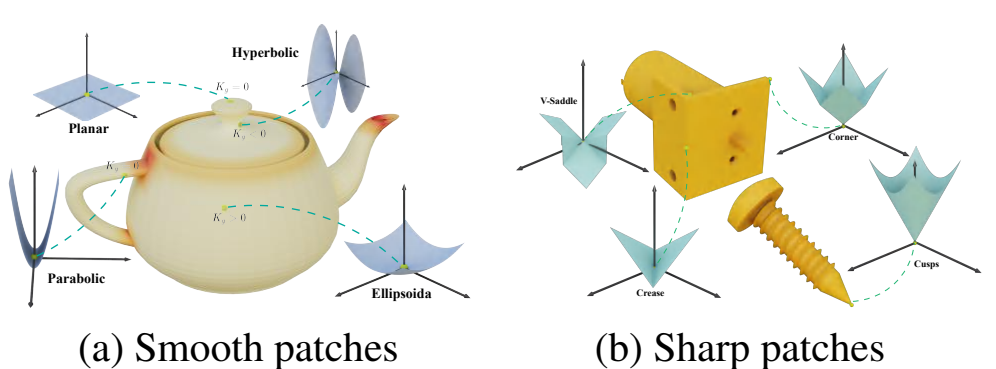
300 dpi PNG · Caption · Source PDF
Original caption, source, and provenance
Fixed source version: CVPR 2025 fixed official PDF
Earliest verified matching figure date (temporal proxy): 2025-05-10
arXiv v1 date: 2024-07-01
Actual drawing date: unknown. See the source record for version checks and temporal-evidence limitations.
Historical PDF · Download citation snapshot · Date evidence · Paper page · Complete screening and version record (Chinese)
Citation threshold evidence: Junhui Hou; 21404 citations; snapshot 2026-10-21.
Recorded drawing-tool disclosure: unknown. No tool attribution is inferred from appearance; see the archival disclosure evidence for scope and wording.
Crop bounding box: [58, 590, 297, 678.5] (PDF points; top-left origin; x0, y0, x1, y1).
Figure 2. Local geometries. (a) For points on a geometry that are
differentiable, the local shape at these points can be approximated
by quadratic surfaces. (b) For points that are non-differentiable, we
can also construct locally approximated surfaces using functions.
Carve3D: Improving Multi-view Reconstruction Consistency for Diffusion Models with RL Finetuning
Venue: CVPR 2024 · Main-conference paper
Figure 2 · PDF page 3 · P336
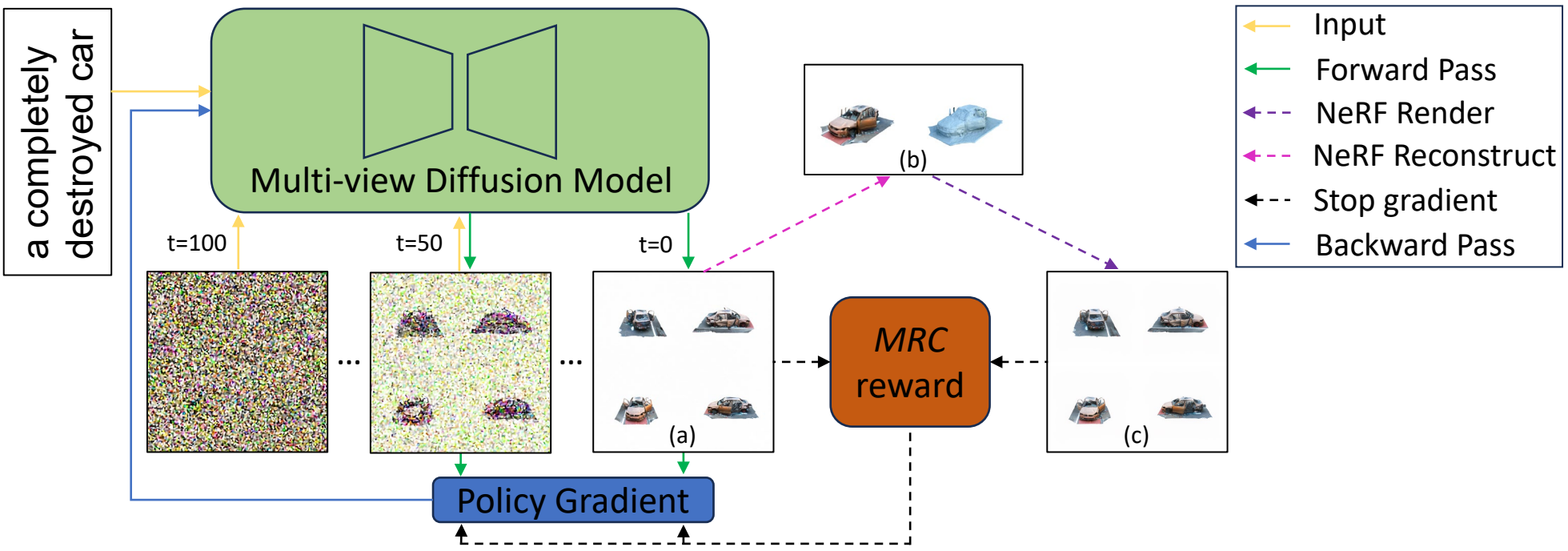
300 dpi PNG · Caption · Source PDF
Original caption, source, and provenance
Fixed source version: CVPR 2024 fixed official PDF
Earliest verified matching figure date (temporal proxy): 2023-12-21
arXiv v1 date: 2023-12-21
Actual drawing date: unknown. See the source record for version checks and temporal-evidence limitations.
Historical PDF · Download citation snapshot · Date evidence · Paper page · Complete screening and version record (Chinese)
Citation threshold evidence: Hao Tan; 12273 citations; snapshot 2026-10-21.
Recorded drawing-tool disclosure: unknown. No tool attribution is inferred from appearance; see the archival disclosure evidence for scope and wording.
Crop bounding box: [64, 72, 534, 237] (PDF points; top-left origin; x0, y0, x1, y1).
Figure 2. Overview of Carve3D. Given a prompt sampled from our curated prompt set and a initial noisy image, we iteratively denoise
the image using the UNet. The final, clean image contains four multi-view images tiled in a 2-by-2 grid. MRC reward is computed by
comparing (a) the generated multi-view images with (c) the corresponding multi-view images rendered at the same camera viewpoints
from (b) the reconstructed NeRF. Then, we train the model with policy gradient loss function, where the loss is derived from the reward
and log probabilities of the UNet’s predictions, accumulated over all denoising timesteps. By using only a set of training text prompts, our
RLFT algorithm finetunes the diffusion model by evaluating its own generated outputs, without relying on ground truth multi-view images.
Carve3D: Improving Multi-view Reconstruction Consistency for Diffusion Models with RL Finetuning
Venue: CVPR 2024 · Main-conference paper
Figure 1 · PDF page 2 · P335
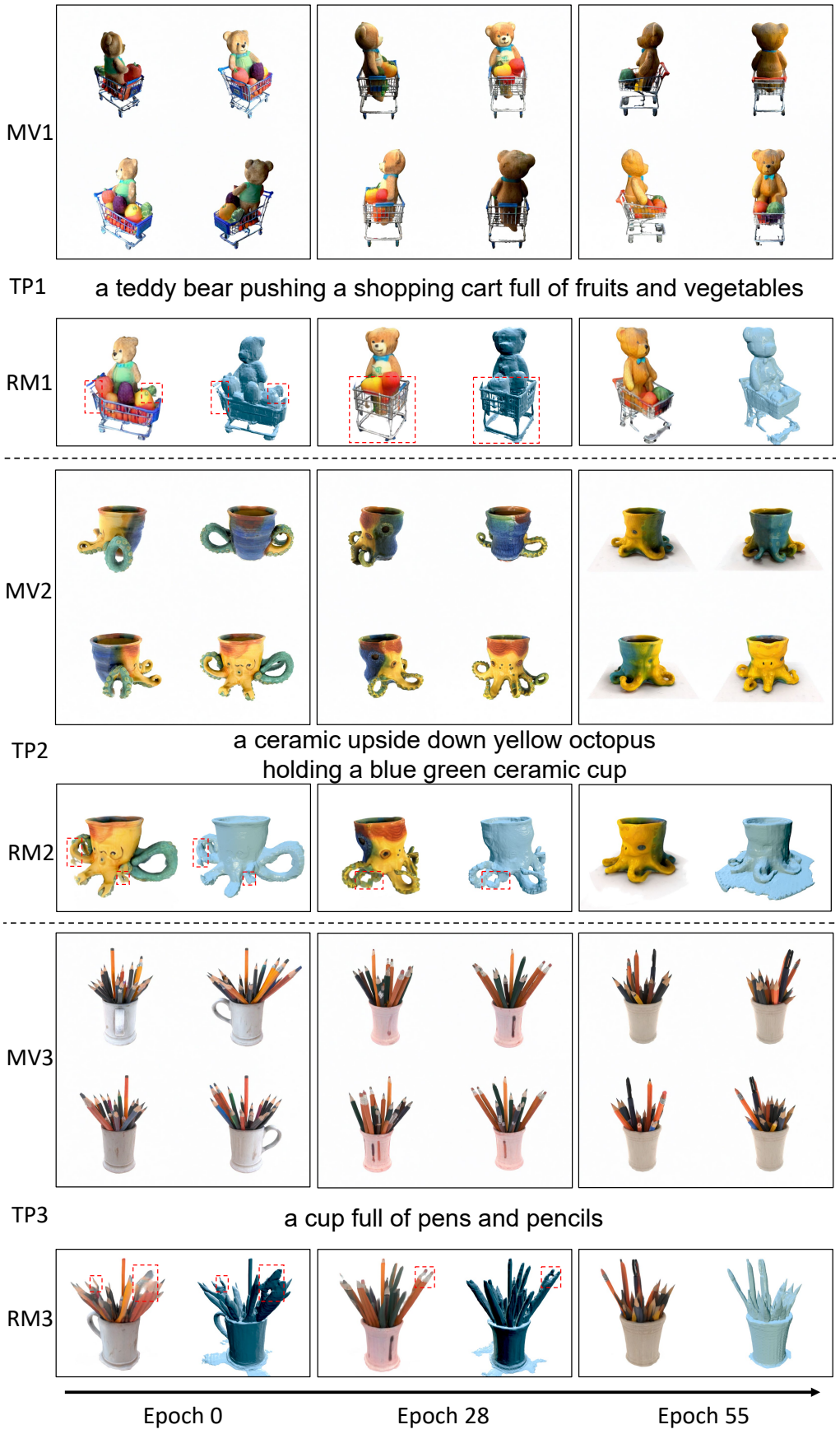
300 dpi PNG · Caption · Source PDF
Original caption, source, and provenance
Fixed source version: CVPR 2024 fixed official PDF
Earliest verified matching figure date (temporal proxy): 2024-04-09
arXiv v1 date: 2023-12-21
Actual drawing date: unknown. See the source record for version checks and temporal-evidence limitations.
Historical PDF · Download citation snapshot · Date evidence · Paper page · Complete screening and version record (Chinese)
Citation threshold evidence: Hao Tan; 12273 citations; snapshot 2026-10-21.
Recorded drawing-tool disclosure: unknown. No tool attribution is inferred from appearance; see the archival disclosure evidence for scope and wording.
Crop bounding box: [49, 72, 294, 490] (PDF points; top-left origin; x0, y0, x1, y1).
Figure 1. Our Carve3D algorithm steadily improves the 3D con-
sistency of a multi-view diffusion model and the resulting quality
of the NeRF and the mesh, without sacrificing its image-prompt
alignment, texture details, or realism. Here, we show 3 testing-
set results (in 3 rows, numbered as 1-3, separated by dotted lines)
from the finetuning process (epoch 0, 28, and 55 in 3 columns).
Each row includes the generated multi-view images (denoted as
MV), the reconstructed NeRF and extracted mesh (denoted as RM)
and the text prompt (denoted as TP). The inconsistencies in the
multi-view images, e.g. the facing direction of the shopping cart,
the position of the octopus arms, and the position of the pencils,
lead to artifacts in the NeRF and the mesh (highlighted in red).
CrossSDF: 3D Reconstruction of Thin Structures From Cross-Sections
Venue: CVPR 2025 · Main-conference paper
Figure 2 · PDF page 3 · P222
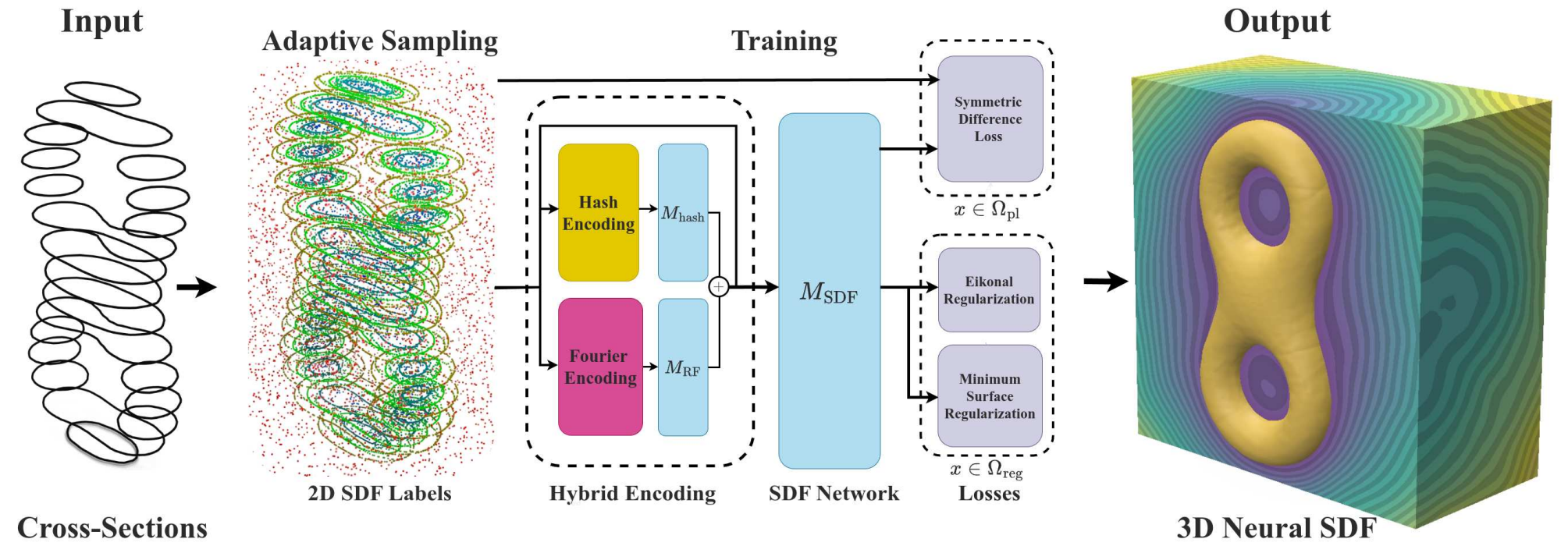
300 dpi PNG · Caption · Source PDF
Original caption, source, and provenance
Fixed source version: CVPR 2025 fixed official PDF
Earliest verified matching figure date (temporal proxy): 2024-12-05
arXiv v1 date: 2024-12-05
Actual drawing date: unknown. See the source record for version checks and temporal-evidence limitations.
Historical PDF · Download citation snapshot · Date evidence · Paper page · Complete screening and version record (Chinese)
Citation threshold evidence: Oisin Mac Aodha; 18397 citations; snapshot 2026-10-21.
Recorded drawing-tool disclosure: unknown. No tool attribution is inferred from appearance; see the archival disclosure evidence for scope and wording.
Crop bounding box: [68, 74, 550, 242] (PDF points; top-left origin; x0, y0, x1, y1).
Figure 2. CrossSDF takes a set of planar cross-sections as input. These cross-sections result in contours which denote the surface
boundaries of the target geometry of interest (left, black lines) and each induces a 2D signed distance field (SDF) in its respective plane.
From this, we generate a set of planar sample points Ω and their 2D SDF labels. During training, points are encoded using our hybrid
pl
encoder before being passed to the SDF network M for prediction. At each iteration we create a set of 3D samples Ω to apply
SDF reg
volumetric regularization. The combination of our novel sampling, loss function, and hybrid encoding results in a high quality 3D SDF.
CrossSDF: 3D Reconstruction of Thin Structures From Cross-Sections
Venue: CVPR 2025 · Main-conference paper
Figure 1 · PDF page 1 · P221
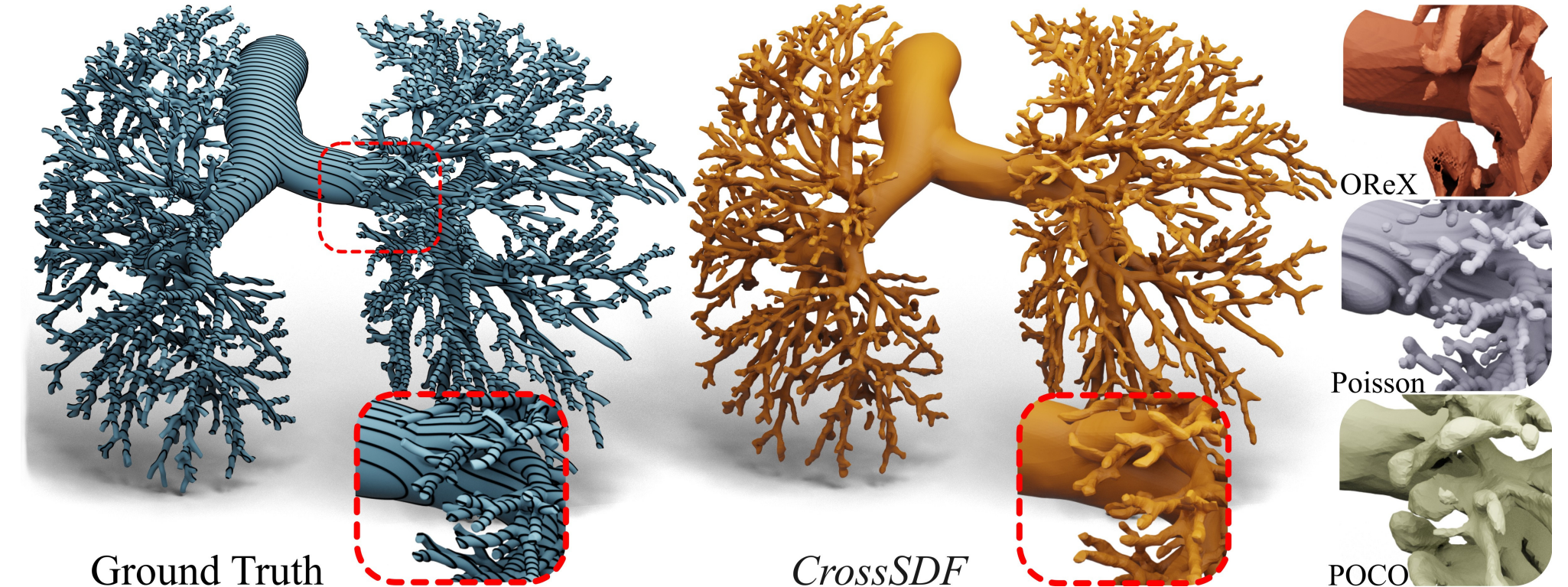
300 dpi PNG · Caption · Source PDF
Original caption, source, and provenance
Fixed source version: CVPR 2025 fixed official PDF
Earliest verified matching figure date (temporal proxy): 2024-12-05
arXiv v1 date: 2024-12-05
Actual drawing date: unknown. See the source record for version checks and temporal-evidence limitations.
Historical PDF · Download citation snapshot · Date evidence · Paper page · Complete screening and version record (Chinese)
Citation threshold evidence: Oisin Mac Aodha; 18397 citations; snapshot 2026-10-21.
Recorded drawing-tool disclosure: unknown. No tool attribution is inferred from appearance; see the archival disclosure evidence for scope and wording.
Crop bounding box: [58, 218, 550, 402] (PDF points; top-left origin; x0, y0, x1, y1).
Figure 1. We propose CrossSDF, a novel approach for reconstructing a 3D signed-distance field from 2D cross-sections. The input is a
set of 2D cross-sections that sample an unobserved ground-truth geometric object by planar intersection (denoted as black lines overlayed
on the ground truth Alveolis structure on the left). CrossSDF (middle) accurately reconstructs thin structures without breakages, over-
smoothing, or cross-sectional artifacts observed in competing methods (right).
DiffHuman: Probabilistic Photorealistic 3D Reconstruction of Humans
Venue: CVPR 2024 · Main-conference paper
Figure 2 · PDF page 2 · P286

300 dpi PNG · Caption · Source PDF
Original caption, source, and provenance
Fixed source version: CVPR 2024 fixed official PDF
Earliest verified matching figure date (temporal proxy): 2024-03-30
arXiv v1 date: 2024-03-30
Actual drawing date: unknown. See the source record for version checks and temporal-evidence limitations.
Historical PDF · Download citation snapshot · Date evidence · Paper page · Complete screening and version record (Chinese)
Citation threshold evidence: Cristian Sminchisescu; 24653 citations; snapshot 2026-10-22.
Recorded drawing-tool disclosure: unknown. No tool attribution is inferred from appearance; see the archival disclosure evidence for scope and wording.
Crop bounding box: [51, 62, 542, 158] (PDF points; top-left origin; x0, y0, x1, y1).
Figure 2. Method overview. We use a diffusion probabilistic model [18] to predict a distribution over plausible 3D reconstructions
conditioned on a single RGB image. During training, we predict noise-dependent pixel-aligned features g (t) (x , I) given a noisy observation
Θ t
set x consisting of front/back albedo, depth and normal renders, and an RGB image I. These features condition an SDF f (t) , which is
t Θ
dependent on both x and I. f (t) and g (t) are neural networks that define an implicit surface S (t) (x , I). Then, we obtain an estimate of the
t Θ Θ Θ t
denoised observation set x(t) by rendering S (t) . We may additionally produce a shaded image C(t) by applying a pixel-wise noise-dependent
0Θ Θ
shading network s(t) . During inference, we can sample trajectories over observation sets x ∼ p (x |I) by computing and rendering
Θ 0:T Θ 0:T
S (t) (x , I) in each denoising step. Our final 3D samples S ∼ p (S |I) are obtained as the final reconstruction S = S (1) (x , I). To mitigate
Θ t Θ Θ 1
the computational cost of rendering an implicit surface in every step, we train a “generator” network h(t) that imitates rendering by directly
Θ
mapping g (t) (x , I) to x(t) . During inference, we denoise using h(t) and only explicitly compute the 3D reconstruction in the last step.
Θ t 0Θ Θ
DiffHuman: Probabilistic Photorealistic 3D Reconstruction of Humans
Venue: CVPR 2024 · Main-conference paper
Figure 3 · PDF page 4 · P285
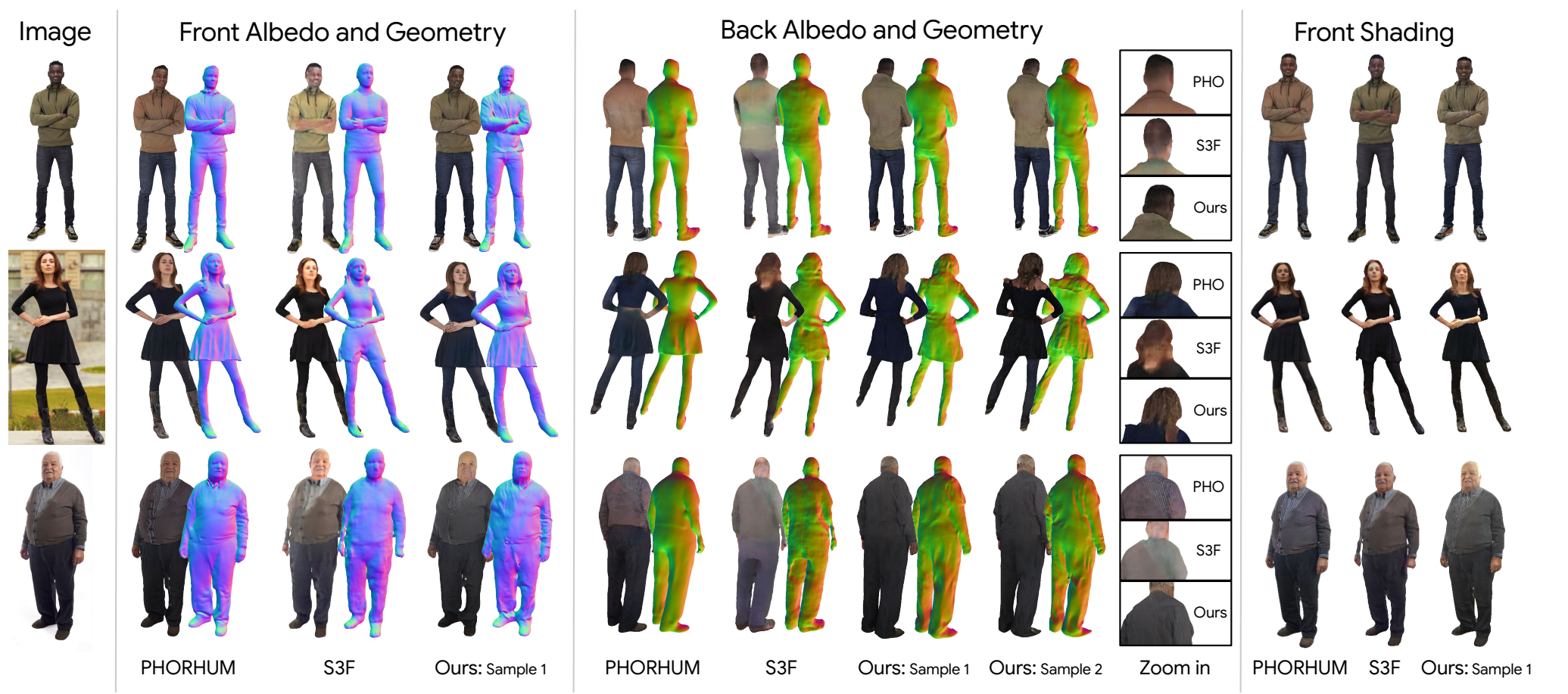
300 dpi PNG · Caption · Source PDF
Original caption, source, and provenance
Fixed source version: CVPR 2024 fixed official PDF
Earliest verified matching figure date (temporal proxy): 2024-03-30
arXiv v1 date: 2024-03-30
Actual drawing date: unknown. See the source record for version checks and temporal-evidence limitations.
Historical PDF · Download citation snapshot · Date evidence · Paper page · Complete screening and version record (Chinese)
Citation threshold evidence: Cristian Sminchisescu; 24653 citations; snapshot 2026-10-22.
Recorded drawing-tool disclosure: unknown. No tool attribution is inferred from appearance; see the archival disclosure evidence for scope and wording.
Crop bounding box: [50, 56, 547, 276] (PDF points; top-left origin; x0, y0, x1, y1).
Figure 3. Qualitative comparison against deterministic monocular 3D human reconstruction methods [5, 10] that predict geometry,
surface albedo and shaded colour. PHORHUM [5] (retrained on our dataset) outputs good front predictions, but exhibits over-smooth, flat
geometry and blurry colours on the back. S3F [10] yields more detailed geometry, but colours are still often blurry. Moreover, both these
methods occasionally paste the front colour predictions onto the back incorrectly (see row 3). Our method outputs multiple diverse samples,
with a greater level of geometric detail and colour sharpness in uncertain regions, that are consistent with the input image after shading.
GenNBV: Generalizable Next-Best-View Policy for Active 3D Reconstruction
Venue: CVPR 2024 · Main-conference paper
Figure 2 · PDF page 3 · P282
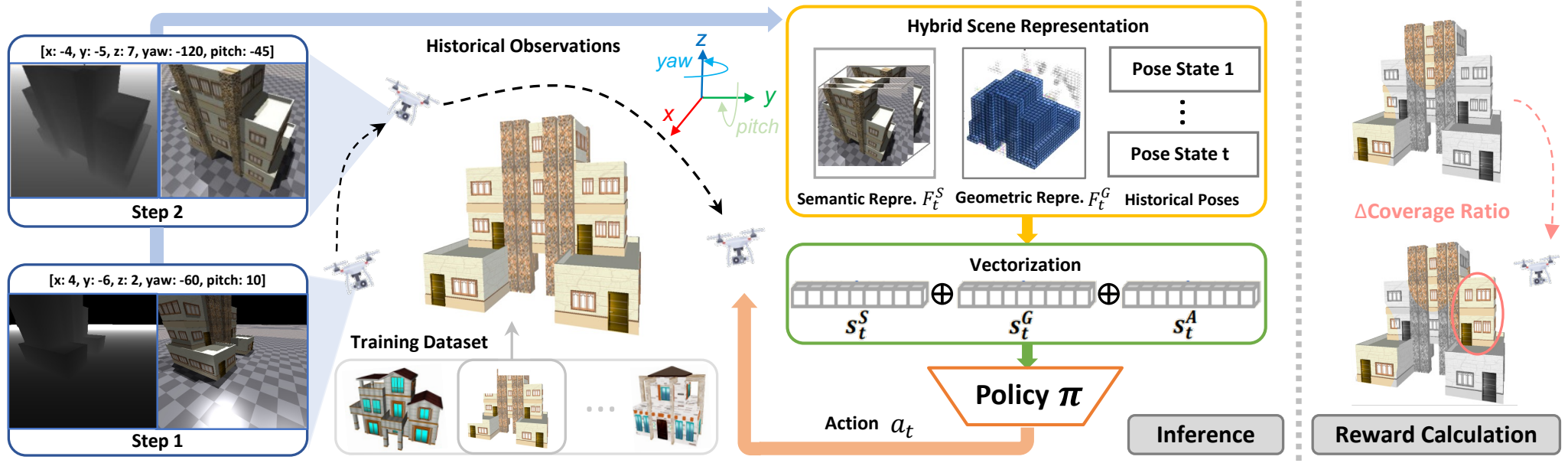
300 dpi PNG · Caption · Source PDF
Original caption, source, and provenance
Fixed source version: CVPR 2024 fixed official PDF
Earliest verified matching figure date (temporal proxy): 2024-02-25
arXiv v1 date: 2024-02-25
Actual drawing date: unknown. See the source record for version checks and temporal-evidence limitations.
Historical PDF · Download citation snapshot · Date evidence · Paper page · Complete screening and version record (Chinese)
Citation threshold evidence: Jiangmiao Pang; 26222 citations; snapshot 2026-10-21.
Recorded drawing-tool disclosure: unknown. No tool attribution is inferred from appearance; see the archival disclosure evidence for scope and wording.
Crop bounding box: [50, 74, 542, 219] (PDF points; top-left origin; x0, y0, x1, y1).
Figure 2. Overview of our proposed framework GenNBV. Our end-to-end policy takes the historical multi-source observations as input,
transforms them into a more informative scene representation, and produces the next viewpoint position. A reward signal will be returned
at training time to optimize the end-to-end policy for maximizing the expected cumulative reward in one episode. Specifically, the signal
is the increased coverage ratio after collecting a new viewpoint.
GenNBV: Generalizable Next-Best-View Policy for Active 3D Reconstruction
Venue: CVPR 2024 · Main-conference paper
Figure 1 · PDF page 1 · P281
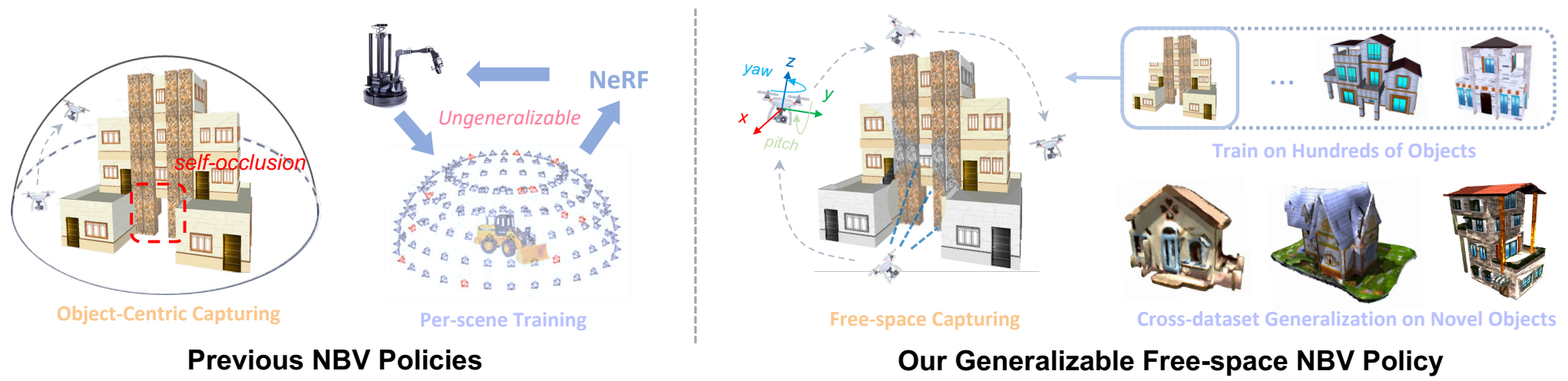
300 dpi PNG · Caption · Source PDF
Original caption, source, and provenance
Fixed source version: CVPR 2024 fixed official PDF
Earliest verified matching figure date (temporal proxy): 2024-02-25
arXiv v1 date: 2024-02-25
Actual drawing date: unknown. See the source record for version checks and temporal-evidence limitations.
Historical PDF · Download citation snapshot · Date evidence · Paper page · Complete screening and version record (Chinese)
Citation threshold evidence: Jiangmiao Pang; 26222 citations; snapshot 2026-10-21.
Recorded drawing-tool disclosure: unknown. No tool attribution is inferred from appearance; see the archival disclosure evidence for scope and wording.
Crop bounding box: [49, 201, 539, 320] (PDF points; top-left origin; x0, y0, x1, y1).
Figure 1. To determine the best view for 3D reconstruction, previous methods only chose from hand-crafted action space or based on
object-centric capturing, lacking the ability to generalize to unforeseen scenes (Left). With our end-to-end trained, generalized free-space
policy, it can generalize to unseen objects, enabling the captured drone to image from any viewpoint (Right).
Generative Multiview Relighting for 3D Reconstruction under Extreme Illumination Variation
Venue: CVPR 2025 · Main-conference paper
Figure 2 · PDF page 4 · P24
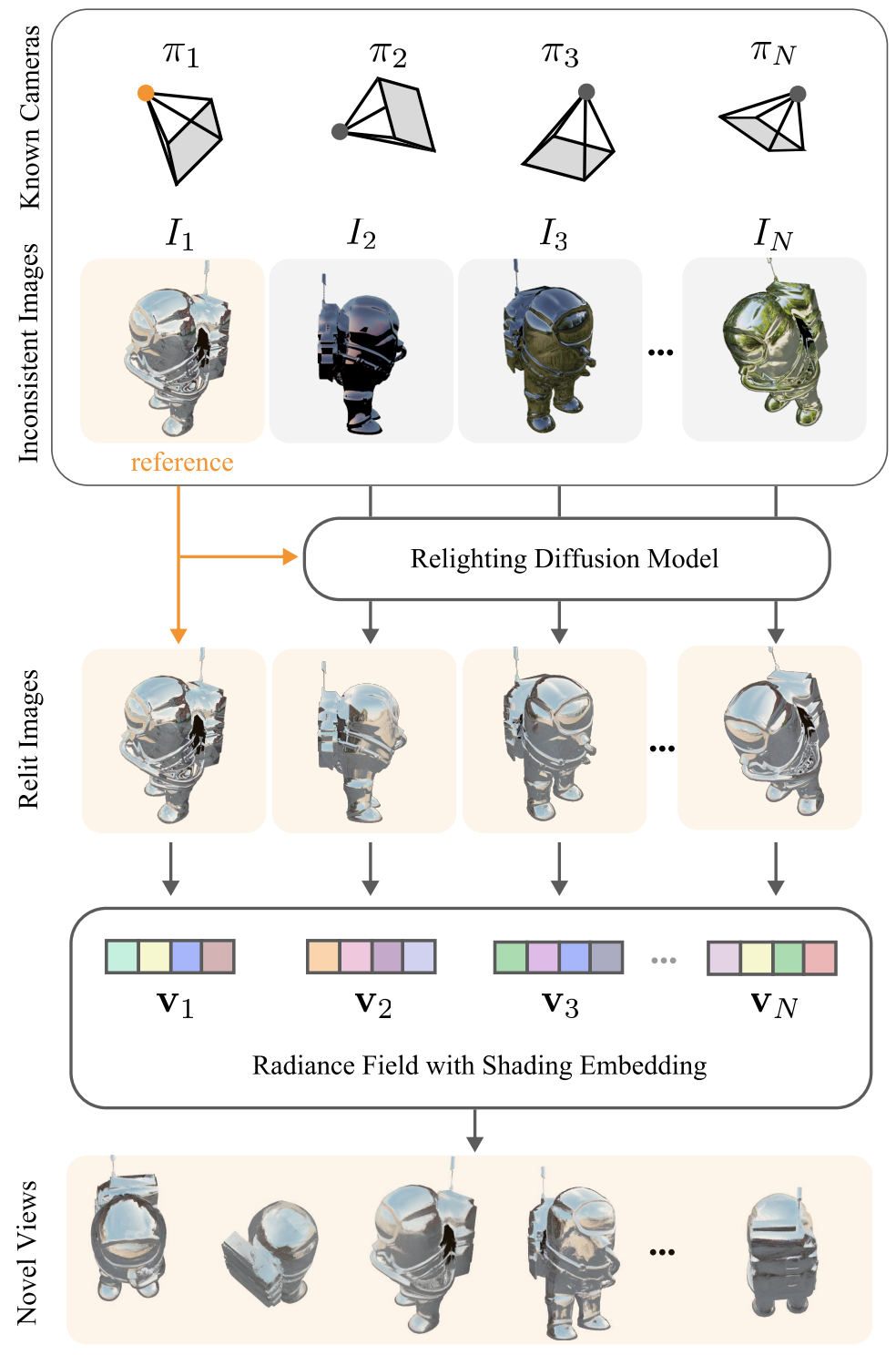
300 dpi PNG · Caption · Source PDF
Original caption, source, and provenance
Fixed source version: CVPR 2025 fixed official PDF
Earliest verified matching figure date (temporal proxy): 2024-12-19
arXiv v1 date: 2024-12-19
Actual drawing date: unknown. See the source record for version checks and temporal-evidence limitations.
Historical PDF · Download citation snapshot · Date evidence · Complete screening and version record (Chinese)
Citation threshold evidence: Jia-Bin Huang; 38451 citations; snapshot 2026-10-21.
Recorded drawing-tool disclosure: unknown. No tool attribution is inferred from appearance; see the archival disclosure evidence for scope and wording.
Crop bounding box: [58, 75, 294, 432] (PDF points; top-left origin; x0, y0, x1, y1).
Figure 2. Method overview. We first apply a relighting diffusion
modelthatconvertsN imagesI ,...,I withknowncameraposes
1 N
π , ..., π , captured under extremely different illuminations, to a
1 N
set of images with the same poses, but rendered under the illumi-
nation of the reference image I (highlighted in orange). We then
1
optimize a neural radiance field to obtain a consistent 3D repre-
sentation with a novel per-image shading embedding, which can
be used to render new views of the scene from unobserved poses.
Generative Multiview Relighting for 3D Reconstruction under Extreme Illumination Variation
Venue: CVPR 2025 · Main-conference paper
Figure 1 · PDF page 1 · P23
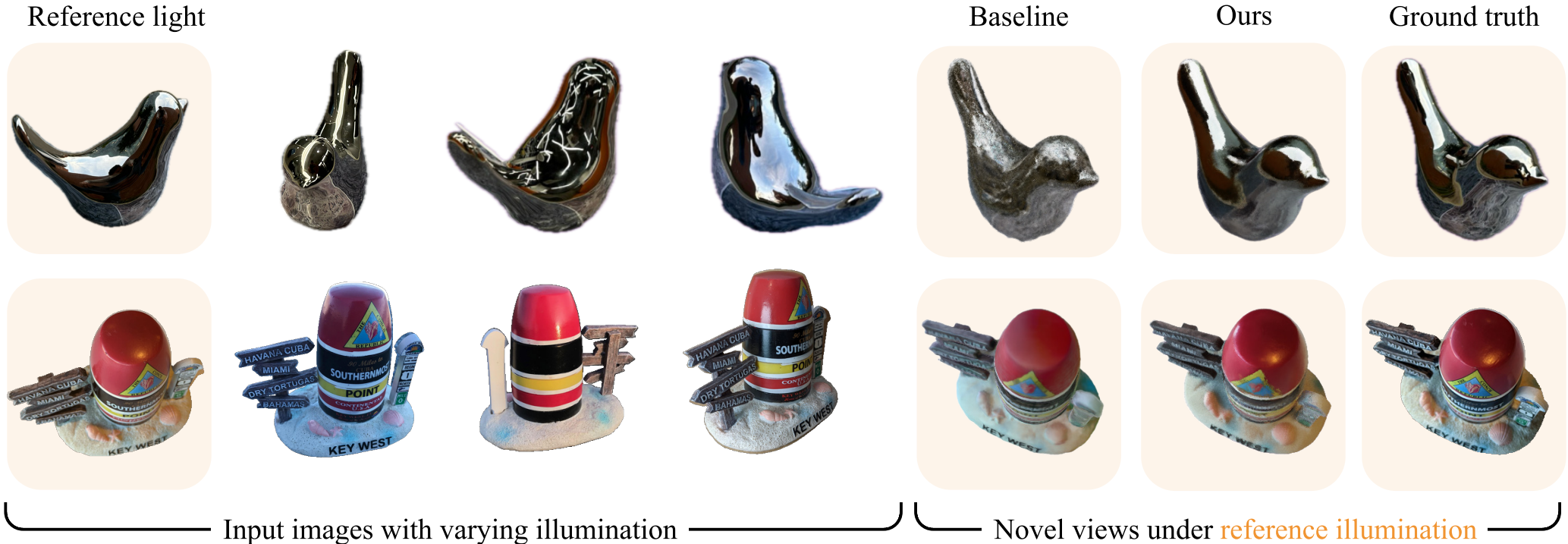
300 dpi PNG · Caption · Source PDF
Original caption, source, and provenance
Fixed source version: CVPR 2025 fixed official PDF
Earliest verified matching figure date (temporal proxy): 2024-12-19
arXiv v1 date: 2024-12-19
Actual drawing date: unknown. See the source record for version checks and temporal-evidence limitations.
Historical PDF · Download citation snapshot · Date evidence · Complete screening and version record (Chinese)
Citation threshold evidence: Jia-Bin Huang; 38451 citations; snapshot 2026-10-21.
Recorded drawing-tool disclosure: unknown. No tool attribution is inferred from appearance; see the archival disclosure evidence for scope and wording.
Crop bounding box: [58, 273, 554, 445] (PDF points; top-left origin; x0, y0, x1, y1).
Figure 1. 3D reconstruction under extreme illumination variation. We propose a method for 3D reconstruction from a set of images
captured under strongly varying illumination. Our method recovers high-fidelity appearance details including specular highlights that prior
state-of-the-artapproachescannotrecover(topbaseline: NeRF-Casting[47]withappearanceembeddings,bottombaseline: NeROIC[25]).
NeRSP: Neural 3D Reconstruction for Reflective Objects with Sparse Polarized Images
Venue: CVPR 2024 · Main-conference paper
Figure 4 · PDF page 5 · P284
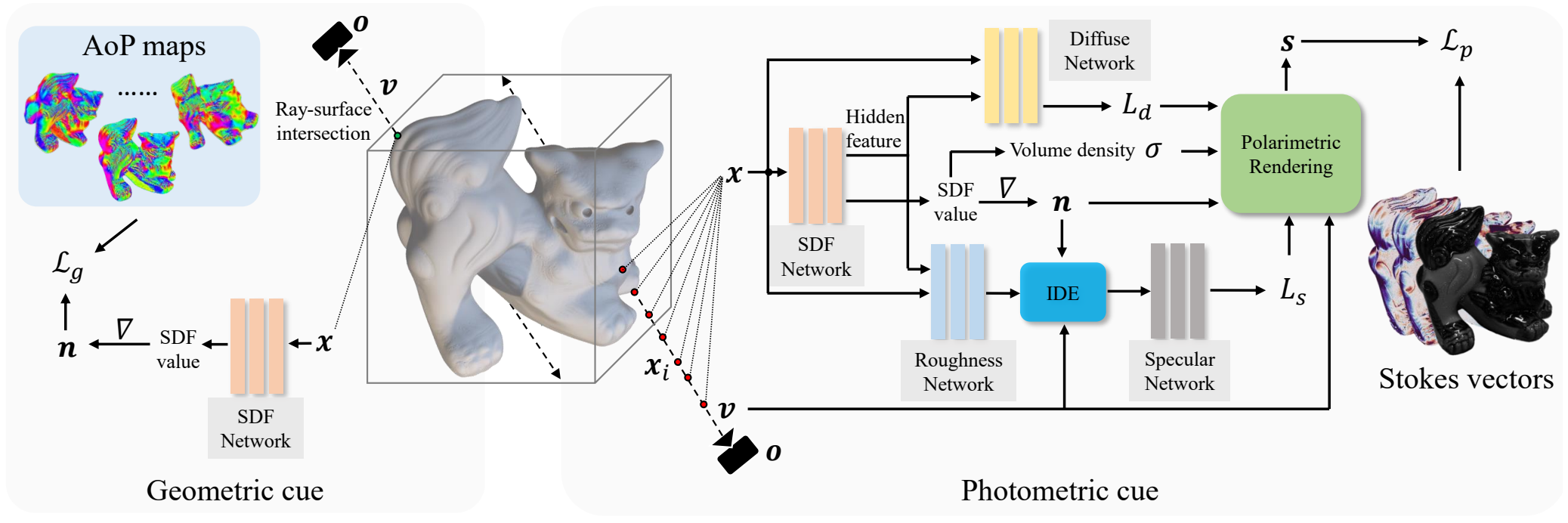
300 dpi PNG · Caption · Source PDF
Original caption, source, and provenance
Fixed source version: CVPR 2024 fixed official PDF
Earliest verified matching figure date (temporal proxy): 2024-06-11
arXiv v1 date: 2024-06-11
Actual drawing date: unknown. See the source record for version checks and temporal-evidence limitations.
Historical PDF · Download citation snapshot · Date evidence · Paper page · Complete screening and version record (Chinese)
Citation threshold evidence: Zhanyu Ma; 11953 citations; snapshot 2026-10-22.
Recorded drawing-tool disclosure: unknown. No tool attribution is inferred from appearance; see the archival disclosure evidence for scope and wording.
Crop bounding box: [49, 71, 547, 237] (PDF points; top-left origin; x0, y0, x1, y1).
Figure 4. Pipeline of our NeRSP.
NeRSP: Neural 3D Reconstruction for Reflective Objects with Sparse Polarized Images
Venue: CVPR 2024 · Main-conference paper
Figure 3 · PDF page 4 · P283
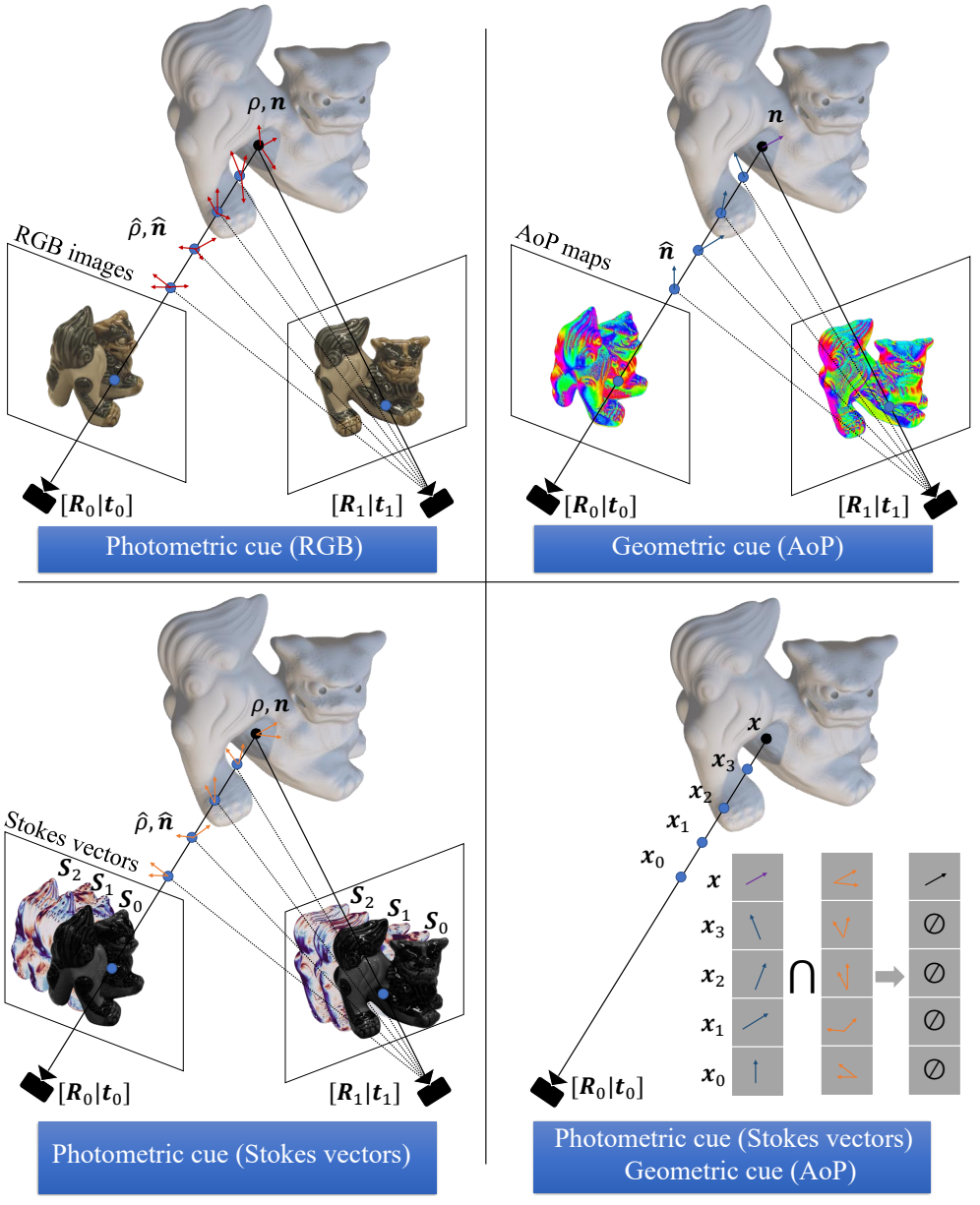
300 dpi PNG · Caption · Source PDF
Original caption, source, and provenance
Fixed source version: CVPR 2024 fixed official PDF
Earliest verified matching figure date (temporal proxy): 2024-06-11
arXiv v1 date: 2024-06-11
Actual drawing date: unknown. See the source record for version checks and temporal-evidence limitations.
Historical PDF · Download citation snapshot · Date evidence · Paper page · Complete screening and version record (Chinese)
Citation threshold evidence: Zhanyu Ma; 11953 citations; snapshot 2026-10-22.
Recorded drawing-tool disclosure: unknown. No tool attribution is inferred from appearance; see the archival disclosure evidence for scope and wording.
Crop bounding box: [308, 72, 547, 366] (PDF points; top-left origin; x0, y0, x1, y1).
Figure 3. Ambiguity of determining 3D postions under sparse
views with geometric and photometric cues.
Parametric Point Cloud Completion for Polygonal Surface Reconstruction
Venue: CVPR 2025 · Main-conference paper
Figure 2 · PDF page 3 · P236
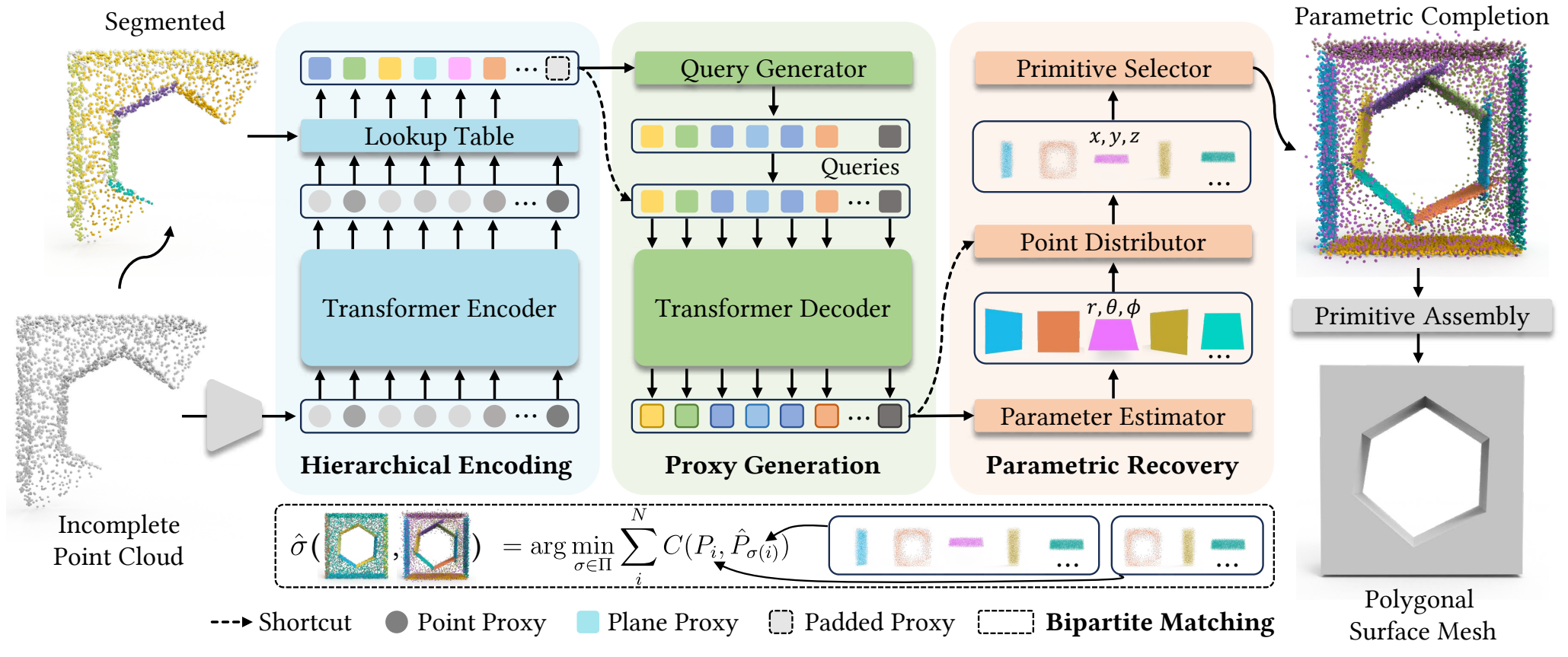
300 dpi PNG · Caption · Source PDF
Original caption, source, and provenance
Fixed source version: CVPR 2025 fixed official PDF
Earliest verified matching figure date (temporal proxy): 2025-03-11
arXiv v1 date: 2025-03-11
Actual drawing date: unknown. See the source record for version checks and temporal-evidence limitations.
Historical PDF · Download citation snapshot · Date evidence · Paper page · Complete screening and version record (Chinese)
Citation threshold evidence: Xiao Xiang Zhu; 51863 citations; snapshot 2026-10-22.
Recorded drawing-tool disclosure: unknown. No tool attribution is inferred from appearance; see the archival disclosure evidence for scope and wording.
Crop bounding box: [59, 71, 553, 278] (PDF points; top-left origin; x0, y0, x1, y1).
Figure 2. Architecture of PaCo. Starting from an incomplete point cloud, we hierarchically encode the points into plane proxies with a
lookup table from segmentation. These proxies inform the proxy generator in producing a set of proxy proposals. The generated proxies
are then passed to the parameter estimator and the point distributor for primitive estimation. Finally, the primitive selector identifies a
subset of primitives to form the parametric completion, with selection optimized via bipartite matching. The resulting primitives enable
direct assembly for polygonal surface reconstruction. Points are colored according to their planar primitives.
Parametric Point Cloud Completion for Polygonal Surface Reconstruction
Venue: CVPR 2025 · Main-conference paper
Figure 1 · PDF page 1 · P235
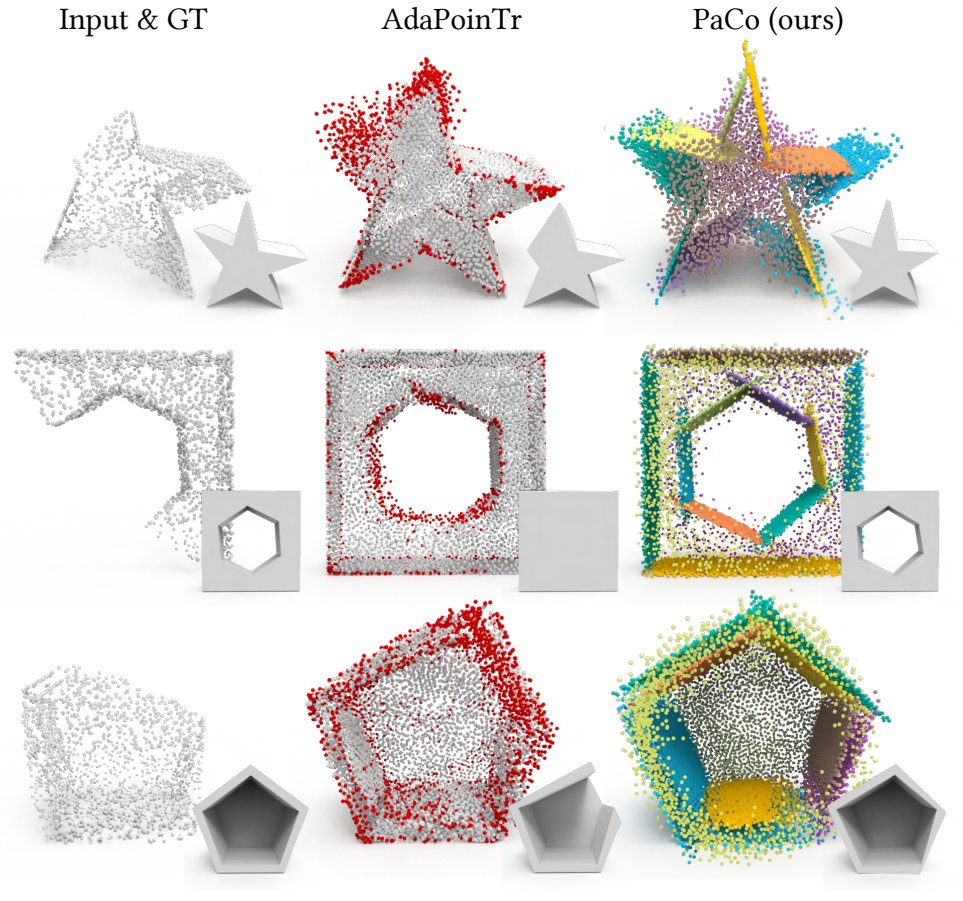
300 dpi PNG · Caption · Source PDF
Original caption, source, and provenance
Fixed source version: CVPR 2025 fixed official PDF
Earliest verified matching figure date (temporal proxy): 2025-03-11
arXiv v1 date: 2025-03-11
Actual drawing date: unknown. See the source record for version checks and temporal-evidence limitations.
Historical PDF · Download citation snapshot · Date evidence · Paper page · Complete screening and version record (Chinese)
Citation threshold evidence: Xiao Xiang Zhu; 51863 citations; snapshot 2026-10-22.
Recorded drawing-tool disclosure: unknown. No tool attribution is inferred from appearance; see the archival disclosure evidence for scope and wording.
Crop bounding box: [322, 203, 553, 419] (PDF points; top-left origin; x0, y0, x1, y1).
Figure 1. Unlike conventional point cloud completion that aims
to recover individual points (middle, non-planar points shown in
red), parametric completion recovers primitive parameters along
with corresponding inlier points. PaCo recovers planar structures
(right, each color denoting a planar primitive), directly enabling
high-quality polygonal surface reconstruction.
PlanarSplatting: Accurate Planar Surface Reconstruction in 3 Minutes
Venue: CVPR 2025 · Main-conference paper
Figure 3 · PDF page 4 · P220
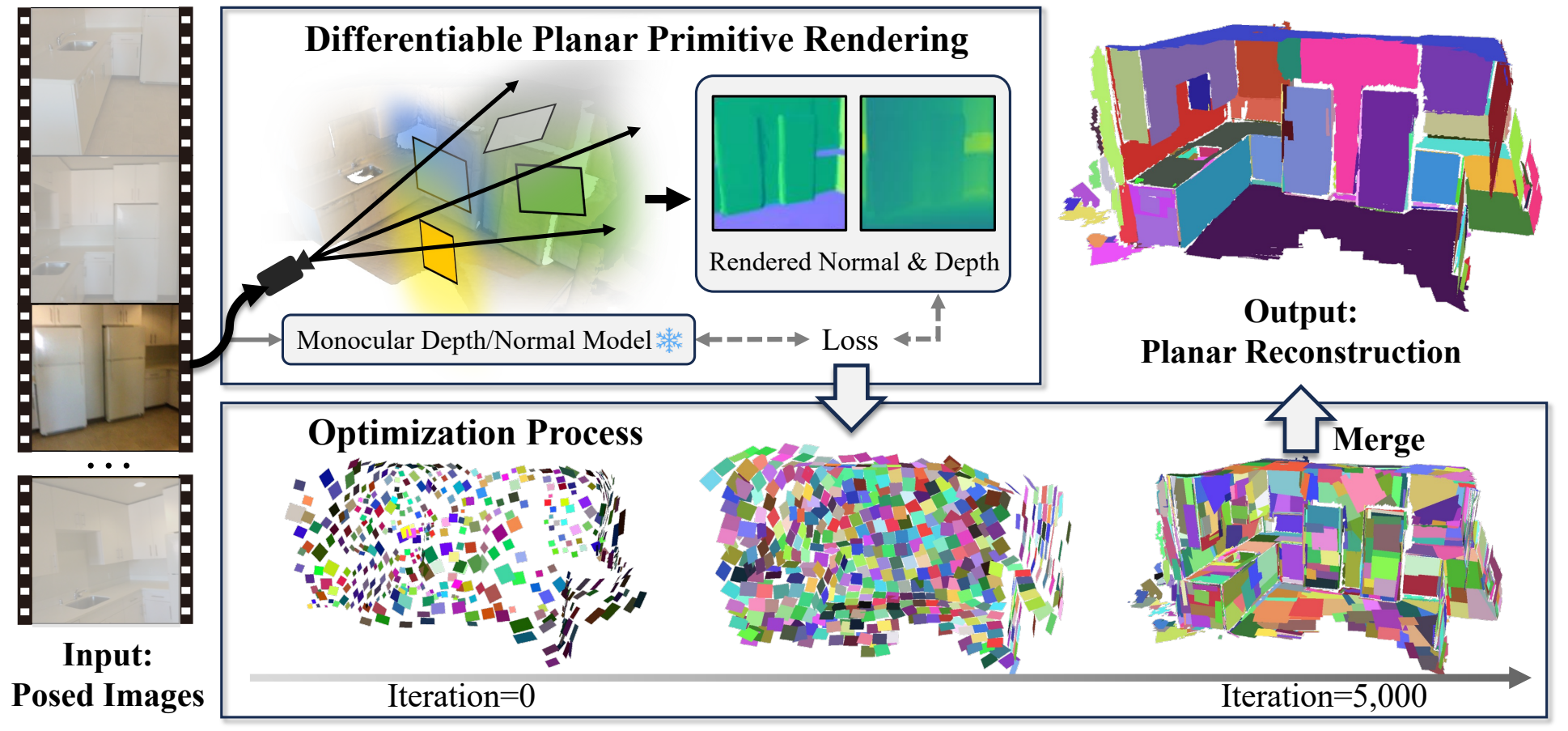
300 dpi PNG · Caption · Source PDF
Original caption, source, and provenance
Fixed source version: CVPR 2025 fixed official PDF
Earliest verified matching figure date (temporal proxy): 2024-12-04
arXiv v1 date: 2024-12-04
Actual drawing date: unknown. See the source record for version checks and temporal-evidence limitations.
Historical PDF · Download citation snapshot · Date evidence · Paper page · Complete screening and version record (Chinese)
Citation threshold evidence: Yujun Shen; 15694 citations; snapshot 2026-10-21.
Recorded drawing-tool disclosure: unknown. No tool attribution is inferred from appearance; see the archival disclosure evidence for scope and wording.
Crop bounding box: [75, 86, 540, 302.5] (PDF points; top-left origin; x0, y0, x1, y1).
Figure 3. Illustration of our proposed PlanarSplatting. Given a set of posed multi-view images of indoor scenes, our method renders
depth and normal maps from 3D plane primitives. Then, with the supervision of monocular cues, these 3D plane primitives are gradually
optimized to recover the scene geometry and finally merged to get the planar reconstruction result.
PlanarSplatting: Accurate Planar Surface Reconstruction in 3 Minutes
Venue: CVPR 2025 · Main-conference paper
Figure 5 · PDF page 4 · P219
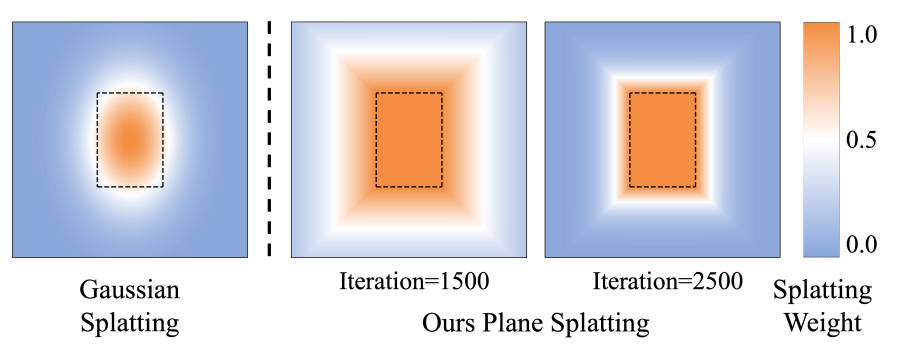
300 dpi PNG · Caption · Source PDF
Original caption, source, and provenance
Fixed source version: CVPR 2025 fixed official PDF
Earliest verified matching figure date (temporal proxy): 2024-12-04
arXiv v1 date: 2024-12-04
Actual drawing date: unknown. See the source record for version checks and temporal-evidence limitations.
Historical PDF · Download citation snapshot · Date evidence · Paper page · Complete screening and version record (Chinese)
Citation threshold evidence: Yujun Shen; 15694 citations; snapshot 2026-10-21.
Recorded drawing-tool disclosure: unknown. No tool attribution is inferred from appearance; see the archival disclosure evidence for scope and wording.
Crop bounding box: [325, 350, 543, 435.5] (PDF points; top-left origin; x0, y0, x1, y1).
Figure 5. Illustration of the proposed plane splatting function.
Naive Gaussian Splatting can not effectively approximate the
boundary of our rectangular plane primitive (shown in black
dashed border). In contrast, our proposed plane splatting function
can approximate the boundary of the rectangle as the number of
iterations increases, allowing our 3D planar primitives to better fit
the surface of the scene.
Pow3R: Empowering Unconstrained 3D Reconstruction with Camera and Scene Priors
Venue: CVPR 2025 · Main-conference paper
Figure 2 · PDF page 3 · P192
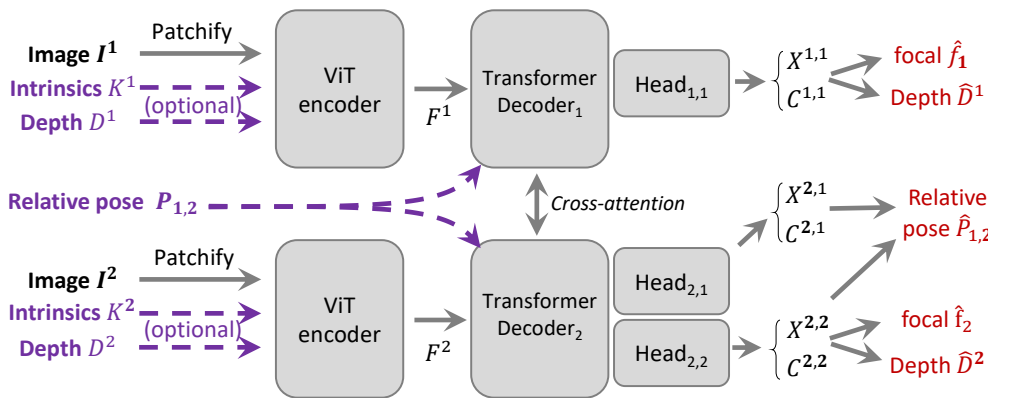
300 dpi PNG · Caption · Source PDF
Original caption, source, and provenance
Fixed source version: CVPR 2025 fixed official PDF
Earliest verified matching figure date (temporal proxy): 2025-03-21
arXiv v1 date: 2025-03-21
Actual drawing date: unknown. See the source record for version checks and temporal-evidence limitations.
Historical PDF · Download citation snapshot · Date evidence · Paper page · Complete screening and version record (Chinese)
Citation threshold evidence: Jerome Revaud; 13410 citations; snapshot 2026-10-21.
Recorded drawing-tool disclosure: unknown. No tool attribution is inferred from appearance; see the archival disclosure evidence for scope and wording.
Crop bounding box: [58, 70, 300, 166] (PDF points; top-left origin; x0, y0, x1, y1).
Figure 2. Overview of the model architecture. Following
DUSt3R [75], images are encoded then decoded with a ViT back-
bone into pointmaps, from which focals, depthmaps and relative
pose can be extracted. Pow3R introduces optional inputs to guide
the regression with prior knowledge about the camera intrinsics
and depth (fed into the encoder) and the pose (into the decoder).
Pow3R: Empowering Unconstrained 3D Reconstruction with Camera and Scene Priors
Venue: CVPR 2025 · Main-conference paper
Figure 4 · PDF page 5 · P191
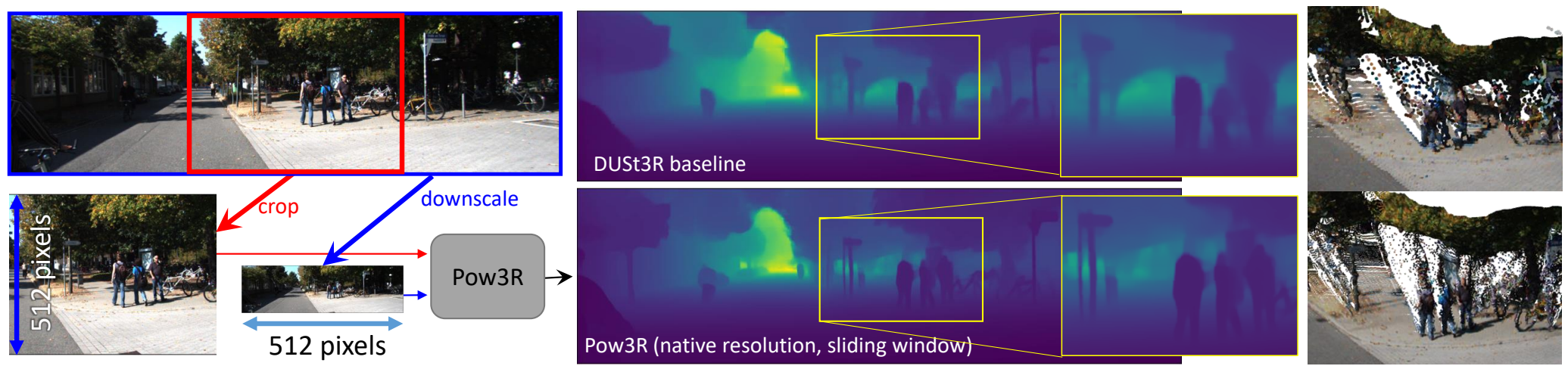
300 dpi PNG · Caption · Source PDF
Original caption, source, and provenance
Fixed source version: CVPR 2025 fixed official PDF
Earliest verified matching figure date (temporal proxy): 2025-03-21
arXiv v1 date: 2025-03-21
Actual drawing date: unknown. See the source record for version checks and temporal-evidence limitations.
Historical PDF · Download citation snapshot · Date evidence · Paper page · Complete screening and version record (Chinese)
Citation threshold evidence: Jerome Revaud; 13410 citations; snapshot 2026-10-21.
Recorded drawing-tool disclosure: unknown. No tool attribution is inferred from appearance; see the archival disclosure evidence for scope and wording.
Crop bounding box: [58, 70, 555, 186] (PDF points; top-left origin; x0, y0, x1, y1).
Figure 4. Native resolution example. Methods like DUSt3R require centered principal point and would thus downscale the image to its
training resolution, leading to blurry prediction (top). With camera intrinsics input, we can process any crop in the image leading to native
resolution prediction (bottom row), for example by dividing the image into 4 crops, that are independently process as the first input image,
while the second input image of the network is set to the downscaled image.
Beyond Prompt Degradation: Prototype-guided Dual-pool Prompting for Incremental Object Detection
Venue: CVPR 2026 · Main-conference paper
Figure 2 · PDF page 3 · P244
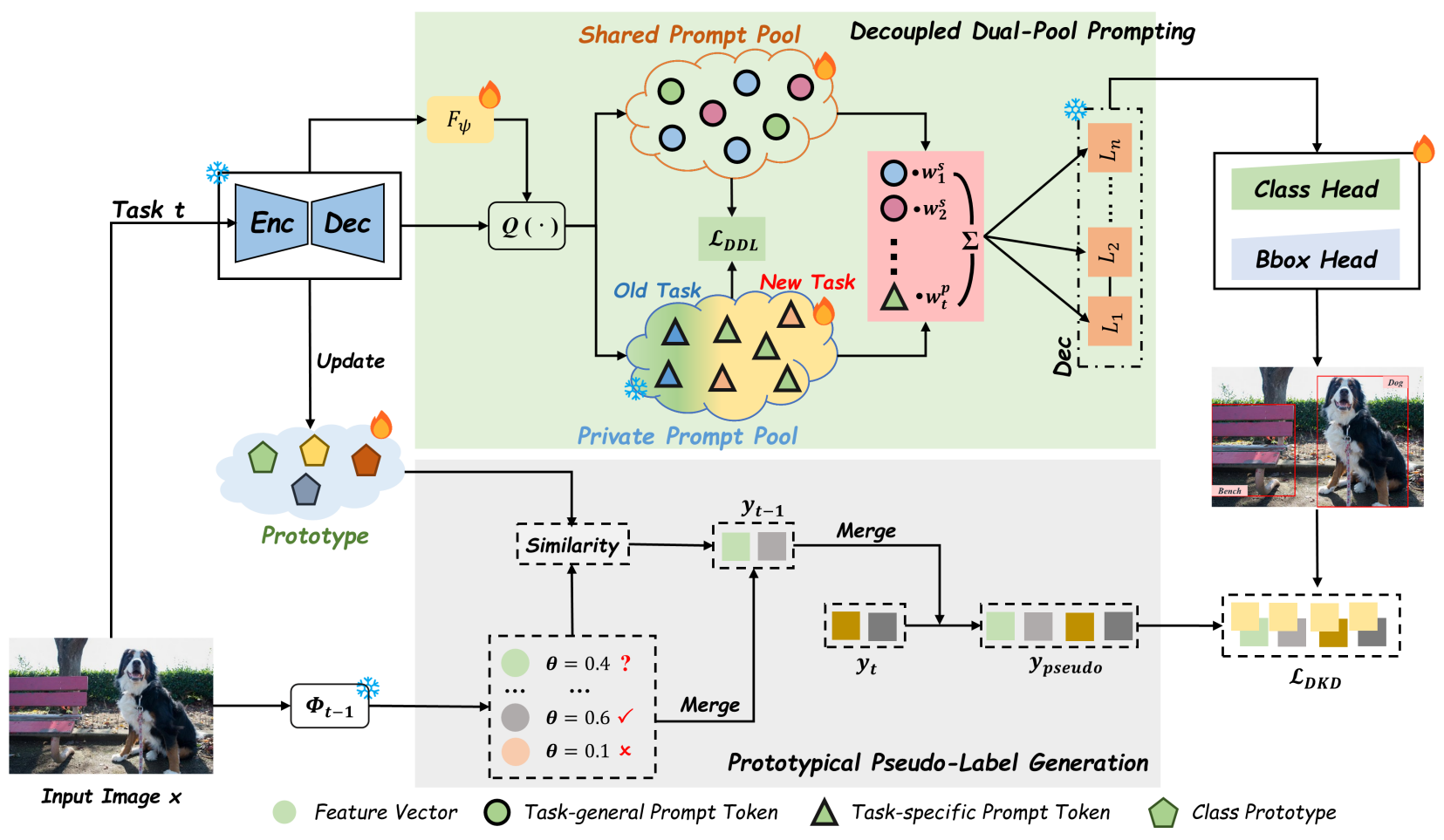
300 dpi PNG · Caption · Source PDF
Original caption, source, and provenance
Fixed source version: CVPR 2026 fixed official PDF
Earliest verified matching figure date (temporal proxy): 2026-03-02
arXiv v1 date: 2026-03-02
Actual drawing date: unknown. See the source record for version checks and temporal-evidence limitations.
Historical PDF · Download citation snapshot · Date evidence · Paper page · Complete screening and version record (Chinese)
Citation threshold evidence: Qi Wang; 21434 citations; snapshot 2026-10-22.
Recorded drawing-tool disclosure: unknown. No tool attribution is inferred from appearance; see the archival disclosure evidence for scope and wording.
Crop bounding box: [108, 72, 505, 303] (PDF points; top-left origin; x0, y0, x1, y1).
Figure 2. Overview of our framework at incremental step t. Given an image x, the query function generates a content-aware query
representation by adaptively computing query weights via a ranking function F and performing weighted aggregation. Subsequently,
ψ
prompts are retrieved from both the shared and private pool and injected into the decoder layer. In parallel, the teacher model Φ
t−1
generates a set of candidate bounding boxes, where potentially valuable ones are projected into the feature space to compute their similarity
with class prototypes. This process yields a set of refined, high-quality pseudo-labels to guide the training of the student model Φ .
t
Beyond Prompt Degradation: Prototype-guided Dual-pool Prompting for Incremental Object Detection
Venue: CVPR 2026 · Main-conference paper
Figure 1 · PDF page 1 · P243
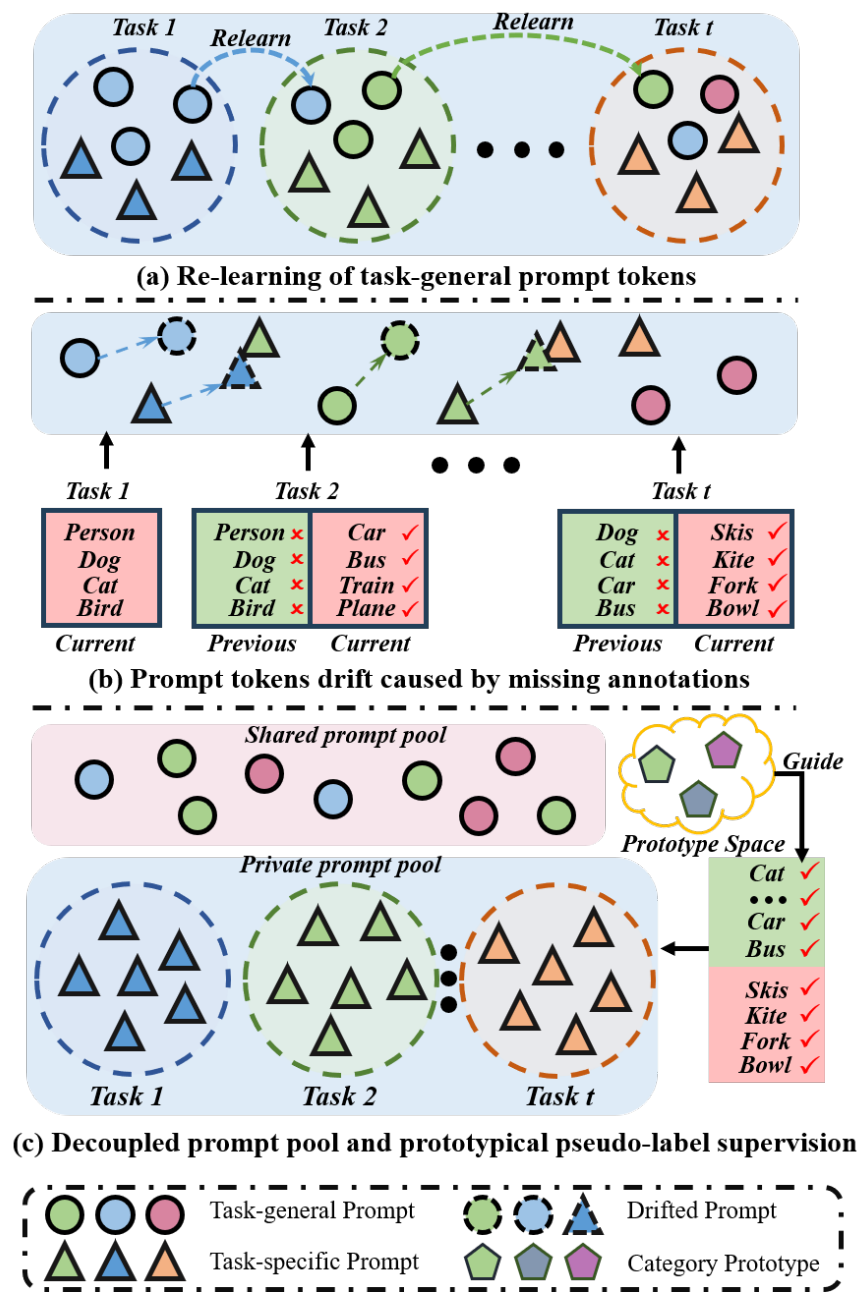
300 dpi PNG · Caption · Source PDF
Original caption, source, and provenance
Fixed source version: CVPR 2026 fixed official PDF
Earliest verified matching figure date (temporal proxy): 2026-03-02
arXiv v1 date: 2026-03-02
Actual drawing date: unknown. See the source record for version checks and temporal-evidence limitations.
Historical PDF · Download citation snapshot · Date evidence · Paper page · Complete screening and version record (Chinese)
Citation threshold evidence: Qi Wang; 21434 citations; snapshot 2026-10-22.
Recorded drawing-tool disclosure: unknown. No tool attribution is inferred from appearance; see the archival disclosure evidence for scope and wording.
Crop bounding box: [331, 232, 539, 545] (PDF points; top-left origin; x0, y0, x1, y1).
Figure 1. Comparison of prompt-based methods. (a) Use task
ID to isolate prompt, which forces task-general prompt to be re-
learned at each task. (b) Missing annotations cause prompt tokens
to drift. (c) The shared prompt pool continuously optimizes task-
general prompt, and category prototypes guide the generation of
pseudo labels for old categories.
EW-DETR: Evolving World Object Detection via Incremental Low-Rank DEtection TRansformer
Venue: CVPR 2026 · Main-conference paper
Figure 3 · PDF page 4 · P198
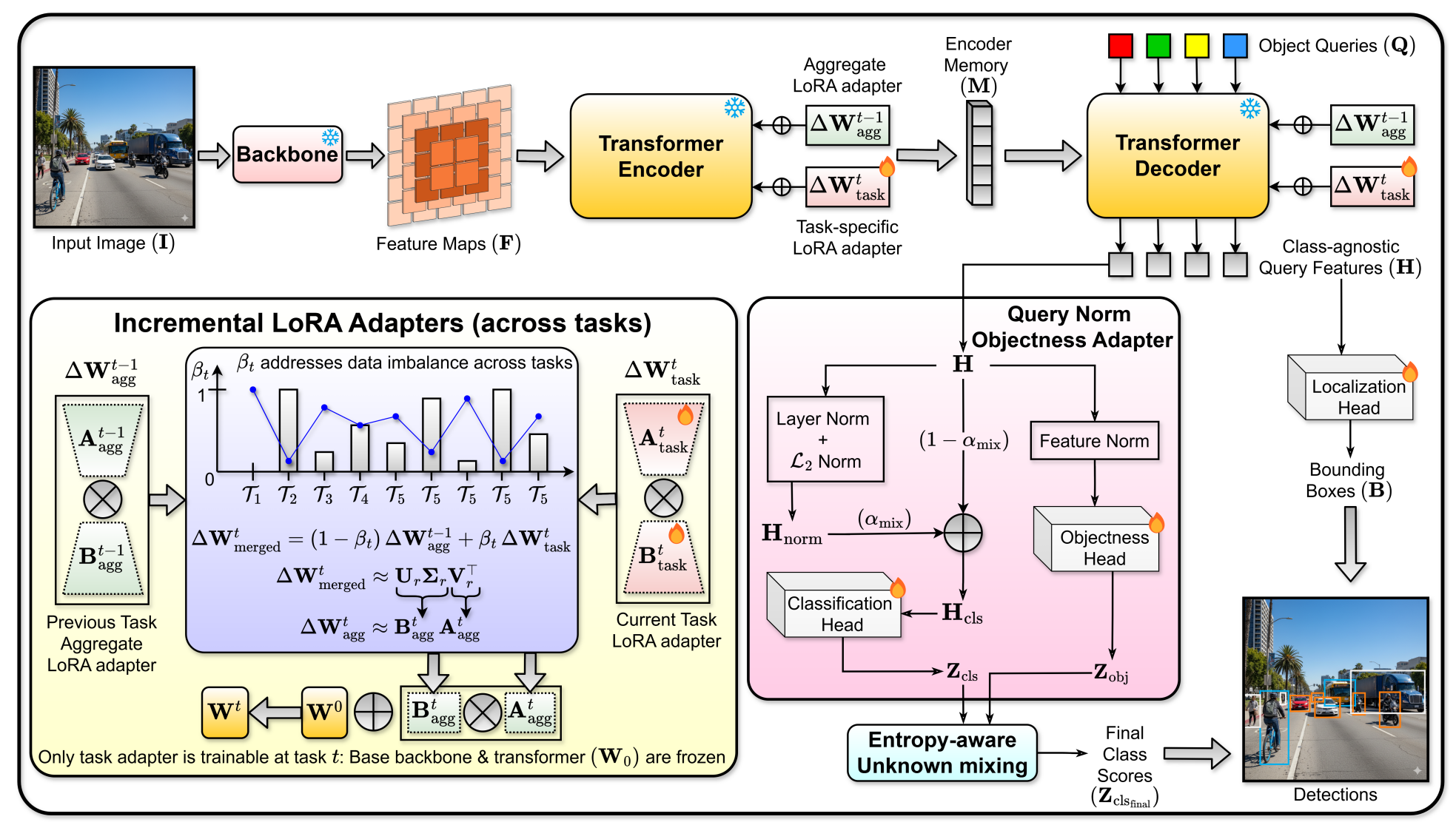
300 dpi PNG · Caption · Source PDF
Original caption, source, and provenance
Fixed source version: CVPR 2026 fixed official PDF
Earliest verified matching figure date (temporal proxy): 2026-02-24
arXiv v1 date: 2026-02-24
Actual drawing date: unknown. See the source record for version checks and temporal-evidence limitations.
Historical PDF · Download citation snapshot · Date evidence · Paper page · Complete screening and version record (Chinese)
Citation threshold evidence: C. V. Jawahar; 32310 citations; snapshot 2026-10-21.
Recorded drawing-tool disclosure: Gemini 2.5 Pro (illustrative scene images only; no inference about the tool used for the overall layout). No tool attribution is inferred from appearance; see the archival disclosure evidence for scope and wording.
Crop bounding box: [69, 69, 541, 336.5] (PDF points; top-left origin; x0, y0, x1, y1).
Figure 3. EW-DETR framework for Evolving-World Object Detection. An input image is processed by a frozen backbone and
transformer encoder–decoder equipped with aggregate (cid:0) ∆Wt−1 (cid:1) and task-specific (cid:0) ∆Wt (cid:1) LoRA adapters, yielding class-agnostic
agg task
query features. These queries are reparameterised by the Query-Norm Objectness Adapter and passed through a classification head and
an objectness head, whose outputs are combined by Entropy-aware Unknown Mixing module to produce calibrated class scores, while a
localisation head predicts bounding boxes to form final detections across tasks1 .
EW-DETR: Evolving World Object Detection via Incremental Low-Rank DEtection TRansformer
Venue: CVPR 2026 · Main-conference paper
Figure 1 · PDF page 1 · P197
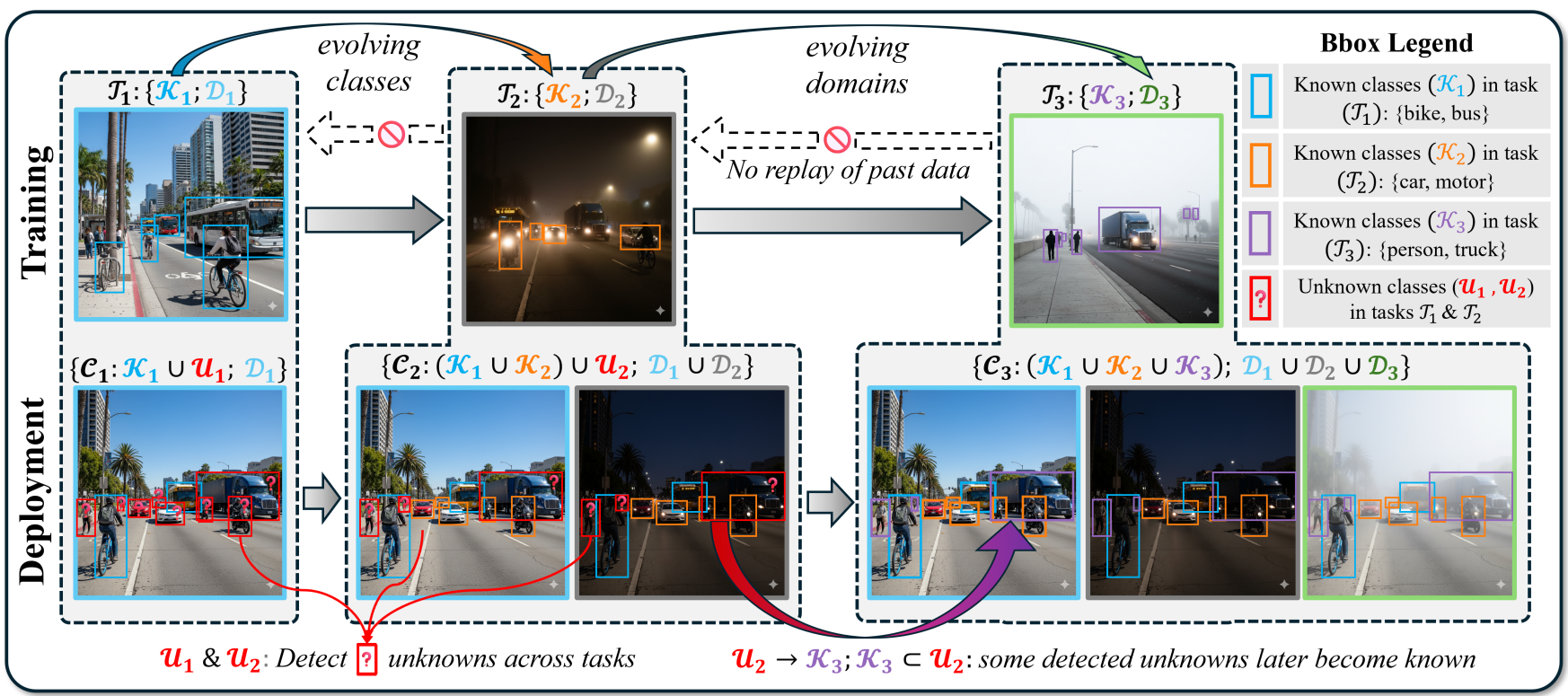
300 dpi PNG · Caption · Source PDF
Original caption, source, and provenance
Fixed source version: CVPR 2026 fixed official PDF
Earliest verified matching figure date (temporal proxy): 2026-02-24
arXiv v1 date: 2026-02-24
Actual drawing date: unknown. See the source record for version checks and temporal-evidence limitations.
Historical PDF · Download citation snapshot · Date evidence · Paper page · Complete screening and version record (Chinese)
Citation threshold evidence: C. V. Jawahar; 32310 citations; snapshot 2026-10-21.
Recorded drawing-tool disclosure: Gemini 2.5 Pro (illustrative scene images only; no inference about the tool used for the overall layout). No tool attribution is inferred from appearance; see the archival disclosure evidence for scope and wording.
Crop bounding box: [95, 184, 514, 370] (PDF points; top-left origin; x0, y0, x1, y1).
Figure 1. Overview of Evolving World Object Detection (EWOD). Top (Training): Sequential tasks introduce disjoint classes K across
t
shifting domains D (Day → Night → Fog). Bottom (Deployment): The detector must (i) identify unseen objects U without supervision;
t t
(ii) retain knowledge of all prior classes across all domains; (iii) incrementally learn former unknowns when their labels are revealed later
(e.g., U → K ) and (iv) achieve all these objectives without revisiting any previous data. Best viewed in colour with zoom1 .
2 3
Fourier Angle Alignment for Oriented Object Detection in Remote Sensing
Venue: CVPR 2026 · Main-conference paper
Figure 1 · PDF page 1 · P154
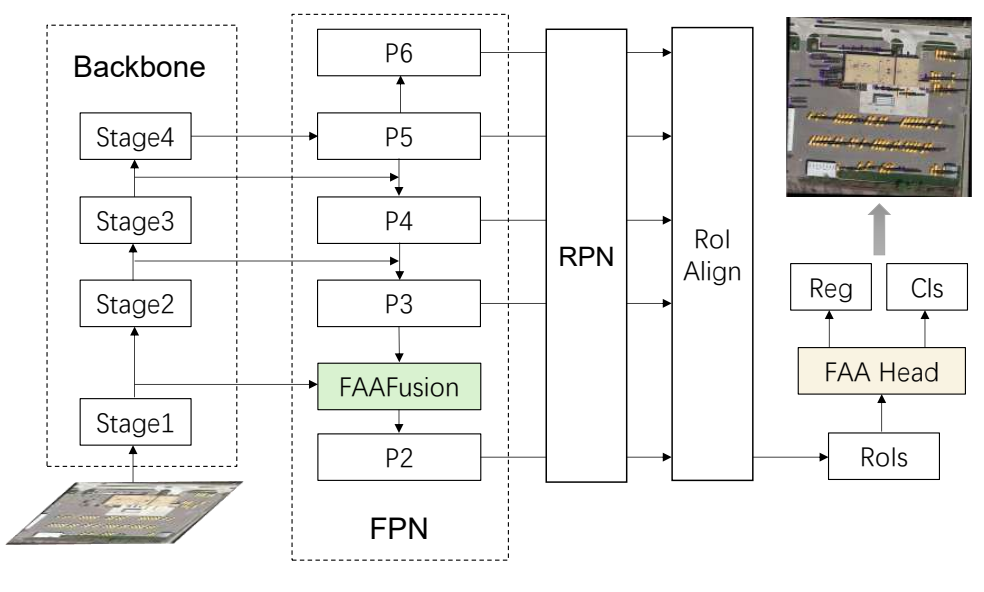
300 dpi PNG · Caption · Source PDF
Original caption, source, and provenance
Fixed source version: CVPR 2026 fixed official PDF
Earliest verified matching figure date (temporal proxy): 2026-02-27
arXiv v1 date: 2026-02-27
Actual drawing date: unknown. See the source record for version checks and temporal-evidence limitations.
Historical PDF · Download citation snapshot · Date evidence · Paper page · Complete screening and version record (Chinese)
Citation threshold evidence: Ying Fu; 11391 citations; snapshot 2026-10-21.
Recorded drawing-tool disclosure: unknown. No tool attribution is inferred from appearance; see the archival disclosure evidence for scope and wording.
Crop bounding box: [317, 242, 553, 384] (PDF points; top-left origin; x0, y0, x1, y1).
Figure 1. The position of FAAFusion and FAA Head.
Fourier Angle Alignment for Oriented Object Detection in Remote Sensing
Venue: CVPR 2026 · Main-conference paper
Figure 2 · PDF page 2 · P153
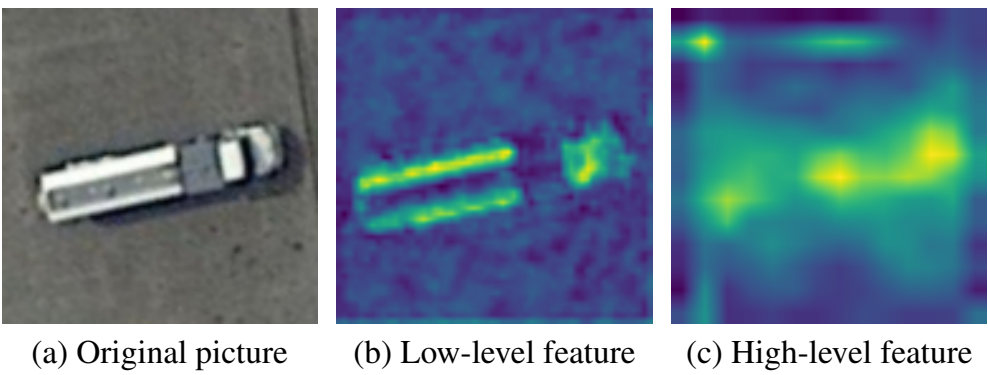
300 dpi PNG · Caption · Source PDF
Original caption, source, and provenance
Fixed source version: CVPR 2026 fixed official PDF
Earliest verified matching figure date (temporal proxy): 2026-02-27
arXiv v1 date: 2026-02-27
Actual drawing date: unknown. See the source record for version checks and temporal-evidence limitations.
Historical PDF · Download citation snapshot · Date evidence · Paper page · Complete screening and version record (Chinese)
Citation threshold evidence: Ying Fu; 11391 citations; snapshot 2026-10-21.
Recorded drawing-tool disclosure: unknown. No tool attribution is inferred from appearance; see the archival disclosure evidence for scope and wording.
Crop bounding box: [58, 70, 295, 160] (PDF points; top-left origin; x0, y0, x1, y1).
Figure 2. Directional incoherence. High-level feature (c) has
strong semantics and large receptive fields but captures the coarse
orientation. Forexample,from(c)wecanonlyinferthattheobject
lieshorizontally. Yetmanydown-samplingsblurspatialdetails, so
the orientation signal is low-frequency and vague. Low-level fea-
ture (b) keeps rich edges, corners, and textures, giving clear and
high-frequency orientation cues.
Heuristic-inspired Reasoning Priors Facilitate Data-Efficient Referring Object Detection
Venue: CVPR 2026 · Main-conference paper
Figure 2 · PDF page 4 · P112
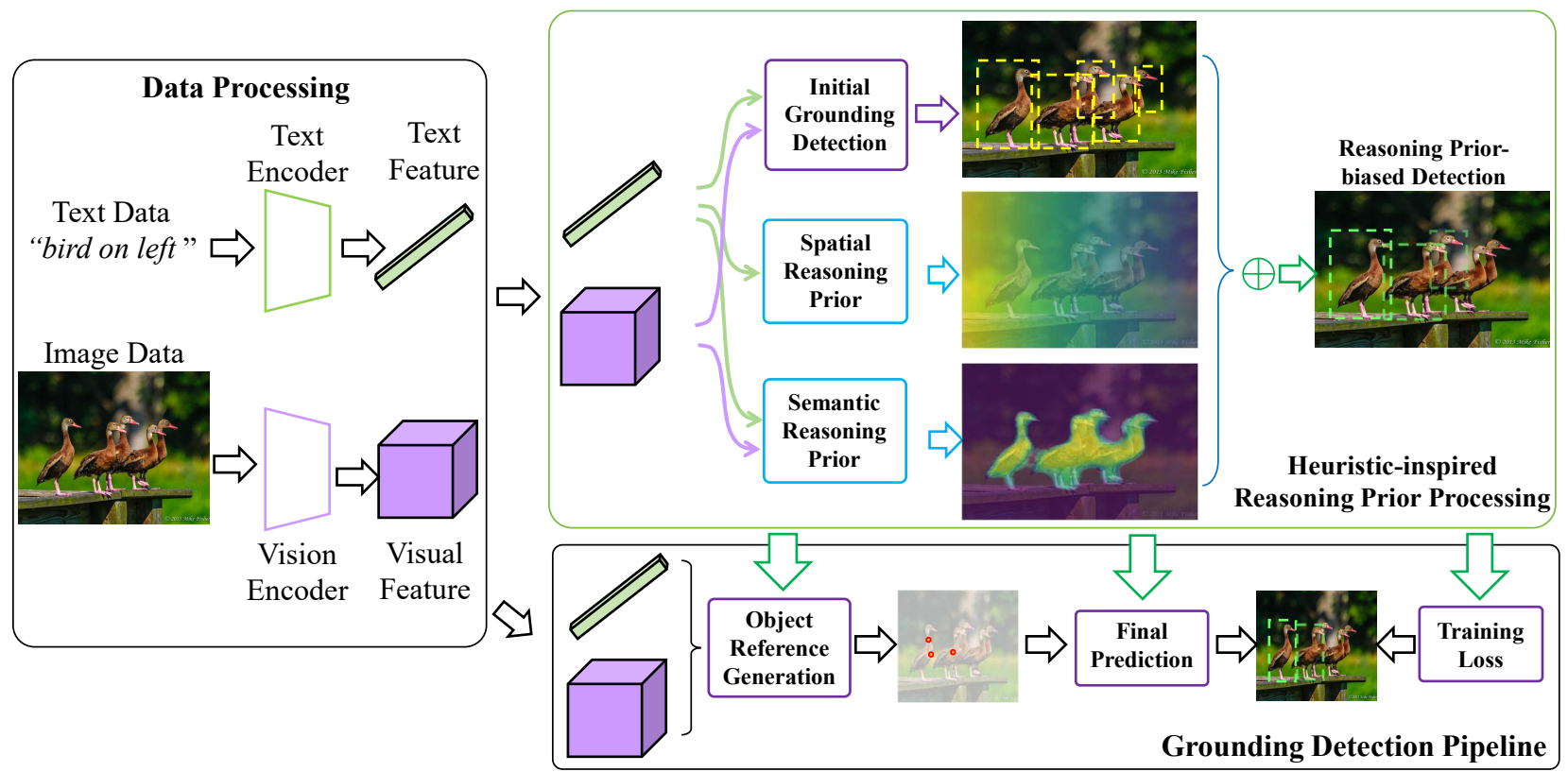
300 dpi PNG · Caption · Source PDF
Original caption, source, and provenance
Fixed source version: CVPR 2026 fixed official PDF
Earliest verified matching figure date (temporal proxy): 2026-03-25
arXiv v1 date: 2026-03-25
Actual drawing date: unknown. See the source record for version checks and temporal-evidence limitations.
Historical PDF · Download citation snapshot · Date evidence · Paper page · Complete screening and version record (Chinese)
Citation threshold evidence: Dacheng Tao; 205014 citations; snapshot 2026-10-21.
Recorded drawing-tool disclosure: unknown. No tool attribution is inferred from appearance; see the archival disclosure evidence for scope and wording.
Crop bounding box: [106, 72, 504, 268] (PDF points; top-left origin; x0, y0, x1, y1).
Figure 2. HeROD pipeline. Text and image features are encoded, and spatial/semantic reasoning priors are derived from the phrase and
image. These priors are injected into reference generation, final prediction, and training loss, guiding the detector toward plausible regions
for more data-efficient learning.
Heuristic-inspired Reasoning Priors Facilitate Data-Efficient Referring Object Detection
Venue: CVPR 2026 · Main-conference paper
Figure 1 · PDF page 1 · P111
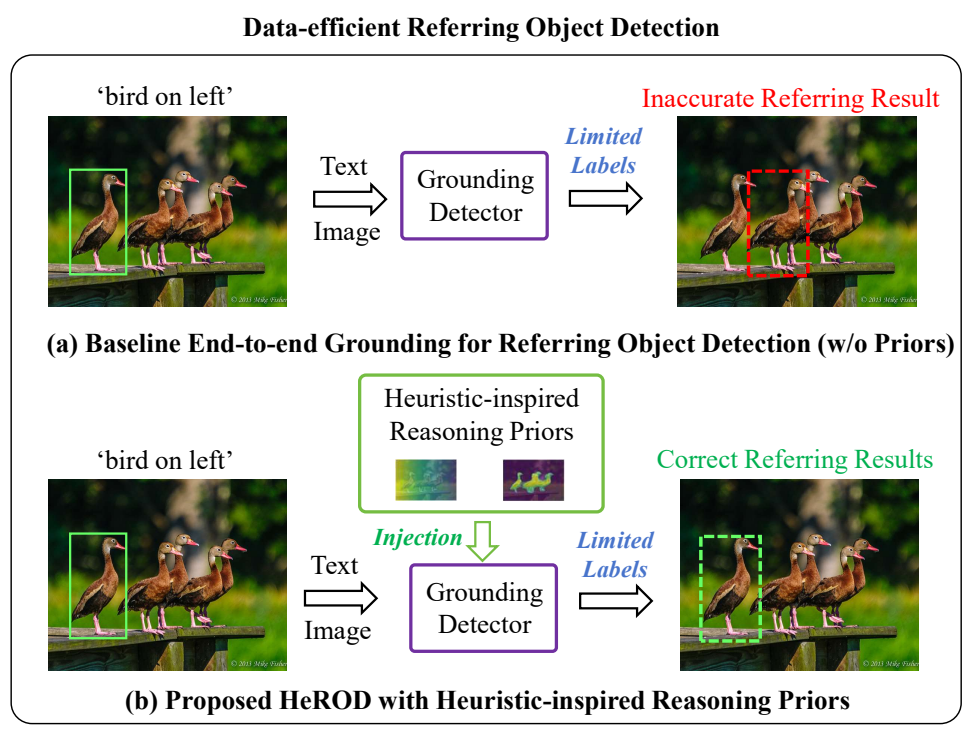
300 dpi PNG · Caption · Source PDF
Original caption, source, and provenance
Fixed source version: CVPR 2026 fixed official PDF
Earliest verified matching figure date (temporal proxy): 2026-03-25
arXiv v1 date: 2026-03-25
Actual drawing date: unknown. See the source record for version checks and temporal-evidence limitations.
Historical PDF · Download citation snapshot · Date evidence · Paper page · Complete screening and version record (Chinese)
Citation threshold evidence: Dacheng Tao; 205014 citations; snapshot 2026-10-21.
Recorded drawing-tool disclosure: unknown. No tool attribution is inferred from appearance; see the archival disclosure evidence for scope and wording.
Crop bounding box: [317, 245, 551, 420] (PDF points; top-left origin; x0, y0, x1, y1).
Figure 1. Conceptual illustration. (a) Without priors, grounding
detectors trained with limited labels often ignore spatial/semantic
cues (e.g., “on the left”). (b) HeROD injects heuristic-inspired
reasoning priors (spatial + semantic), guiding the detector toward
correct localization and improving data-efficient learning.
Instance-Free Domain Adaptive Object Detection
Source: arXiv 2026 · Figure source: archived arXiv v1
Figure 2 · PDF page 3 · P288
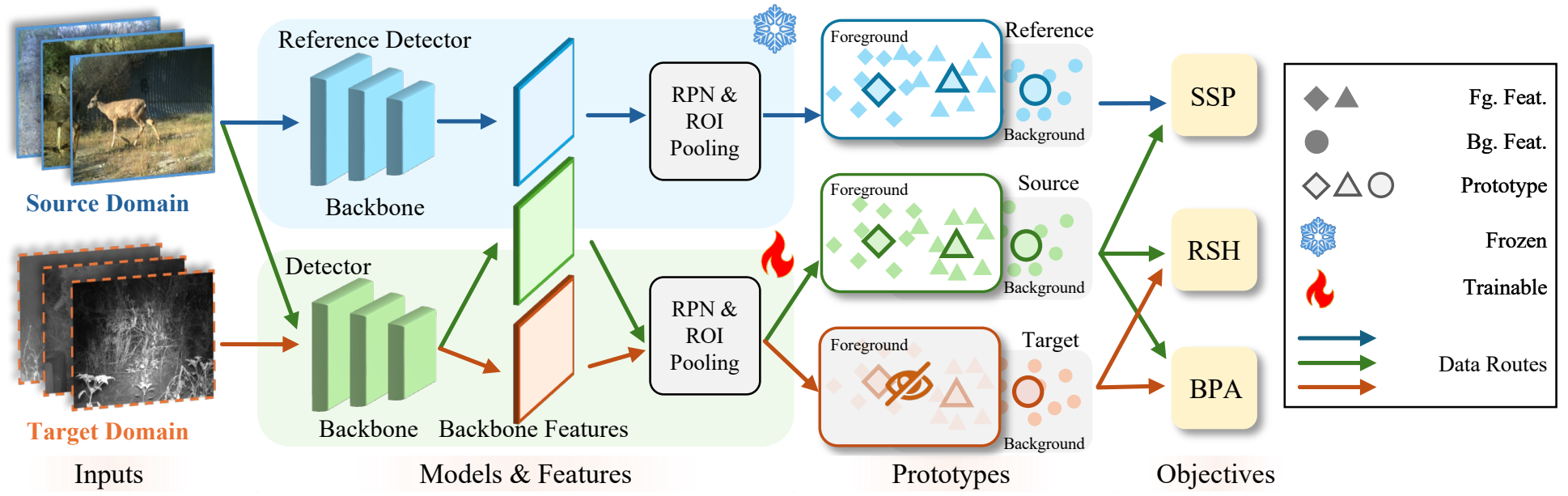
300 dpi PNG · Caption · Source PDF
Original caption, source, and provenance
Fixed source version: arXiv v1 fixed
Earliest verified matching figure date (temporal proxy): 2026-02-06
arXiv v1 date: 2026-02-06
Actual drawing date: unknown. See the source record for version checks and temporal-evidence limitations.
Historical PDF · Download citation snapshot · Date evidence · Complete screening and version record (Chinese)
Citation threshold evidence: Wen Li; 14507 citations; snapshot 2026-10-21.
Recorded drawing-tool disclosure: unknown. No tool attribution is inferred from appearance; see the archival disclosure evidence for scope and wording.
Crop bounding box: [66, 67, 531, 214] (PDF points; top-left origin; x0, y0, x1, y1).
Figure 2. An overview of the proposed RSCN. For every batch, source-domain images with labeled foreground objects and target-domain
images without foreground objects are fed to the detector. The background prototypes are aligned with the BPA objective in Eq. 5. RSH in
Eq. 6 keeps the relative geometric relationship for the source and target background prototypes to the shared foreground prototype anchors.
A frozen reference detector is utilized to maintain the source-domain structure in order to avoid the feature collapse with SSP in Eq. 7.
Instance-Free Domain Adaptive Object Detection
Source: arXiv 2026 · Figure source: archived arXiv v1
Figure 1 · PDF page 1 · P287
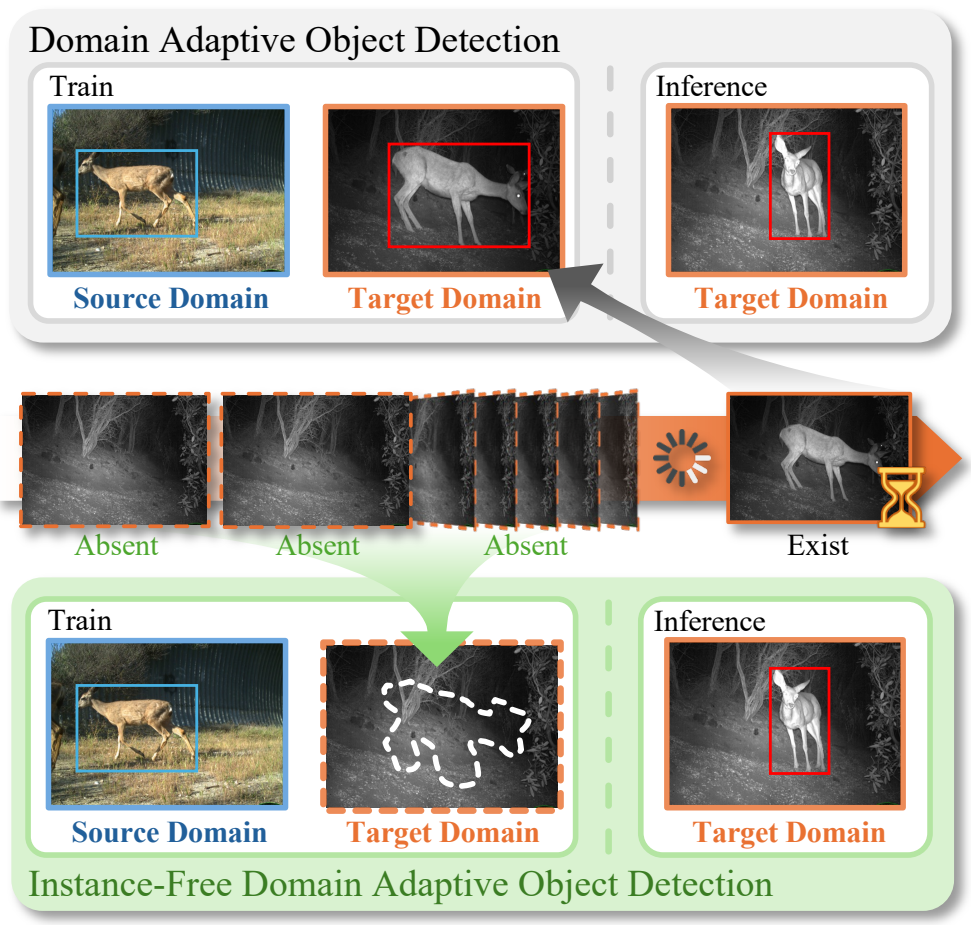
300 dpi PNG · Caption · Source PDF
Original caption, source, and provenance
Fixed source version: arXiv v1 fixed
Earliest verified matching figure date (temporal proxy): 2026-02-06
arXiv v1 date: 2026-02-06
Actual drawing date: unknown. See the source record for version checks and temporal-evidence limitations.
Historical PDF · Download citation snapshot · Date evidence · Complete screening and version record (Chinese)
Citation threshold evidence: Wen Li; 14507 citations; snapshot 2026-10-21.
Recorded drawing-tool disclosure: unknown. No tool attribution is inferred from appearance; see the archival disclosure evidence for scope and wording.
Crop bounding box: [308, 174, 541, 397] (PDF points; top-left origin; x0, y0, x1, y1).
Figure 1. Illustration of Instance-Free DAOD. The orange time-
line indicates that target-domain instances appear only after a
long waiting period and require costly manual screening. Tradi-
tional DAOD (top) relies on target images containing foreground
instances, whereas Instance-Free DAOD (bottom) enables transfer-
ring using only background-only target images.
IoUCert: Robustness Verification for Anchor-based Object Detectors
Venue: ECCV 2026 · Main-conference paper
Figure 2 · PDF page 5 · P32
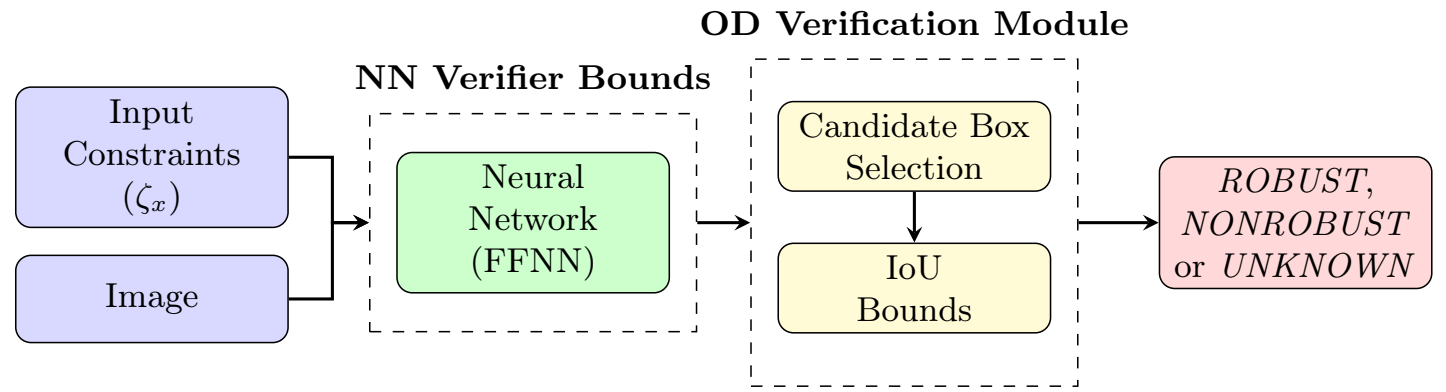
300 dpi PNG · Caption · Source PDF
Original caption, source, and provenance
Fixed source version: ECCV 2026 fixed official PDF
Earliest verified matching figure date (temporal proxy): 2026-03-03
arXiv v1 date: 2026-03-03
Actual drawing date: unknown. See the source record for version checks and temporal-evidence limitations.
Historical PDF · Download citation snapshot · Date evidence · Complete screening and version record (Chinese)
Citation threshold evidence: Alessio R Lomuscio; 11623 citations; snapshot 2026-10-21.
Recorded drawing-tool disclosure: unknown. No tool attribution is inferred from appearance; see the archival disclosure evidence for scope and wording.
Crop bounding box: [134, 116, 481, 210] (PDF points; top-left origin; x0, y0, x1, y1).
Fig.2: Pipeline of our object detection (OD) verification framework, combining verifier
bounds, candidate selection, and optimal IoU bound derivation to reach ROBUST,
NONROBUST or UNKNOWN conclusions.
IoUCert: Robustness Verification for Anchor-based Object Detectors
Venue: ECCV 2026 · Main-conference paper
Figure 1 · PDF page 2 · P31
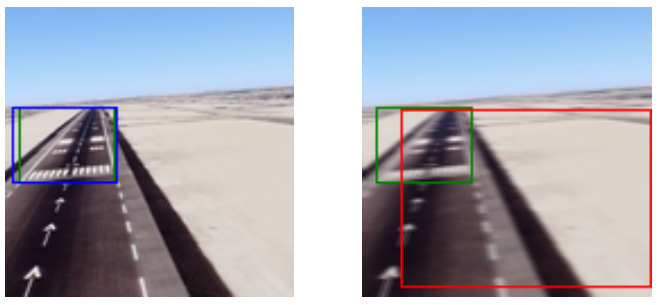
300 dpi PNG · Caption · Source PDF
Original caption, source, and provenance
Fixed source version: ECCV 2026 fixed official PDF
Earliest verified matching figure date (temporal proxy): 2026-03-03
arXiv v1 date: 2026-03-03
Actual drawing date: unknown. See the source record for version checks and temporal-evidence limitations.
Historical PDF · Download citation snapshot · Date evidence · Complete screening and version record (Chinese)
Citation threshold evidence: Alessio R Lomuscio; 11623 citations; snapshot 2026-10-21.
Recorded drawing-tool disclosure: unknown. No tool attribution is inferred from appearance; see the archival disclosure evidence for scope and wording.
Crop bounding box: [229, 114, 387, 187] (PDF points; top-left origin; x0, y0, x1, y1).
Fig.1: A counterexample from robustness verification of a YOLOv3 model on a runway
detection task. Left: original image; right: perturbed image. Green boxes: ground truth,
blue box: original model prediction (IoU = 0.89), red box: prediction on the perturbed
image (IoU = 0.11).
LAB-Det: Language as a Domain-Invariant Bridge for Training-Free One-Shot Domain Generalization in Object Detection
Source: arXiv 2026 · Figure source: archived arXiv v1
Figure 2 · PDF page 4 · P290
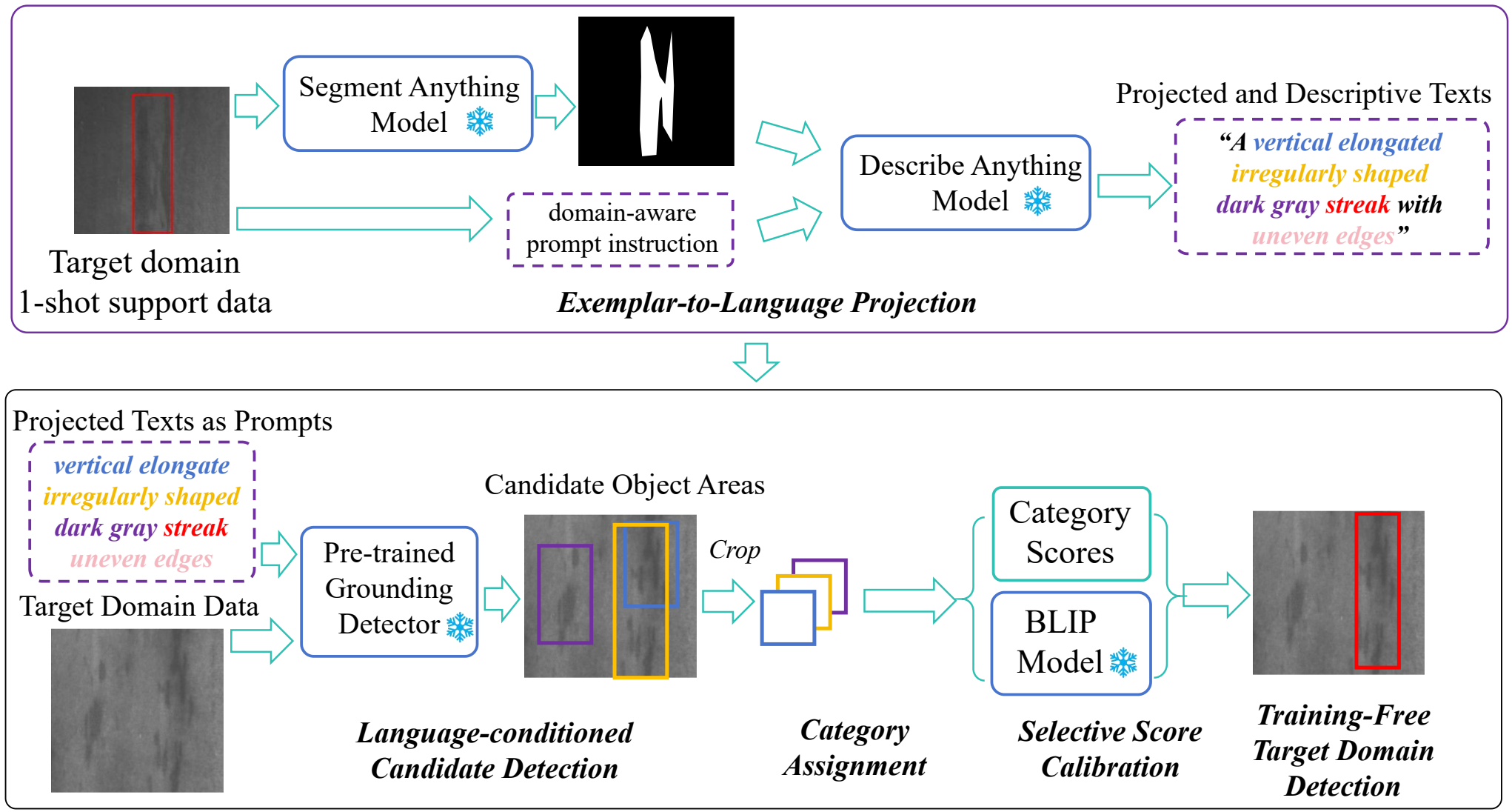
300 dpi PNG · Caption · Source PDF
Original caption, source, and provenance
Fixed source version: arXiv v1 fixed
Earliest verified matching figure date (temporal proxy): 2026-02-06
arXiv v1 date: 2026-02-06
Actual drawing date: unknown. See the source record for version checks and temporal-evidence limitations.
Historical PDF · Download citation snapshot · Date evidence · Complete screening and version record (Chinese)
Citation threshold evidence: Dacheng Tao; 205014 citations; snapshot 2026-10-21.
Recorded drawing-tool disclosure: unknown. No tool attribution is inferred from appearance; see the archival disclosure evidence for scope and wording.
Crop bounding box: [62, 74, 552, 337] (PDF points; top-left origin; x0, y0, x1, y1).
Figure 2. Overview of LAB-Det. Top: exemplar-to-language projection. A single annotated exemplar is segmented by SAM and described
by DAM under a domain-aware prompt, yielding natural-language phrases (e.g., “rough texture”). Bottom: these phrases condition a
frozen detector (e.g., Grounding DINO) to generate candidate boxes and phrase scores. Category scores are obtained by averaging phrase
scores, and an optional BLIP-based calibration refines small or ambiguous detections. The entire pipeline is training-free and interpretable.
LAB-Det: Language as a Domain-Invariant Bridge for Training-Free One-Shot Domain Generalization in Object Detection
Source: arXiv 2026 · Figure source: archived arXiv v1
Figure 1 · PDF page 1 · P289
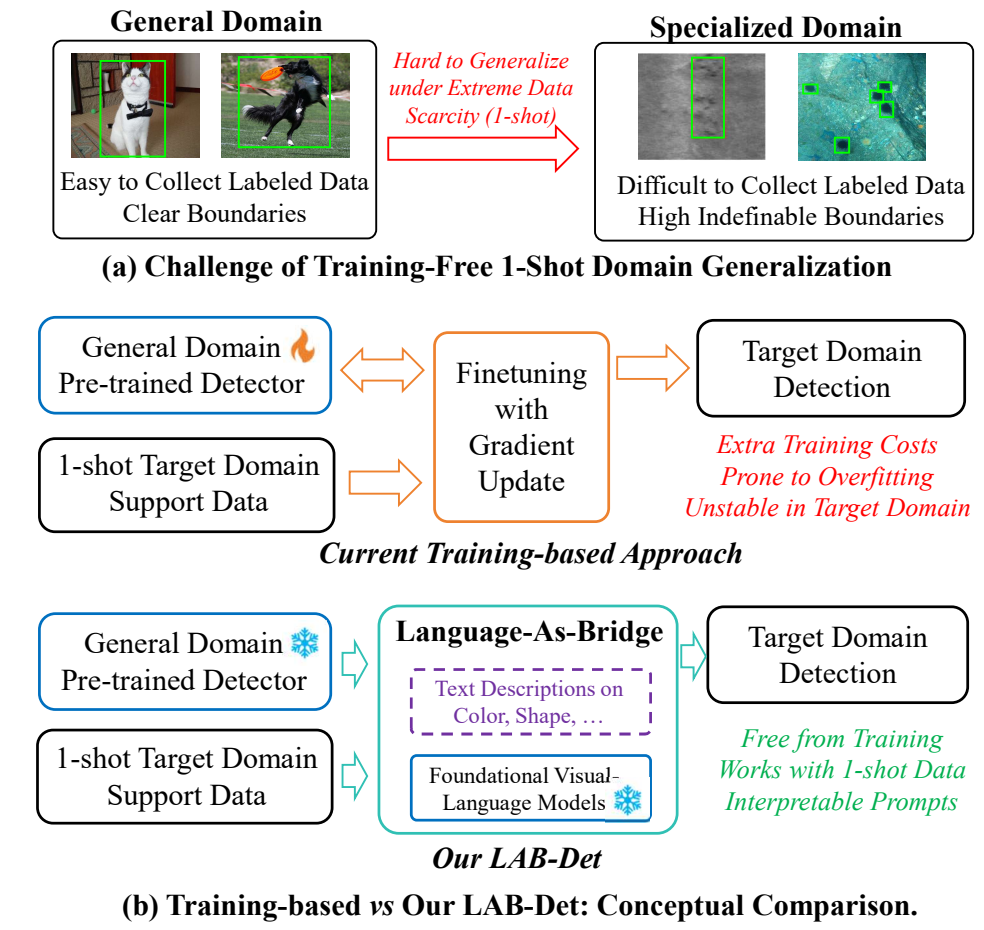
300 dpi PNG · Caption · Source PDF
Original caption, source, and provenance
Fixed source version: arXiv v1 fixed
Earliest verified matching figure date (temporal proxy): 2026-02-06
arXiv v1 date: 2026-02-06
Actual drawing date: unknown. See the source record for version checks and temporal-evidence limitations.
Historical PDF · Download citation snapshot · Date evidence · Complete screening and version record (Chinese)
Citation threshold evidence: Dacheng Tao; 205014 citations; snapshot 2026-10-21.
Recorded drawing-tool disclosure: unknown. No tool attribution is inferred from appearance; see the archival disclosure evidence for scope and wording.
Crop bounding box: [317, 248, 553, 471] (PDF points; top-left origin; x0, y0, x1, y1).
Figure 1. Challenge and conceptual comparison of training-free 1-
shot domain generalization for object detection. (a) In specialized
domains (e.g., underwater or industrial), data can be very scarce
(e.g., only one labeled exemplar per class) and object boundaries
are ambiguous, making general-domain detectors fail under severe
domain gaps. (b) Training-based approaches rely on fine-tuning
with gradient updates, which incur extra cost, overfit under 1-shot
supervision, and remain unstable in high-IB domains. In contrast,
LAB-Det leverages language as a domain-invariant bridge: sup-
port exemplars are re-expressed as descriptive text and injected
into frozen vision–language models, enabling training-free, inter-
pretable, and robust target-domain detection.
NoOVD: Novel Category Discovery and Embedding for Open-Vocabulary Object Detection
Venue: CVPR 2026 · Main-conference paper
Figure 2 · PDF page 3 · P248
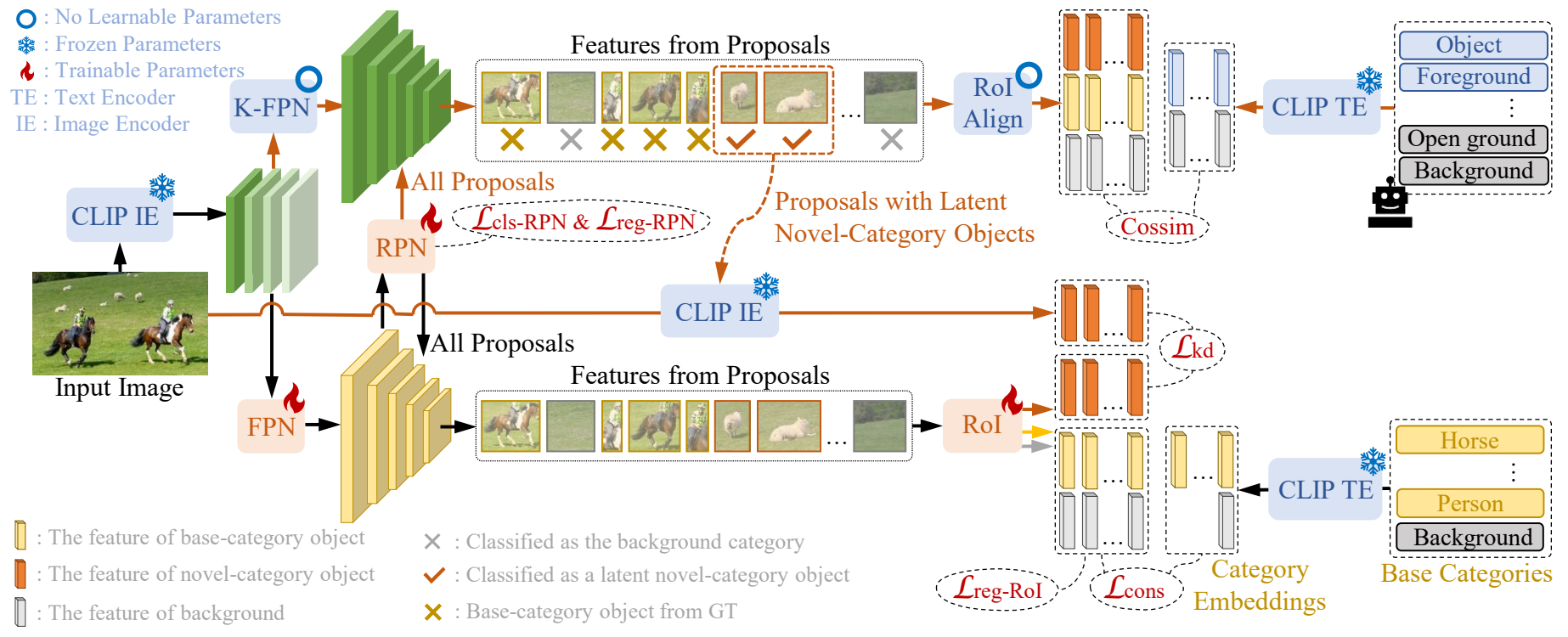
300 dpi PNG · Caption · Source PDF
Original caption, source, and provenance
Fixed source version: CVPR 2026 fixed official PDF
Earliest verified matching figure date (temporal proxy): 2026-03-22
arXiv v1 date: 2026-03-22
Actual drawing date: unknown. See the source record for version checks and temporal-evidence limitations.
Historical PDF · Download citation snapshot · Date evidence · Paper page · Complete screening and version record (Chinese)
Citation threshold evidence: Wei Feng; 11058 citations; snapshot 2026-10-22.
Recorded drawing-tool disclosure: unknown. No tool attribution is inferred from appearance; see the archival disclosure evidence for scope and wording.
Crop bounding box: [82, 72, 525, 252] (PDF points; top-left origin; x0, y0, x1, y1).
Figure 2. Illustration of the training process of NoOVD. We use K-FPN to extract the pyramid embeddings from frozen CLIP to identify
latent novel-category objects. Besides the image-text alignment with L , we also align the features of the RoI head with the features
cons
from K-FPN via knowledge self-distillation with L .
kd
NoOVD: Novel Category Discovery and Embedding for Open-Vocabulary Object Detection
Venue: CVPR 2026 · Main-conference paper
Figure 1 · PDF page 1 · P247
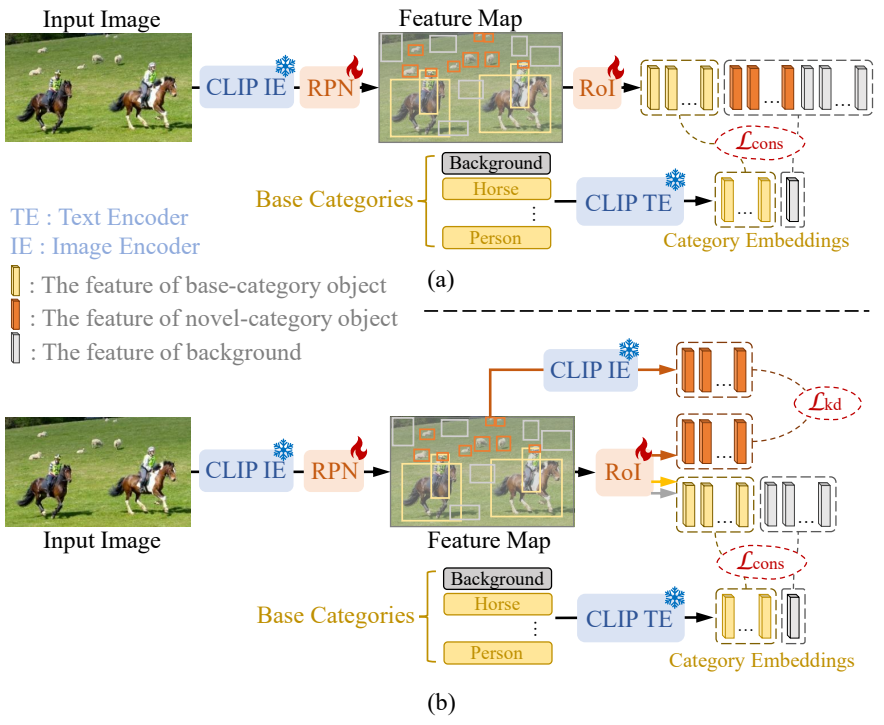
300 dpi PNG · Caption · Source PDF
Original caption, source, and provenance
Fixed source version: CVPR 2026 fixed official PDF
Earliest verified matching figure date (temporal proxy): 2026-03-22
arXiv v1 date: 2026-03-22
Actual drawing date: unknown. See the source record for version checks and temporal-evidence limitations.
Historical PDF · Download citation snapshot · Date evidence · Paper page · Complete screening and version record (Chinese)
Citation threshold evidence: Wei Feng; 11058 citations; snapshot 2026-10-22.
Recorded drawing-tool disclosure: unknown. No tool attribution is inferred from appearance; see the archival disclosure evidence for scope and wording.
Crop bounding box: [329, 276, 541, 450] (PDF points; top-left origin; x0, y0, x1, y1).
Figure 1. Training process for OVD using frozen CLIP. (a) Com-
monly used training process, (b) Our training process.
RiO-DETR: DETR for Real-time Oriented Object Detection
Source: arXiv 2026 · Figure source: archived arXiv v1 · ECCV 2026 — conference version also recorded
Figure 2 · PDF page 5 · P194
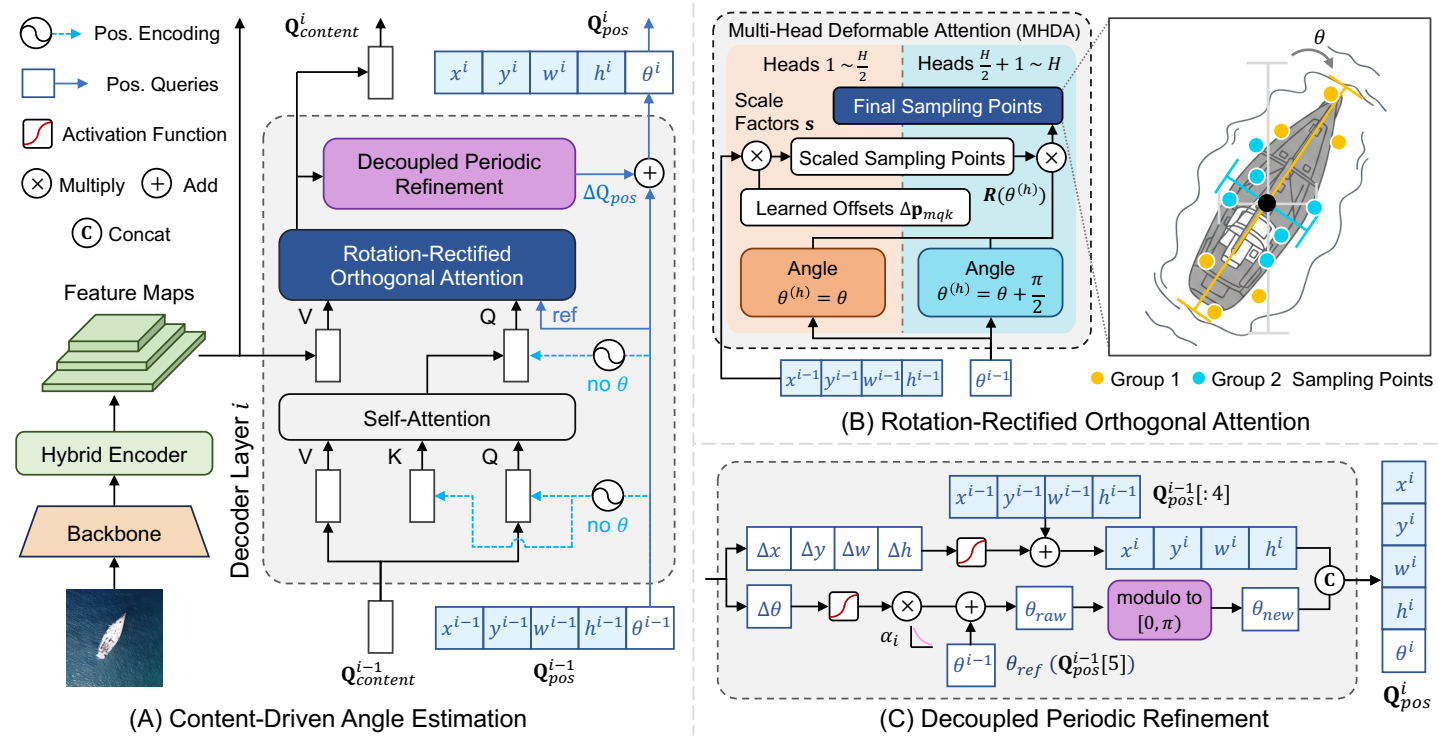
300 dpi PNG · Caption · Source PDF
Original caption, source, and provenance
Fixed source version: arXiv v1 fixed
Earliest verified matching figure date (temporal proxy): 2026-03-10
arXiv v1 date: 2026-03-10
Actual drawing date: unknown. See the source record for version checks and temporal-evidence limitations.
Historical PDF · Download citation snapshot · Date evidence · Complete screening and version record (Chinese)
Citation threshold evidence: Xiaoyan Sun; 15442 citations; snapshot 2026-10-21.
Recorded drawing-tool disclosure: unknown. No tool attribution is inferred from appearance; see the archival disclosure evidence for scope and wording.
Crop bounding box: [134, 116, 479, 294] (PDF points; top-left origin; x0, y0, x1, y1).
Fig. 2: The main architecture of our proposed RiO-DETR. The framework highlights
three key components: (A) Content-Driven Angle Estimation, (B) Rotation-Rectified
Orthogonal Attention, and (C) Decoupled Periodic Refinement.
RiO-DETR: DETR for Real-time Oriented Object Detection
Source: arXiv 2026 · Figure source: archived arXiv v1 · ECCV 2026 — conference version also recorded
Figure 3 · PDF page 7 · P193
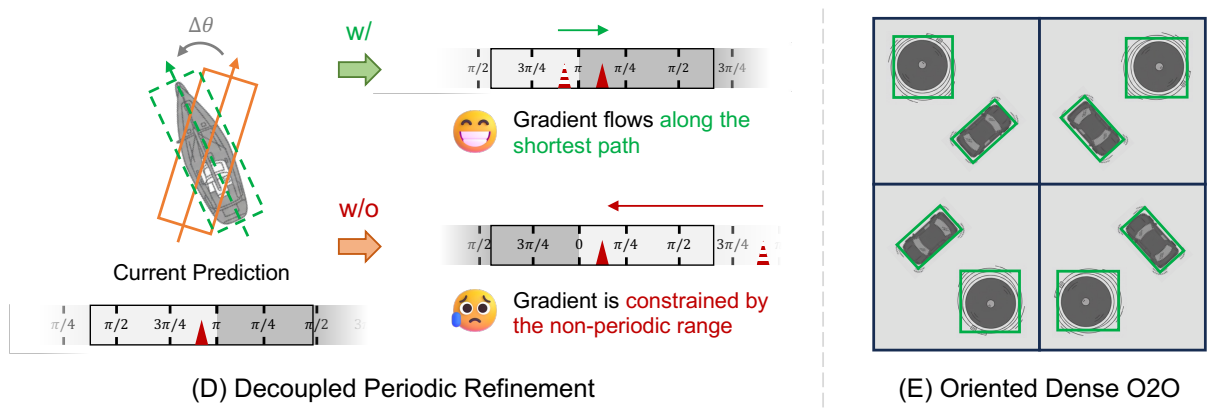
300 dpi PNG · Caption · Source PDF
Original caption, source, and provenance
Fixed source version: arXiv v1 fixed
Earliest verified matching figure date (temporal proxy): 2026-03-10
arXiv v1 date: 2026-03-10
Actual drawing date: unknown. See the source record for version checks and temporal-evidence limitations.
Historical PDF · Download citation snapshot · Date evidence · Complete screening and version record (Chinese)
Citation threshold evidence: Xiaoyan Sun; 15442 citations; snapshot 2026-10-21.
Recorded drawing-tool disclosure: unknown. No tool attribution is inferred from appearance; see the archival disclosure evidence for scope and wording.
Crop bounding box: [161, 115, 453, 215] (PDF points; top-left origin; x0, y0, x1, y1).
Fig. 3: An intuitive illustration of (D) Decoupled Periodic Refinement and (E) Oriented
Dense O2O.
VLOD-TTA: Test-Time Adaptation of Vision-Language Object Detectors
Venue: ECCV 2026 · Main-conference paper
Figure 3 · PDF page 5 · P34
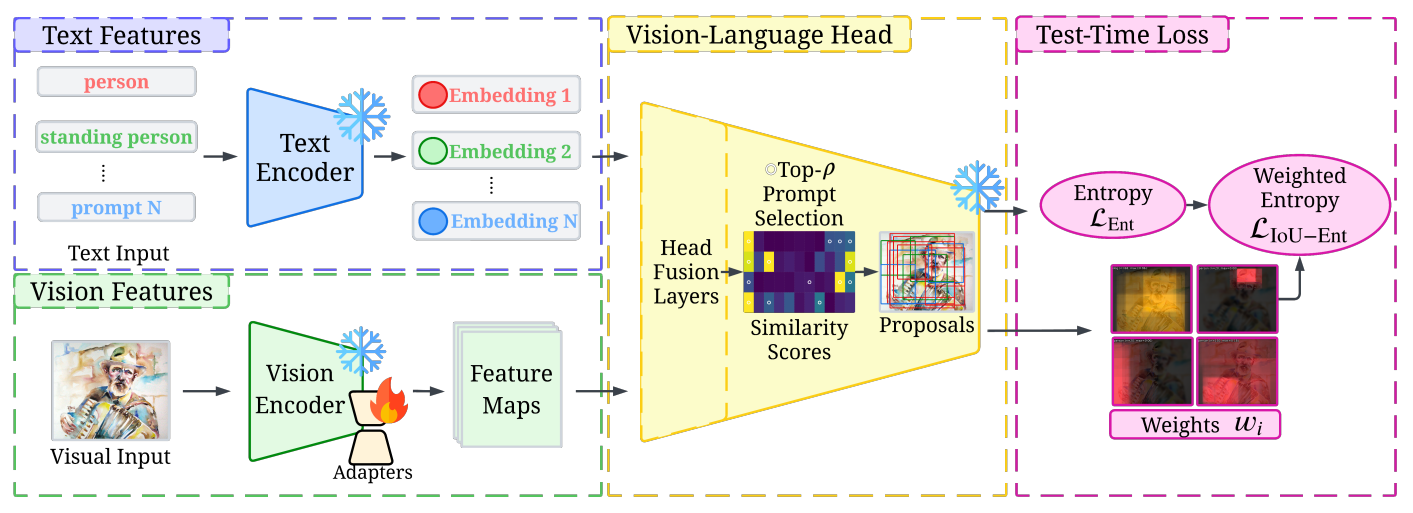
300 dpi PNG · Caption · Source PDF
Original caption, source, and provenance
Fixed source version: ECCV 2026 fixed official PDF
Earliest verified matching figure date (temporal proxy): 2026-03-17
arXiv v1 date: 2025-10-01
Actual drawing date: unknown. See the source record for version checks and temporal-evidence limitations.
Historical PDF · Download citation snapshot · Date evidence · Complete screening and version record (Chinese)
Citation threshold evidence: Eric Granger; 14279 citations; snapshot 2026-10-21.
Recorded drawing-tool disclosure: unknown. No tool attribution is inferred from appearance; see the archival disclosure evidence for scope and wording.
Crop bounding box: [137, 114, 476, 237] (PDF points; top-left origin; x0, y0, x1, y1).
Fig.3: Overview of VLOD-TTA. Given an input image and a pool of class
prompts, the text encoder produces embeddings that interact with region proposals
through the vision–language head to compute similarity scores. IPS selects the top-ρ
prompts and averages their scores to obtain per-proposal class scores. IWE then com-
bines per-proposal entropy with IoU-based weights to form the adaptation objective.
VLOD-TTA: Test-Time Adaptation of Vision-Language Object Detectors
Venue: ECCV 2026 · Main-conference paper
Figure 1 · PDF page 2 · P33
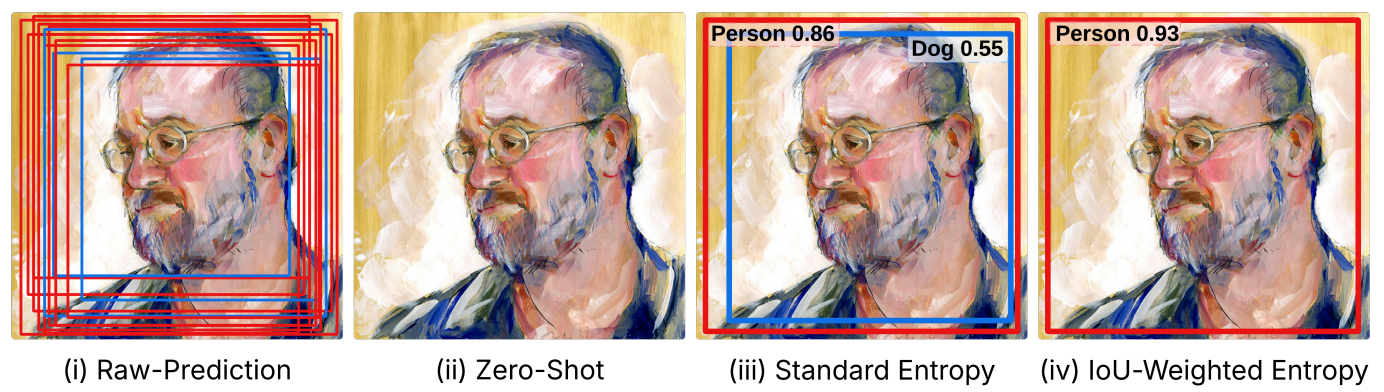
300 dpi PNG · Caption · Source PDF
Original caption, source, and provenance
Fixed source version: ECCV 2026 fixed official PDF
Earliest verified matching figure date (temporal proxy): 2026-03-17
arXiv v1 date: 2025-10-01
Actual drawing date: unknown. See the source record for version checks and temporal-evidence limitations.
Historical PDF · Download citation snapshot · Date evidence · Complete screening and version record (Chinese)
Citation threshold evidence: Eric Granger; 14279 citations; snapshot 2026-10-21.
Recorded drawing-tool disclosure: unknown. No tool attribution is inferred from appearance; see the archival disclosure evidence for scope and wording.
Crop bounding box: [142, 114, 474, 208] (PDF points; top-left origin; x0, y0, x1, y1).
Fig.1: Motivation for IWE. Left→right: (i) Raw predictions before thresholding
for two classes — a true positive Person (red) (bbox cluster size = 167, max score
= 0.14) and a false positive Dog (blue) (bbox cluster size = 45, max score = 0.15);
(ii) In ZS, all scores remain below the detection threshold, causing a missed detection;
(iii) Standard entropy minimization over-confidently sharpens scores, resulting in a dog
false positive; and (iv) IWE focuses updates on dense bbox clusters and suppresses
isolated boxes, producing only the correct person detection.
Direct Segmentation without Logits Optimization for Training-Free Open-Vocabulary Semantic Segmentation
Venue: CVPR 2026 · Main-conference paper
Figure 2 · PDF page 3 · P44
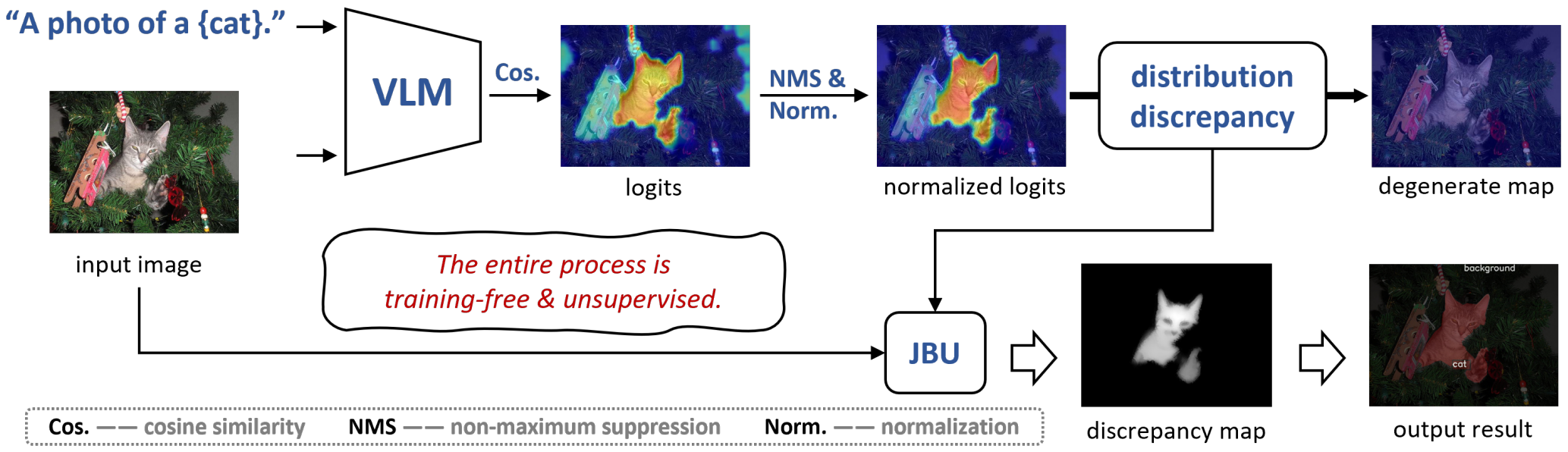
300 dpi PNG · Caption · Source PDF
Original caption, source, and provenance
Fixed source version: CVPR 2026 fixed official PDF
Earliest verified matching figure date (temporal proxy): 2026-04-09
arXiv v1 date: 2026-04-09
Actual drawing date: unknown. See the source record for version checks and temporal-evidence limitations.
Historical PDF · Download citation snapshot · Date evidence · Complete screening and version record (Chinese)
Citation threshold evidence: Yanyun Qu; 11764 citations; snapshot 2026-10-21.
Recorded drawing-tool disclosure: unknown. No tool attribution is inferred from appearance; see the archival disclosure evidence for scope and wording.
Crop bounding box: [58, 71, 554, 214] (PDF points; top-left origin; x0, y0, x1, y1).
Figure 2. Overview of the proposed method. The pipeline begins by computing the cosine similarity (Cos.) between vision-language
features to obtain logits, followed by non-maximum suppression (NMS) and normalization (Norm.) to filter low-confidence patches. The
core step involves calculating the distribution discrepancy between the normalized logits and the degenerate distribution map. This solved
discrepancy is then upsampled to the original image resolution via joint bilateral upsampling (JBU) to obtain the discrepancy map. Finally,
the semantic map is generated by applying an argmax operation to the discrepancy map.
Direct Segmentation without Logits Optimization for Training-Free Open-Vocabulary Semantic Segmentation
Venue: CVPR 2026 · Main-conference paper
Figure 1 · PDF page 1 · P43
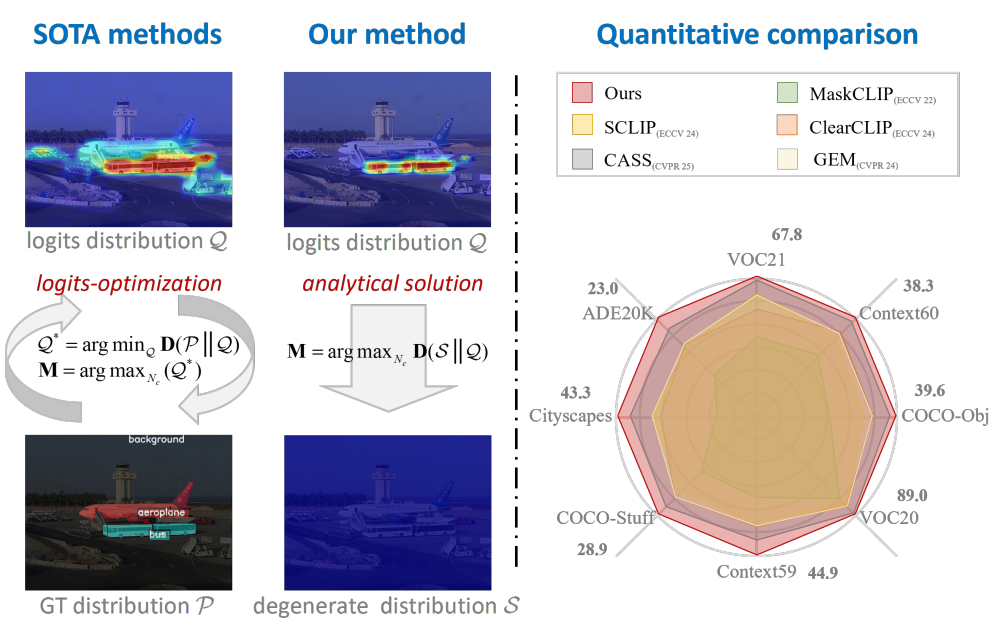
300 dpi PNG · Caption · Source PDF
Original caption, source, and provenance
Fixed source version: CVPR 2026 fixed official PDF
Earliest verified matching figure date (temporal proxy): 2026-04-09
arXiv v1 date: 2026-04-09
Actual drawing date: unknown. See the source record for version checks and temporal-evidence limitations.
Historical PDF · Download citation snapshot · Date evidence · Complete screening and version record (Chinese)
Citation threshold evidence: Yanyun Qu; 11764 citations; snapshot 2026-10-21.
Recorded drawing-tool disclosure: unknown. No tool attribution is inferred from appearance; see the archival disclosure evidence for scope and wording.
Crop bounding box: [316, 241, 555, 391] (PDF points; top-left origin; x0, y0, x1, y1).
Figure 1. Compared with the logits-optimization methods seeking
optimal solutions, we reformulate the problem as an analytical so-
lution form. This reformulation confers three key advantages: in-
dependence from GT annotations, elimination of time-consuming
training, and freedom from model-specific modulation.
Do Instance Priors Help Weakly Supervised Semantic Segmentation?
Source: arXiv 2026 · Figure source: archived arXiv v1
Figure 3 · PDF page 4 · P292
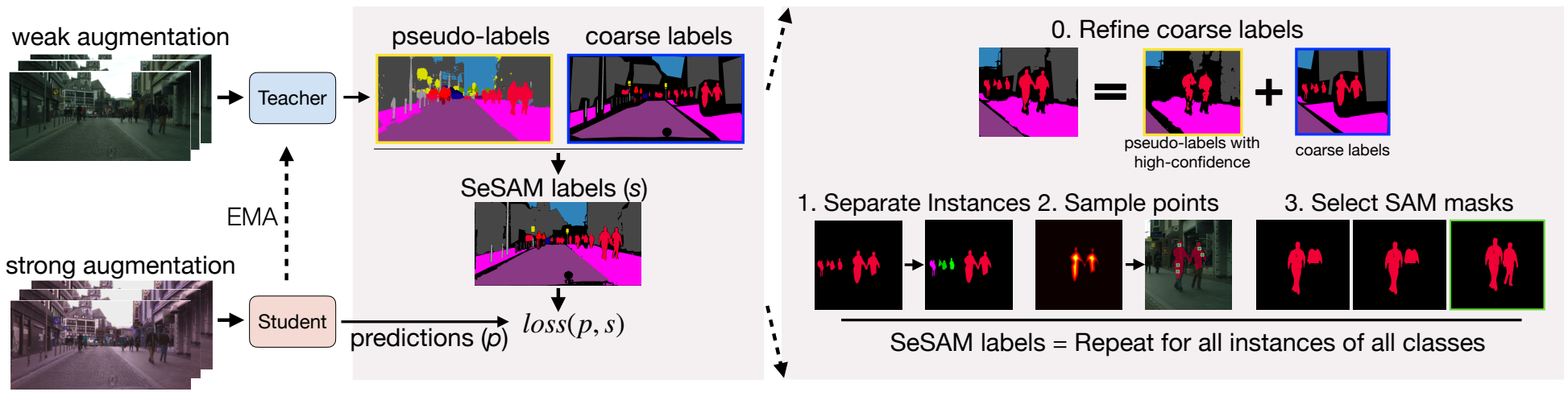
300 dpi PNG · Caption · Source PDF
Original caption, source, and provenance
Fixed source version: arXiv v1 fixed
Earliest verified matching figure date (temporal proxy): 2026-04-13
arXiv v1 date: 2026-04-13
Actual drawing date: unknown. See the source record for version checks and temporal-evidence limitations.
Historical PDF · Download citation snapshot · Date evidence · Complete screening and version record (Chinese)
Citation threshold evidence: Bernt Schiele; 131438 citations; snapshot 2026-10-21.
Recorded drawing-tool disclosure: unknown. No tool attribution is inferred from appearance; see the archival disclosure evidence for scope and wording.
Crop bounding box: [73, 82, 540, 200] (PDF points; top-left origin; x0, y0, x1, y1).
Figure 3: SeSAM framework for coarse sup ervision. First, pseudo-labels for training images are
generated by the teacher model. Next, these pseudo-labels are then refined following the key steps 1-3,
namely instance separation, point sampling and mask selection (see Section 3). To improve mask quality,
we augment coarse labels with high-confidence pseudo-labels before applying SAM (step 0). The resulting
refined labels, called SeSAM labels, are then used to train the student network.
Do Instance Priors Help Weakly Supervised Semantic Segmentation?
Source: arXiv 2026 · Figure source: archived arXiv v1
Figure 2 · PDF page 3 · P291
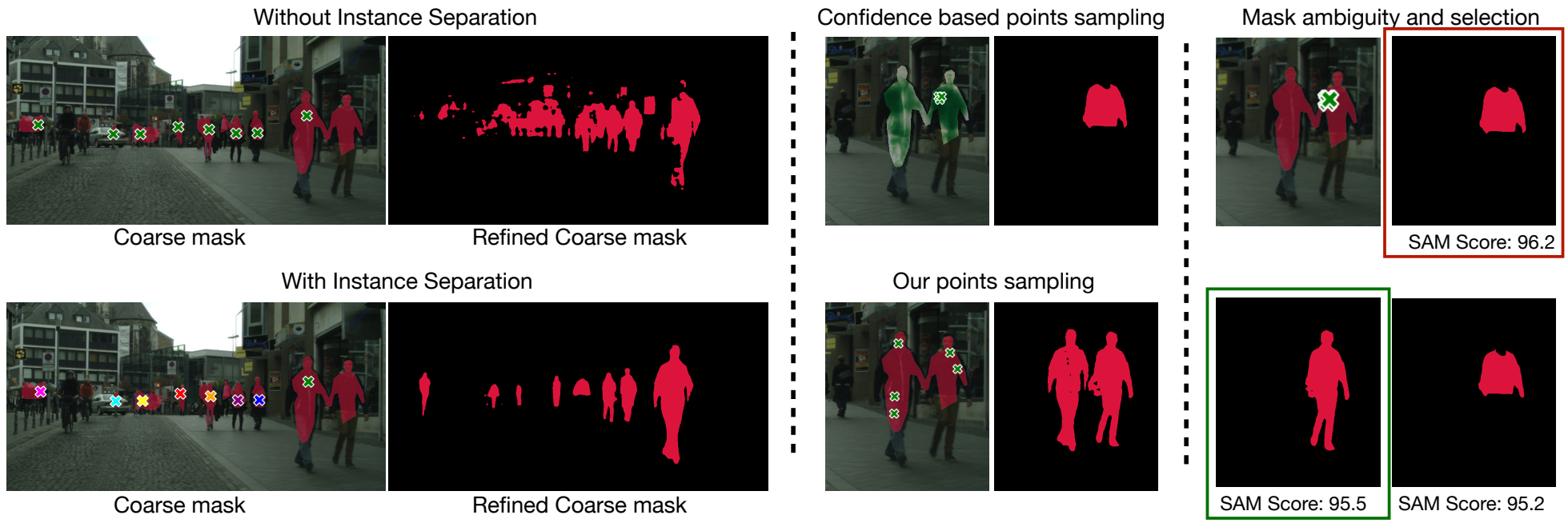
300 dpi PNG · Caption · Source PDF
Original caption, source, and provenance
Fixed source version: arXiv v1 fixed
Earliest verified matching figure date (temporal proxy): 2026-04-13
arXiv v1 date: 2026-04-13
Actual drawing date: unknown. See the source record for version checks and temporal-evidence limitations.
Historical PDF · Download citation snapshot · Date evidence · Complete screening and version record (Chinese)
Citation threshold evidence: Bernt Schiele; 131438 citations; snapshot 2026-10-21.
Recorded drawing-tool disclosure: unknown. No tool attribution is inferred from appearance; see the archival disclosure evidence for scope and wording.
Crop bounding box: [70, 91, 540, 249] (PDF points; top-left origin; x0, y0, x1, y1).
Figure 2: SAM challenges. Left: As an instance-based model, SAM performs poorly when segmenting a
class comprising multiple instances, see the class “person”. Splitting the class mask into individual instances
addresses this challenge. Middle: Confidence-based sampling (Kweon & Yoon, 2024) yields a suboptimal
mask; in contrast, our proposed sampling strategy achieves comprehensive mask coverage, resulting in im-
proved segmentation. Right: SAM score-based mask selection may not give the best desired segmentation
(see mask in red box). Our mask selection strategy using intersection with the coarse mask determines the
desired mask granularity (see mask in green box).
Generalizable Knowledge Distillation from Vision Foundation Models for Semantic Segmentation
Venue: CVPR 2026 · Figure source: archived arXiv v1
Figure 4 · PDF page 4 · P14
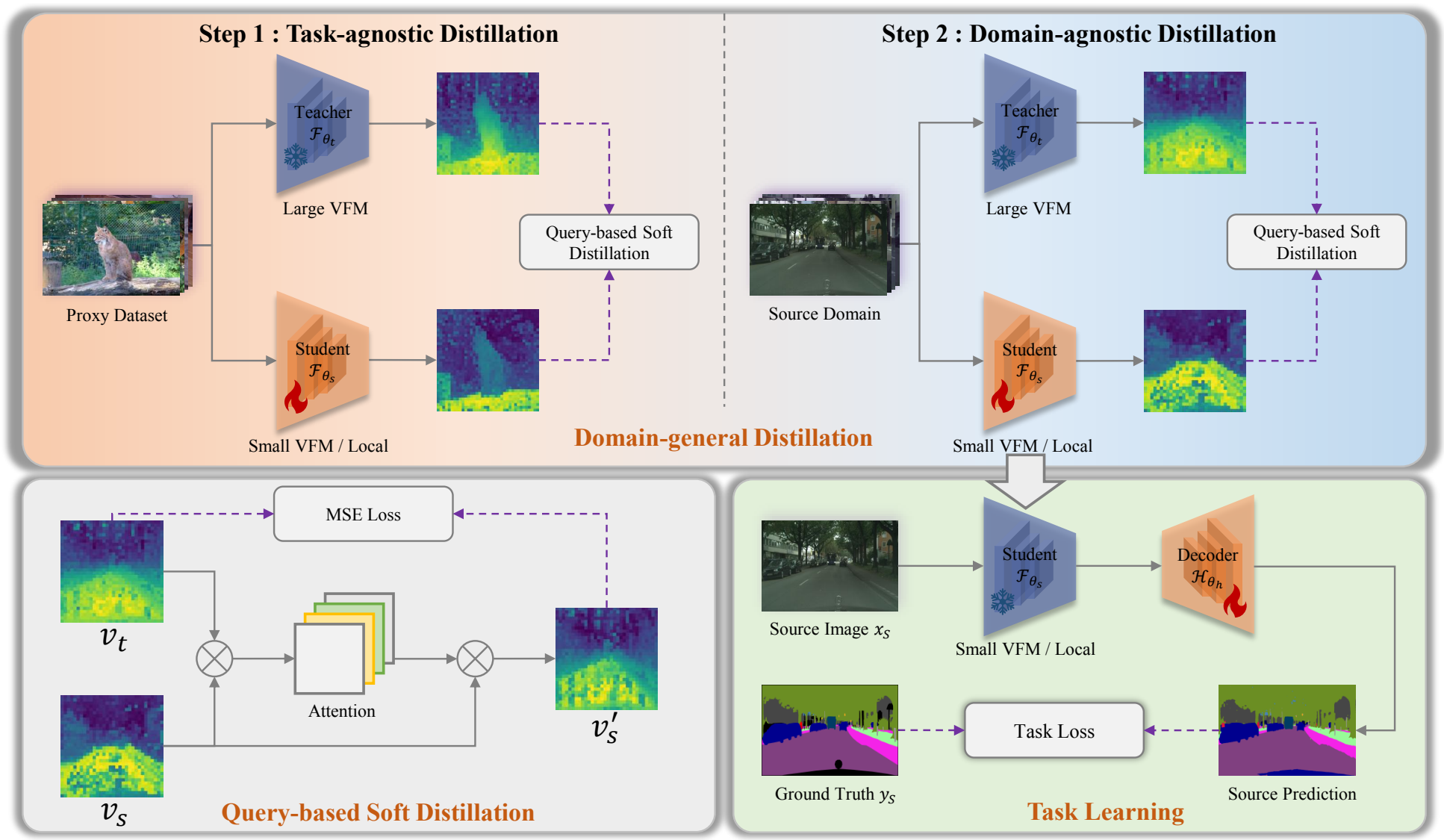
300 dpi PNG · Caption · Source PDF
Original caption, source, and provenance
Fixed source version: arXiv v1 fixed source
Earliest verified matching figure date (temporal proxy): 2026-03-03
arXiv v1 date: 2026-03-03
Actual drawing date: unknown. See the source record for version checks and temporal-evidence limitations.
Historical PDF · Download citation snapshot · Date evidence · Complete screening and version record (Chinese)
Citation threshold evidence: Nicu Sebe; 59898 citations; snapshot 2026-10-21.
Recorded drawing-tool disclosure: unknown. No tool attribution is inferred from appearance; see the archival disclosure evidence for scope and wording.
Crop bounding box: [72, 71, 536, 341] (PDF points; top-left origin; x0, y0, x1, y1).
Figure 4. Overview of the proposed GKD framework. GKD comprises two major parts: domain-general distillation and task learning. In
the domain-general distillation stage, the student sequentially performs task-agnostic and domain-agnostic distillation, both via the Query-
based Soft Distillation mechanism. In the task learning stage, only the decoder is trained on source annotations, while the student encoder
is frozen to preserve the domain-general representations.
Generalizable Knowledge Distillation from Vision Foundation Models for Semantic Segmentation
Venue: CVPR 2026 · Figure source: archived arXiv v1
Figure 1 · PDF page 1 · P13
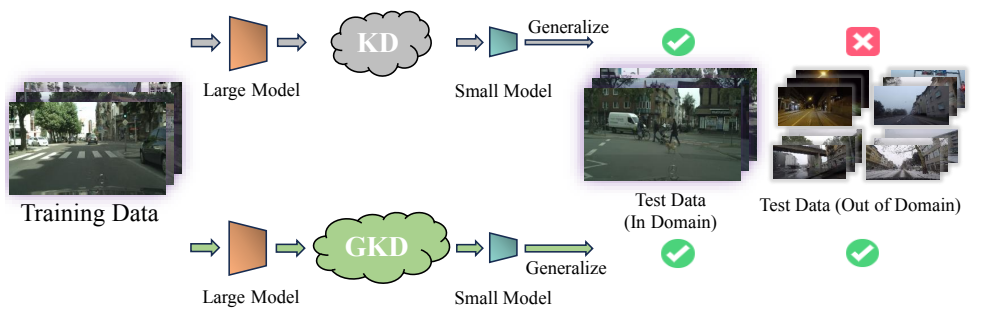
300 dpi PNG · Caption · Source PDF
Original caption, source, and provenance
Fixed source version: arXiv v1 fixed source
Earliest verified matching figure date (temporal proxy): 2026-03-03
arXiv v1 date: 2026-03-03
Actual drawing date: unknown. See the source record for version checks and temporal-evidence limitations.
Historical PDF · Download citation snapshot · Date evidence · Complete screening and version record (Chinese)
Citation threshold evidence: Nicu Sebe; 59898 citations; snapshot 2026-10-21.
Recorded drawing-tool disclosure: unknown. No tool attribution is inferred from appearance; see the archival disclosure evidence for scope and wording.
Crop bounding box: [316, 260, 555, 335] (PDF points; top-left origin; x0, y0, x1, y1).
Figure 1. Comparison of Knowledge Distillation (KD) and our
proposed generalizable KD (GKD). Conventional KD preserves
accuracy within the same domain but overlooks generalization to
unseen domains.
MARIS: Marine Open-Vocabulary Instance Segmentation with Geometric Enhancement and Semantic Alignment
Venue: CVPR 2026 · Main-conference paper
Figure 3 · PDF page 4 · P114
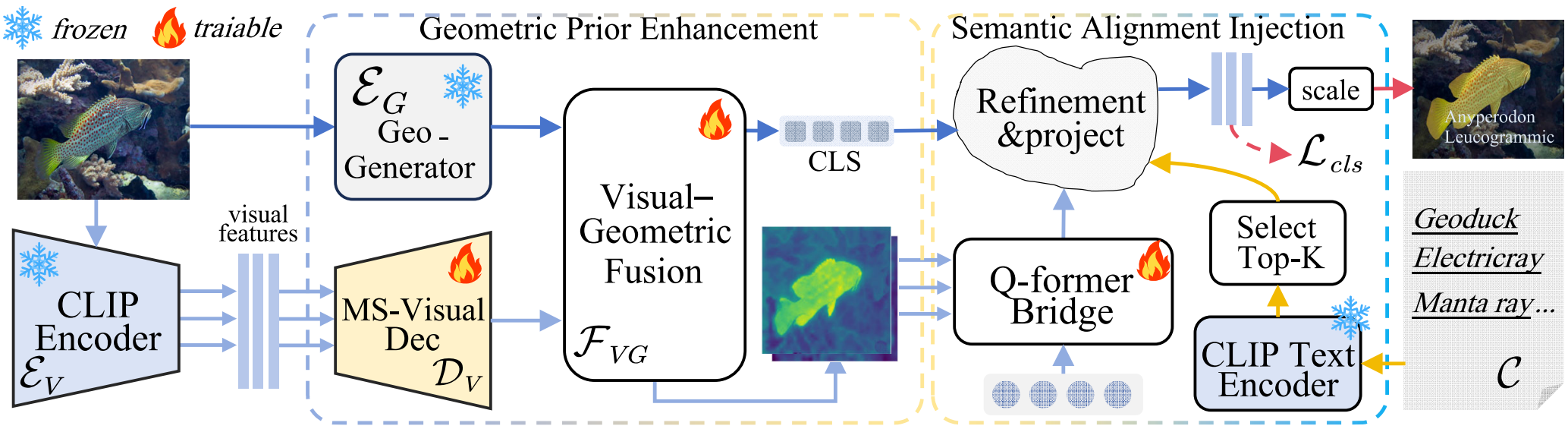
300 dpi PNG · Caption · Source PDF
Original caption, source, and provenance
Fixed source version: CVPR 2026 fixed official PDF
Earliest verified matching figure date (temporal proxy): 2026-03-17
arXiv v1 date: 2025-10-17
Actual drawing date: unknown. See the source record for version checks and temporal-evidence limitations.
Historical PDF · Download citation snapshot · Date evidence · Paper page · Complete screening and version record (Chinese)
Citation threshold evidence: Xuelong Li; 102448 citations; snapshot 2026-10-21.
Recorded drawing-tool disclosure: unknown. No tool attribution is inferred from appearance; see the archival disclosure evidence for scope and wording.
Crop bounding box: [58, 70, 554, 205.5] (PDF points; top-left origin; x0, y0, x1, y1).
Figure 3. Overall framework of the proposed Method. The Geometric Prior Enhancement module strengthens structural representa-
tions via visual–geometric fusion and transformer-based query refinement. The Semantic Alignment Injection mechanism align category
semantics with degraded underwater conditions.
MARIS: Marine Open-Vocabulary Instance Segmentation with Geometric Enhancement and Semantic Alignment
Venue: CVPR 2026 · Main-conference paper
Figure 1 · PDF page 1 · P113
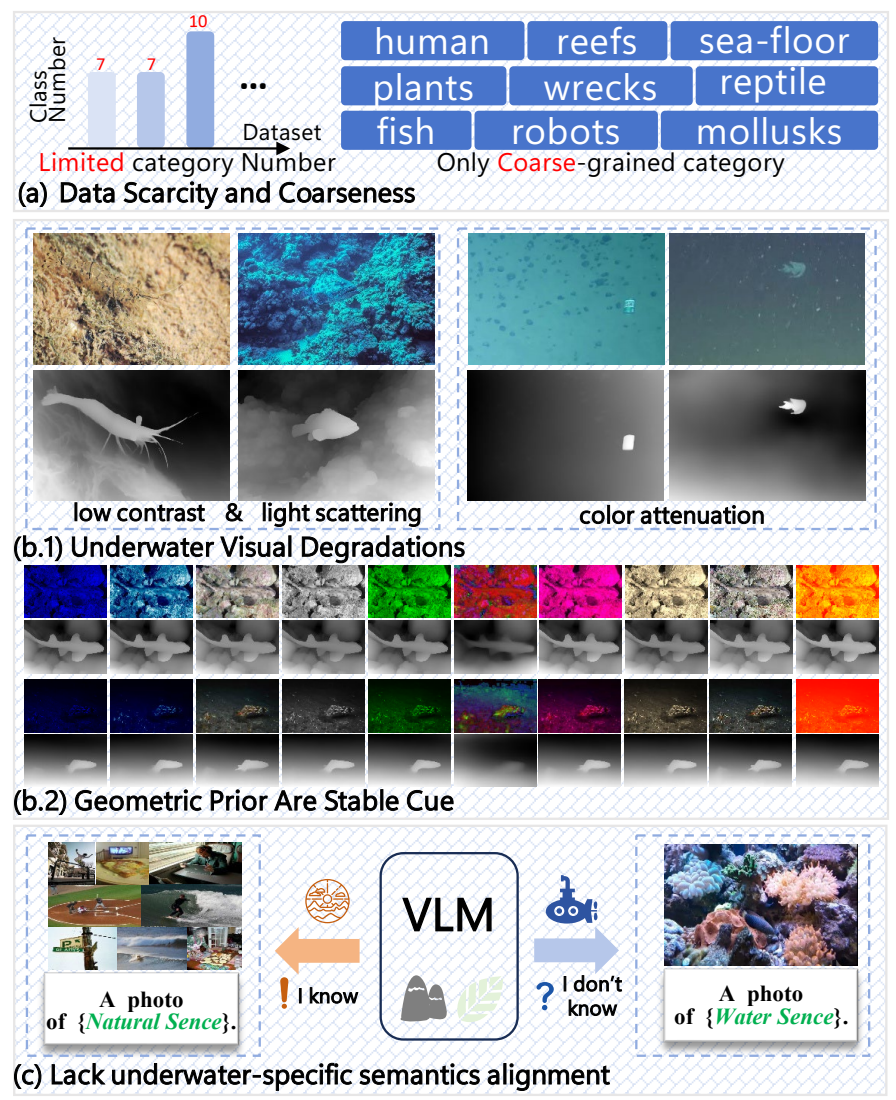
300 dpi PNG · Caption · Source PDF
Original caption, source, and provenance
Fixed source version: CVPR 2026 fixed official PDF
Earliest verified matching figure date (temporal proxy): 2025-10-17
arXiv v1 date: 2025-10-17
Actual drawing date: unknown. See the source record for version checks and temporal-evidence limitations.
Historical PDF · Download citation snapshot · Date evidence · Paper page · Complete screening and version record (Chinese)
Citation threshold evidence: Xuelong Li; 102448 citations; snapshot 2026-10-21.
Recorded drawing-tool disclosure: unknown. No tool attribution is inferred from appearance; see the archival disclosure evidence for scope and wording.
Crop bounding box: [326, 240, 541, 504] (PDF points; top-left origin; x0, y0, x1, y1).
Figure 1. The challenges of transferring OV instance segmen-
tation to underwater scenarios in terms of (a) datasets and (b-c)
methods, which have motivated the contributions of this study.
Make It Up: Fake Images, Real Gains in Generalized Few-shot Semantic Segmentation
Source: arXiv 2026 · Figure source: archived arXiv v1
Figure 2 · PDF page 4 · P296
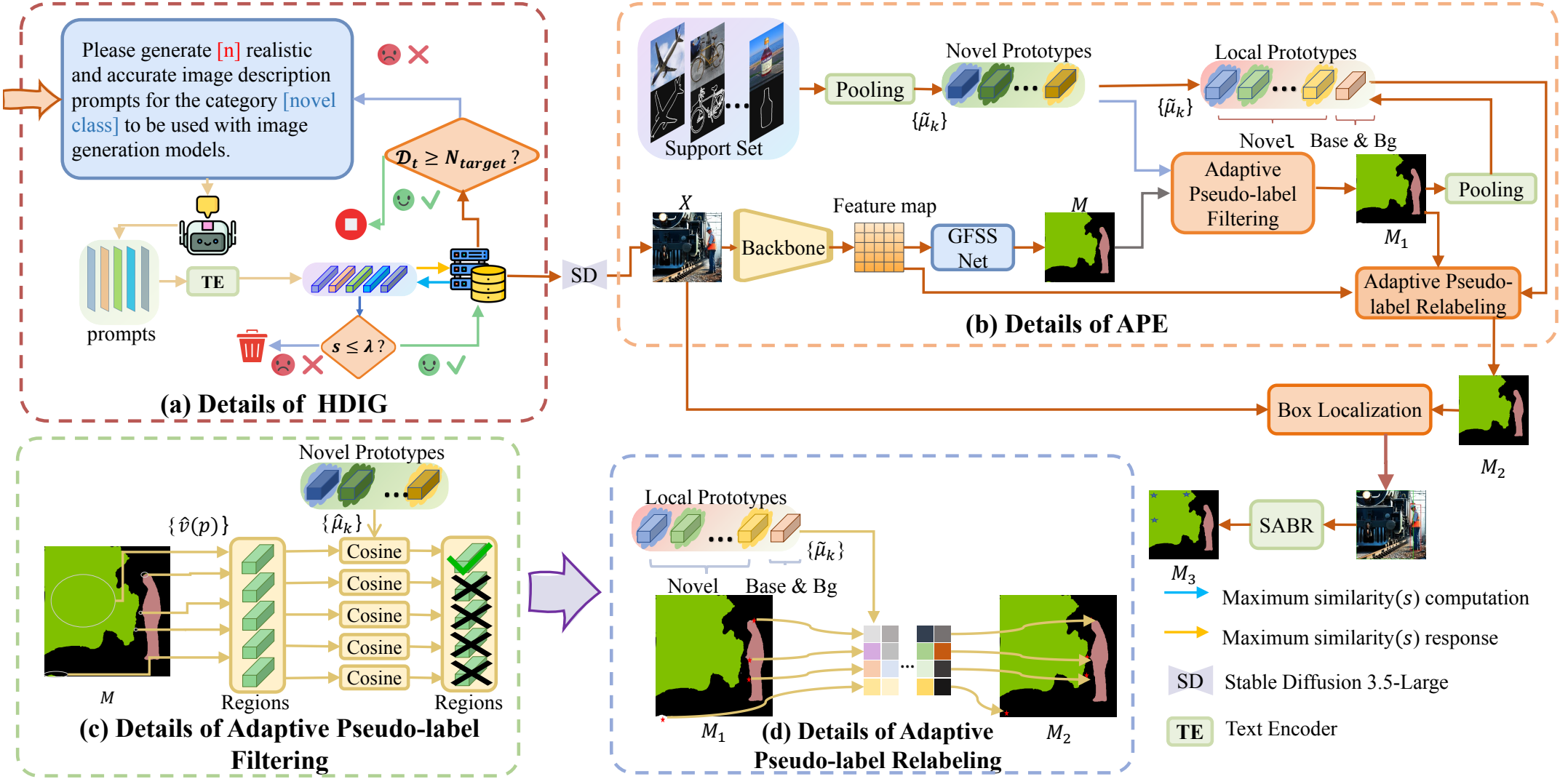
300 dpi PNG · Caption · Source PDF
Original caption, source, and provenance
Fixed source version: arXiv v1 fixed
Earliest verified matching figure date (temporal proxy): 2026-03-28
arXiv v1 date: 2026-03-28
Actual drawing date: unknown. See the source record for version checks and temporal-evidence limitations.
Historical PDF · Download citation snapshot · Date evidence · Complete screening and version record (Chinese)
Citation threshold evidence: Ming-Ming Cheng; 85763 citations; snapshot 2026-10-21.
Recorded drawing-tool disclosure: unknown. No tool attribution is inferred from appearance; see the archival disclosure evidence for scope and wording.
Crop bounding box: [48, 56, 565, 313] (PDF points; top-left origin; x0, y0, x1, y1).
Fig. 2. (a), (b) Given several novel classes and their support set, we first use HDIG to synthesize high-quality, diverse novel class images proportional to the
base class images. Guided by support images, APE refines these synthesized images to generate accurate masks through two stages: Adaptive Pseudo-label
Filtering (APF) and Adaptive Pseudo-label Relabeling (APR). Specifically, APF filters noisy regions in the initial mask M to obtain M1 ; APR relabels these
unlabeled regions to yield M2 . Finally, SAM-based Boundary Refinement (SABR) further refines the mask boundaries, yielding the final M3 . (c), (d) illustrate
the details of APF and APR.
Make It Up: Fake Images, Real Gains in Generalized Few-shot Semantic Segmentation
Source: arXiv 2026 · Figure source: archived arXiv v1
Figure 1 · PDF page 1 · P295
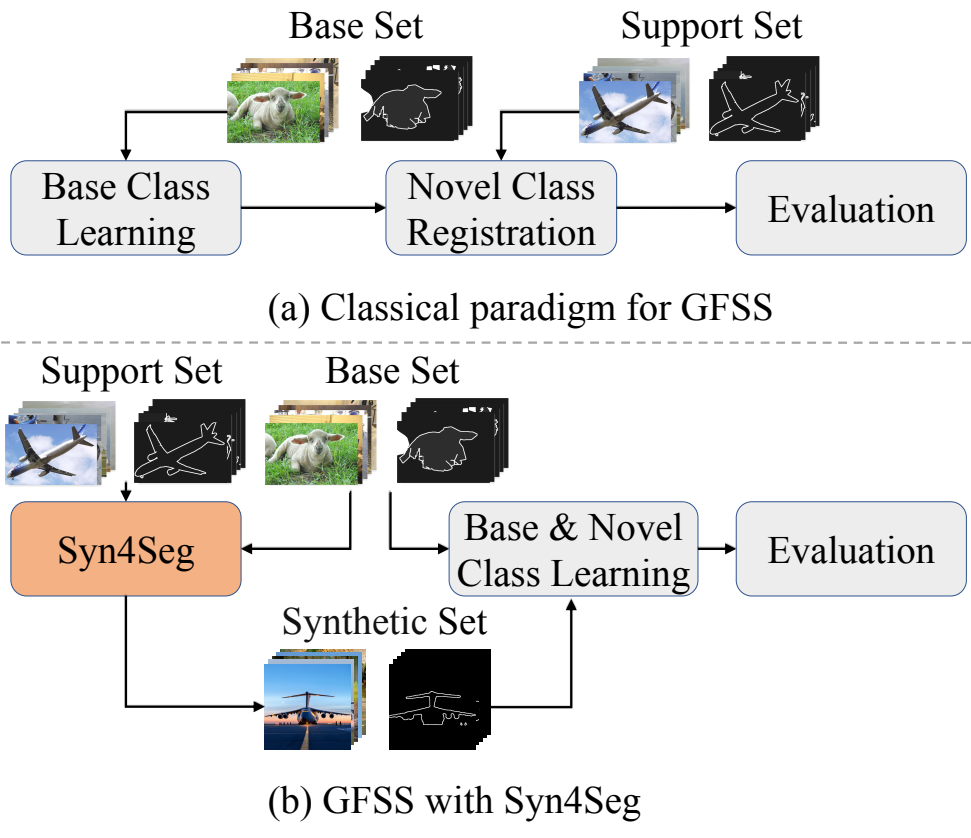
300 dpi PNG · Caption · Source PDF
Original caption, source, and provenance
Fixed source version: arXiv v1 fixed
Earliest verified matching figure date (temporal proxy): 2026-03-28
arXiv v1 date: 2026-03-28
Actual drawing date: unknown. See the source record for version checks and temporal-evidence limitations.
Historical PDF · Download citation snapshot · Date evidence · Complete screening and version record (Chinese)
Citation threshold evidence: Ming-Ming Cheng; 85763 citations; snapshot 2026-10-21.
Recorded drawing-tool disclosure: unknown. No tool attribution is inferred from appearance; see the archival disclosure evidence for scope and wording.
Crop bounding box: [321, 176, 554, 377] (PDF points; top-left origin; x0, y0, x1, y1).
Fig. 1. Pipelines of classical GFSS works and our Syn4Seg framework.
(a) Classical GFSS methods follow three stages: base class learning, novel
class registration, and evaluation, where novel classes rely on limited manual
annotations, resulting in low diversity and constrained performance. (b) Our
Syn4Seg framework synthesizes diverse, realistic novel class images and
pseudo labels guided by support annotations. These synthesized samples,
together with base data, are used to train a semantic segmentation model,
enabling robust recognition of both base and novel classes during evaluation.
PEARL: Geometry Aligns Semantics for Training-Free Open-Vocabulary Semantic Segmentation
Venue: CVPR 2026 · Main-conference paper
Figure 2 · PDF page 4 · P12
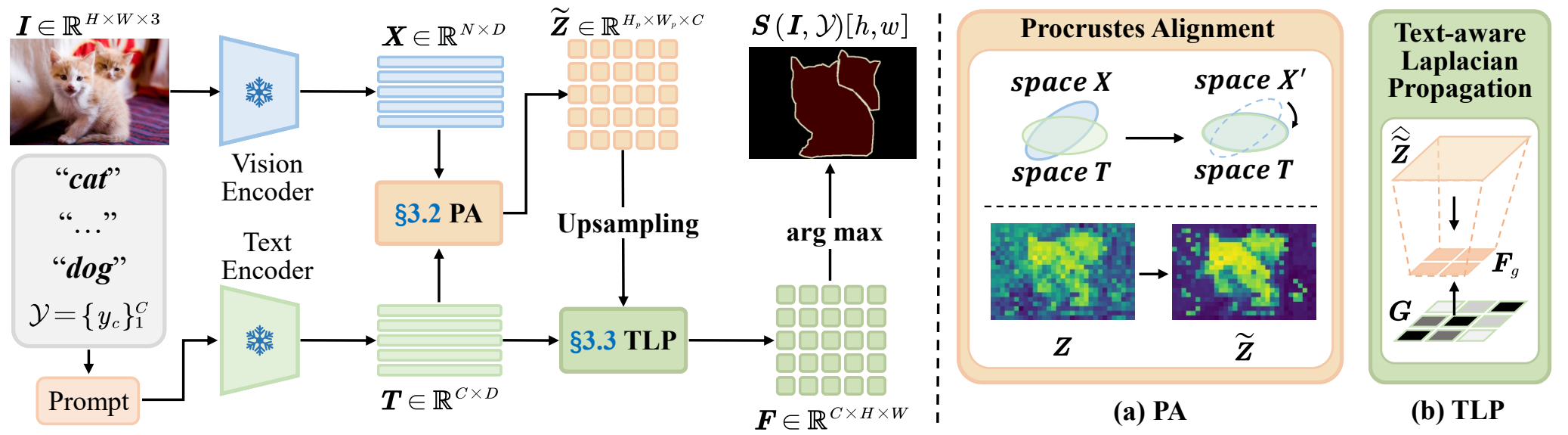
300 dpi PNG · Caption · Source PDF
Original caption, source, and provenance
Fixed source version: CVPR 2026 fixed official PDF
Earliest verified matching figure date (temporal proxy): 2026-03-23
arXiv v1 date: 2026-03-23
Actual drawing date: unknown. See the source record for version checks and temporal-evidence limitations.
Historical PDF · Download citation snapshot · Date evidence · Paper page · Complete screening and version record (Chinese)
Citation threshold evidence: Byeungwoo Jeon; 11367 citations; snapshot 2026-10-21.
Recorded drawing-tool disclosure: unknown. No tool attribution is inferred from appearance; see the archival disclosure evidence for scope and wording.
Crop bounding box: [57, 70, 555, 208] (PDF points; top-left origin; x0, y0, x1, y1).
Figure 2. Our PEARL framework with align-then-propagate. Given an image I and a label set Y , a frozen ViT vision encoder yields
patch tokens. Procrustes alignment is inserted in the last self-attention block: for each head (J heads), queries and keys are weighted-
centered and the keys are orthogonally rotated toward the query subspace, producing geometry-corrected patch features. A frozen text
encoder maps Y to unit-norm prototypes T . Patch-text cosine similarity gives initial logits Z(cid:101) . Text-aware Laplacian propagation then
refines Z(cid:101) on a compact grid using a class graph G induced by T and confidence weights, and the refined scores are upsampled to full
resolution F . The final segmentation S is obtained by selecting, at each pixel, the class with the highest score.
PEARL: Geometry Aligns Semantics for Training-Free Open-Vocabulary Semantic Segmentation
Venue: CVPR 2026 · Main-conference paper
Figure 1 · PDF page 1 · P11
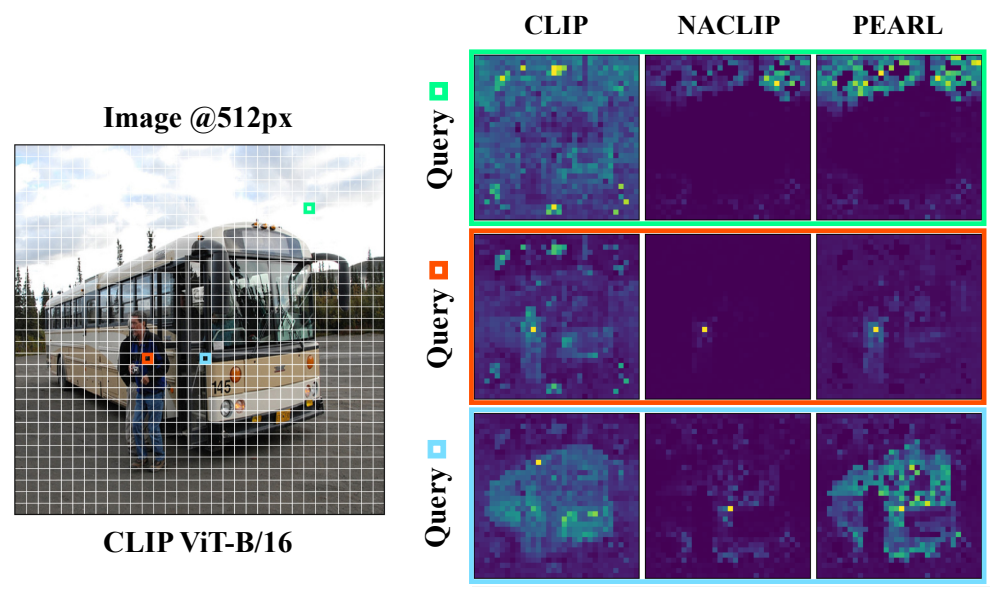
300 dpi PNG · Caption · Source PDF
Original caption, source, and provenance
Fixed source version: CVPR 2026 fixed official PDF
Earliest verified matching figure date (temporal proxy): 2026-03-23
arXiv v1 date: 2026-03-23
Actual drawing date: unknown. See the source record for version checks and temporal-evidence limitations.
Historical PDF · Download citation snapshot · Date evidence · Paper page · Complete screening and version record (Chinese)
Citation threshold evidence: Byeungwoo Jeon; 11367 citations; snapshot 2026-10-21.
Recorded drawing-tool disclosure: unknown. No tool attribution is inferred from appearance; see the archival disclosure evidence for scope and wording.
Crop bounding box: [316, 258, 555, 400] (PDF points; top-left origin; x0, y0, x1, y1).
Figure 1. Attention visualization at selected query points. We
show an input resized to 512 × 512 using the CLIP ViT-B/16 vi-
sion encoder. For each colored query, we compare the attention
maps produced by CLIP [51], NACLIP [26], and our PEARL.
CLIP exhibits diffuse and background-biased responses, while
NACLIP improves localization but often fragments objects into
isolated peaks. By performing Procrustes alignment in the last
self-attention block, PEARL yields compact and object-consistent
attention, suppresses background spill, and better preserves thin
parts, resulting in stable focus with reduced grid artifacts.
REL-SF4PASS: Panoramic Semantic Segmentation with REL Depth Representation and Spherical Fusion
Source: arXiv 2026 · Figure source: archived arXiv v1 · CVPR 2026 — conference version also recorded
Figure 2 · PDF page 3 · P224
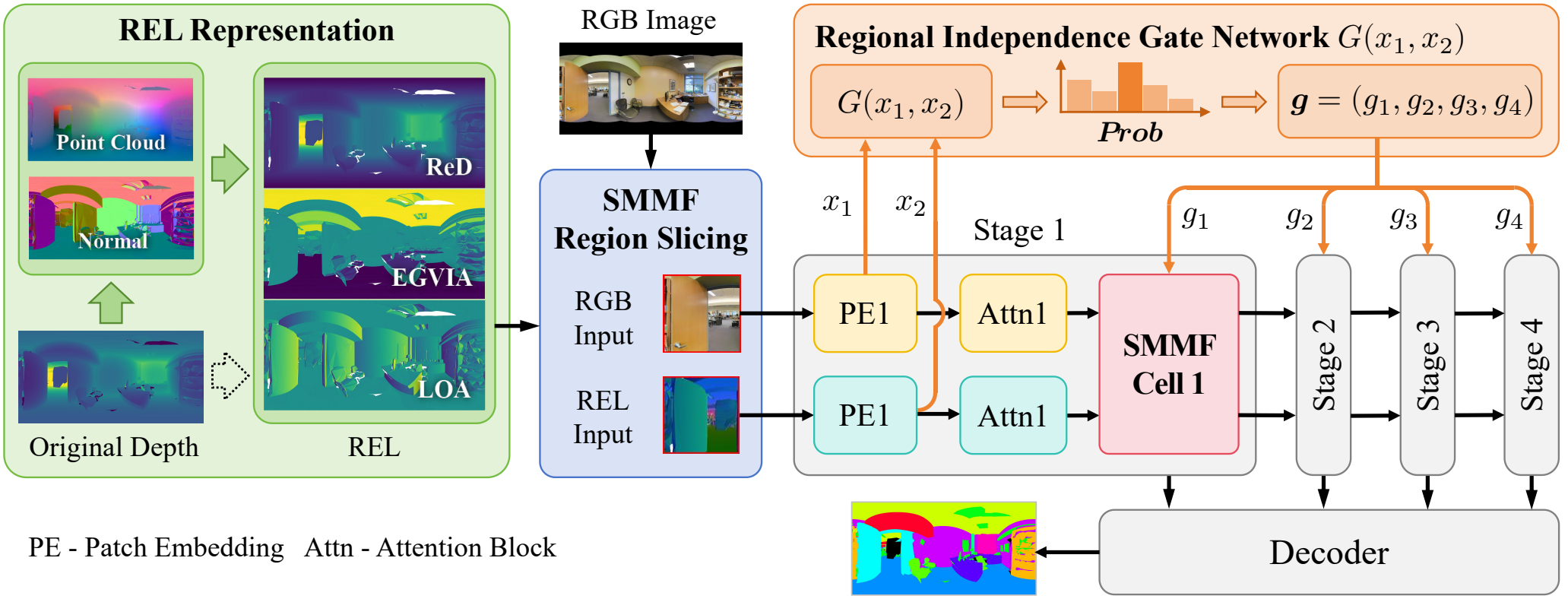
300 dpi PNG · Caption · Source PDF
Original caption, source, and provenance
Fixed source version: arXiv v1 fixed
Earliest verified matching figure date (temporal proxy): 2026-01-23
arXiv v1 date: 2026-01-23
Actual drawing date: unknown. See the source record for version checks and temporal-evidence limitations.
Historical PDF · Download citation snapshot · Date evidence · Complete screening and version record (Chinese)
Citation threshold evidence: Xi Li; 19440 citations; snapshot 2026-10-21.
Recorded drawing-tool disclosure: unknown. No tool attribution is inferred from appearance; see the archival disclosure evidence for scope and wording.
Crop bounding box: [59, 74, 554, 263] (PDF points; top-left origin; x0, y0, x1, y1).
Figure 2. The overview of REL-SF4PASS. Firstly, REL representation effectively represents the depth information by using ReD, EGVIA,
and LOA, which contains the 3D location and surface normal direction. Secondly, Our SMMF to get image regions from cylinder side
surface and uses a Gate Network to independently determine the fusion used in each region.
REL-SF4PASS: Panoramic Semantic Segmentation with REL Depth Representation and Spherical Fusion
Source: arXiv 2026 · Figure source: archived arXiv v1 · CVPR 2026 — conference version also recorded
Figure 1 · PDF page 1 · P223
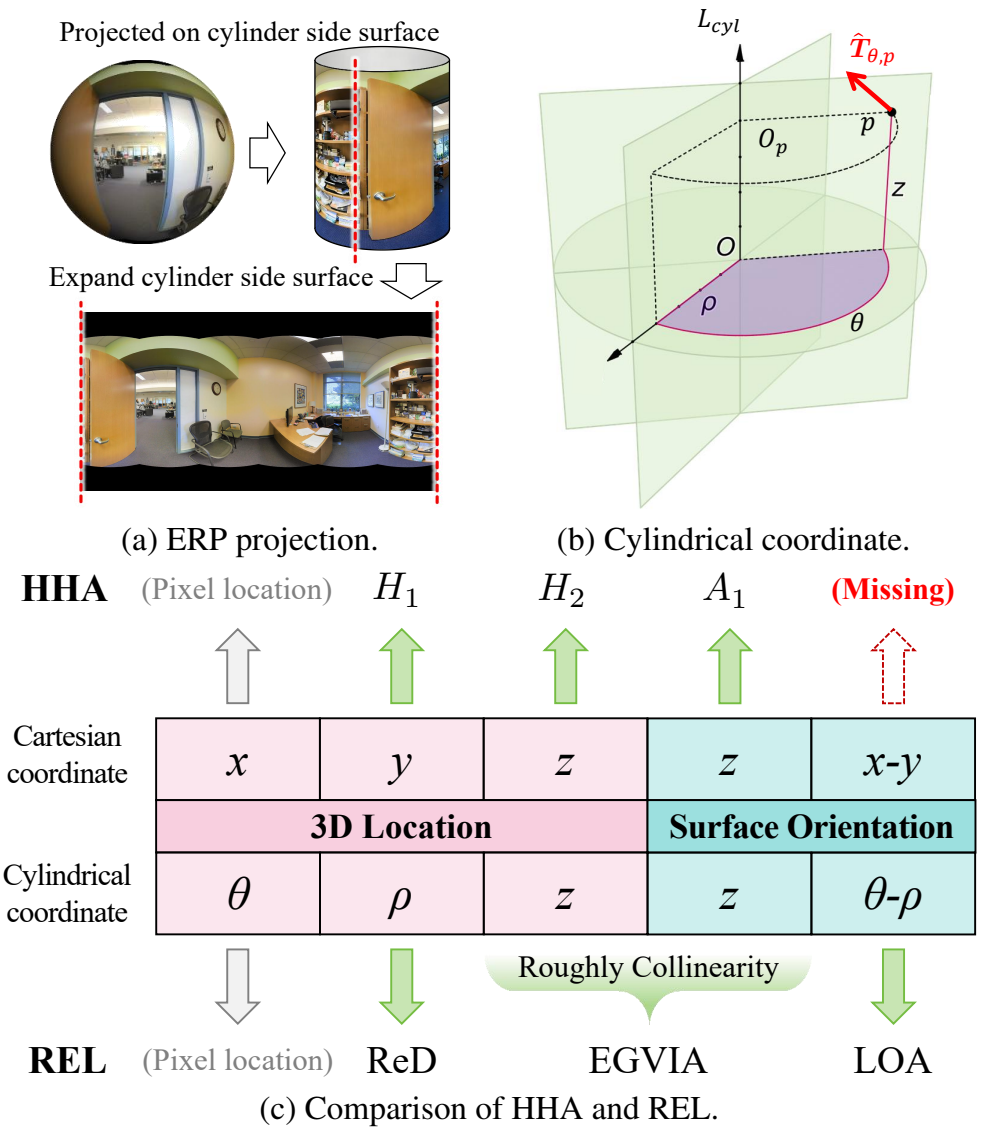
300 dpi PNG · Caption · Source PDF
Original caption, source, and provenance
Fixed source version: arXiv v1 fixed
Earliest verified matching figure date (temporal proxy): 2026-01-23
arXiv v1 date: 2026-01-23
Actual drawing date: unknown. See the source record for version checks and temporal-evidence limitations.
Historical PDF · Download citation snapshot · Date evidence · Complete screening and version record (Chinese)
Citation threshold evidence: Xi Li; 19440 citations; snapshot 2026-10-21.
Recorded drawing-tool disclosure: unknown. No tool attribution is inferred from appearance; see the archival disclosure evidence for scope and wording.
Crop bounding box: [318, 231, 554, 504] (PDF points; top-left origin; x0, y0, x1, y1).
Figure 1. Overview of ERP projection, cylindrical coordinate and
comparison of HHA and REL. Tˆ is the tangent line to circle O
θ,p p
at point p. Circle O lies in the plane perpendicular to gravity,
p
passes through point p, and its center lies on the cylindrical axis
L of ρθz . In (c), we compared how different structure informa-
cyl
tion are represented in REL and HHA.
Rewis3d: Reconstruction Improves Weakly-Supervised Semantic Segmentation
Venue: CVPR 2026 · Main-conference paper
Figure 3 · PDF page 3 · P06
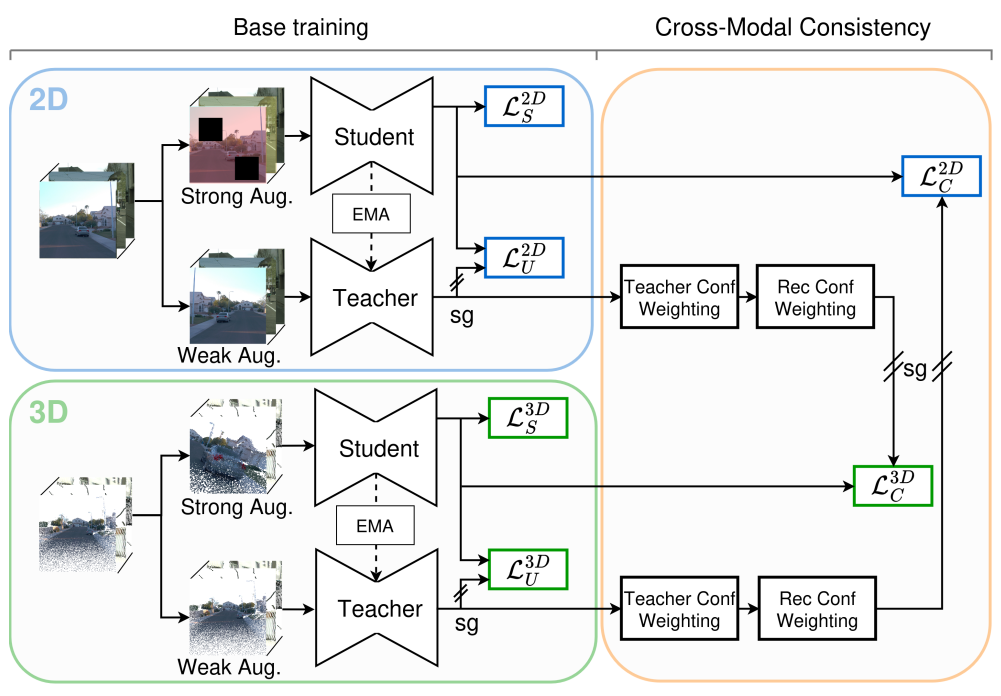
300 dpi PNG · Caption · Source PDF
Original caption, source, and provenance
Fixed source version: CVPR 2026 main-conference fixed open-access version
Earliest verified matching figure date (temporal proxy): 2026-03-06
arXiv v1 date: 2026-03-06
Actual drawing date: unknown. See the source record for version checks and temporal-evidence limitations.
Historical PDF · Download citation snapshot · Date evidence · Complete screening and version record (Chinese)
Citation threshold evidence: Bernt Schiele; 131438 citations; snapshot 2026-10-21.
Recorded drawing-tool disclosure: unknown. No tool attribution is inferred from appearance; see the archival disclosure evidence for scope and wording.
Crop bounding box: [315, 72, 555, 239] (PDF points; top-left origin; x0, y0, x1, y1).
Figure 3. Overview of the training pipeline. Our framework operates in two stages. Base Training (blue and green) establishes independent student-teacher setups for each modality using sparse supervision. Cross-Modal Consistency (orange) introduces our core contribution: bidirectional knowledge transfer where the teacher of one modality supervises the student of the other, weighted by our dual confidence mechanism leveraging prediction certainty and reconstruction quality.
Rewis3d: Reconstruction Improves Weakly-Supervised Semantic Segmentation
Venue: CVPR 2026 · Main-conference paper
Figure 2 · PDF page 2 · P05
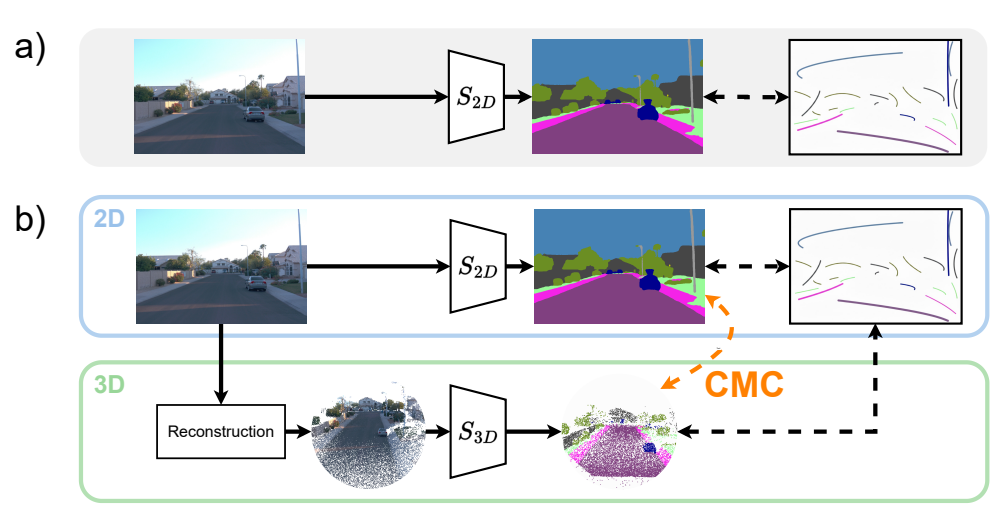
300 dpi PNG · Caption · Source PDF
Original caption, source, and provenance
Fixed source version: CVPR 2026 main-conference fixed open-access version
Earliest verified matching figure date (temporal proxy): 2026-03-06
arXiv v1 date: 2026-03-06
Actual drawing date: unknown. See the source record for version checks and temporal-evidence limitations.
Historical PDF · Download citation snapshot · Date evidence · Complete screening and version record (Chinese)
Citation threshold evidence: Bernt Schiele; 131438 citations; snapshot 2026-10-21.
Recorded drawing-tool disclosure: unknown. No tool attribution is inferred from appearance; see the archival disclosure evidence for scope and wording.
Crop bounding box: [315, 72, 555, 195] (PDF points; top-left origin; x0, y0, x1, y1).
Figure 2. Conceptual overview of weakly-supervised segmentation approaches. (a) Traditional methods rely solely on sparse 2D annotations, limiting supervision propagation. (b) Our proposed method Rewis3d introduces a 3D branch, enforcing cross-modal consistency (CMC) between 2D predictions and 3D predictions from reconstructed geometry.
SAGE: Style-Adaptive Generalization for Privacy-Constrained Semantic Segmentation Across Domains
Venue: CVPR 2026 · Main-conference paper
Figure 2 · PDF page 4 · P156
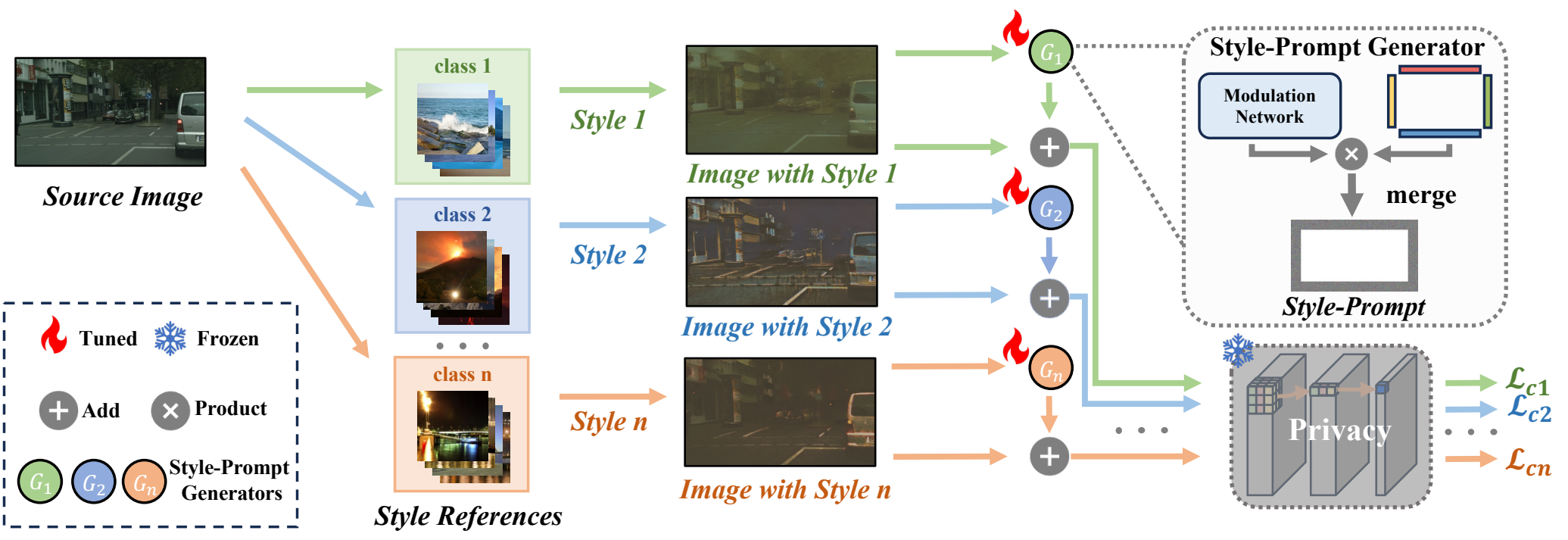
300 dpi PNG · Caption · Source PDF
Original caption, source, and provenance
Fixed source version: CVPR 2026 fixed official PDF
Earliest verified matching figure date (temporal proxy): 2025-12-02
arXiv v1 date: 2025-12-02
Actual drawing date: unknown. See the source record for version checks and temporal-evidence limitations.
Historical PDF · Download citation snapshot · Date evidence · Paper page · Complete screening and version record (Chinese)
Citation threshold evidence: Haohuan Fu; 14800 citations; snapshot 2026-10-21.
Recorded drawing-tool disclosure: unknown. No tool attribution is inferred from appearance; see the archival disclosure evidence for scope and wording.
Crop bounding box: [58, 70, 555, 241] (PDF points; top-left origin; x0, y0, x1, y1).
Figure 2. The training process of SPG: each style reference guides the source image through a dedicated generator G to produce a style-
i
aware prompt. Prompts are merged and used to optimize a frozen privacy model. Each style-prompt generator consists of a modulation
network and a learnable prompt template, producing the final style-prompt via element-wise modulation.
SAGE: Style-Adaptive Generalization for Privacy-Constrained Semantic Segmentation Across Domains
Venue: CVPR 2026 · Main-conference paper
Figure 1 · PDF page 2 · P155
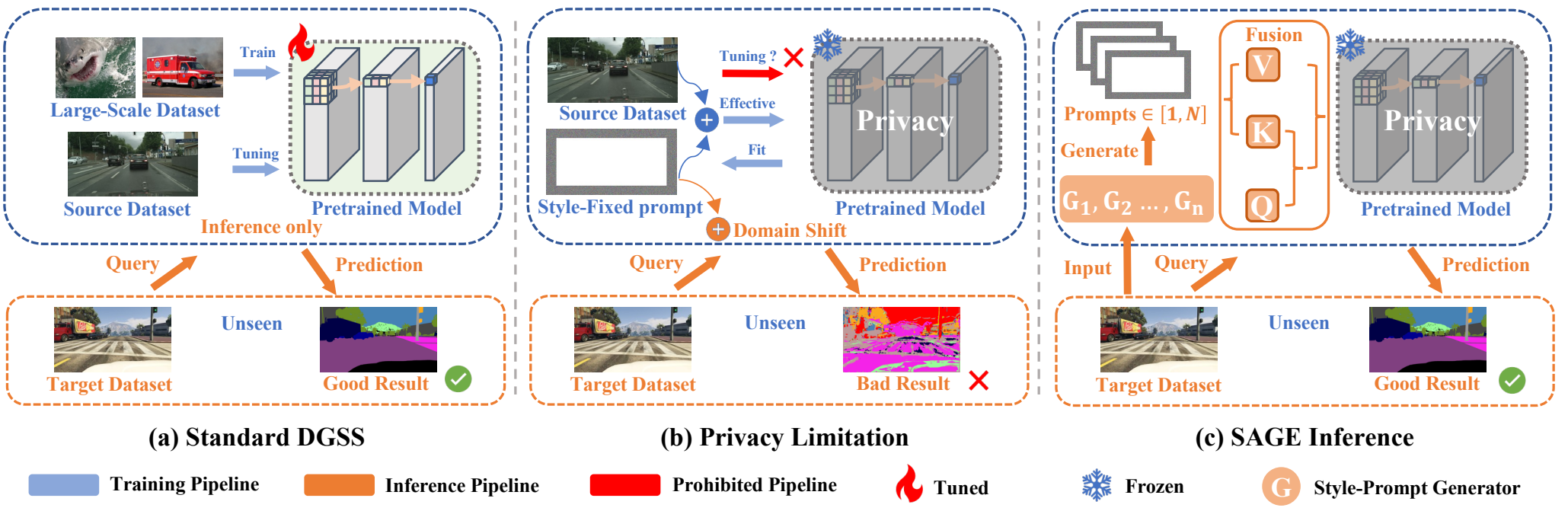
300 dpi PNG · Caption · Source PDF
Original caption, source, and provenance
Fixed source version: CVPR 2026 fixed official PDF
Earliest verified matching figure date (temporal proxy): 2025-12-02
arXiv v1 date: 2025-12-02
Actual drawing date: unknown. See the source record for version checks and temporal-evidence limitations.
Historical PDF · Download citation snapshot · Date evidence · Paper page · Complete screening and version record (Chinese)
Citation threshold evidence: Haohuan Fu; 14800 citations; snapshot 2026-10-21.
Recorded drawing-tool disclosure: unknown. No tool attribution is inferred from appearance; see the archival disclosure evidence for scope and wording.
Crop bounding box: [58, 70, 552, 231] (PDF points; top-left origin; x0, y0, x1, y1).
Figure 1. Overview of domain generalization settings under privacy constraints. (a) Standard DGSS requires backbone tuning. (b) Style-
fixed prompting is ineffective on unseen domains. (c) SAGE inference overcomes privacy limitations.
SegEarth-OV3: Exploring SAM 3 for Open-Vocabulary Semantic Segmentation in Remote Sensing Images
Source: arXiv 2025 · Figure source: archived arXiv v1
Figure 2 · PDF page 3 · P294
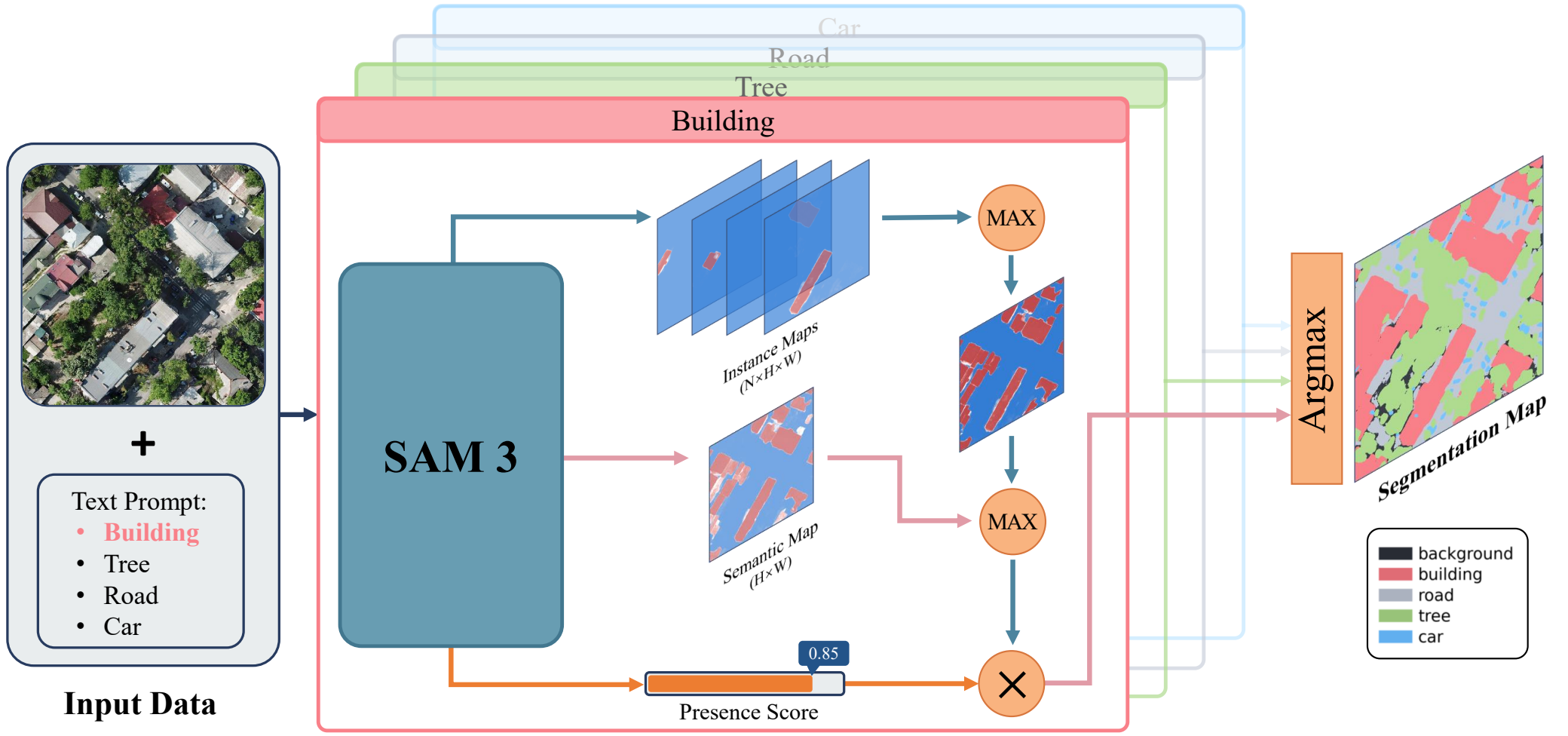
300 dpi PNG · Caption · Source PDF
Original caption, source, and provenance
Fixed source version: arXiv v1 fixed
Earliest verified matching figure date (temporal proxy): 2025-12-09
arXiv v1 date: 2025-12-09
Actual drawing date: unknown. See the source record for version checks and temporal-evidence limitations.
Historical PDF · Download citation snapshot · Date evidence · Complete screening and version record (Chinese)
Citation threshold evidence: Deyu Meng; 49595 citations; snapshot 2026-10-21.
Recorded drawing-tool disclosure: unknown. No tool attribution is inferred from appearance; see the archival disclosure evidence for scope and wording.
Crop bounding box: [59, 73, 558, 307] (PDF points; top-left origin; x0, y0, x1, y1).
Figure 2. The overall inference pipeline of SegEarth-OV3. Given an input image and a list of text prompts, we leverage SAM 3’s decoupled
outputs. The pipeline involves: (1) instance aggregation to consolidate sparse object queries; (2) dual-head mask fusion to combine the
fine-grained instance details with the global coverage of the semantic head; and (3) presence-guided filtering (using the presence score) to
suppress false positives from absent categories. denotes the element-wise maximum operation, and denotes multiplication.
SegEarth-OV3: Exploring SAM 3 for Open-Vocabulary Semantic Segmentation in Remote Sensing Images
Source: arXiv 2025 · Figure source: archived arXiv v1
Figure 1 · PDF page 2 · P293
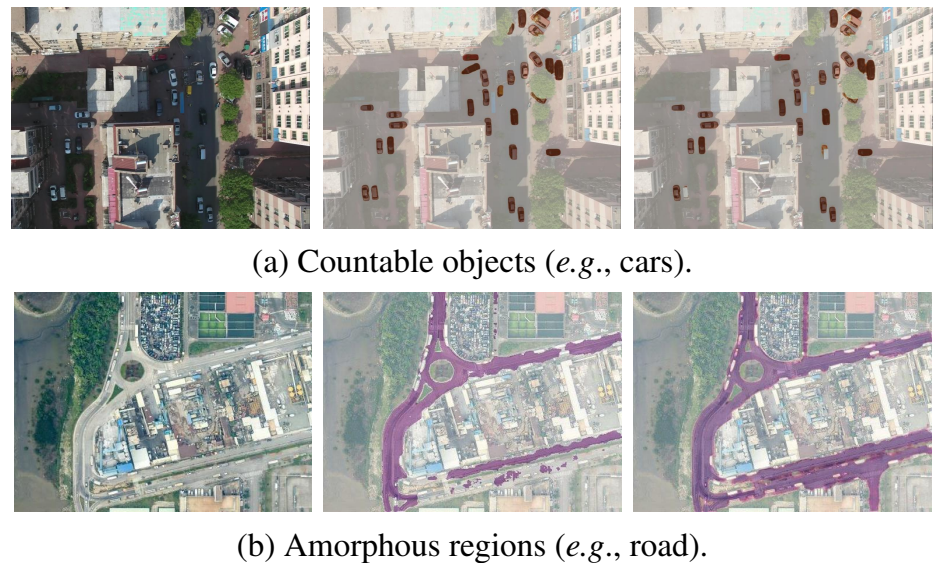
300 dpi PNG · Caption · Source PDF
Original caption, source, and provenance
Fixed source version: arXiv v1 fixed
Earliest verified matching figure date (temporal proxy): 2025-12-09
arXiv v1 date: 2025-12-09
Actual drawing date: unknown. See the source record for version checks and temporal-evidence limitations.
Historical PDF · Download citation snapshot · Date evidence · Complete screening and version record (Chinese)
Citation threshold evidence: Deyu Meng; 49595 citations; snapshot 2026-10-21.
Recorded drawing-tool disclosure: unknown. No tool attribution is inferred from appearance; see the archival disclosure evidence for scope and wording.
Crop bounding box: [322, 71, 548, 206] (PDF points; top-left origin; x0, y0, x1, y1).
Figure 1. The Transformer decoder of SAM 3 excels at delineat-
ing countable objects but produces fragmented masks for amor-
phous regions, while the semantic head preserves continuity for
amorphous regions but lacks boundary precision for small targets.
(Left: Remote sensing image. Middle: Prediction of Transformer
Decoder. Right: Prediction of semantic segmentation head.)
Beyond the Ground Truth: Enhanced Supervision for Image Restoration
Venue: CVPR 2026 · Main-conference paper
Figure 2 · PDF page 3 · P42
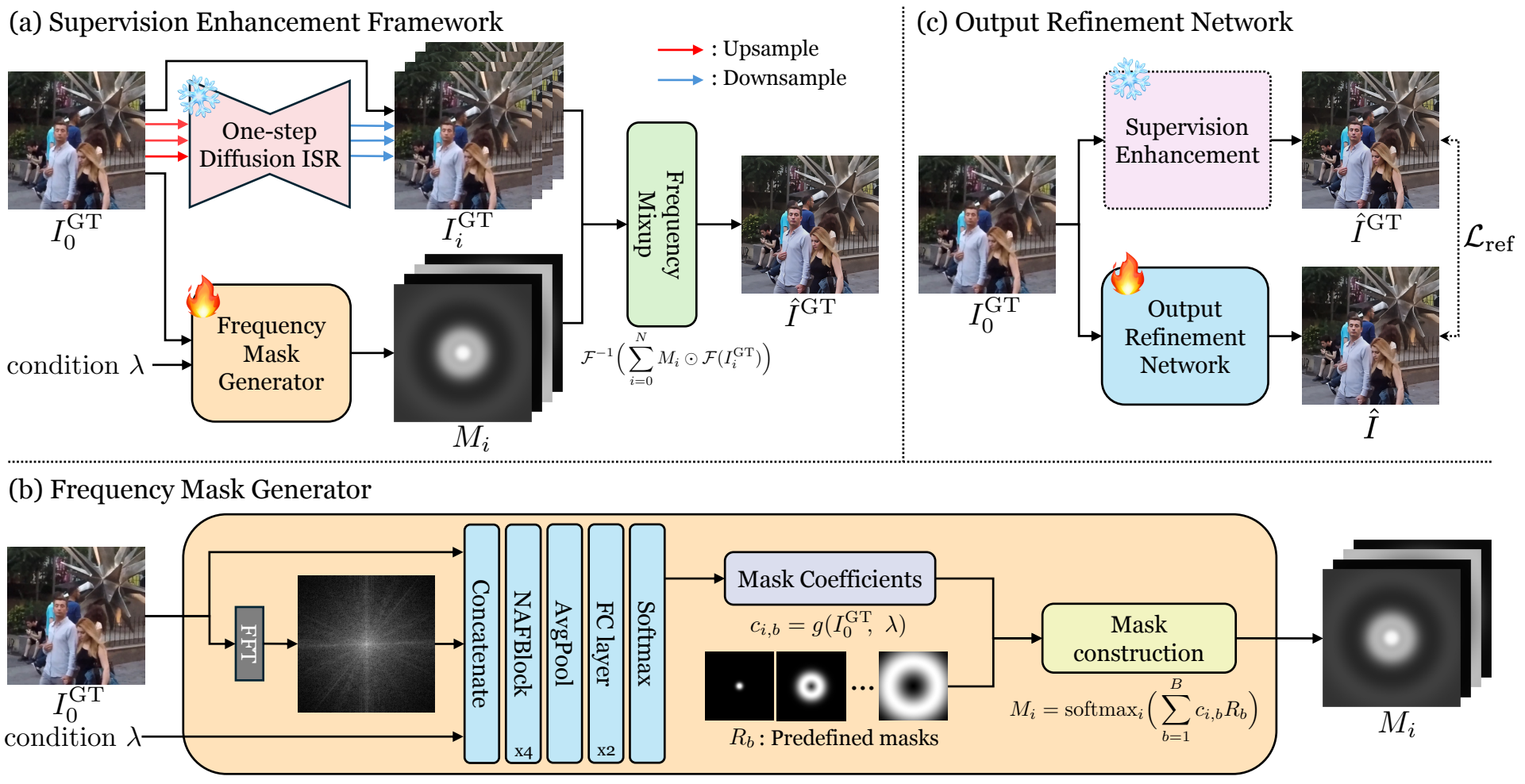
300 dpi PNG · Caption · Source PDF
Original caption, source, and provenance
Fixed source version: CVPR 2026 fixed official PDF
Earliest verified matching figure date (temporal proxy): 2025-12-04
arXiv v1 date: 2025-12-03
Actual drawing date: unknown. See the source record for version checks and temporal-evidence limitations.
Historical PDF · Download citation snapshot · Date evidence · Complete screening and version record (Chinese)
Citation threshold evidence: Bohyung Han; 31556 citations; snapshot 2026-10-21.
Recorded drawing-tool disclosure: unknown. No tool attribution is inferred from appearance; see the archival disclosure evidence for scope and wording.
Crop bounding box: [77, 73, 538, 310] (PDF points; top-left origin; x0, y0, x1, y1).
Figure 2. Overview of our framework. (a) The supervision enhancement framework produces enhanced ground truth images by fusing frequency components from the original ground truth I_0^GT and its super-resolved variants I_i^GT using adaptive frequency masks M_i. (b) The conditional frequency mask generator constructs M_i by combining predefined masks R_b weighted with predicted coefficients c_{i,b}, followed by a softmax function. (c) The output refinement network (ORNet) is trained with this enhanced supervision to improve perceptual quality.Beyond the Ground Truth: Enhanced Supervision for Image Restoration
Venue: CVPR 2026 · Main-conference paper
Figure 1 · PDF page 1 · P41
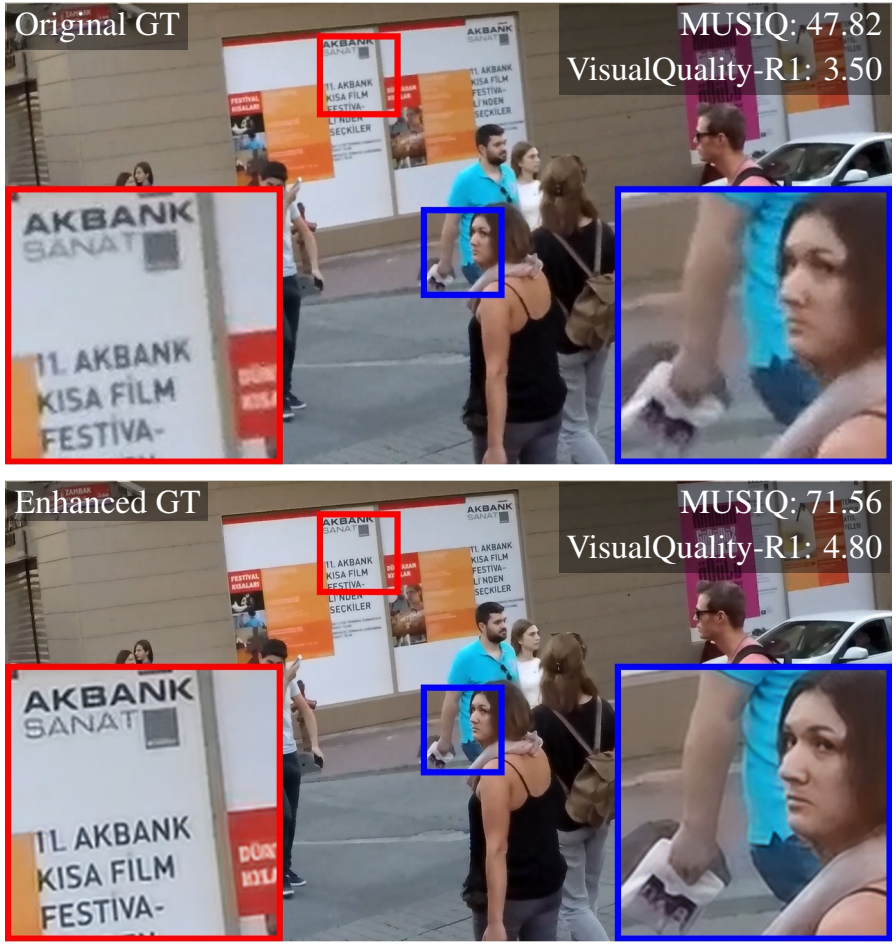
300 dpi PNG · Caption · Source PDF
Original caption, source, and provenance
Fixed source version: CVPR 2026 fixed official PDF
Earliest verified matching figure date (temporal proxy): 2025-12-03
arXiv v1 date: 2025-12-03
Actual drawing date: unknown. See the source record for version checks and temporal-evidence limitations.
Historical PDF · Download citation snapshot · Date evidence · Complete screening and version record (Chinese)
Citation threshold evidence: Bohyung Han; 31556 citations; snapshot 2026-10-21.
Recorded drawing-tool disclosure: unknown. No tool attribution is inferred from appearance; see the archival disclosure evidence for scope and wording.
Crop bounding box: [330, 227, 545, 454] (PDF points; top-left origin; x0, y0, x1, y1).
Figure 1. Visualization of our enhanced ground truth (GT). Our
enhanced GT not only demonstrates sharper text and superior per-
ceptualqualitybutalsomaintainssemanticconsistencywithrespect
to the original GT. Zoom in for better visualization.
Enhancing Unregistered Hyperspectral Image Super-Resolution via Unmixing-based Abundance Fusion Learning
Venue: CVPR 2026 · Main-conference paper
Figure 3 · PDF page 3 · P150
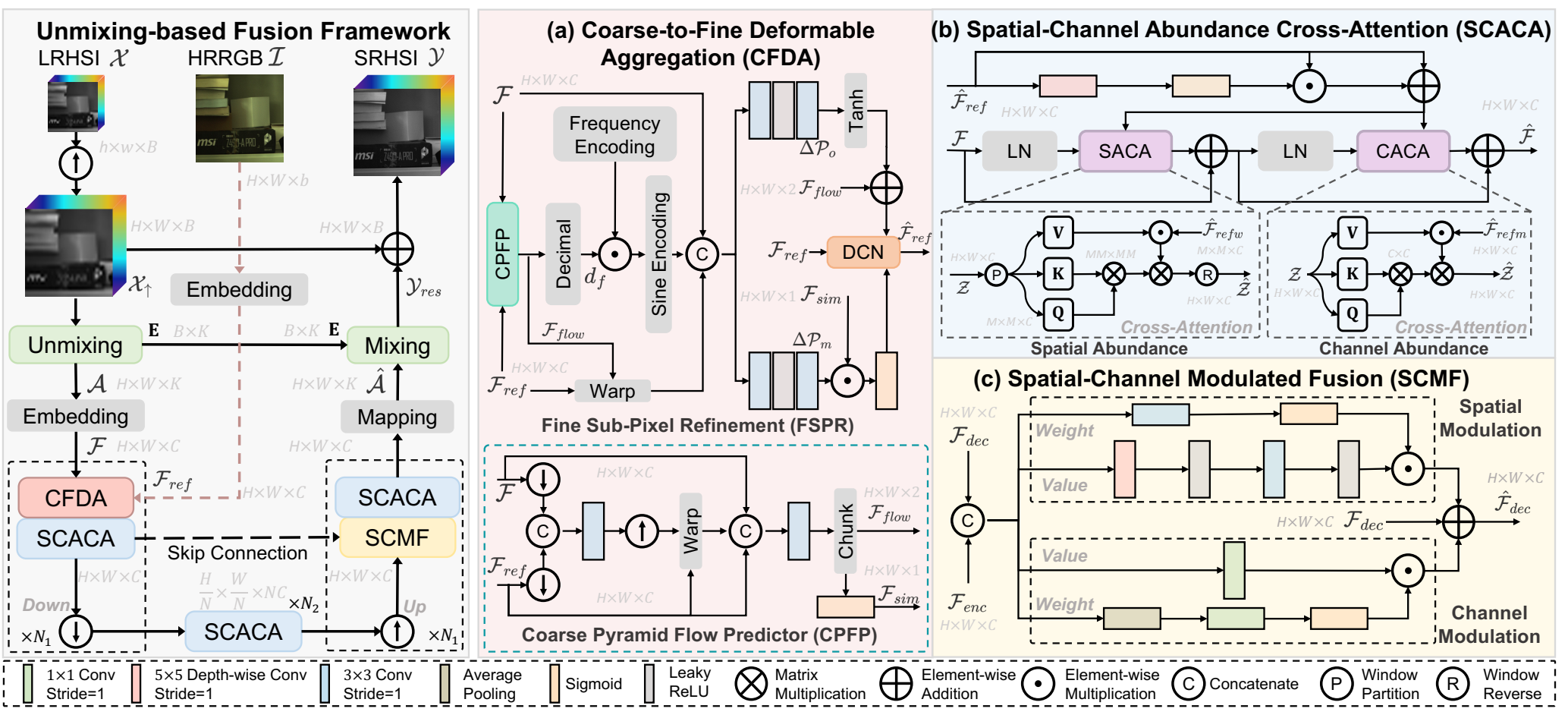
300 dpi PNG · Caption · Source PDF
Original caption, source, and provenance
Fixed source version: CVPR 2026 fixed official PDF
Earliest verified matching figure date (temporal proxy): 2026-03-09
arXiv v1 date: 2026-03-09
Actual drawing date: unknown. See the source record for version checks and temporal-evidence limitations.
Historical PDF · Download citation snapshot · Date evidence · Paper page · Complete screening and version record (Chinese)
Citation threshold evidence: Ying Fu; 11391 citations; snapshot 2026-10-21.
Recorded drawing-tool disclosure: unknown. No tool attribution is inferred from appearance; see the archival disclosure evidence for scope and wording.
Crop bounding box: [58, 70, 554, 296] (PDF points; top-left origin; x0, y0, x1, y1).
Figure 3. The overall architecture. We adopt a multi-scale encoder-decoder based on unmixing with several key modules: (a) Coarse-
to-Fine Deformable Aggregation module, (b) Spatial-Channel Abundance Cross-Attention module, and (c) Spatial-Channel Modulation
Fusion module to super-resolve high-quality HR HSI.
Enhancing Unregistered Hyperspectral Image Super-Resolution via Unmixing-based Abundance Fusion Learning
Venue: CVPR 2026 · Main-conference paper
Figure 2 · PDF page 2 · P149
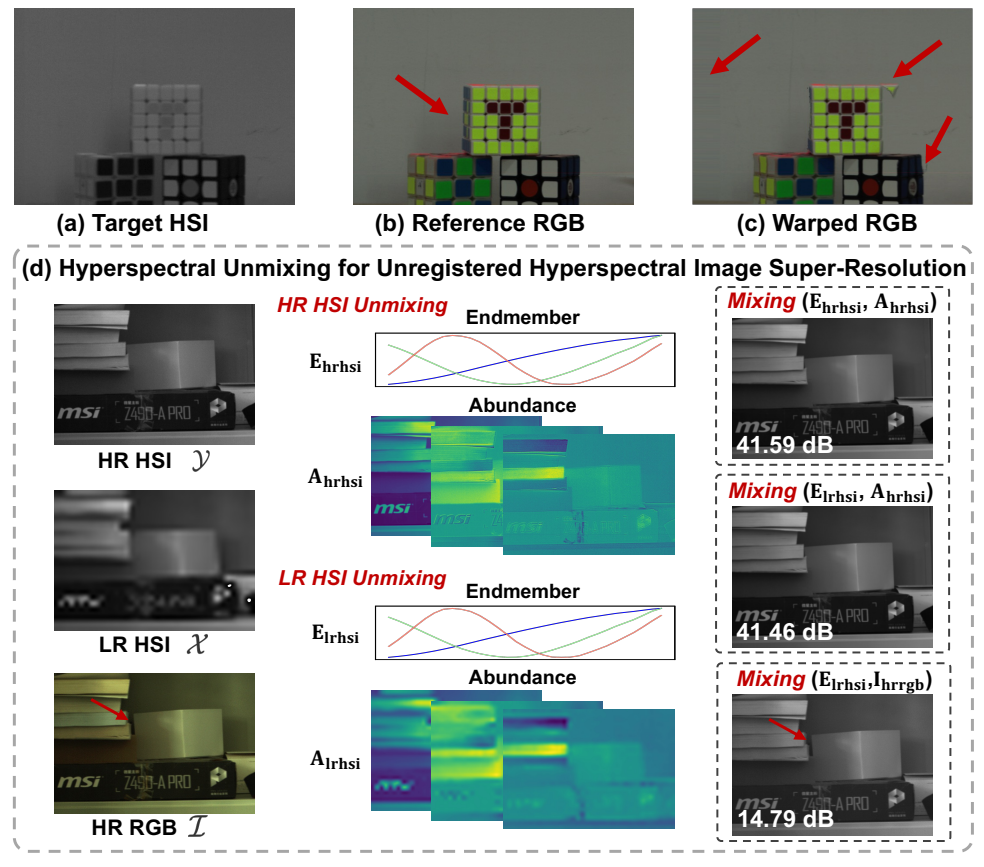
300 dpi PNG · Caption · Source PDF
Original caption, source, and provenance
Fixed source version: CVPR 2026 fixed official PDF
Earliest verified matching figure date (temporal proxy): 2026-03-09
arXiv v1 date: 2026-03-09
Actual drawing date: unknown. See the source record for version checks and temporal-evidence limitations.
Historical PDF · Download citation snapshot · Date evidence · Paper page · Complete screening and version record (Chinese)
Citation threshold evidence: Ying Fu; 11391 citations; snapshot 2026-10-21.
Recorded drawing-tool disclosure: unknown. No tool attribution is inferred from appearance; see the archival disclosure evidence for scope and wording.
Crop bounding box: [58, 70, 294, 278] (PDF points; top-left origin; x0, y0, x1, y1).
Figure 2. The motivation. (c) The explicit alignment within the
SSCH [53] is prone to introducing spatial distortions and textural
artifacts into the warped image. (d) The result validates the princi-
plethatleveragingawell-aligned, high-fidelityabundanceenables
the reconstruction of the HR HSI from its LR counterpart.
FinPercep-RM: A Fine-grained Reward Model and Co-evolutionary Curriculum for RL-based Real-world Super-Resolution
Venue: CVPR 2026 · Main-conference paper
Figure 2 · PDF page 4 · P120
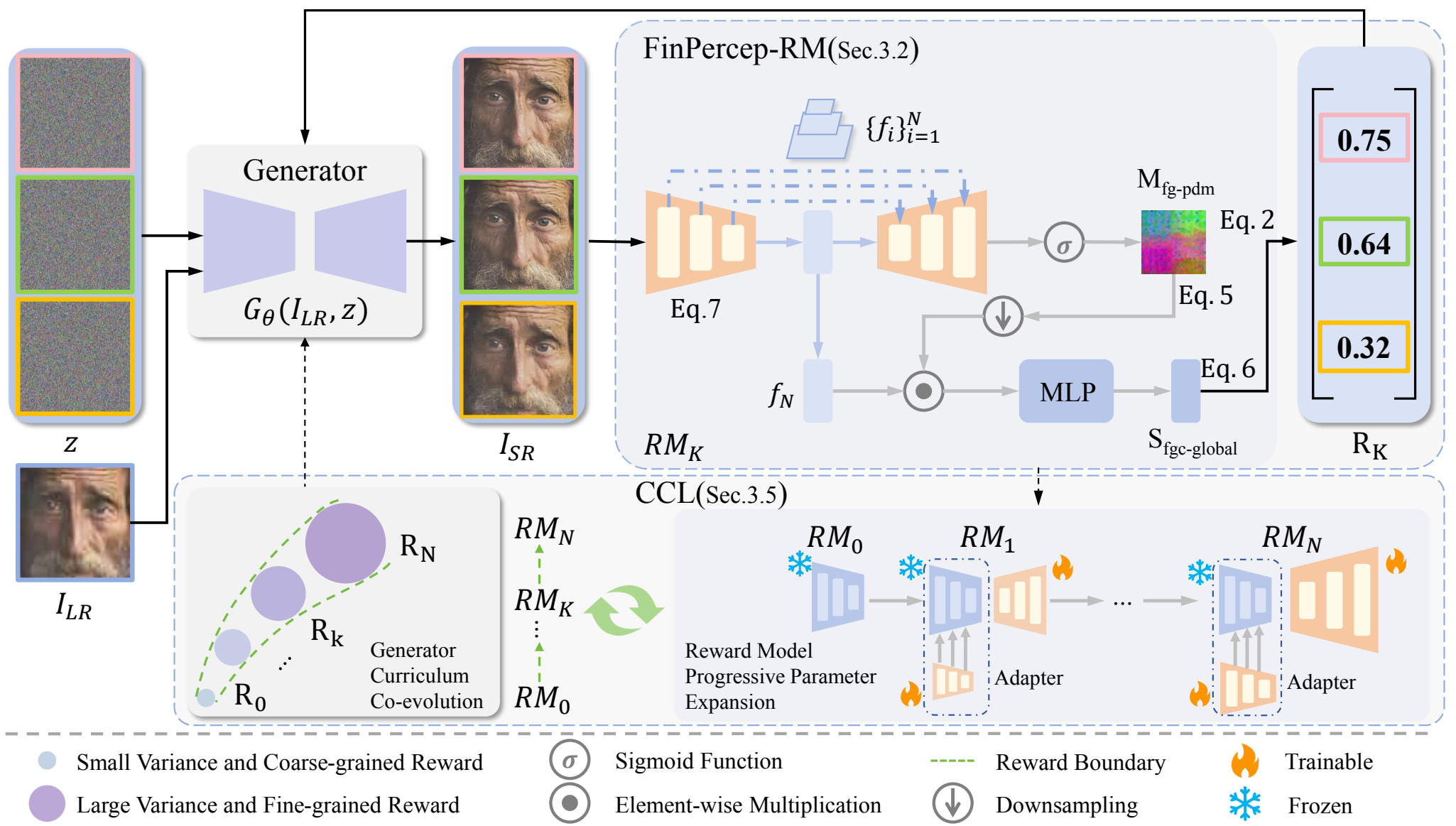
300 dpi PNG · Caption · Source PDF
Original caption, source, and provenance
Fixed source version: CVPR 2026 fixed official PDF
Earliest verified matching figure date (temporal proxy): 2026-04-06
arXiv v1 date: 2025-12-27
Actual drawing date: unknown. See the source record for version checks and temporal-evidence limitations.
Historical PDF · Download citation snapshot · Date evidence · Paper page · Complete screening and version record (Chinese)
Citation threshold evidence: Zheng-Jun Zha; 30479 citations; snapshot 2026-10-21.
Recorded drawing-tool disclosure: unknown. No tool attribution is inferred from appearance; see the archival disclosure evidence for scope and wording.
Crop bounding box: [63, 71, 555, 350] (PDF points; top-left origin; x0, y0, x1, y1).
Figure2. TheoverallpipelineoftheproposedFinPercep-RMandCo-evolutionaryCurriculumLearning(CCL)framework. FinPercep-RM
producesaFine-grainedPerceptualDegradationMapthatcapturesspatiallylocalizeddefectlikelihoodandintensity, andtherewardmodel
is progressively expanded from small-variance, coarse-grained rewards to large-variance, fine-grained signals. During training, under the
CCL mechanism, the Generator first learns with the coarse global reward from RM for a stable and easy initialization, and is then co-
0
evolutionarily guided by increasingly strict RM versions to enhance local fidelity and suppress reward hacking.
k
FinPercep-RM: A Fine-grained Reward Model and Co-evolutionary Curriculum for RL-based Real-world Super-Resolution
Venue: CVPR 2026 · Main-conference paper
Figure 1 · PDF page 1 · P119
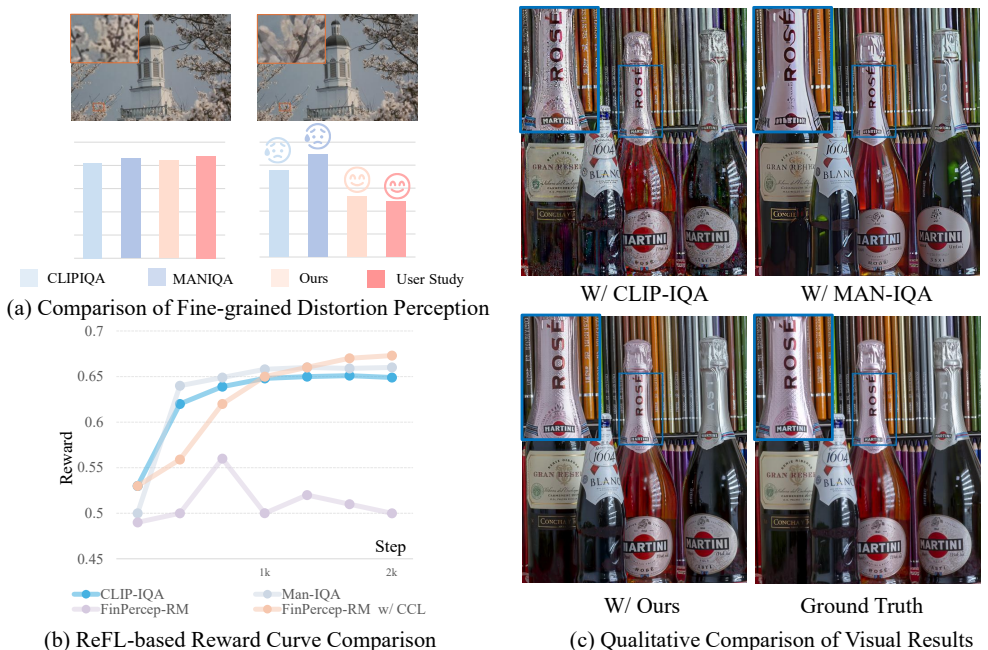
300 dpi PNG · Caption · Source PDF
Original caption, source, and provenance
Fixed source version: CVPR 2026 fixed official PDF
Earliest verified matching figure date (temporal proxy): 2025-12-27
arXiv v1 date: 2025-12-27
Actual drawing date: unknown. See the source record for version checks and temporal-evidence limitations.
Historical PDF · Download citation snapshot · Date evidence · Paper page · Complete screening and version record (Chinese)
Citation threshold evidence: Zheng-Jun Zha; 30479 citations; snapshot 2026-10-21.
Recorded drawing-tool disclosure: unknown. No tool attribution is inferred from appearance; see the archival disclosure evidence for scope and wording.
Crop bounding box: [317, 260, 554, 416] (PDF points; top-left origin; x0, y0, x1, y1).
Figure 1. Motivation for FinPercep-RM and CCL. (a) Standard
IQAs lack fine-grained perception and struggle to penalize lo-
cal distortions, while Ours aligns with human judgment (User
Study). (b) The training curves illustrate the stability-robustness
dilemma: baseline IQA rewards (blue/purple) converge quickly,
while FinPercep-RM (light blue) is oscillatory and unstable. Our
completemethod(FinPercep-RMw/CCL,orange)achievesstable
and optimal convergence. (c) Visualization of Reward Hacking:
baseline rewards (W/ CLIP-IQA, W/ MAN-IQA) produce local
artifacts, whereas our results are faithful to the Ground Truth.
GDPO-SR: Group Direct Preference Optimization for One-Step Generative Image Super-Resolution
Venue: CVPR 2026 · Main-conference paper
Figure 2 · PDF page 4 · P76
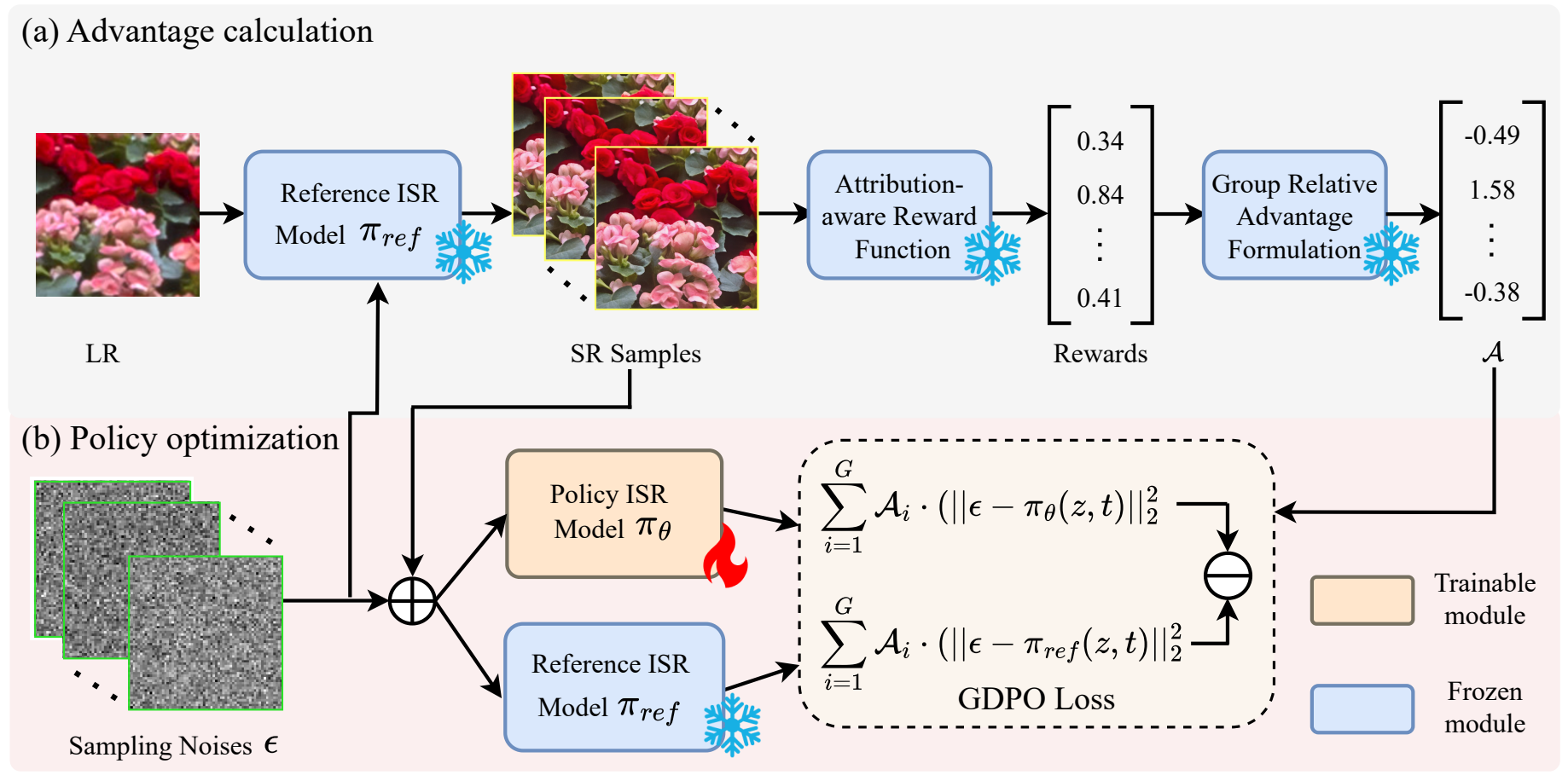
300 dpi PNG · Caption · Source PDF
Original caption, source, and provenance
Fixed source version: CVPR 2026 fixed official PDF
Earliest verified matching figure date (temporal proxy): 2026-03-16
arXiv v1 date: 2026-03-16
Actual drawing date: unknown. See the source record for version checks and temporal-evidence limitations.
Historical PDF · Download citation snapshot · Date evidence · Paper page · Complete screening and version record (Chinese)
Citation threshold evidence: Lei Zhang; 137335 citations; snapshot 2026-10-21.
Recorded drawing-tool disclosure: unknown. No tool attribution is inferred from appearance; see the archival disclosure evidence for scope and wording.
Crop bounding box: [80, 71, 521, 289] (PDF points; top-left origin; x0, y0, x1, y1).
Figure 2. The framework of GDPO, which consists of two core stages: (a) advantage calculation and (b) policy optimization. Firstly, we
employ a pre-trained one-step Real-ISR model as the reference model to generate a group of diverse outputs by injecting different random
noises. Subsequently, we compute the advantage A for each sample by evaluating its reward with our designed attribute-aware reward
functions and converting these rewards into group-relative advantages. In the policy optimization stage, we feed these samples along with
noises into both the policy model and the reference ISR model, and update the parameters of the policy ISR model by minimizing the
proposed GDPO loss, steering it to favor generating high-reward samples.
GDPO-SR: Group Direct Preference Optimization for One-Step Generative Image Super-Resolution
Venue: CVPR 2026 · Main-conference paper
Figure 1 · PDF page 2 · P75
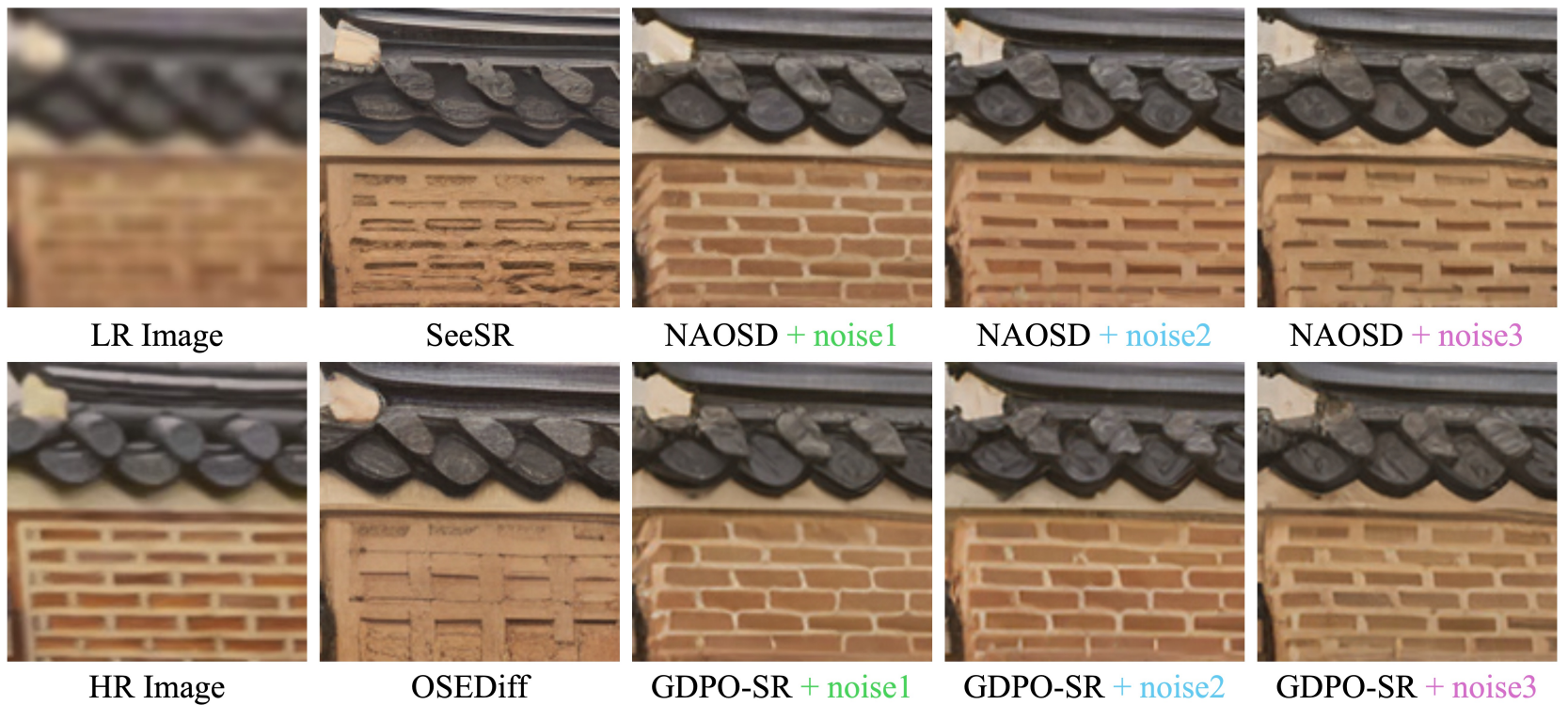
300 dpi PNG · Caption · Source PDF
Original caption, source, and provenance
Fixed source version: CVPR 2026 fixed official PDF
Earliest verified matching figure date (temporal proxy): 2026-03-16
arXiv v1 date: 2026-03-16
Actual drawing date: unknown. See the source record for version checks and temporal-evidence limitations.
Historical PDF · Download citation snapshot · Date evidence · Paper page · Complete screening and version record (Chinese)
Citation threshold evidence: Lei Zhang; 137335 citations; snapshot 2026-10-21.
Recorded drawing-tool disclosure: unknown. No tool attribution is inferred from appearance; see the archival disclosure evidence for scope and wording.
Crop bounding box: [105, 70, 505, 250] (PDF points; top-left origin; x0, y0, x1, y1).
Figure 1. Noise regulates the diversity of generated samples. Different noise inputs yield both high-quality samples (e.g., noise1) and
low-quality ones (e.g., noise2 and noise3). After preference learning, the model produces more visually pleasing results.
One-Step Diffusion Transformer for Controllable Real-World Image Super-Resolution
Venue: CVPR 2026 · Main-conference paper
Figure 3 · PDF page 4 · P200
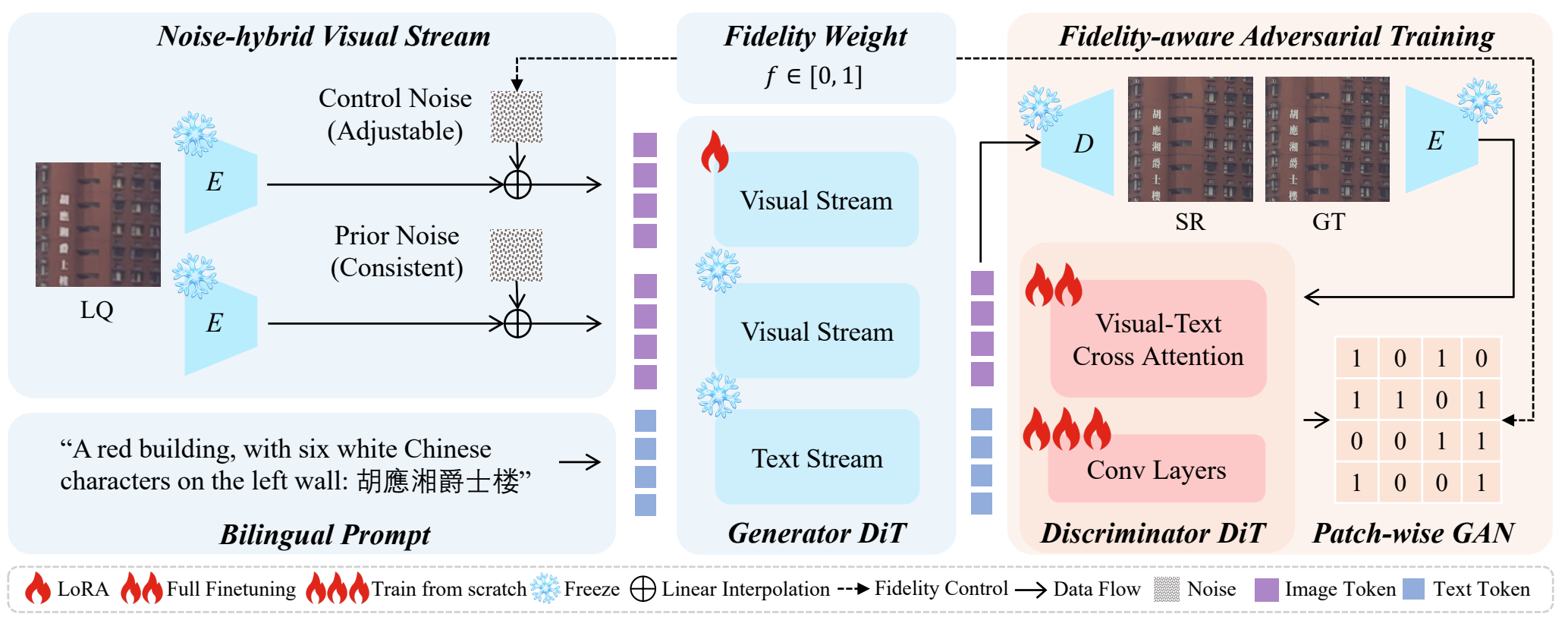
300 dpi PNG · Caption · Source PDF
Original caption, source, and provenance
Fixed source version: CVPR 2026 fixed official PDF
Earliest verified matching figure date (temporal proxy): 2025-11-21
arXiv v1 date: 2025-11-21
Actual drawing date: unknown. See the source record for version checks and temporal-evidence limitations.
Historical PDF · Download citation snapshot · Date evidence · Paper page · Complete screening and version record (Chinese)
Citation threshold evidence: Ya Zhang; 25506 citations; snapshot 2026-10-21.
Recorded drawing-tool disclosure: unknown. No tool attribution is inferred from appearance; see the archival disclosure evidence for scope and wording.
Crop bounding box: [59, 70, 555, 265] (PDF points; top-left origin; x0, y0, x1, y1).
Figure 3. Overall framework. We extend the visual stream into a frozen Prior Noise stream that preserves the pretrained diffusion prior
and a Control Noise stream that adaptively modulates noise based on the Fidelity Weight to restore fine details, forming a Noise-hybrid
Visual Stream. Leveraging the Fidelity Weight to adjust adversarial signals adaptively, Fidelity-aware Adversarial Training enhances
controllability and achieves one-step inference.
One-Step Diffusion Transformer for Controllable Real-World Image Super-Resolution
Venue: CVPR 2026 · Main-conference paper
Figure 2 · PDF page 3 · P199
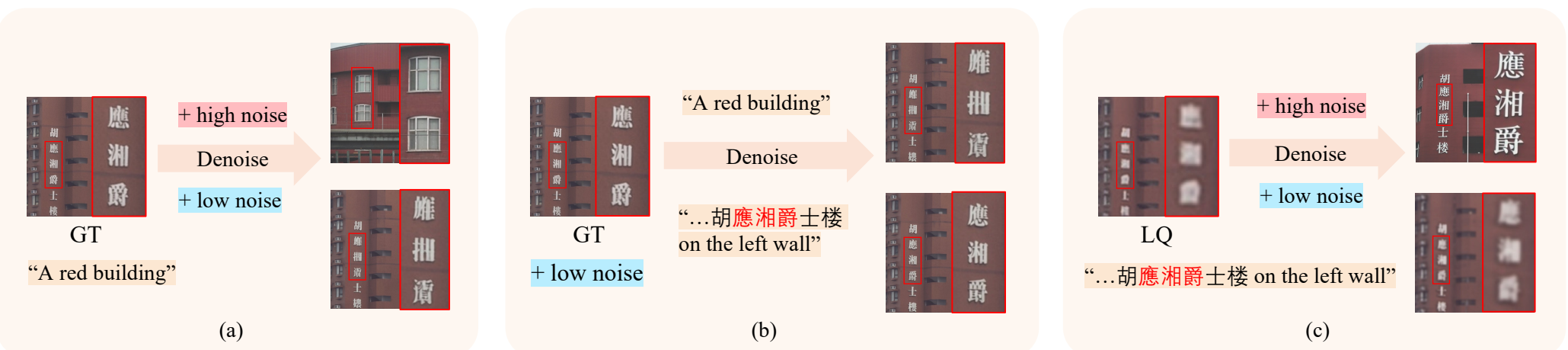
300 dpi PNG · Caption · Source PDF
Original caption, source, and provenance
Fixed source version: CVPR 2026 fixed official PDF
Earliest verified matching figure date (temporal proxy): 2025-11-21
arXiv v1 date: 2025-11-21
Actual drawing date: unknown. See the source record for version checks and temporal-evidence limitations.
Historical PDF · Download citation snapshot · Date evidence · Paper page · Complete screening and version record (Chinese)
Citation threshold evidence: Ya Zhang; 25506 citations; snapshot 2026-10-21.
Recorded drawing-tool disclosure: unknown. No tool attribution is inferred from appearance; see the archival disclosure evidence for scope and wording.
Crop bounding box: [60, 70, 554, 180] (PDF points; top-left origin; x0, y0, x1, y1).
Figure 2. Effects of Noise on Fidelity and Controllability. Based on pretrained Qwen-Image, (a) shows the denoising results of ground-
truth (GT) under the same prompt and different levels of noise. (b) adopts low noise level and different prompts (with Chinese annotation).
(c) studies the effects of noise on LQ with the same prompt. High-noise inputs improve perceptual quality and controllability but reduce
fidelity, whereas low-noise inputs preserve original details yet fail to deliver enhanced super-resolution effects.
RefReward-SR: LR-Conditioned Reward Modeling for Preference-Aligned Super-Resolution
Venue: ECCV 2026 · Main-conference paper
Figure 2 · PDF page 6 · P196
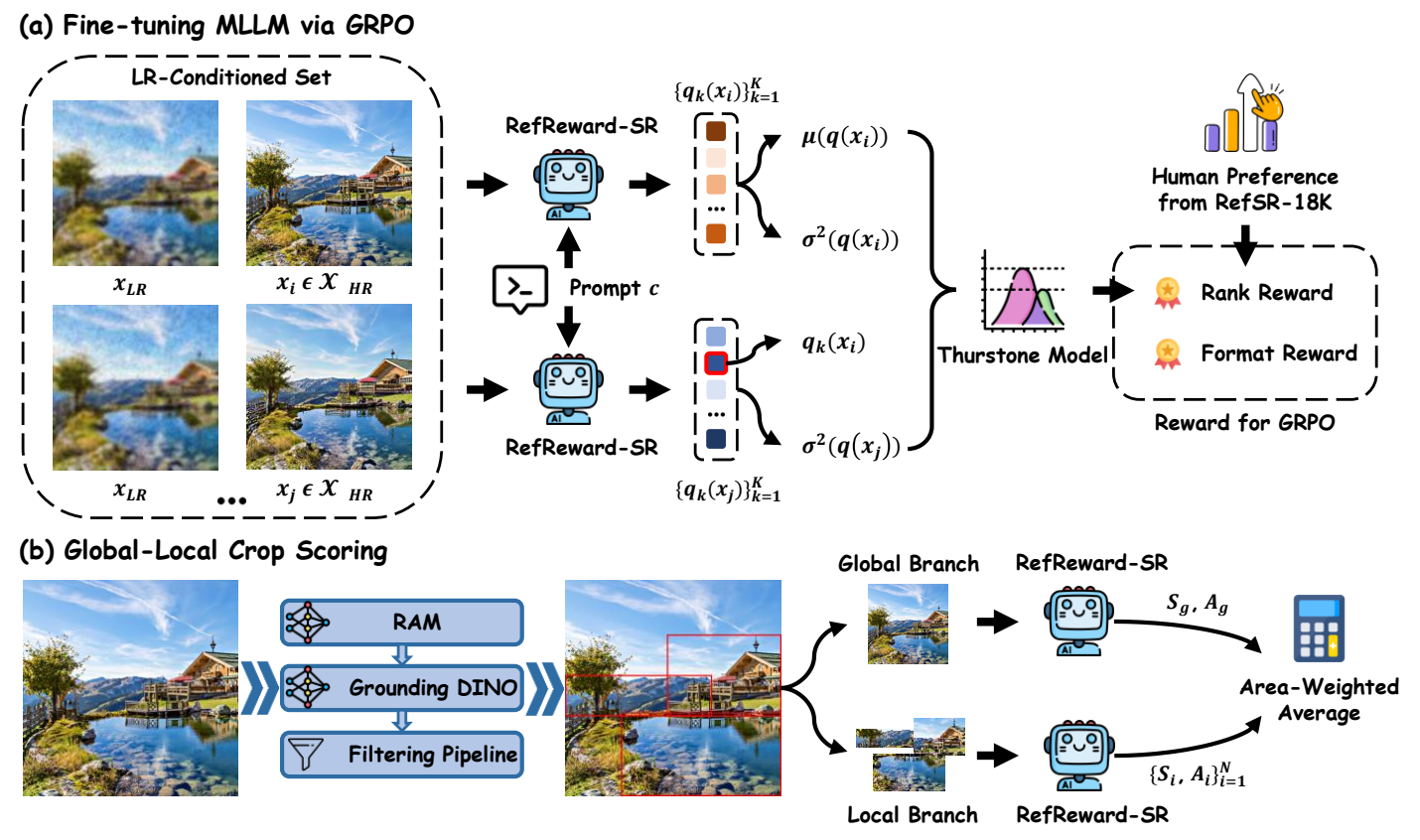
300 dpi PNG · Caption · Source PDF
Original caption, source, and provenance
Fixed source version: ECCV 2026 fixed official PDF
Earliest verified matching figure date (temporal proxy): 2026-03-25
arXiv v1 date: 2026-03-25
Actual drawing date: unknown. See the source record for version checks and temporal-evidence limitations.
Historical PDF · Download citation snapshot · Date evidence · Paper page · Complete screening and version record (Chinese)
Citation threshold evidence: Jing Liu; 22235 citations; snapshot 2026-10-21.
Recorded drawing-tool disclosure: unknown. No tool attribution is inferred from appearance; see the archival disclosure evidence for scope and wording.
Crop bounding box: [135, 116, 478, 319] (PDF points; top-left origin; x0, y0, x1, y1).
Fig. 2: The proposed RefReward-SR framework. (a) MLLM Fine-tuning:
Fine-tuning via GRPO with format and LR-conditioned rank rewards from RefSR-
18K for human preference alignment. (b) Global-Local Crop Scoring: Extracting
representative local crops via RAM and Grounding DINO, then fusing multi-scale
MLLM scores via area-weighted averaging for comprehensive evaluation.
RefReward-SR: LR-Conditioned Reward Modeling for Preference-Aligned Super-Resolution
Venue: ECCV 2026 · Main-conference paper
Figure 1 · PDF page 3 · P195
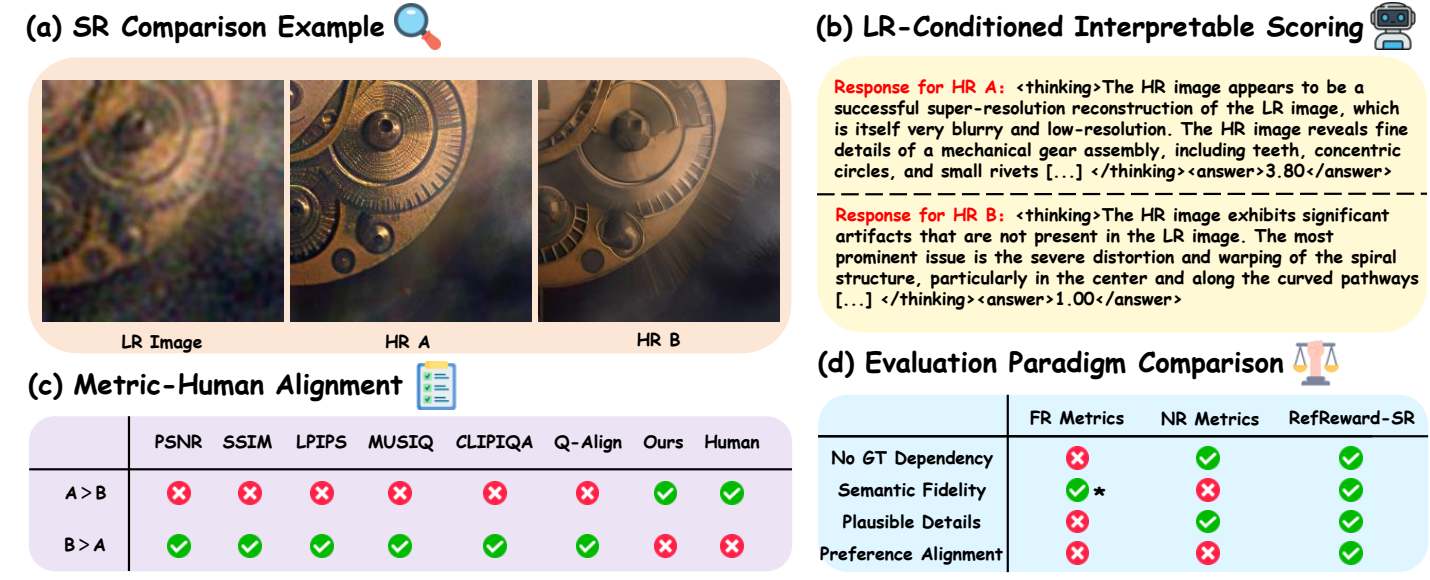
300 dpi PNG · Caption · Source PDF
Original caption, source, and provenance
Fixed source version: ECCV 2026 fixed official PDF
Earliest verified matching figure date (temporal proxy): 2026-03-25
arXiv v1 date: 2026-03-25
Actual drawing date: unknown. See the source record for version checks and temporal-evidence limitations.
Historical PDF · Download citation snapshot · Date evidence · Paper page · Complete screening and version record (Chinese)
Citation threshold evidence: Jing Liu; 22235 citations; snapshot 2026-10-21.
Recorded drawing-tool disclosure: unknown. No tool attribution is inferred from appearance; see the archival disclosure evidence for scope and wording.
Crop bounding box: [135, 116, 478, 255] (PDF points; top-left origin; x0, y0, x1, y1).
Fig. 1: Overview of our proposed evaluation paradigm. (a) HR A preserves structures,
while HR B shows severe distortions. (b) RefReward-SR uses an MLLM for inter-
pretable, LR-conditioned semantic scoring. (c) Existing metrics wrongly favor the dis-
torted HR B, whereas ours aligns with human perception. (d) RefReward-SR uniquely
ensures semantic fidelity and preference alignment without GT dependency. The as-
terisk(*) indicates that FR metrics evaluate high-level semantics only passively via
low-level correspondence.
Residual Diffusion Bridge Model for Image Restoration
Venue: CVPR 2026 · Main-conference paper
Figure 2 · PDF page 3 · P148
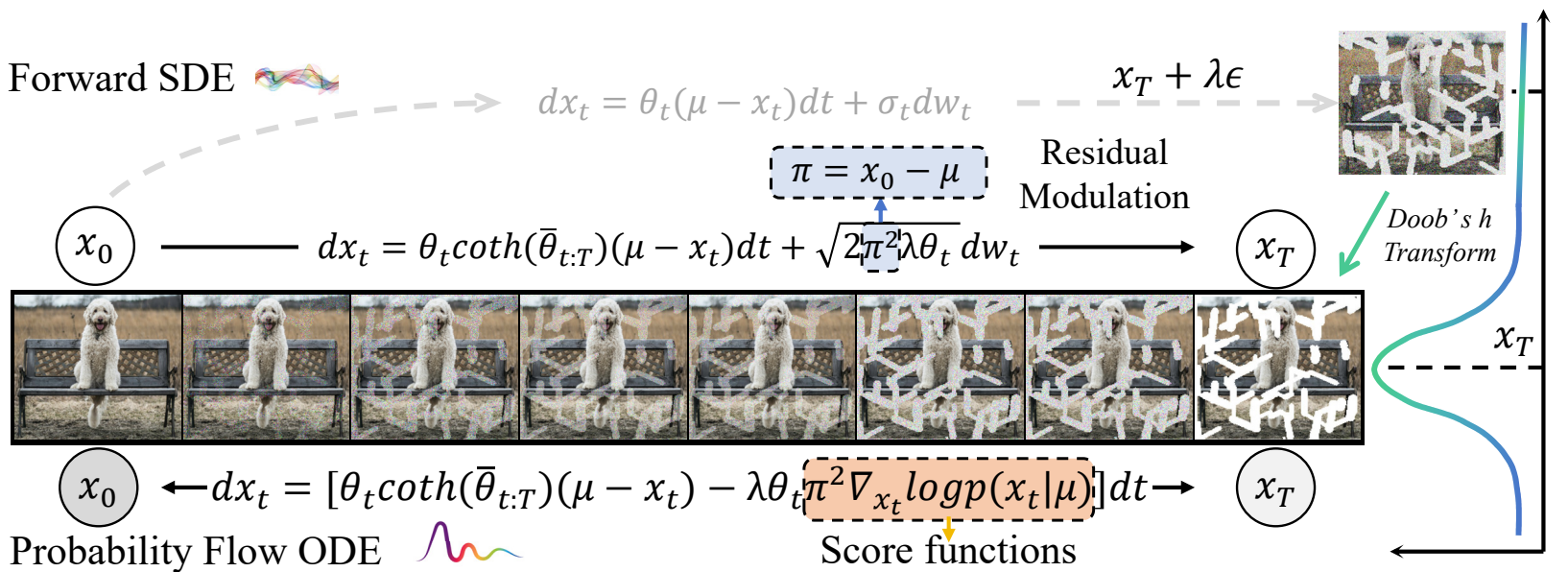
300 dpi PNG · Caption · Source PDF
Original caption, source, and provenance
Fixed source version: CVPR 2026 fixed official PDF
Earliest verified matching figure date (temporal proxy): 2026-04-18
arXiv v1 date: 2025-10-27
Actual drawing date: unknown. See the source record for version checks and temporal-evidence limitations.
Historical PDF · Download citation snapshot · Date evidence · Paper page · Complete screening and version record (Chinese)
Citation threshold evidence: Bo Du; 50901 citations; snapshot 2026-10-21.
Recorded drawing-tool disclosure: unknown. No tool attribution is inferred from appearance; see the archival disclosure evidence for scope and wording.
Crop bounding box: [110, 70, 502, 213] (PDF points; top-left origin; x0, y0, x1, y1).
Figure 2. A schematic of Residual Diffusion Bridge Models. RDBM utilizes a diffusion process guided by Doob’s h-transform towards an endpoint xT = µ free from stationary noise λϵ. Modulated by the residual component π = x0 − xT , the noise perturbation is selectively imposed on different regions with diverse degradation levels, thereby constructing probabilistic paths. Besides, it learns to reverse the process by matching the residual bridge score functions, facilitating an adaptive inversion from xT ∼ pprior(x) to x0 ∼ pdata(x).
Residual Diffusion Bridge Model for Image Restoration
Venue: CVPR 2026 · Main-conference paper
Figure 1 · PDF page 1 · P147
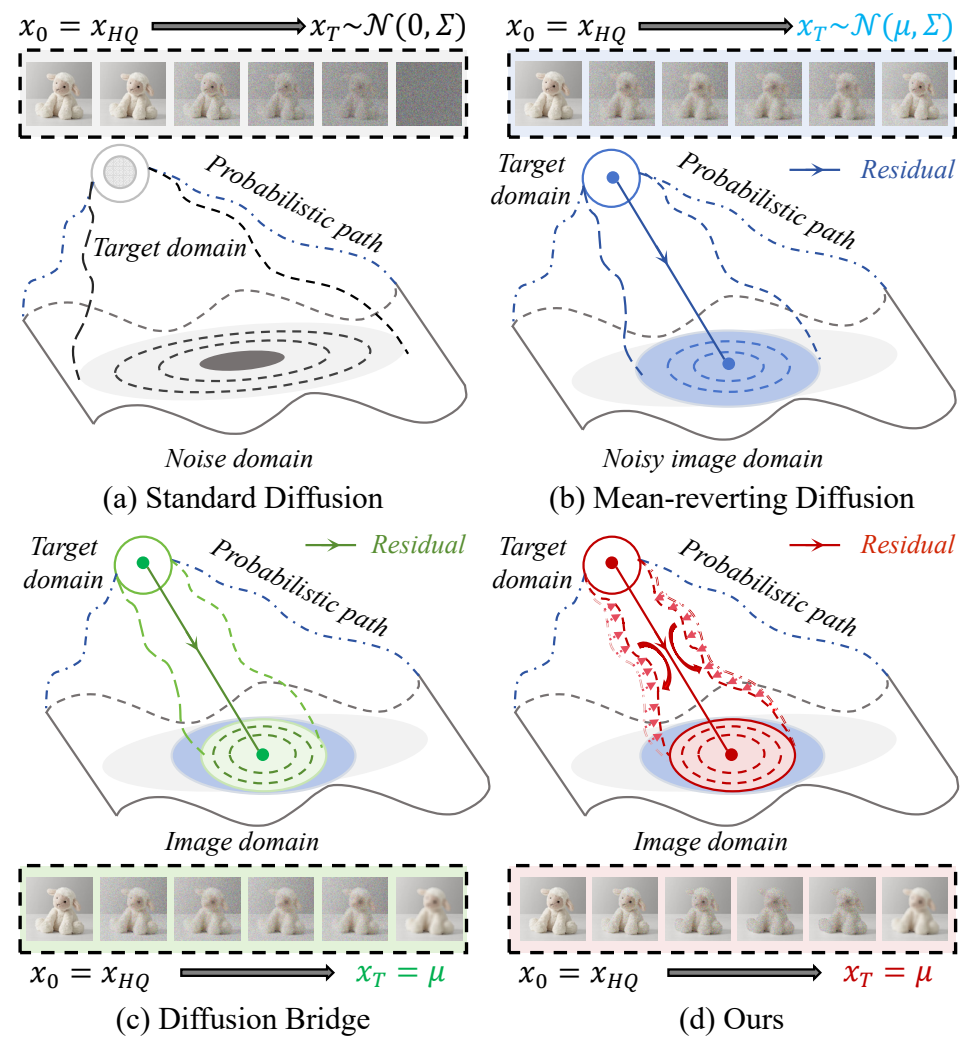
300 dpi PNG · Caption · Source PDF
Original caption, source, and provenance
Fixed source version: CVPR 2026 fixed official PDF
Earliest verified matching figure date (temporal proxy): 2026-04-18
arXiv v1 date: 2025-10-27
Actual drawing date: unknown. See the source record for version checks and temporal-evidence limitations.
Historical PDF · Download citation snapshot · Date evidence · Paper page · Complete screening and version record (Chinese)
Citation threshold evidence: Bo Du; 50901 citations; snapshot 2026-10-21.
Recorded drawing-tool disclosure: unknown. No tool attribution is inferred from appearance; see the archival disclosure evidence for scope and wording.
Crop bounding box: [317, 295, 552, 543.7] (PDF points; top-left origin; x0, y0, x1, y1).
Figure 1. Typical diffusion processes. (a) Standard diffusion maps high-quality images to Gaussian noise domain. (b) Mean-reverting diffusion drives terminal state toward a low-quality domain with stationary noise. (c) Diffusion bridge establishes direct probabilistic transitions between known distributions. All inject noise globally, disrupting overall structures and constraining transitions. (d) In contrast, our RDBM selectively reconstructs degraded regions (e.g., the doll) while preserving intact areas (e.g., the background).
Statistical Characteristic-Guided Denoising for Rapid High-Resolution Transmission Electron Microscopy Imaging
Venue: CVPR 2026 · Main-conference paper
Figure 2 · PDF page 3 · P146
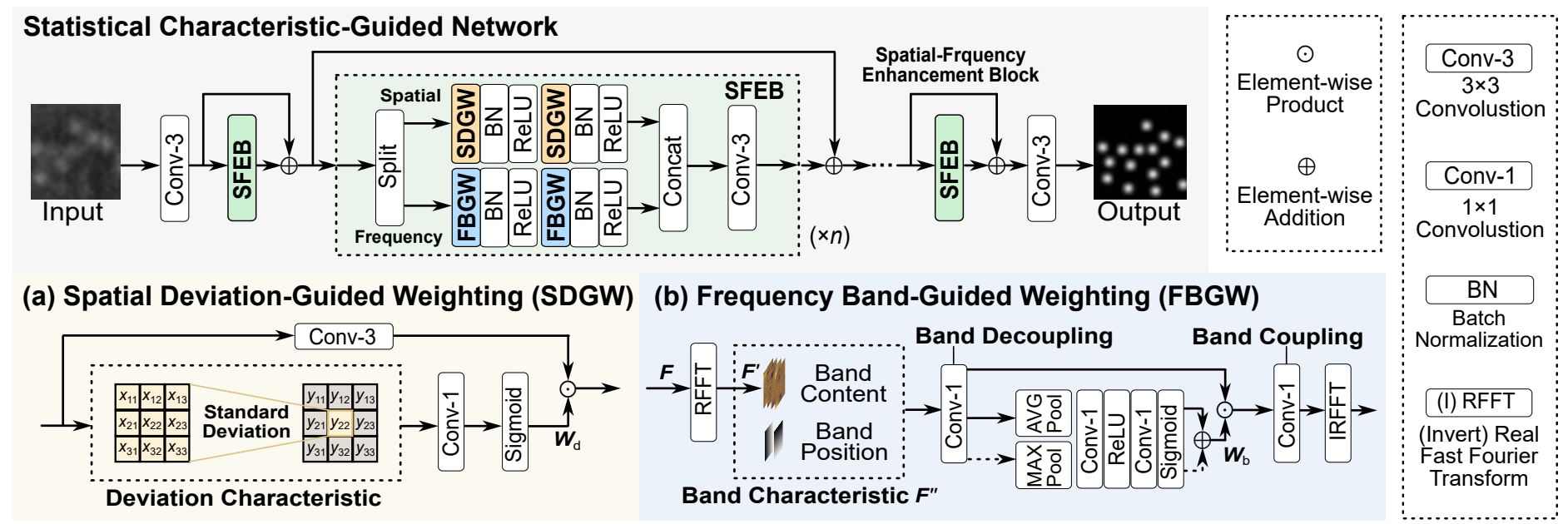
300 dpi PNG · Caption · Source PDF
Original caption, source, and provenance
Fixed source version: CVPR 2026 fixed official PDF
Earliest verified matching figure date (temporal proxy): 2026-03-19
arXiv v1 date: 2026-03-19
Actual drawing date: unknown. See the source record for version checks and temporal-evidence limitations.
Historical PDF · Download citation snapshot · Date evidence · Paper page · Complete screening and version record (Chinese)
Citation threshold evidence: Ying Fu; 11391 citations; snapshot 2026-10-21.
Recorded drawing-tool disclosure: unknown. No tool attribution is inferred from appearance; see the archival disclosure evidence for scope and wording.
Crop bounding box: [70, 70, 522, 221] (PDF points; top-left origin; x0, y0, x1, y1).
Figure 2. The framework of our statistical-characteristic guided network. It enhances signals and suppresses noise in the spatial and
frequency domains using spatial deviation-guided weighting and frequency band-guided weighting, respectively.
Statistical Characteristic-Guided Denoising for Rapid High-Resolution Transmission Electron Microscopy Imaging
Venue: CVPR 2026 · Main-conference paper
Figure 1 · PDF page 2 · P145
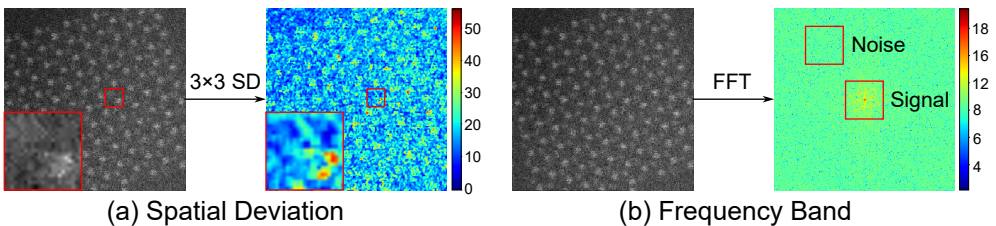
300 dpi PNG · Caption · Source PDF
Original caption, source, and provenance
Fixed source version: CVPR 2026 fixed official PDF
Earliest verified matching figure date (temporal proxy): 2026-03-19
arXiv v1 date: 2026-03-19
Actual drawing date: unknown. See the source record for version checks and temporal-evidence limitations.
Historical PDF · Download citation snapshot · Date evidence · Paper page · Complete screening and version record (Chinese)
Citation threshold evidence: Ying Fu; 11391 citations; snapshot 2026-10-21.
Recorded drawing-tool disclosure: unknown. No tool attribution is inferred from appearance; see the archival disclosure evidence for scope and wording.
Crop bounding box: [308, 70, 547, 124] (PDF points; top-left origin; x0, y0, x1, y1).
Figure 1. Visualization of the two kinds of statistical characteris-
tics that we used to guide the denoising process. (a) The spatial
deviation characteristic obtained by calculating the pixel standard
deviation (SD) within 3 × 3 windows. It reflects the fluctuation
conditions of different spatial positions in the image. (b) The fre-
quencybandcharacteristicobtainedbytheFastFourierTransform
(FFT). Signal and noise are distributed at different frequency band
positions and have different patterns.
TIR-Agent: Training an Explorative and Efficient Agent for Image Restoration
Venue: ECCV 2026 · Main-conference paper
Figure 3 · PDF page 6 · P80
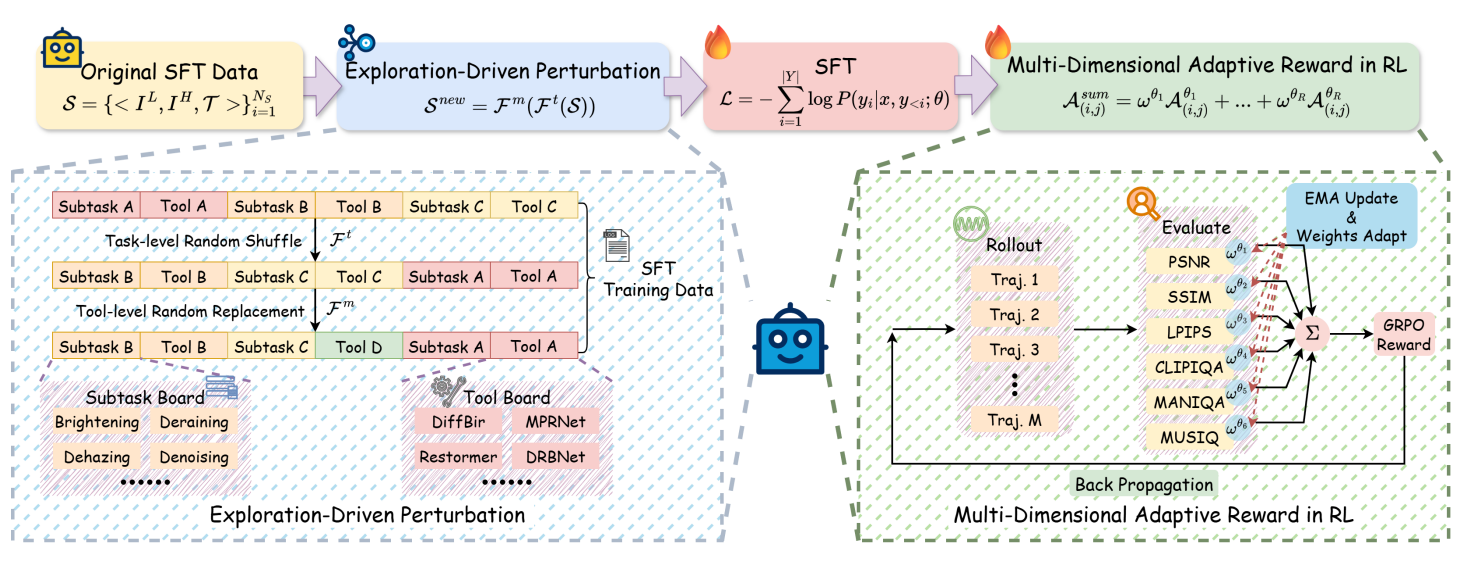
300 dpi PNG · Caption · Source PDF
Original caption, source, and provenance
Fixed source version: ECCV 2026 fixed official PDF
Earliest verified matching figure date (temporal proxy): 2026-03-29
arXiv v1 date: 2026-03-29
Actual drawing date: unknown. See the source record for version checks and temporal-evidence limitations.
Historical PDF · Download citation snapshot · Date evidence · Paper page · Complete screening and version record (Chinese)
Citation threshold evidence: Bowen Zhou; 32977 citations; snapshot 2026-10-21.
Recorded drawing-tool disclosure: unknown. No tool attribution is inferred from appearance; see the archival disclosure evidence for scope and wording.
Crop bounding box: [132, 112, 484, 248] (PDF points; top-left origin; x0, y0, x1, y1).
Fig.3: Training pipeline of TIR-Agent. The process begins with SFT Data Gen-
eration, followed by Exploration-Driven Perturbation to enhance data diversity
via shuffled task sequences and tool substitutions. Following SFT, the agent undergoes
RL with a Multi-Dimensional Adaptive Reward mechanism, which dynamically
balances metric weights based on their EMA trends to optimize the restoration policy.
TIR-Agent: Training an Explorative and Efficient Agent for Image Restoration
Venue: ECCV 2026 · Main-conference paper
Figure 1 · PDF page 2 · P79
300 dpi PNG · Caption · Source PDF
Original caption, source, and provenance
Fixed source version: ECCV 2026 fixed official PDF
Earliest verified matching figure date (temporal proxy): 2026-03-29
arXiv v1 date: 2026-03-29
Actual drawing date: unknown. See the source record for version checks and temporal-evidence limitations.
Historical PDF · Download citation snapshot · Date evidence · Paper page · Complete screening and version record (Chinese)
Citation threshold evidence: Bowen Zhou; 32977 citations; snapshot 2026-10-21.
Recorded drawing-tool disclosure: unknown. No tool attribution is inferred from appearance; see the archival disclosure evidence for scope and wording.
Crop bounding box: [134, 113, 482, 332] (PDF points; top-left origin; x0, y0, x1, y1).
Fig.1: Comparison of restoration paradigms. (a) All-in-one model: Uses
a single network with specialized heads to inject various degradation features. (b)
Training-free Agent: Uses VLMs for static task planning, executing sub-tasks se-
quentially via exhaustive tool traversal. (c) TIR-Agent (Ours): A trainable agent
that dynamically decides the next sub-task based on current results and learns to di-
rectly select the optimal tool, avoiding redundant execution.
UARE: A Unified Vision-Language Model for Image Quality Assessment, Restoration, and Enhancement
Venue: CVPR 2026 · Main-conference paper
Figure 2 · PDF page 3 · P38
300 dpi PNG · Caption · Source PDF
Original caption, source, and provenance
Fixed source version: CVPR 2026 fixed official PDF
Earliest verified matching figure date (temporal proxy): 2025-12-07
arXiv v1 date: 2025-12-07
Actual drawing date: unknown. See the source record for version checks and temporal-evidence limitations.
Historical PDF · Download citation snapshot · Date evidence · Complete screening and version record (Chinese)
Citation threshold evidence: Jian Zhang; 21725 citations; snapshot 2026-10-21.
Recorded drawing-tool disclosure: unknown. No tool attribution is inferred from appearance; see the archival disclosure evidence for scope and wording.
Crop bounding box: [58, 71, 554, 338] (PDF points; top-left origin; x0, y0, x1, y1).
Figure2. Illustrationofthearchitectureandtwo-stagetrainingframeworkofUARE.TwotransformerexpertsareusedtoprocessIQA
and restoration, respectively. Training stages include (1) a progressive, easy-to-hard schedule that moves from single-type to high-order
degradations. In this stage, only the restoration expert is trained to make UARE handle multiple degradations. (2) Unified fine-tuning of
the entire model to strengthen the IQA ability and align the IQA signals with restoration objectives through interleaved data.
UARE: A Unified Vision-Language Model for Image Quality Assessment, Restoration, and Enhancement
Venue: CVPR 2026 · Main-conference paper
Figure 1 · PDF page 1 · P37
300 dpi PNG · Caption · Source PDF
Original caption, source, and provenance
Fixed source version: CVPR 2026 fixed official PDF
Earliest verified matching figure date (temporal proxy): 2025-12-07
arXiv v1 date: 2025-12-07
Actual drawing date: unknown. See the source record for version checks and temporal-evidence limitations.
Historical PDF · Download citation snapshot · Date evidence · Complete screening and version record (Chinese)
Citation threshold evidence: Jian Zhang; 21725 citations; snapshot 2026-10-21.
Recorded drawing-tool disclosure: unknown. No tool attribution is inferred from appearance; see the archival disclosure evidence for scope and wording.
Crop bounding box: [58, 237, 554, 528] (PDF points; top-left origin; x0, y0, x1, y1).
Figure 1. Showcase of UARE. It supports image quality assessment (image scoring and comparison), image restoration/enhancement
(super-resolution, dehazing, and low-light enhancement, etc.), and assessment-guided restoration and enhancement in one unified model.
CUPID: Generative 3D Reconstruction via Joint Object and Pose Modeling
Venue: CVPR 2026 · Main-conference paper
Figure 3 · PDF page 4 · P158
300 dpi PNG · Caption · Source PDF
Original caption, source, and provenance
Fixed source version: CVPR 2026 fixed official PDF
Earliest verified matching figure date (temporal proxy): 2025-10-23
arXiv v1 date: 2025-10-23
Actual drawing date: unknown. See the source record for version checks and temporal-evidence limitations.
Historical PDF · Download citation snapshot · Date evidence · Paper page · Complete screening and version record (Chinese)
Citation threshold evidence: Shenghua Gao; 29917 citations; snapshot 2026-10-21.
Recorded drawing-tool disclosure: unknown. No tool attribution is inferred from appearance; see the archival disclosure evidence for scope and wording.
Crop bounding box: [58, 70, 554, 253] (PDF points; top-left origin; x0, y0, x1, y1).
Figure 3. Overview of CUPID’s pipeline. From a single input image, CUPID first generates an occupancy and a UV cube in canonical
space. Then, a Perspective-n-Point (PnP) solver (i.e., Eq. 2) recovers the camera pose. Using this recovered camera pose, we extract pose-
aligned conditioning latents and visual features (i.e., Eq. 3), along with noisy structured latents, to generate the geometry and appearance
features, which will be decoded to the 3D Gaussian splats and mesh.
CUPID: Generative 3D Reconstruction via Joint Object and Pose Modeling
Venue: CVPR 2026 · Main-conference paper
Figure 1 · PDF page 1 · P157
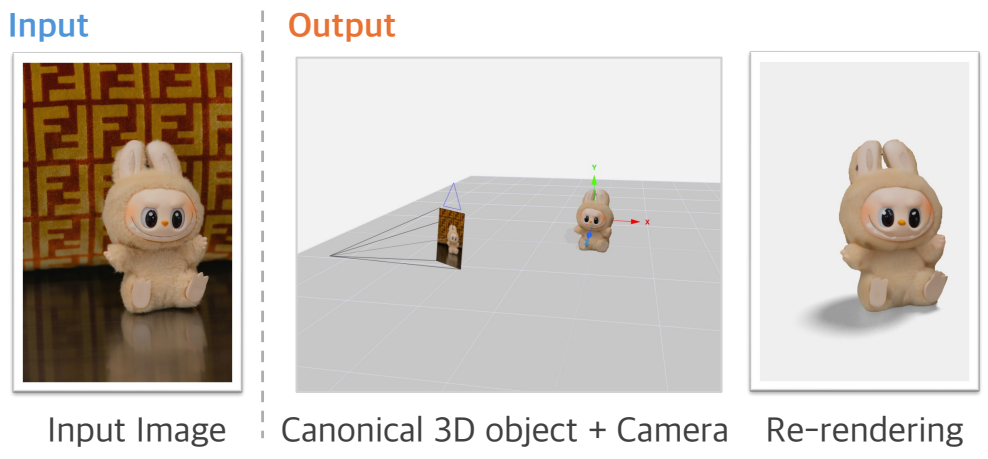
300 dpi PNG · Caption · Source PDF
Original caption, source, and provenance
Fixed source version: CVPR 2026 fixed official PDF
Earliest verified matching figure date (temporal proxy): 2025-11-24
arXiv v1 date: 2025-10-23
Actual drawing date: unknown. See the source record for version checks and temporal-evidence limitations.
Historical PDF · Download citation snapshot · Date evidence · Paper page · Complete screening and version record (Chinese)
Citation threshold evidence: Shenghua Gao; 29917 citations; snapshot 2026-10-21.
Recorded drawing-tool disclosure: unknown. No tool attribution is inferred from appearance; see the archival disclosure evidence for scope and wording.
Crop bounding box: [317, 228, 554, 338] (PDF points; top-left origin; x0, y0, x1, y1).
Figure 1. Generative 3D reconstruction from a single image.
Left: Input image. Middle: Our method recovers a canonical 3D
model (intrinsic properties such as shape and texture) along with
theexactcamerapose(extrinsicproperty)thatgeneratedtheinput.
Right: Re-rendering the 3D model from the estimated pose faith-
fully reproduces the input.
E-RayZer: Self-supervised 3D Reconstruction as Spatial Visual Pre-training
Venue: CVPR 2026 · Main-conference paper
Figure 2 · PDF page 4 · P188
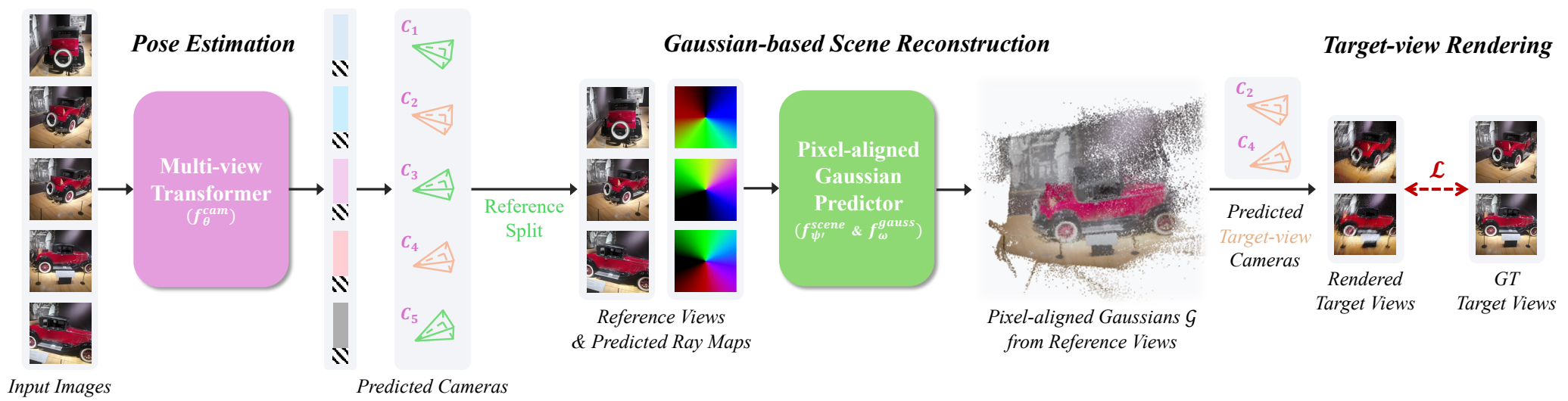
300 dpi PNG · Caption · Source PDF
Original caption, source, and provenance
Fixed source version: CVPR 2026 fixed official PDF
Earliest verified matching figure date (temporal proxy): 2025-12-11
arXiv v1 date: 2025-12-11
Actual drawing date: unknown. See the source record for version checks and temporal-evidence limitations.
Historical PDF · Download citation snapshot · Date evidence · Paper page · Complete screening and version record (Chinese)
Citation threshold evidence: Shubham Tulsiani; 13507 citations; snapshot 2026-10-21.
Recorded drawing-tool disclosure: unknown. No tool attribution is inferred from appearance; see the archival disclosure evidence for scope and wording.
Crop bounding box: [58, 70, 555, 197] (PDF points; top-left origin; x0, y0, x1, y1).
Figure 2. E-RayZer Model & Training. E-RayZer first predicts camera poses and intrinsics for all images. Then it follows RayZer [25] to
split images into two sets. E-RayZer predicts explicit 3D Gaussians as scene representation from the reference views (I ), and renders the
ref
scene using self-predicted target-view (I ) cameras. Finally, E-RayZer is trained with self-supervised photometric losses on target views.
tgt
E-RayZer: Self-supervised 3D Reconstruction as Spatial Visual Pre-training
Venue: CVPR 2026 · Main-conference paper
Figure 3 · PDF page 5 · P187
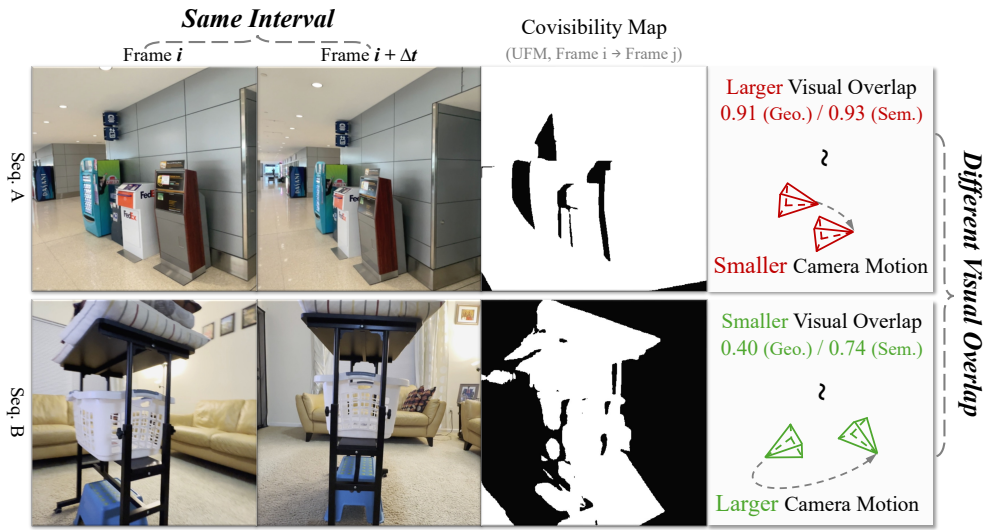
300 dpi PNG · Caption · Source PDF
Original caption, source, and provenance
Fixed source version: CVPR 2026 fixed official PDF
Earliest verified matching figure date (temporal proxy): 2025-12-11
arXiv v1 date: 2025-12-11
Actual drawing date: unknown. See the source record for version checks and temporal-evidence limitations.
Historical PDF · Download citation snapshot · Date evidence · Paper page · Complete screening and version record (Chinese)
Citation threshold evidence: Shubham Tulsiani; 13507 citations; snapshot 2026-10-21.
Recorded drawing-tool disclosure: unknown. No tool attribution is inferred from appearance; see the archival disclosure evidence for scope and wording.
Crop bounding box: [58, 70, 296, 197] (PDF points; top-left origin; x0, y0, x1, y1).
Figure 3. Different Visual Overlaps under the Same Frame In-
terval. Two sequences from DL3DV [34] share the same frame in-
terval yet exhibit drastically different levels of visual overlap. Our
proposed semantic and geometric overlap metrics more accurately
capture the true difficulty (or camera motion) of each sequence.
EMGauss: Continuous Slice-to-3D Reconstruction via Dynamic Gaussian Modeling in Volume Electron Microscopy
Venue: CVPR 2026 · Main-conference paper
Figure 2 · PDF page 3 · P186
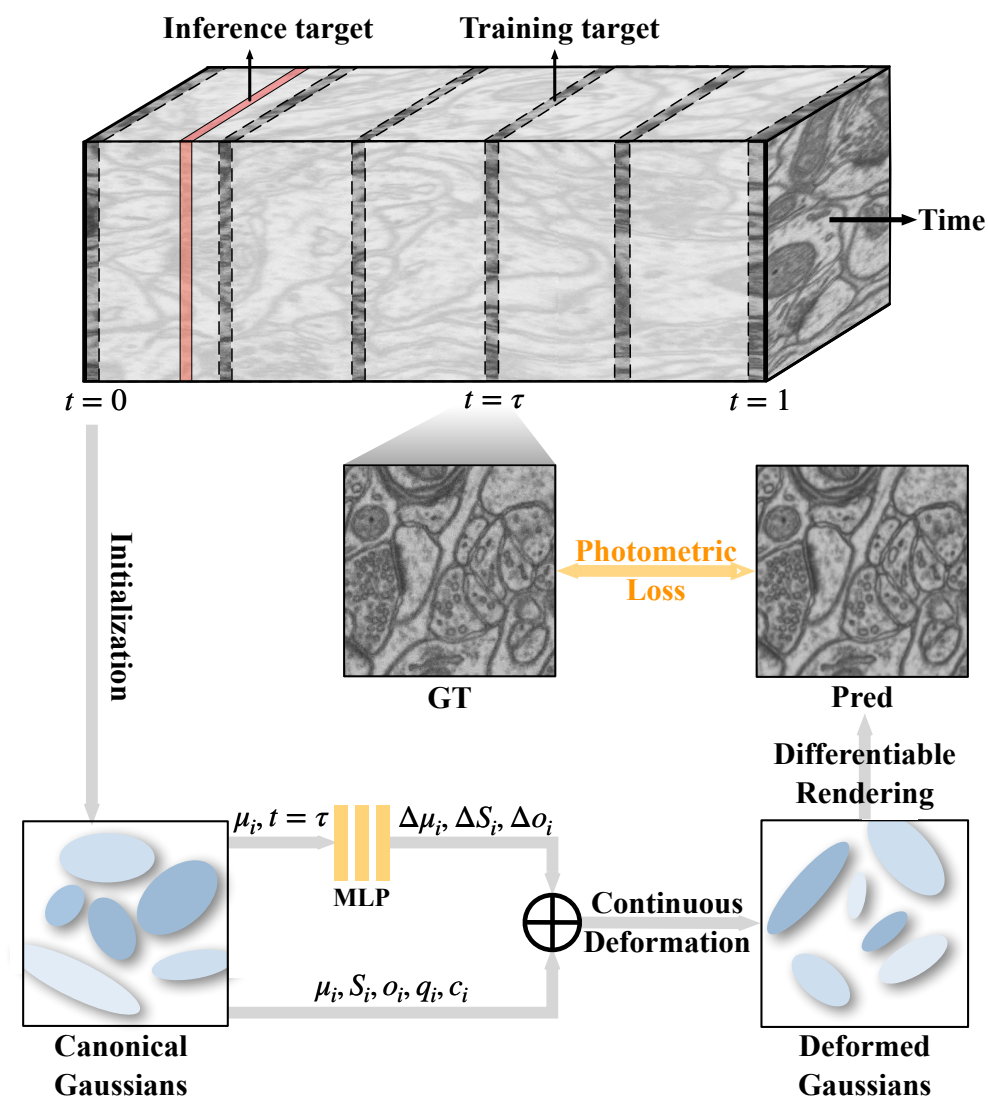
300 dpi PNG · Caption · Source PDF
Original caption, source, and provenance
Fixed source version: CVPR 2026 fixed official PDF
Earliest verified matching figure date (temporal proxy): 2026-03-13
arXiv v1 date: 2025-12-07
Actual drawing date: unknown. See the source record for version checks and temporal-evidence limitations.
Historical PDF · Download citation snapshot · Date evidence · Paper page · Complete screening and version record (Chinese)
Citation threshold evidence: Xiaokang Yang; 50795 citations; snapshot 2026-10-21.
Recorded drawing-tool disclosure: unknown. No tool attribution is inferred from appearance; see the archival disclosure evidence for scope and wording.
Crop bounding box: [317, 70, 554, 336] (PDF points; top-left origin; x0, y0, x1, y1).
Figure 2. Overview of the pipeline of EMGauss. Given a vol-
ume EM dataset (top), the gray-shaded regions denote the miss-
ing intermediate slices to be interpolated, while the visible regions
represent the available anisotropic training data. We interpret the
low-resolution z -axis as a temporal dimension and employ a de-
formable 2D Gaussian splatting representation to model the ge-
ometric evolution of 2D structures along depth. During inference,
the model synthesizes the target slice by directly conditioning on
the relative temporal coordinate corresponding to the desired in-
terpolation position.
EMGauss: Continuous Slice-to-3D Reconstruction via Dynamic Gaussian Modeling in Volume Electron Microscopy
Venue: CVPR 2026 · Main-conference paper
Figure 1 · PDF page 2 · P185
300 dpi PNG · Caption · Source PDF
Original caption, source, and provenance
Fixed source version: CVPR 2026 fixed official PDF
Earliest verified matching figure date (temporal proxy): 2026-03-13
arXiv v1 date: 2025-12-07
Actual drawing date: unknown. See the source record for version checks and temporal-evidence limitations.
Historical PDF · Download citation snapshot · Date evidence · Paper page · Complete screening and version record (Chinese)
Citation threshold evidence: Xiaokang Yang; 50795 citations; snapshot 2026-10-21.
Recorded drawing-tool disclosure: unknown. No tool attribution is inferred from appearance; see the archival disclosure evidence for scope and wording.
Crop bounding box: [58, 70, 298, 309] (PDF points; top-left origin; x0, y0, x1, y1).
Figure 1. Different paradigms of isotropic reconstruction from
anisotropic datasets. Existing approaches typically extract vol-
ume features from abundant xy-plane images. After stacking
anisotropic slices along the z-axis (top), they: (a) Video inter-
polation along the z-axis: models are trained along the x or y
direction, where adjacent frames are input to synthesize the inter-
mediate frame; during inference, the trained model is repurposed
to interpolate along the z-axis, generating intermediate slices cor-
responding to continuous temporal coordinates (τ ∈ [0, 1]). (b)
Image super-resolution on xz/yz planes: Since the xy-plane im-
ages are of much higher resolution, a low-resolution counterpart
can be generated either by manual downsampling [21] or by learn-
ing a degradation model [6], forming paired HR–LR supervision
for training; during inference, the resulting super-resolution model
is then applied along the z-axis to enhance xz/yz slices. Both
paradigms implicitly assume spatial isotropy. In contrast, our
method directly performs inference in continuous 3D space, with-
out relying on such isotropic assumptions.
From None to All: Self-Supervised 3D Reconstruction via Novel View Synthesis
Venue: CVPR 2026 · Main-conference paper
Figure 2 · PDF page 4 · P184
300 dpi PNG · Caption · Source PDF
Original caption, source, and provenance
Fixed source version: CVPR 2026 fixed official PDF
Earliest verified matching figure date (temporal proxy): 2026-03-29
arXiv v1 date: 2026-03-29
Actual drawing date: unknown. See the source record for version checks and temporal-evidence limitations.
Historical PDF · Download citation snapshot · Date evidence · Paper page · Complete screening and version record (Chinese)
Citation threshold evidence: Krystian Mikolajczyk; 49785 citations; snapshot 2026-10-21.
Recorded drawing-tool disclosure: unknown. No tool attribution is inferred from appearance; see the archival disclosure evidence for scope and wording.
Crop bounding box: [58, 70, 554, 196] (PDF points; top-left origin; x0, y0, x1, y1).
Figure 2. Training pipeline of NAS3R. Subscripts “C ” and “T ” denote context and target views, respectively. Unconstrained images are
patchified into visual tokens and concatenated with a learnable camera token for camera prediction. A masked decoder regulates cross-view
interactions and prevents target-to-context leakage. Refined context tokens are then processed by the Gaussian head to predict Gaussian
parameters, while a depth head estimates depth maps that are lifted into 3D Gaussian centers using the predicted context poses. The
predicted target poses are finally used to render novel views, providing photometric supervision for end-to-end training.
From None to All: Self-Supervised 3D Reconstruction via Novel View Synthesis
Venue: CVPR 2026 · Main-conference paper
Figure 1 · PDF page 1 · P183
300 dpi PNG · Caption · Source PDF
Original caption, source, and provenance
Fixed source version: CVPR 2026 fixed official PDF
Earliest verified matching figure date (temporal proxy): 2026-03-29
arXiv v1 date: 2026-03-29
Actual drawing date: unknown. See the source record for version checks and temporal-evidence limitations.
Historical PDF · Download citation snapshot · Date evidence · Paper page · Complete screening and version record (Chinese)
Citation threshold evidence: Krystian Mikolajczyk; 49785 citations; snapshot 2026-10-21.
Recorded drawing-tool disclosure: unknown. No tool attribution is inferred from appearance; see the archival disclosure evidence for scope and wording.
Crop bounding box: [58, 214, 554, 403] (PDF points; top-left origin; x0, y0, x1, y1).
Figure 1. NAS3R is a self-supervised framework that requires no ground-truth annotations and no pretrained priors during training, and
jointly infers 3D Gassian parameters, camera intrinsics and extrinsics and depth maps, also enabling high-quality novel view synthesis.
G$^2$VLM: Geometry Grounded Vision Language Model with Unified 3D Reconstruction and Spatial Reasoning
Venue: CVPR 2026 · Main-conference paper
Figure 3 · PDF page 3 · P190
300 dpi PNG · Caption · Source PDF
Original caption, source, and provenance
Fixed source version: CVPR 2026 fixed official PDF
Earliest verified matching figure date (temporal proxy): 2025-11-26
arXiv v1 date: 2025-11-26
Actual drawing date: unknown. See the source record for version checks and temporal-evidence limitations.
Historical PDF · Download citation snapshot · Date evidence · Paper page · Complete screening and version record (Chinese)
Citation threshold evidence: Jiangmiao Pang; 26222 citations; snapshot 2026-10-21.
Recorded drawing-tool disclosure: unknown. No tool attribution is inferred from appearance; see the archival disclosure evidence for scope and wording.
Crop bounding box: [58, 70, 555, 274] (PDF points; top-left origin; x0, y0, x1, y1).
Figure 3. We present G²VLM, a unified model that integrates both a geometric perception expert for 3D reconstruction and a semantic
perception expert for multimodal understanding and spatial reasoning tasks. All tokens can do shared multi-modal self attention in each
transformer block.
G$^2$VLM: Geometry Grounded Vision Language Model with Unified 3D Reconstruction and Spatial Reasoning
Venue: CVPR 2026 · Main-conference paper
Figure 1 · PDF page 1 · P189
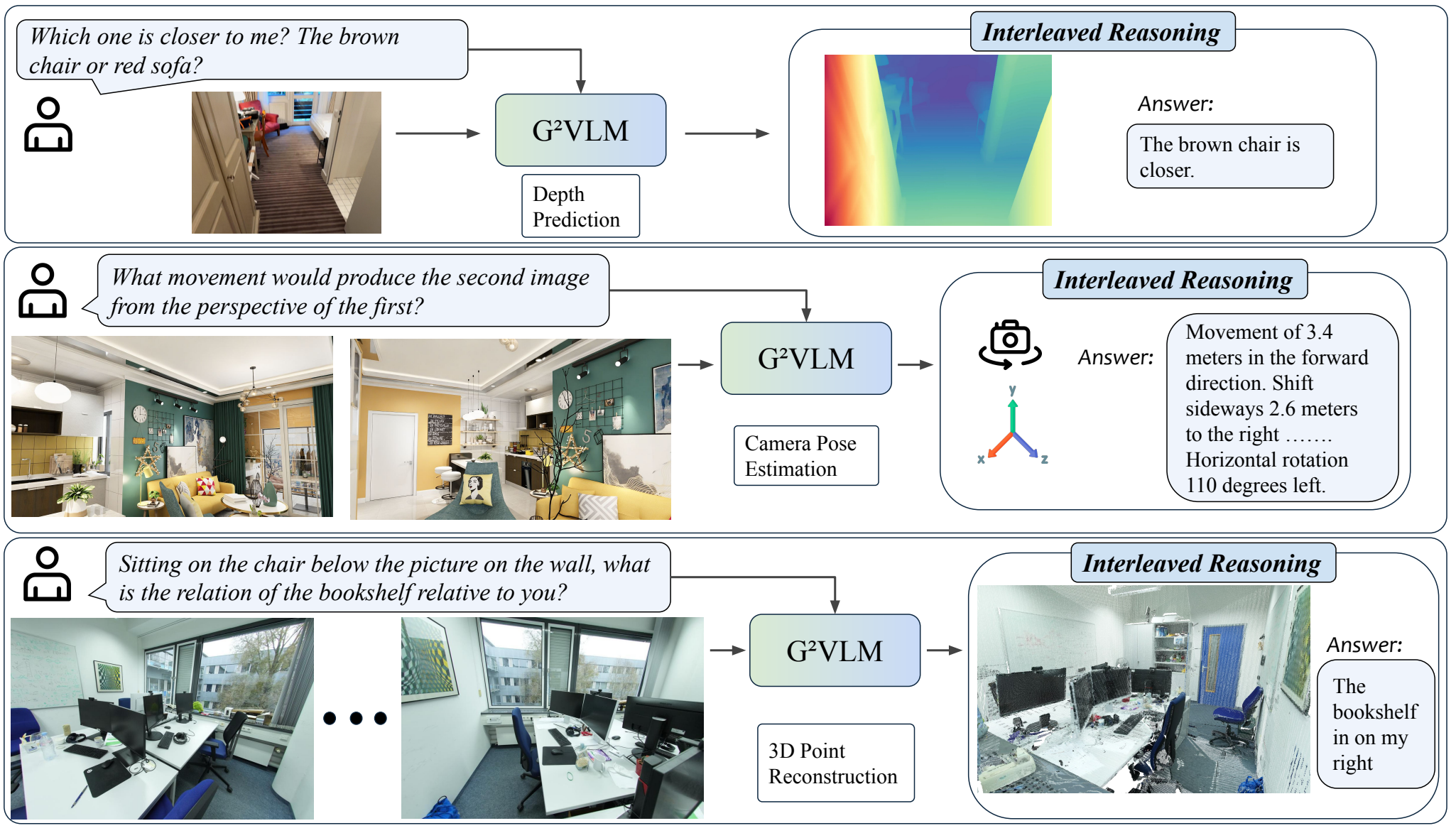
300 dpi PNG · Caption · Source PDF
Original caption, source, and provenance
Fixed source version: CVPR 2026 fixed official PDF
Earliest verified matching figure date (temporal proxy): 2025-11-26
arXiv v1 date: 2025-11-26
Actual drawing date: unknown. See the source record for version checks and temporal-evidence limitations.
Historical PDF · Download citation snapshot · Date evidence · Paper page · Complete screening and version record (Chinese)
Citation threshold evidence: Jiangmiao Pang; 26222 citations; snapshot 2026-10-21.
Recorded drawing-tool disclosure: unknown. No tool attribution is inferred from appearance; see the archival disclosure evidence for scope and wording.
Crop bounding box: [58, 254, 550, 537] (PDF points; top-left origin; x0, y0, x1, y1).
Figure 1. We present G²VLM, a geometry grounded vision-language model proficient in both spatial 3D reconstruction and spatial
understanding tasks. For spatial reasoning questions, G²VLM can predict 3D geometry and employ interleaved reasoning for an answer.
PanoVGGT: Feed-Forward 3D Reconstruction from Panoramic Imagery
Venue: CVPR 2026 · Main-conference paper
Figure 2 · PDF page 4 · P204
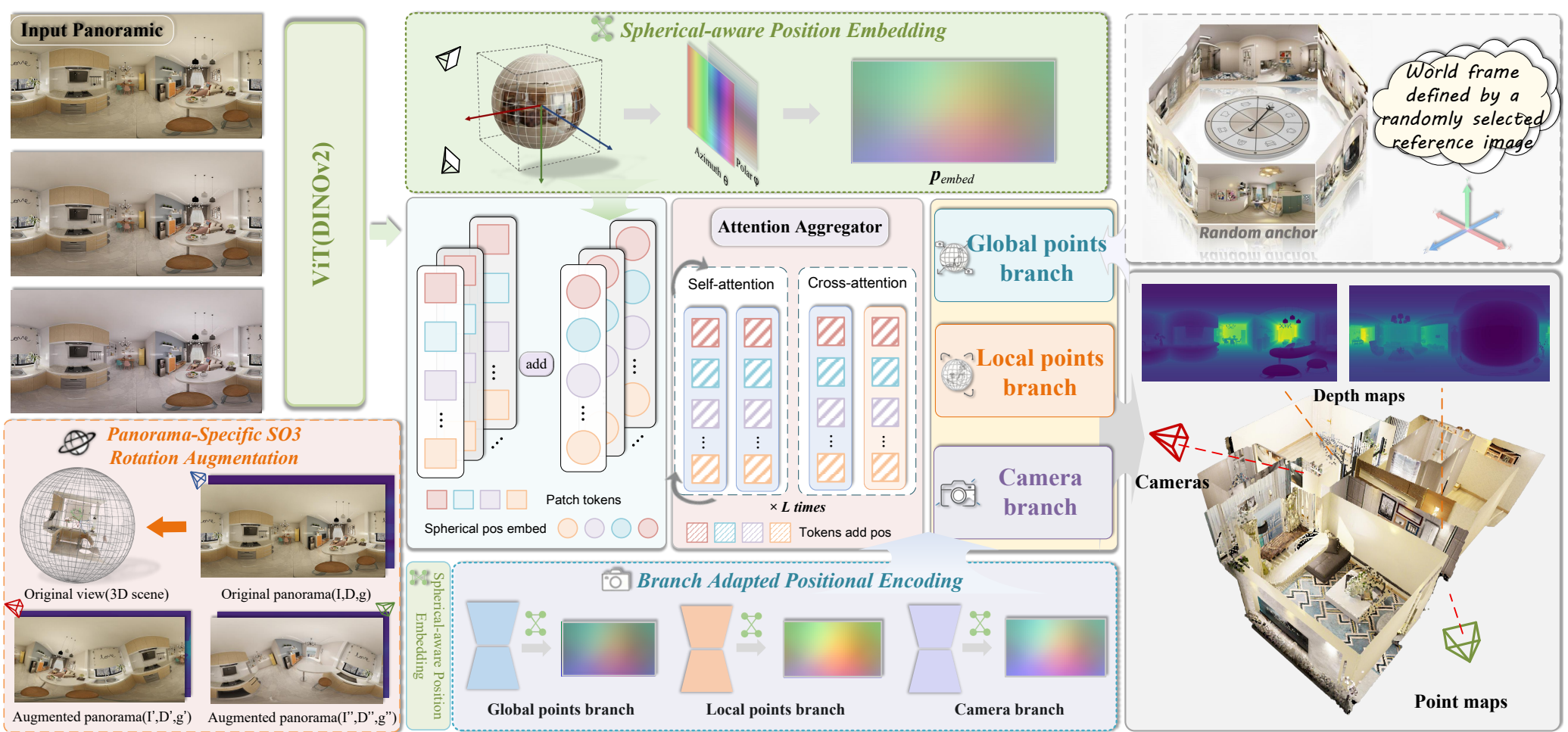
300 dpi PNG · Caption · Source PDF
Original caption, source, and provenance
Fixed source version: CVPR 2026 fixed official PDF
Earliest verified matching figure date (temporal proxy): 2026-03-18
arXiv v1 date: 2026-03-18
Actual drawing date: unknown. See the source record for version checks and temporal-evidence limitations.
Historical PDF · Download citation snapshot · Date evidence · Paper page · Complete screening and version record (Chinese)
Citation threshold evidence: Jingyi Yu; 24450 citations; snapshot 2026-10-21.
Recorded drawing-tool disclosure: unknown. No tool attribution is inferred from appearance; see the archival disclosure evidence for scope and wording.
Crop bounding box: [58, 70, 555, 302] (PDF points; top-left origin; x0, y0, x1, y1).
Figure 2. Overview of the proposed PanoVGGT framework. Given one or multiple panoramic images, PanoVGGT extracts spherical
patch tokens using a ViT backbone, augments them via S O(3) geometric augmentation, and encodes them with shared and branch-adapted
positional embeddings. A multi-branch attention aggregator jointly reasons about local geometry, global structure, and camera motion.
The model outputs dense depth maps, camera poses (under a randomly selected global anchor), and local/global point maps for final 3D
reconstruction.
PanoVGGT: Feed-Forward 3D Reconstruction from Panoramic Imagery
Venue: CVPR 2026 · Main-conference paper
Figure 1 · PDF page 1 · P203
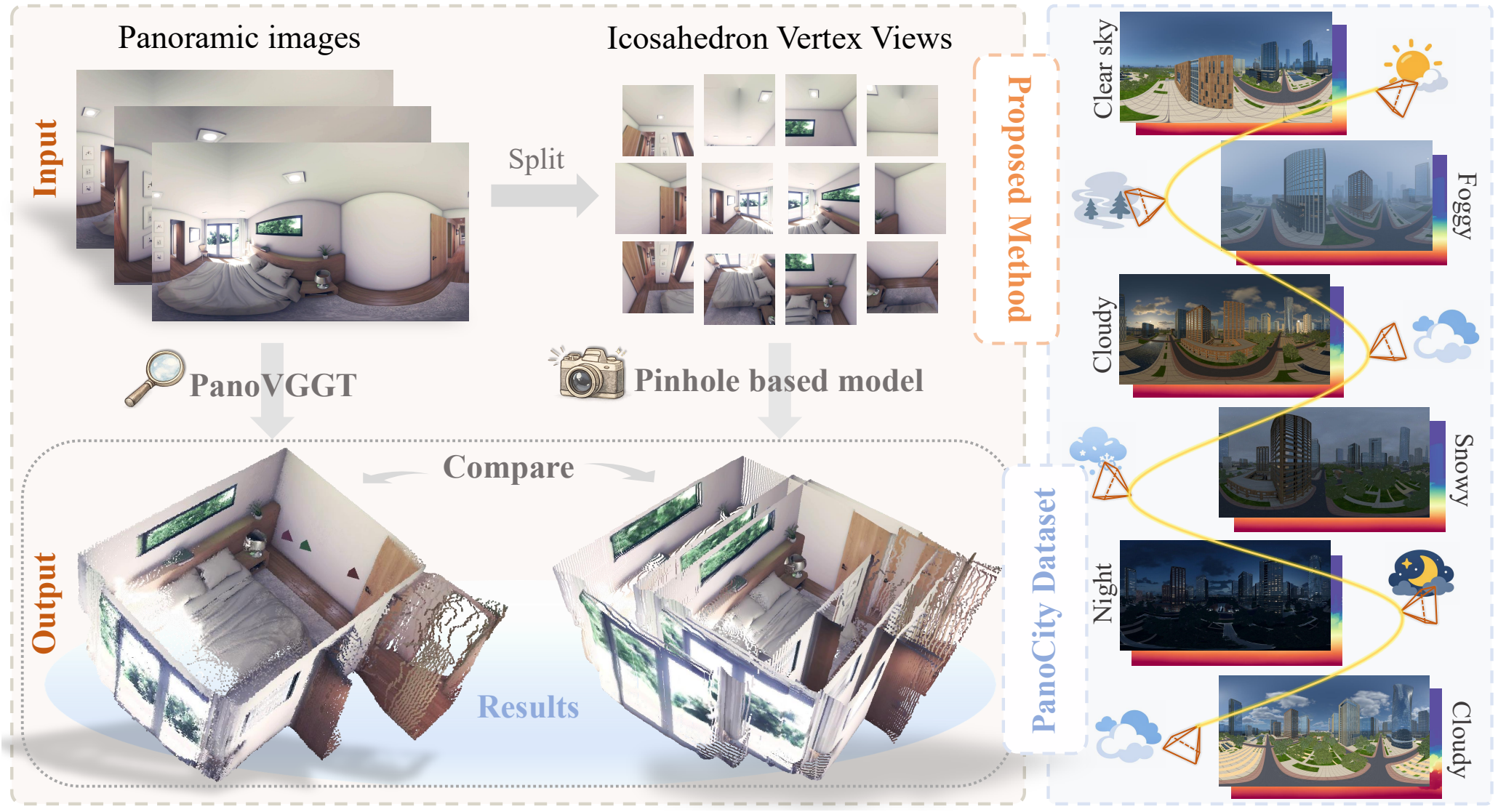
300 dpi PNG · Caption · Source PDF
Original caption, source, and provenance
Fixed source version: CVPR 2026 fixed official PDF
Earliest verified matching figure date (temporal proxy): 2026-03-18
arXiv v1 date: 2026-03-18
Actual drawing date: unknown. See the source record for version checks and temporal-evidence limitations.
Historical PDF · Download citation snapshot · Date evidence · Paper page · Complete screening and version record (Chinese)
Citation threshold evidence: Jingyi Yu; 24450 citations; snapshot 2026-10-21.
Recorded drawing-tool disclosure: unknown. No tool attribution is inferred from appearance; see the archival disclosure evidence for scope and wording.
Crop bounding box: [58, 211, 555, 479] (PDF points; top-left origin; x0, y0, x1, y1).
Figure 1. Overview of PanoVGGT and the PanoCity dataset. PanoVGGT predicts camera poses, dense depth, and consistent 3D point
clouds from unordered panoramas. Compared with perspective-based pipelines that split panoramas into pinhole views, it yields more
accurate 3D reconstructions. PanoCity contains over 120k outdoor panoramas under diverse urban scenes and weather conditions.
PoInit-of-View: Poisoning Initialization of Views Transfers Across Multiple 3D Reconstruction Systems
Venue: CVPR 2026 · Main-conference paper
Figure 2 · PDF page 3 · P78

300 dpi PNG · Caption · Source PDF
Original caption, source, and provenance
Fixed source version: CVPR 2026 fixed official PDF
Earliest verified matching figure date (temporal proxy): 2026-04-17
arXiv v1 date: 2026-04-17
Actual drawing date: unknown. See the source record for version checks and temporal-evidence limitations.
Historical PDF · Download citation snapshot · Date evidence · Paper page · Complete screening and version record (Chinese)
Citation threshold evidence: Nicu Sebe; 59898 citations; snapshot 2026-10-21.
Recorded drawing-tool disclosure: unknown. No tool attribution is inferred from appearance; see the archival disclosure evidence for scope and wording.
Crop bounding box: [57, 72, 554, 146] (PDF points; top-left origin; x0, y0, x1, y1).
Figure 2. Framework of PoInit-of-View.
PoInit-of-View: Poisoning Initialization of Views Transfers Across Multiple 3D Reconstruction Systems
Venue: CVPR 2026 · Main-conference paper
Figure 1 · PDF page 1 · P77
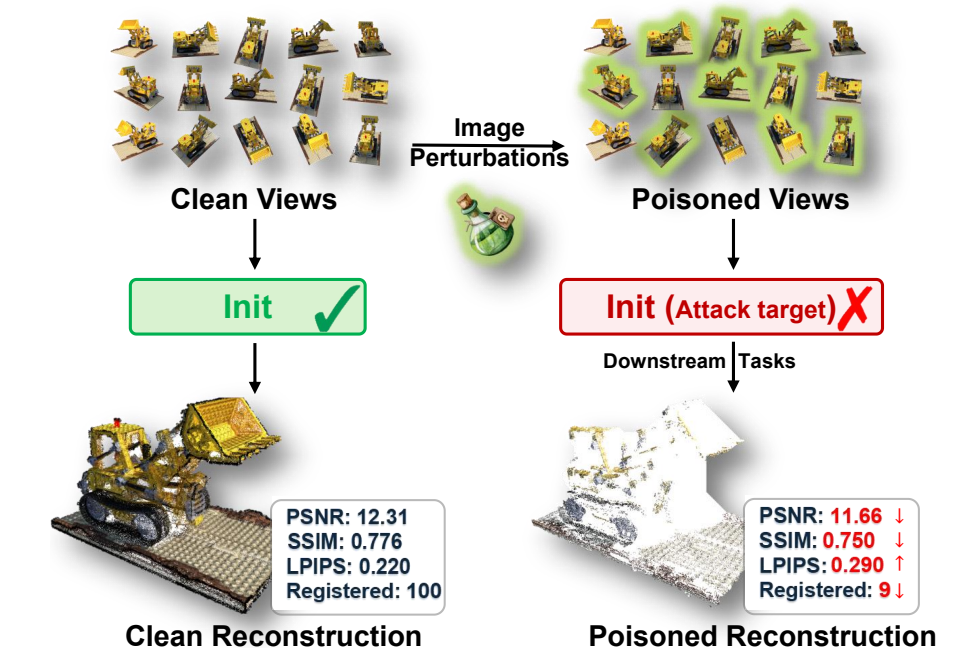
300 dpi PNG · Caption · Source PDF
Original caption, source, and provenance
Fixed source version: CVPR 2026 fixed official PDF
Earliest verified matching figure date (temporal proxy): 2026-04-17
arXiv v1 date: 2026-04-17
Actual drawing date: unknown. See the source record for version checks and temporal-evidence limitations.
Historical PDF · Download citation snapshot · Date evidence · Paper page · Complete screening and version record (Chinese)
Citation threshold evidence: Nicu Sebe; 59898 citations; snapshot 2026-10-21.
Recorded drawing-tool disclosure: unknown. No tool attribution is inferred from appearance; see the archival disclosure evidence for scope and wording.
Crop bounding box: [317, 232, 551, 390] (PDF points; top-left origin; x0, y0, x1, y1).
Figure1. OurPoInit-of-Viewmethodinjectsimperceptiblepertur-
bations into input views (top) to induce cross-view inconsistency
(seedetailsinFigure3)inthefoundationalStructure-from-Motion
(SfM)initializationratherthanthesingle-view-basedlossinexist-
ing attacks. The corrupted feature correspondences propagate to
inaccurate point triangulation, leading to erroneous camera poses
and severely degraded 3D reconstruction results (bottom). Com-
paredtocleanviews,ourpoisonedinputsyieldfarfewerregistered
images, and as a result, lower quality of rendered views.
RayMap3R: Inference-Time RayMap for Dynamic 3D Reconstruction
Venue: ECCV 2026 · Main-conference paper
Figure 4 · PDF page 7 · P202
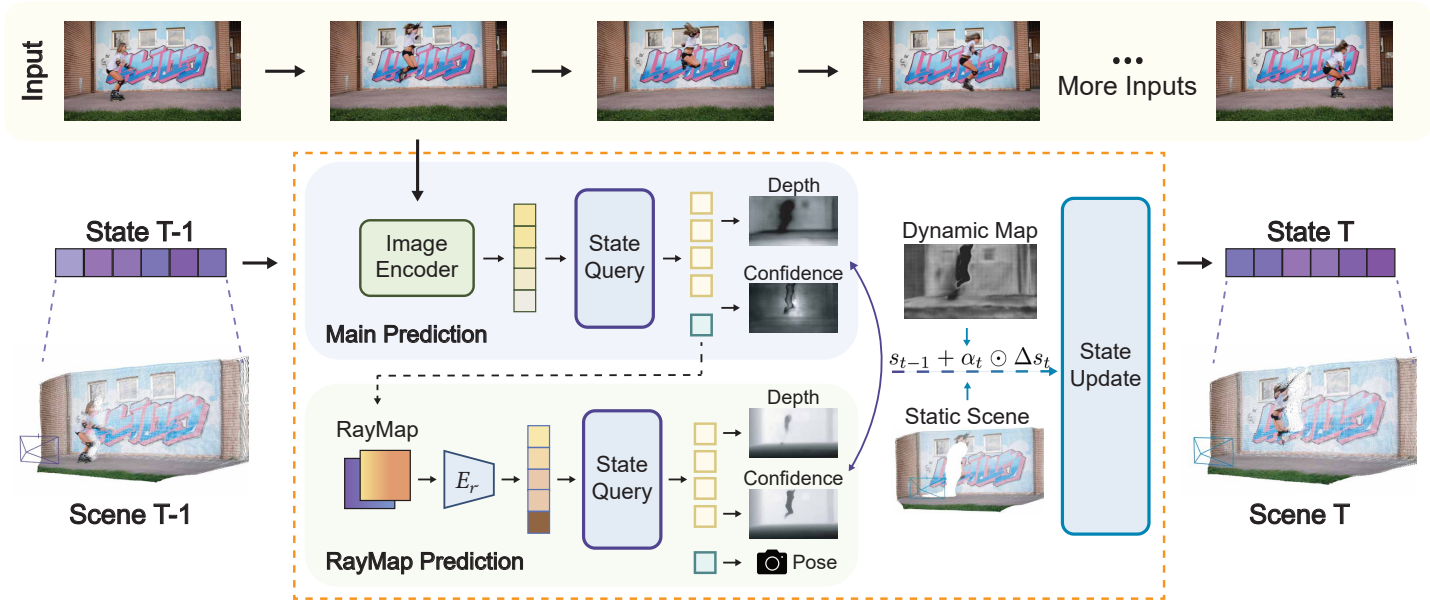
300 dpi PNG · Caption · Source PDF
Original caption, source, and provenance
Fixed source version: ECCV 2026 fixed official PDF
Earliest verified matching figure date (temporal proxy): 2026-03-21
arXiv v1 date: 2026-03-21
Actual drawing date: unknown. See the source record for version checks and temporal-evidence limitations.
Historical PDF · Download citation snapshot · Date evidence · Paper page · Complete screening and version record (Chinese)
Citation threshold evidence: Yan Yan; 13225 citations; snapshot 2026-10-21.
Recorded drawing-tool disclosure: unknown. No tool attribution is inferred from appearance; see the archival disclosure evidence for scope and wording.
Crop bounding box: [135, 116, 478, 262] (PDF points; top-left origin; x0, y0, x1, y1).
Fig. 4: Method Overview. Our method performs streaming 3D reconstruction via
dual-branch inference. At time step t, the main branch predicts depth and pose from
state s using both image and RayMap features. The predicted pose Tˆ is remapped
t−1 t
into RayMap and encoded into tokens r′ , then queried against the frozen state s
t t−1
by the RayMap branch to obtain a static-biased prediction. The depth difference
between branches is pro jected via image-state attention to form staticness weights α
t
that suppress dynamic regions during state update (s = s + α ⊙ ∆s ). This dual-
t t−1 t t
branch scheme identifies and suppresses dynamic regions at inference time.
RayMap3R: Inference-Time RayMap for Dynamic 3D Reconstruction
Venue: ECCV 2026 · Main-conference paper
Figure 2 · PDF page 6 · P201
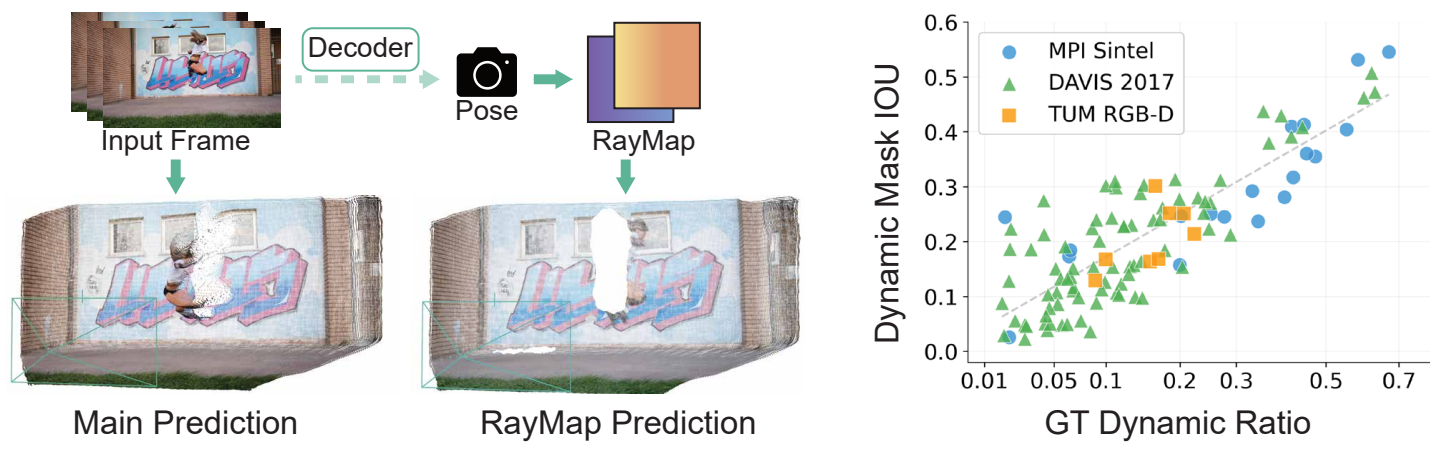
300 dpi PNG · Caption · Source PDF
Original caption, source, and provenance
Fixed source version: ECCV 2026 fixed official PDF
Earliest verified matching figure date (temporal proxy): 2026-03-21
arXiv v1 date: 2026-03-21
Actual drawing date: unknown. See the source record for version checks and temporal-evidence limitations.
Historical PDF · Download citation snapshot · Date evidence · Paper page · Complete screening and version record (Chinese)
Citation threshold evidence: Yan Yan; 13225 citations; snapshot 2026-10-21.
Recorded drawing-tool disclosure: unknown. No tool attribution is inferred from appearance; see the archival disclosure evidence for scope and wording.
Crop bounding box: [135, 116, 478, 227] (PDF points; top-left origin; x0, y0, x1, y1).
Fig. 2: RayMap Static Bias. Left: The main prediction and RayMap prediction pro-
duce differing depth estimates in dynamic regions, suggesting a static bias in RayMap
predictions. Right: The depth discrepancy correlates with ground-truth dynamic ratio
across multiple datasets, suggesting a consistent signal for dynamic identification.
Seeing through Light and Darkness: Sensor-Physics Grounded Deblurring HDR NeRF from Single-Exposure Images and Events
Venue: CVPR 2026 · Main-conference paper
Figure 3 · PDF page 4 · P10
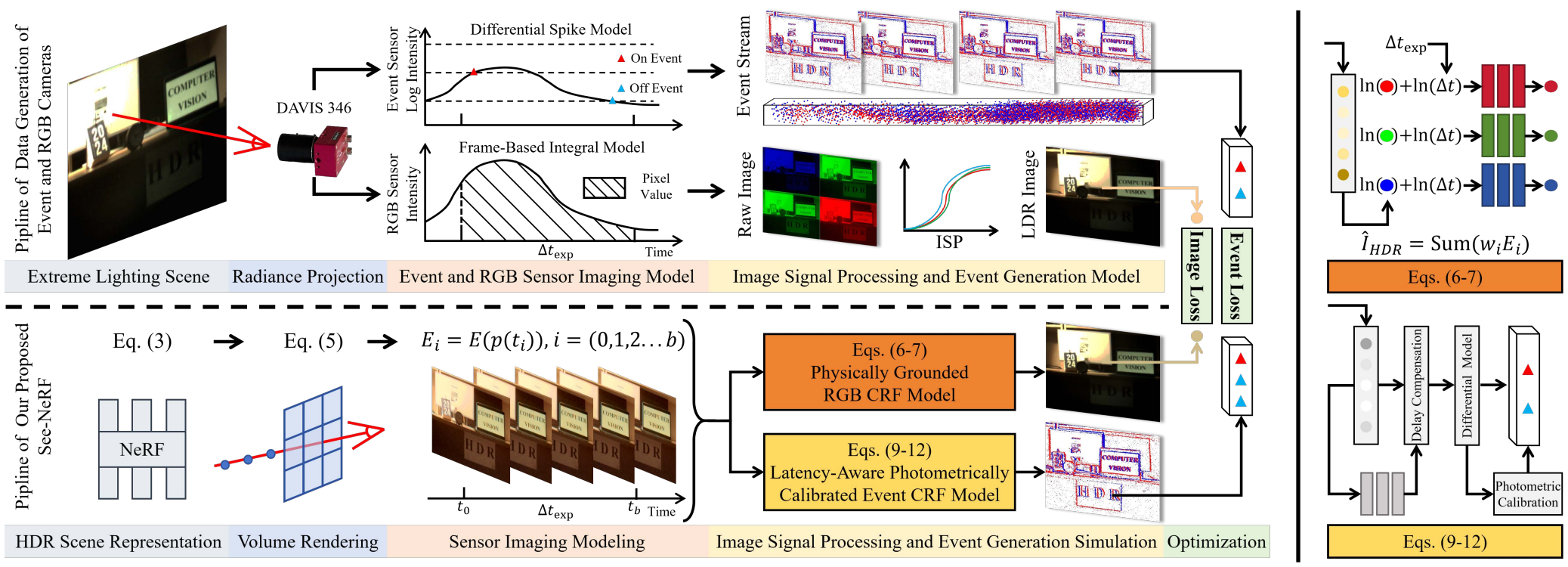
300 dpi PNG · Caption · Source PDF
Original caption, source, and provenance
Fixed source version: CVPR 2026 fixed official open-access version
Earliest verified matching figure date (temporal proxy): 2026-04-02
arXiv v1 date: 2026-01-21
Actual drawing date: unknown. See the source record for version checks and temporal-evidence limitations.
Historical PDF · Download citation snapshot · Date evidence · Paper page · Complete screening and version record (Chinese)
Citation threshold evidence: Jia Li; 12248 citations; snapshot 2026-10-21.
Recorded drawing-tool disclosure: unknown. No tool attribution is inferred from appearance; see the archival disclosure evidence for scope and wording.
Crop bounding box: [57, 70, 555, 250] (PDF points; top-left origin; x0, y0, x1, y1).
Figure 3. The data generation process of event and RGB cameras (upper parts) and the pipeline of See-NeRF (lower parts) are shown in the
figure. We use NeRF to represent the actual radiance of an extreme lighting scene in the HDR domain. The volume rendering simulates the
raw scene radiance rays hitting the sensor and obtaining the raw sensor values. The predicted LDR images and events are generated with our
proposed sensor-physics grounded RGB and event CRF models (details are shown in the right part of the figure). The image loss and event
loss are employed to jointly supervise the optimization of the two CRF models and the NeRF network.
Seeing through Light and Darkness: Sensor-Physics Grounded Deblurring HDR NeRF from Single-Exposure Images and Events
Venue: CVPR 2026 · Main-conference paper
Figure 1 · PDF page 1 · P09
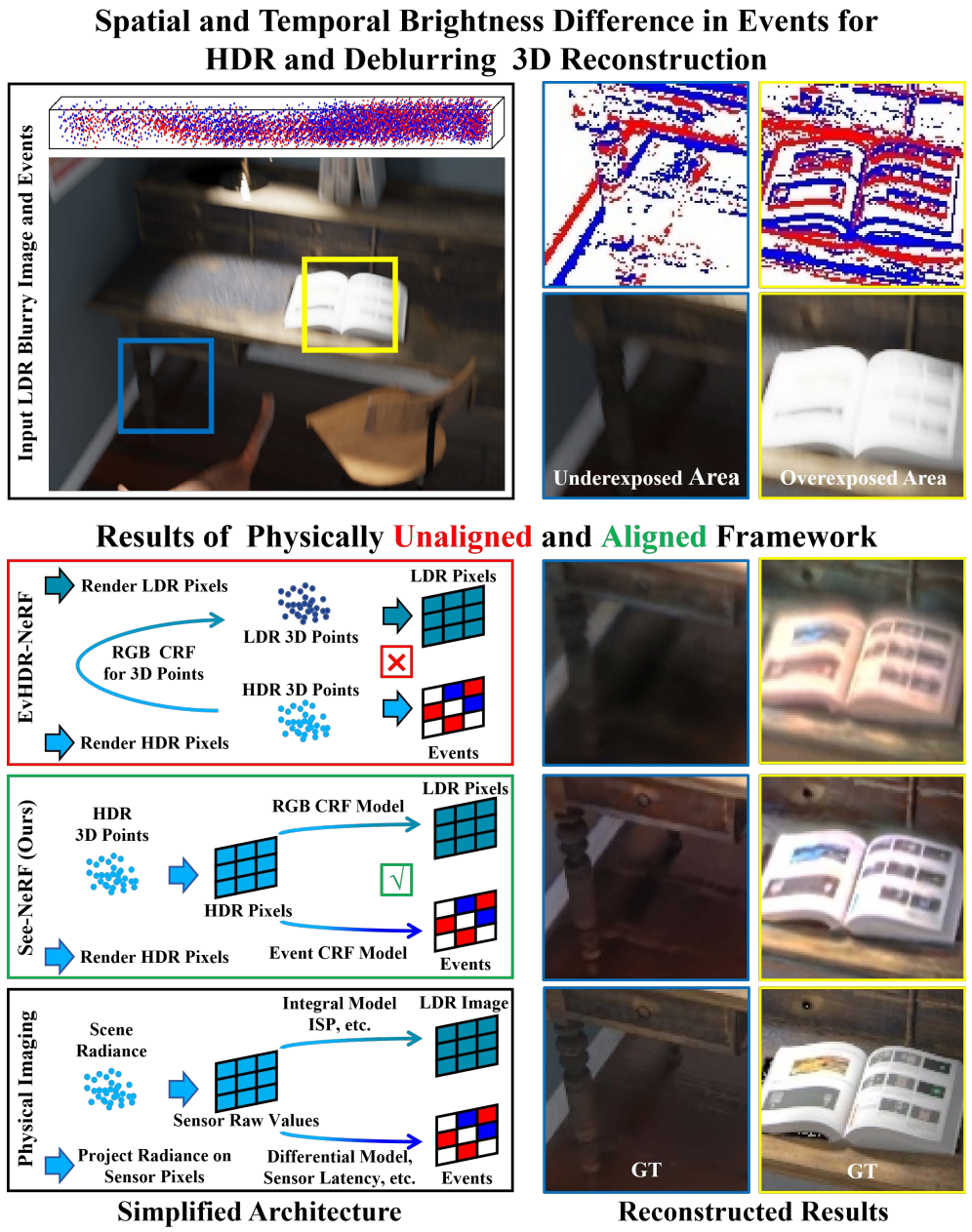
300 dpi PNG · Caption · Source PDF
Original caption, source, and provenance
Fixed source version: CVPR 2026 fixed official open-access version
Earliest verified matching figure date (temporal proxy): 2026-04-02
arXiv v1 date: 2026-01-21
Actual drawing date: unknown. See the source record for version checks and temporal-evidence limitations.
Historical PDF · Download citation snapshot · Date evidence · Paper page · Complete screening and version record (Chinese)
Citation threshold evidence: Jia Li; 12248 citations; snapshot 2026-10-21.
Recorded drawing-tool disclosure: unknown. No tool attribution is inferred from appearance; see the archival disclosure evidence for scope and wording.
Crop bounding box: [316, 255, 555, 558] (PDF points; top-left origin; x0, y0, x1, y1).
Figure 1. Events corresponding to a blurry LDR image contain
spatial difference (High Dynamic Range) and temporal difference
(High Temporal Resolution) information of the scene radiance,
making it an ideal data for enhancing HDR sharp 3D scene recon-
struction. See-NeRF models the physical imaging process with
proposed RGB and event CRF models to bridge the sensor-physics
discrepancy, leveraging events to infer scene dynamics and achiev-
ing sharper and better HDR novel view synthesis results compared
to the physical unaligned method EvHDR-NeRF [5].
SplatSuRe: Selective Super-Resolution for Multi-view Consistent 3D Gaussian Splatting
Venue: CVPR 2026 · Main-conference paper
Figure 2 · PDF page 3 · P118
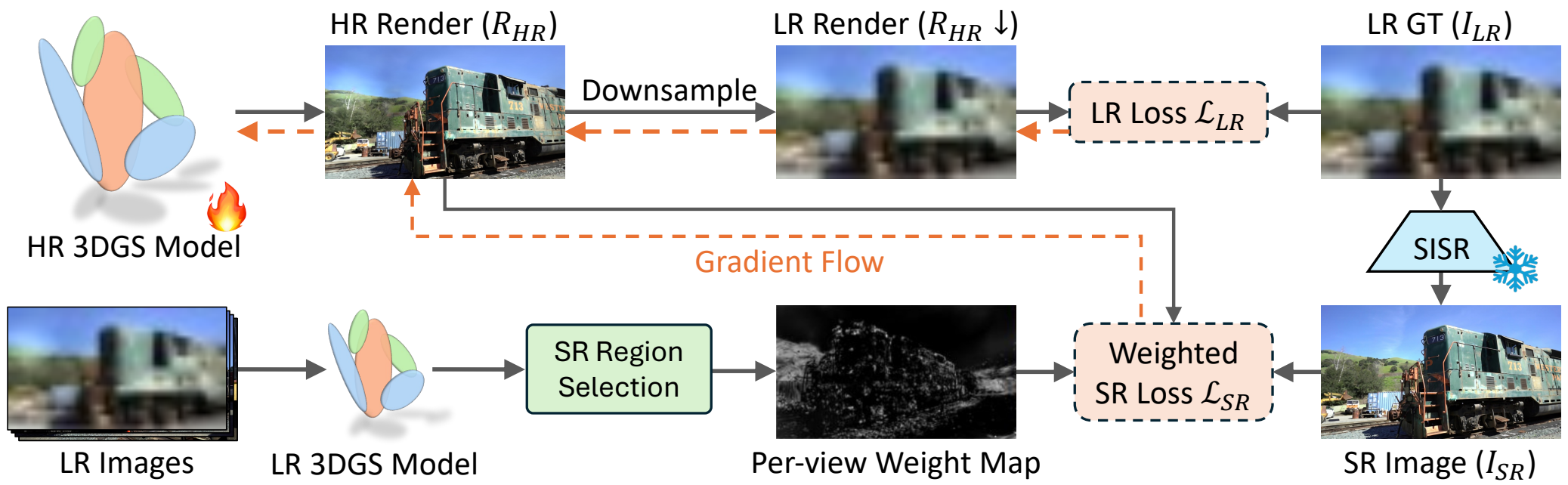
300 dpi PNG · Caption · Source PDF
Original caption, source, and provenance
Fixed source version: CVPR 2026 fixed official PDF
Earliest verified matching figure date (temporal proxy): 2025-12-01
arXiv v1 date: 2025-12-01
Actual drawing date: unknown. See the source record for version checks and temporal-evidence limitations.
Historical PDF · Download citation snapshot · Date evidence · Paper page · Complete screening and version record (Chinese)
Citation threshold evidence: Matthias Zwicker; 17011 citations; snapshot 2026-10-21.
Recorded drawing-tool disclosure: unknown. No tool attribution is inferred from appearance; see the archival disclosure evidence for scope and wording.
Crop bounding box: [57, 71, 555, 225] (PDF points; top-left origin; x0, y0, x1, y1).
Figure 2. Overview of our SplatSuRe framework. A high-resolution (HR) 3D Gaussian Splatting (3DGS) model is trained using low-
resolution (LR) and super-resolution (SR) inputs. We first train a 3DGS model on LR inputs to identify undersampled regions and render
per-view weight maps that indicate where SR is needed. During training of the HR 3DGS model, the images produced by the frozen
single-image super-resolution (SISR) model are spatially weighted by these maps to form the SR loss L . A complementary LR loss
SR
L compares the downsampled HR render against the original LR ground truth to provide consistent supervision across the entire image.
LR
SplatSuRe: Selective Super-Resolution for Multi-view Consistent 3D Gaussian Splatting
Venue: CVPR 2026 · Main-conference paper
Figure 3 · PDF page 4 · P117
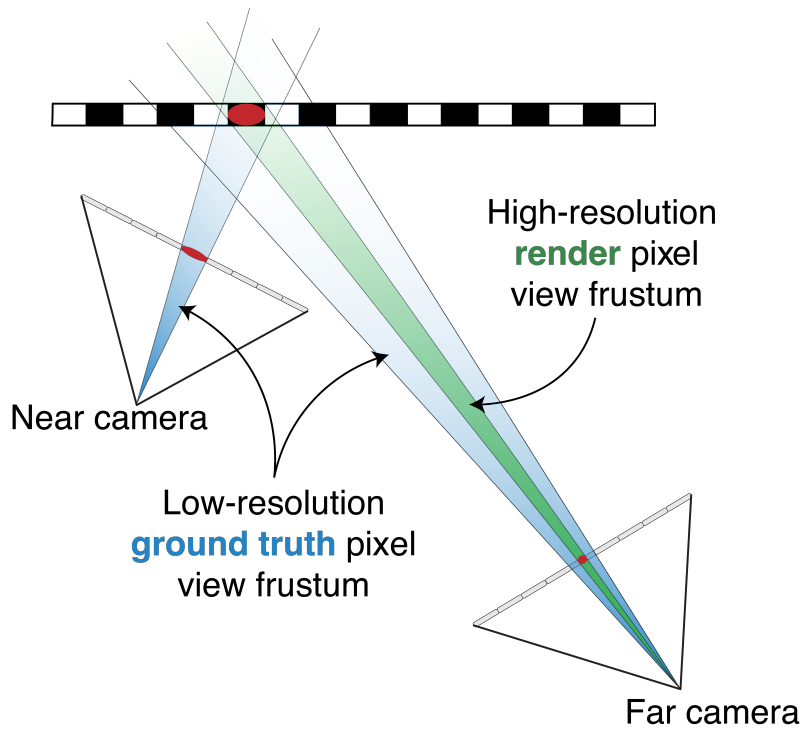
300 dpi PNG · Caption · Source PDF
Original caption, source, and provenance
Fixed source version: CVPR 2026 fixed official PDF
Earliest verified matching figure date (temporal proxy): 2025-12-01
arXiv v1 date: 2025-12-01
Actual drawing date: unknown. See the source record for version checks and temporal-evidence limitations.
Historical PDF · Download citation snapshot · Date evidence · Paper page · Complete screening and version record (Chinese)
Citation threshold evidence: Matthias Zwicker; 17011 citations; snapshot 2026-10-21.
Recorded drawing-tool disclosure: unknown. No tool attribution is inferred from appearance; see the archival disclosure evidence for scope and wording.
Crop bounding box: [337, 70, 531, 249] (PDF points; top-left origin; x0, y0, x1, y1).
Figure 3. Disparity in high-frequency ground truth informa-
tion across different views. Low-resolution ground truth from
near cameras provides high-resolution information for rendering
distant views, reducing the need for additional generated detail
in those views. Conversely, super-resolution is needed in views
where no other camera provides higher-resolution information.
AnyDepth-DETR/-YOLO: Any-depth object detection with a single network
Venue: ICLR 2027 · Submission (under review at collection)
Figure 1 · PDF page 2 · ICLR27_8qFCNFz8Tq_F
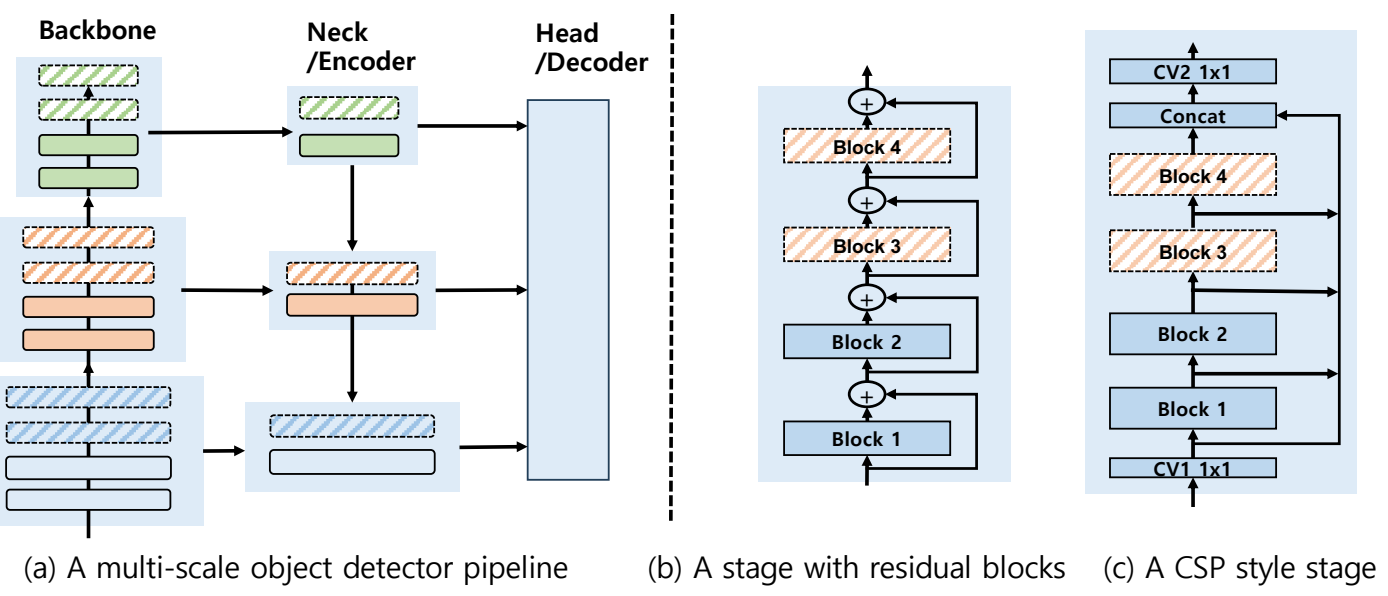
300 dpi PNG · Caption · Source PDF
Original caption, source, and provenance
Fixed source version: ICLR 2027 frozen anonymous submission PDF; retrieved 2026-10-28 UTC
Earliest verified matching figure date (temporal proxy): 2026-05-10
arXiv v1 date: 2026-05-10
Actual drawing date: unknown. See the source record for version checks and temporal-evidence limitations.
Historical PDF · Date evidence · Paper page · Complete screening and version record (Chinese)
Recorded drawing-tool disclosure: unknown. No tool attribution is inferred from appearance; see the archival disclosure evidence for scope and wording.
Crop bounding box: [144, 79, 477, 222] (PDF points; top-left origin; x0, y0, x1, y1).
Figure 1: (a) Overall pipeline of our any-depth object detection network, following the standard
backbone–neck–head design common to modern detectors such as RT-DETR and YOLO, operating
on multi-scale features. Each stage in both the backbone and neck is divided into an essential path
(solid blocks) and a skippable refinement path (dashed blocks). At inference time, any combination
of essential and full paths across stages yields a valid sub-network, enabling a continuous range of
accuracy–efficiency trade-offs from a single set of weights. (b) A residual-block stage, as used in
RT-DETR. (c) A CSP-style stage, as used in the YOLO family. In both stage types, the essential and
full paths are jointly trained via self-distillation to produce aligned feature representations at each
stage boundary, so that downstream stages can process the output of either path reliably.
AnyDepth-DETR/-YOLO: Any-depth object detection with a single network
Venue: ICLR 2027 · Submission (under review at collection)
Figure 2 · PDF page 6 · ICLR27_8qFCNFz8Tq_M
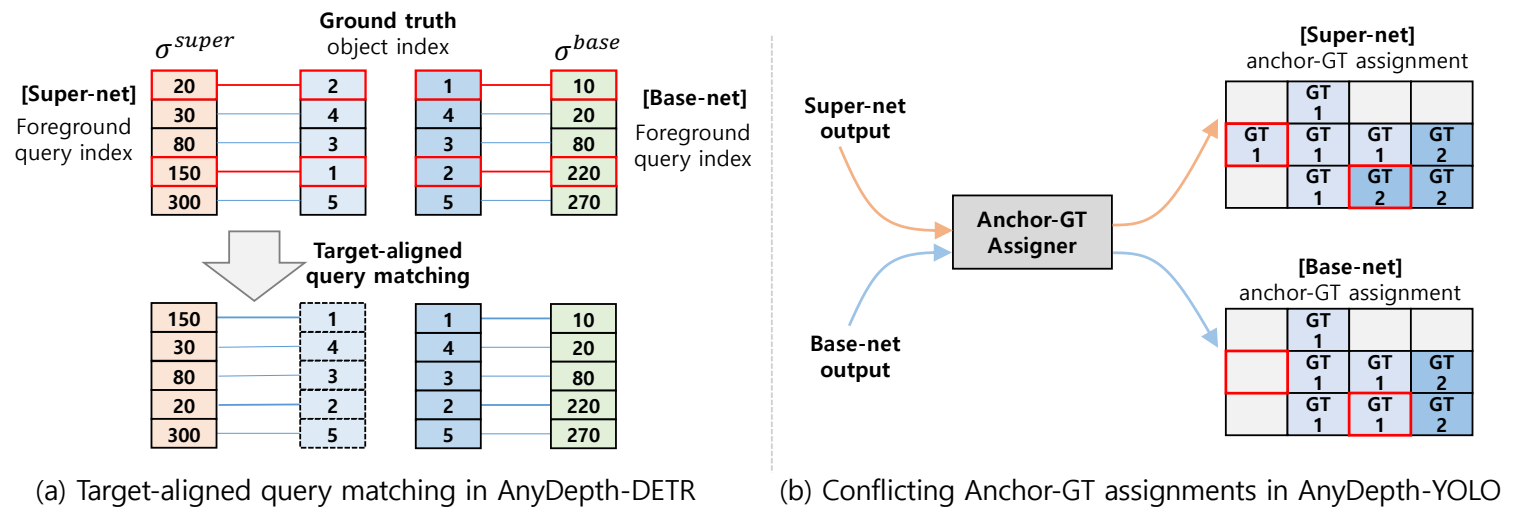
300 dpi PNG · Caption · Source PDF
Original caption, source, and provenance
Fixed source version: ICLR 2027 frozen anonymous submission PDF; retrieved 2026-10-28 UTC
Earliest verified matching figure date (temporal proxy): 2026-05-10
arXiv v1 date: 2026-05-10
Actual drawing date: unknown. See the source record for version checks and temporal-evidence limitations.
Historical PDF · Date evidence · Paper page · Complete screening and version record (Chinese)
Recorded drawing-tool disclosure: unknown. No tool attribution is inferred from appearance; see the archival disclosure evidence for scope and wording.
Crop bounding box: [124, 79, 491, 203] (PDF points; top-left origin; x0, y0, x1, y1).
Figure 2: Conflicting target assignment in any-depth detectors. (a) In AnyDepth-DETR, the Hungarian
matcher can assign different queries to the same ground-truth objects across the two execution paths.
We reorder the super-net’s foreground queries to align with the base-net’s target-matched query
ordering before applying KD. (b) In AnyDepth-YOLO, the Task-Aligned Assigner (TAL) can assign
the super-net and base-net outputs to different anchors for the same ground-truth object. We exclude
conflicting anchor assignments (in red boxes) from the foreground distillation set.
CANDIDATE-BOX SELECTION MATTERS FOR CROSS- DOMAIN FEW-SHOT OBJECT DETECTION
Venue: ICLR 2027 · Submission (under review at collection)
Figure 2 · PDF page 5 · ICLR27_6kDoAMVPn5_F
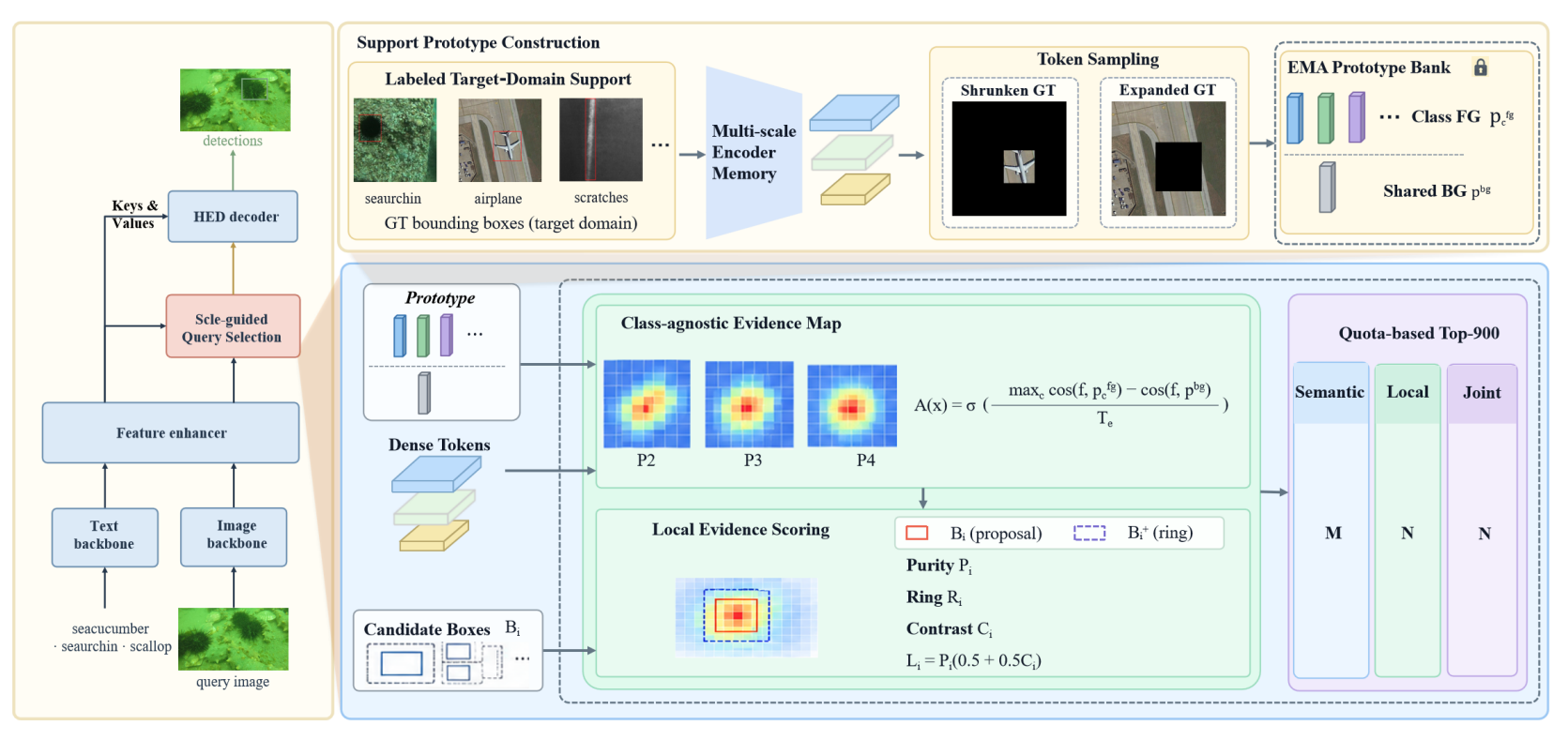
300 dpi PNG · Caption · Source PDF
Original caption, source, and provenance
Fixed source version: ICLR 2027 frozen anonymous submission PDF; retrieved 2026-10-28 UTC
Earliest verified matching figure date (temporal proxy): 2026-10-03
Actual drawing date: unknown. See the source record for version checks and temporal-evidence limitations.
Date evidence · Paper page · Complete screening and version record (Chinese)
Recorded drawing-tool disclosure: unknown. No tool attribution is inferred from appearance; see the archival disclosure evidence for scope and wording.
Crop bounding box: [106, 79, 507, 272] (PDF points; top-left origin; x0, y0, x1, y1).
Figure 2: SCLE only modifies the pre-decoder selection stage of the language-guided detector. Left: detection pipeline, where SCLE-driven query selection replaces text-score ranking before the HED decoder. Upper right: class-wise foreground prototypes and one shared background prototype, updated by exponential moving average from labeled support samples. Lower right: the prototype bank produces a class-agnostic evidence map. Candidates are scored using interior purity P_i, ring evidence R_i, and contrast C_i. A quota divides the Top-900 budget into semantic, local-evidence and joint channels. Only the indices fed into the decoder are changed.
CANDIDATE-BOX SELECTION MATTERS FOR CROSS- DOMAIN FEW-SHOT OBJECT DETECTION
Venue: ICLR 2027 · Submission (under review at collection)
Figure 1 · PDF page 2 · ICLR27_6kDoAMVPn5_M
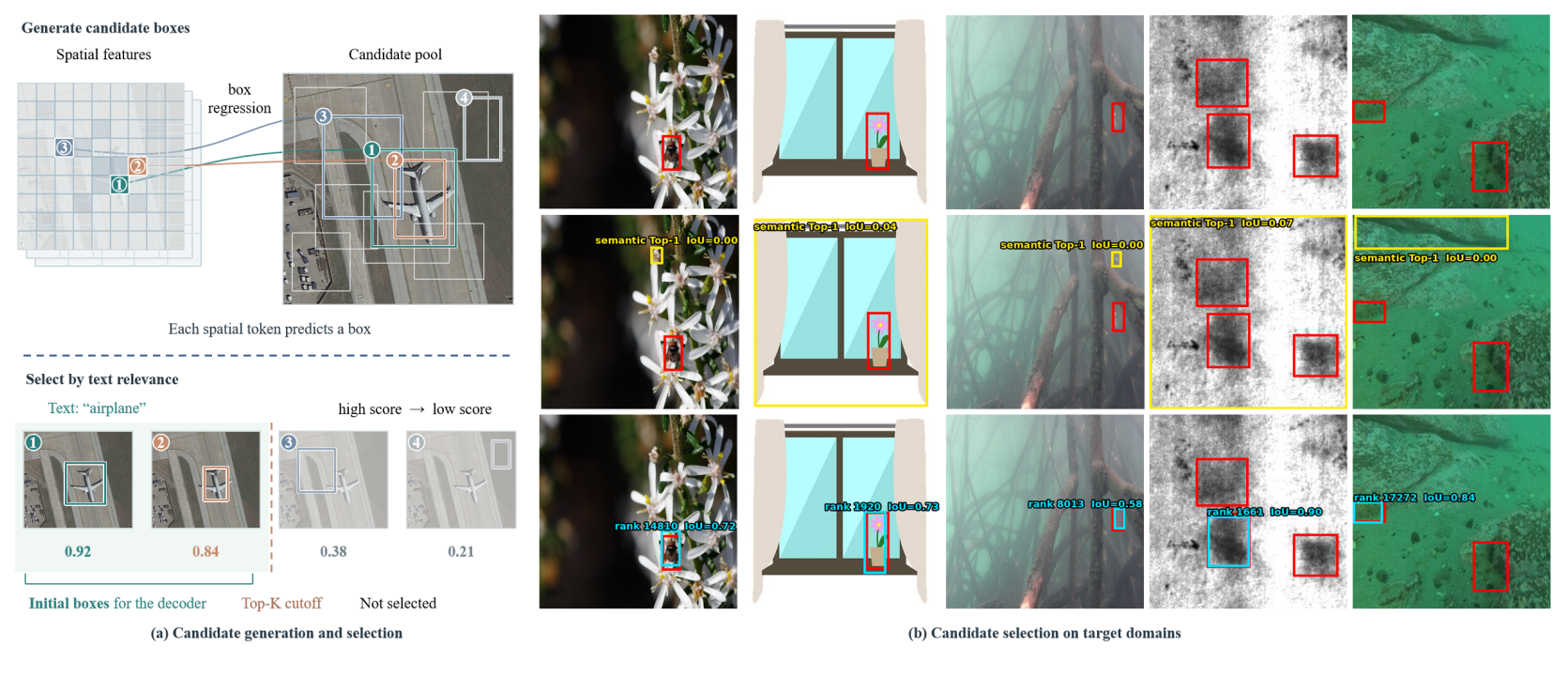
300 dpi PNG · Caption · Source PDF
Original caption, source, and provenance
Fixed source version: ICLR 2027 frozen anonymous submission PDF; retrieved 2026-10-28 UTC
Earliest verified matching figure date (temporal proxy): 2026-10-03
Actual drawing date: unknown. See the source record for version checks and temporal-evidence limitations.
Date evidence · Paper page · Complete screening and version record (Chinese)
Recorded drawing-tool disclosure: unknown. No tool attribution is inferred from appearance; see the archival disclosure evidence for scope and wording.
Crop bounding box: [106, 79, 507, 252] (PDF points; top-left origin; x0, y0, x1, y1).
Figure 1: (a) A brief illustration of the current Grounding-DINO-based works. (b) We find that
compared with the ground-truth bounding box (red), for target domains, the top-ranked candidate
boxes (yellow) are less likely to tightly bound the objects, where the better candidate boxes (cyan)
may be ranked outside the Top-900 quota. Unlike current work, we identify the selected candidate
boxes as another bottleneck for the CD-FSOD task, which we aim to address in this paper.
DCHA: Dynamic Compositional Adaptation with Hierarchical Drift Constraints for Incremental Vision-Language Object Detection
Venue: ICLR 2027 · Submission (under review at collection)
Figure 2 · PDF page 4 · ICLR27_WrLCWdkY49_F
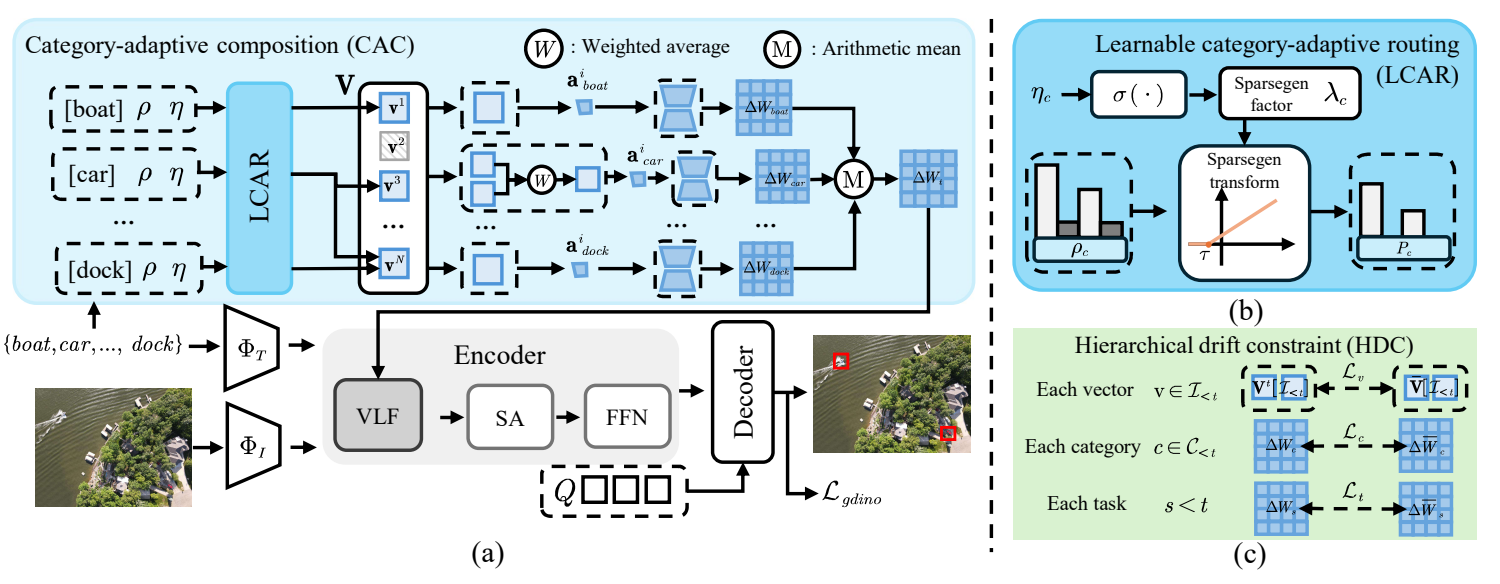
300 dpi PNG · Caption · Source PDF
Original caption, source, and provenance
Fixed source version: ICLR 2027 frozen anonymous submission PDF; retrieved 2026-10-28 UTC
Earliest verified matching figure date (temporal proxy): 2026-10-03
Actual drawing date: unknown. See the source record for version checks and temporal-evidence limitations.
Date evidence · Paper page · Complete screening and version record (Chinese)
Recorded drawing-tool disclosure: unknown. No tool attribution is inferred from appearance; see the archival disclosure evidence for scope and wording.
Crop bounding box: [128, 79, 488, 219] (PDF points; top-left origin; x0, y0, x1, y1).
Figure 2: Overview of the proposed DCHA framework. (a) DCHA constructs category-specific
LoRA by composing vectors from a shared bank and averages the resulting category updates to form
the task-level adaptation for the VLF layers. (b) LCAR transforms category-specific routing logits
into sparse composition weights using a learnable sparsity coefficient, enabling category-dependent
vector selection. (c) HDC preserves historical adaptation knowledge by constraining deviations at
the bank-vector, category-update, and task-update levels.
DCHA: Dynamic Compositional Adaptation with Hierarchical Drift Constraints for Incremental Vision-Language Object Detection
Venue: ICLR 2027 · Submission (under review at collection)
Figure 1 · PDF page 2 · ICLR27_WrLCWdkY49_M
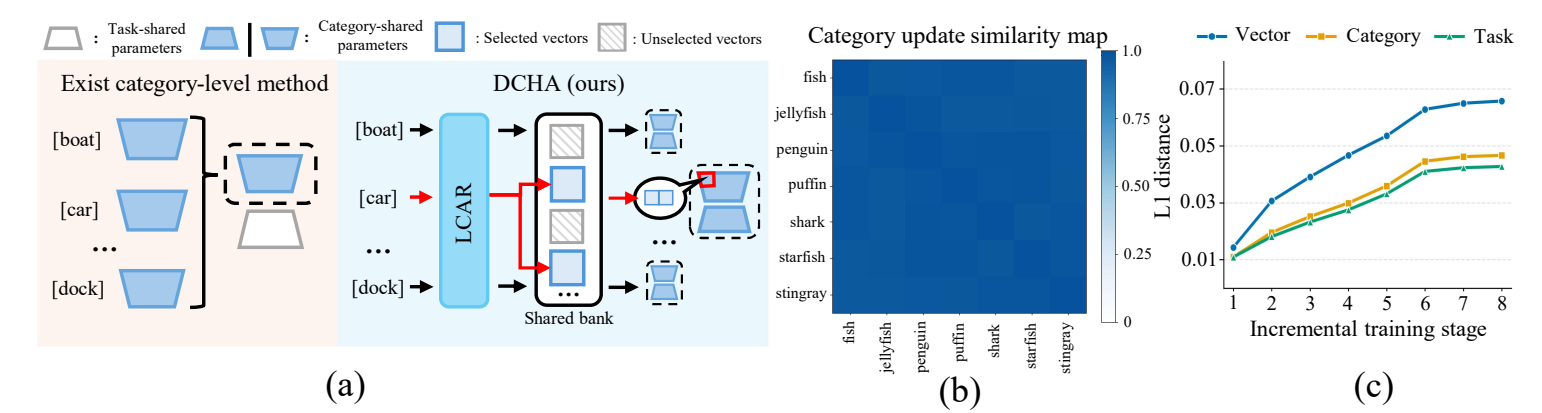
300 dpi PNG · Caption · Source PDF
Original caption, source, and provenance
Fixed source version: ICLR 2027 frozen anonymous submission PDF; retrieved 2026-10-28 UTC
Earliest verified matching figure date (temporal proxy): 2026-10-03
Actual drawing date: unknown. See the source record for version checks and temporal-evidence limitations.
Date evidence · Paper page · Complete screening and version record (Chinese)
Recorded drawing-tool disclosure: unknown. No tool attribution is inferred from appearance; see the archival disclosure evidence for scope and wording.
Crop bounding box: [118, 79, 488, 178] (PDF points; top-left origin; x0, y0, x1, y1).
Figure 1: Motivation of DCHA. (a) Existing category-level methods rigidly assign fixed experts
based on category, whereas DCHA dynamically selects and composes fine-grained parameter vec-
tors according to category demands. (b) Category-specific updates produced by existing category-
level methods exhibit uniformly high pairwise similarities within the same task. (c) Shared bank
parameter deviations progressively accumulate at the vector, category, and task levels during incre-
mental training, resulting in hierarchical drift.
DeCo: A Multimodal Detection Framework based on Density Consensus Learning
Venue: ICLR 2027 · Submission (under review at collection)
Figure 2 · PDF page 4 · ICLR27_8P9XSKFW9N_F
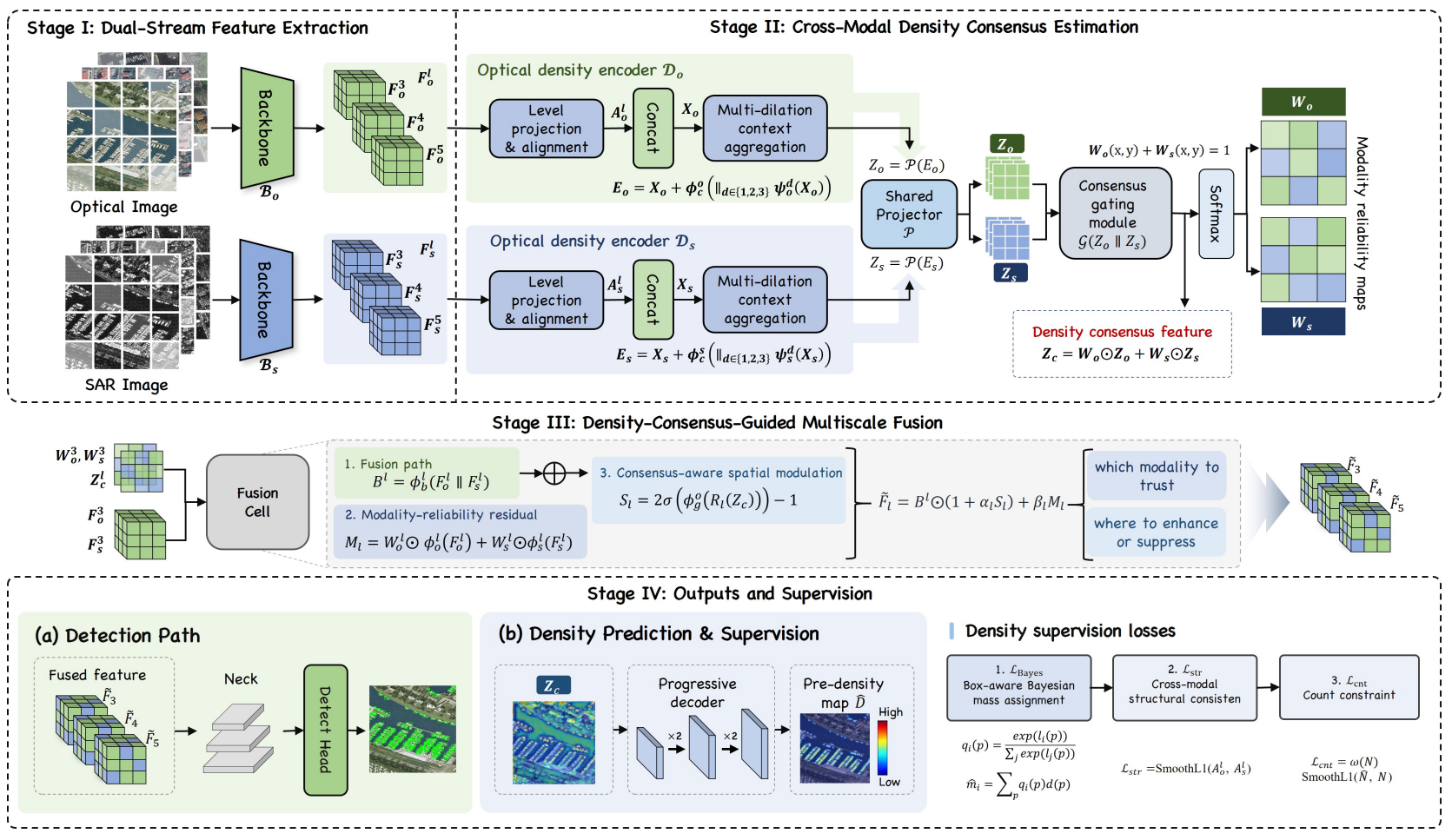
300 dpi PNG · Caption · Source PDF
Original caption, source, and provenance
Fixed source version: ICLR 2027 frozen anonymous submission PDF; retrieved 2026-10-28 UTC
Earliest verified matching figure date (temporal proxy): 2026-10-03
Actual drawing date: unknown. See the source record for version checks and temporal-evidence limitations.
Date evidence · Paper page · Complete screening and version record (Chinese)
Recorded drawing-tool disclosure: unknown. No tool attribution is inferred from appearance; see the archival disclosure evidence for scope and wording.
Crop bounding box: [106, 79, 507, 311] (PDF points; top-left origin; x0, y0, x1, y1).
Figure 2: Overview of DeCo. Independent backbones extract multimodal, multiscale features, which
are projected into a shared density space to estimate modality reliability and construct density con-
sensus. The resulting consensus guides multiscale feature fusion for detection and is simultaneously
decoded into a density map for density supervision.
DeCo: A Multimodal Detection Framework based on Density Consensus Learning
Venue: ICLR 2027 · Submission (under review at collection)
Figure 1 · PDF page 2 · ICLR27_8P9XSKFW9N_M
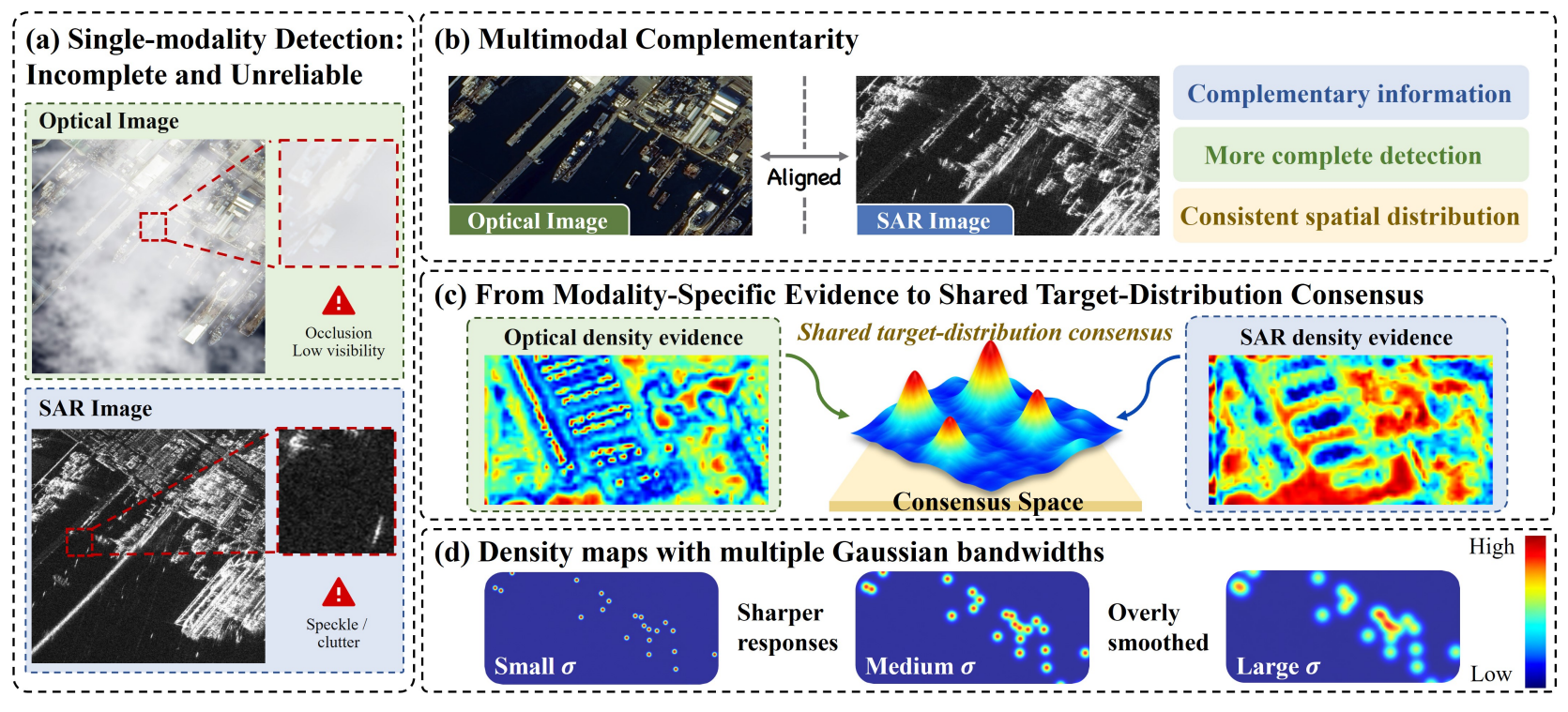
300 dpi PNG · Caption · Source PDF
Original caption, source, and provenance
Fixed source version: ICLR 2027 frozen anonymous submission PDF; retrieved 2026-10-28 UTC
Earliest verified matching figure date (temporal proxy): 2026-10-03
Actual drawing date: unknown. See the source record for version checks and temporal-evidence limitations.
Date evidence · Paper page · Complete screening and version record (Chinese)
Recorded drawing-tool disclosure: unknown. No tool attribution is inferred from appearance; see the archival disclosure evidence for scope and wording.
Crop bounding box: [106, 79, 507, 261] (PDF points; top-left origin; x0, y0, x1, y1).
Figure 1: Motivation for density consensus learning. OPT and SAR observations provide heteroge-
neous and spatially varying evidence for the same underlying ship distribution. We establish their
agreement in a shared density space to preserve mutually supported target responses while suppress-
ing modality-specific interference. Different Gaussian bandwidths in (d) illustrate the dependence
of conventional pixel-wise density targets on predefined kernel shapes.
Different Instances, Different Supervision: Instance-Adaptive Point-Supervised Oriented Object Detection
Venue: ICLR 2027 · Submission (under review at collection)
Figure 3 · PDF page 4 · ICLR27_AUmtOiMvCa_F
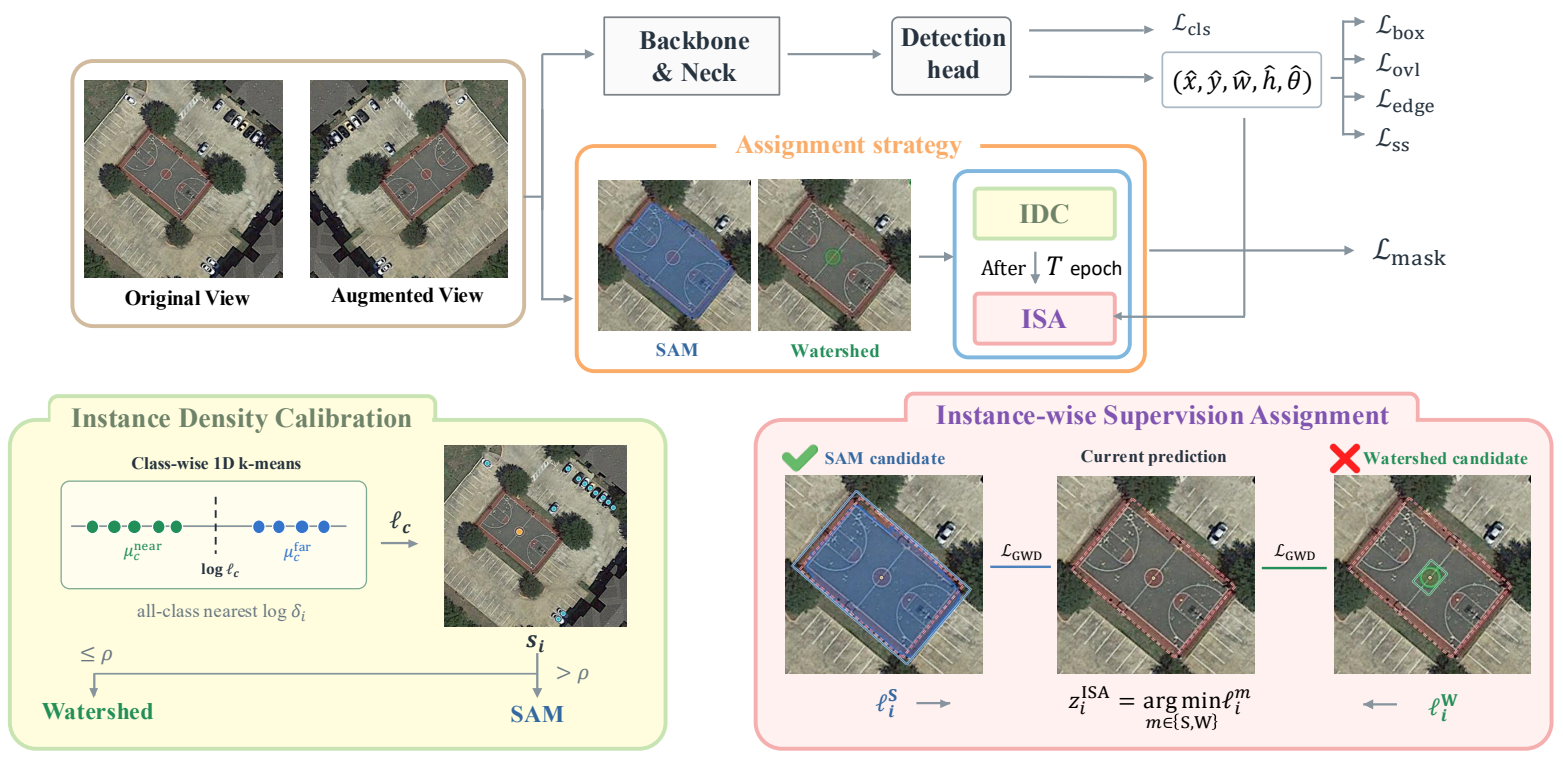
300 dpi PNG · Caption · Source PDF
Original caption, source, and provenance
Fixed source version: ICLR 2027 frozen anonymous submission PDF; retrieved 2026-10-28 UTC
Earliest verified matching figure date (temporal proxy): 2026-10-03
Actual drawing date: unknown. See the source record for version checks and temporal-evidence limitations.
Date evidence · Paper page · Complete screening and version record (Chinese)
Recorded drawing-tool disclosure: unknown. No tool attribution is inferred from appearance; see the archival disclosure evidence for scope and wording.
Crop bounding box: [119, 77, 494, 263] (PDF points; top-left origin; x0, y0, x1, y1).
Figure 3: Overview of InstaPoint. IDC initializes instance-wise assignments to SAM or watershed
using class-calibrated point spacing. ISA then makes a one-time selection of the source with the
lower GWD-based size loss relative to the detector’s current prediction.
Different Instances, Different Supervision: Instance-Adaptive Point-Supervised Oriented Object Detection
Venue: ICLR 2027 · Submission (under review at collection)
Figure 1 · PDF page 2 · ICLR27_AUmtOiMvCa_M
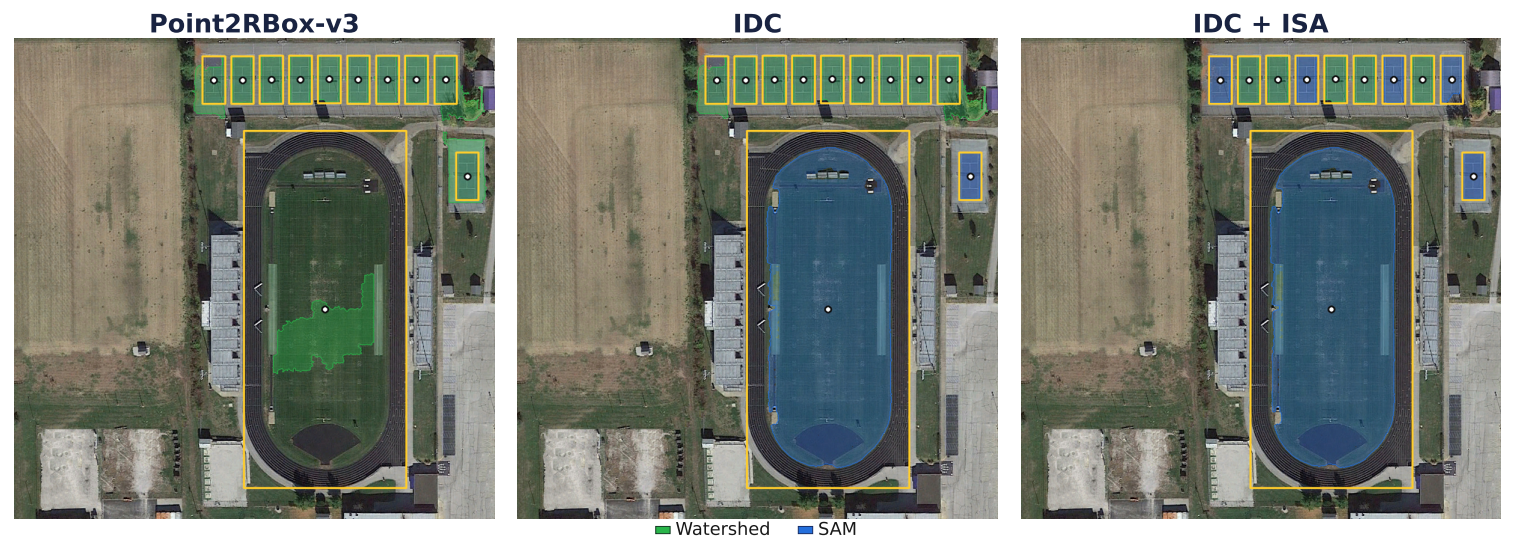
300 dpi PNG · Caption · Source PDF
Original caption, source, and provenance
Fixed source version: ICLR 2027 frozen anonymous submission PDF; retrieved 2026-10-28 UTC
Earliest verified matching figure date (temporal proxy): 2026-10-03
Actual drawing date: unknown. See the source record for version checks and temporal-evidence limitations.
Date evidence · Paper page · Complete screening and version record (Chinese)
Recorded drawing-tool disclosure: unknown. No tool attribution is inferred from appearance; see the archival disclosure evidence for scope and wording.
Crop bounding box: [123, 79, 486, 210] (PDF points; top-left origin; x0, y0, x1, y1).
Figure 1: Qualitative comparison of supervision assignment. Point2RBox-v3 (Zhang et al., 2026)
uses a shared patch-wise supervision source, while our Instance Density Calibration (IDC) and
Instance-wise Supervision Assignment (ISA) perform instance-wise source assignment between
SAM (blue) and watershed (green) supervision. Yellow boxes denote the RBoxes and white dots
denote point annotations.
Imbalance-Adaptive Cross Consistency Learning for Semi-Supervised Oriented Object Detection
Venue: ICLR 2027 · Submission (under review at collection)
Figure 3 · PDF page 4 · ICLR27_0jbdTGiGaz_F
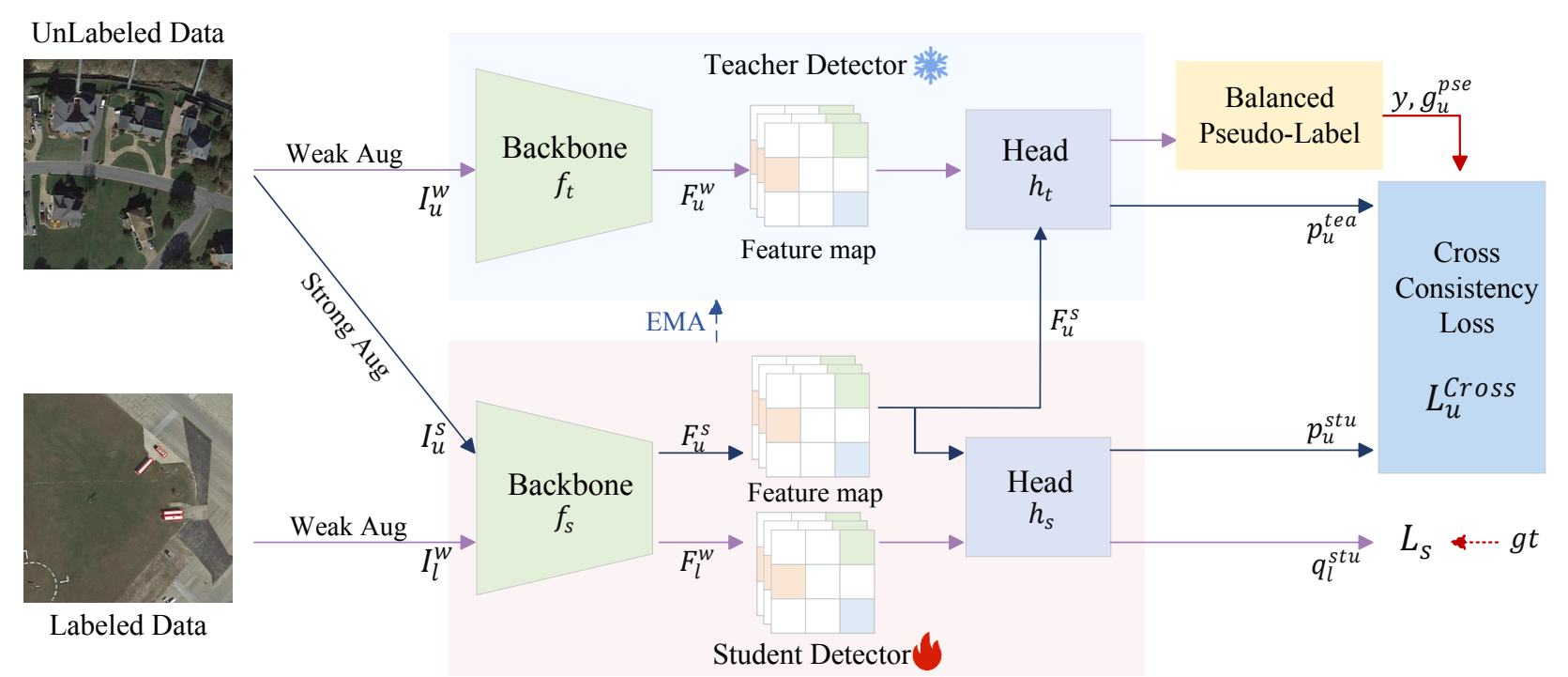
300 dpi PNG · Caption · Source PDF
Original caption, source, and provenance
Fixed source version: ICLR 2027 frozen anonymous submission PDF; retrieved 2026-10-28 UTC
Earliest verified matching figure date (temporal proxy): 2026-10-03
Actual drawing date: unknown. See the source record for version checks and temporal-evidence limitations.
Date evidence · Paper page · Complete screening and version record (Chinese)
Recorded drawing-tool disclosure: unknown. No tool attribution is inferred from appearance; see the archival disclosure evidence for scope and wording.
Crop bounding box: [106, 79, 507, 252] (PDF points; top-left origin; x0, y0, x1, y1).
Figure 3: An illustration of our proposed IACCL
Imbalance-Adaptive Cross Consistency Learning for Semi-Supervised Oriented Object Detection
Venue: ICLR 2027 · Submission (under review at collection)
Figure 1 · PDF page 2 · ICLR27_0jbdTGiGaz_M
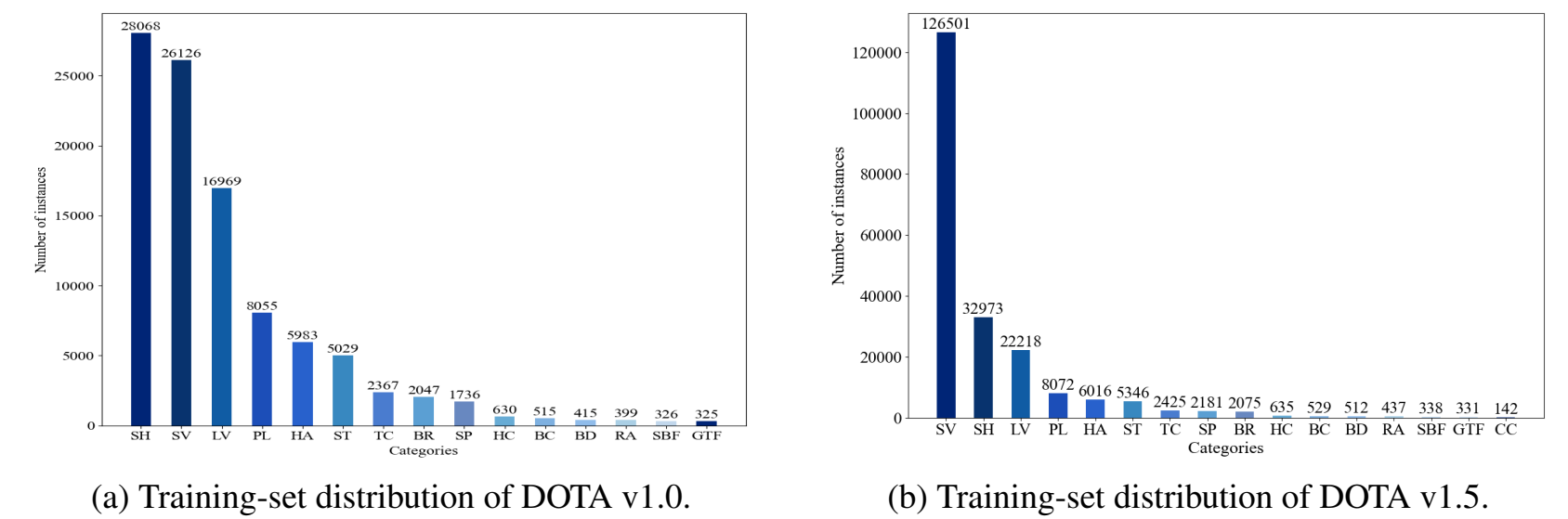
300 dpi PNG · Caption · Source PDF
Original caption, source, and provenance
Fixed source version: ICLR 2027 frozen anonymous submission PDF; retrieved 2026-10-28 UTC
Earliest verified matching figure date (temporal proxy): 2026-10-03
Actual drawing date: unknown. See the source record for version checks and temporal-evidence limitations.
Date evidence · Paper page · Complete screening and version record (Chinese)
Recorded drawing-tool disclosure: unknown. No tool attribution is inferred from appearance; see the archival disclosure evidence for scope and wording.
Crop bounding box: [102, 79, 507, 213] (PDF points; top-left origin; x0, y0, x1, y1).
Figure 1: Long-tailed category distributions in the DOTA v1.0 and DOTA v1.5 training sets.
PULSE: PERSISTENT UTILIZATION OF LIMITED SUPPORT EVIDENCE FOR CROSS-DOMAIN FEW-SHOT OBJECT DETECTION
Venue: ICLR 2027 · Submission (under review at collection)
Figure 2 · PDF page 4 · ICLR27_ad0Os8QbxN_F
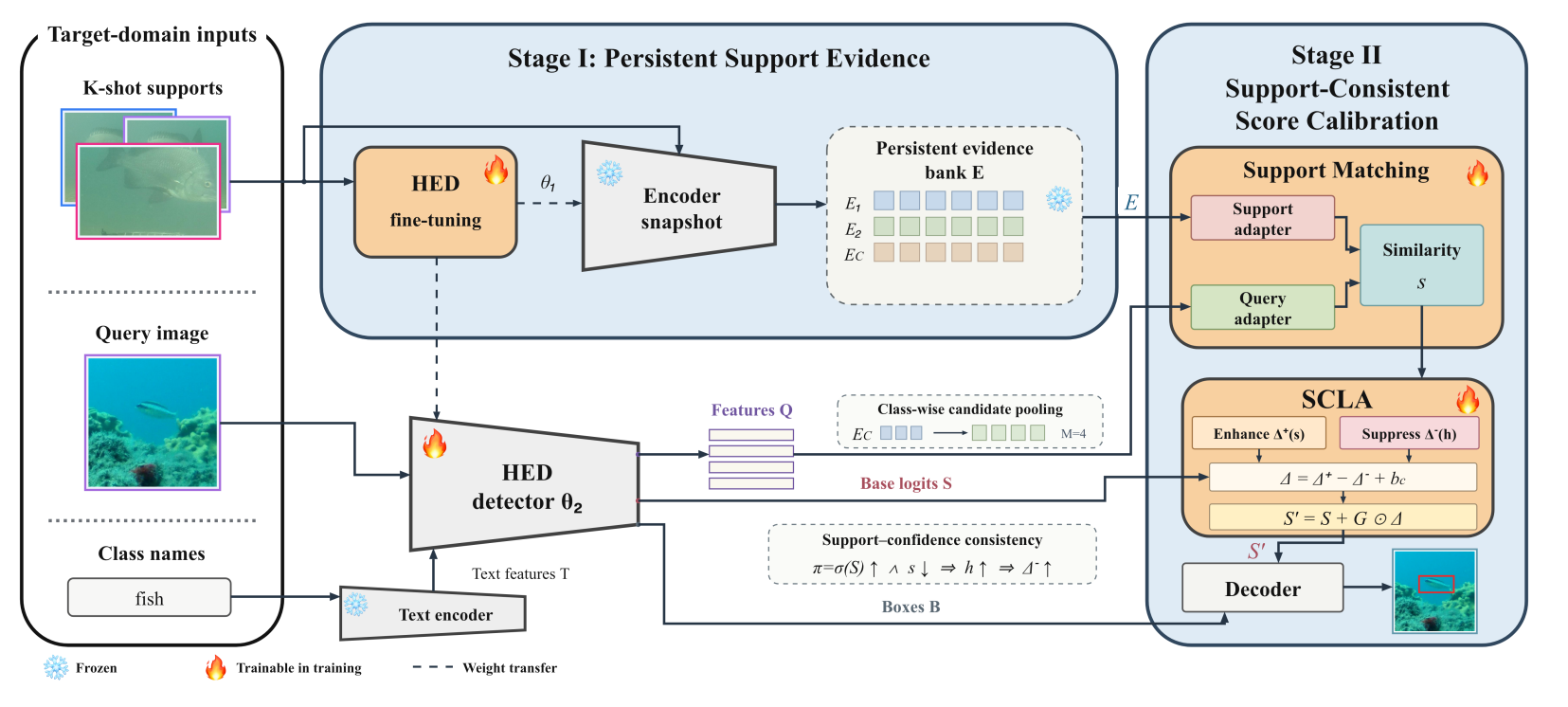
300 dpi PNG · Caption · Source PDF
Original caption, source, and provenance
Fixed source version: ICLR 2027 frozen anonymous submission PDF; retrieved 2026-10-28 UTC
Earliest verified matching figure date (temporal proxy): 2026-10-03
Actual drawing date: unknown. See the source record for version checks and temporal-evidence limitations.
Date evidence · Paper page · Complete screening and version record (Chinese)
Recorded drawing-tool disclosure: generative_AI_figure_preparation_unspecified_tool. No tool attribution is inferred from appearance; see the archival disclosure evidence for scope and wording.
Crop bounding box: [110, 169, 507, 348] (PDF points; top-left origin; x0, y0, x1, y1).
Figure 2: Persistent support evidence and SSCA-centered calibration in PULSE. In Stage I, HED
is fine-tuned on the target support set, and the resulting encoder snapshot is frozen to construct the
evidence bank E. In Stage II, the query detector is initialized with the Stage I weights and produces
query features Q, base class logits S, and predicted boxes B. SSCA matches Q with the cached
evidence E to obtain support agreement s and refines the base logits as S′ = S + G ⊙ ∆, while the
box coordinates bypass score calibration and remain unchanged. The evidence bank remains fixed
throughout Stage II training and inference. Flames indicate trainable parameters during training,
whereas snowflakes indicate frozen modules or fixed evidence. All model parameters are fixed during
inference. Test images from the DeepFish dataset (Fu et al., 2024) are adopted for illustration and do
not correspond to the sampled adaptation episode; the displayed output box is schematic rather than
an actual model prediction.
PULSE: PERSISTENT UTILIZATION OF LIMITED SUPPORT EVIDENCE FOR CROSS-DOMAIN FEW-SHOT OBJECT DETECTION
Venue: ICLR 2027 · Submission (under review at collection)
Figure 1 · PDF page 2 · ICLR27_ad0Os8QbxN_M
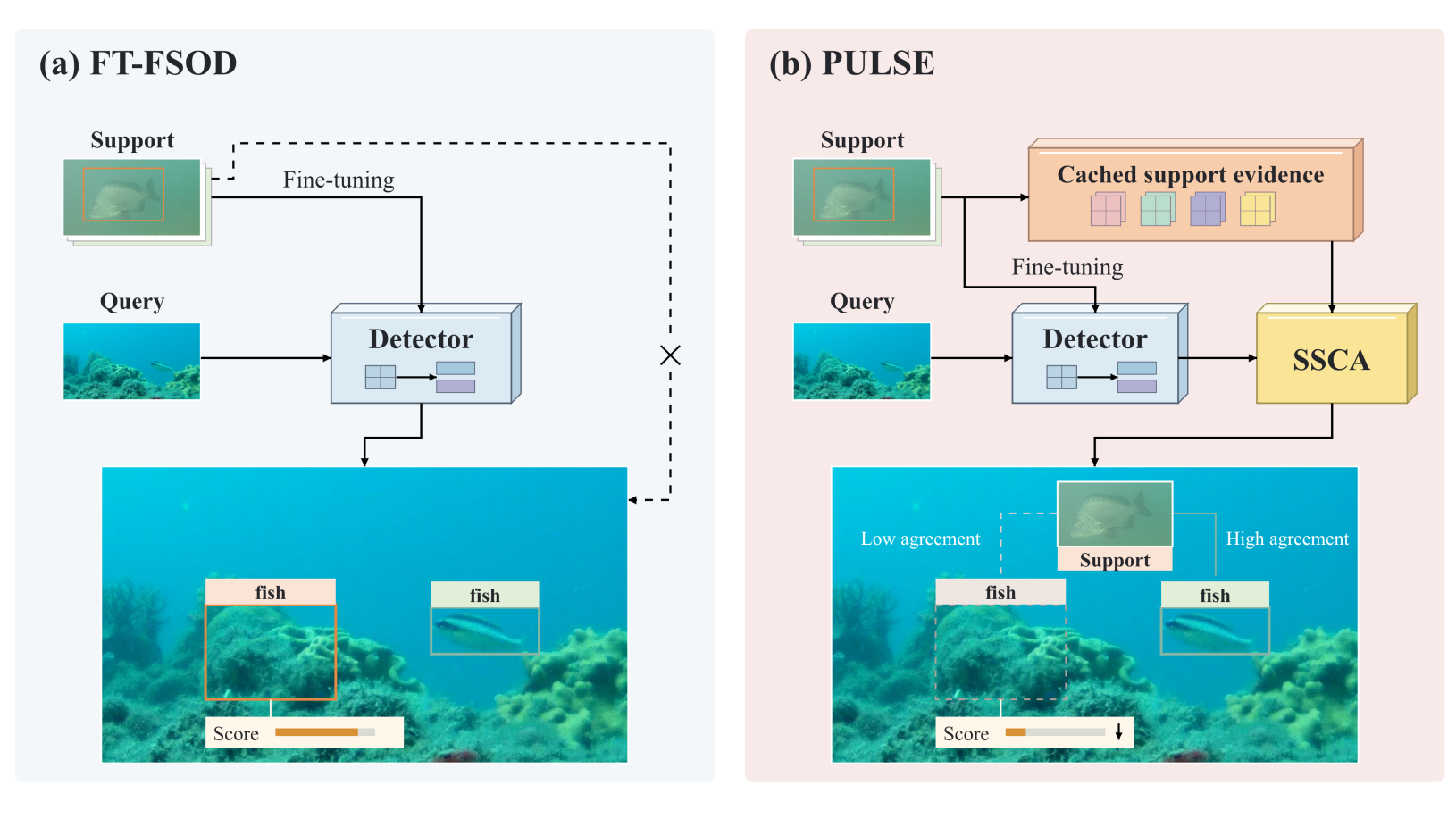
300 dpi PNG · Caption · Source PDF
Original caption, source, and provenance
Fixed source version: ICLR 2027 frozen anonymous submission PDF; retrieved 2026-10-28 UTC
Earliest verified matching figure date (temporal proxy): 2026-10-03
Actual drawing date: unknown. See the source record for version checks and temporal-evidence limitations.
Date evidence · Paper page · Complete screening and version record (Chinese)
Recorded drawing-tool disclosure: generative_AI_figure_preparation_unspecified_tool. No tool attribution is inferred from appearance; see the archival disclosure evidence for scope and wording.
Crop bounding box: [110, 79, 501, 301] (PDF points; top-left origin; x0, y0, x1, y1).
Figure 1: Target-support use in FT-FSOD (Yu et al., 2026) and PULSE. (a) FT-FSOD uses support
annotations for target-domain fine-tuning and subsequently scores query predictions without explicitly
consulting the support examples. (b) PULSE retains cached support evidence and uses SSCA to
refine classification scores according to support–query agreement. Box tags denote predicted classes,
and bar lengths illustrate schematic confidence. The dashed candidate illustrates score suppression at
the same location. Test images from DeepFish (Fu et al., 2024) are used for illustration; the support
examples, bounding boxes, and score changes are schematic.
Rethinking Over-Segmentation in Few-Shot Object Detection with Vision Foundation Models: A Training-Free Prototype Refinement and Occlusion-Aware Discrimination Approach
Venue: ICLR 2027 · Submission (under review at collection)
Figure 1 · PDF page 3 · ICLR27_V5RmhtXTMG_F
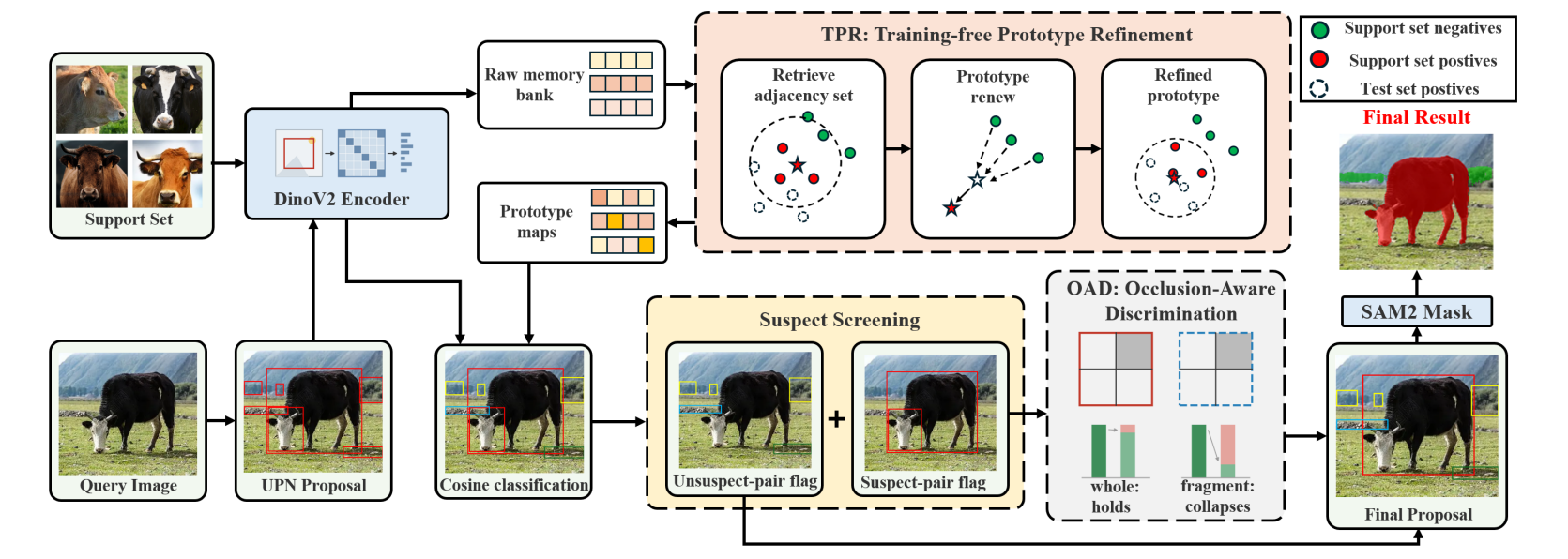
300 dpi PNG · Caption · Source PDF
Original caption, source, and provenance
Fixed source version: ICLR 2027 frozen anonymous submission PDF; retrieved 2026-10-28 UTC
Earliest verified matching figure date (temporal proxy): 2026-10-03
Actual drawing date: unknown. See the source record for version checks and temporal-evidence limitations.
Date evidence · Paper page · Complete screening and version record (Chinese)
Recorded drawing-tool disclosure: unknown. No tool attribution is inferred from appearance; see the archival disclosure evidence for scope and wording.
Crop bounding box: [106, 79, 507, 222] (PDF points; top-left origin; x0, y0, x1, y1).
Figure 1: POISE overview. The support set is encoded by a frozen DINOv2 encoder into a raw memory
bank and per-class prototype maps. TPR retrieves an adjacency set of hard negatives, renews each prototype
by a bounded one-step update, and writes the refined prototype back. UPN proposals are scored by cosine
classification against the refined prototypes; suspect screening flags nested same-class pairs and passes only
those to OAD, which separates whole objects from fragments.
Rethinking Over-Segmentation in Few-Shot Object Detection with Vision Foundation Models: A Training-Free Prototype Refinement and Occlusion-Aware Discrimination Approach
Venue: ICLR 2027 · Submission (under review at collection)
Figure 2 · PDF page 4 · ICLR27_V5RmhtXTMG_M
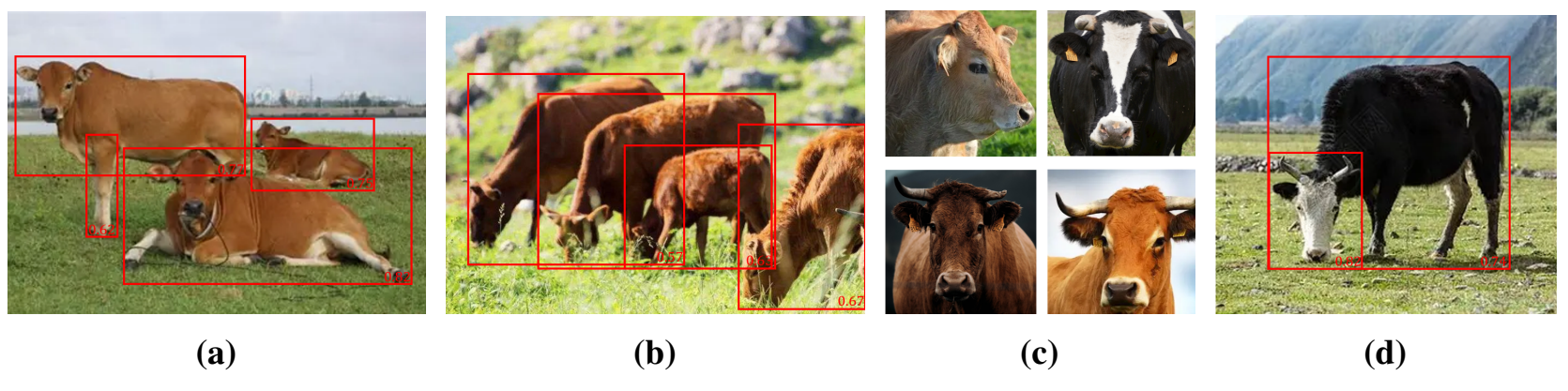
300 dpi PNG · Caption · Source PDF
Original caption, source, and provenance
Fixed source version: ICLR 2027 frozen anonymous submission PDF; retrieved 2026-10-28 UTC
Earliest verified matching figure date (temporal proxy): 2026-10-03
Actual drawing date: unknown. See the source record for version checks and temporal-evidence limitations.
Date evidence · Paper page · Complete screening and version record (Chinese)
Recorded drawing-tool disclosure: unknown. No tool attribution is inferred from appearance; see the archival disclosure evidence for scope and wording.
Crop bounding box: [106, 79, 507, 179] (PDF points; top-left origin; x0, y0, x1, y1).
Figure 2: Why over-segmentation defeats confidence-based suppression in the few-shot regime. (a) Real
scenes contain multiple overlapping same-class instances, so class-agnostic proposal generators fragment ob-
jects into nested, mutually overlapping proposals that simple merging cannot consolidate. (b) The smaller
member of a nested pair is occasionally a genuine, distinct object, so the covered box cannot simply be dis-
carded. (c) Few-shot support sets are frequently biased: a handful of examples may emphasise part-views and
fail to represent the class as a whole. (d) Under such bias, the prototype shifts towards part-views, and an
over-segmentation fragment can attain higher classification confidence than the correct whole-object proposal.
Towards Trustworthy Object Detection: Adaptive Boundary Optimization with Joint Classification and Localization Risk Control
Venue: ICLR 2027 · Submission (under review at collection)
Figure 1 · PDF page 2 · ICLR27_1I3yfptfr1_F
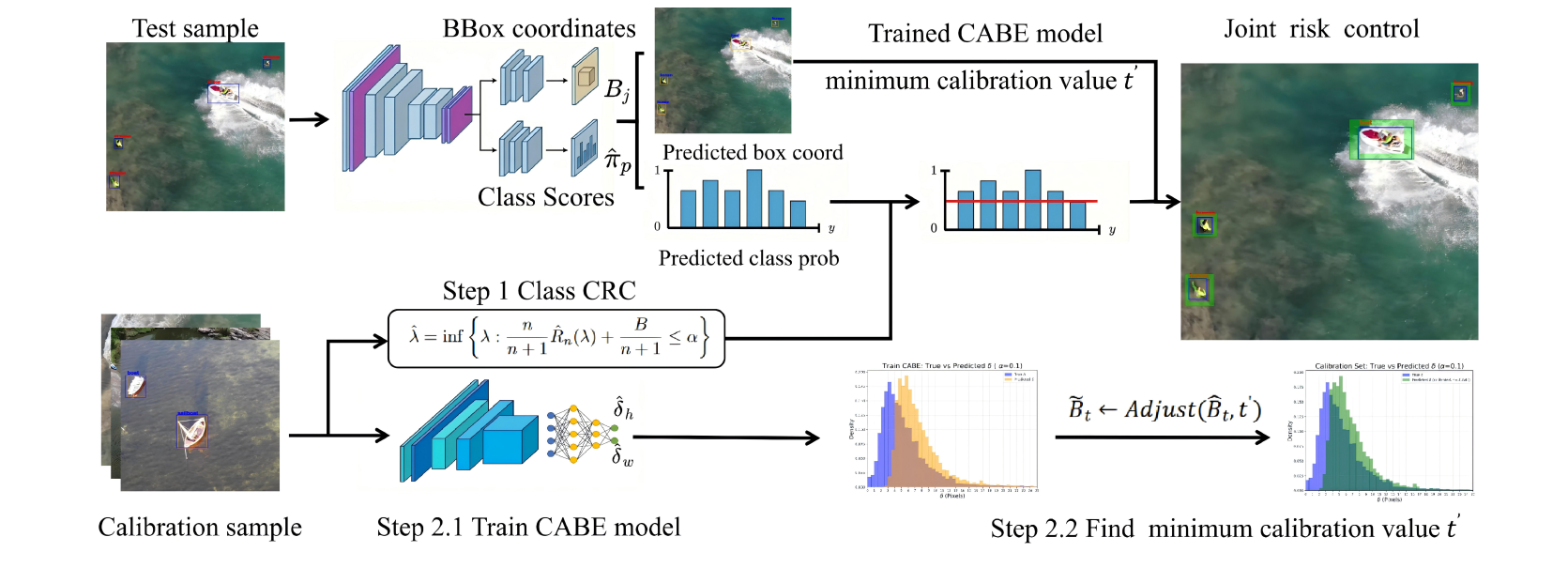
300 dpi PNG · Caption · Source PDF
Original caption, source, and provenance
Fixed source version: ICLR 2027 frozen anonymous submission PDF; retrieved 2026-10-28 UTC
Earliest verified matching figure date (temporal proxy): 2026-10-03
Actual drawing date: unknown. See the source record for version checks and temporal-evidence limitations.
Date evidence · Paper page · Complete screening and version record (Chinese)
Recorded drawing-tool disclosure: unknown. No tool attribution is inferred from appearance; see the archival disclosure evidence for scope and wording.
Crop bounding box: [106, 564, 507, 713] (PDF points; top-left origin; x0, y0, x1, y1).
Figure 1: Schematic Overview of the CABE Framework Pipeline
Towards Trustworthy Object Detection: Adaptive Boundary Optimization with Joint Classification and Localization Risk Control
Venue: ICLR 2027 · Submission (under review at collection)
Figure 2 · PDF page 5 · ICLR27_1I3yfptfr1_M
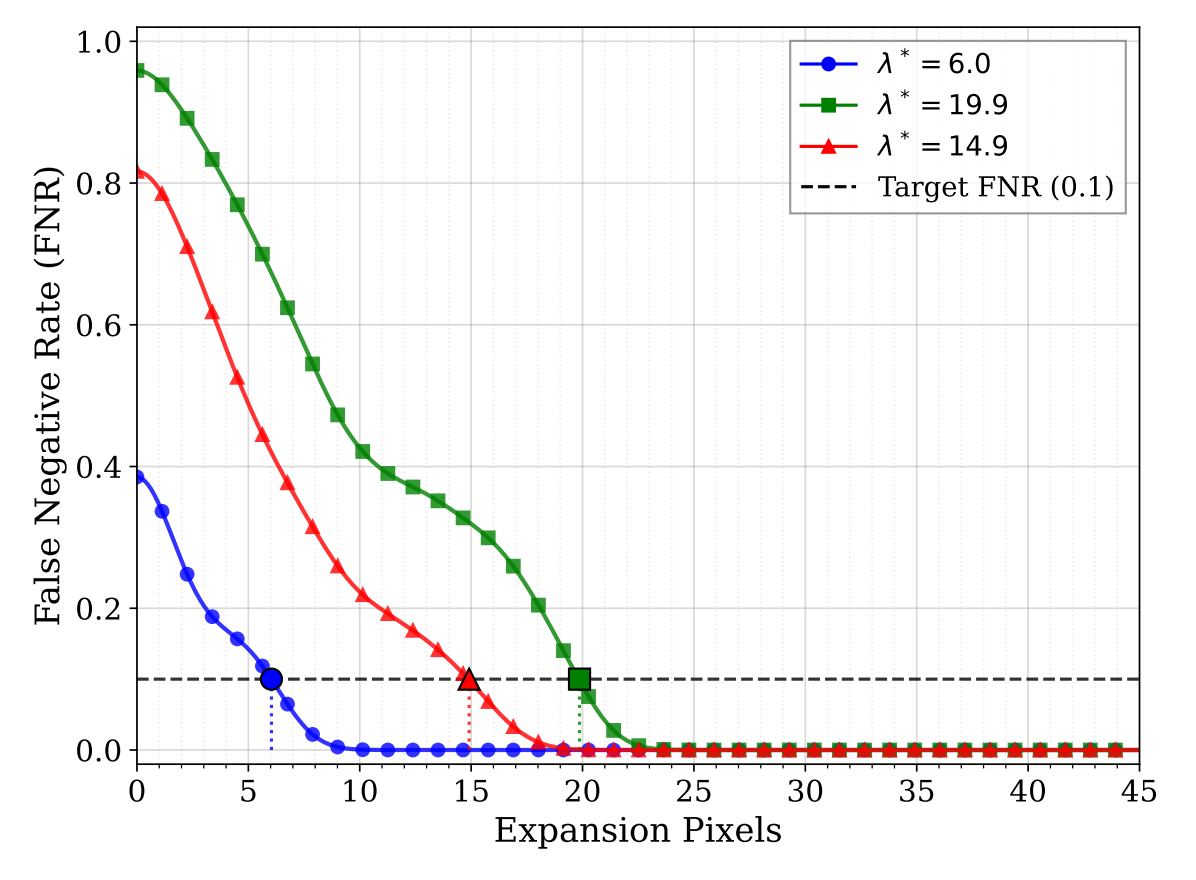
300 dpi PNG · Caption · Source PDF
Original caption, source, and provenance
Fixed source version: ICLR 2027 frozen anonymous submission PDF; retrieved 2026-10-28 UTC
Earliest verified matching figure date (temporal proxy): 2026-10-03
Actual drawing date: unknown. See the source record for version checks and temporal-evidence limitations.
Date evidence · Paper page · Complete screening and version record (Chinese)
Recorded drawing-tool disclosure: unknown. No tool attribution is inferred from appearance; see the archival disclosure evidence for scope and wording.
Crop bounding box: [163, 79, 450, 290] (PDF points; top-left origin; x0, y0, x1, y1).
Figure 2: The relationship between Expansion pixels and the empirical FNR across different images.
UniOSE: Semantics-Enriched Object Queries for Open-Ended Detection and Segmentation
Venue: ICLR 2027 · Submission (under review at collection)
Figure 2 · PDF page 4 · ICLR27_vTYhIzoLzY_F
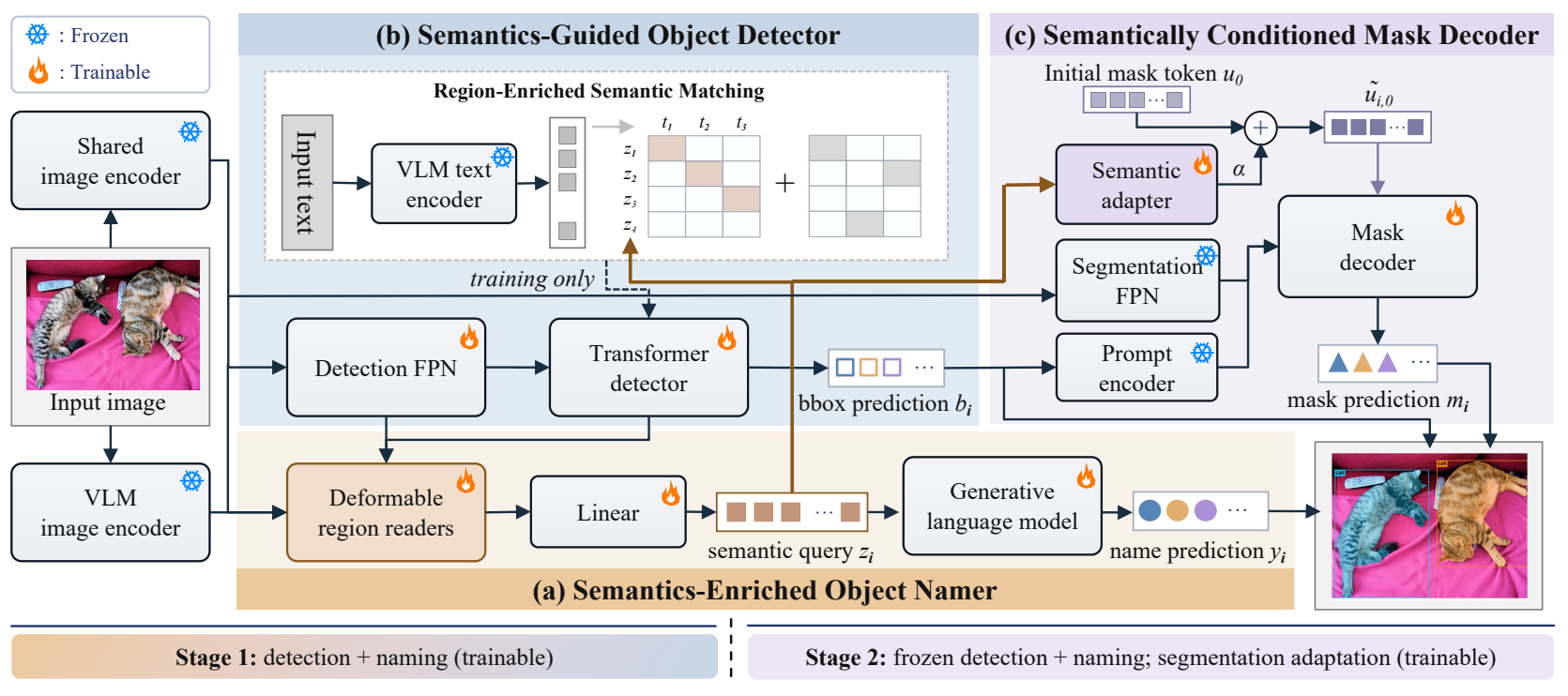
300 dpi PNG · Caption · Source PDF
Original caption, source, and provenance
Fixed source version: ICLR 2027 frozen anonymous submission PDF; retrieved 2026-10-28 UTC
Earliest verified matching figure date (temporal proxy): 2026-10-03
Actual drawing date: unknown. See the source record for version checks and temporal-evidence limitations.
Date evidence · Paper page · Complete screening and version record (Chinese)
Recorded drawing-tool disclosure: unknown. No tool attribution is inferred from appearance; see the archival disclosure evidence for scope and wording.
Crop bounding box: [106, 79, 507, 257] (PDF points; top-left origin; x0, y0, x1, y1).
Figure 2: Overview of the UniOSE model. (a) Semantics-Enriched Object Namer combines
Deformable region reader layer
detector features with region-level VLM semantics to construct queries z and generates category
i
names with a generative lang F uage model. (b) Semantics-Guided Object Dx2etector predicts candi-
q Deformable
date boxes and combines query–targ+et caLteaygeroNroyrmmatchFiFnNg cos+ts wiLtahyesrNpoarmtial costs for training-time
Cross-Attention
supervision assignment. (c) Semantically Conditioned Mask Decoder injects z into the first mask
i
token and combines it with image features and predicted boxes to generate masks.
UniOSE: Semantics-Enriched Object Queries for Open-Ended Detection and Segmentation
Venue: ICLR 2027 · Submission (under review at collection)
Figure 1 · PDF page 2 · ICLR27_vTYhIzoLzY_M
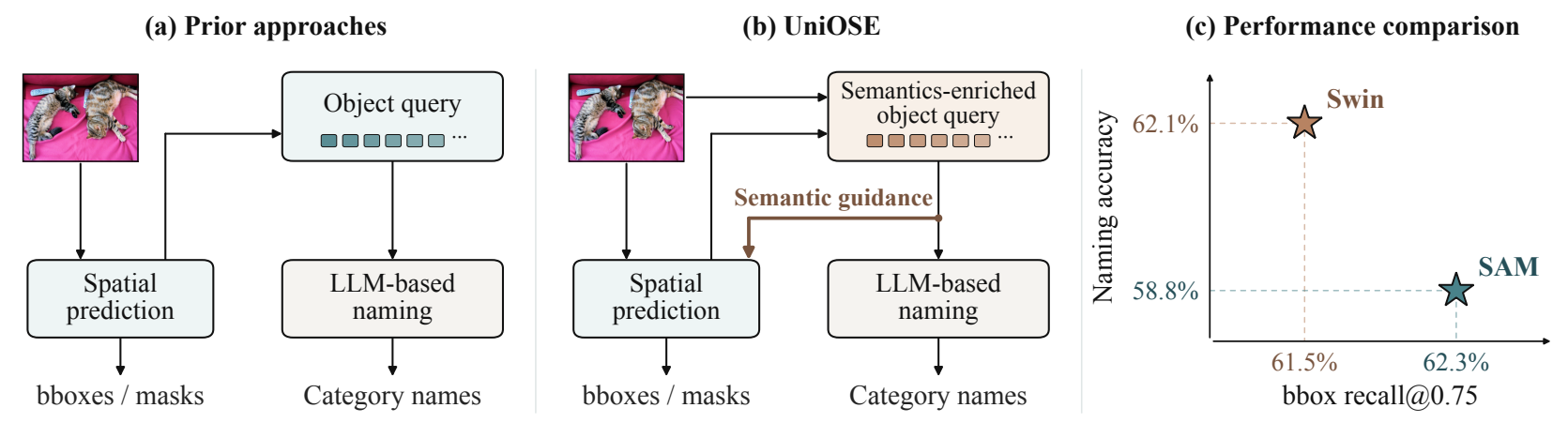
300 dpi PNG · Caption · Source PDF
Original caption, source, and provenance
Fixed source version: ICLR 2027 frozen anonymous submission PDF; retrieved 2026-10-28 UTC
Earliest verified matching figure date (temporal proxy): 2026-10-03
Actual drawing date: unknown. See the source record for version checks and temporal-evidence limitations.
Date evidence · Paper page · Complete screening and version record (Chinese)
Recorded drawing-tool disclosure: unknown. No tool attribution is inferred from appearance; see the archival disclosure evidence for scope and wording.
Crop bounding box: [106, 79, 507, 191] (PDF points; top-left origin; x0, y0, x1, y1).
Figure 1: Object semantics for open-ended naming and spatial prediction. (a) Spatial prediction produces object queries for LLM-based naming. (b) UniOSE enriches these queries with image-derived regional semantics and uses them for training-time detection matching and mask conditioning. Semantic guidance originates from the enriched query before LLM-based naming. (c) Comparison of box recall@0.75 and naming accuracy. Swin and SAM denote Open-Det Swin-T and its fully fine-tuned SAM2-T backbone variant, respectively. The protocol, metric definitions, and source results are provided in Appendix A.1.
Architectural Missing-Modality Robustness in Semantic Segmentation
Venue: ICLR 2027 · Submission (under review at collection)
Figure 2 · PDF page 3 · ICLR27_ymk7OpPLY8_F

300 dpi PNG · Caption · Source PDF
Original caption, source, and provenance
Fixed source version: ICLR 2027 frozen anonymous submission PDF; retrieved 2026-10-28 UTC
Earliest verified matching figure date (temporal proxy): 2026-10-03
Actual drawing date: unknown. See the source record for version checks and temporal-evidence limitations.
Date evidence · Paper page · Complete screening and version record (Chinese)
Recorded drawing-tool disclosure: unknown. No tool attribution is inferred from appearance; see the archival disclosure evidence for scope and wording.
Crop bounding box: [106, 79, 507, 133] (PDF points; top-left origin; x0, y0, x1, y1).
Figure 2: A-MoM integration with a Transformer. A single Transformer with shared weights
processes all modalities stacked along the batch dimension; A-MoM fuses them between layers,
independently at every token. A learned aggregation merges m tokens into 1 token at the stage output.
Architectural Missing-Modality Robustness in Semantic Segmentation
Venue: ICLR 2027 · Submission (under review at collection)
Figure 1 · PDF page 2 · ICLR27_ymk7OpPLY8_M

300 dpi PNG · Caption · Source PDF
Original caption, source, and provenance
Fixed source version: ICLR 2027 frozen anonymous submission PDF; retrieved 2026-10-28 UTC
Earliest verified matching figure date (temporal proxy): 2026-10-03
Actual drawing date: unknown. See the source record for version checks and temporal-evidence limitations.
Date evidence · Paper page · Complete screening and version record (Chinese)
Recorded drawing-tool disclosure: unknown. No tool attribution is inferred from appearance; see the archival disclosure evidence for scope and wording.
Crop bounding box: [106, 79, 507, 143] (PDF points; top-left origin; x0, y0, x1, y1).
Figure 1: Token-level motivation. Sensor advantages are local, so the fusion decision belongs at the
token level, illustrated by 1 case each for RGB, events, and depth.
Calibration-Guided State Selection and Class-Conditioned Fusion for Frozen Diffusion Segmentation
Venue: ICLR 2027 · Submission (under review at collection)
Figure 3 · PDF page 5 · ICLR27_NYrrKvi2Dy_F
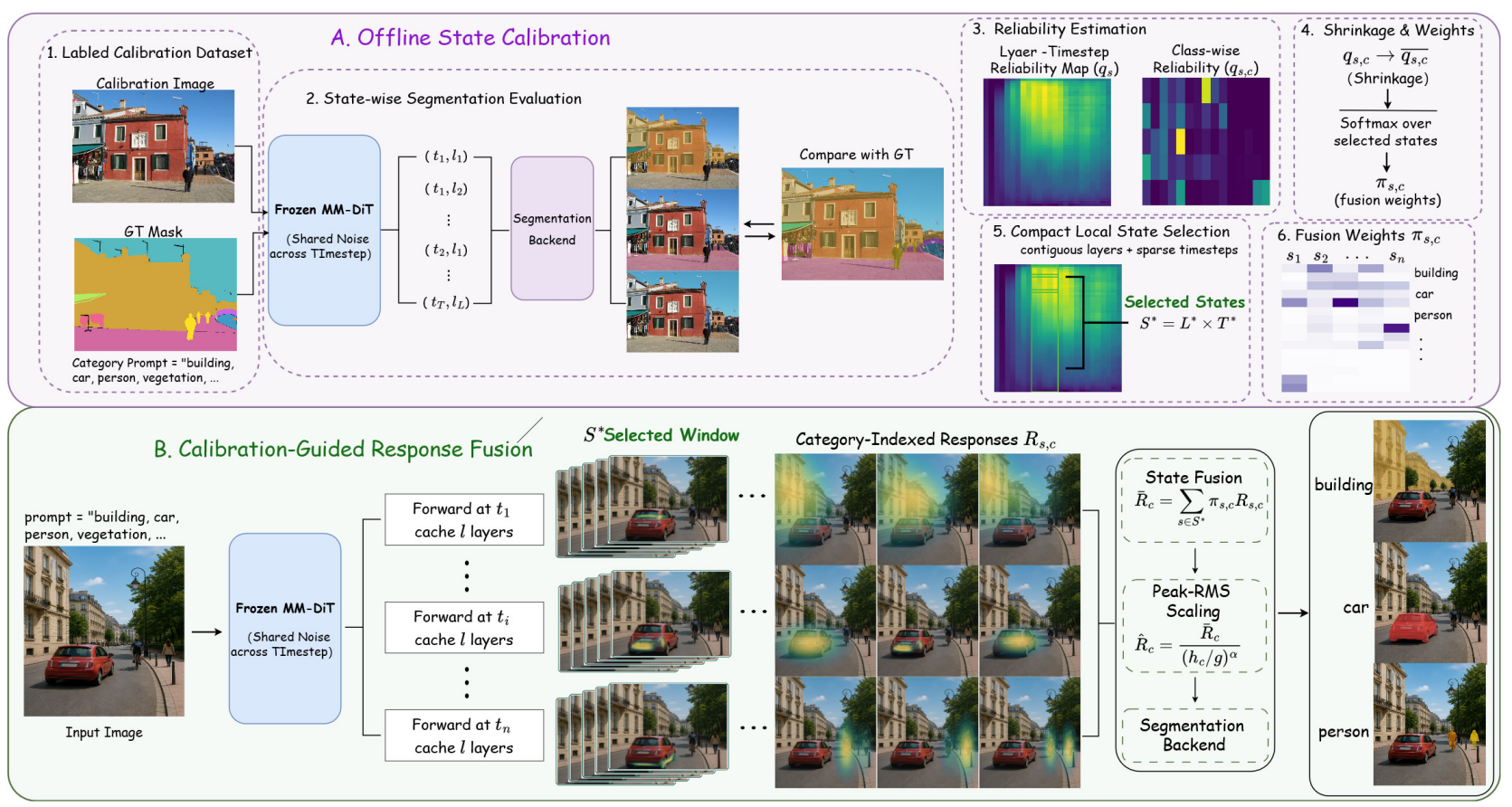
300 dpi PNG · Caption · Source PDF
Original caption, source, and provenance
Fixed source version: ICLR 2027 frozen anonymous submission PDF; retrieved 2026-10-28 UTC
Earliest verified matching figure date (temporal proxy): 2026-10-03
Actual drawing date: unknown. See the source record for version checks and temporal-evidence limitations.
Date evidence · Paper page · Complete screening and version record (Chinese)
Recorded drawing-tool disclosure: unknown. No tool attribution is inferred from appearance; see the archival disclosure evidence for scope and wording.
Crop bounding box: [106, 79, 507, 293] (PDF points; top-left origin; x0, y0, x1, y1).
Figure 3: Overview of Classwise State Routing. Top: A labeled calibration set estimates down-
stream class-by-state reliability, selects a compact shared state pool, and fixes class-conditioned
routing weights. Bottom: For a new image, the frozen backbone extracts selected-state responses,
which are fused and rescaled before unchanged backend-native decoding.
Calibration-Guided State Selection and Class-Conditioned Fusion for Frozen Diffusion Segmentation
Venue: ICLR 2027 · Submission (under review at collection)
Figure 2 · PDF page 3 · ICLR27_NYrrKvi2Dy_M
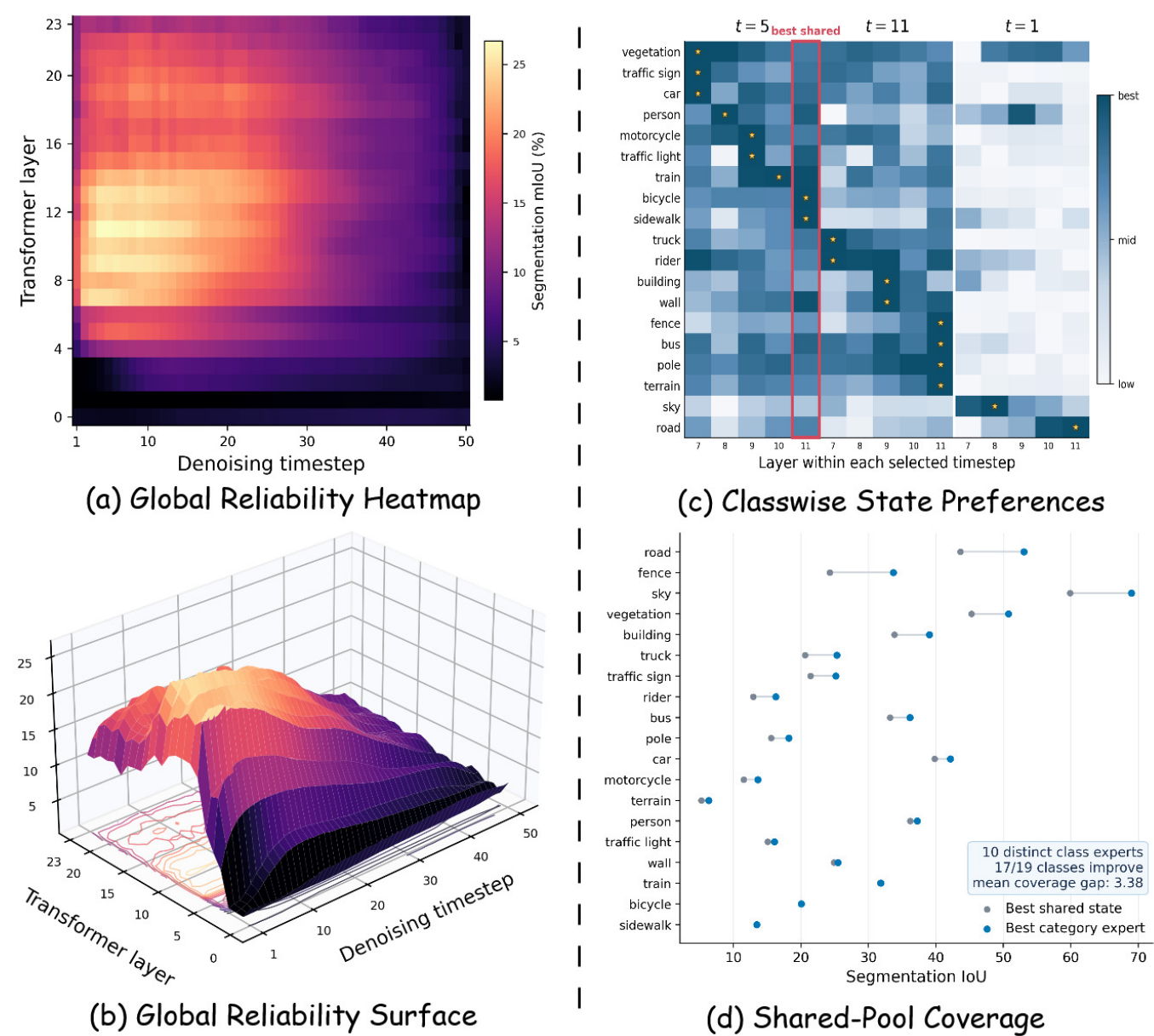
300 dpi PNG · Caption · Source PDF
Original caption, source, and provenance
Fixed source version: ICLR 2027 frozen anonymous submission PDF; retrieved 2026-10-28 UTC
Earliest verified matching figure date (temporal proxy): 2026-10-03
Actual drawing date: unknown. See the source record for version checks and temporal-evidence limitations.
Date evidence · Paper page · Complete screening and version record (Chinese)
Recorded drawing-tool disclosure: unknown. No tool attribution is inferred from appearance; see the archival disclosure evidence for scope and wording.
Crop bounding box: [139, 80, 464, 372] (PDF points; top-left origin; x0, y0, x1, y1).
Figure 2: (a) Segmentation mIoU over 1,200 layer–timestep states; (b) Three-dimensional view
of the same performance landscape. (c) Classwise reliability over the selected states; stars mark
classwise maxima and red marks the strongest shared state. (d) Class IoU of the strongest shared
state and each class’s preferred state.
DevoSeg: Budget-Aware Self-Evolving Semantic Segmentation under Visual Degradation
Venue: ICLR 2027 · Submission (under review at collection)
Figure 2 · PDF page 4 · ICLR27_8aErJ21sV6_F
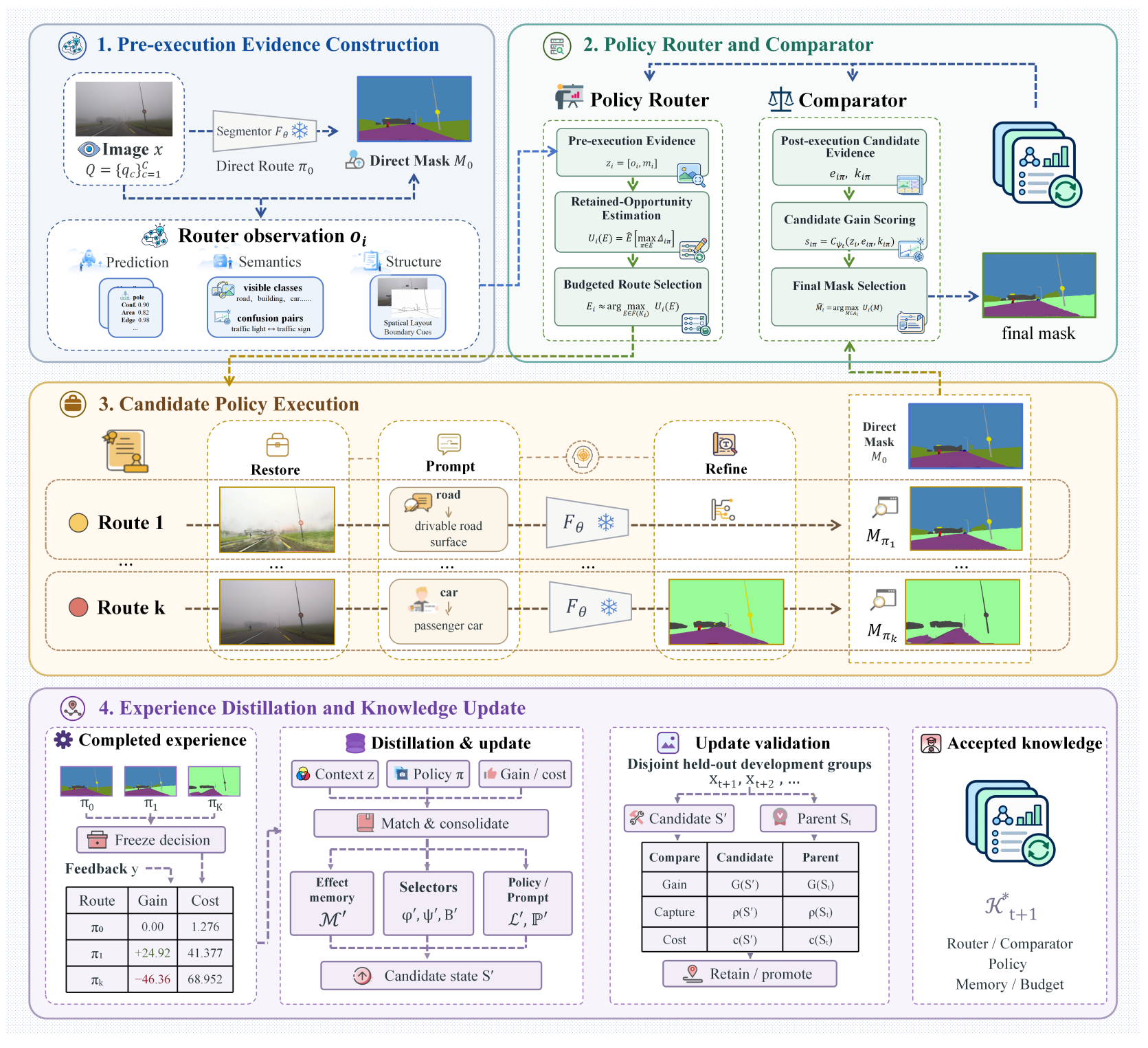
300 dpi PNG · Caption · Source PDF
Original caption, source, and provenance
Fixed source version: ICLR 2027 frozen anonymous submission PDF; retrieved 2026-10-28 UTC
Earliest verified matching figure date (temporal proxy): 2026-10-03
Actual drawing date: unknown. See the source record for version checks and temporal-evidence limitations.
Date evidence · Paper page · Complete screening and version record (Chinese)
Recorded drawing-tool disclosure: unknown. No tool attribution is inferred from appearance; see the archival disclosure evidence for scope and wording.
Crop bounding box: [106, 79, 507, 445] (PDF points; top-left origin; x0, y0, x1, y1).
Figure 2: DevoSeg’s decision process. The Router chooses policies before execution; the Compara-
tor selects among their masks and the independent Direct mask afterward. Completed outcomes
provide evidence for subsequent knowledge updates.
DevoSeg: Budget-Aware Self-Evolving Semantic Segmentation under Visual Degradation
Venue: ICLR 2027 · Submission (under review at collection)
Figure 1 · PDF page 2 · ICLR27_8aErJ21sV6_M
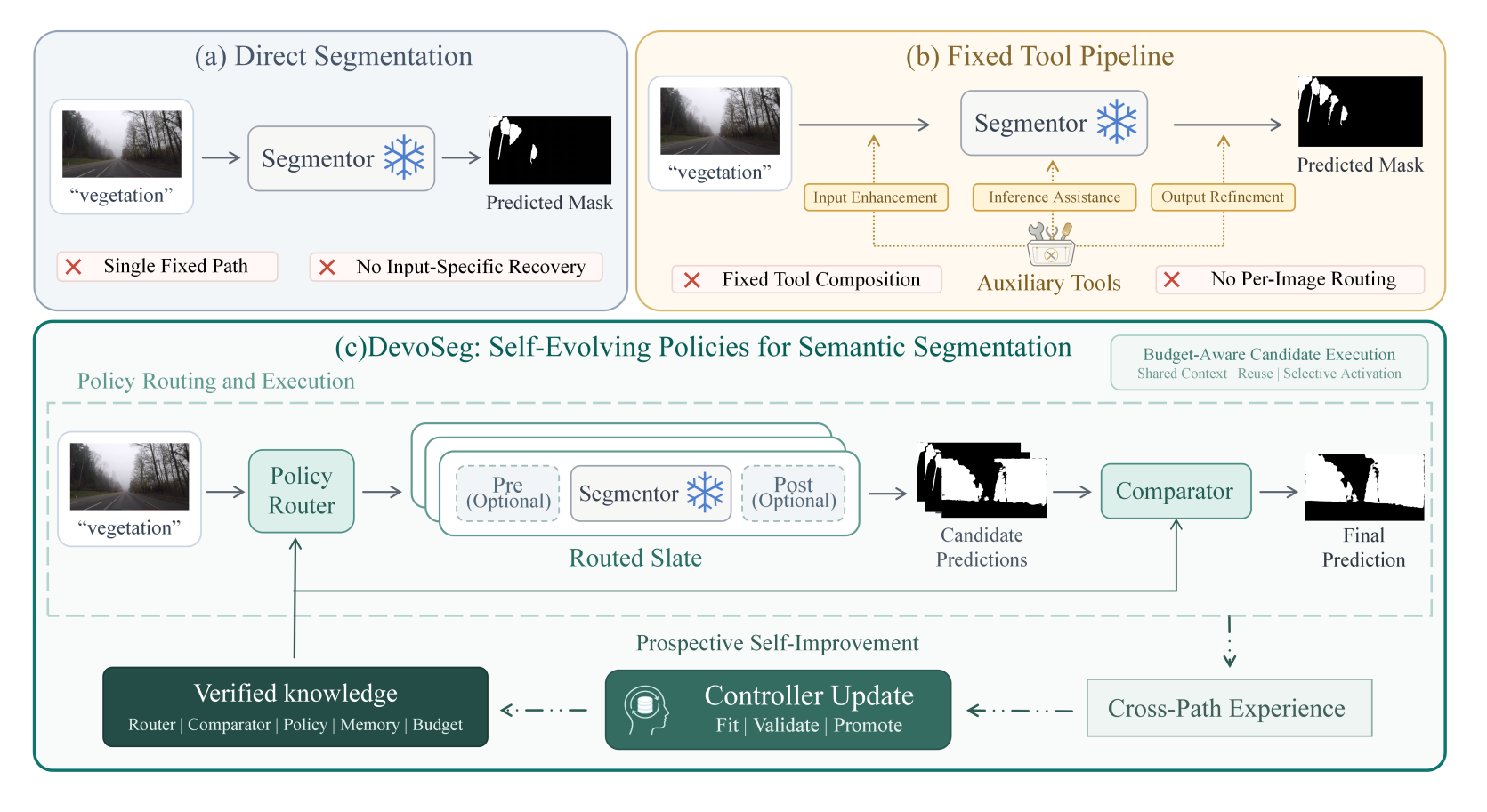
300 dpi PNG · Caption · Source PDF
Original caption, source, and provenance
Fixed source version: ICLR 2027 frozen anonymous submission PDF; retrieved 2026-10-28 UTC
Earliest verified matching figure date (temporal proxy): 2026-10-03
Actual drawing date: unknown. See the source record for version checks and temporal-evidence limitations.
Date evidence · Paper page · Complete screening and version record (Chinese)
Recorded drawing-tool disclosure: unknown. No tool attribution is inferred from appearance; see the archival disclosure evidence for scope and wording.
Crop bounding box: [106, 79, 507, 298] (PDF points; top-left origin; x0, y0, x1, y1).
Figure 1: Direct segmentation and a fixed tool pipeline follow predetermined paths. DevoSeg routes
policies per image, compares their masks, and uses completed cases to update its decision state.
HIVE: Holistic Image-Adaptive Vocabulary Evolution for Training-Free Dense Vision-Language Inference
Venue: ICLR 2027 · Submission (under review at collection)
Figure 2 · PDF page 4 · ICLR27_kv0BeIZGMk_F
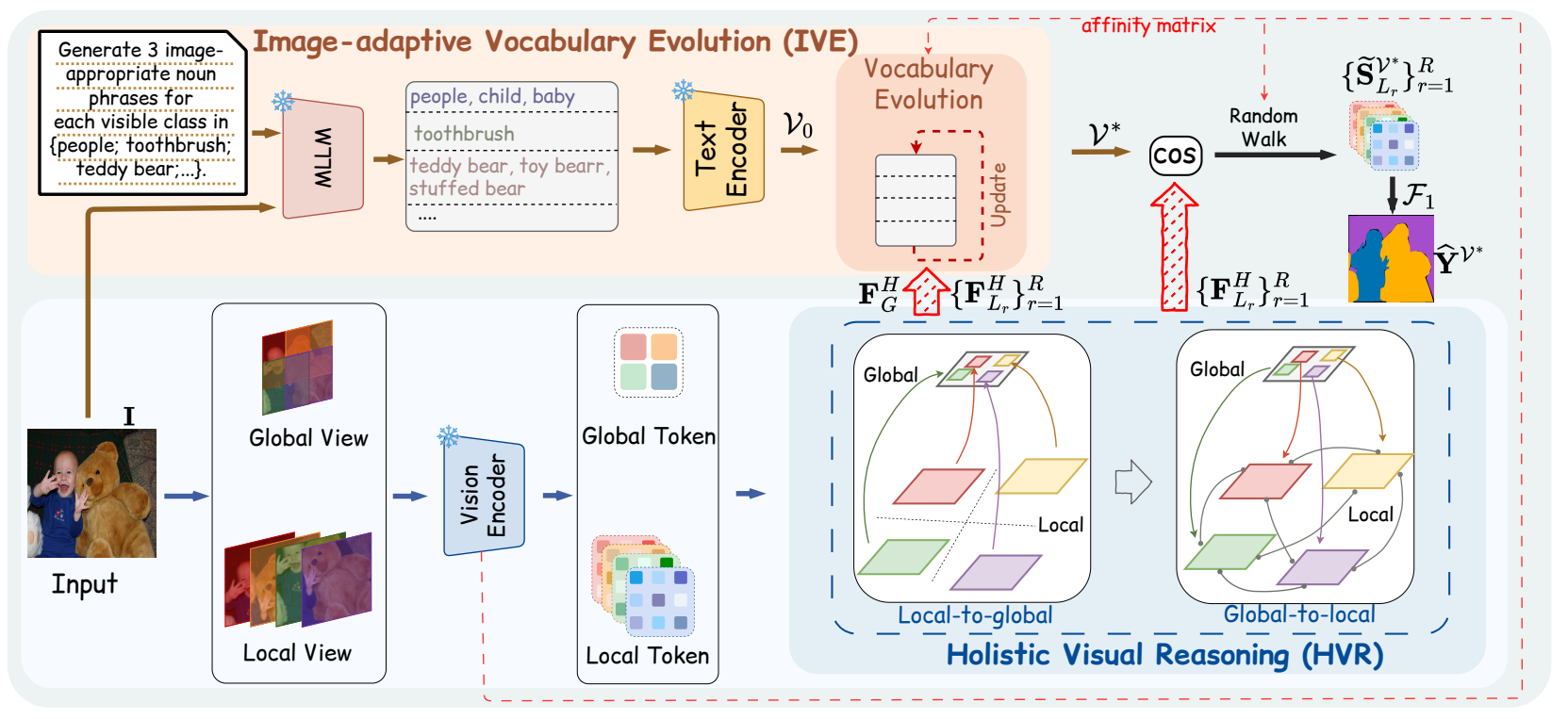
300 dpi PNG · Caption · Source PDF
Original caption, source, and provenance
Fixed source version: ICLR 2027 frozen anonymous submission PDF; retrieved 2026-10-28 UTC
Earliest verified matching figure date (temporal proxy): 2026-10-03
Actual drawing date: unknown. See the source record for version checks and temporal-evidence limitations.
Date evidence · Paper page · Complete screening and version record (Chinese)
Recorded drawing-tool disclosure: unknown. No tool attribution is inferred from appearance; see the archival disclosure evidence for scope and wording.
Crop bounding box: [107, 80, 506, 263] (PDF points; top-left origin; x0, y0, x1, y1).
Figure 2: Overview of HIVE. A frozen visual encoder processes a global view and multiple overlap-
ping local views. HVR refines local features through local-to-global-to-local interaction, producing
holistic local representations {FH }R . IVE iteratively evolves an image-specific vocabulary set
Lr r=1
V∗ under visual guidance. Finally, the local predictions derived from {ZV∗}R are refined and
Lr r=1
fused to produce the final segmentation Y˜︁ V∗.HIVE: Holistic Image-Adaptive Vocabulary Evolution for Training-Free Dense Vision-Language Inference
Venue: ICLR 2027 · Submission (under review at collection)
Figure 1 · PDF page 1 · ICLR27_kv0BeIZGMk_M
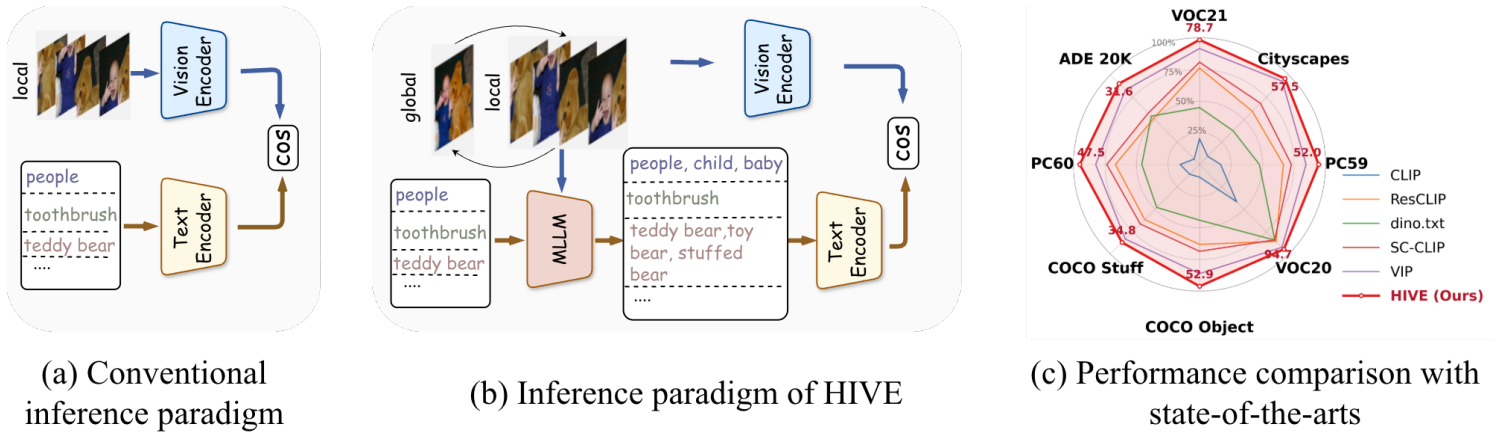
300 dpi PNG · Caption · Source PDF
Original caption, source, and provenance
Fixed source version: ICLR 2027 frozen anonymous submission PDF; retrieved 2026-10-28 UTC
Earliest verified matching figure date (temporal proxy): 2026-10-03
Actual drawing date: unknown. See the source record for version checks and temporal-evidence limitations.
Date evidence · Paper page · Complete screening and version record (Chinese)
Recorded drawing-tool disclosure: unknown. No tool attribution is inferred from appearance; see the archival disclosure evidence for scope and wording.
Crop bounding box: [126, 216, 486, 322] (PDF points; top-left origin; x0, y0, x1, y1).
Figure 1: Paradigm and performance comparison between conventional approach and our HIVE.
Past as Guidance, Not Just Constraint: Cross-Level Knowledge Reorganization for Class-Incremental Semantic Segmentation
Venue: ICLR 2027 · Submission (under review at collection)
Figure 3 · PDF page 5 · ICLR27_9S1a6H8xUR_F
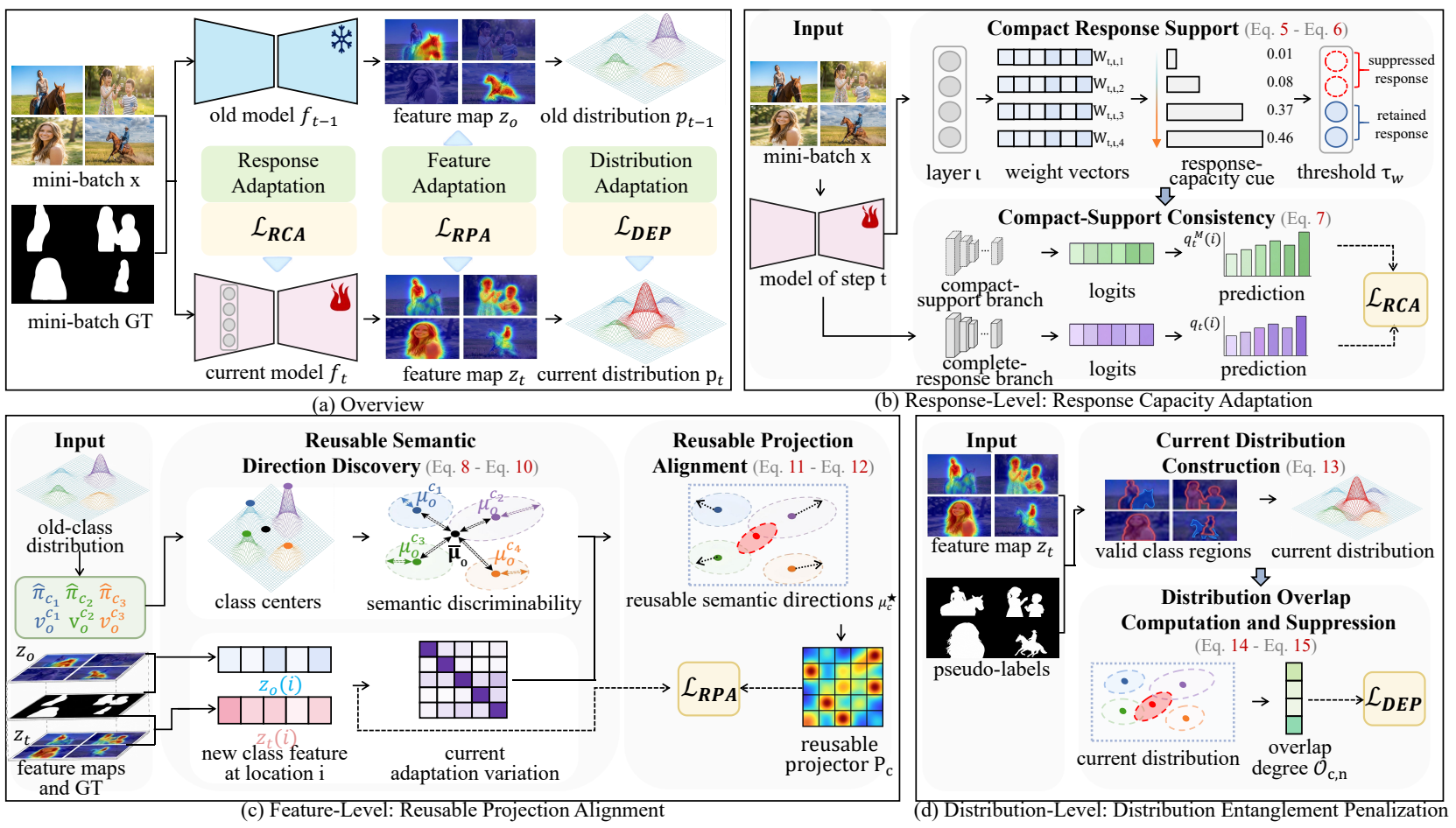
300 dpi PNG · Caption · Source PDF
Original caption, source, and provenance
Fixed source version: ICLR 2027 frozen anonymous submission PDF; retrieved 2026-10-28 UTC
Earliest verified matching figure date (temporal proxy): 2026-10-03
Actual drawing date: unknown. See the source record for version checks and temporal-evidence limitations.
Date evidence · Paper page · Complete screening and version record (Chinese)
Recorded drawing-tool disclosure: unknown. No tool attribution is inferred from appearance; see the archival disclosure evidence for scope and wording.
Crop bounding box: [107, 80, 506, 307] (PDF points; top-left origin; x0, y0, x1, y1).
Figure 3: Overview of AKI. (a) Three-level knowledge reorganization. (b) RCA constructs compact
response support and enforces response consistency. (c) RPA discovers reusable semantic directions
for selective alignment. (d) DEP suppresses current old–new distribution overlap.
Past as Guidance, Not Just Constraint: Cross-Level Knowledge Reorganization for Class-Incremental Semantic Segmentation
Venue: ICLR 2027 · Submission (under review at collection)
Figure 1 · PDF page 2 · ICLR27_9S1a6H8xUR_M
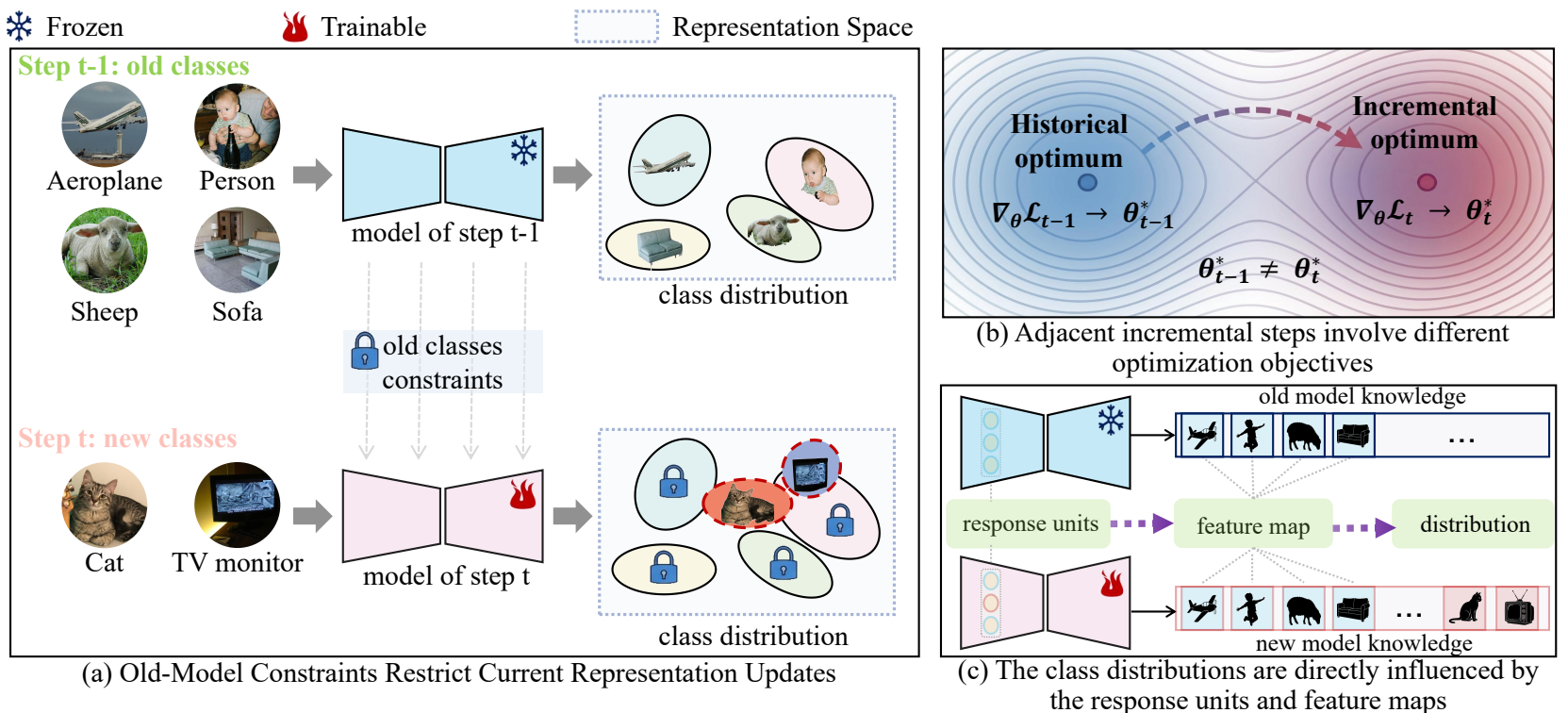
300 dpi PNG · Caption · Source PDF
Original caption, source, and provenance
Fixed source version: ICLR 2027 frozen anonymous submission PDF; retrieved 2026-10-28 UTC
Earliest verified matching figure date (temporal proxy): 2026-10-03
Actual drawing date: unknown. See the source record for version checks and temporal-evidence limitations.
Date evidence · Paper page · Complete screening and version record (Chinese)
Recorded drawing-tool disclosure: unknown. No tool attribution is inferred from appearance; see the archival disclosure evidence for scope and wording.
Crop bounding box: [107, 80, 506, 261.4] (PDF points; top-left origin; x0, y0, x1, y1).
Figure 1: Motivation of AKI. (a) Under fixed model capacity, inherited constraints can restrict the representation reorganization required by current supervision, increasing old–new distribution overlap. (b) Cross-step optimization analysis shows that adjacent incremental objectives generally correspond to different stationary states, θ*_(t−1) ≠ θ*_t, while inheritance constraints can restrict current-task-aligned adaptation. (c) Empirical analysis reveals cross-level coupling among response, feature, and distribution variations, motivating coordinated knowledge reorganization across three levels.
ReTax-Seg: Visually Grounded Reversible Taxonomy Transport for Image Segmentation
Venue: ICLR 2027 · Submission (under review at collection)
Figure 2 · PDF page 6 · ICLR27_dMBwWu68Lm_F
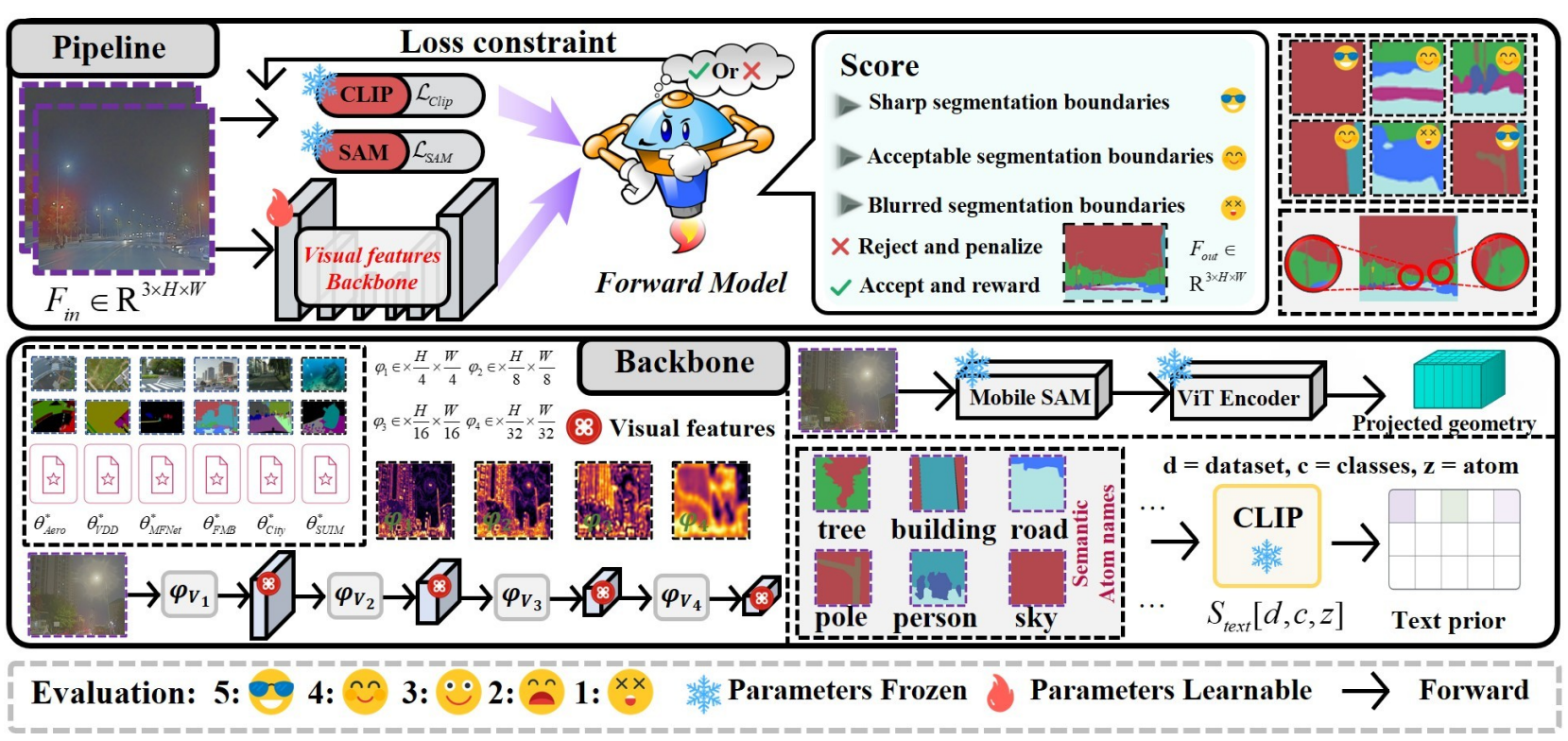
300 dpi PNG · Caption · Source PDF
Original caption, source, and provenance
Fixed source version: ICLR 2027 frozen anonymous submission PDF; retrieved 2026-10-28 UTC
Earliest verified matching figure date (temporal proxy): 2026-10-03
Actual drawing date: unknown. See the source record for version checks and temporal-evidence limitations.
Date evidence · Paper page · Complete screening and version record (Chinese)
Recorded drawing-tool disclosure: unknown; authors_deny_generative_AI_assistance. No tool attribution is inferred from appearance; see the archival disclosure evidence for scope and wording.
Crop bounding box: [107, 80, 505, 268] (PDF points; top-left origin; x0, y0, x1, y1).
Figure 2: Overview of ReTax-Seg. The upper panel summarizes the training pipeline. The visual
backbone and forward model are learnable. CLIP and SAM remain frozen. Boundary quality scores
the segmentation outputs. The lower panel details the multiscale visual backbone, the frozen Mobile-
SAM geometry branch, representative semantic atoms, and the frozen CLIP text-prior construction.
The symbol θ∗ denotes the weights associated with dataset d. The star marks the selected trained
d
checkpoint. For example, θ∗ represents the Cityscapes-specific weights. Snowflakes and flames
City
indicate frozen and learnable components, respectively.
ReTax-Seg: Visually Grounded Reversible Taxonomy Transport for Image Segmentation
Venue: ICLR 2027 · Submission (under review at collection)
Figure 1 · PDF page 2 · ICLR27_dMBwWu68Lm_M
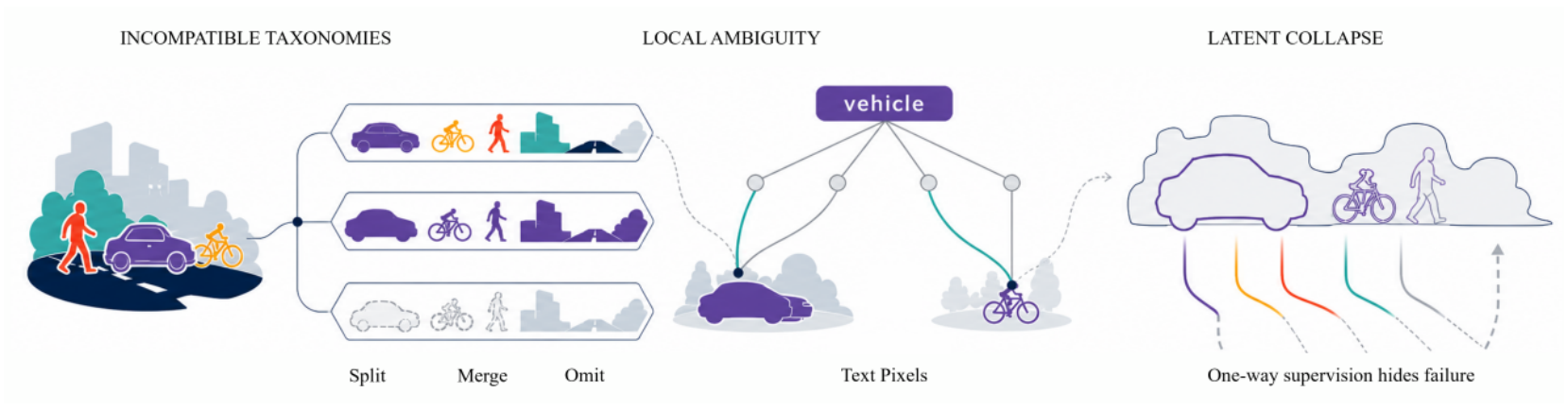
300 dpi PNG · Caption · Source PDF
Original caption, source, and provenance
Fixed source version: ICLR 2027 frozen anonymous submission PDF; retrieved 2026-10-28 UTC
Earliest verified matching figure date (temporal proxy): 2026-10-03
Actual drawing date: unknown. See the source record for version checks and temporal-evidence limitations.
Date evidence · Paper page · Complete screening and version record (Chinese)
Recorded drawing-tool disclosure: unknown; authors_deny_generative_AI_assistance. No tool attribution is inferred from appearance; see the archival disclosure evidence for scope and wording.
Crop bounding box: [107, 80, 505, 184] (PDF points; top-left origin; x0, y0, x1, y1).
Figure 1: Three unresolved challenges in taxonomy-aware segmentation. Left: identical visual
concepts can be split, merged, or omitted by different annotation policies. Center: a coarse label such
as vehicle is compatible with several semantic atoms, but the correct relation changes with local visual
evidence, which a class name alone cannot observe. Right: forward-only supervision can preserve an
apparently correct coarse mask even when distinct atom channels become indistinguishable. A useful
compiler must therefore be local, visually grounded, and semantically recoverable.
Rethinking Unaligned RGB-T Dense Prediction as Cross-Modal Information Transport
Venue: ICLR 2027 · Submission (under review at collection)
Figure 2 · PDF page 4 · ICLR27_OHqdlezqWF_F
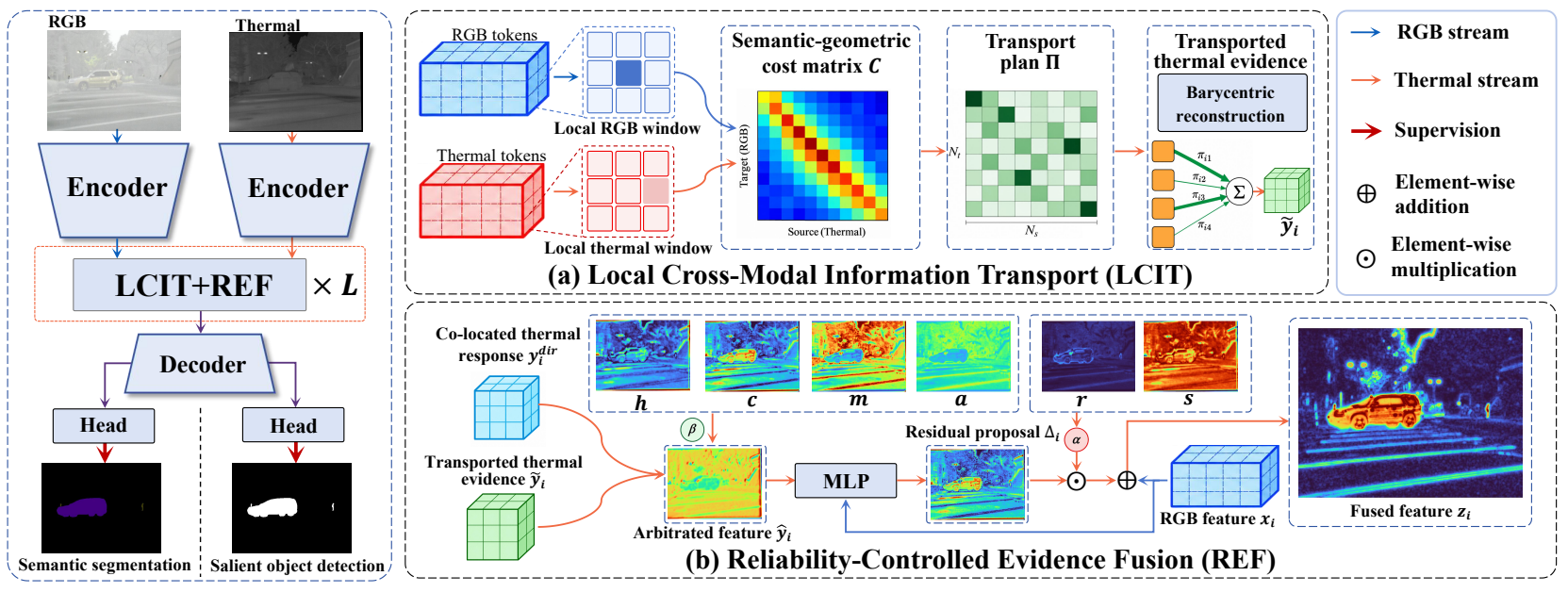
300 dpi PNG · Caption · Source PDF
Original caption, source, and provenance
Fixed source version: ICLR 2027 frozen anonymous submission PDF; retrieved 2026-10-28 UTC
Earliest verified matching figure date (temporal proxy): 2026-10-03
Actual drawing date: unknown. See the source record for version checks and temporal-evidence limitations.
Date evidence · Paper page · Complete screening and version record (Chinese)
Recorded drawing-tool disclosure: unknown. No tool attribution is inferred from appearance; see the archival disclosure evidence for scope and wording.
Crop bounding box: [107, 80, 506, 235] (PDF points; top-left origin; x0, y0, x1, y1).
Figure 2: Overview of the proposed UCMIT framework. At each scale, LCIT reconstructs RGB-
aligned thermal evidence from nearby thermal sources. REF then arbitrates between co-located and
transported evidence and regulates its residual injection into the RGB stream. The resulting multi-
scale representations are progressively aggregated for task-specific dense prediction.
Rethinking Unaligned RGB-T Dense Prediction as Cross-Modal Information Transport
Venue: ICLR 2027 · Submission (under review at collection)
Figure 1 · PDF page 2 · ICLR27_OHqdlezqWF_M
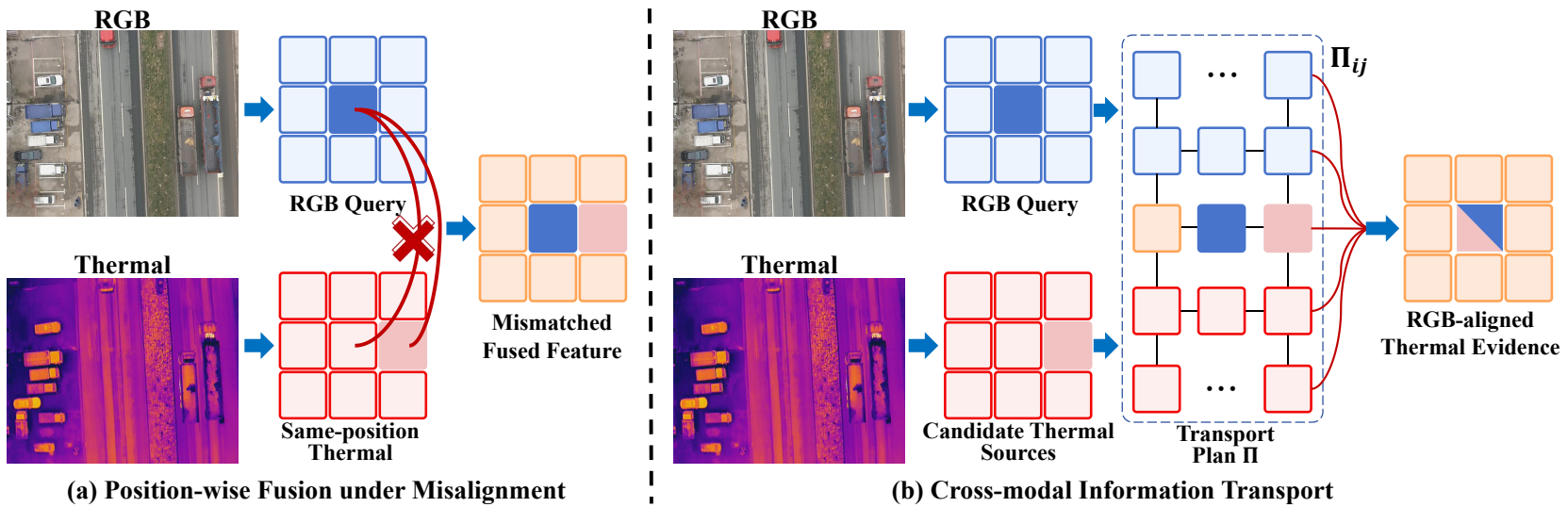
300 dpi PNG · Caption · Source PDF
Original caption, source, and provenance
Fixed source version: ICLR 2027 frozen anonymous submission PDF; retrieved 2026-10-28 UTC
Earliest verified matching figure date (temporal proxy): 2026-10-03
Actual drawing date: unknown. See the source record for version checks and temporal-evidence limitations.
Date evidence · Paper page · Complete screening and version record (Chinese)
Recorded drawing-tool disclosure: unknown. No tool attribution is inferred from appearance; see the archival disclosure evidence for scope and wording.
Crop bounding box: [107, 80, 506, 209] (PDF points; top-left origin; x0, y0, x1, y1).
Figure 1: Motivation of UCMIT. Unlike position-wise fusion under cross-modal misalignment,
UCMIT retrieves complementary thermal evidence from plausible nearby locations and reconstructs
it in RGB coordinates before representation update.
SEER: Semantic Evidence for Executable Region Propagation in Open-Vocabulary Semantic Segmentation
Venue: ICLR 2027 · Submission (under review at collection)
Figure 2 · PDF page 3 · ICLR27_hEBqQJhg1b_F
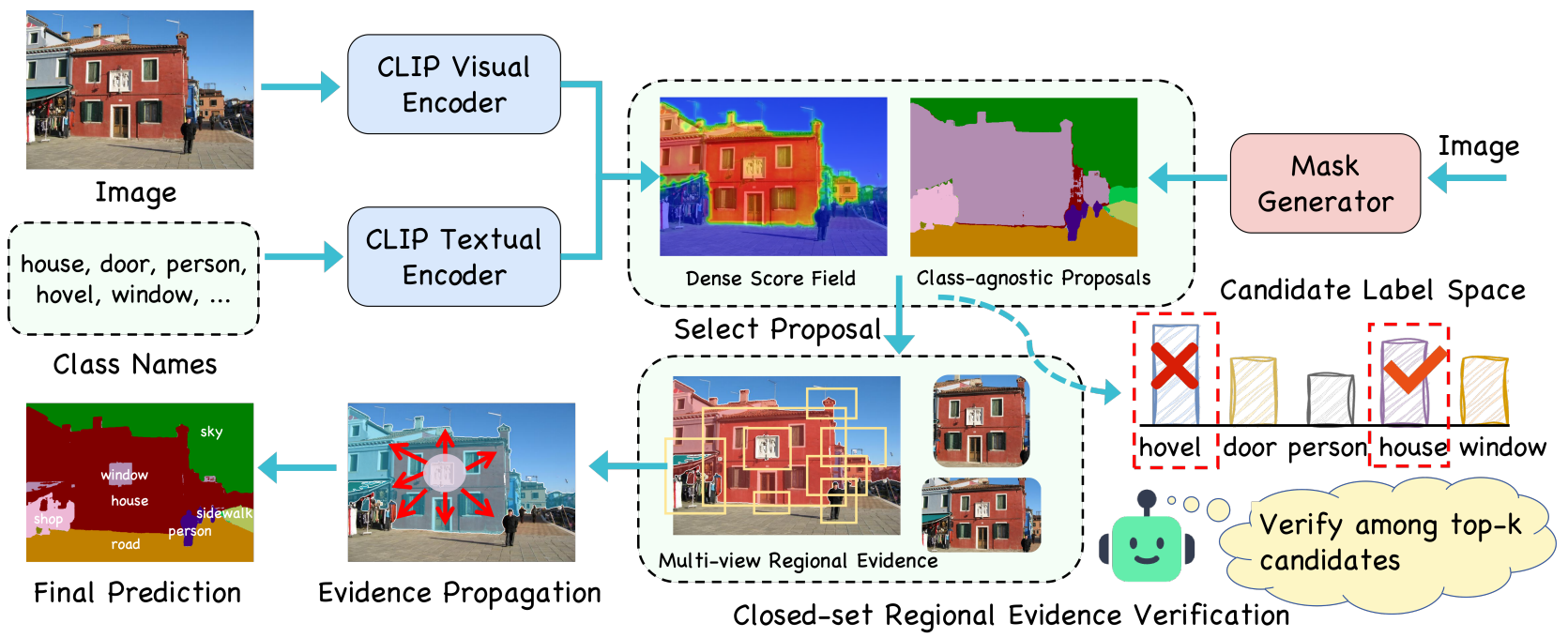
300 dpi PNG · Caption · Source PDF
Original caption, source, and provenance
Fixed source version: ICLR 2027 frozen anonymous submission PDF; retrieved 2026-10-28 UTC
Earliest verified matching figure date (temporal proxy): 2026-10-03
Actual drawing date: unknown. See the source record for version checks and temporal-evidence limitations.
Date evidence · Paper page · Complete screening and version record (Chinese)
Recorded drawing-tool disclosure: unknown. No tool attribution is inferred from appearance; see the archival disclosure evidence for scope and wording.
Crop bounding box: [106, 79, 507, 242] (PDF points; top-left origin; x0, y0, x1, y1).
Figure 2: Overview of SEER. SEER converts regional VLM evidence into executable OVSS label
propagation. From a fixed prediction, it selects ambiguous proposals, derives score-based candidates,
and verifies them with multi-view closed-set reasoning. Score support and vocabulary legality certify
the verified label, and the OVSS model controls its pixel propagation.
SEER: Semantic Evidence for Executable Region Propagation in Open-Vocabulary Semantic Segmentation
Venue: ICLR 2027 · Submission (under review at collection)
Figure 5 · PDF page 9 · ICLR27_hEBqQJhg1b_M
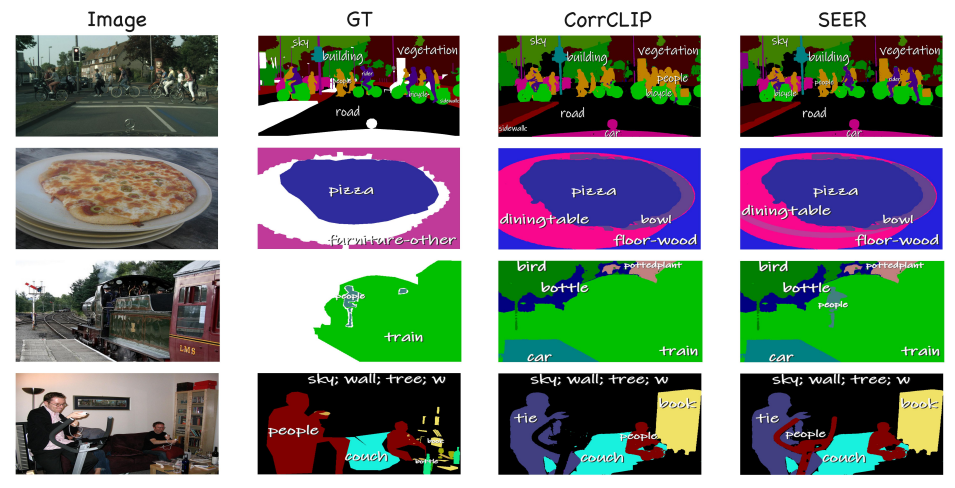
300 dpi PNG · Caption · Source PDF
Original caption, source, and provenance
Fixed source version: ICLR 2027 frozen anonymous submission PDF; retrieved 2026-10-28 UTC
Earliest verified matching figure date (temporal proxy): 2026-10-03
Actual drawing date: unknown. See the source record for version checks and temporal-evidence limitations.
Date evidence · Paper page · Complete screening and version record (Chinese)
Recorded drawing-tool disclosure: unknown. No tool attribution is inferred from appearance; see the archival disclosure evidence for scope and wording.
Crop bounding box: [114, 91, 343, 208] (PDF points; top-left origin; x0, y0, x1, y1).
Figure 5: Residual failure cases. Mixed proposals, thin struc-
tures, and weak score support can leave errors near boundaries.
Additional examples appear in Appendix K.
SHAPE: Structural Hierarchy of Affinities for Patch Enhancement in Training-Free Open-Vocabulary Semantic Segmentation
Venue: ICLR 2027 · Submission (under review at collection)
Figure 2 · PDF page 4 · ICLR27_67ApUu5dSo_F
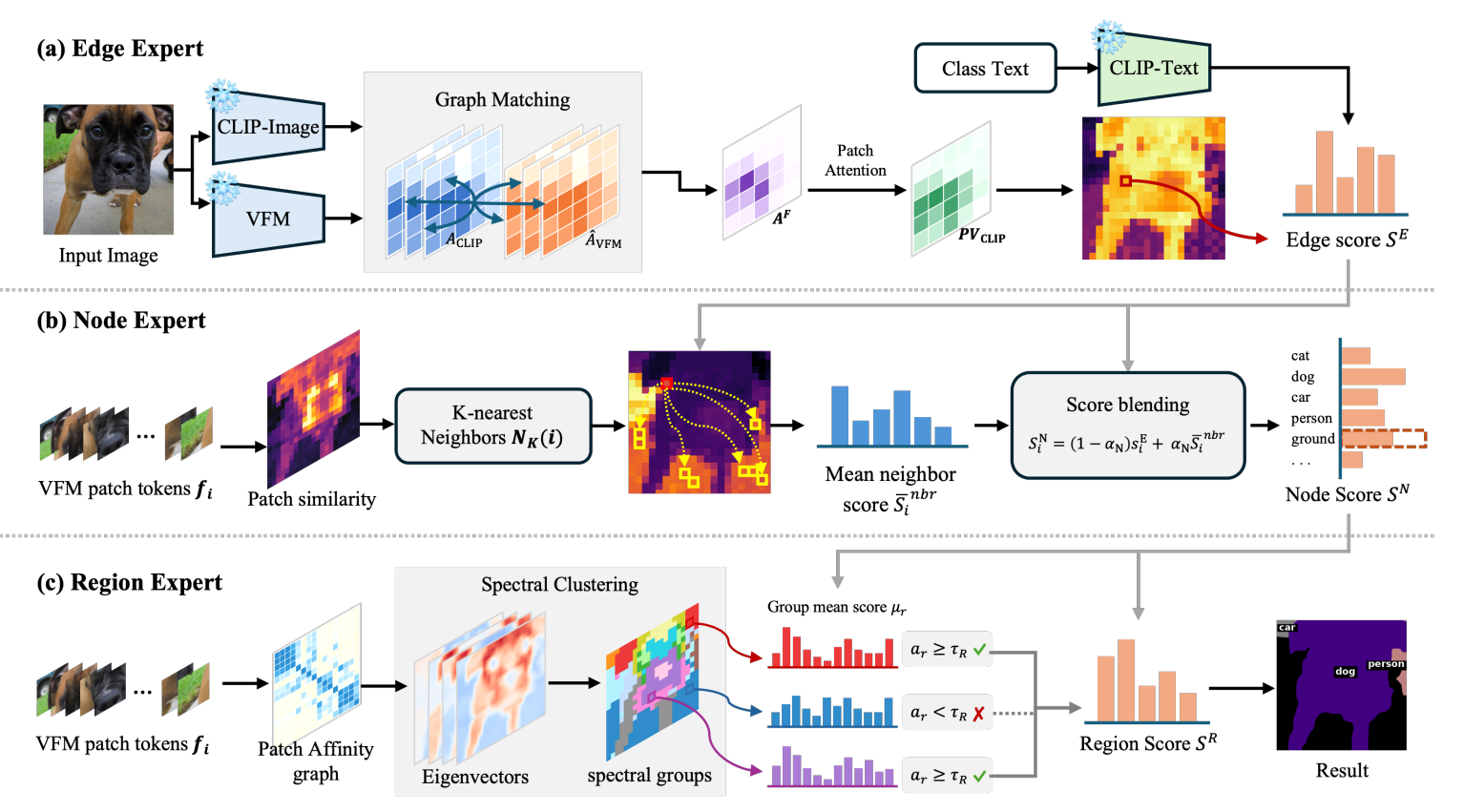
300 dpi PNG · Caption · Source PDF
Original caption, source, and provenance
Fixed source version: ICLR 2027 frozen anonymous submission PDF; retrieved 2026-10-28 UTC
Earliest verified matching figure date (temporal proxy): 2026-10-03
Actual drawing date: unknown. See the source record for version checks and temporal-evidence limitations.
Date evidence · Paper page · Complete screening and version record (Chinese)
Recorded drawing-tool disclosure: unknown. No tool attribution is inferred from appearance; see the archival disclosure evidence for scope and wording.
Crop bounding box: [122, 79, 490, 283] (PDF points; top-left origin; x0, y0, x1, y1).
Figure 2: Overview of SHAPE. (a) The Edge Expert uses relation-level VFM support to guide
CLIP feature aggregation. (b) The Node Expert uses a patch-specific VFM neighborhood to refine
each score. (c) The Region Expert uses an agreement-gated regional support to reduce residual
fragmentation. Together, the three experts organize VFM structure into complementary supports for
feature aggregation, patch-specific correction, and regional consistency.
SHAPE: Structural Hierarchy of Affinities for Patch Enhancement in Training-Free Open-Vocabulary Semantic Segmentation
Venue: ICLR 2027 · Submission (under review at collection)
Figure 1 · PDF page 2 · ICLR27_67ApUu5dSo_M
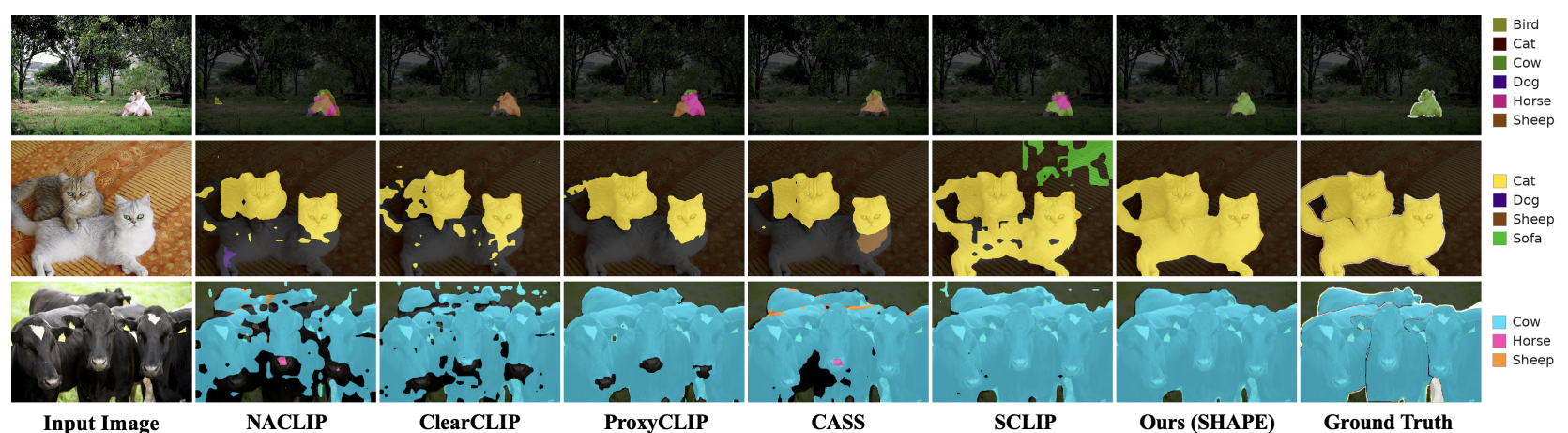
300 dpi PNG · Caption · Source PDF
Original caption, source, and provenance
Fixed source version: ICLR 2027 frozen anonymous submission PDF; retrieved 2026-10-28 UTC
Earliest verified matching figure date (temporal proxy): 2026-10-03
Actual drawing date: unknown. See the source record for version checks and temporal-evidence limitations.
Date evidence · Paper page · Complete screening and version record (Chinese)
Recorded drawing-tool disclosure: unknown. No tool attribution is inferred from appearance; see the archival disclosure evidence for scope and wording.
Crop bounding box: [106, 79, 507, 189.5] (PDF points; top-left origin; x0, y0, x1, y1).
Figure 1: Patch noise and region noise. Patch noise refers to isolated predictions that disagree with
surrounding patches, as seen in the cows (bottom), whereas region noise occurs when a semantic
region is split into inconsistent labels, as shown in the cow (top) and cats (middle). SHAPE reduces
both types of noise by selectively exploiting structural support through its Edge, Node, and Region
Experts at relation, patch, and region levels, respectively.
Where from Above, What from the Street: Learning Semantic Routing for Cross-View Segmentation under Pose Uncertainty
Venue: ICLR 2027 · Submission (under review at collection)
Figure 2 · PDF page 4 · ICLR27_J2V6tPOCod_F
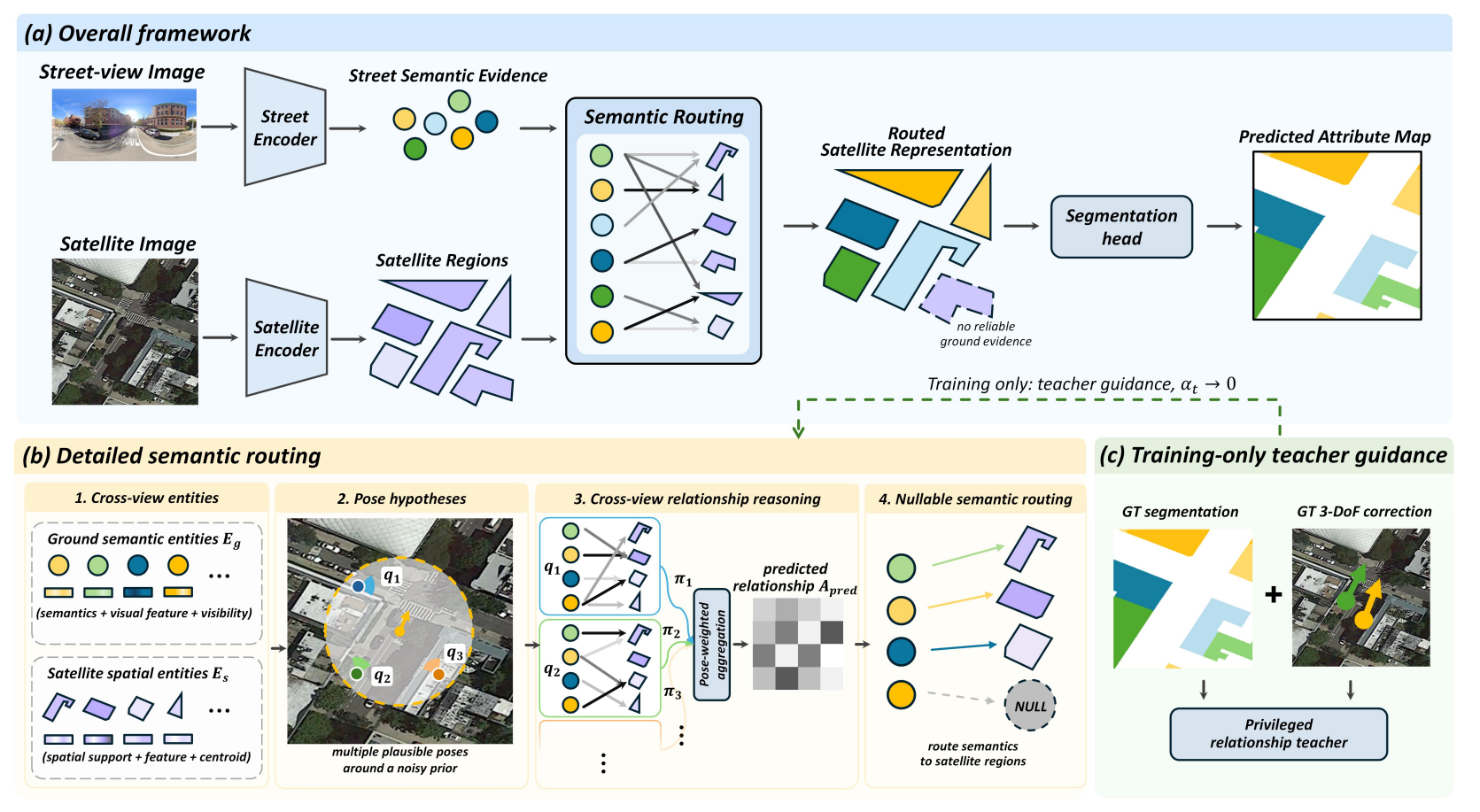
300 dpi PNG · Caption · Source PDF
Original caption, source, and provenance
Fixed source version: ICLR 2027 frozen anonymous submission PDF; retrieved 2026-10-28 UTC
Earliest verified matching figure date (temporal proxy): 2026-10-03
Actual drawing date: unknown. See the source record for version checks and temporal-evidence limitations.
Date evidence · Paper page · Complete screening and version record (Chinese)
Recorded drawing-tool disclosure: generative_AI_figure_editing_unspecified_tool. No tool attribution is inferred from appearance; see the archival disclosure evidence for scope and wording.
Crop bounding box: [106, 79, 507, 299] (PDF points; top-left origin; x0, y0, x1, y1).
Figure 2: Overview of CVRoute. (a) Street-view semantics are routed to satellite-defined regions
for satellite-space prediction. (b) Cross-view entities are matched over multiple pose hypotheses and
fused through pose-marginalized nullable routing. (c) A training-only privileged relationship teacher
guides early routing and is gradually annealed out; inference uses only predicted relationships.
Where from Above, What from the Street: Learning Semantic Routing for Cross-View Segmentation under Pose Uncertainty
Venue: ICLR 2027 · Submission (under review at collection)
Figure 1 · PDF page 2 · ICLR27_J2V6tPOCod_M
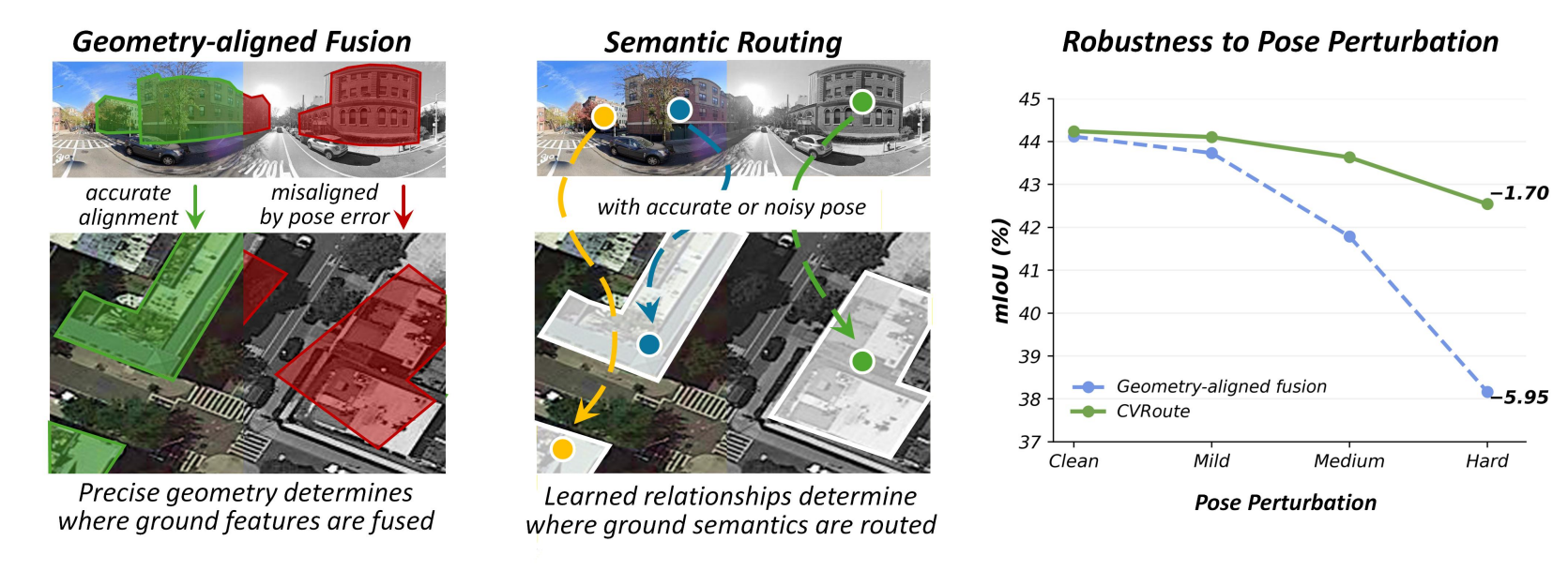
300 dpi PNG · Caption · Source PDF
Original caption, source, and provenance
Fixed source version: ICLR 2027 frozen anonymous submission PDF; retrieved 2026-10-28 UTC
Earliest verified matching figure date (temporal proxy): 2026-10-03
Actual drawing date: unknown. See the source record for version checks and temporal-evidence limitations.
Date evidence · Paper page · Complete screening and version record (Chinese)
Recorded drawing-tool disclosure: generative_AI_figure_editing_unspecified_tool. No tool attribution is inferred from appearance; see the archival disclosure evidence for scope and wording.
Crop bounding box: [106, 79, 507, 229] (PDF points; top-left origin; x0, y0, x1, y1).
Figure 1: Motivation for semantic routing under pose uncertainty. Pose errors weaken the spatial
correspondence used by alignment-based cross-view fusion, motivating CVRoute to associate street-
view semantic evidence with satellite regions through learned cross-view relationships.
$\mathrm{S}^{3}$-PnP: Plug-and-Play Denoising for Scientific Imaging with Self-Supervised Score Priors
Venue: ICLR 2027 · Submission (under review at collection)
Figure 2 · PDF page 6 · ICLR27_v44KR7QgKE_F
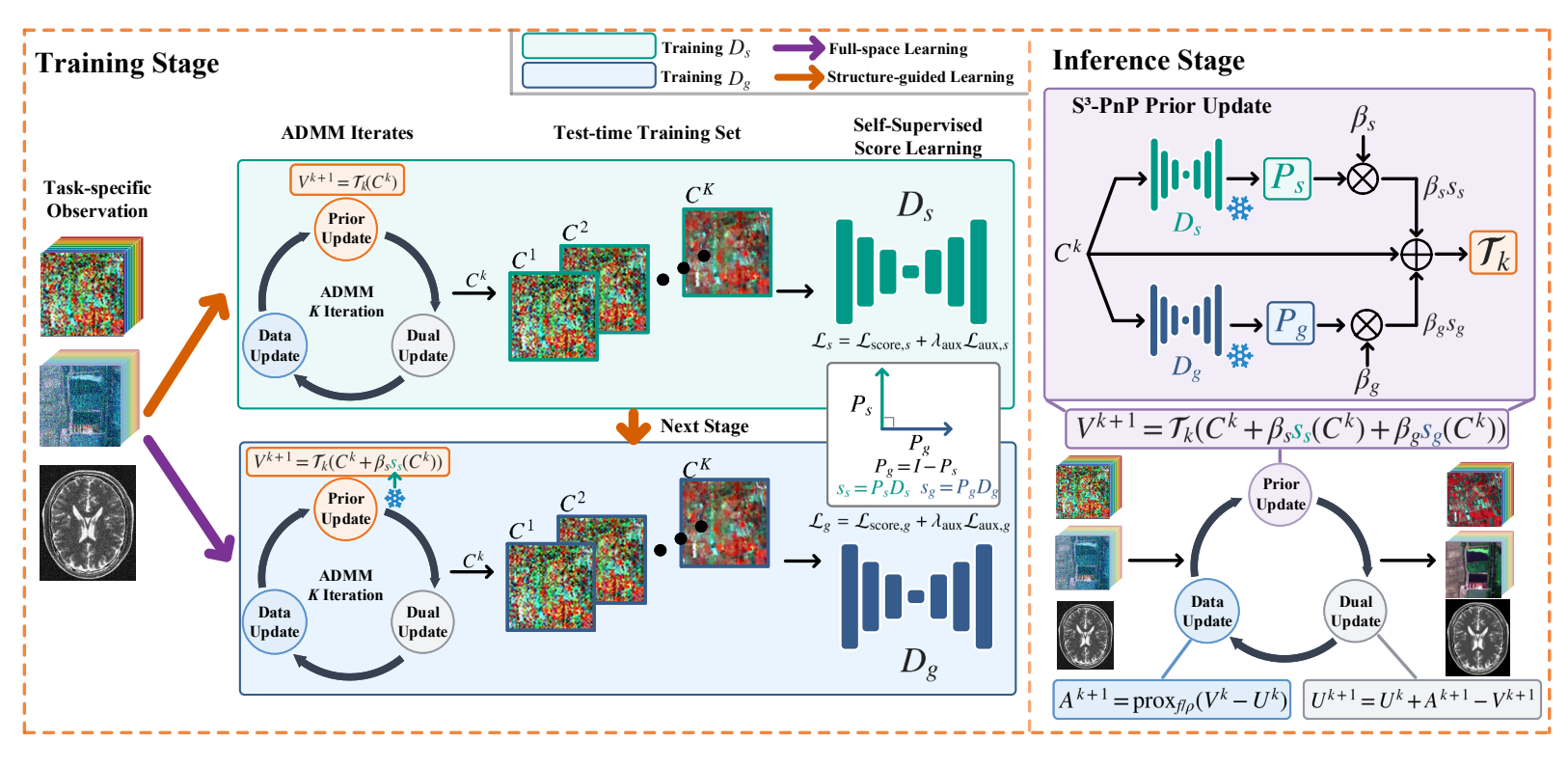
300 dpi PNG · Caption · Source PDF
Original caption, source, and provenance
Fixed source version: ICLR 2027 frozen anonymous submission PDF; retrieved 2026-10-28 UTC
Earliest verified matching figure date (temporal proxy): 2026-10-03
arXiv v1 date: 2026-10-13
Actual drawing date: unknown. See the source record for version checks and temporal-evidence limitations.
Historical PDF · Download citation snapshot · Date evidence · Paper page · Complete screening and version record (Chinese)
Citation threshold evidence: Konrad Schindler; 47613 citations; snapshot 2026-10-21.
Recorded drawing-tool disclosure: unknown. No tool attribution is inferred from appearance; see the archival disclosure evidence for scope and wording.
Crop bounding box: [111, 82, 501, 273] (PDF points; top-left origin; x0, y0, x1, y1).
Figure 2: Training and inference of S3-PnP. Purple arrows indicate full-space learning with P = 0,
s
P = I, and β = 0. Orange arrows indicate structure-guided learning: D is trained and frozen, and
g s s
its correction is enabled to collect a new state training set for D . At inference, active corrections are
g
evaluated at the same ADMM input and combined before a single analytical prior update. Snowflakes
denote frozen networks.
$\mathrm{S}^{3}$-PnP: Plug-and-Play Denoising for Scientific Imaging with Self-Supervised Score Priors
Venue: ICLR 2027 · Submission (under review at collection)
Figure 1 · PDF page 2 · ICLR27_v44KR7QgKE_M
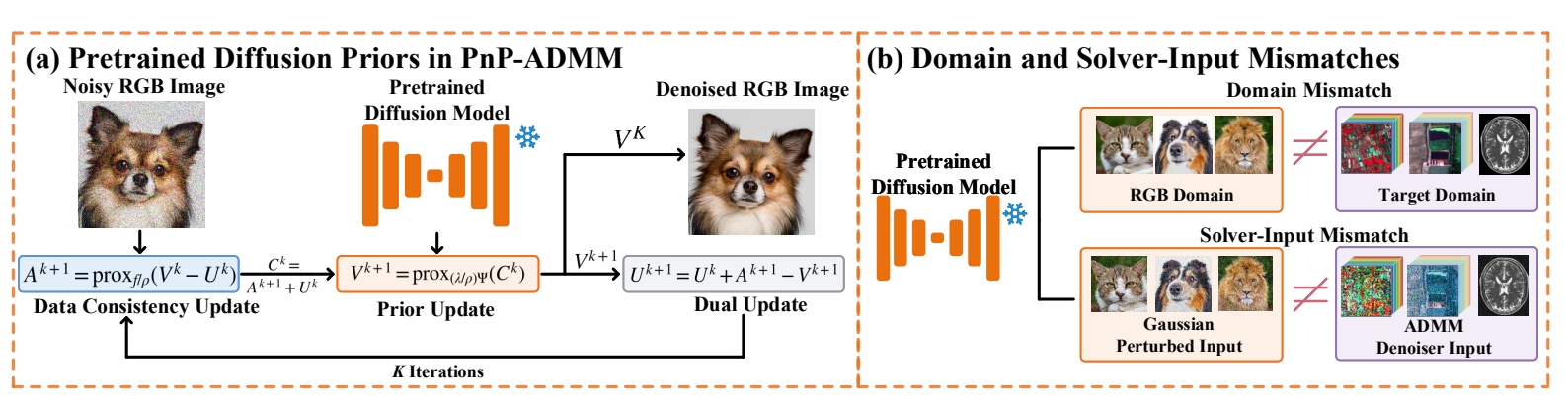
300 dpi PNG · Caption · Source PDF
Original caption, source, and provenance
Fixed source version: ICLR 2027 frozen anonymous submission PDF; retrieved 2026-10-28 UTC
Earliest verified matching figure date (temporal proxy): 2026-10-03
arXiv v1 date: 2026-10-13
Actual drawing date: unknown. See the source record for version checks and temporal-evidence limitations.
Historical PDF · Download citation snapshot · Date evidence · Paper page · Complete screening and version record (Chinese)
Citation threshold evidence: Konrad Schindler; 47613 citations; snapshot 2026-10-21.
Recorded drawing-tool disclosure: unknown. No tool attribution is inferred from appearance; see the archival disclosure evidence for scope and wording.
Crop bounding box: [121, 81, 502, 181] (PDF points; top-left origin; x0, y0, x1, y1).
Figure 1: Two sources of mismatch when using pretrained image priors in scientific imaging:
differences between the pretraining and target image domains, and differences between score-model
training inputs and ADMM denoiser inputs.
Degradation Frequency Curve: An Explicit Frequency-Quantified Representation for All-in-One Image Restoration
Venue: ICLR 2027 · Submission (under review at collection)
Figure 4 · PDF page 6 · ICLR27_IP9k9VdnnS_F
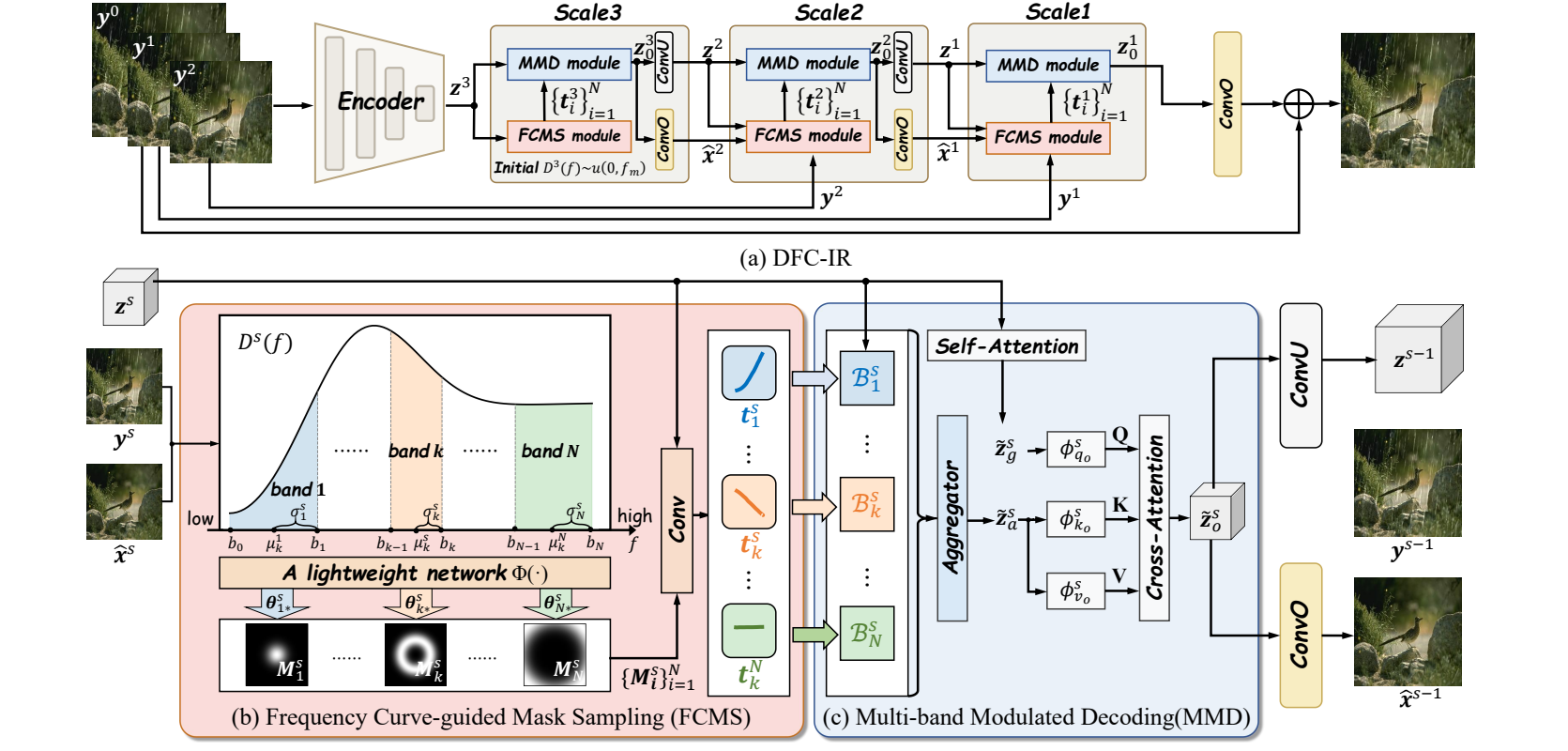
300 dpi PNG · Caption · Source PDF
Original caption, source, and provenance
Fixed source version: ICLR 2027 frozen anonymous submission PDF; retrieved 2026-10-28 UTC
Earliest verified matching figure date (temporal proxy): 2026-10-03
arXiv v1 date: 2026-05-17
Actual drawing date: unknown. See the source record for version checks and temporal-evidence limitations.
Historical PDF · Download citation snapshot · Date evidence · Paper page · Complete screening and version record (Chinese)
Citation threshold evidence: Qibin Hou; 34230 citations; snapshot 2026-10-21.
Recorded drawing-tool disclosure: unknown. No tool attribution is inferred from appearance; see the archival disclosure evidence for scope and wording.
Crop bounding box: [106, 79, 507, 271] (PDF points; top-left origin; x0, y0, x1, y1).
Figure 4: (a) The overall framework of DFC-IR. (b) FCMS for adaptive DFC tokenization and
spectral token extraction. (c) MMD for token-guided feature modulation and aggregation.
Degradation Frequency Curve: An Explicit Frequency-Quantified Representation for All-in-One Image Restoration
Venue: ICLR 2027 · Submission (under review at collection)
Figure 1 · PDF page 1 · ICLR27_IP9k9VdnnS_M
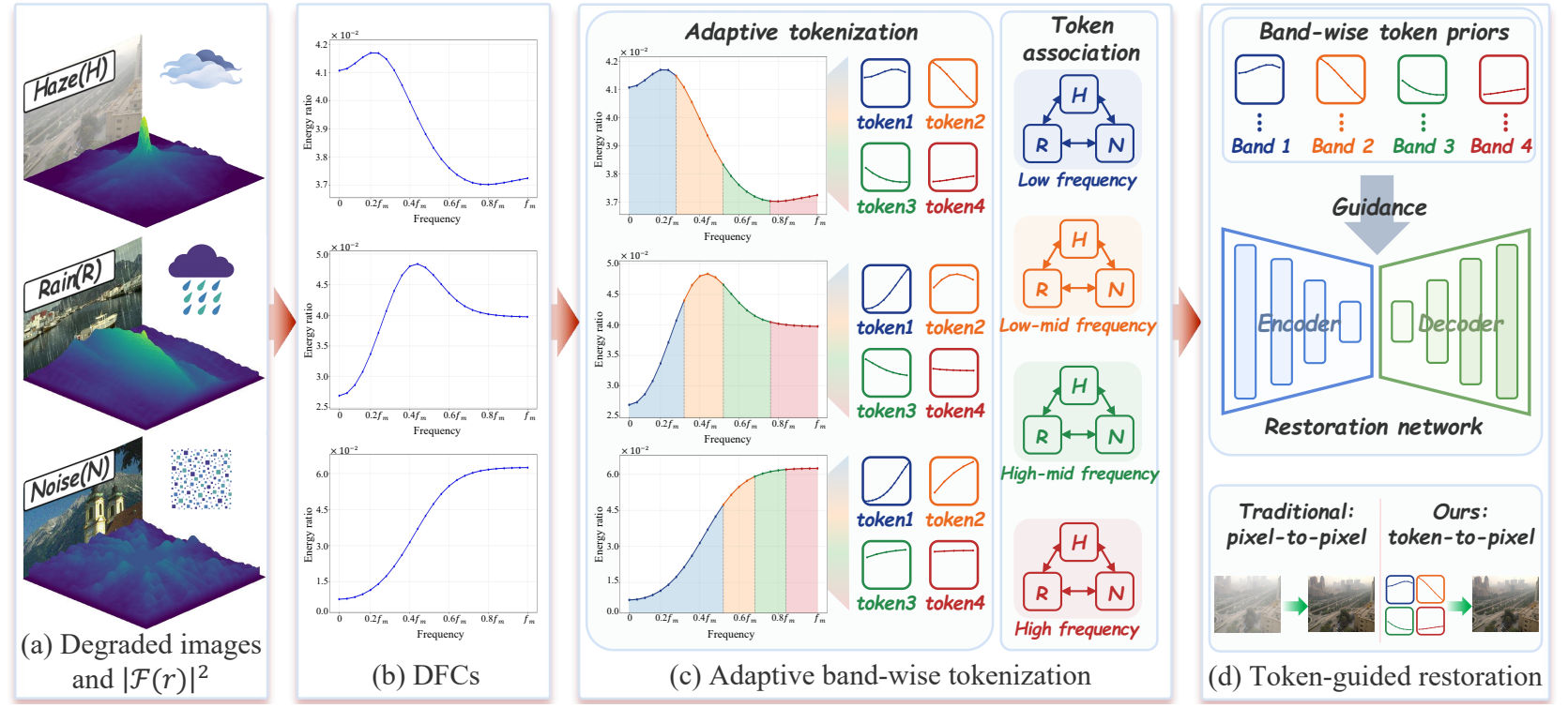
300 dpi PNG · Caption · Source PDF
Original caption, source, and provenance
Fixed source version: ICLR 2027 frozen anonymous submission PDF; retrieved 2026-10-28 UTC
Earliest verified matching figure date (temporal proxy): 2026-10-03
arXiv v1 date: 2026-05-17
Actual drawing date: unknown. See the source record for version checks and temporal-evidence limitations.
Historical PDF · Download citation snapshot · Date evidence · Paper page · Complete screening and version record (Chinese)
Citation threshold evidence: Qibin Hou; 34230 citations; snapshot 2026-10-21.
Recorded drawing-tool disclosure: unknown. No tool attribution is inferred from appearance; see the archival disclosure evidence for scope and wording.
Crop bounding box: [106, 189, 507, 370] (PDF points; top-left origin; x0, y0, x1, y1).
Figure 1: Motivation of the proposed DFC-guided restoration paradigm. (a) Degraded images and residual frequency-domain energy maps; (b) DFCs derived from residual-to-degraded energy ratios; (c) Adaptive DFC tokenization into band-wise spectral tokens, where same-band tokens across degradations form reusable spectral priors; (d) Token-guided degradation-aware restoration.
Fixing the Last Mile: Failure-Aware Image Restoration with Region-Specific Guidance
Venue: ICLR 2027 · Submission (under review at collection)
Figure 6 · PDF page 6 · ICLR27_kQkih2eMHu_F
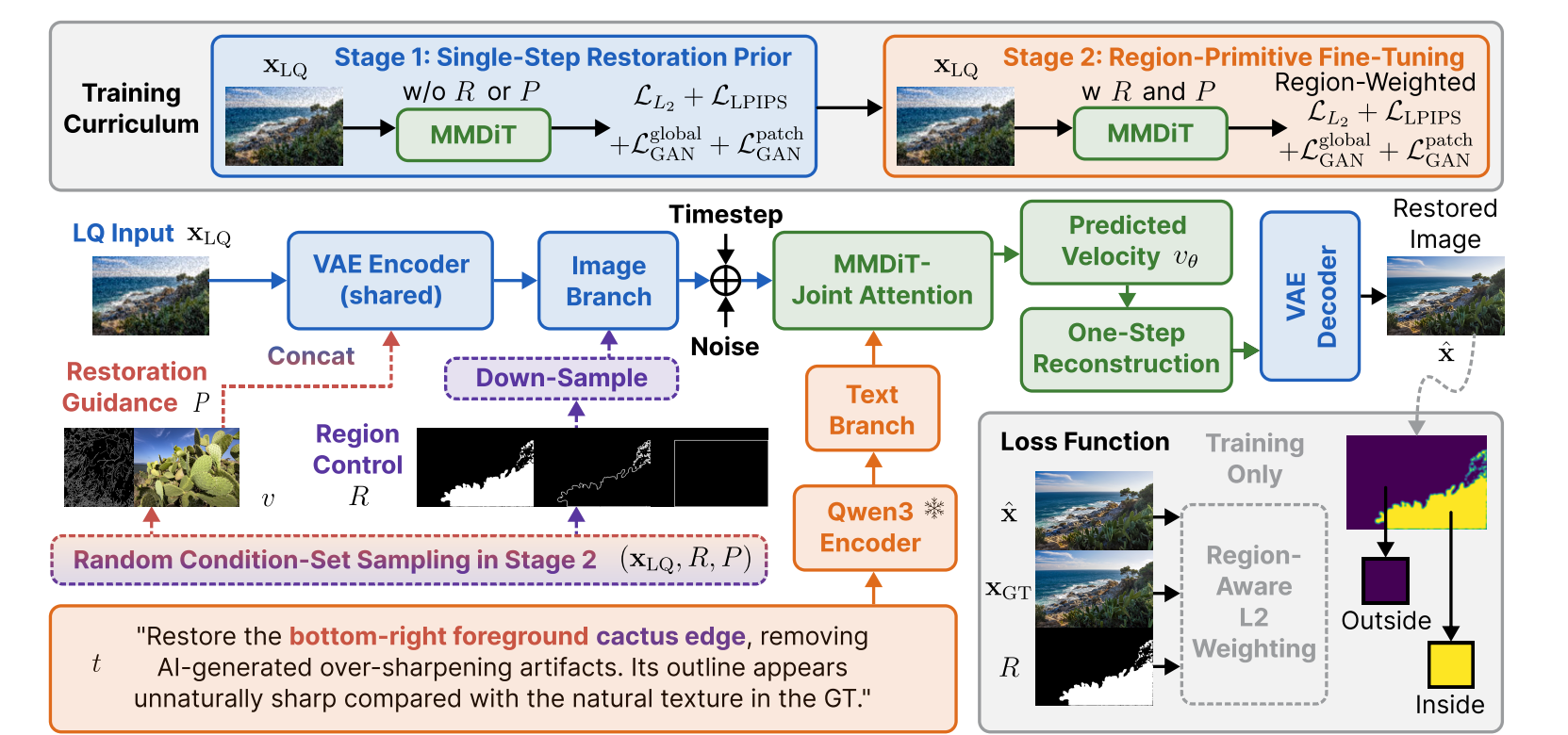
300 dpi PNG · Caption · Source PDF
Original caption, source, and provenance
Fixed source version: ICLR 2027 frozen anonymous submission PDF; retrieved 2026-10-28 UTC
Earliest verified matching figure date (temporal proxy): 2026-10-03
Actual drawing date: unknown. See the source record for version checks and temporal-evidence limitations.
Date evidence · Paper page · Complete screening and version record (Chinese)
Recorded drawing-tool disclosure: unknown. No tool attribution is inferred from appearance; see the archival disclosure evidence for scope and wording.
Crop bounding box: [107, 79, 506, 266] (PDF points; top-left origin; x0, y0, x1, y1).
Figure 6: Overview of FAIR’s two-stage training. Stage 1 learns a general restoration prior. Stage 2
conditions restoration on region control R and guidance P = (t, v), using region-aware supervision
to bind the guidance to its target region.
Fixing the Last Mile: Failure-Aware Image Restoration with Region-Specific Guidance
Venue: ICLR 2027 · Submission (under review at collection)
Figure 1 · PDF page 2 · ICLR27_kQkih2eMHu_M
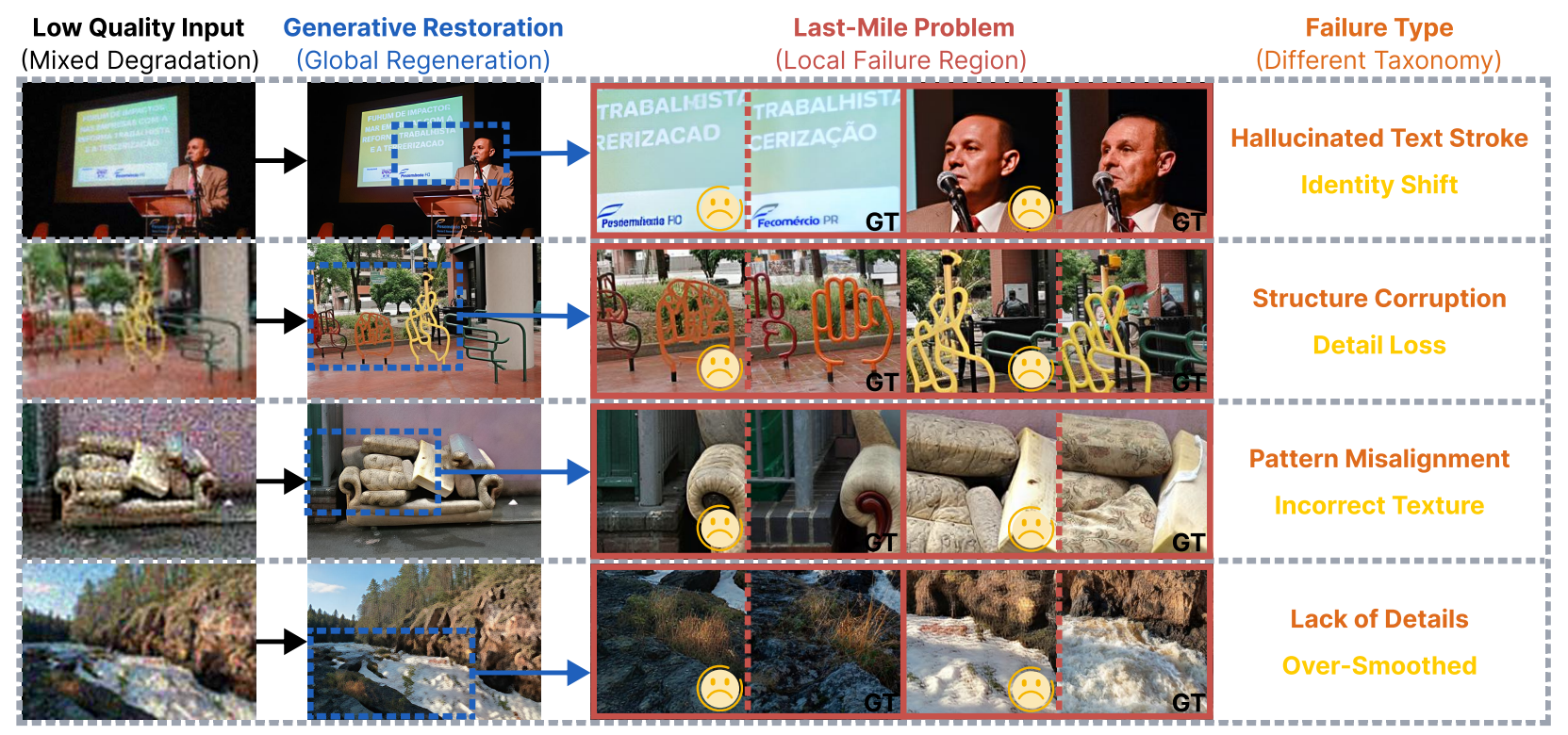
300 dpi PNG · Caption · Source PDF
Original caption, source, and provenance
Fixed source version: ICLR 2027 frozen anonymous submission PDF; retrieved 2026-10-28 UTC
Earliest verified matching figure date (temporal proxy): 2026-10-03
Actual drawing date: unknown. See the source record for version checks and temporal-evidence limitations.
Date evidence · Paper page · Complete screening and version record (Chinese)
Recorded drawing-tool disclosure: unknown. No tool attribution is inferred from appearance; see the archival disclosure evidence for scope and wording.
Crop bounding box: [107, 79, 506, 266] (PDF points; top-left origin; x0, y0, x1, y1).
Figure 1: The “last-mile” problem in generative image restoration. State-of-the-art methods (Yu
et al., 2024; Wu et al., 2024b; Lin et al., 2025) produce globally plausible reconstructions from
severely degraded inputs, yet localized failures persist. Despite their small spatial extent, these
failures dominate perceived quality and practical acceptability.
GGT-100K: Generative Ground Truth for Generalizable Real-World Image Restoration
Venue: ICLR 2027 · Submission (under review at collection)
Figure 3 · PDF page 4 · ICLR27_1n4L8nXB1I_F
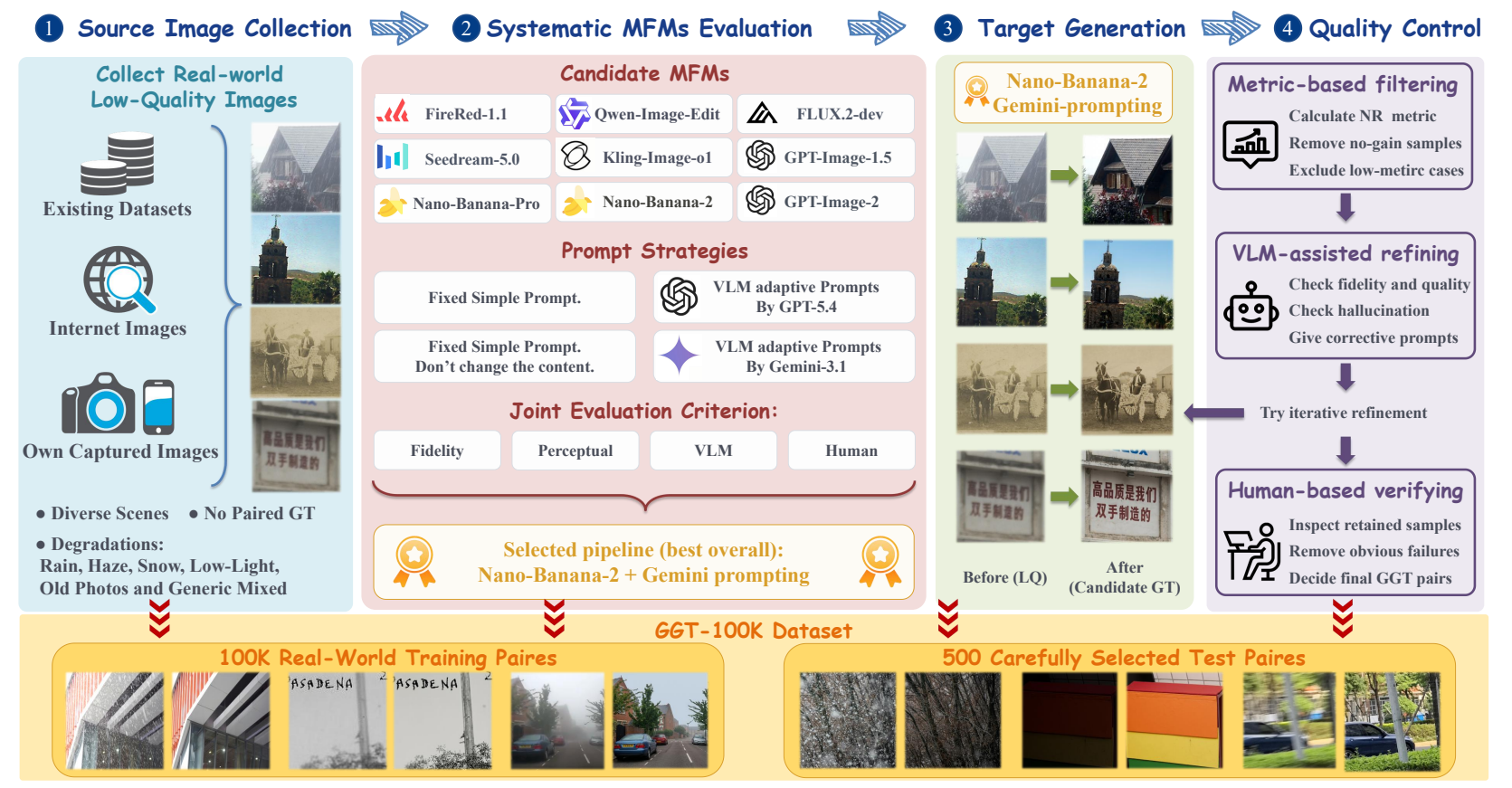
300 dpi PNG · Caption · Source PDF
Original caption, source, and provenance
Fixed source version: ICLR 2027 frozen anonymous submission PDF; retrieved 2026-10-28 UTC
Earliest verified matching figure date (temporal proxy): 2026-05-29
arXiv v1 date: 2026-05-29
Actual drawing date: unknown. See the source record for version checks and temporal-evidence limitations.
Historical PDF · Download citation snapshot · Date evidence · Paper page · Complete screening and version record (Chinese)
Citation threshold evidence: Lei Zhang; 137335 citations; snapshot 2026-10-21.
Recorded drawing-tool disclosure: unknown. No tool attribution is inferred from appearance; see the archival disclosure evidence for scope and wording.
Crop bounding box: [106, 80, 507, 289] (PDF points; top-left origin; x0, y0, x1, y1).
Figure 3: Overview of the GGT-100K construction pipeline. We collect diverse real-world LQ images,
evaluate MFMs for HQ target generation, and apply multi-stage quality control to build the dataset.
GGT-100K: Generative Ground Truth for Generalizable Real-World Image Restoration
Venue: ICLR 2027 · Submission (under review at collection)
Figure 2 · PDF page 2 · ICLR27_1n4L8nXB1I_M
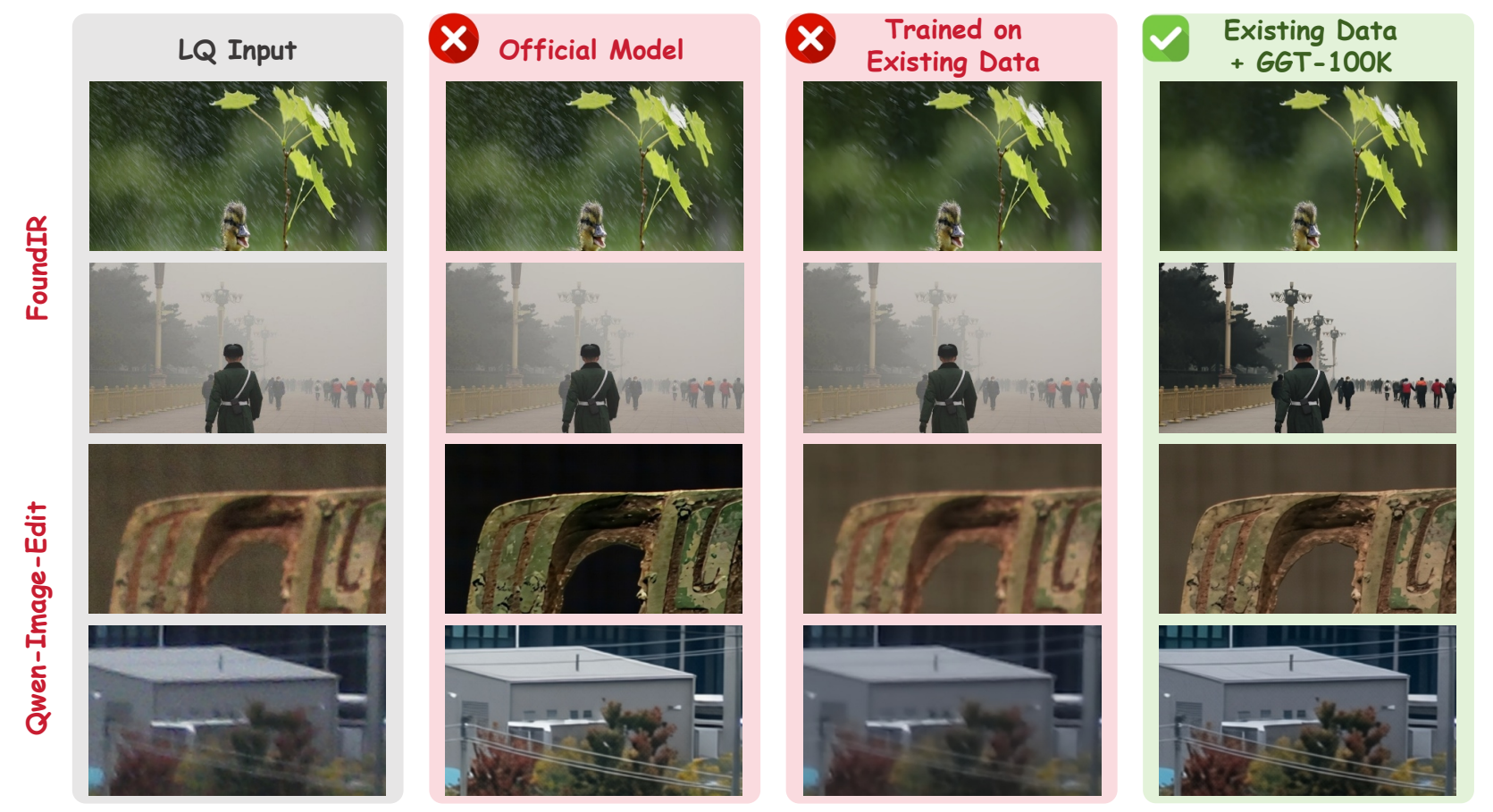
300 dpi PNG · Caption · Source PDF
Original caption, source, and provenance
Fixed source version: ICLR 2027 frozen anonymous submission PDF; retrieved 2026-10-28 UTC
Earliest verified matching figure date (temporal proxy): 2026-05-29
arXiv v1 date: 2026-05-29
Actual drawing date: unknown. See the source record for version checks and temporal-evidence limitations.
Historical PDF · Download citation snapshot · Date evidence · Paper page · Complete screening and version record (Chinese)
Citation threshold evidence: Lei Zhang; 137335 citations; snapshot 2026-10-21.
Recorded drawing-tool disclosure: unknown. No tool attribution is inferred from appearance; see the archival disclosure evidence for scope and wording.
Crop bounding box: [106, 80, 507, 298] (PDF points; top-left origin; x0, y0, x1, y1).
Figure 2: Qualitative comparison of FoundIR (Li et al., 2025) and Qwen-Image-Edit (Wu et al., 2025)
trained/finetuned on different datasets. FoundIR shows limited generalization to real rain and haze,
even after finetuned on existing restoration datasets. Qwen-Image-Edit produces sharper details with
its strong generative prior but may introduce hallucinations or color shifts, while finetuning on existing
datasets weakens its detail generation ability. GGT-100K significantly improves the generalization
capability of them to real-world degradations, enhancing visual details while preserving scene fidelity.
HarnessIR: Harnessing Multimodal Foundation Models for Universal Real-World Image Restoration
Venue: ICLR 2027 · Submission (under review at collection)
Figure 2 · PDF page 4 · ICLR27_QlpWNkJcBr_F
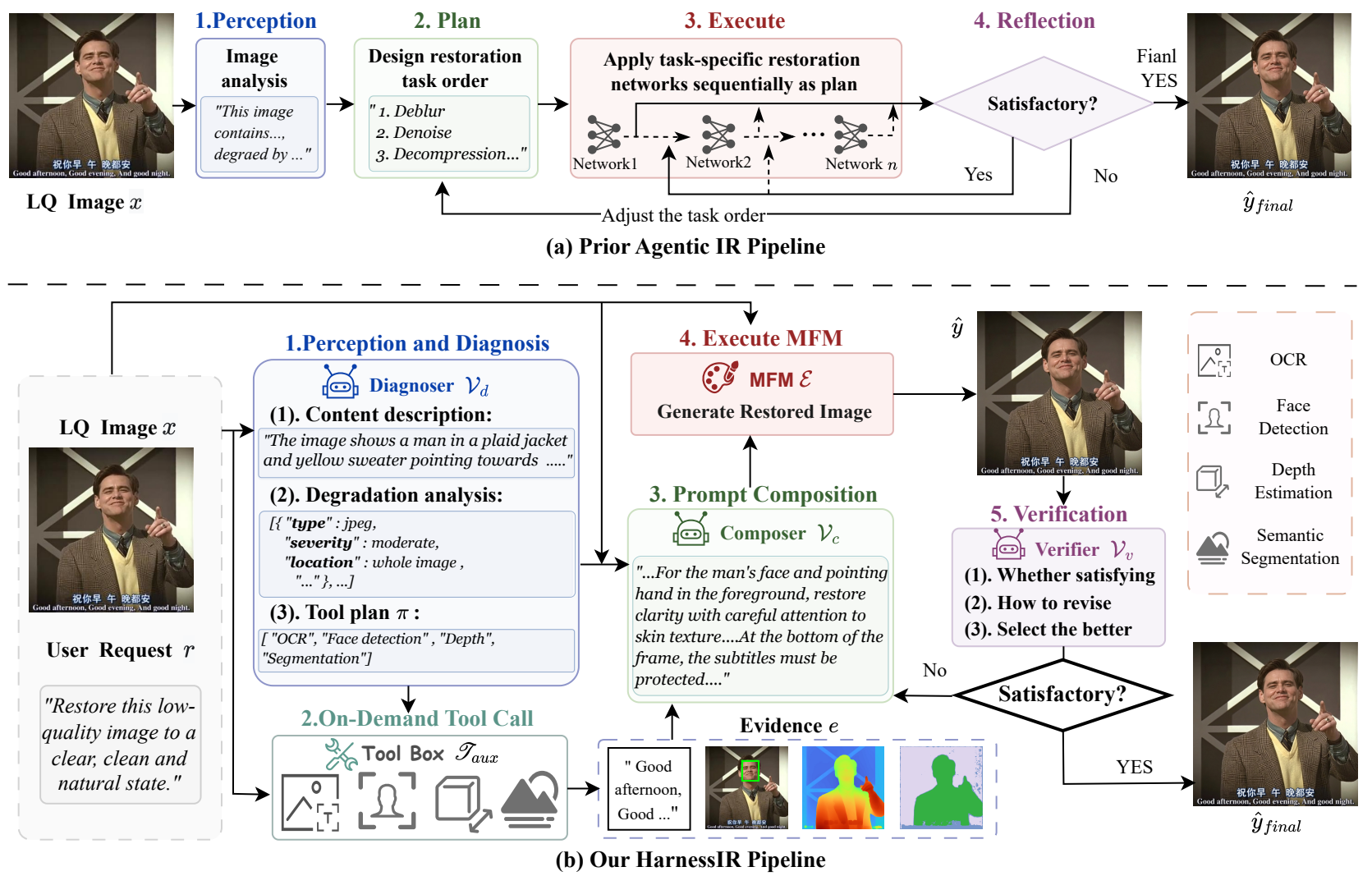
300 dpi PNG · Caption · Source PDF
Original caption, source, and provenance
Fixed source version: ICLR 2027 frozen anonymous submission PDF; retrieved 2026-10-28 UTC
Earliest verified matching figure date (temporal proxy): 2026-10-03
arXiv v1 date: 2026-10-07
Actual drawing date: unknown. See the source record for version checks and temporal-evidence limitations.
Historical PDF · Download citation snapshot · Date evidence · Paper page · Complete screening and version record (Chinese)
Citation threshold evidence: Lei Zhang; 137335 citations; snapshot 2026-10-21.
Recorded drawing-tool disclosure: unknown. No tool attribution is inferred from appearance; see the archival disclosure evidence for scope and wording.
Crop bounding box: [106, 79, 507, 335] (PDF points; top-left origin; x0, y0, x1, y1).
Figure 2: Comparison between (a) prior agentic IR pipelines (top) and (b) HarnessIR (bottom).
Prior methods sequentially apply task-specific restoration models planned by VLMs to produce the
output. HarnessIR instead uses auxiliary tools for image-specific evidence, composes a restoration
instruction for MFM, and invokes verification-driven re-execution when necessary.
HarnessIR: Harnessing Multimodal Foundation Models for Universal Real-World Image Restoration
Venue: ICLR 2027 · Submission (under review at collection)
Figure 3 · PDF page 6 · ICLR27_QlpWNkJcBr_M
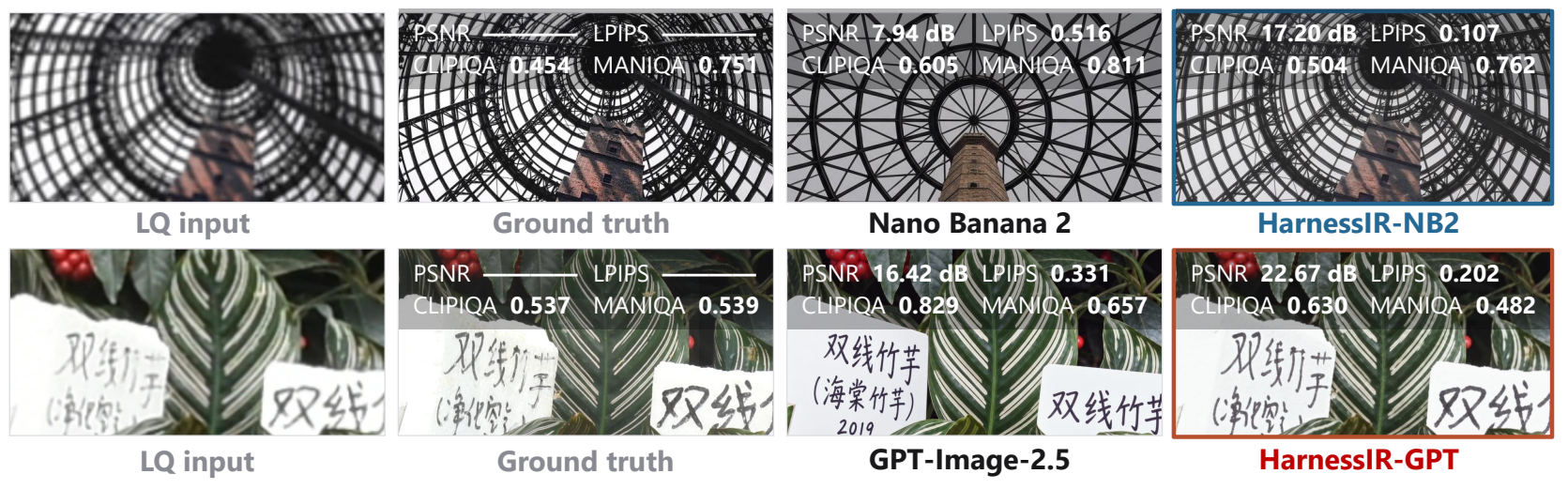
300 dpi PNG · Caption · Source PDF
Original caption, source, and provenance
Fixed source version: ICLR 2027 frozen anonymous submission PDF; retrieved 2026-10-28 UTC
Earliest verified matching figure date (temporal proxy): 2026-10-03
arXiv v1 date: 2026-10-07
Actual drawing date: unknown. See the source record for version checks and temporal-evidence limitations.
Historical PDF · Download citation snapshot · Date evidence · Paper page · Complete screening and version record (Chinese)
Citation threshold evidence: Lei Zhang; 137335 citations; snapshot 2026-10-21.
Recorded drawing-tool disclosure: unknown. No tool attribution is inferred from appearance; see the archival disclosure evidence for scope and wording.
Crop bounding box: [106, 80, 507, 205] (PDF points; top-left origin; x0, y0, x1, y1).
Figure 3: Direct use of MFMs may yield higher NR-IQA scores than GT, even when the image
content is largely altered. NR-IQA should not be used as an independent metric for IR performance.
Learning to Restore More: Continual Capability Expansion for Pretrained Image Restoration Models
Venue: ICLR 2027 · Submission (under review at collection)
Figure 2 · PDF page 5 · ICLR27_Cdx9a9GdBy_F
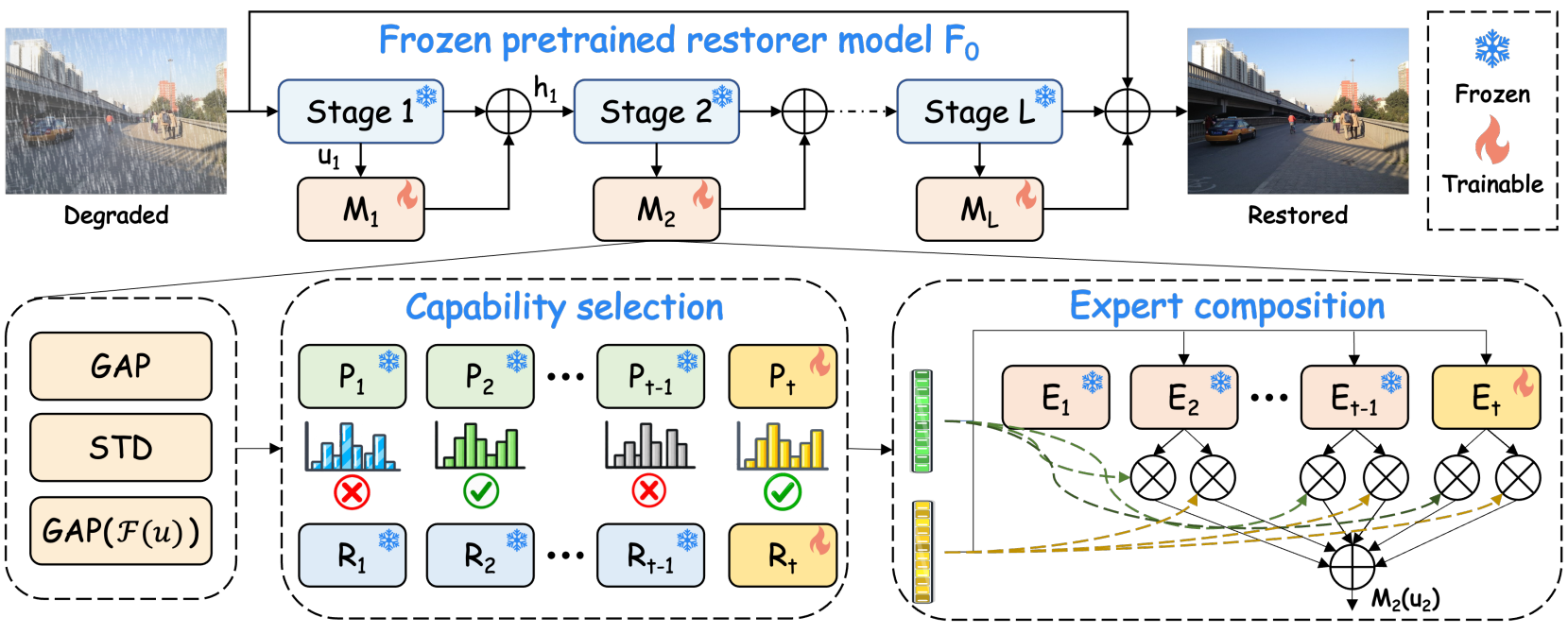
300 dpi PNG · Caption · Source PDF
Original caption, source, and provenance
Fixed source version: ICLR 2027 frozen anonymous submission PDF; retrieved 2026-10-28 UTC
Earliest verified matching figure date (temporal proxy): 2026-08-31
arXiv v1 date: 2026-08-31
Actual drawing date: unknown. See the source record for version checks and temporal-evidence limitations.
Historical PDF · Citation evidence · Date evidence · Paper page · Complete screening and version record (Chinese)
Citation threshold evidence: Lizhuang Ma; 13785 citations; snapshot 2026-10-28.
Recorded drawing-tool disclosure: unknown. No tool attribution is inferred from appearance; see the archival disclosure evidence for scope and wording.
Crop bounding box: [107, 80, 505, 241] (PDF points; top-left origin; x0, y0, x1, y1).
Figure 2: Overview of the proposed RestoreMore framework. A pretrained restoration model is
preserved as a frozen capability anchor, and lightweight residual expansion modules are inserted at
selected feature stages. Inside each expansion module, a degradation descriptor is first constructed
from spatial and frequency statistics. Top-M capability selection is then performed over accumu-
lated capability prototypes and routers. The selected routers further retrieve complementary experts
from the expert-key bank through query–key matching. Frozen historical components and trainable
current-task components are indicated by snowflake and flame icons, respectively.
Learning to Restore More: Continual Capability Expansion for Pretrained Image Restoration Models
Venue: ICLR 2027 · Submission (under review at collection)
Figure 1 · PDF page 2 · ICLR27_Cdx9a9GdBy_M
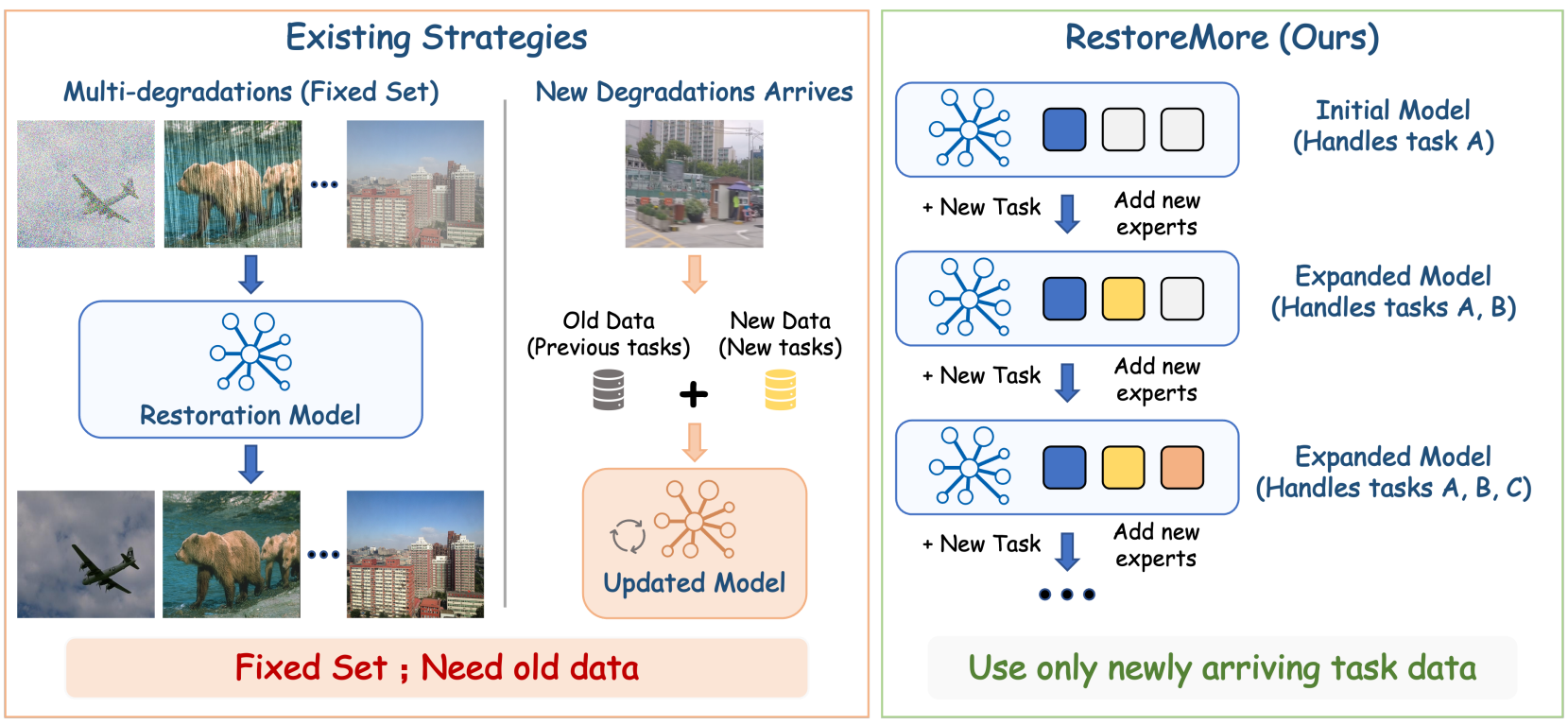
300 dpi PNG · Caption · Source PDF
Original caption, source, and provenance
Fixed source version: ICLR 2027 frozen anonymous submission PDF; retrieved 2026-10-28 UTC
Earliest verified matching figure date (temporal proxy): 2026-08-31
arXiv v1 date: 2026-08-31
Actual drawing date: unknown. See the source record for version checks and temporal-evidence limitations.
Historical PDF · Citation evidence · Date evidence · Paper page · Complete screening and version record (Chinese)
Citation threshold evidence: Lizhuang Ma; 13785 citations; snapshot 2026-10-28.
Recorded drawing-tool disclosure: unknown. No tool attribution is inferred from appearance; see the archival disclosure evidence for scope and wording.
Crop bounding box: [107, 80, 505, 264] (PDF points; top-left origin; x0, y0, x1, y1).
Figure 1: Comparison of existing restoration strategies and RestoreMore. Existing methods are
limited to a fixed degradation set and typically require joint retraining with historical and new data
when new degradations arrive. In contrast, RestoreMore continually expands a pretrained restorer
by adding new experts using only newly arriving task data.
Look Before You Restore: Learning to Predict Before Acting for Agentic Image Restoration
Venue: ICLR 2027 · Submission (under review at collection)
Figure 2 · PDF page 4 · ICLR27_rCgxaWvBRj_F
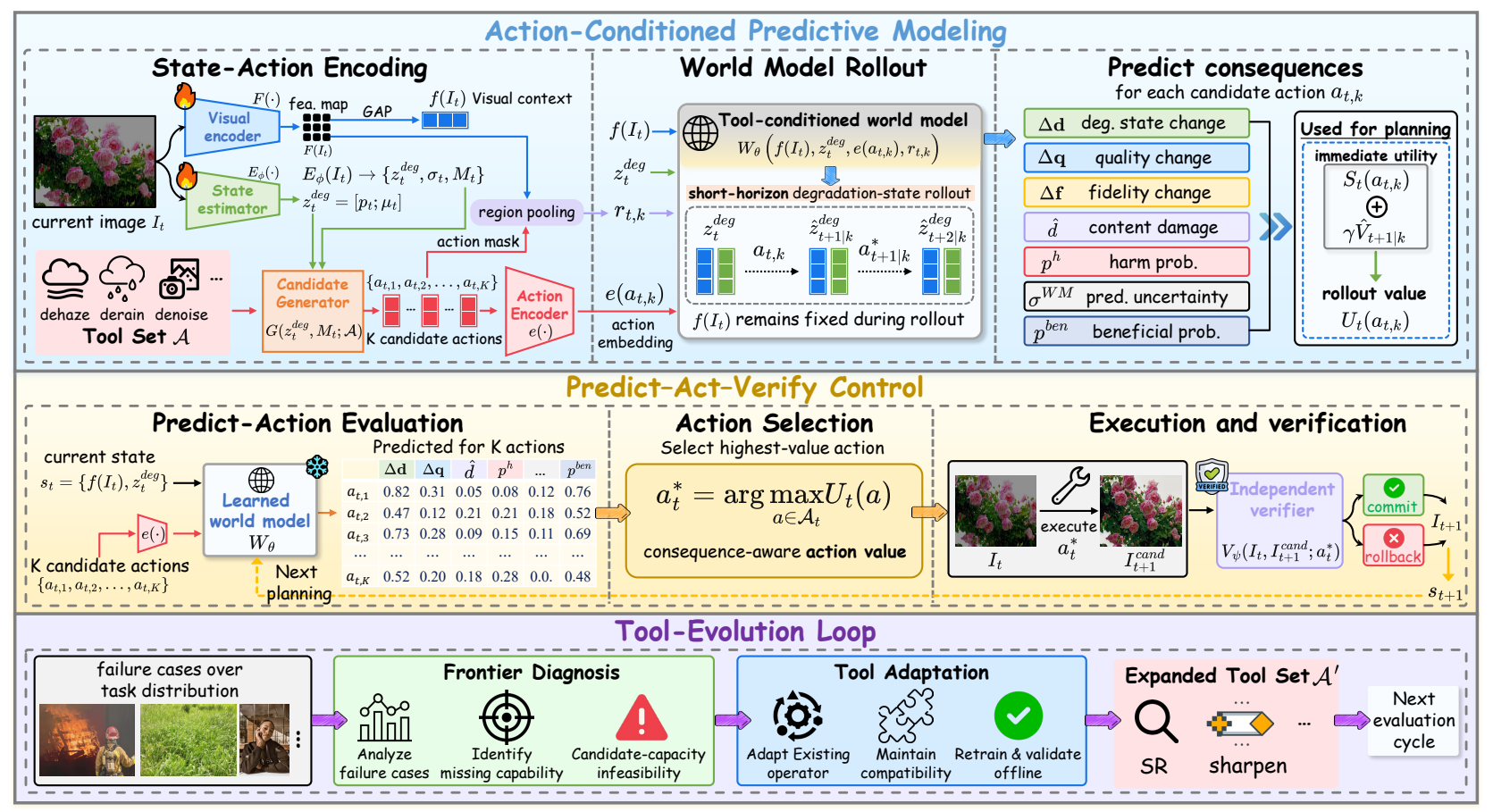
300 dpi PNG · Caption · Source PDF
Original caption, source, and provenance
Fixed source version: ICLR 2027 frozen anonymous submission PDF; retrieved 2026-10-28 UTC
Earliest verified matching figure date (temporal proxy): 2026-10-03
arXiv v1 date: 2026-10-14
Actual drawing date: unknown. See the source record for version checks and temporal-evidence limitations.
Historical PDF · Download citation snapshot · Date evidence · Paper page · Complete screening and version record (Chinese)
Citation threshold evidence: Lefei Zhang; 18509 citations; snapshot 2026-10-21.
Recorded drawing-tool disclosure: unknown. No tool attribution is inferred from appearance; see the archival disclosure evidence for scope and wording.
Crop bounding box: [106, 80, 507, 298] (PDF points; top-left origin; x0, y0, x1, y1).
Figure 2: Overview of PreActIR. The world model predicts action consequences before execution,
while the predict–act–verify controller executes and verifies the selected action with commit or
rollback. A tool-evolution loop performs candidate-frontier audit and targeted tool adaptation.
Look Before You Restore: Learning to Predict Before Acting for Agentic Image Restoration
Venue: ICLR 2027 · Submission (under review at collection)
Figure 1 · PDF page 2 · ICLR27_rCgxaWvBRj_M
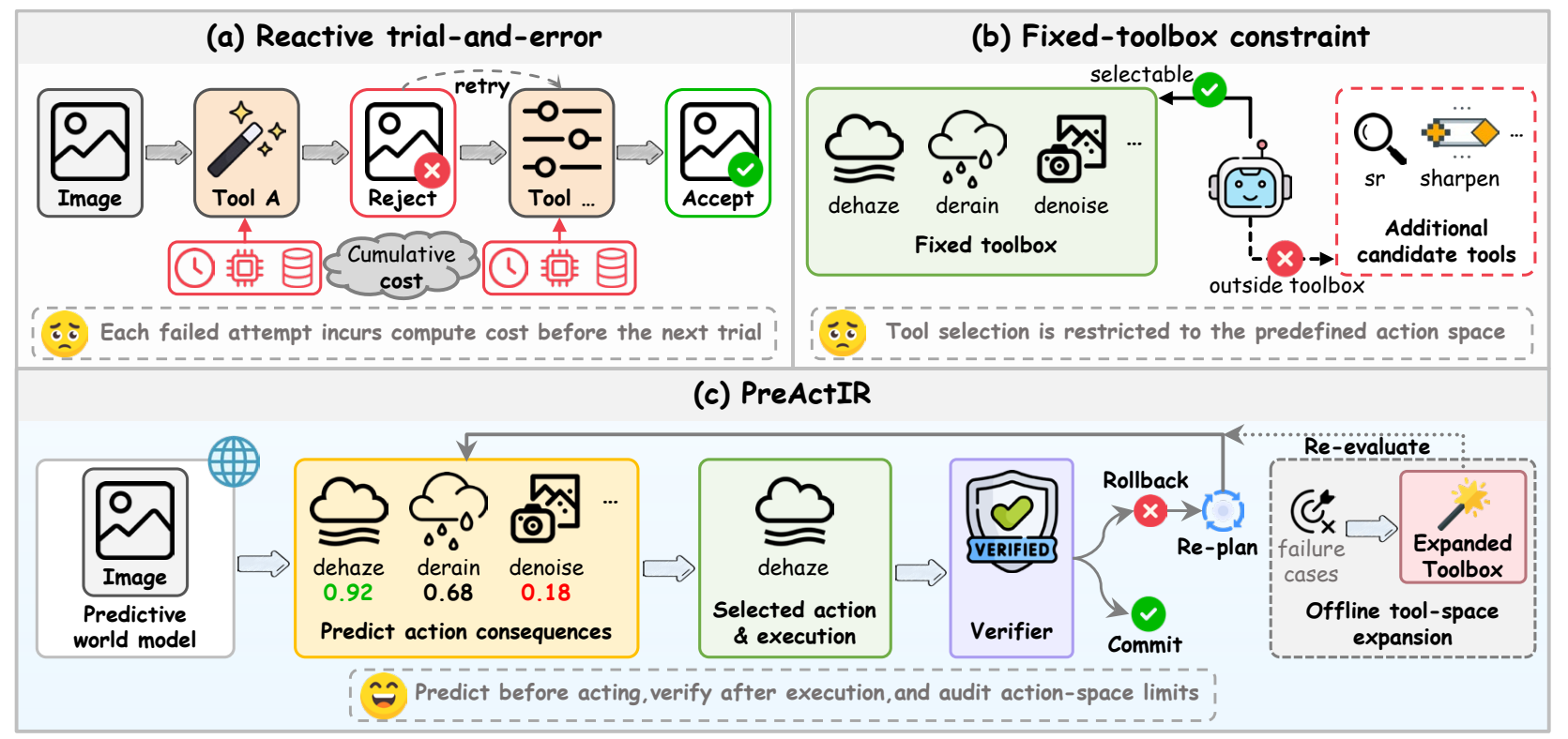
300 dpi PNG · Caption · Source PDF
Original caption, source, and provenance
Fixed source version: ICLR 2027 frozen anonymous submission PDF; retrieved 2026-10-28 UTC
Earliest verified matching figure date (temporal proxy): 2026-10-03
arXiv v1 date: 2026-10-14
Actual drawing date: unknown. See the source record for version checks and temporal-evidence limitations.
Historical PDF · Download citation snapshot · Date evidence · Paper page · Complete screening and version record (Chinese)
Citation threshold evidence: Lefei Zhang; 18509 citations; snapshot 2026-10-21.
Recorded drawing-tool disclosure: unknown. No tool attribution is inferred from appearance; see the archival disclosure evidence for scope and wording.
Crop bounding box: [106, 81, 507, 270] (PDF points; top-left origin; x0, y0, x1, y1).
Figure 1: Motivation of PreActIR. Existing agentic restoration is largely reactive: tool effects are
observed only after execution, while decisions remain restricted to the available action space. Pre-
ActIR predicts action consequences before execution.
PhoenixSR: Generative Heterogeneous Distillation Unleashes Efficient Models for Real-World Super-Resolution
Venue: ICLR 2027 · Submission (under review at collection)
Figure 4 · PDF page 5 · ICLR27_anN7bIopnC_F
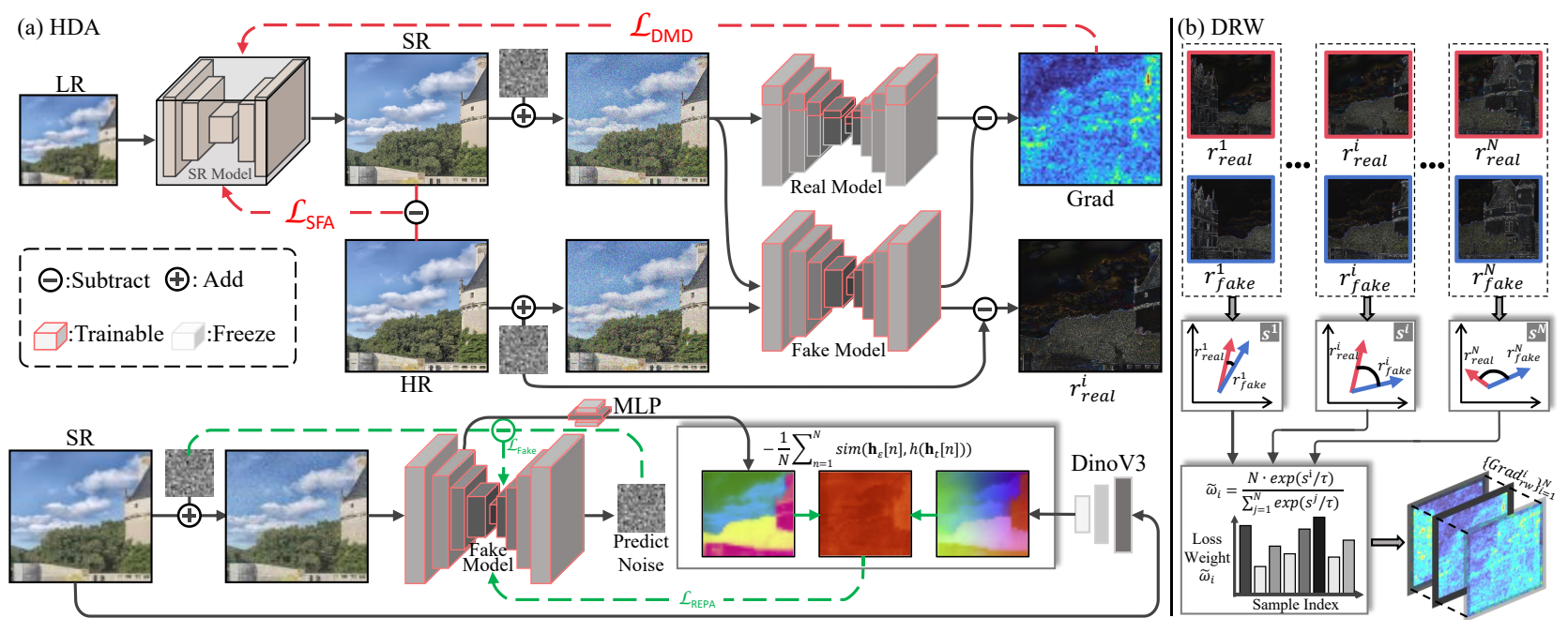
300 dpi PNG · Caption · Source PDF
Original caption, source, and provenance
Fixed source version: ICLR 2027 frozen anonymous submission PDF; retrieved 2026-10-28 UTC
Earliest verified matching figure date (temporal proxy): 2026-10-03
arXiv v1 date: 2026-09-25
Actual drawing date: unknown. See the source record for version checks and temporal-evidence limitations.
Historical PDF · Download citation snapshot · Date evidence · Paper page · Complete screening and version record (Chinese)
Citation threshold evidence: Zheng-Jun Zha; 30479 citations; snapshot 2026-10-21.
Recorded drawing-tool disclosure: unknown. No tool attribution is inferred from appearance; see the archival disclosure evidence for scope and wording.
Crop bounding box: [106, 79, 507, 241] (PDF points; top-left origin; x0, y0, x1, y1).
Figure 4: Overview of PhoenixSR. HDA adapts real-score estimation, tracks the evolving student
distribution, and anchors paired fidelity. DRW reweights sample-wise guidance according to residual-
direction consistency.
PhoenixSR: Generative Heterogeneous Distillation Unleashes Efficient Models for Real-World Super-Resolution
Venue: ICLR 2027 · Submission (under review at collection)
Figure 2 · PDF page 2 · ICLR27_anN7bIopnC_M
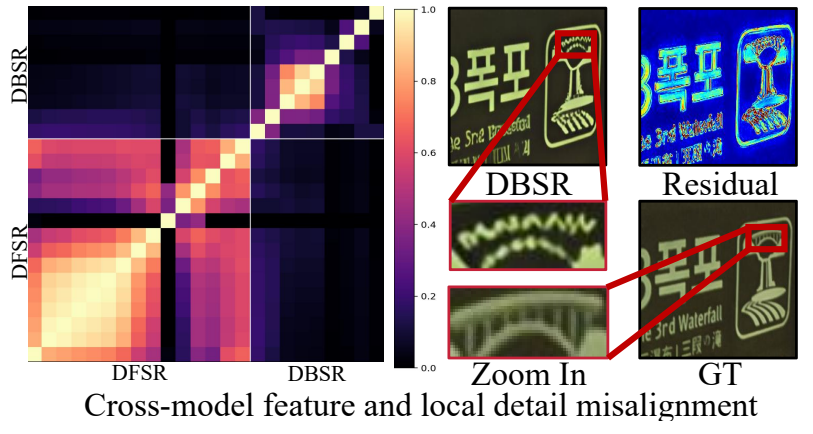
300 dpi PNG · Caption · Source PDF
Original caption, source, and provenance
Fixed source version: ICLR 2027 frozen anonymous submission PDF; retrieved 2026-10-28 UTC
Earliest verified matching figure date (temporal proxy): 2026-09-25
arXiv v1 date: 2026-09-25
Actual drawing date: unknown. See the source record for version checks and temporal-evidence limitations.
Historical PDF · Download citation snapshot · Date evidence · Paper page · Complete screening and version record (Chinese)
Citation threshold evidence: Zheng-Jun Zha; 30479 citations; snapshot 2026-10-21.
Recorded drawing-tool disclosure: unknown. No tool attribution is inferred from appearance; see the archival disclosure evidence for scope and wording.
Crop bounding box: [312, 460, 507, 564] (PDF points; top-left origin; x0, y0, x1, y1).
Figure 2: Motivation. CKA (Kornblith et al.,
2019) (left) reveals weak feature correspondence
between DBSR and DFSR, while residual and
zoom-in comparisons (right) show local discrep-
ancies between DBSR outputs and paired HR
targets.
Restoring without Forgetting: Filter-Level Continual Image Restoration via Parameter-Space Integrated Gradients
Venue: ICLR 2027 · Submission (under review at collection)
Figure 2 · PDF page 3 · ICLR27_80XJOuh0nO_F
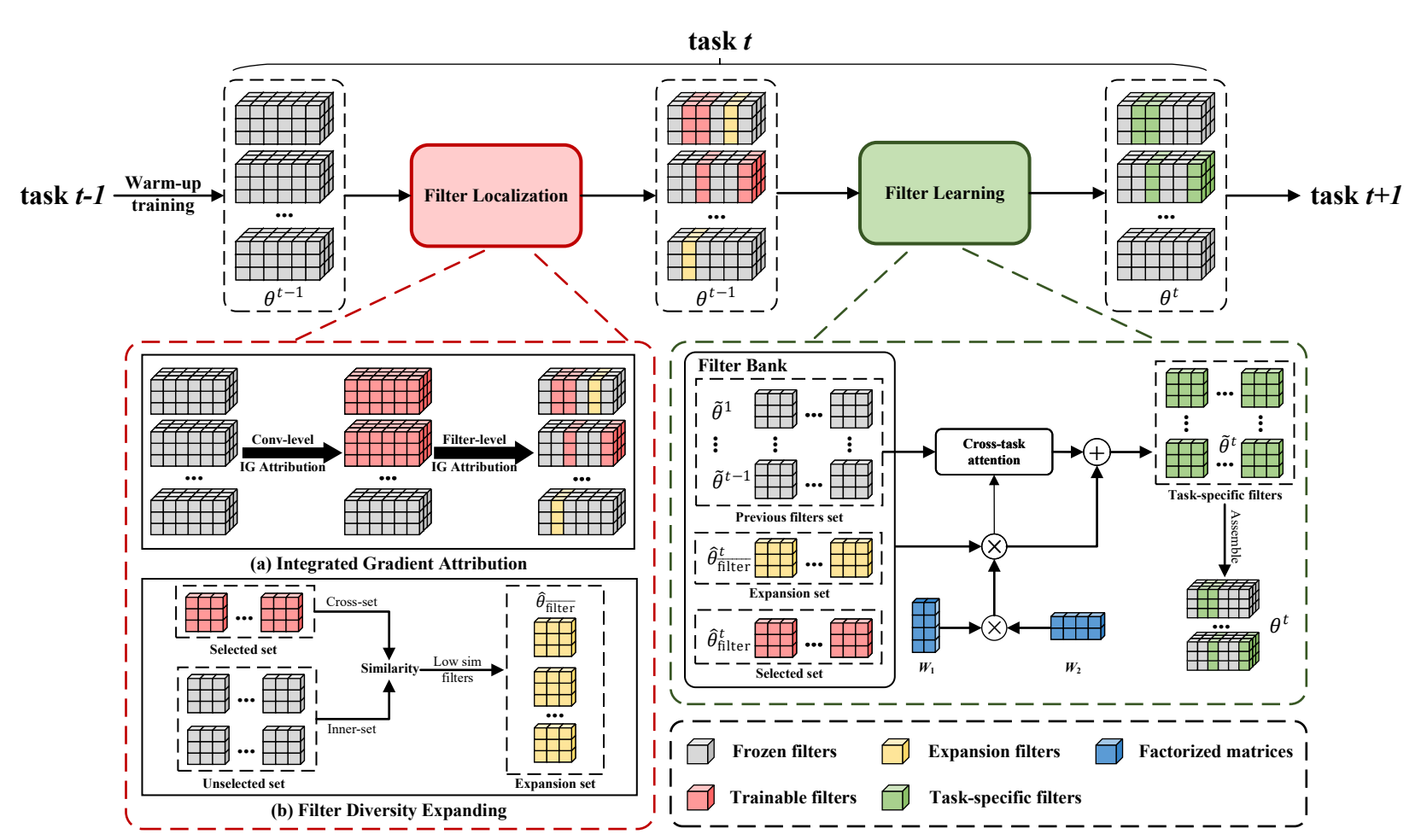
300 dpi PNG · Caption · Source PDF
Original caption, source, and provenance
Fixed source version: ICLR 2027 frozen anonymous submission PDF; retrieved 2026-10-28 UTC
Earliest verified matching figure date (temporal proxy): 2026-09-29
arXiv v1 date: 2026-09-29
Actual drawing date: unknown. See the source record for version checks and temporal-evidence limitations.
Historical PDF · Download citation snapshot · Date evidence · Paper page · Complete screening and version record (Chinese)
Citation threshold evidence: Guangming Lu; 13904 citations; snapshot 2026-10-21.
Recorded drawing-tool disclosure: unknown; authors_deny_generative_AI_figures. No tool attribution is inferred from appearance; see the archival disclosure evidence for scope and wording.
Crop bounding box: [106, 45, 507, 281] (PDF points; top-left origin; x0, y0, x1, y1).
Figure 2: Overview of RwF. Filter localization (left): parameter-space integrated gradients rank
layers, then filters within them, and the selected set is expanded with high-IG, low-similarity filters.
Filter learning (right): the localized filters are regenerated from a filter bank by factorized matrices
with cross-task attention and assembled back into the frozen backbone.
Restoring without Forgetting: Filter-Level Continual Image Restoration via Parameter-Space Integrated Gradients
Venue: ICLR 2027 · Submission (under review at collection)
Figure 1 · PDF page 2 · ICLR27_80XJOuh0nO_M
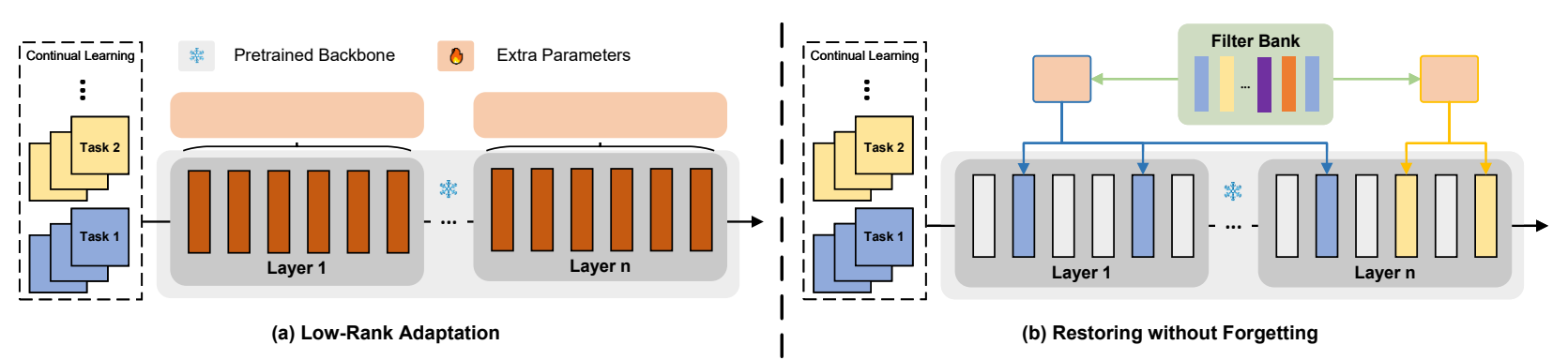
300 dpi PNG · Caption · Source PDF
Original caption, source, and provenance
Fixed source version: ICLR 2027 frozen anonymous submission PDF; retrieved 2026-10-28 UTC
Earliest verified matching figure date (temporal proxy): 2026-09-29
arXiv v1 date: 2026-09-29
Actual drawing date: unknown. See the source record for version checks and temporal-evidence limitations.
Historical PDF · Download citation snapshot · Date evidence · Paper page · Complete screening and version record (Chinese)
Citation threshold evidence: Guangming Lu; 13904 citations; snapshot 2026-10-21.
Recorded drawing-tool disclosure: unknown; authors_deny_generative_AI_figures. No tool attribution is inferred from appearance; see the archival disclosure evidence for scope and wording.
Crop bounding box: [106, 60, 507, 152] (PDF points; top-left origin; x0, y0, x1, y1).
Figure 1: (a) LoRA updates every filter of each adapted layer through low-rank matrices. (b) RwF
localizes the few degradation-critical filters of each task and regenerates only them from a shared
filter bank, leaving the rest of the backbone frozen.
SegDem: Segmentation helps Demosaicing
Venue: ICLR 2027 · Submission (under review at collection)
Figure 2 · PDF page 3 · ICLR27_3Kt188v0Yl_F
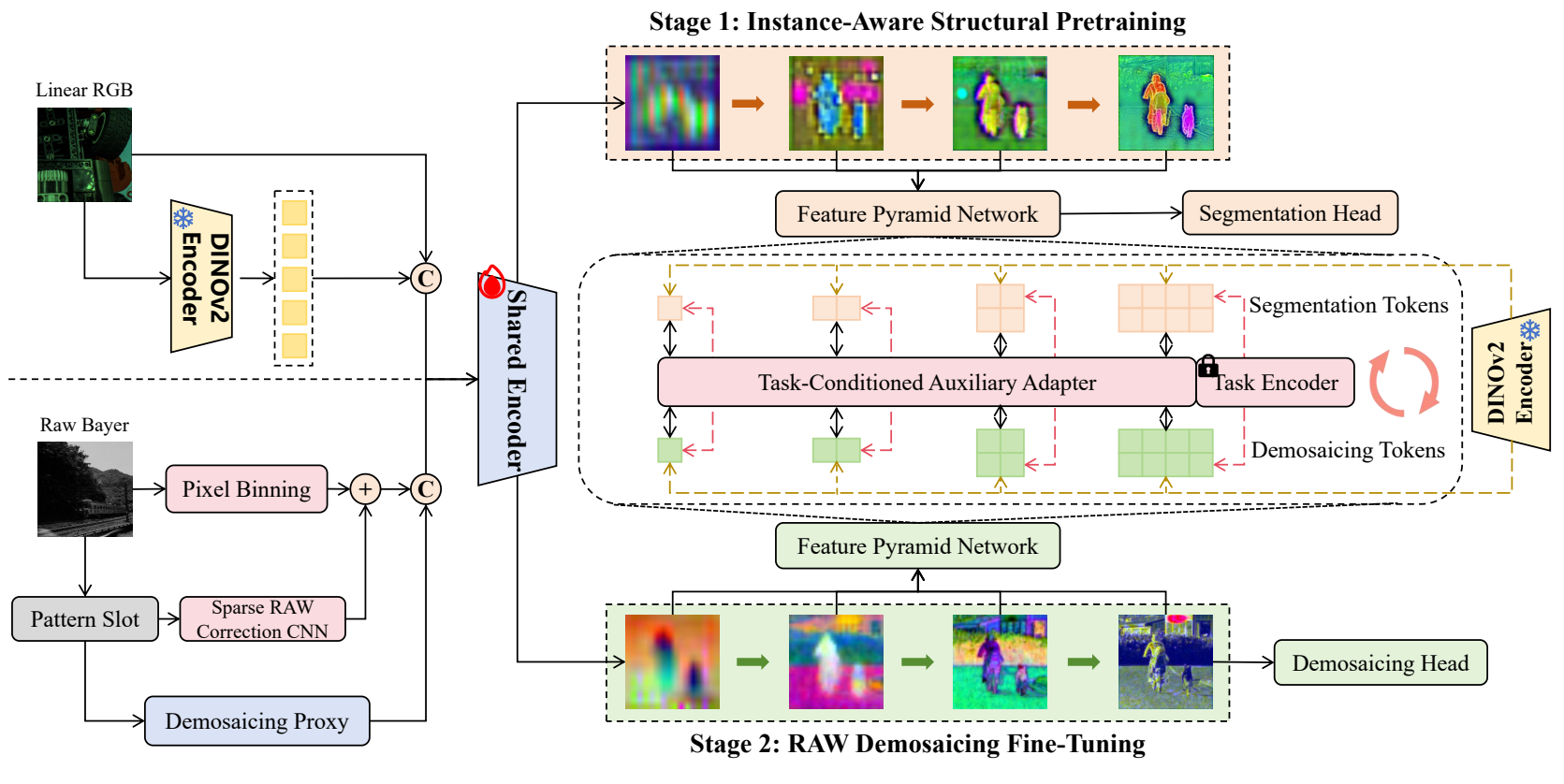
300 dpi PNG · Caption · Source PDF
Original caption, source, and provenance
Fixed source version: ICLR 2027 frozen anonymous submission PDF; retrieved 2026-10-28 UTC
Earliest verified matching figure date (temporal proxy): 2026-10-03
arXiv v1 date: 2026-08-08
Actual drawing date: unknown. See the source record for version checks and temporal-evidence limitations.
Historical PDF · Download citation snapshot · Date evidence · Paper page · Complete screening and version record (Chinese)
Citation threshold evidence: Kai Zhang; 48468 citations; snapshot 2026-10-21.
Recorded drawing-tool disclosure: generative_AI_figures_reported; selected_MF_tool_unknown. No tool attribution is inferred from appearance; see the archival disclosure evidence for scope and wording.
Crop bounding box: [106, 79, 507, 280] (PDF points; top-left origin; x0, y0, x1, y1).
Figure 2: Overview of SegDem. Stage 1 learns region- and boundary-aware representations using a
clean linear-RGB image state while retaining the mosaicked observation as an auxiliary RAW con-
dition. Stage 2 transfers the pretrained decoder parameters to demosaicing, while task-conditioned
auxiliary features and training-only DINOv2 alignment provide structural supervision without alter-
ing the sensor-conditioned output pathway.
SegDem: Segmentation helps Demosaicing
Venue: ICLR 2027 · Submission (under review at collection)
Figure 1 · PDF page 1 · ICLR27_3Kt188v0Yl_M
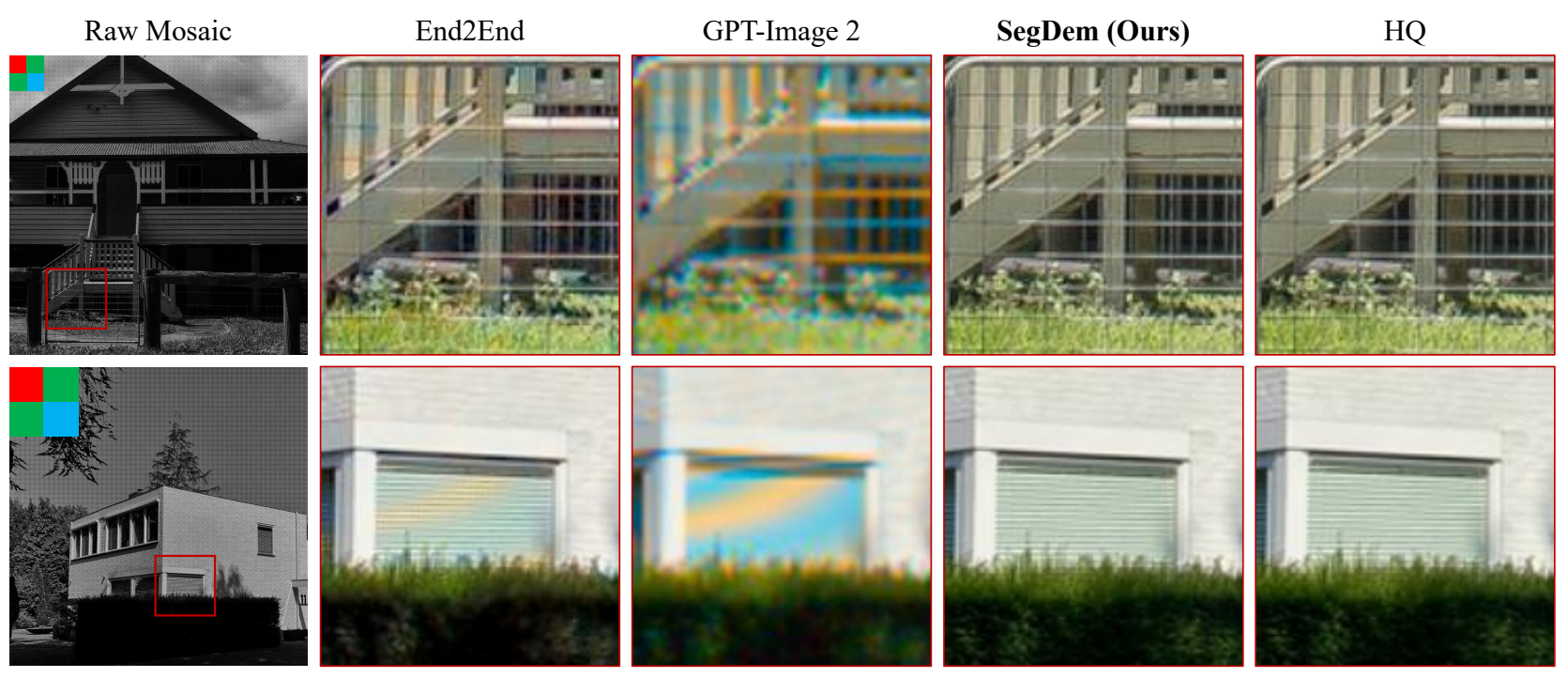
300 dpi PNG · Caption · Source PDF
Original caption, source, and provenance
Fixed source version: ICLR 2027 frozen anonymous submission PDF; retrieved 2026-10-28 UTC
Earliest verified matching figure date (temporal proxy): 2026-10-03
arXiv v1 date: 2026-08-08
Actual drawing date: unknown. See the source record for version checks and temporal-evidence limitations.
Historical PDF · Download citation snapshot · Date evidence · Paper page · Complete screening and version record (Chinese)
Citation threshold evidence: Kai Zhang; 48468 citations; snapshot 2026-10-21.
Recorded drawing-tool disclosure: generative_AI_figures_reported; selected_MF_tool_unknown. No tool attribution is inferred from appearance; see the archival disclosure evidence for scope and wording.
Crop bounding box: [106, 168, 507, 345] (PDF points; top-left origin; x0, y0, x1, y1).
Figure 1: Motivation of SegDem. Conventional regression is prone to false colors and moire´ arti-
facts in ambiguous regions, while generative models may hallucinate details unsupported by RAW
measurements. SegDem instead transfers structural decoder representations from segmentation to
demosaicing, improving boundary-aware reconstruction.
ARROW: Arbitrary Reconstruction and Tracking of 4D Observations in the Wild
Venue: ICLR 2027 · Submission (under review at collection)
Figure 3 · PDF page 4 · ICLR27_hShILxckIE_F
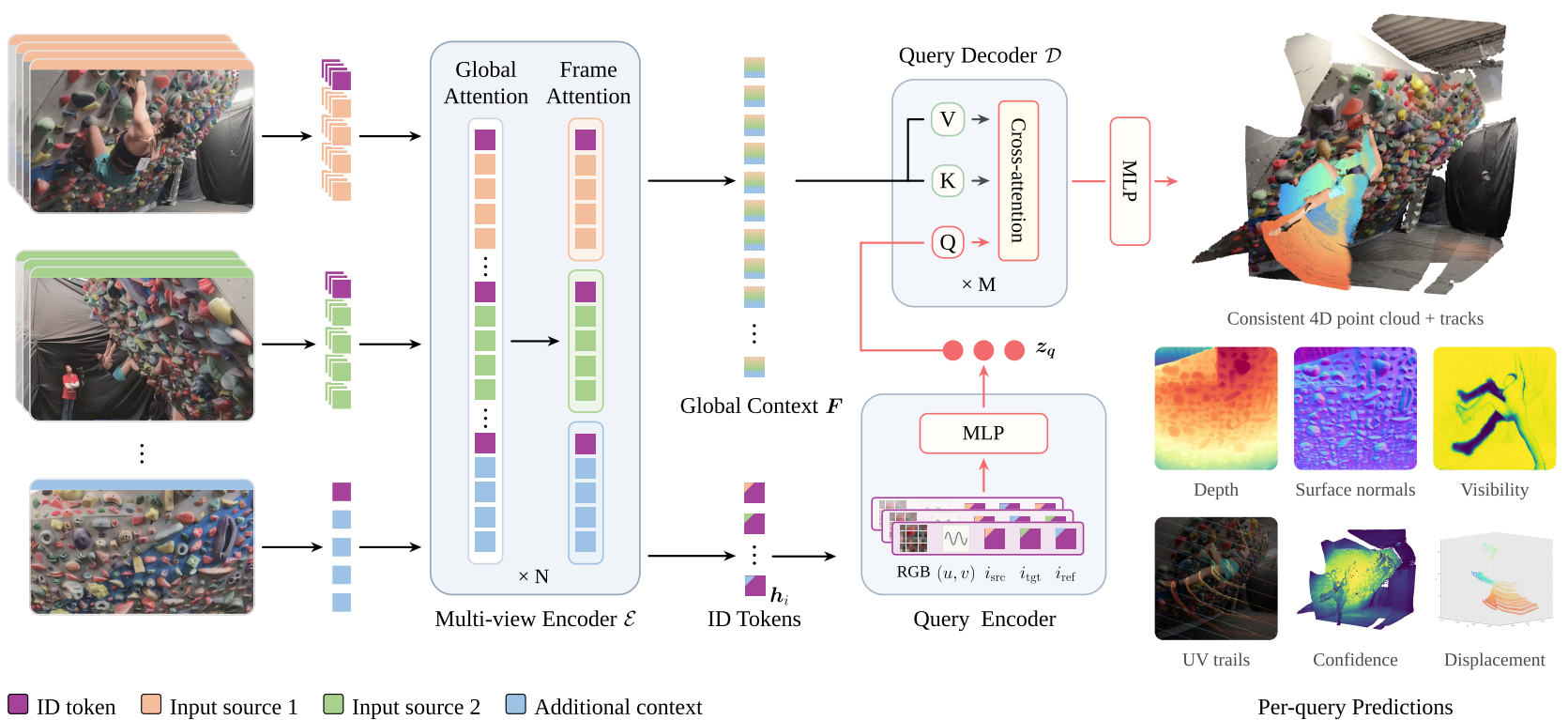
300 dpi PNG · Caption · Source PDF
Original caption, source, and provenance
Fixed source version: ICLR 2027 frozen anonymous submission PDF; retrieved 2026-10-28 UTC
Earliest verified matching figure date (temporal proxy): 2026-10-01
arXiv v1 date: 2026-10-01
Actual drawing date: unknown. See the source record for version checks and temporal-evidence limitations.
Historical PDF · Download citation snapshot · Date evidence · Paper page · Complete screening and version record (Chinese)
Citation threshold evidence: Bastian Leibe; 44197 citations; snapshot 2026-10-21.
Recorded drawing-tool disclosure: unknown. No tool attribution is inferred from appearance; see the archival disclosure evidence for scope and wording.
Crop bounding box: [106, 79, 507, 263] (PDF points; top-left origin; x0, y0, x1, y1).
Figure 3: ARROW architecture. The multi-view encoder E tokenizes each frame independently
and employs global attention to produce a shared global context F together with an ID token h for
i
each frame. The query encoder combines a source-centered RGB crop, the Fourier-encoded (u, v)
coordinate, and the ID tokens of the queried source, target, and reference view frames into a latent
query token z . Each latent query token independently cross-attends to the global context, so a single
q
encoding serves arbitrarily many queries and yields a consistent 4D representation of the scene.
ARROW: Arbitrary Reconstruction and Tracking of 4D Observations in the Wild
Venue: ICLR 2027 · Submission (under review at collection)
Figure 2 · PDF page 3 · ICLR27_hShILxckIE_M
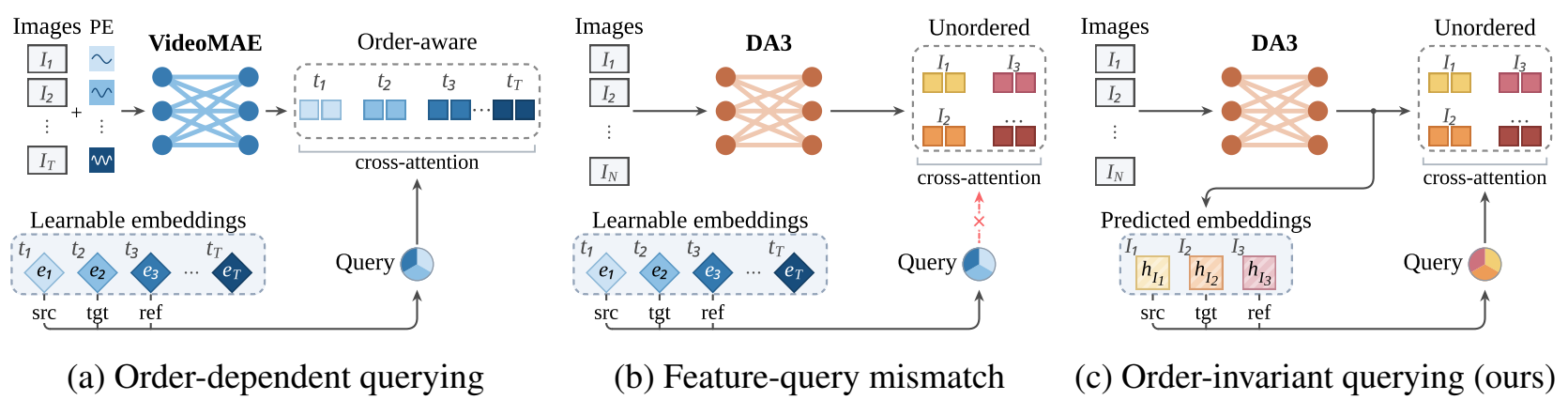
300 dpi PNG · Caption · Source PDF
Original caption, source, and provenance
Fixed source version: ICLR 2027 frozen anonymous submission PDF; retrieved 2026-10-28 UTC
Earliest verified matching figure date (temporal proxy): 2026-10-01
arXiv v1 date: 2026-10-01
Actual drawing date: unknown. See the source record for version checks and temporal-evidence limitations.
Historical PDF · Download citation snapshot · Date evidence · Paper page · Complete screening and version record (Chinese)
Citation threshold evidence: Bastian Leibe; 44197 citations; snapshot 2026-10-21.
Recorded drawing-tool disclosure: unknown. No tool attribution is inferred from appearance; see the archival disclosure evidence for scope and wording.
Crop bounding box: [106, 79, 507, 181] (PDF points; top-left origin; x0, y0, x1, y1).
Figure 2: From indexed to input-dependent correspondence. (a) Order-aware global context
enables position-based associations. (b) Order-invariant global context exposes no fixed order to
exploit. (c) Content-derived identity embeddings enable order-invariant associations.
Drive3R: Block-wise Streaming Geometric Foundation Models for Autonomous Driving
Venue: ICLR 2027 · Submission (under review at collection)
Figure 3 · PDF page 5 · ICLR27_4hJ82iauw9_F
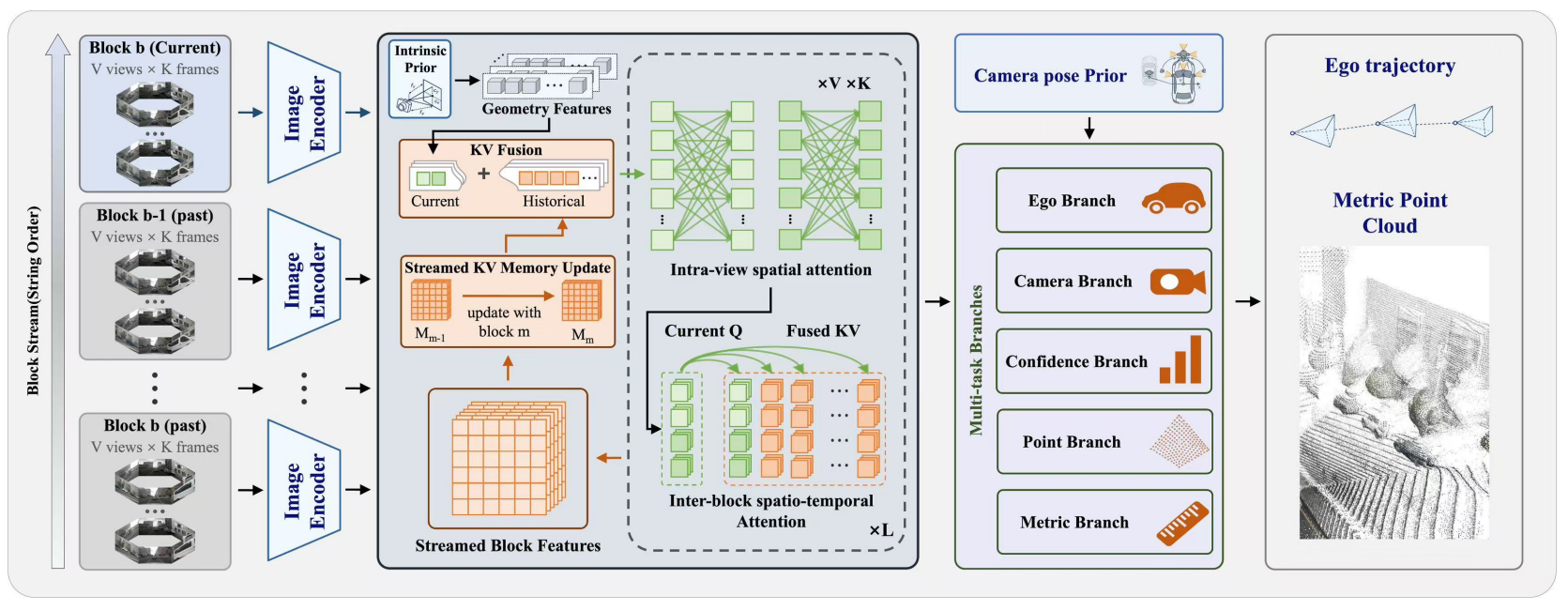
300 dpi PNG · Caption · Source PDF
Original caption, source, and provenance
Fixed source version: ICLR 2027 frozen anonymous submission PDF; retrieved 2026-10-28 UTC
Earliest verified matching figure date (temporal proxy): 2026-10-03
arXiv v1 date: 2026-10-10
Actual drawing date: unknown. See the source record for version checks and temporal-evidence limitations.
Historical PDF · Download citation snapshot · Date evidence · Paper page · Complete screening and version record (Chinese)
Citation threshold evidence: Li Jiang; 19563 citations; snapshot 2026-10-21.
Recorded drawing-tool disclosure: unknown. No tool attribution is inferred from appearance; see the archival disclosure evidence for scope and wording.
Crop bounding box: [106, 79, 507, 235] (PDF points; top-left origin; x0, y0, x1, y1).
Figure 3: The pipeline of our method. Multi-view image streams are processed in a block-wise
manner. Each image block is first encoded with intrinsic priors and then processed by a spatio-
temporal decoder. By maintaining a streamed KV memory across consecutive blocks, the model
continuously extracts consistent geometry features for multi-task predictions, including ego-centric
motion and dense metric 3D reconstruction.
Drive3R: Block-wise Streaming Geometric Foundation Models for Autonomous Driving
Venue: ICLR 2027 · Submission (under review at collection)
Figure 2 · PDF page 2 · ICLR27_4hJ82iauw9_M
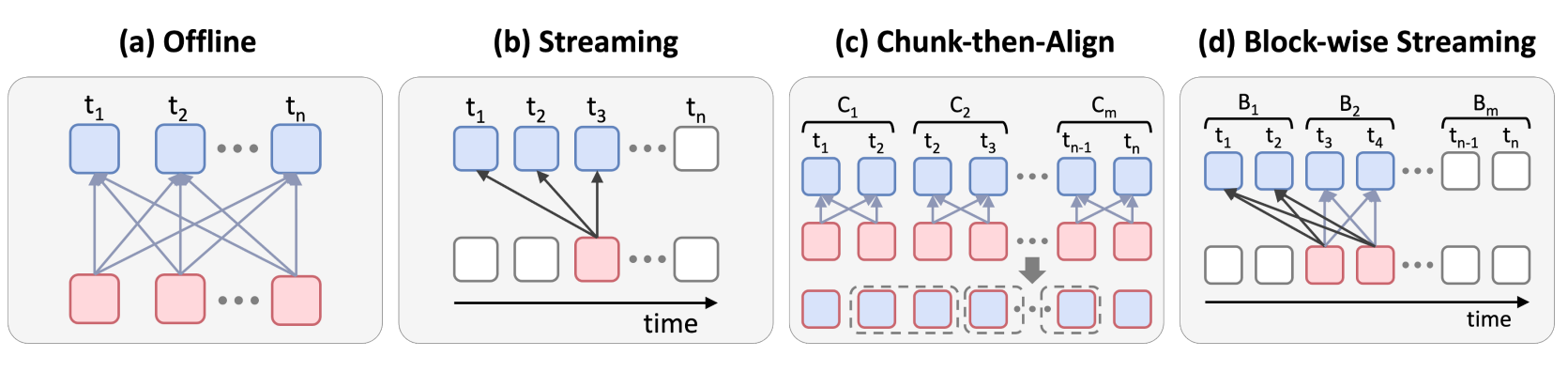
300 dpi PNG · Caption · Source PDF
Original caption, source, and provenance
Fixed source version: ICLR 2027 frozen anonymous submission PDF; retrieved 2026-10-28 UTC
Earliest verified matching figure date (temporal proxy): 2026-10-03
arXiv v1 date: 2026-10-10
Actual drawing date: unknown. See the source record for version checks and temporal-evidence limitations.
Historical PDF · Download citation snapshot · Date evidence · Paper page · Complete screening and version record (Chinese)
Citation threshold evidence: Li Jiang; 19563 citations; snapshot 2026-10-21.
Recorded drawing-tool disclosure: unknown. No tool attribution is inferred from appearance; see the archival disclosure evidence for scope and wording.
Crop bounding box: [106, 79, 507, 174] (PDF points; top-left origin; x0, y0, x1, y1).
Figure 2: Paradigm comparison between previous sequence processing strategies (offline, streaming,
chunk-then-align) and our proposed block-wise streaming approach, Drive3R.
Failure-Aware Adaptation for Transparent Objects in Feed-Forward 3D Reconstruction
Venue: ICLR 2027 · Submission (under review at collection)
Figure 3 · PDF page 5 · ICLR27_iRCP1uMP8S_F
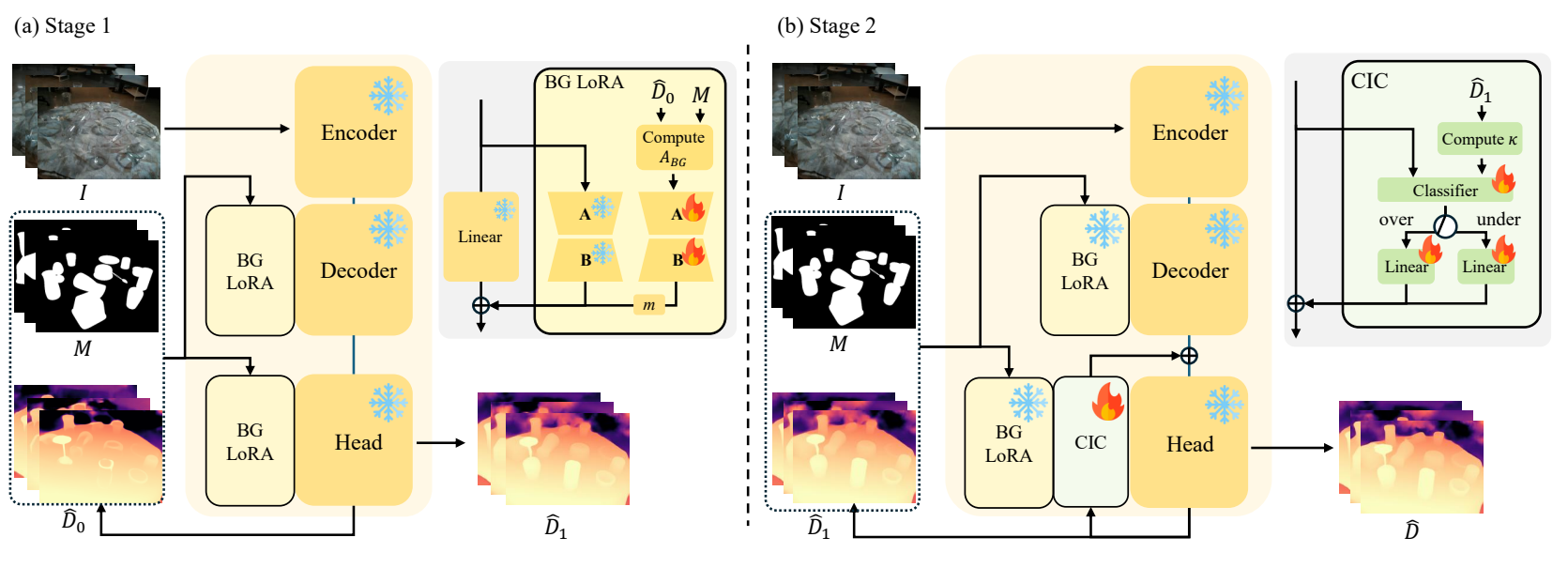
300 dpi PNG · Caption · Source PDF
Original caption, source, and provenance
Fixed source version: ICLR 2027 frozen anonymous submission PDF; retrieved 2026-10-28 UTC
Earliest verified matching figure date (temporal proxy): 2026-10-03
Actual drawing date: unknown. See the source record for version checks and temporal-evidence limitations.
Date evidence · Paper page · Complete screening and version record (Chinese)
Recorded drawing-tool disclosure: unknown. No tool attribution is inferred from appearance; see the archival disclosure evidence for scope and wording.
Crop bounding box: [106, 79, 507, 224] (PDF points; top-left origin; x0, y0, x1, y1).
Figure 3: Overview of our two-stage failure-aware adaptation framework. Starting from a
frozen backbone with adapted LoRA parameters, (a) Stage 1 trains Background-aware LoRA to
correct background leakage, and (b) Stage 2 freezes the preceding components and trains CIC to
correct the remaining directional errors.
Failure-Aware Adaptation for Transparent Objects in Feed-Forward 3D Reconstruction
Venue: ICLR 2027 · Submission (under review at collection)
Figure 1 · PDF page 1 · ICLR27_iRCP1uMP8S_M
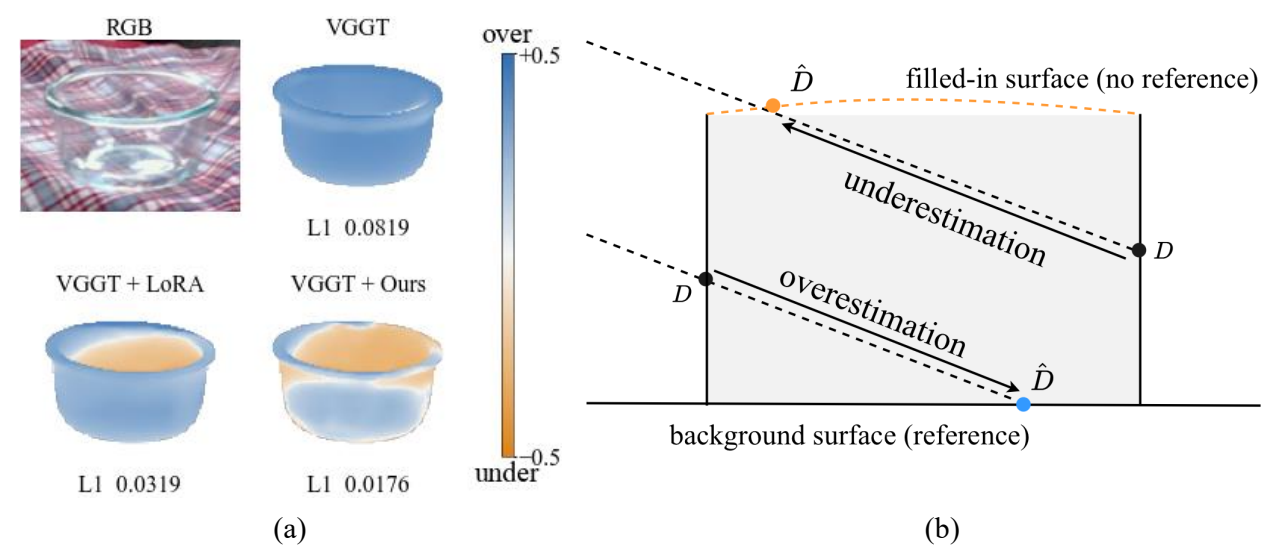
300 dpi PNG · Caption · Source PDF
Original caption, source, and provenance
Fixed source version: ICLR 2027 frozen anonymous submission PDF; retrieved 2026-10-28 UTC
Earliest verified matching figure date (temporal proxy): 2026-10-03
Actual drawing date: unknown. See the source record for version checks and temporal-evidence limitations.
Date evidence · Paper page · Complete screening and version record (Chinese)
Recorded drawing-tool disclosure: unknown. No tool attribution is inferred from appearance; see the archival disclosure evidence for scope and wording.
Crop bounding box: [143, 188, 450, 322] (PDF points; top-left origin; x0, y0, x1, y1).
Figure 1: Feed-forward 3D foundation models fail on transparent objects in two opposite directions.
(a) L1 depth error for a transparent object under zero-shot prediction, LoRA, and Ours. The zero-
shot prediction is dominated by overestimation associated with background leakage. LoRA reduces
the error, but underestimation around the concave interior remains, whereas our method corrects both
error directions. (b) The two error directions differ in reference availability. Background leakage
can be related to an observable background surface, whereas a filled-in concavity has no analogous
geometric reference for recovering the missing depth.
Latent Bridge: From Video Latents to 3D Geometry via Feature Alignment
Venue: ICLR 2027 · Submission (under review at collection)
Figure 2 · PDF page 4 · ICLR27_dPyGZiJESZ_F
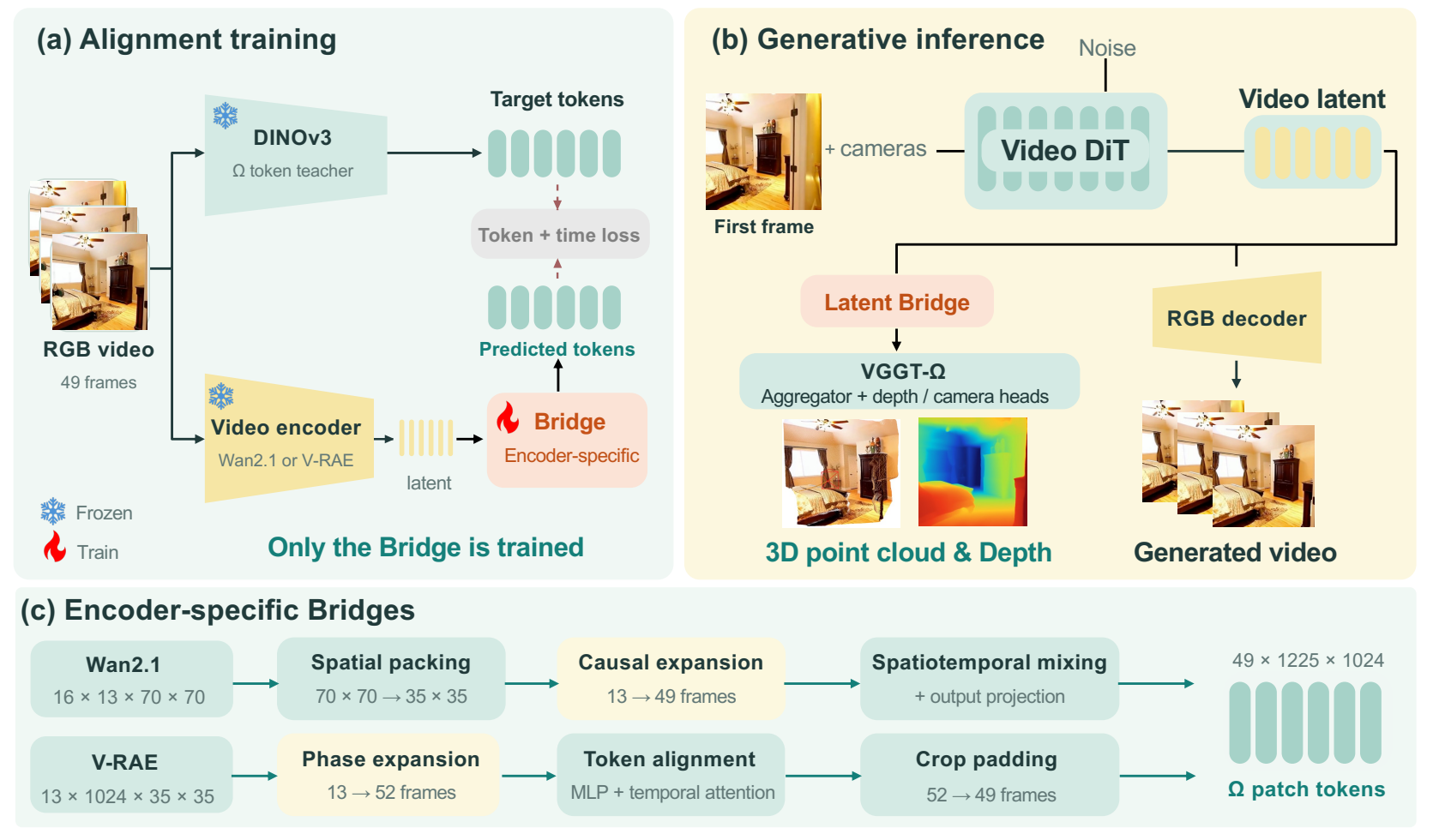
300 dpi PNG · Caption · Source PDF
Original caption, source, and provenance
Fixed source version: ICLR 2027 frozen anonymous submission PDF; retrieved 2026-10-28 UTC
Earliest verified matching figure date (temporal proxy): 2026-10-03
arXiv v1 date: 2026-10-20
Actual drawing date: unknown. See the source record for version checks and temporal-evidence limitations.
Historical PDF · Download citation snapshot · Date evidence · Paper page · Complete screening and version record (Chinese)
Citation threshold evidence: Xinggang Wang; 65000 citations; snapshot 2026-10-21.
Recorded drawing-tool disclosure: unknown. No tool attribution is inferred from appearance; see the archival disclosure evidence for scope and wording.
Crop bounding box: [106, 384, 507, 619] (PDF points; top-left origin; x0, y0, x1, y1).
Figure 2: Overview of Latent Bridge, showing (a) feature alignment training, (b) video generation
and geometry prediction from a shared latent, and (c) the architectures of bridges.
Latent Bridge: From Video Latents to 3D Geometry via Feature Alignment
Venue: ICLR 2027 · Submission (under review at collection)
Figure 1 · PDF page 2 · ICLR27_dPyGZiJESZ_M
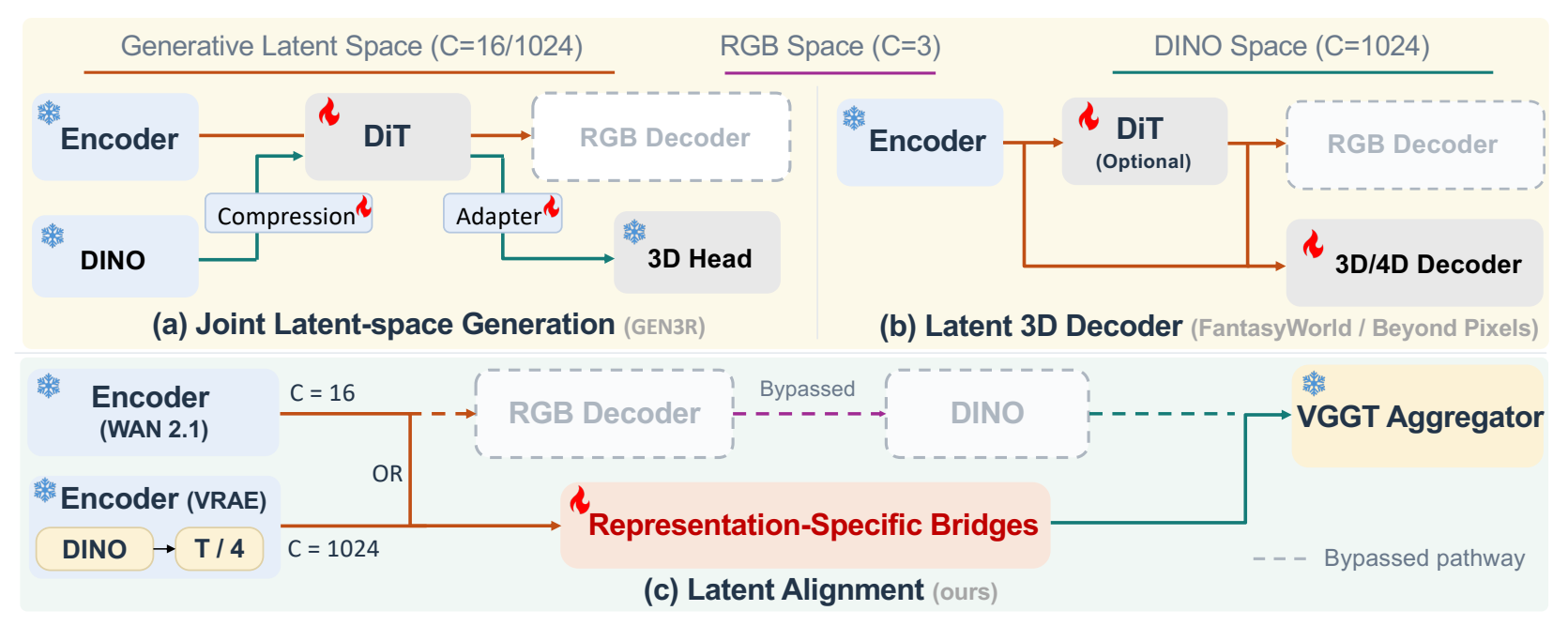
300 dpi PNG · Caption · Source PDF
Original caption, source, and provenance
Fixed source version: ICLR 2027 frozen anonymous submission PDF; retrieved 2026-10-28 UTC
Earliest verified matching figure date (temporal proxy): 2026-10-03
arXiv v1 date: 2026-10-20
Actual drawing date: unknown. See the source record for version checks and temporal-evidence limitations.
Historical PDF · Download citation snapshot · Date evidence · Paper page · Complete screening and version record (Chinese)
Citation threshold evidence: Xinggang Wang; 65000 citations; snapshot 2026-10-21.
Recorded drawing-tool disclosure: unknown. No tool attribution is inferred from appearance; see the archival disclosure evidence for scope and wording.
Crop bounding box: [106, 79, 507, 239] (PDF points; top-left origin; x0, y0, x1, y1).
Figure 1: Bypass the video decoder and directly align latent spaces to generate 3D outputs.
LonGaussian: Tracking Foundation Priors for Long-Context Feedforward Gaussian Reconstruction
Venue: ICLR 2027 · Submission (under review at collection)
Figure 3 · PDF page 4 · ICLR27_WiNCsgDP25_F
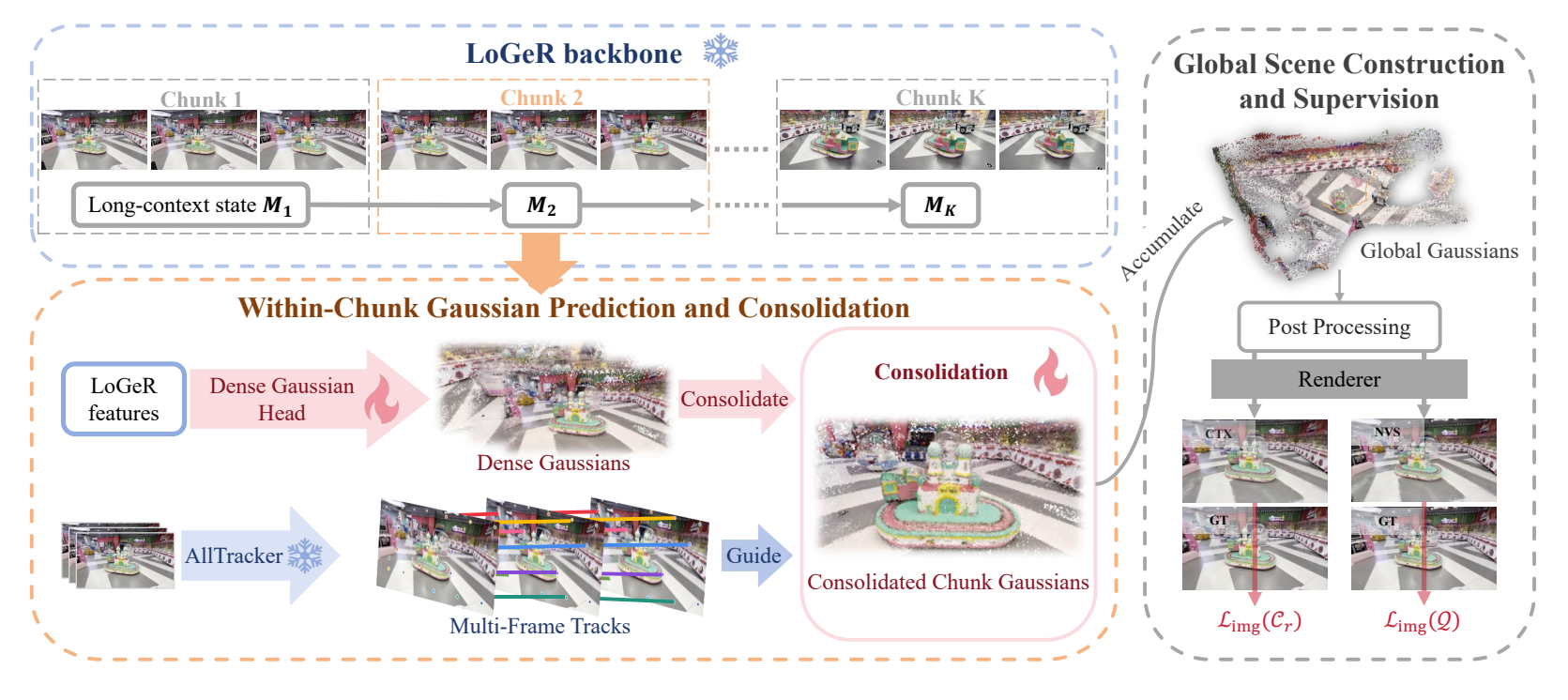
300 dpi PNG · Caption · Source PDF
Original caption, source, and provenance
Fixed source version: ICLR 2027 frozen anonymous submission PDF; retrieved 2026-10-28 UTC
Earliest verified matching figure date (temporal proxy): 2026-10-03
arXiv v1 date: 2026-10-16
Actual drawing date: unknown. See the source record for version checks and temporal-evidence limitations.
Historical PDF · Download citation snapshot · Date evidence · Paper page · Complete screening and version record (Chinese)
Citation threshold evidence: Xinggang Wang; 65000 citations; snapshot 2026-10-21.
Recorded drawing-tool disclosure: unknown; authors_deny_generative_AI_figures. No tool attribution is inferred from appearance; see the archival disclosure evidence for scope and wording.
Crop bounding box: [106, 79, 507, 258] (PDF points; top-left origin; x0, y0, x1, y1).
Figure 3: Overview of LonGaussian. LoGeR processes overlapping chunks, and AllTracker cor-
respondences guide Gaussian consolidation before cross-chunk filtering and far-field modeling.
Snowflakes and flames denote frozen and trainable modules, respectively.
LonGaussian: Tracking Foundation Priors for Long-Context Feedforward Gaussian Reconstruction
Venue: ICLR 2027 · Submission (under review at collection)
Figure 2 · PDF page 2 · ICLR27_WiNCsgDP25_M
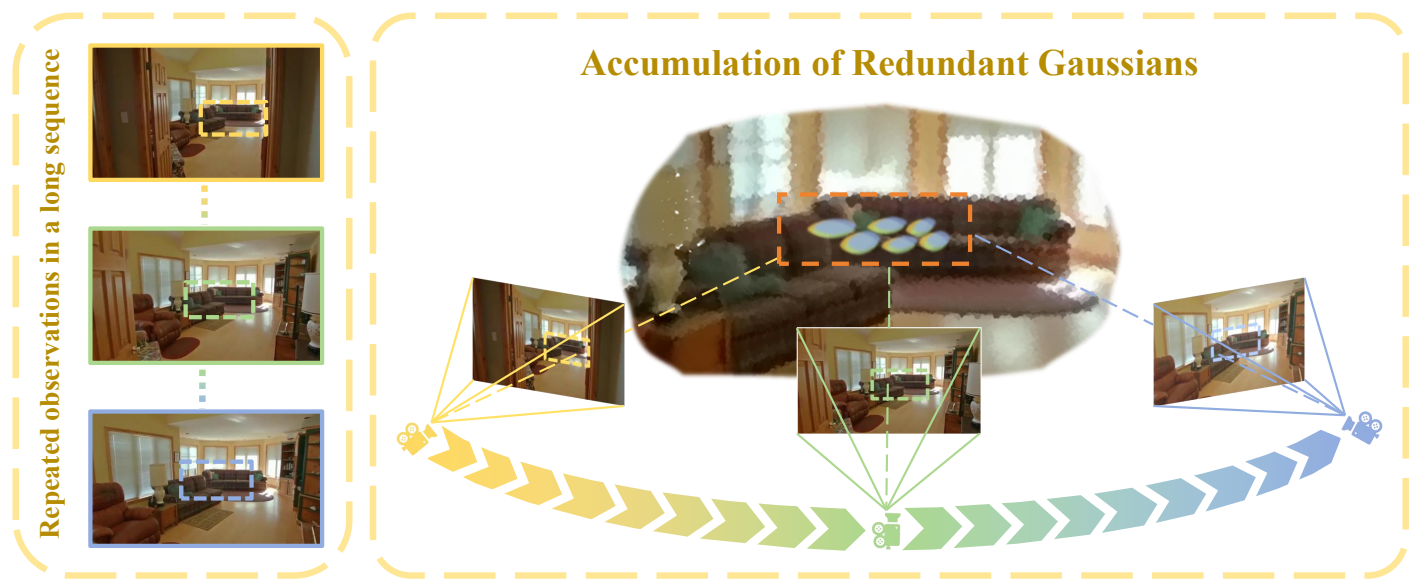
300 dpi PNG · Caption · Source PDF
Original caption, source, and provenance
Fixed source version: ICLR 2027 frozen anonymous submission PDF; retrieved 2026-10-28 UTC
Earliest verified matching figure date (temporal proxy): 2026-10-03
arXiv v1 date: 2026-10-16
Actual drawing date: unknown. See the source record for version checks and temporal-evidence limitations.
Historical PDF · Download citation snapshot · Date evidence · Paper page · Complete screening and version record (Chinese)
Citation threshold evidence: Xinggang Wang; 65000 citations; snapshot 2026-10-21.
Recorded drawing-tool disclosure: unknown; authors_deny_generative_AI_figures. No tool attribution is inferred from appearance; see the archival disclosure evidence for scope and wording.
Crop bounding box: [136, 79, 478, 219] (PDF points; top-left origin; x0, y0, x1, y1).
Figure 2: Gaussian redundancy from repeated observations. Pixel-aligned predictions accumulate
overlapping primitives for the same surface, increasing storage and rendering costs; matching colors
denote corresponding observations and Gaussians.
PAIR3D: Learning Physics-Aligned and Visually Consistent 3D Scene Layouts from Verifiable Rewards
Venue: ICLR 2027 · Submission (under review at collection)
Figure 2 · PDF page 4 · ICLR27_e8KzLssuLH_F
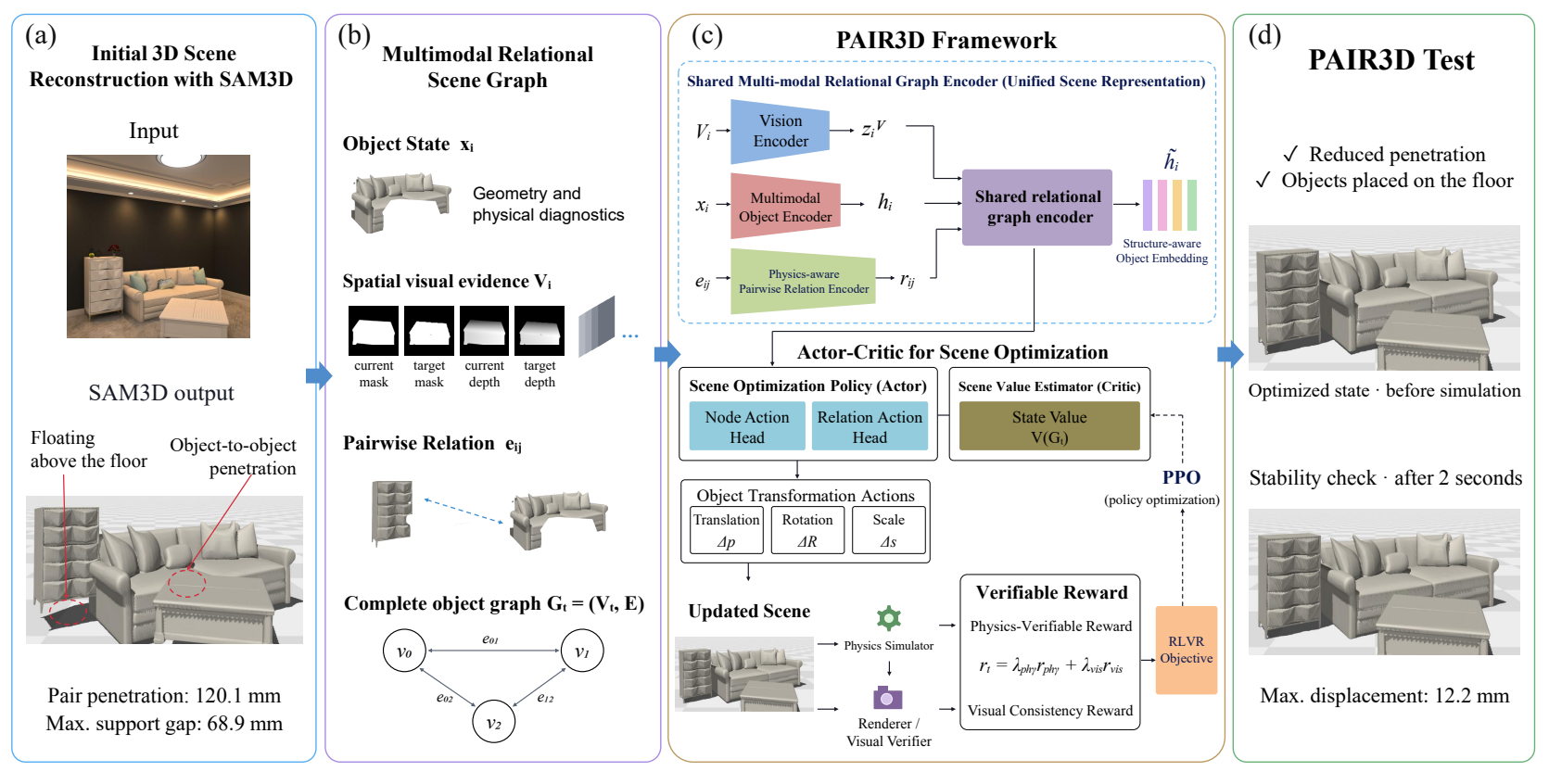
300 dpi PNG · Caption · Source PDF
Original caption, source, and provenance
Fixed source version: ICLR 2027 frozen anonymous submission PDF; retrieved 2026-10-28 UTC
Earliest verified matching figure date (temporal proxy): 2026-10-03
Actual drawing date: unknown. See the source record for version checks and temporal-evidence limitations.
Date evidence · Paper page · Complete screening and version record (Chinese)
Recorded drawing-tool disclosure: unknown. No tool attribution is inferred from appearance; see the archival disclosure evidence for scope and wording.
Crop bounding box: [106, 79, 507, 282] (PDF points; top-left origin; x0, y0, x1, y1).
Figure 2: Overview of PAIR3D. PAIR3D aligns reconstructed 3D scenes with physical constraints
through verifiable feedback. Given an initial SAM3D reconstruction with artifacts such as floating
objects and inter-object penetration, we construct a multimodal relational scene graph from object
states, spatial visual evidence, and pairwise relations. A shared relational encoder provides structure-
aware representations to an actor–critic policy, which iteratively updates object translation, rotation,
and scale. Physics simulation and visual verification provide verifiable rewards for PPO training. The
resulting policy directly refines scenes at test time, reducing penetration and support violations while
producing configurations that remain stable under simulation.
PAIR3D: Learning Physics-Aligned and Visually Consistent 3D Scene Layouts from Verifiable Rewards
Venue: ICLR 2027 · Submission (under review at collection)
Figure 1 · PDF page 2 · ICLR27_e8KzLssuLH_M
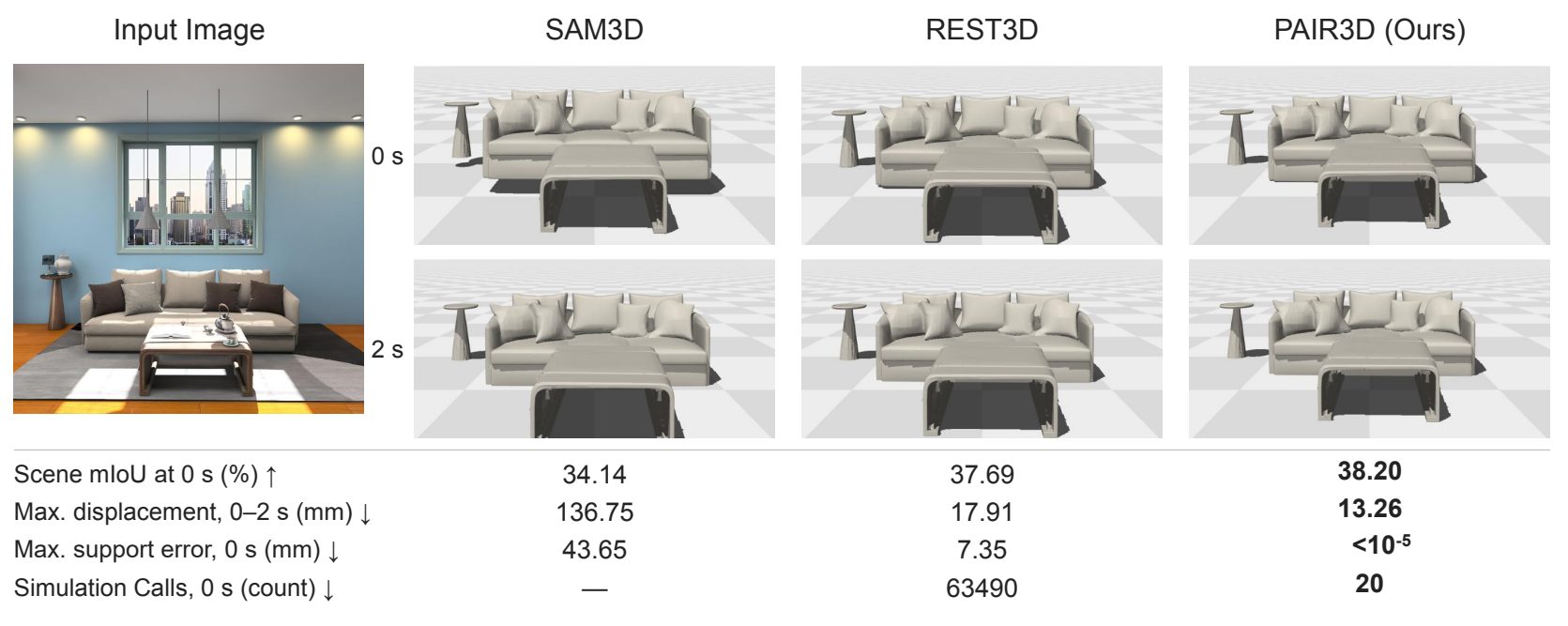
300 dpi PNG · Caption · Source PDF
Original caption, source, and provenance
Fixed source version: ICLR 2027 frozen anonymous submission PDF; retrieved 2026-10-28 UTC
Earliest verified matching figure date (temporal proxy): 2026-10-03
Actual drawing date: unknown. See the source record for version checks and temporal-evidence limitations.
Date evidence · Paper page · Complete screening and version record (Chinese)
Recorded drawing-tool disclosure: unknown. No tool attribution is inferred from appearance; see the archival disclosure evidence for scope and wording.
Crop bounding box: [106, 79, 507, 239] (PDF points; top-left origin; x0, y0, x1, y1).
Figure 1: Physics alignment and visual consistency under various methods for a reconstructed
scene. We compare SAM3D (Chen et al., 2026), REST3D (Ma et al., 2026), and PAIR3D (ours)
at initialization and after 2 seconds of MuJoCo simulation, rendered from the input camera. In
this example, PAIR3D achieves the highest scene mIoU, near-zero support error, and the smallest
simulation-induced displacement, while using fewer simulation rollouts for scene refinement. The
mIoU and support error are measured at initialization; displacement denotes the maximum per-object
translation between 0 and 2 seconds.
PCAsplat: Gaussian Splatting with Local PCA Regularization
Venue: ICLR 2027 · Submission (under review at collection)
Figure 2 · PDF page 4 · ICLR27_0X2ay3NW4Z_F
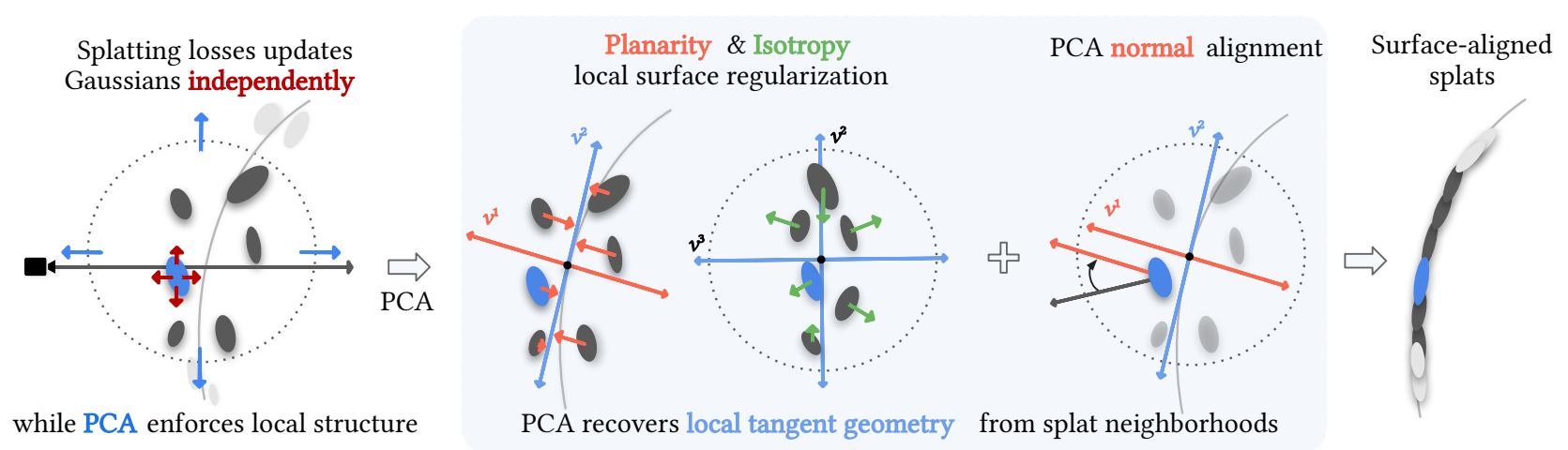
300 dpi PNG · Caption · Source PDF
Original caption, source, and provenance
Fixed source version: ICLR 2027 frozen anonymous submission PDF; retrieved 2026-10-28 UTC
Earliest verified matching figure date (temporal proxy): 2026-10-03
arXiv v1 date: 2026-10-07
Actual drawing date: unknown. See the source record for version checks and temporal-evidence limitations.
Historical PDF · Download citation snapshot · Date evidence · Paper page · Complete screening and version record (Chinese)
Citation threshold evidence: Gordon Wetzstein; 47402 citations; snapshot 2026-10-21.
Recorded drawing-tool disclosure: unknown. No tool attribution is inferred from appearance; see the archival disclosure evidence for scope and wording.
Crop bounding box: [106, 79, 507, 194] (PDF points; top-left origin; x0, y0, x1, y1).
Figure 2: Overview of PCAsplat. We regularize Gaussian neighborhoods directly in scene space.
For each Gaussian, we estimate a local neighborhood and compute differentiable PCA statistics
that capture the underlying tangent structure. We then regularize the local eigenspectrum to reduce
neighborhood thickness and promote isotropic tangent-plane coverage. We also align Gaussian
normals with PCA-derived normals, encouraging surface-aligned and well-localized splats. Our
formulation is lightweight, differentiable, and directly compatible with existing splatting pipelines.
PCAsplat: Gaussian Splatting with Local PCA Regularization
Venue: ICLR 2027 · Submission (under review at collection)
Figure 1 · PDF page 2 · ICLR27_0X2ay3NW4Z_M
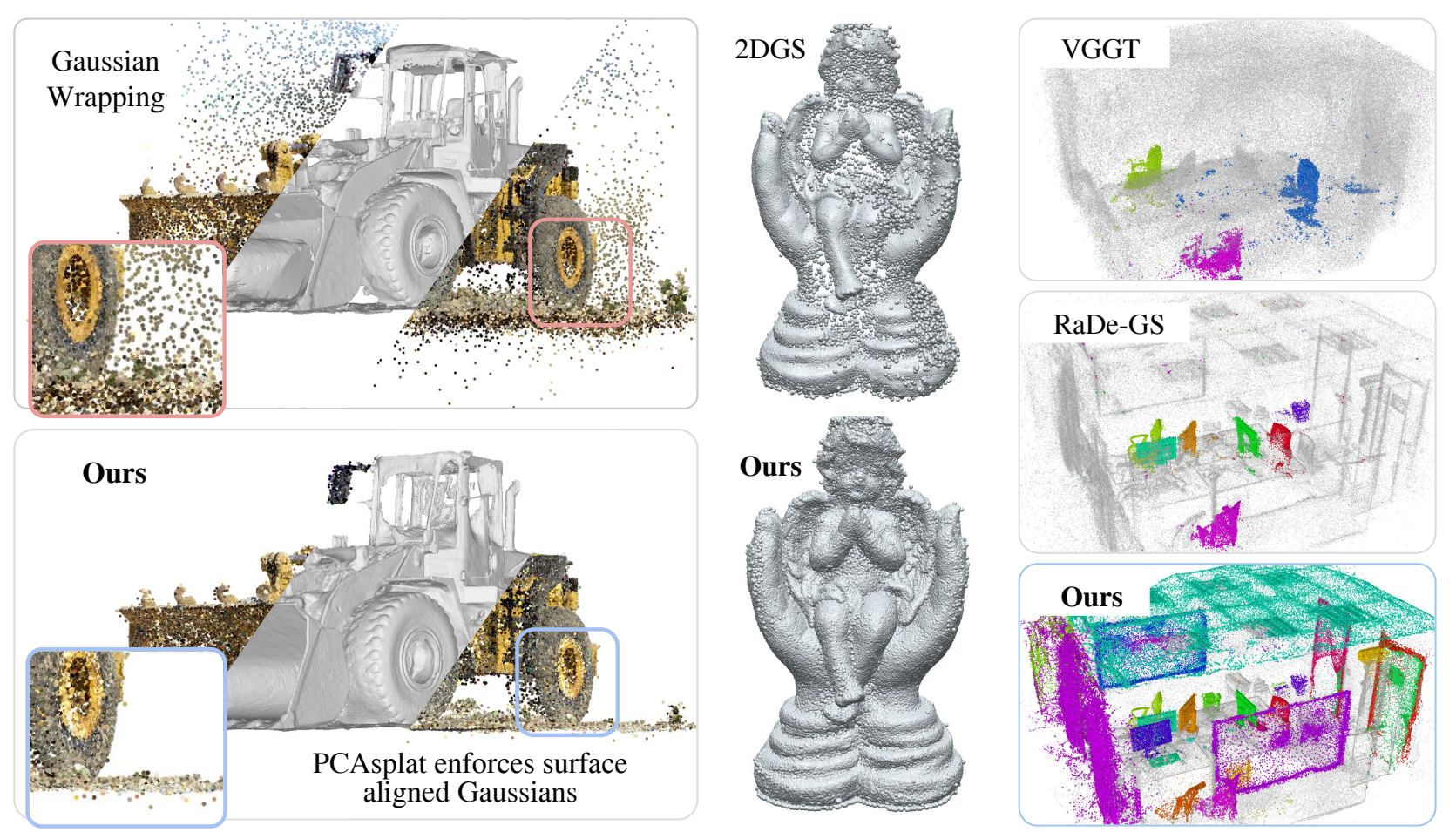
300 dpi PNG · Caption · Source PDF
Original caption, source, and provenance
Fixed source version: ICLR 2027 frozen anonymous submission PDF; retrieved 2026-10-28 UTC
Earliest verified matching figure date (temporal proxy): 2026-10-03
arXiv v1 date: 2026-10-07
Actual drawing date: unknown. See the source record for version checks and temporal-evidence limitations.
Historical PDF · Download citation snapshot · Date evidence · Paper page · Complete screening and version record (Chinese)
Citation threshold evidence: Gordon Wetzstein; 47402 citations; snapshot 2026-10-21.
Recorded drawing-tool disclosure: unknown. No tool attribution is inferred from appearance; see the archival disclosure evidence for scope and wording.
Crop bounding box: [106, 79, 507, 308] (PDF points; top-left origin; x0, y0, x1, y1).
Figure 1: We present PCAsplat, a geometric regularization of Gaussian splatting that aligns Gaus-
sians with surfaces through differentiable local PCA. Compared with current methods, PCAsplat
substantially reduces floaters (left) and produces cleaner point clouds with better surface coverage
(center). This improved point-cloud enables downstream tasks such as instance segmentation (right).
SM4RT: Learning Structured Motion Geometry for 4D Reconstruction
Venue: ICLR 2027 · Submission (under review at collection)
Figure 4 · PDF page 5 · ICLR27_Y69S27nWgp_F
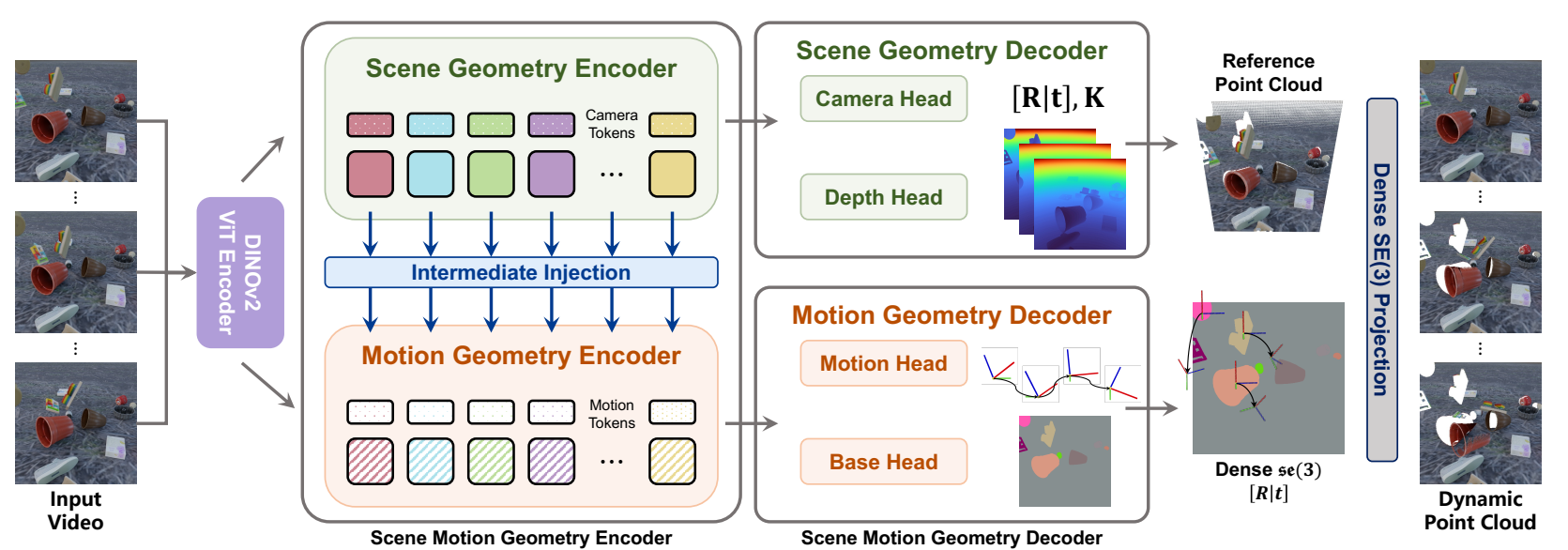
300 dpi PNG · Caption · Source PDF
Original caption, source, and provenance
Fixed source version: ICLR 2027 frozen anonymous submission PDF; retrieved 2026-10-28 UTC
Earliest verified matching figure date (temporal proxy): 2026-07-24
arXiv v1 date: 2026-07-24
Actual drawing date: unknown. See the source record for version checks and temporal-evidence limitations.
Historical PDF · Download citation snapshot · Date evidence · Paper page · Complete screening and version record (Chinese)
Citation threshold evidence: Jie Zhou; 56256 citations; snapshot 2026-10-21.
Recorded drawing-tool disclosure: generative_AI_layout_guidance_unspecified_tool. No tool attribution is inferred from appearance; see the archival disclosure evidence for scope and wording.
Crop bounding box: [106, 79, 507, 219.5] (PDF points; top-left origin; x0, y0, x1, y1).
Figure 4: Overview of our SM4RT. Given a monocular input video, SM4RT extracts latent geome-
try tokens with a DINOv2 backbone, then decouples them into scene geometry and motion geometry
tokens. The scene decoder predicts camera parameters and depth, while the motion decoder esti-
mates sparse se(3) transforms and motion base weights for dense SE(3) projection.
SM4RT: Learning Structured Motion Geometry for 4D Reconstruction
Venue: ICLR 2027 · Submission (under review at collection)
Figure 2 · PDF page 3 · ICLR27_Y69S27nWgp_M
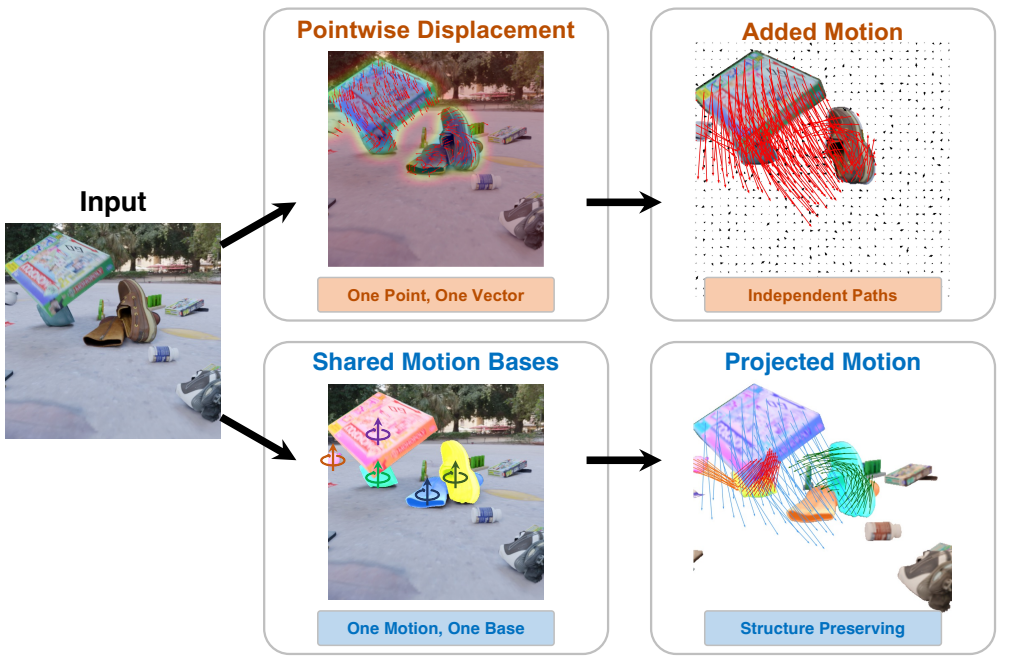
300 dpi PNG · Caption · Source PDF
Original caption, source, and provenance
Fixed source version: ICLR 2027 frozen anonymous submission PDF; retrieved 2026-10-28 UTC
Earliest verified matching figure date (temporal proxy): 2026-07-24
arXiv v1 date: 2026-07-24
Actual drawing date: unknown. See the source record for version checks and temporal-evidence limitations.
Historical PDF · Download citation snapshot · Date evidence · Paper page · Complete screening and version record (Chinese)
Citation threshold evidence: Jie Zhou; 56256 citations; snapshot 2026-10-21.
Recorded drawing-tool disclosure: generative_AI_layout_guidance_unspecified_tool. No tool attribution is inferred from appearance; see the archival disclosure evidence for scope and wording.
Crop bounding box: [265, 416, 507, 574] (PDF points; top-left origin; x0, y0, x1, y1).
Figure 2: Comparison of motion representations. The
proposed representation preserves the structure of object
motion, which provides a more structured description than
standard per-pixel displacement and encouraging intra-
object homogeneity.
UniForge3D: Joint 3D Reconstruction and Generation in a Shared Anchor-Guided Space
Venue: ICLR 2027 · Submission (under review at collection)
Figure 3 · PDF page 4 · ICLR27_dpOjIHiDKY_F
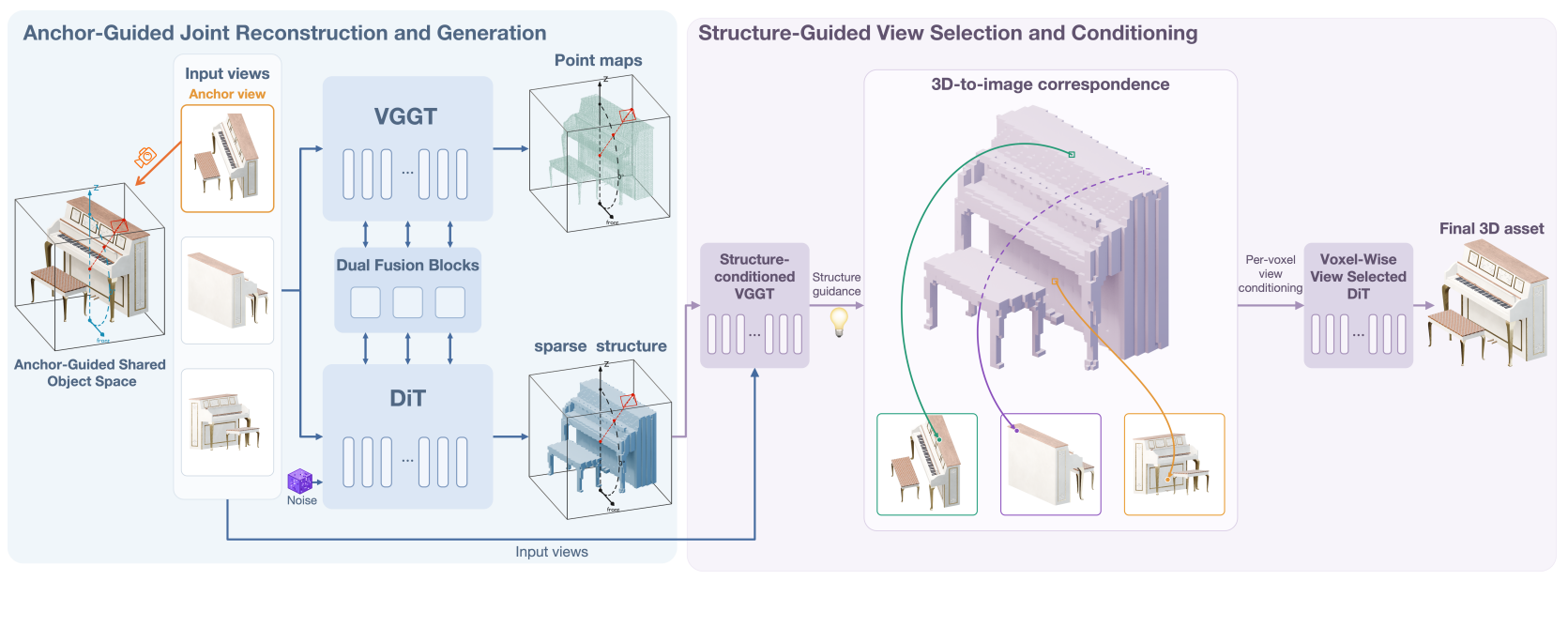
300 dpi PNG · Caption · Source PDF
Original caption, source, and provenance
Fixed source version: ICLR 2027 frozen anonymous submission PDF; retrieved 2026-10-28 UTC
Earliest verified matching figure date (temporal proxy): 2026-10-03
arXiv v1 date: 2026-10-11
Actual drawing date: unknown. See the source record for version checks and temporal-evidence limitations.
Historical PDF · Download citation snapshot · Date evidence · Paper page · Complete screening and version record (Chinese)
Citation threshold evidence: Yuan Liu; 12285 citations; snapshot 2026-10-21.
Recorded drawing-tool disclosure: unknown. No tool attribution is inferred from appearance; see the archival disclosure evidence for scope and wording.
Crop bounding box: [106, 79, 507, 243] (PDF points; top-left origin; x0, y0, x1, y1).
Figure 3: Overview of UniForge3D. Left: The reconstruction and generation branches interact
bidirectionally to predict multi-view point maps and a complete sparse structure in a shared anchor-
guided space. Right: Structure-conditioned point maps establish voxel-to-pixel correspondences,
enabling the model to select informative views and use their image features to guide detailed shape
generation.
UniForge3D: Joint 3D Reconstruction and Generation in a Shared Anchor-Guided Space
Venue: ICLR 2027 · Submission (under review at collection)
Figure 2 · PDF page 2 · ICLR27_dpOjIHiDKY_M
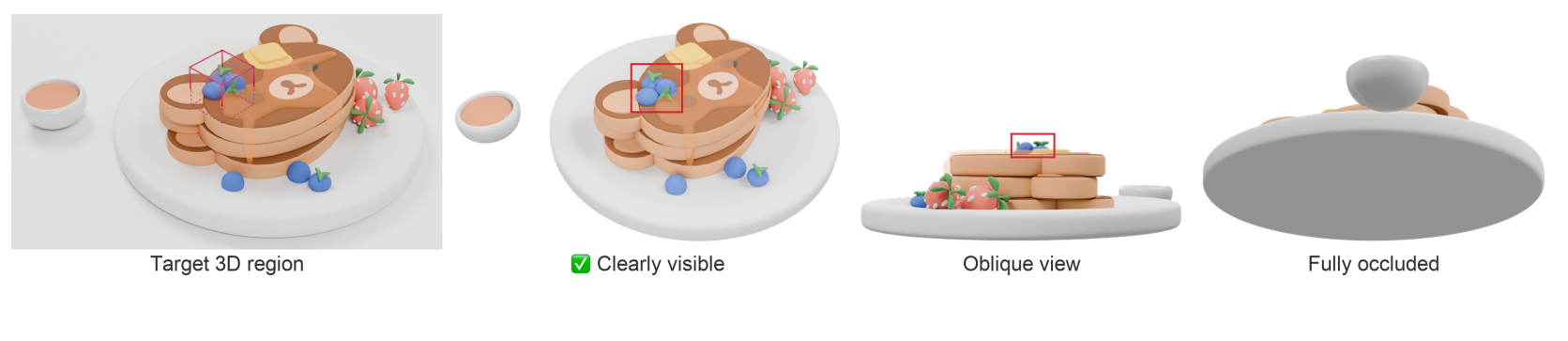
300 dpi PNG · Caption · Source PDF
Original caption, source, and provenance
Fixed source version: ICLR 2027 frozen anonymous submission PDF; retrieved 2026-10-28 UTC
Earliest verified matching figure date (temporal proxy): 2026-10-03
arXiv v1 date: 2026-10-11
Actual drawing date: unknown. See the source record for version checks and temporal-evidence limitations.
Historical PDF · Download citation snapshot · Date evidence · Paper page · Complete screening and version record (Chinese)
Citation threshold evidence: Yuan Liu; 12285 citations; snapshot 2026-10-21.
Recorded drawing-tool disclosure: unknown. No tool attribution is inferred from appearance; see the archival disclosure evidence for scope and wording.
Crop bounding box: [106, 79, 507, 166] (PDF points; top-left origin; x0, y0, x1, y1).
Figure 2: Different views provide different evidence for the same 3D region. The 3D box marks
three blueberries, which are clearly visible, seen at an oblique angle, or fully occluded across the
three views, motivating region-specific view selection.
VASC: Value-Aware Sparse Attention with Cross-layer Memory for Efficient 3D Reconstruction
Venue: ICLR 2027 · Submission (under review at collection)
Figure 4 · PDF page 5 · ICLR27_X7FI3N35Hq_F
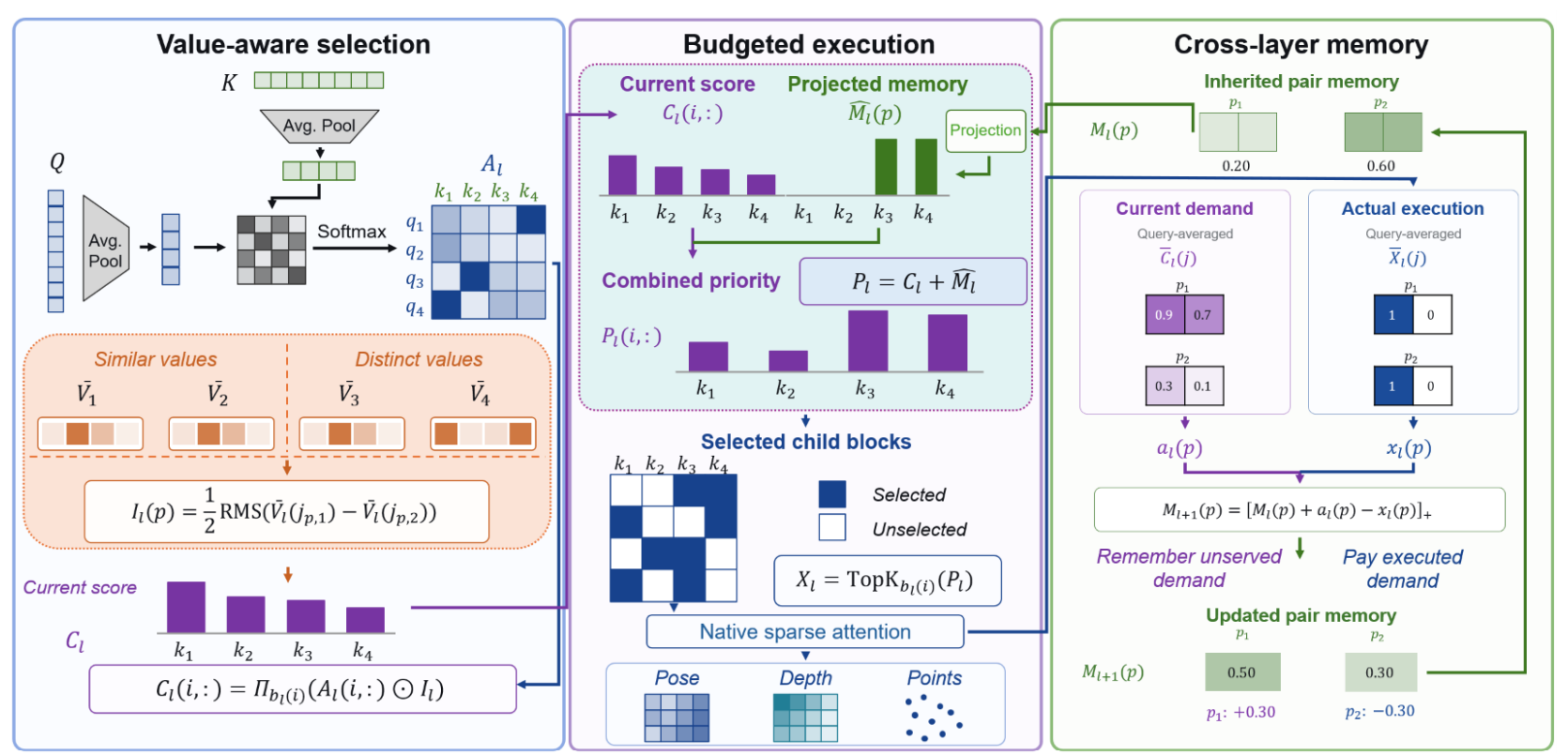
300 dpi PNG · Caption · Source PDF
Original caption, source, and provenance
Fixed source version: ICLR 2027 frozen anonymous submission PDF; retrieved 2026-10-28 UTC
Earliest verified matching figure date (temporal proxy): 2026-10-01
arXiv v1 date: 2026-10-01
Actual drawing date: unknown. See the source record for version checks and temporal-evidence limitations.
Historical PDF · Download citation snapshot · Date evidence · Paper page · Complete screening and version record (Chinese)
Citation threshold evidence: Yulun Zhang; 40552 citations; snapshot 2026-10-21.
Recorded drawing-tool disclosure: generative_AI_figure_composition_unspecified_tool. No tool attribution is inferred from appearance; see the archival disclosure evidence for scope and wording.
Crop bounding box: [106, 79, 507, 272] (PDF points; top-left origin; x0, y0, x1, y1).
Figure 4: VASC overview. Value contrast and cross-layer memory jointly guide block selection
within a fixed budget. Actual execution updates memory for the next layer.
VASC: Value-Aware Sparse Attention with Cross-layer Memory for Efficient 3D Reconstruction
Venue: ICLR 2027 · Submission (under review at collection)
Figure 3 · PDF page 4 · ICLR27_X7FI3N35Hq_M
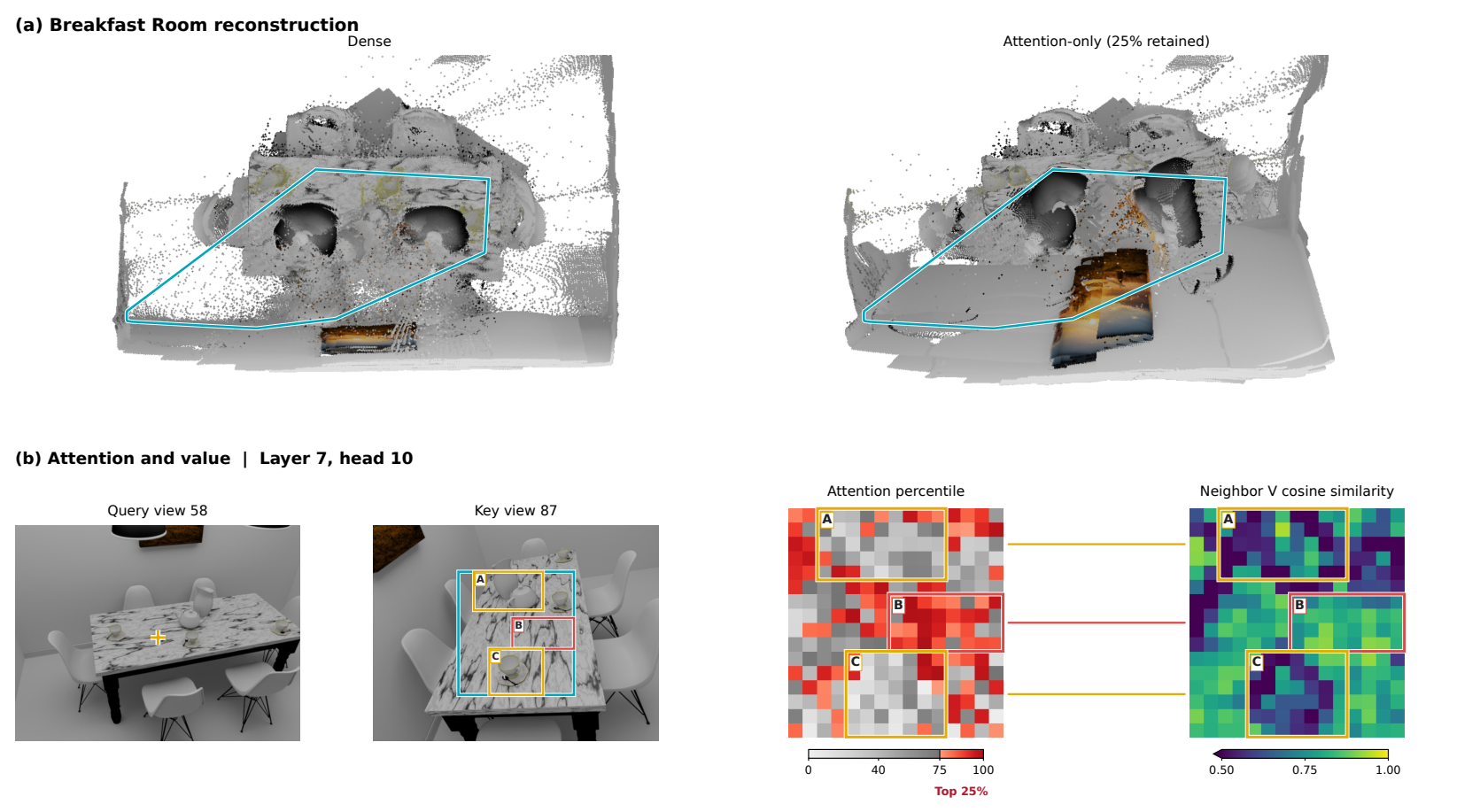
300 dpi PNG · Caption · Source PDF
Original caption, source, and provenance
Fixed source version: ICLR 2027 frozen anonymous submission PDF; retrieved 2026-10-28 UTC
Earliest verified matching figure date (temporal proxy): 2026-10-01
arXiv v1 date: 2026-10-01
Actual drawing date: unknown. See the source record for version checks and temporal-evidence limitations.
Historical PDF · Download citation snapshot · Date evidence · Paper page · Complete screening and version record (Chinese)
Citation threshold evidence: Yulun Zhang; 40552 citations; snapshot 2026-10-21.
Recorded drawing-tool disclosure: generative_AI_figure_composition_unspecified_tool. No tool attribution is inferred from appearance; see the archival disclosure evidence for scope and wording.
Crop bounding box: [106, 210, 507, 430] (PDF points; top-left origin; x0, y0, x1, y1).
Figure 3: Attention priority and local value variation. (a) Dense and attention-only reconstruction
with 25% of connections retained. (b) Attention and neighboring-value similarity reveal different
spatial patterns; lower similarity indicates greater directional variation.
S4-AI-Style · 40 papers · 51 figures (11 M / 40 F)
Additional purposive style-contrast sample across all ICLR 2027 topics. These papers are separate from the 160-paper main cohort. The label does not establish that any figure was drawn using AI.
40-paper list (CSV)
S4-AI-Style · Agent-based image restoration · MotivationPurposive style-contrast cohortGRASP: Grounded Restoration with Agent-Refined Semantic Prompts for Real-World Image Super-Resolution
Venue: ICLR 2027 · Submission (under review at collection)
Figure 1 · PDF page 2 · AI_3gogFGspDb_M
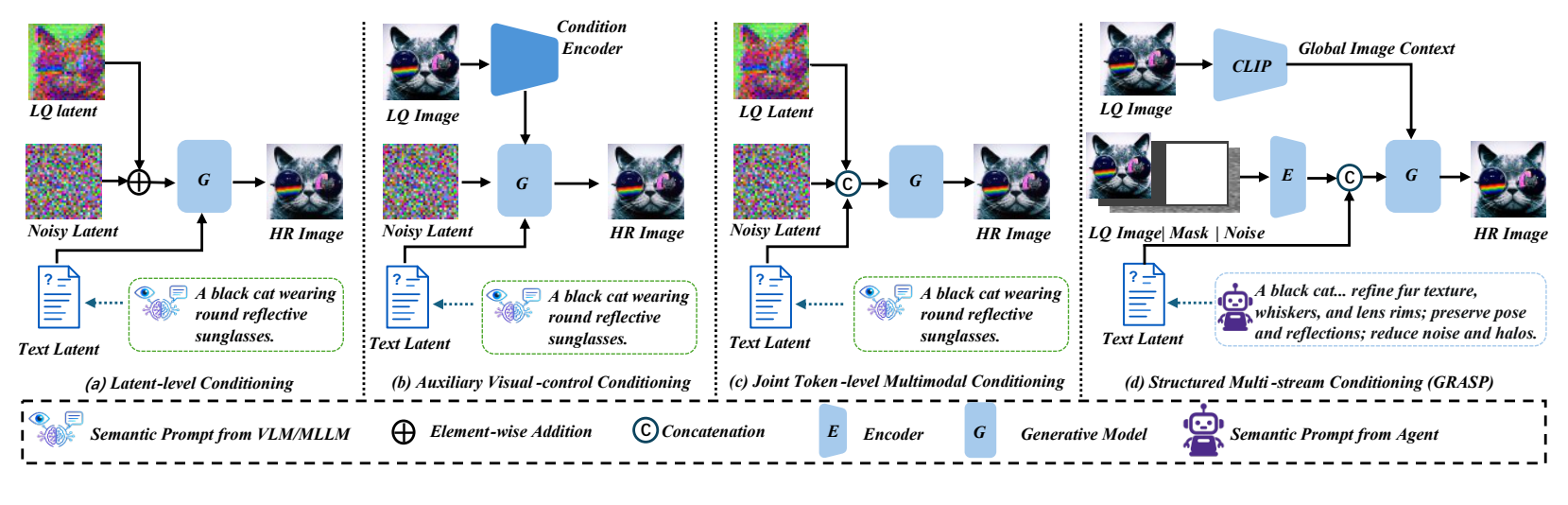
300 dpi PNG · Caption · Source PDF
Original caption, source, and provenance
Fixed source version: fixed public ICLR2027 anonymous submission
Public submission date (temporal proxy): 2026-10-03
Actual drawing date: unknown. See the source record for version checks and temporal-evidence limitations.
ICLR 2027 OpenReview submission · Original disclosure record · Complete screening and version record (Chinese)
Recorded drawing-tool disclosure: unknown. No tool attribution is inferred from appearance; see the archival disclosure evidence for scope and wording.
Crop bounding box: [107, 80, 505, 208] (PDF points; top-left origin; x0, y0, x1, y1).
Figure 1: Schematic comparison of conditioning paradigms in generative Real-ISR. Prior methods
typically inject low-quality observations and semantic prompts through latent-level conditioning,
auxiliary visual-control branches, or joint token-level multimodal conditioning. Panel (a) illustrates an
additive implementation of latent-level conditioning. GRASP organizes local visual evidence, global
image context, and agent-refined semantic prompts as distinct condition streams with complementary
functions for the SR objective.
GRASP: Grounded Restoration with Agent-Refined Semantic Prompts for Real-World Image Super-Resolution
Venue: ICLR 2027 · Submission (under review at collection)
Figure 2 · PDF page 4 · AI_3gogFGspDb_F
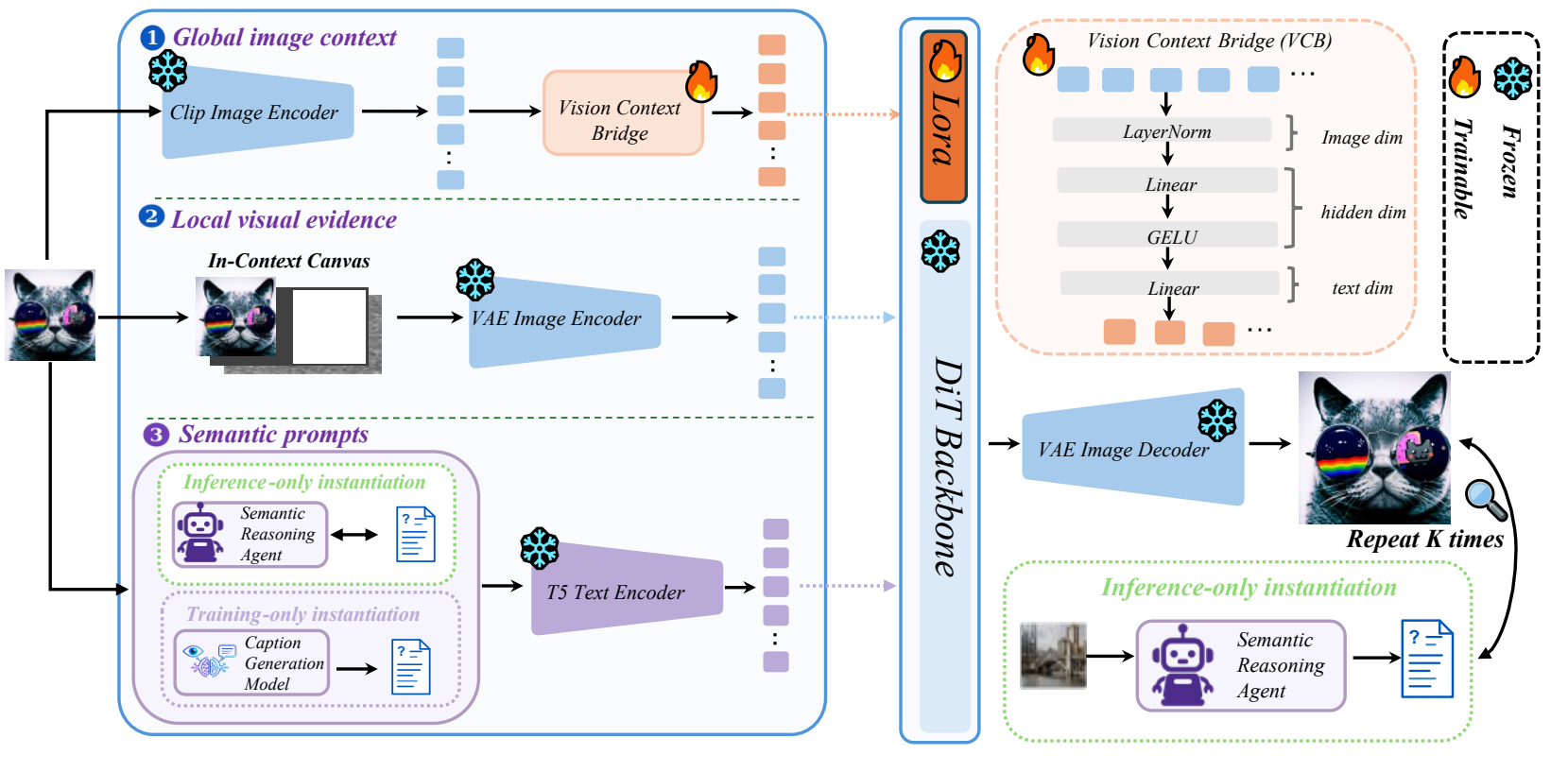
300 dpi PNG · Caption · Source PDF
Original caption, source, and provenance
Fixed source version: fixed public ICLR2027 anonymous submission
Public submission date (temporal proxy): 2026-10-03
Actual drawing date: unknown. See the source record for version checks and temporal-evidence limitations.
ICLR 2027 OpenReview submission · Original disclosure record · Complete screening and version record (Chinese)
Recorded drawing-tool disclosure: unknown. No tool attribution is inferred from appearance; see the archival disclosure evidence for scope and wording.
Crop bounding box: [107, 80, 505, 276] (PDF points; top-left origin; x0, y0, x1, y1).
Figure 2: Overview of GRASP. Real-ISR is cast as visual in-context completion. Local visual
evidence comes from the diptych, global image context from the Vision-Context Bridge over CLIP,
and semantic prompts from LLaVA captions during training and agent refinement during inference.
$\mathrm{E}^2$IR-Agent: Experience-Driven Self-Evolving Image Restoration Agentic System
Venue: ICLR 2027 · Submission (under review at collection)
Figure 2 · PDF page 3 · AI_hFRPKRZXeS_F
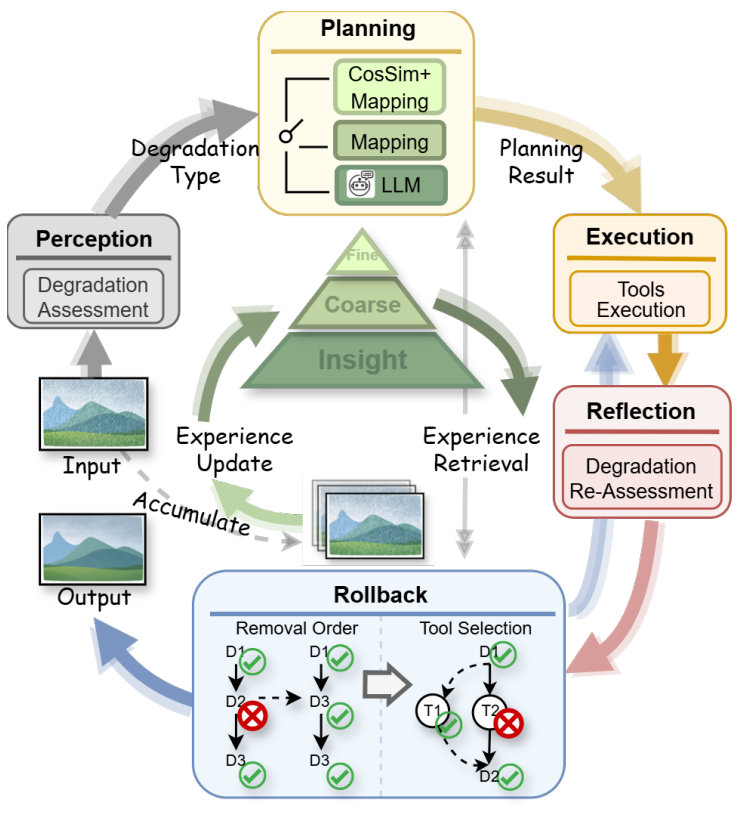
300 dpi PNG · Caption · Source PDF
Original caption, source, and provenance
Fixed source version: fixed public ICLR2027 anonymous submission
Public submission date (temporal proxy): 2026-10-03
Actual drawing date: unknown. See the source record for version checks and temporal-evidence limitations.
ICLR 2027 OpenReview submission · Original disclosure record · Complete screening and version record (Chinese)
Recorded drawing-tool disclosure: unknown. No tool attribution is inferred from appearance; see the archival disclosure evidence for scope and wording.
Crop bounding box: [328, 502, 505, 700] (PDF points; top-left origin; x0, y0, x1, y1).
Figure 2: Overview of the experience-driven
inference workflow in E2IR-Agent.
GATOR: Generative and Agentic 3D Object Reconstruction from Casual Images
Venue: ICLR 2027 · Submission (under review at collection)
Figure 2 · PDF page 4 · AI_12nS7mYinw_F
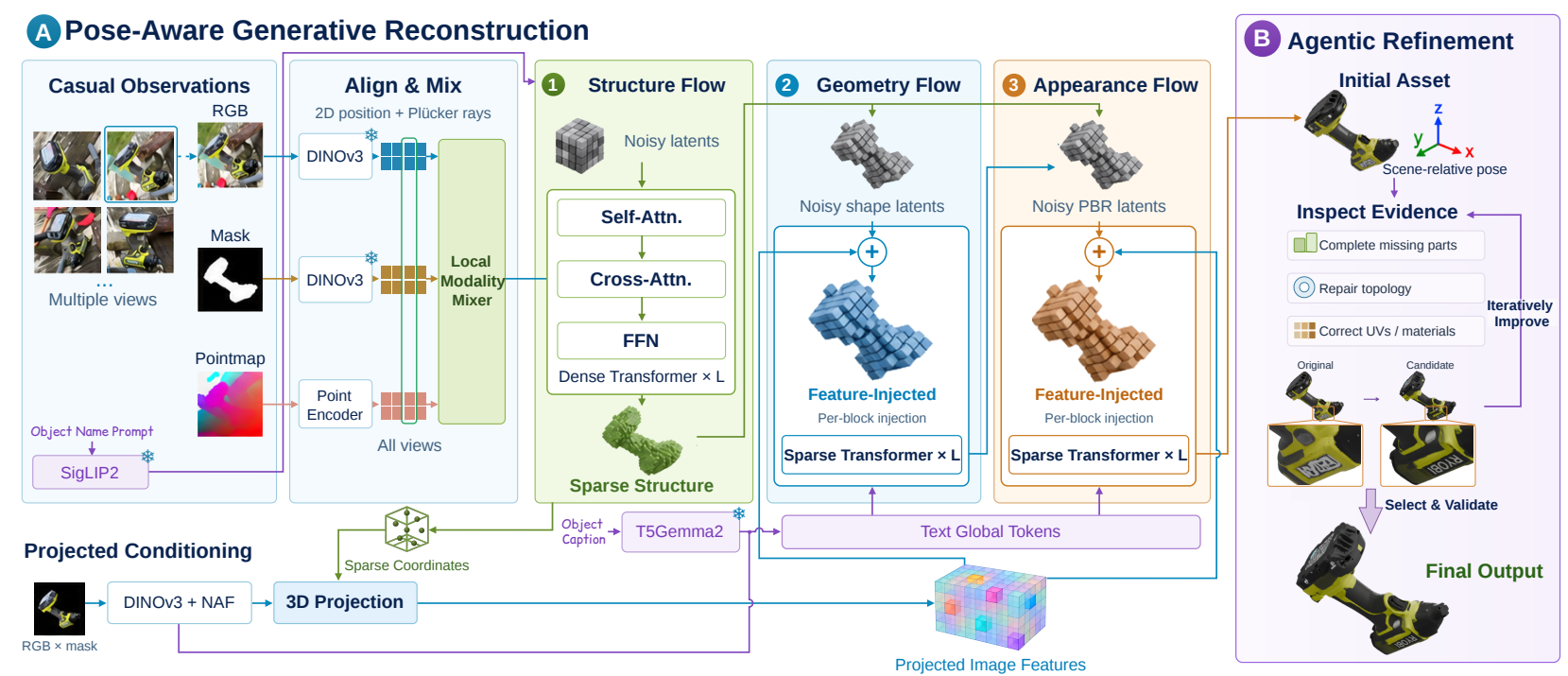
300 dpi PNG · Caption · Source PDF
Original caption, source, and provenance
Fixed source version: fixed public ICLR2027 anonymous submission
Public submission date (temporal proxy): 2026-10-03
Actual drawing date: unknown. See the source record for version checks and temporal-evidence limitations.
ICLR 2027 OpenReview submission · Original disclosure record · Complete screening and version record (Chinese)
Recorded drawing-tool disclosure: unknown. No tool attribution is inferred from appearance; see the archival disclosure evidence for scope and wording.
Crop bounding box: [107, 80, 505, 251.5] (PDF points; top-left origin; x0, y0, x1, y1).
Fig. 2: GATOR architecture. (A) Pose-aware generative reconstruction. Following TRELLIS.2 (Xiang
et al., 2026), GATOR uses conditional flows for sparse structure, geometry, and appearance. RGB images and
depth-derived pointmaps retain scene context, while masks identify the target. Tokens from all three modalities
share a patch grid with common 2D position and Plücker-ray encodings. A local mixer exchanges information
at each patch within a view (Secs. 3.2 and 3.3). Cross-view attention and SigLIP2 object-name conditioning
guide structure generation. At its active coordinates, projected DINOv3 and NAF-upsampled features from
target-masked images are averaged across valid views and injected into every geometry and appearance de-
noising block. Global image tokens and T5Gemma2-encoded captions supply cross-attention. Shape latents
condition PBR material generation (Sec. 3.4). ❄ denotes frozen encoders. (B) Agentic refinement. Initialized
with the complete, scene-aligned asset, an agent uses input images and structural priors to complete parts, re-
pair topology, and refine texture coordinates and materials. Its edit-render-review loop compares original and
candidate renders under matched cameras and lighting to retain or revert local edits. Within the time budget, it
selects the best inspected asset while preserving reliable regions and scene-relative placement (Sec. 3.5).
Stride: Scale-Aware Multi-Agent Evolutionary Refinement for Infographic Generation
Venue: ICLR 2027 · Submission (under review at collection)
Figure 1 · PDF page 3 · AI_qT1Thc0dst_F
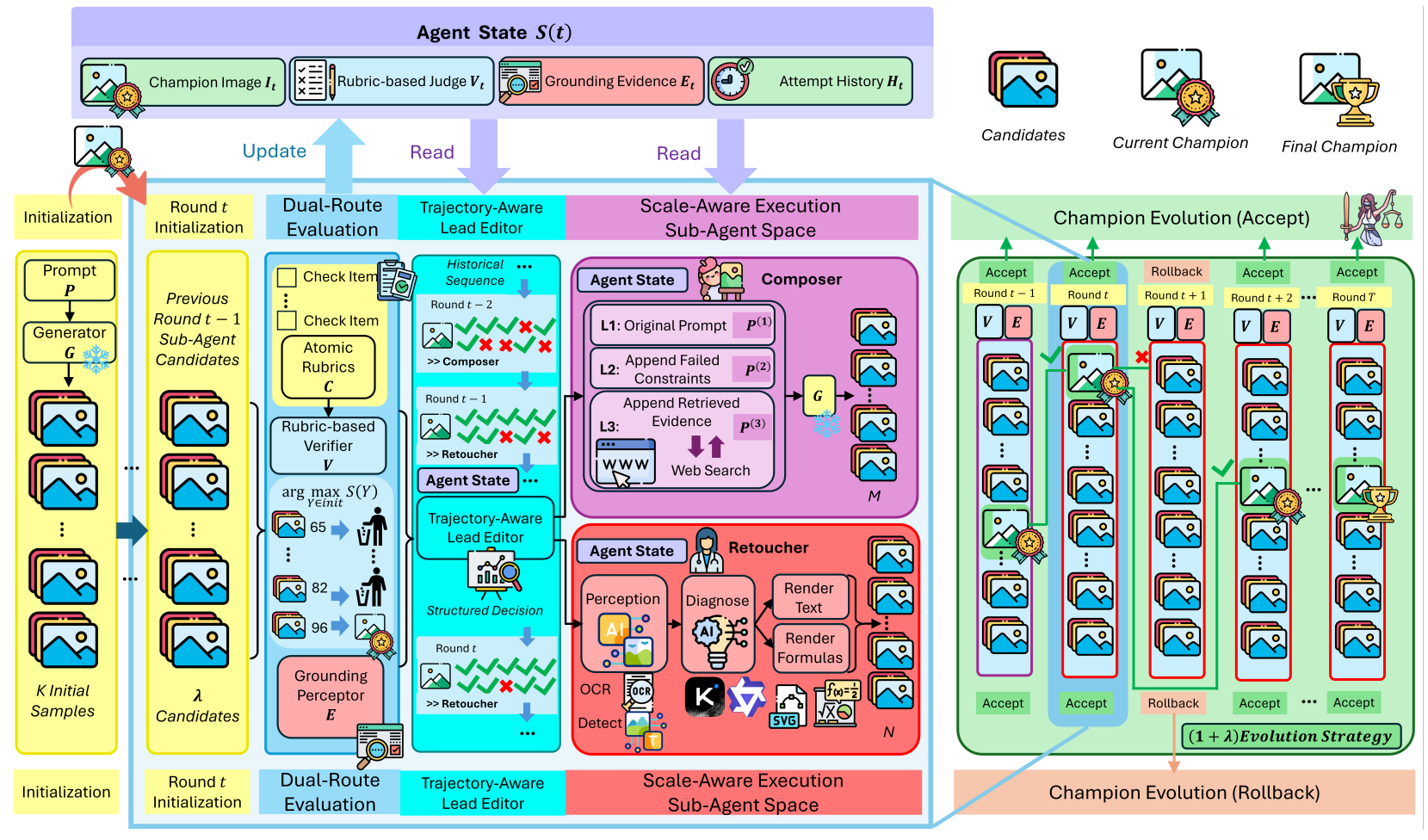
300 dpi PNG · Caption · Source PDF
Original caption, source, and provenance
Fixed source version: fixed public ICLR2027 anonymous submission
Public submission date (temporal proxy): 2026-10-03
Actual drawing date: unknown. See the source record for version checks and temporal-evidence limitations.
ICLR 2027 OpenReview submission · Original disclosure record · Complete screening and version record (Chinese)
Recorded drawing-tool disclosure: unknown. No tool attribution is inferred from appearance; see the archival disclosure evidence for scope and wording.
Crop bounding box: [107, 80, 505, 314] (PDF points; top-left origin; x0, y0, x1, y1).
Figure 1: Overview of STRIDE. From K initial samples, STRIDE selects a champion and refines it
for t rounds. Each round performs evolutionary refinement and agent state update through dual-route
evaluation: the verifier scores candidate images against the rubrics, while the perceptor provides vi-
sual grounding of the observed failures. The lead editor then analyzes the agent state and refinement
trajectory to route the champion to either the composer for global redraw or the retoucher for local
editing. The generated candidates are then re-evaluated, and the champion is updated only when a
candidate improves the verifier score. Repeating this process yields the final champion.
Frameworkers: A Dynamic Multi-Agent Framework for AI Video Production
Venue: ICLR 2027 · Submission (under review at collection)
Figure 1 · PDF page 2 · AI_X31pnGGh8D_F
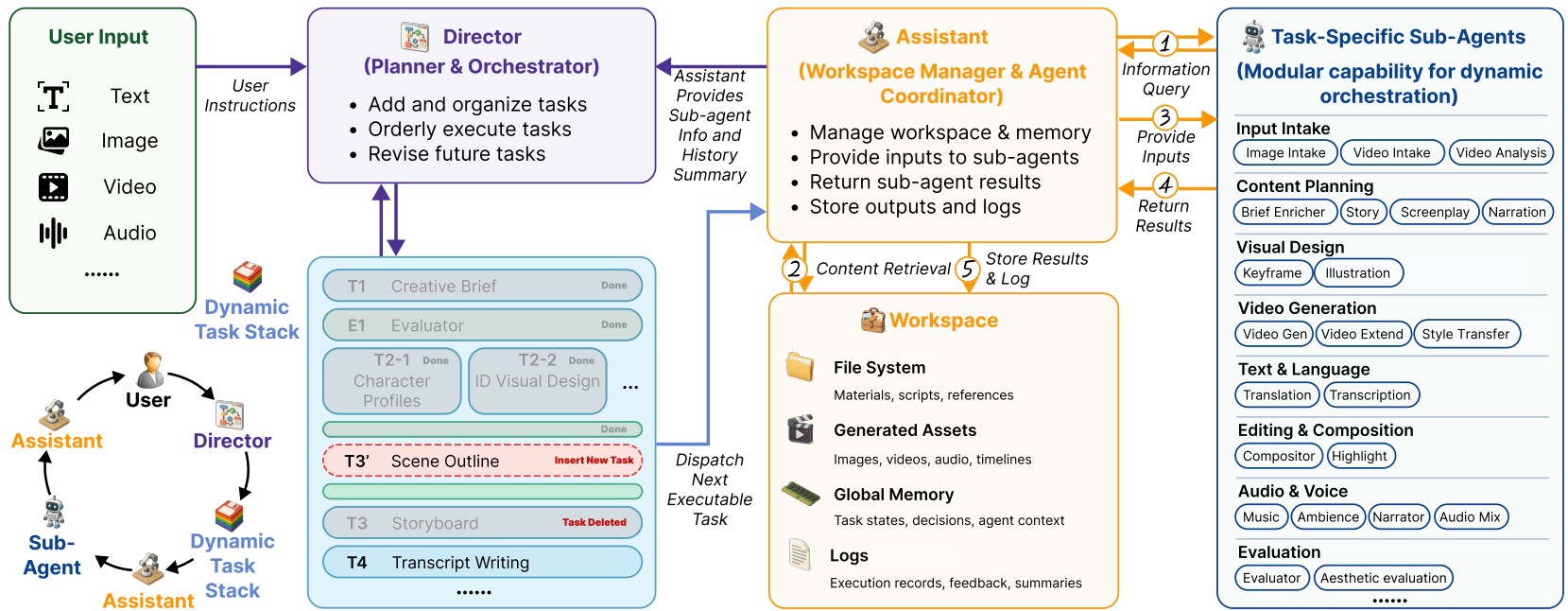
300 dpi PNG · Caption · Source PDF
Original caption, source, and provenance
Fixed source version: fixed public ICLR2027 anonymous submission
Public submission date (temporal proxy): 2026-10-03
Actual drawing date: unknown. See the source record for version checks and temporal-evidence limitations.
ICLR 2027 OpenReview submission · Original disclosure record · Complete screening and version record (Chinese)
Recorded drawing-tool disclosure: unknown. No tool attribution is inferred from appearance; see the archival disclosure evidence for scope and wording.
Crop bounding box: [107, 80, 505, 235] (PDF points; top-left origin; x0, y0, x1, y1).
Figure 1: Closed-loop orchestration in FRAMEWORKERS. The Director edits the Dynamic Task
Stack from the user input and the Assistant’s summaries; the stack shows completed tasks, an in-
serted task (T3′), and a deleted pending task (T3). The Assistant executes the dispatched task (arrows
1–5): it queries the sub-agent’s input requirements, retrieves the inputs from the Workspace, pro-
vides them to the sub-agent, receives the results, and stores results and logs in the Workspace. Right:
the sub-agent inventory, grouped by capability.
An Agentic AI Scientific Community for Automated Neural Operator Discovery
Venue: ICLR 2027 · Submission (under review at collection)
Figure 1 · PDF page 2 · AI_RPFKIcqk1w_F
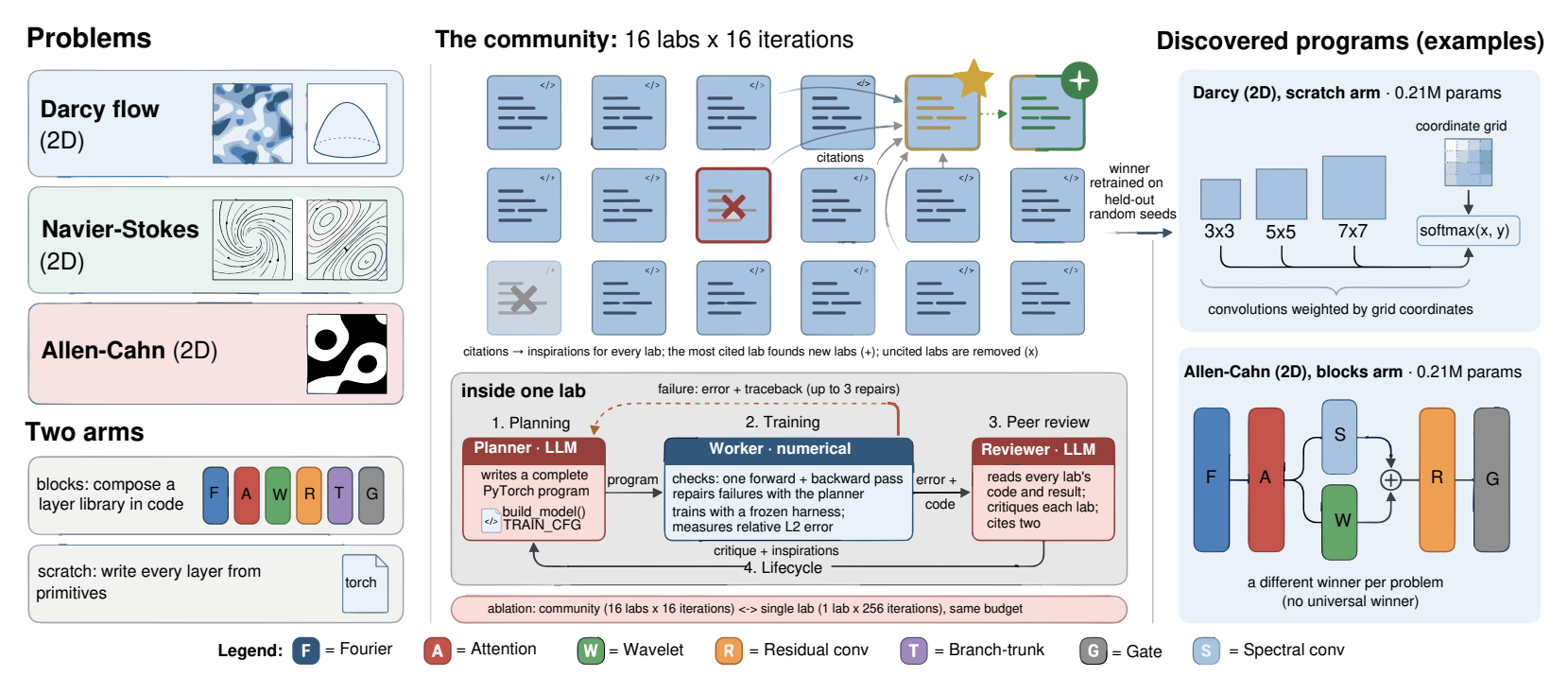
300 dpi PNG · Caption · Source PDF
Original caption, source, and provenance
Fixed source version: fixed public ICLR2027 anonymous submission
Public submission date (temporal proxy): 2026-10-03
Actual drawing date: unknown. See the source record for version checks and temporal-evidence limitations.
ICLR 2027 OpenReview submission · Original disclosure record · Complete screening and version record (Chinese)
Recorded drawing-tool disclosure: unknown. No tool attribution is inferred from appearance; see the archival disclosure evidence for scope and wording.
Crop bounding box: [107, 80, 505, 256] (PDF points; top-left origin; x0, y0, x1, y1).
Figure 1: The neural operator AI scientific community: the three problems and the two arms (left), a
community of 16 labs and the four phases of each iteration inside a lab (center), and two discovered
programs (right). Every winning program is retrained on held-out random seeds before it is compared
with other models.
Sprout: Building Dynamic Memory While Reasoning for Agentic Video Understanding
Venue: ICLR 2027 · Submission (under review at collection)
Figure 1 · PDF page 2 · AI_VA0yCrShah_M
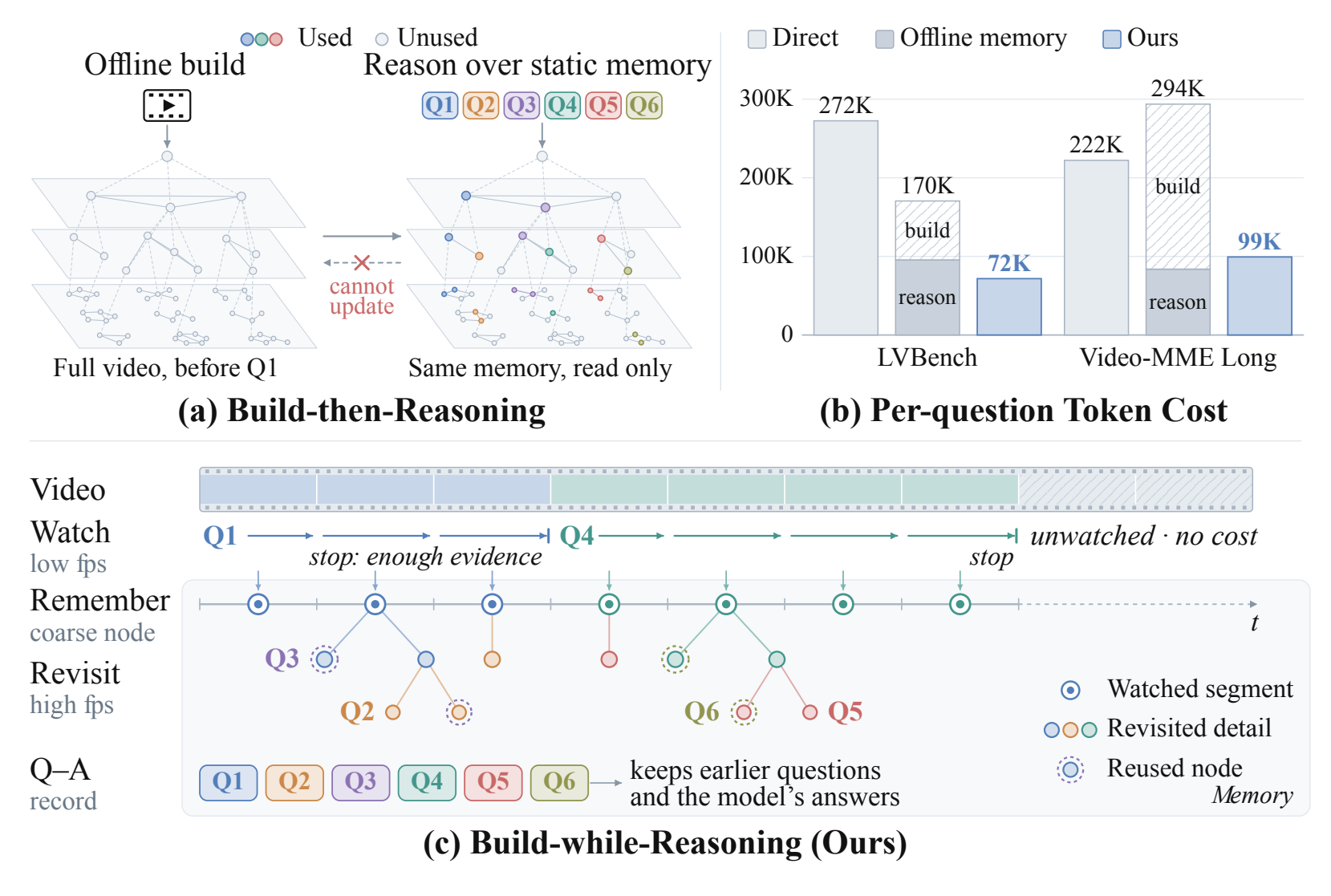
300 dpi PNG · Caption · Source PDF
Original caption, source, and provenance
Fixed source version: fixed public ICLR2027 anonymous submission
Public submission date (temporal proxy): 2026-10-03
Actual drawing date: unknown. See the source record for version checks and temporal-evidence limitations.
ICLR 2027 OpenReview submission · Original disclosure record · Complete screening and version record (Chinese)
Recorded drawing-tool disclosure: unknown. No tool attribution is inferred from appearance; see the archival disclosure evidence for scope and wording.
Crop bounding box: [107, 80, 505, 348] (PDF points; top-left origin; x0, y0, x1, y1).
Figure 1: (a) Offline memory is first built for the whole video before the first question; Q1–Q6 then
reason over the same memory without updating it. Nodes used by a question take that question’s
color, and the rest are never touched. (b) Per-question tokens with Gemini 3.8 Flash as the model.
Direct feeds the video and question directly to the model. Offline memory is Qwen-MM-Plugins:
its construction cost, amortized over the benchmark’s questions. Our method has no construction
stage. (c) Sprout builds memory while reasoning. The agent watches the video segment by segment
at a low frame rate and stops once the question has enough evidence, so the tail of the video is never
watched and costs nothing. Each watched segment is remembered as a coarse textual node written
into memory; revisits at a higher frame rate add child nodes beneath the intervals a question needs.
Sprout: Building Dynamic Memory While Reasoning for Agentic Video Understanding
Venue: ICLR 2027 · Submission (under review at collection)
Figure 2 · PDF page 5 · AI_VA0yCrShah_F
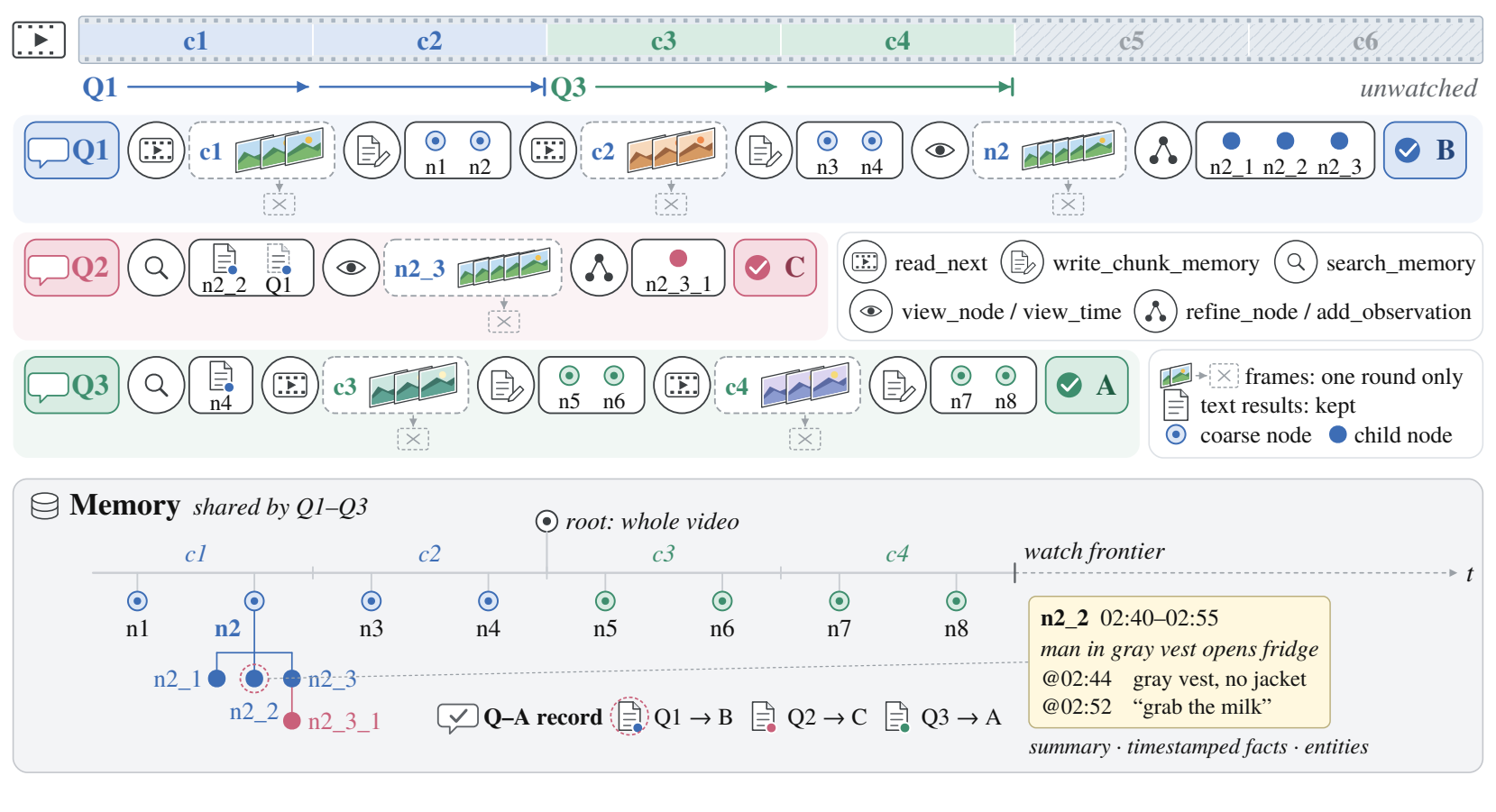
300 dpi PNG · Caption · Source PDF
Original caption, source, and provenance
Fixed source version: fixed public ICLR2027 anonymous submission
Public submission date (temporal proxy): 2026-10-03
Actual drawing date: unknown. See the source record for version checks and temporal-evidence limitations.
ICLR 2027 OpenReview submission · Original disclosure record · Complete screening and version record (Chinese)
Recorded drawing-tool disclosure: unknown. No tool attribution is inferred from appearance; see the archival disclosure evidence for scope and wording.
Crop bounding box: [107, 80, 505, 296] (PDF points; top-left origin; x0, y0, x1, y1).
Figure 2: Pipeline of Sprout. Three questions about one video are answered in order, building one
memory. Each row shows the rounds of one question: tool calls (circles) and their results (boxes).
Video frames stay in the context for one round only; text results are kept. Q1 watches the first two
chunks, remembers them as coarse nodes, and revisits n at a higher frame rate to add finer child
2
nodes. Q2 reuses the memory: search returns a node and Q1’s answer, and a short revisit adds one
more detail, without watching new video. Q3 finds that the memory does not cover what it asks, so
it watches two more chunks. The last two chunks are never watched. The memory tree (bottom) is
drawn on the same time axis as the video; node colors show which question added each node.
MatGym: An Agent-Centric Environment Bridging Materials Discovery and Reproducible Synthesis
Venue: ICLR 2027 · Submission (under review at collection)
Figure 1 · PDF page 4 · AI_1Xi9fslMSG_F
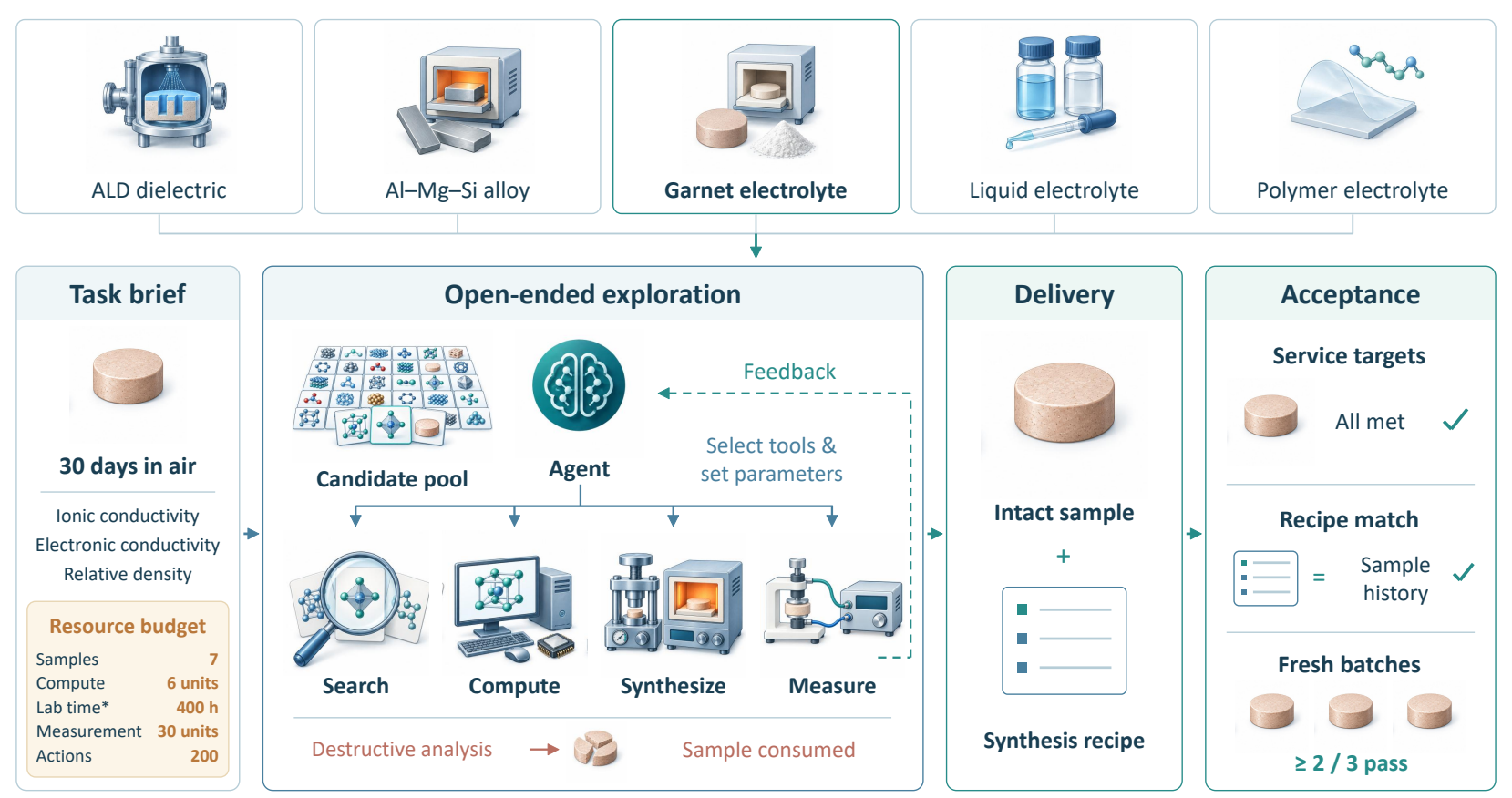
300 dpi PNG · Caption · Source PDF
Original caption, source, and provenance
Fixed source version: fixed public ICLR2027 anonymous submission
Public submission date (temporal proxy): 2026-10-03
Actual drawing date: unknown. See the source record for version checks and temporal-evidence limitations.
ICLR 2027 OpenReview submission · Original disclosure record · Complete screening and version record (Chinese)
Recorded drawing-tool disclosure: unknown. No tool attribution is inferred from appearance; see the archival disclosure evidence for scope and wording.
Crop bounding box: [107, 80, 505, 290] (PDF points; top-left origin; x0, y0, x1, y1).
Figure 1: Overview of MatGym. Across five simulated laboratories, agents explore candidates and
adapt tool use to feedback under resource budgets, then deliver a sample and its synthesis recipe.
Acceptance requires service performance, recipe–history consistency, and success on at least two of
three fresh batches. An earlier garnet task is shown. *Lab time excludes the simulated storage wait.
EmboScope: A Multi-Source Comprehensive Benchmark for Embodied Perception, Understanding, and Planning
Venue: ICLR 2027 · Submission (under review at collection)
Figure 1 · PDF page 4 · AI_vowOuAXSIO_F
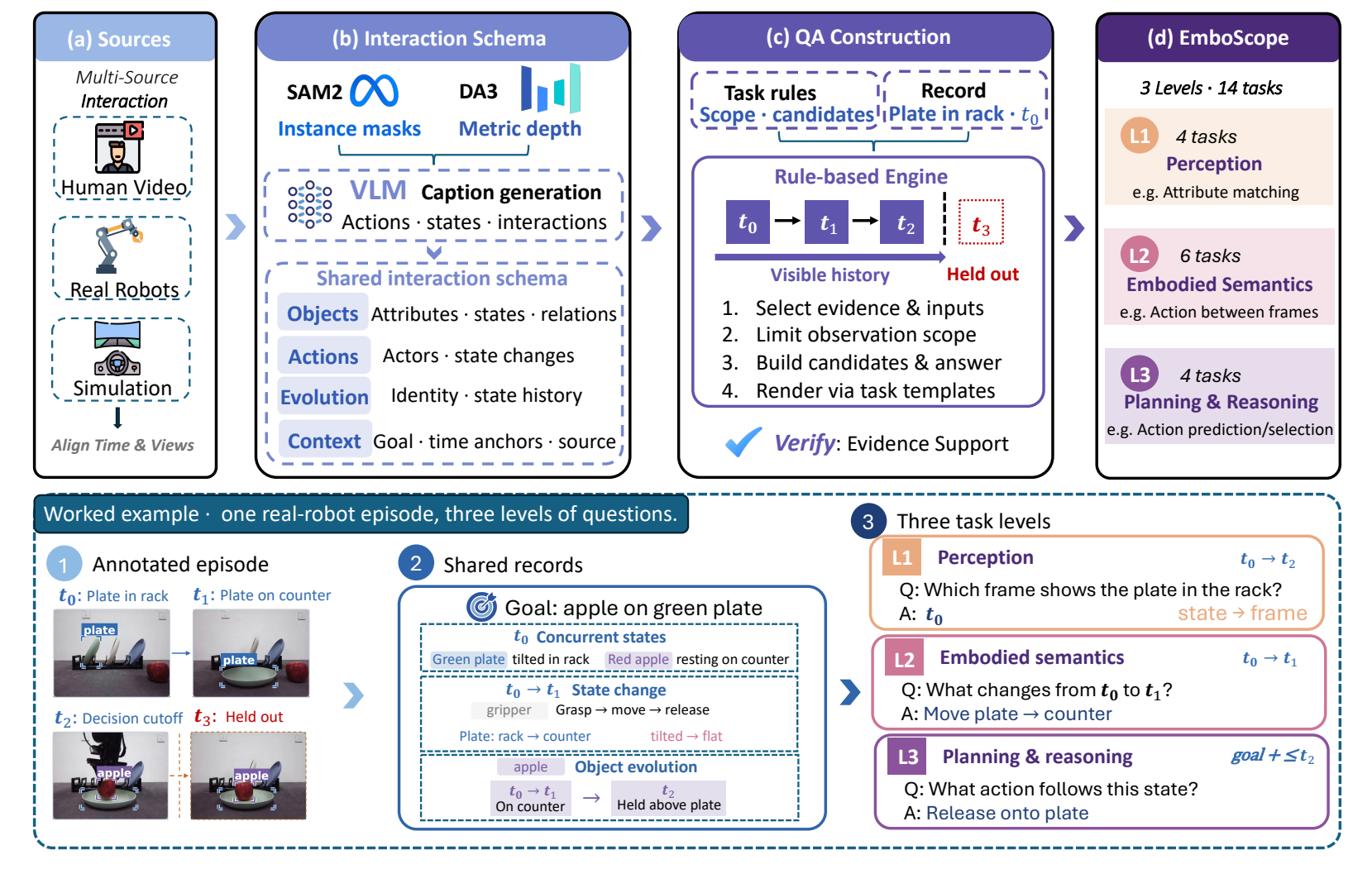
300 dpi PNG · Caption · Source PDF
Original caption, source, and provenance
Fixed source version: fixed public ICLR2027 anonymous submission
Public submission date (temporal proxy): 2026-10-03
Actual drawing date: unknown. See the source record for version checks and temporal-evidence limitations.
ICLR 2027 OpenReview submission · Original disclosure record · Complete screening and version record (Chinese)
Recorded drawing-tool disclosure: unknown. No tool attribution is inferred from appearance; see the archival disclosure evidence for scope and wording.
Crop bounding box: [107, 80, 505, 339] (PDF points; top-left origin; x0, y0, x1, y1).
Figure 1: Constructing EmboScope from shared interaction schemas with a rule-based engine.
Bottom: Illustrative annotations and QA at three capability levels from one real episode. L3 observes t₀–t₂; t₃ is held out.
MemVista: Benchmarking Long-Term Memory for Multimodal Agents in Evolving Projects
Venue: ICLR 2027 · Submission (under review at collection)
Figure 2 · PDF page 5 · AI_Dli0qriFyd_F
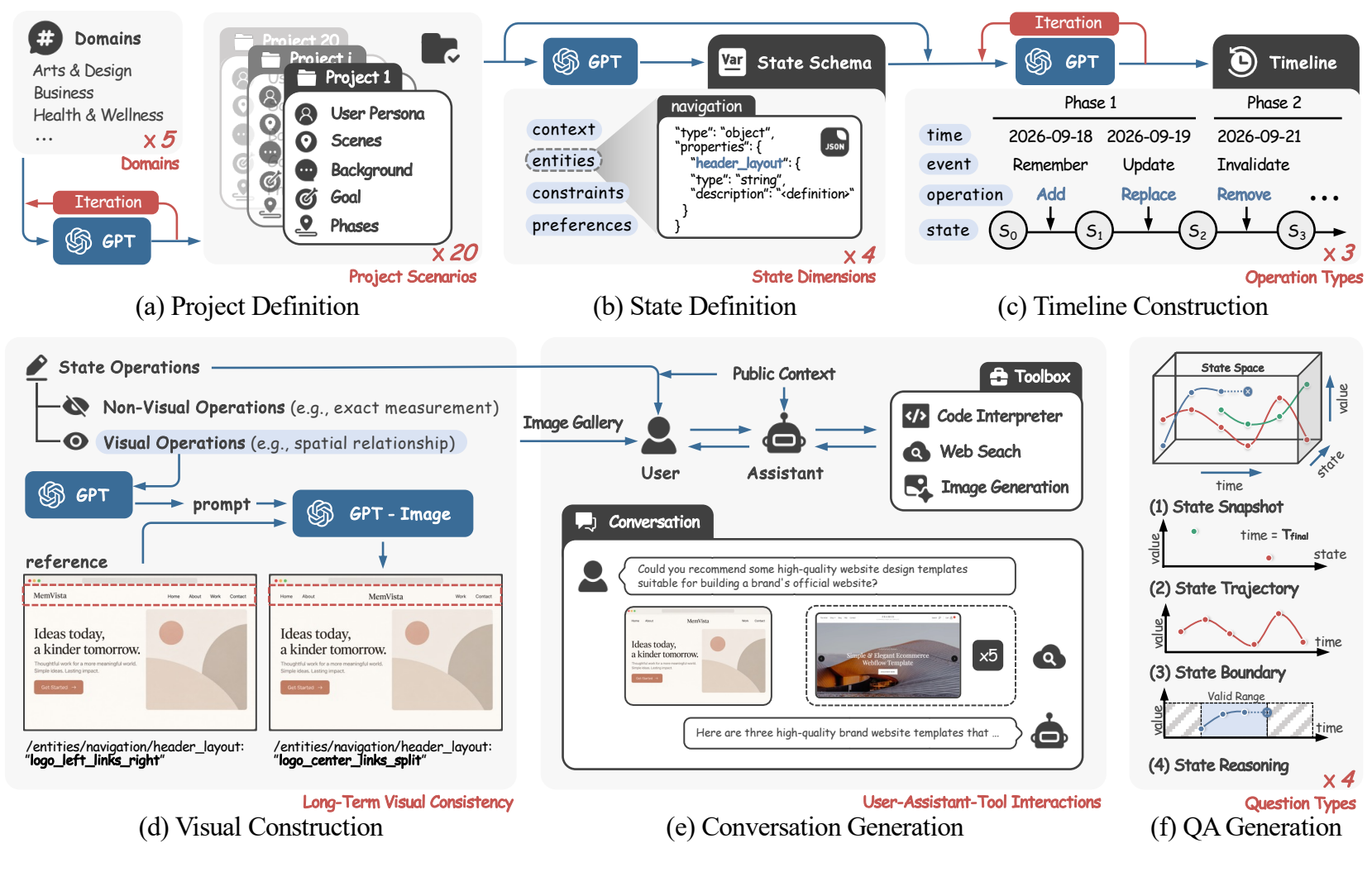
300 dpi PNG · Caption · Source PDF
Original caption, source, and provenance
Fixed source version: fixed public ICLR2027 anonymous submission
Public submission date (temporal proxy): 2026-10-03
Actual drawing date: unknown. See the source record for version checks and temporal-evidence limitations.
ICLR 2027 OpenReview submission · Original disclosure record · Complete screening and version record (Chinese)
Recorded drawing-tool disclosure: unknown. No tool attribution is inferred from appearance; see the archival disclosure evidence for scope and wording.
Crop bounding box: [107, 80, 505, 333] (PDF points; top-left origin; x0, y0, x1, y1).
Figure 2: Overview of the MEMVISTA construction pipeline. Project scenarios and state schemas
define the setting, while state operations specify its evolution. Images and turn-by-turn user–agent
interactions realize this progression as multimodal histories. The completed histories and validated
state records support four task families: snapshot, trajectory, boundary, and reasoning.
OmniClinic: Evaluating Active Evidence Acquisition in a Multimodal Clinical Sandbox
Venue: ICLR 2027 · Submission (under review at collection)
Figure 1 · PDF page 2 · AI_EkkRujJohS_F
300 dpi PNG · Caption · Source PDF
Original caption, source, and provenance
Fixed source version: fixed public ICLR2027 anonymous submission
Public submission date (temporal proxy): 2026-10-03
Actual drawing date: unknown. See the source record for version checks and temporal-evidence limitations.
ICLR 2027 OpenReview submission · Original disclosure record · Complete screening and version record (Chinese)
Recorded drawing-tool disclosure: unknown. No tool attribution is inferred from appearance; see the archival disclosure evidence for scope and wording.
Crop bounding box: [107, 80, 505, 312] (PDF points; top-left origin; x0, y0, x1, y1).
Figure 1: Overview of OmniClinic. Each electronic health record instantiates a patient agent and
defines the case evidence. The sandbox exposes a finite action space spanning clinical consultation
and bedside physical examinations with common clinical tools. The doctor agent selects among these
actions to acquire multimodal evidence before submitting a diagnosis. Examination succeeds only
with the appropriate tool, body region, patient pose, and doctor (agent) position.
DUDA-Bench: Benchmarking LLM Agents on Multimodal Data-Driven Urban Diagnosis
Venue: ICLR 2027 · Submission (under review at collection)
Figure 1 · PDF page 3 · AI_FqbDu6m3j2_F
300 dpi PNG · Caption · Source PDF
Original caption, source, and provenance
Fixed source version: fixed public ICLR2027 anonymous submission
Public submission date (temporal proxy): 2026-10-03
Actual drawing date: unknown. See the source record for version checks and temporal-evidence limitations.
ICLR 2027 OpenReview submission · Original disclosure record · Complete screening and version record (Chinese)
Recorded drawing-tool disclosure: unknown. No tool attribution is inferred from appearance; see the archival disclosure evidence for scope and wording.
Crop bounding box: [107, 80, 505, 267] (PDF points; top-left origin; x0, y0, x1, y1).
Figure 1: Overview of DUDA-Bench. The benchmark connects a hierarchical task taxonomy and
multimodal urban case dataset with an interactive agent environment, and formulates urban diagno-
sis as a four-stage analytical workflow.
When Should AI Chime In? Benchmarking Timely Contribution of Proactive Agents in Multi-Party Chat
Venue: ICLR 2027 · Submission (under review at collection)
Figure 1 · PDF page 2 · AI_MI8d8y9Hja_F
300 dpi PNG · Caption · Source PDF
Original caption, source, and provenance
Fixed source version: fixed public ICLR2027 anonymous submission
Public submission date (temporal proxy): 2026-10-03
Actual drawing date: unknown. See the source record for version checks and temporal-evidence limitations.
ICLR 2027 OpenReview submission · Original disclosure record · Complete screening and version record (Chinese)
Recorded drawing-tool disclosure: unknown. No tool attribution is inferred from appearance; see the archival disclosure evidence for scope and wording.
Crop bounding box: [107, 80, 505, 269] (PDF points; top-left origin; x0, y0, x1, y1).
Figure 1: PITCH (Proactive Intervention Timing in CHat) is the first benchmark for proactive inter-
vention timing built from unscripted human conversations and participants’ own judgments of when
proactive interjections should occur. We collected the benchmark data via a four-phrase protocol:
Conversation, Message Contribution, Timing Judgments, and Deliberation. We then evaluated 15
models across 28 configurations against the benchmark in three task setups that differ in their task
difficulty and realism for real-world deployment of agents in group conversations.
LEGO-Anything: Coding Agents for 3D Scene Reconstruction
Venue: ICLR 2027 · Submission (under review at collection)
Figure 2 · PDF page 4 · AI_olW2A6zx75_F
300 dpi PNG · Caption · Source PDF
Original caption, source, and provenance
Fixed source version: fixed public ICLR2027 anonymous submission
Public submission date (temporal proxy): 2026-10-03
Actual drawing date: unknown. See the source record for version checks and temporal-evidence limitations.
ICLR 2027 OpenReview submission · Original disclosure record · Complete screening and version record (Chinese)
Recorded drawing-tool disclosure: unknown. No tool attribution is inferred from appearance; see the archival disclosure evidence for scope and wording.
Crop bounding box: [107, 80, 505, 272] (PDF points; top-left origin; x0, y0, x1, y1).
Figure 2: Agentic scene construction, abstracted from a GPT-6-astra trajectory: workspace,
action space, Blender code structure, and construction workflow.
Topological Coherence for Self-Evolving Multi-Agent Systems
Venue: ICLR 2027 · Submission (under review at collection)
Figure 2 · PDF page 4 · AI_VJ7YUdWOrj_F
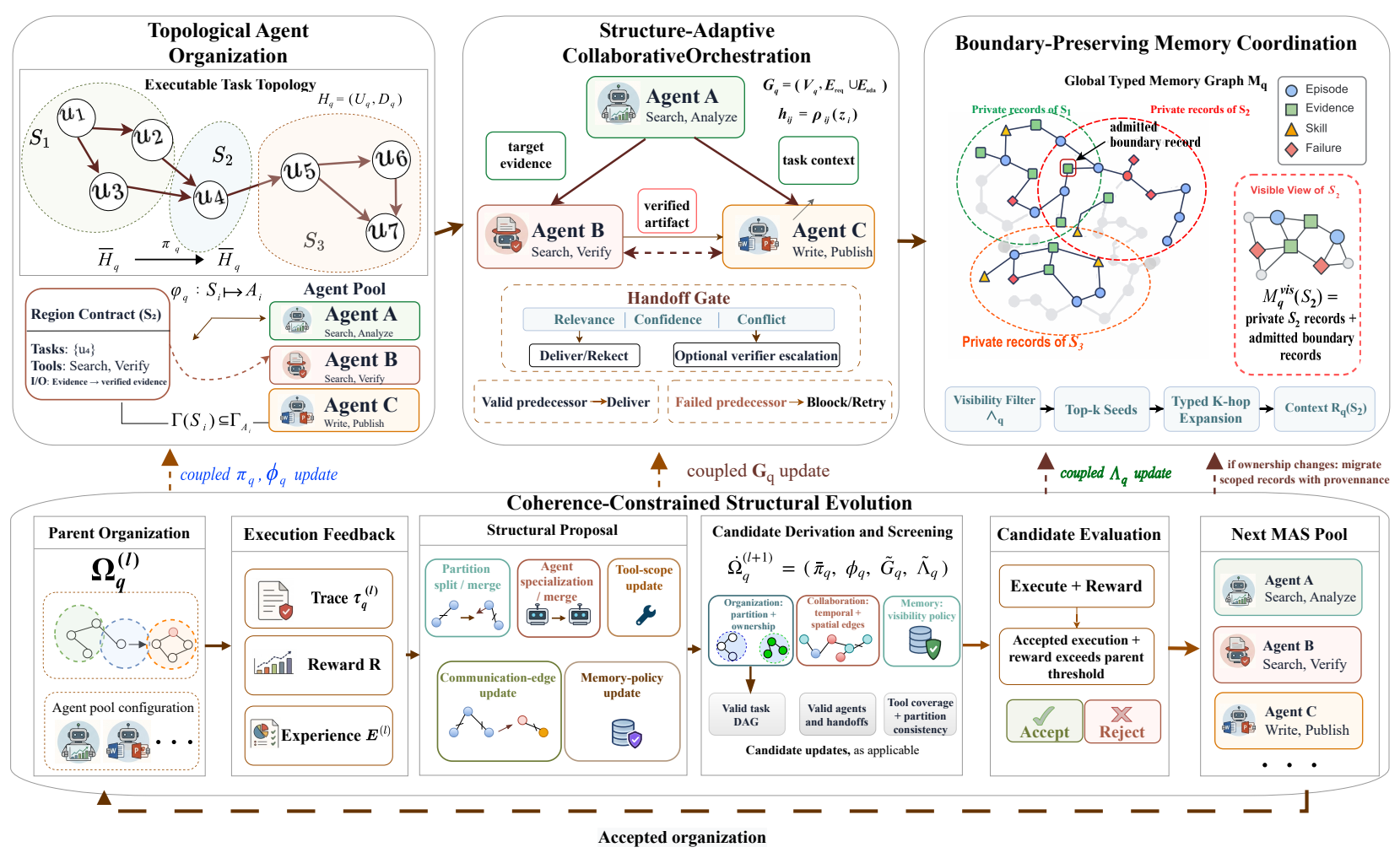
300 dpi PNG · Caption · Source PDF
Original caption, source, and provenance
Fixed source version: fixed public ICLR2027 anonymous submission
Public submission date (temporal proxy): 2026-10-03
Actual drawing date: unknown. See the source record for version checks and temporal-evidence limitations.
ICLR 2027 OpenReview submission · Original disclosure record · Complete screening and version record (Chinese)
Recorded drawing-tool disclosure: unknown. No tool attribution is inferred from appearance; see the archival disclosure evidence for scope and wording.
Crop bounding box: [107, 80, 505, 324] (PDF points; top-left origin; x0, y0, x1, y1).
Figure 2: Overview of TOCOMAS. Task-derived responsibility regions organize agents, handoffs,
and memory boundaries; online evolution preserves their coherence.
Harmony Harness: Multi-Objective Self-Evolution of Agent Harnesses
Venue: ICLR 2027 · Submission (under review at collection)
Figure 1 · PDF page 4 · AI_cR0St8qS2n_F
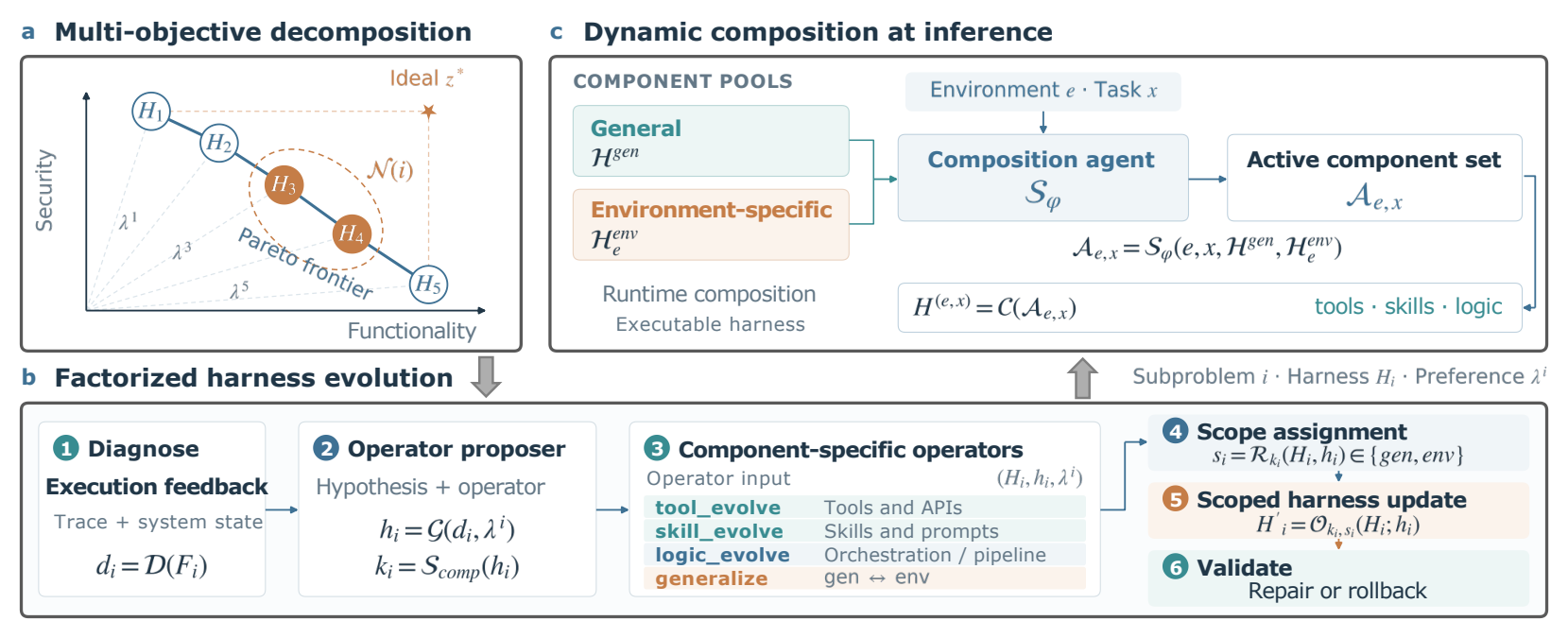
300 dpi PNG · Caption · Source PDF
Original caption, source, and provenance
Fixed source version: fixed public ICLR2027 anonymous submission
Public submission date (temporal proxy): 2026-10-03
Actual drawing date: unknown. See the source record for version checks and temporal-evidence limitations.
ICLR 2027 OpenReview submission · Original disclosure record · Complete screening and version record (Chinese)
Recorded drawing-tool disclosure: unknown. No tool attribution is inferred from appearance; see the archival disclosure evidence for scope and wording.
Crop bounding box: [107, 80, 505, 242] (PDF points; top-left origin; x0, y0, x1, y1).
Figure 1: Overview of HARMONY HARNESS. (a) The functionality–security space is split into
weighted subproblems. Each subproblem keeps a harness and together they approximate the Pareto
frontier. (b) An LLM proposer diagnoses failures and forms a hypothesis. Operators edit tools, skills,
or logic, and place each edit in either the general scope or the environment-specific scope. The child
is validated before evaluation. (c) At inference, a composition agent picks components from the
general and environment-specific pools to build a task-specific harness.
BodyBound: A Benchmark for Diagnosing Robot-Policy Responses to Body Changes Beyond Task Success
Venue: ICLR 2027 · Submission (under review at collection)
Figure 1 · PDF page 2 · AI_skorOYrYml_F
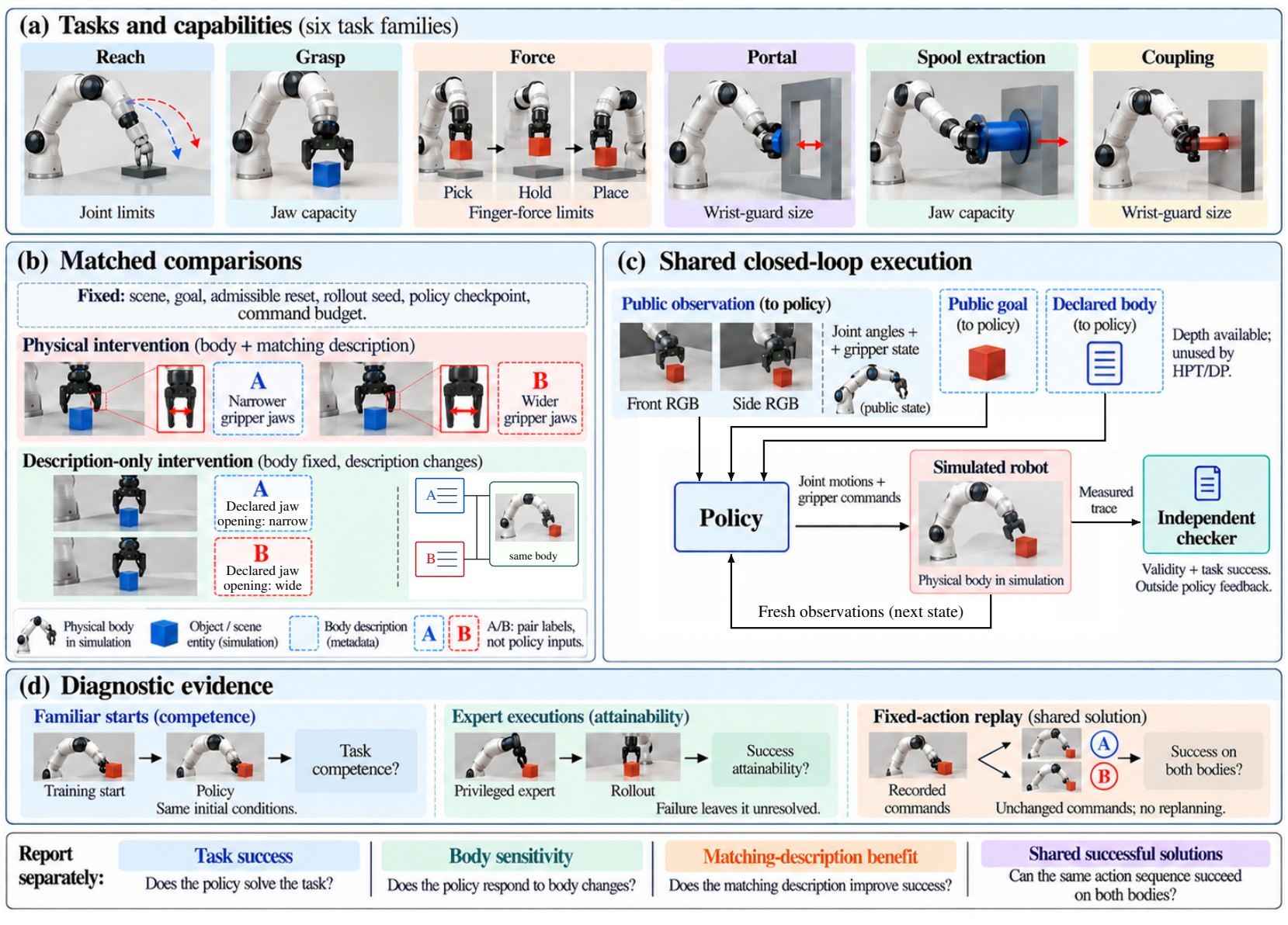
300 dpi PNG · Caption · Source PDF
Original caption, source, and provenance
Fixed source version: fixed public ICLR2027 anonymous submission
Public submission date (temporal proxy): 2026-10-03
Actual drawing date: unknown. See the source record for version checks and temporal-evidence limitations.
ICLR 2027 OpenReview submission · Original disclosure record · Complete screening and version record (Chinese)
Recorded drawing-tool disclosure: unknown. No tool attribution is inferred from appearance; see the archival disclosure evidence for scope and wording.
Crop bounding box: [107, 80, 505, 366] (PDF points; top-left origin; x0, y0, x1, y1).
Figure 1: BodyBound in simulation. (a) Task schematics show six families and their intervened
body parameters. (b) Paired comparisons change the physical body with its matching description,
or the description alone. (c) Policies act from public observations, goals, and body descriptions;
fresh observations close the loop, while an independent checker evaluates measured traces. HPT
and Diffusion Policy use RGB, not depth. (d) Familiar starts, expert executions, and unchanged-
command replay separate task competence, attainability, and shared solutions. Scene geometry
stays fixed within each pair.
CUAWright: A Minimal Unified Interface for Computer Use Agents
Venue: ICLR 2027 · Submission (under review at collection)
Figure 2 · PDF page 3 · AI_zploFP1iVU_F
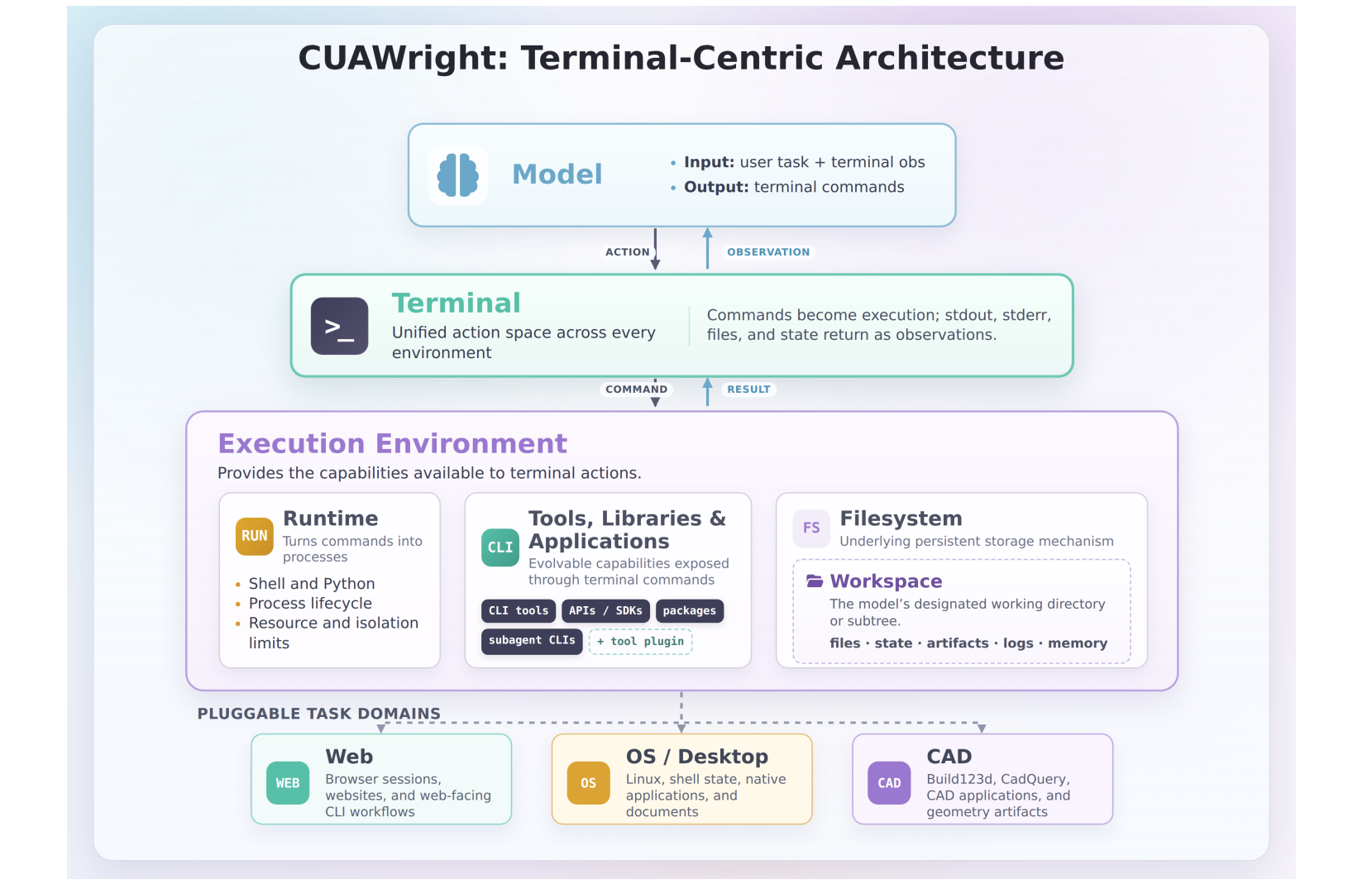
300 dpi PNG · Caption · Source PDF
Original caption, source, and provenance
Fixed source version: fixed public ICLR2027 anonymous submission
Public submission date (temporal proxy): 2026-10-03
Actual drawing date: unknown. See the source record for version checks and temporal-evidence limitations.
ICLR 2027 OpenReview submission · Original disclosure record · Complete screening and version record (Chinese)
Recorded drawing-tool disclosure: unknown. No tool attribution is inferred from appearance; see the archival disclosure evidence for scope and wording.
Crop bounding box: [107, 80, 505, 338] (PDF points; top-left origin; x0, y0, x1, y1).
Figure 2: The CUAWright architecture. Terminal serves as the sole interface between the agent
and the task environment. At each step of task execution process, the agent model receives com-
mand line output as observation or call a CLI tool to load image into context on demand, and output
commands that gets executed. The underlying execution environment contains a runtime, an ex-
pandable set of installed CLI tools and applications, and a file system as the agent’s workspace to
programmatically manage system state and craft new tools.
Agent Skills Under Change: A Lifecycle Benchmark and Coordinate-Guided Updates
Venue: ICLR 2027 · Submission (under review at collection)
Figure 1 · PDF page 2 · AI_O7Vvd7kb57_M
300 dpi PNG · Caption · Source PDF
Original caption, source, and provenance
Fixed source version: fixed public ICLR2027 anonymous submission
Public submission date (temporal proxy): 2026-10-03
Actual drawing date: unknown. See the source record for version checks and temporal-evidence limitations.
ICLR 2027 OpenReview submission · Original disclosure record · Complete screening and version record (Chinese)
Recorded drawing-tool disclosure: unknown. No tool attribution is inferred from appearance; see the archival disclosure evidence for scope and wording.
Crop bounding box: [107, 80, 505, 262] (PDF points; top-left origin; x0, y0, x1, y1).
Figure 1: Risks across successive Skill updates. An edit can repair the current task while breaking
existing capabilities, with errors persisting into later tasks. Checking recovery and retention after
each change informs whether to adopt the new version.
Agent Skills Under Change: A Lifecycle Benchmark and Coordinate-Guided Updates
Venue: ICLR 2027 · Submission (under review at collection)
Figure 2 · PDF page 3 · AI_O7Vvd7kb57_F
300 dpi PNG · Caption · Source PDF
Original caption, source, and provenance
Fixed source version: fixed public ICLR2027 anonymous submission
Public submission date (temporal proxy): 2026-10-03
Actual drawing date: unknown. See the source record for version checks and temporal-evidence limitations.
ICLR 2027 OpenReview submission · Original disclosure record · Complete screening and version record (Chinese)
Recorded drawing-tool disclosure: unknown. No tool attribution is inferred from appearance; see the archival disclosure evidence for scope and wording.
Crop bounding box: [107, 80, 505, 309] (PDF points; top-left origin; x0, y0, x1, y1).
Figure 2: LifecycleSkillBench construction and evaluation. Public tasks, tools, and rules support re-
producible environmental changes, paired affected and capability-retention tasks, and persistent up-
date histories. The evaluated method receives the change description, pre-update Skill, and available
evidence. The evaluator separately stores test tasks, reference outcomes, and recoverable historical
versions, and reports recovery, retention, error propagation, and execution cost.
Ontology-Harnessing Multi-Agent System for Abstractive Visual Understanding
Venue: ICLR 2027 · Submission (under review at collection)
Figure 1 · PDF page 2 · AI_jVkkfpmnAw_M
300 dpi PNG · Caption · Source PDF
Original caption, source, and provenance
Fixed source version: fixed public ICLR2027 anonymous submission
Public submission date (temporal proxy): 2026-10-03
Actual drawing date: unknown. See the source record for version checks and temporal-evidence limitations.
ICLR 2027 OpenReview submission · Original disclosure record · Complete screening and version record (Chinese)
Recorded drawing-tool disclosure: unknown. No tool attribution is inferred from appearance; see the archival disclosure evidence for scope and wording.
Crop bounding box: [107, 80, 505, 263] (PDF points; top-left origin; x0, y0, x1, y1).
Figure 1: Illustrative examples of ontology-harnessed reasoning in OHM. In knowledge graph (KG)
completion (left), type knowledge helps identify the missing entity. In anomaly detection (right),
relation-domain knowledge reveals that Lived in is incompatible with Tesla as a company. The
ontology provides supporting evidence rather than a hard decision rule.
Ontology-Harnessing Multi-Agent System for Abstractive Visual Understanding
Venue: ICLR 2027 · Submission (under review at collection)
Figure 2 · PDF page 4 · AI_jVkkfpmnAw_F
300 dpi PNG · Caption · Source PDF
Original caption, source, and provenance
Fixed source version: fixed public ICLR2027 anonymous submission
Public submission date (temporal proxy): 2026-10-03
Actual drawing date: unknown. See the source record for version checks and temporal-evidence limitations.
ICLR 2027 OpenReview submission · Original disclosure record · Complete screening and version record (Chinese)
Recorded drawing-tool disclosure: unknown. No tool attribution is inferred from appearance; see the archival disclosure evidence for scope and wording.
Crop bounding box: [107, 80, 505, 283] (PDF points; top-left origin; x0, y0, x1, y1).
Figure 2: Workflow of OHM. Given a structured visual representation and a task-specific question,
the orchestration agent routes the input to perception agents that recover entities and relations. The
validation module examines the recovered graph with support from the ontology, after which task-
specific reasoning agents produce the final answer.
BrainIPAgent: Multi-Agent Interpretable Structural Priors for Multimodal Brain Network Learning
Venue: ICLR 2027 · Submission (under review at collection)
Figure 1 · PDF page 3 · AI_YLI8SRurGG_F
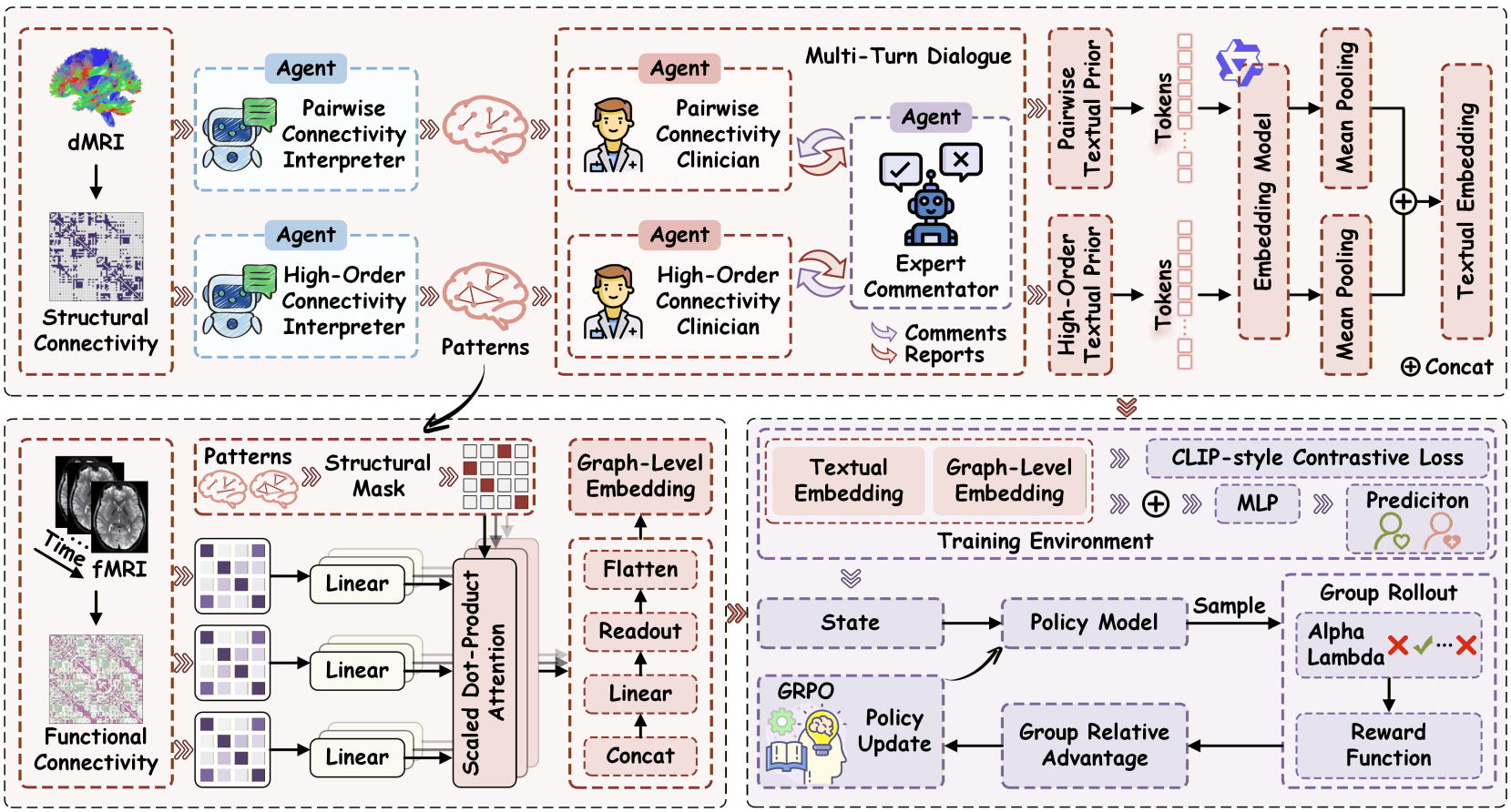
300 dpi PNG · Caption · Source PDF
Original caption, source, and provenance
Fixed source version: fixed public ICLR2027 anonymous submission
Public submission date (temporal proxy): 2026-10-03
Actual drawing date: unknown. See the source record for version checks and temporal-evidence limitations.
ICLR 2027 OpenReview submission · Original disclosure record · Complete screening and version record (Chinese)
Recorded drawing-tool disclosure: unknown. No tool attribution is inferred from appearance; see the archival disclosure evidence for scope and wording.
Crop bounding box: [107, 80, 505, 294] (PDF points; top-left origin; x0, y0, x1, y1).
Figure 1: Overview of the BrainIPAgent framework. (1) The Multi-Agent Interpretation Frame-
work extracts structural patterns via collaborative reasoning to generate sparsity masks and textual
priors. (2) The Structure-Aware Functional Encoder maps these patterns to attention biases in
the logit space and projects them via mask propagation. (3) The RL-Guided Alignment Module
dynamically regulates structural guidance strength Alpha (α) and alignment weight Lambda (λ).
Beyond Dyadic Memory: Interaction-Aware Multimodal Memory with Adaptive Agentic Retrieval for Multi-Party Spoken Conversations
Venue: ICLR 2027 · Submission (under review at collection)
Figure 2 · PDF page 5 · AI_0ZTqgrmYaQ_F
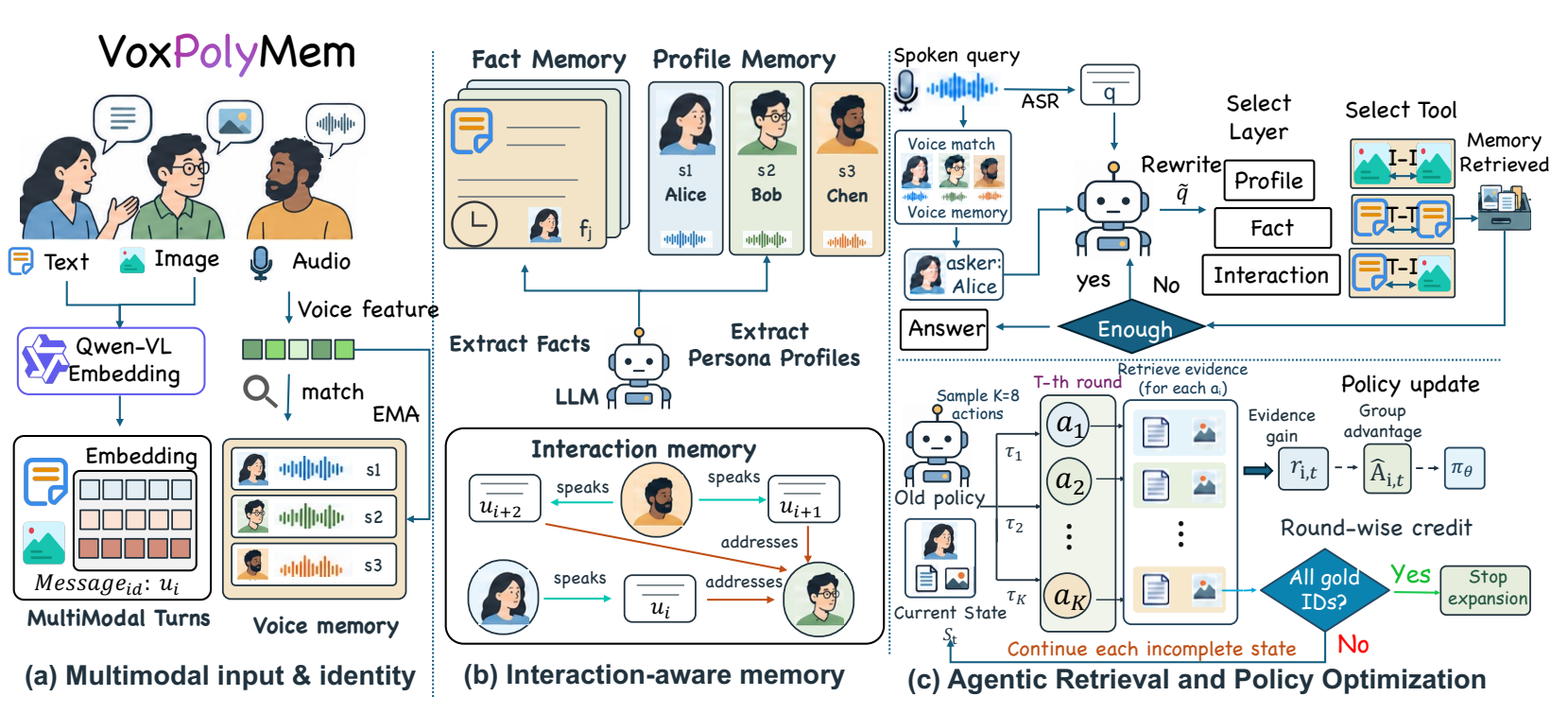
300 dpi PNG · Caption · Source PDF
Original caption, source, and provenance
Fixed source version: fixed public ICLR2027 anonymous submission
Public submission date (temporal proxy): 2026-10-03
Actual drawing date: unknown. See the source record for version checks and temporal-evidence limitations.
ICLR 2027 OpenReview submission · Original disclosure record · Complete screening and version record (Chinese)
Recorded drawing-tool disclosure: unknown. No tool attribution is inferred from appearance; see the archival disclosure evidence for scope and wording.
Crop bounding box: [107, 80, 505, 261] (PDF points; top-left origin; x0, y0, x1, y1).
Figure 2: VoxPolyMem identifies recurring speakers, constructs interaction memory, facts, and par-
ticipant profiles, and adaptively retrieves evidence across memory layers and modalities.
AccessWorld: A Benchmark for Computer Use Agents Operating Assistive Technologies
Venue: ICLR 2027 · Submission (under review at collection)
Figure 1 · PDF page 2 · AI_uLkUAjKWe6_F
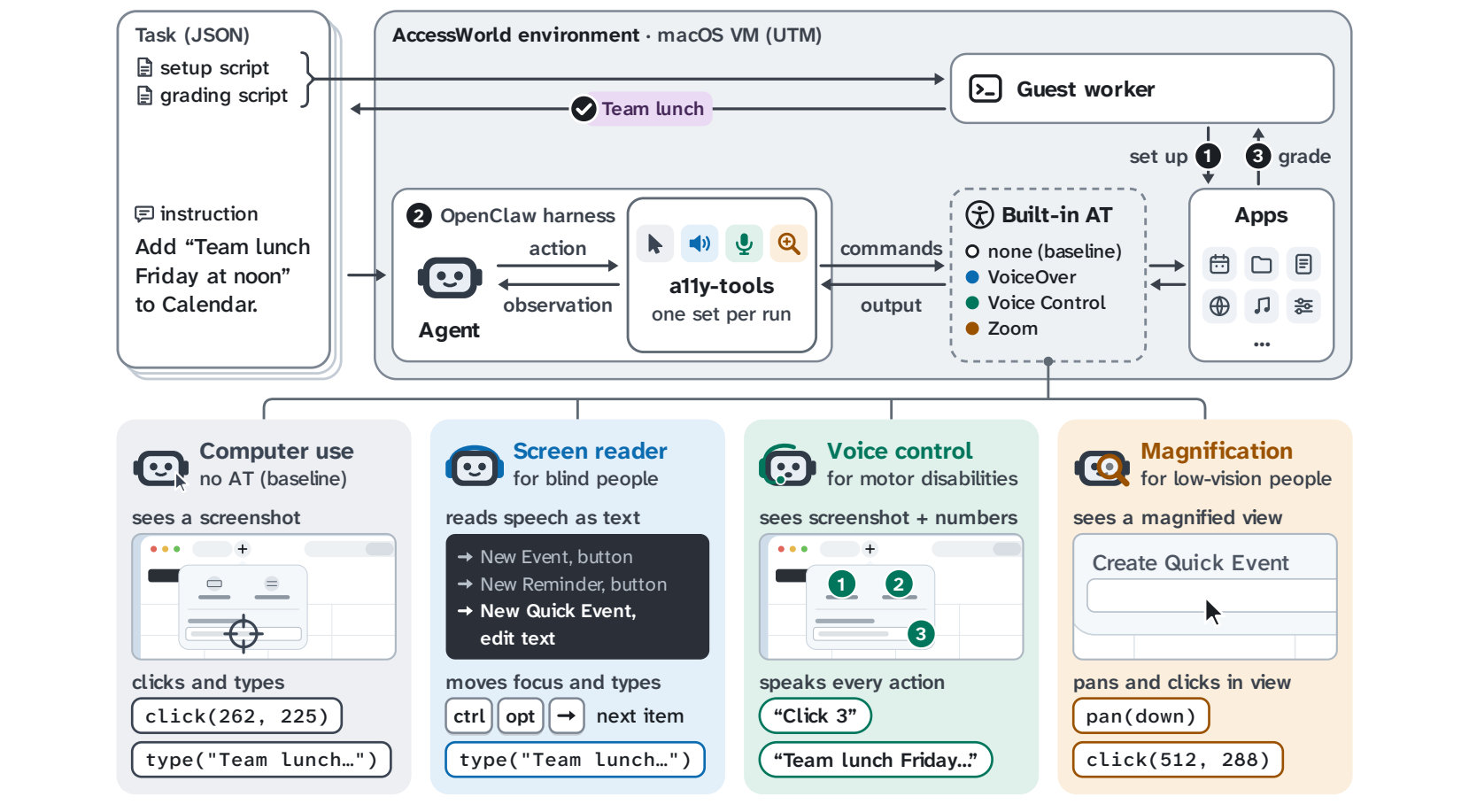
300 dpi PNG · Caption · Source PDF
Original caption, source, and provenance
Fixed source version: fixed public ICLR2027 anonymous submission
Public submission date (temporal proxy): 2026-10-03
Actual drawing date: unknown. See the source record for version checks and temporal-evidence limitations.
ICLR 2027 OpenReview submission · Original disclosure record · Complete screening and version record (Chinese)
Recorded drawing-tool disclosure: unknown. No tool attribution is inferred from appearance; see the archival disclosure evidence for scope and wording.
Crop bounding box: [107, 80, 505, 300] (PDF points; top-left origin; x0, y0, x1, y1).
Figure 1: AccessWorld Overview. Each task has an instruction and grader, with task-specific
setup when needed, and runs in the same macOS virtual machine. OpenClaw connects the agent to
standard computer use, VoiceOver, Voice Control, or Zoom. The task and grader stay fixed while
the available observations and actions change with the interaction condition.
SpatialAgent: Working Memory for Long-Horizon Spatial Reasoning
Venue: ICLR 2027 · Submission (under review at collection)
Figure 1 · PDF page 3 · AI_xGIdDM5rYW_F
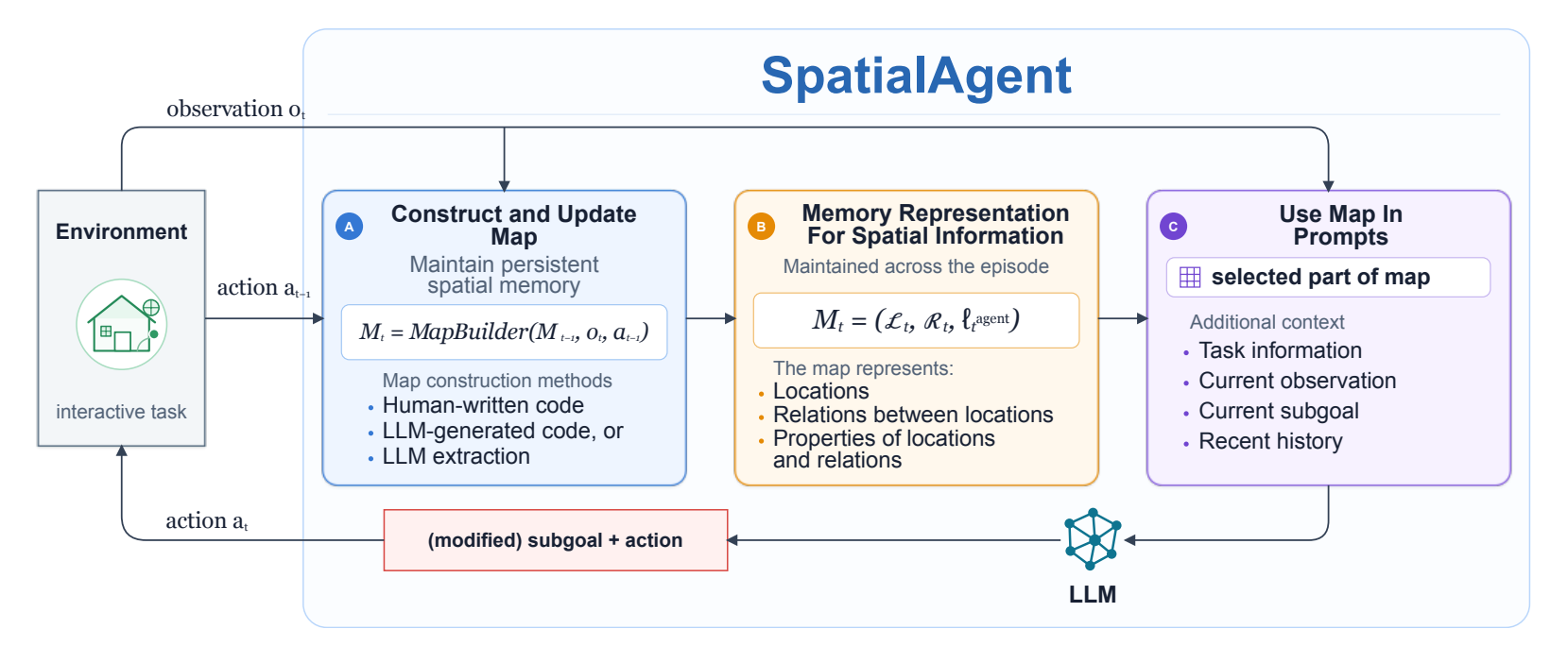
300 dpi PNG · Caption · Source PDF
Original caption, source, and provenance
Fixed source version: fixed public ICLR2027 anonymous submission
Public submission date (temporal proxy): 2026-10-03
Actual drawing date: unknown. See the source record for version checks and temporal-evidence limitations.
ICLR 2027 OpenReview submission · Original disclosure record · Complete screening and version record (Chinese)
Recorded drawing-tool disclosure: unknown. No tool attribution is inferred from appearance; see the archival disclosure evidence for scope and wording.
Crop bounding box: [107, 76, 505, 240] (PDF points; top-left origin; x0, y0, x1, y1).
Figure 1: Overview of SpatialAgent. The MapBuilder maintains a persistent spatial map from
observations and actions, which is provided to the LLM for decision making.
TARSphere: A Robot-Oriented Full-Stack Framework for Long-Horizon Embodied Agents in Evolving Physical and Social Environments
Venue: ICLR 2027 · Submission (under review at collection)
Figure 1 · PDF page 1 · AI_eFi9w6vSHP_M
300 dpi PNG · Caption · Source PDF
Original caption, source, and provenance
Fixed source version: fixed public ICLR2027 anonymous submission
Public submission date (temporal proxy): 2026-10-03
Actual drawing date: unknown. See the source record for version checks and temporal-evidence limitations.
ICLR 2027 OpenReview submission · Original disclosure record · Complete screening and version record (Chinese)
Recorded drawing-tool disclosure: unknown. No tool attribution is inferred from appearance; see the archival disclosure evidence for scope and wording.
Crop bounding box: [107, 493, 505, 654] (PDF points; top-left origin; x0, y0, x1, y1).
Figure 1: Robot execution and human interaction in a changing world.
TARSphere: A Robot-Oriented Full-Stack Framework for Long-Horizon Embodied Agents in Evolving Physical and Social Environments
Venue: ICLR 2027 · Submission (under review at collection)
Figure 3 · PDF page 4 · AI_eFi9w6vSHP_F
300 dpi PNG · Caption · Source PDF
Original caption, source, and provenance
Fixed source version: fixed public ICLR2027 anonymous submission
Public submission date (temporal proxy): 2026-10-03
Actual drawing date: unknown. See the source record for version checks and temporal-evidence limitations.
ICLR 2027 OpenReview submission · Original disclosure record · Complete screening and version record (Chinese)
Recorded drawing-tool disclosure: unknown. No tool attribution is inferred from appearance; see the archival disclosure evidence for scope and wording.
Crop bounding box: [107, 80, 505, 304] (PDF points; top-left origin; x0, y0, x1, y1).
Figure 3: TARSphere-Harness: the embodied brain harness. (a) Current observations and (b) hierarchical
memory inform (c) MLLM decisions. (d) The unified skill interface routes actions to (e) controller backends. (f)
Observations, execution feedback, and public world events close the loop.
BKBAgent: A Battery Parameter Identification Agent with Bayesian Experimental Design and Knowledge Graph
Venue: ICLR 2027 · Submission (under review at collection)
Figure 1 · PDF page 2 · AI_whcg806KGZ_M
300 dpi PNG · Caption · Source PDF
Original caption, source, and provenance
Fixed source version: fixed public ICLR2027 anonymous submission
Public submission date (temporal proxy): 2026-10-03
Actual drawing date: unknown. See the source record for version checks and temporal-evidence limitations.
ICLR 2027 OpenReview submission · Original disclosure record · Complete screening and version record (Chinese)
Recorded drawing-tool disclosure: unknown. No tool attribution is inferred from appearance; see the archival disclosure evidence for scope and wording.
Crop bounding box: [107, 80, 505, 337] (PDF points; top-left origin; x0, y0, x1, y1).
Figure 1: Illustration of agent-based battery parameter identification and its key challenge.
BKBAgent: A Battery Parameter Identification Agent with Bayesian Experimental Design and Knowledge Graph
Venue: ICLR 2027 · Submission (under review at collection)
Figure 2 · PDF page 4 · AI_whcg806KGZ_F
300 dpi PNG · Caption · Source PDF
Original caption, source, and provenance
Fixed source version: fixed public ICLR2027 anonymous submission
Public submission date (temporal proxy): 2026-10-03
Actual drawing date: unknown. See the source record for version checks and temporal-evidence limitations.
ICLR 2027 OpenReview submission · Original disclosure record · Complete screening and version record (Chinese)
Recorded drawing-tool disclosure: unknown. No tool attribution is inferred from appearance; see the archival disclosure evidence for scope and wording.
Crop bounding box: [107, 80, 505, 301] (PDF points; top-left origin; x0, y0, x1, y1).
Figure 2: Illustration of the BKBAgent framework for battery parameter identification. Utility de-
notes the approximate expected belief change in Eq. (3).
FM-Bench: A Benchmark for Long-Horizon Management with Competing Agents
Venue: ICLR 2027 · Submission (under review at collection)
Figure 1 · PDF page 2 · AI_ZEeYfne3aD_F
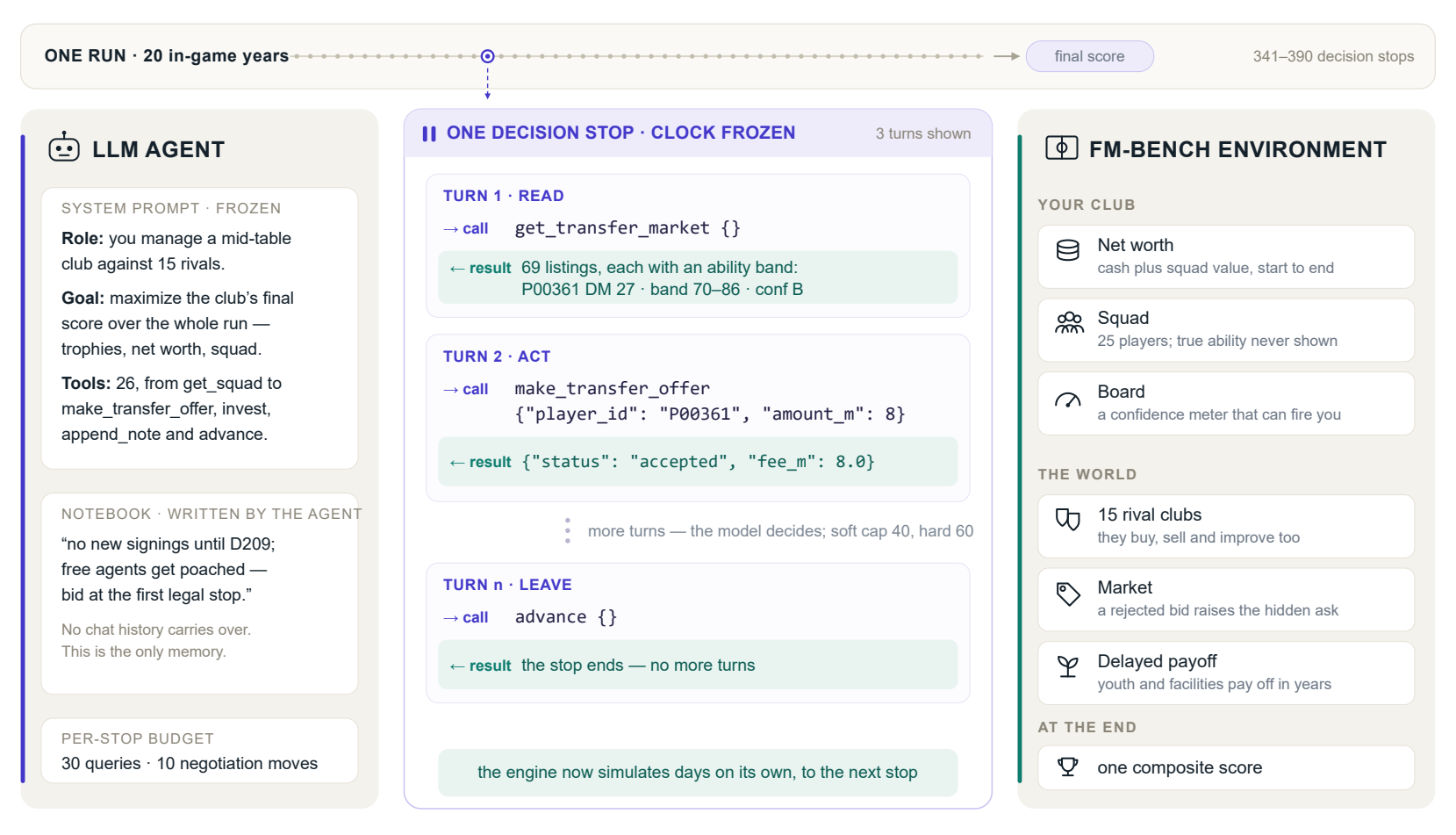
300 dpi PNG · Caption · Source PDF
Original caption, source, and provenance
Fixed source version: fixed public ICLR2027 anonymous submission
Public submission date (temporal proxy): 2026-10-03
Actual drawing date: unknown. See the source record for version checks and temporal-evidence limitations.
ICLR 2027 OpenReview submission · Original disclosure record · Complete screening and version record (Chinese)
Recorded drawing-tool disclosure: unknown. No tool attribution is inferred from appearance; see the archival disclosure evidence for scope and wording.
Crop bounding box: [107, 80, 505, 308] (PDF points; top-left origin; x0, y0, x1, y1).
Figure 1: How a run works. One run spans 20 in-game years and roughly 340 to 400 decision stops,
ending in a single composite score. At each stop, the clock freezes and the agent takes as many tool-
call turns as it wants (read → act → advance). The agent’s only cross-stop memory is its self-
written notebook (§3.2); the environment side holds the club (net worth, squad with permanently
hidden true ability, a board that can fire the manager) and the world (15 rival clubs, a counter-
adaptive market, delayed-payoff investments).
EngiWorld: What Can Frontier Agents Deliver in Professional Engineering Environments?
Venue: ICLR 2027 · Submission (under review at collection)
Figure 2 · PDF page 4 · AI_4kPwNYWJYm_F
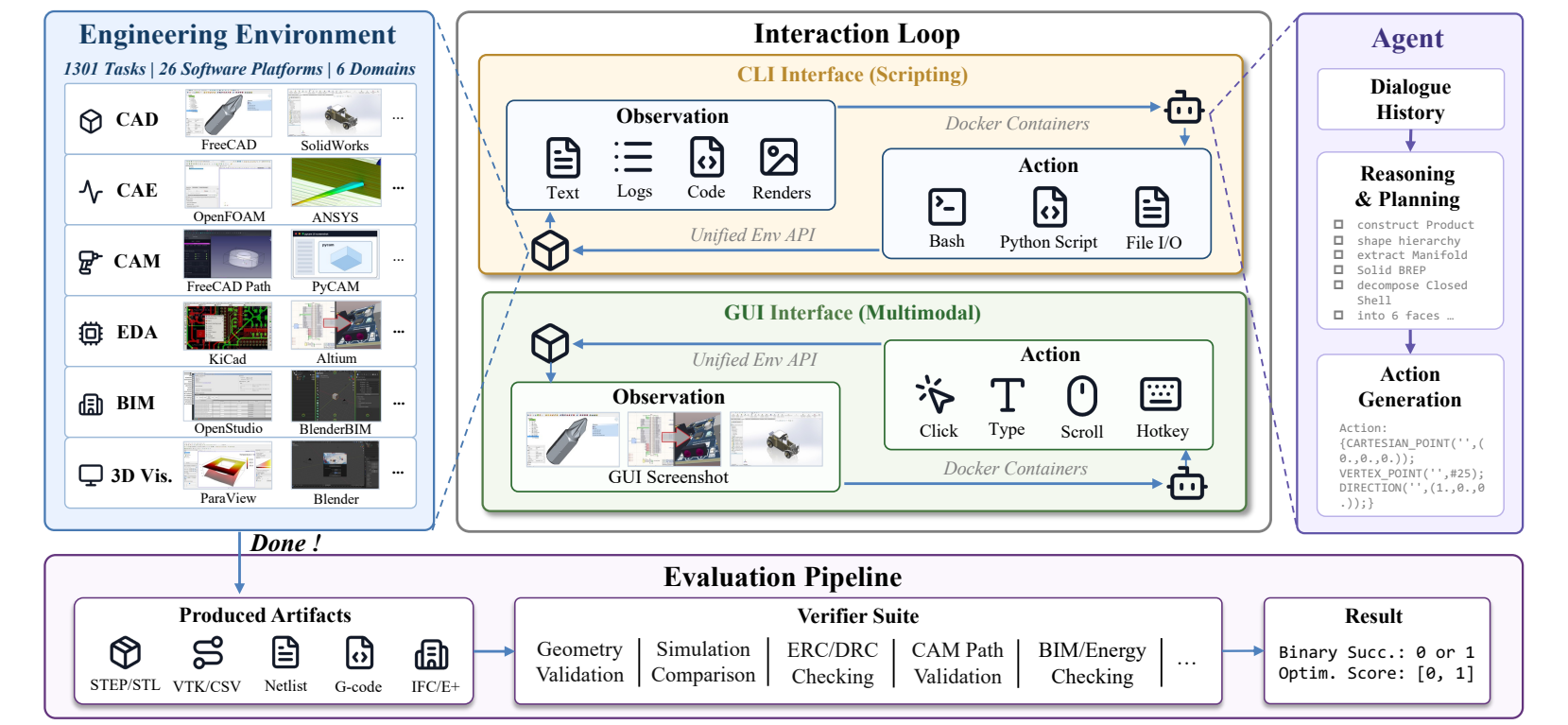
300 dpi PNG · Caption · Source PDF
Original caption, source, and provenance
Fixed source version: fixed public ICLR2027 anonymous submission
Public submission date (temporal proxy): 2026-10-03
Actual drawing date: unknown. See the source record for version checks and temporal-evidence limitations.
ICLR 2027 OpenReview submission · Original disclosure record · Complete screening and version record (Chinese)
Recorded drawing-tool disclosure: unknown. No tool attribution is inferred from appearance; see the archival disclosure evidence for scope and wording.
Crop bounding box: [107, 188, 505, 372] (PDF points; top-left origin; x0, y0, x1, y1).
Figure 2: Overview of the ENGIWORLD framework. Agents interact with engineering applica-
tions through CLI or GUI interfaces and are evaluated from the artifacts produced during execution.
Domain-specific verifiers check whether these artifacts satisfy the required engineering constraints.
VEvo-Harness: Causally-Guarded Self-Evolving Harness for Agentic Image Generation
Venue: ICLR 2027 · Submission (under review at collection)
Figure 1 · PDF page 2 · AI_UPFHZRl39C_M
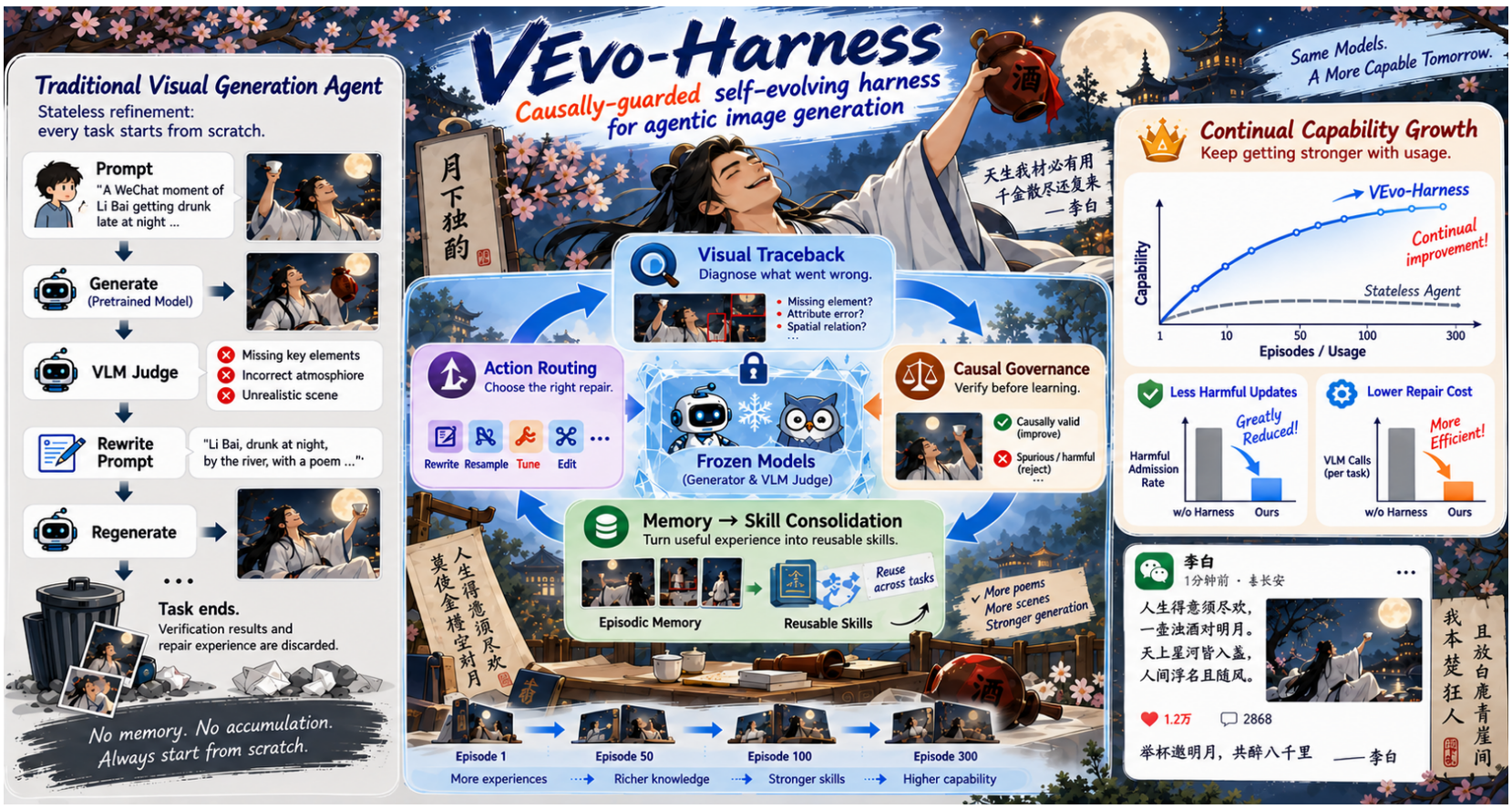
300 dpi PNG · Caption · Source PDF
Original caption, source, and provenance
Fixed source version: fixed public ICLR2027 anonymous submission
Public submission date (temporal proxy): 2026-10-03
Actual drawing date: unknown. See the source record for version checks and temporal-evidence limitations.
ICLR 2027 OpenReview submission · Original disclosure record · Complete screening and version record (Chinese)
Recorded drawing-tool disclosure: unknown. No tool attribution is inferred from appearance; see the archival disclosure evidence for scope and wording.
Crop bounding box: [107, 80, 505, 293.1] (PDF points; top-left origin; x0, y0, x1, y1).
Figure 1: From stateless refinement to continual capability growth. VEvo-Harness causally verifies
and reuses visual experience, enabling frozen generators to become progressively stronger with usage.
VEvo-Harness: Causally-Guarded Self-Evolving Harness for Agentic Image Generation
Venue: ICLR 2027 · Submission (under review at collection)
Figure 2 · PDF page 3 · AI_UPFHZRl39C_F
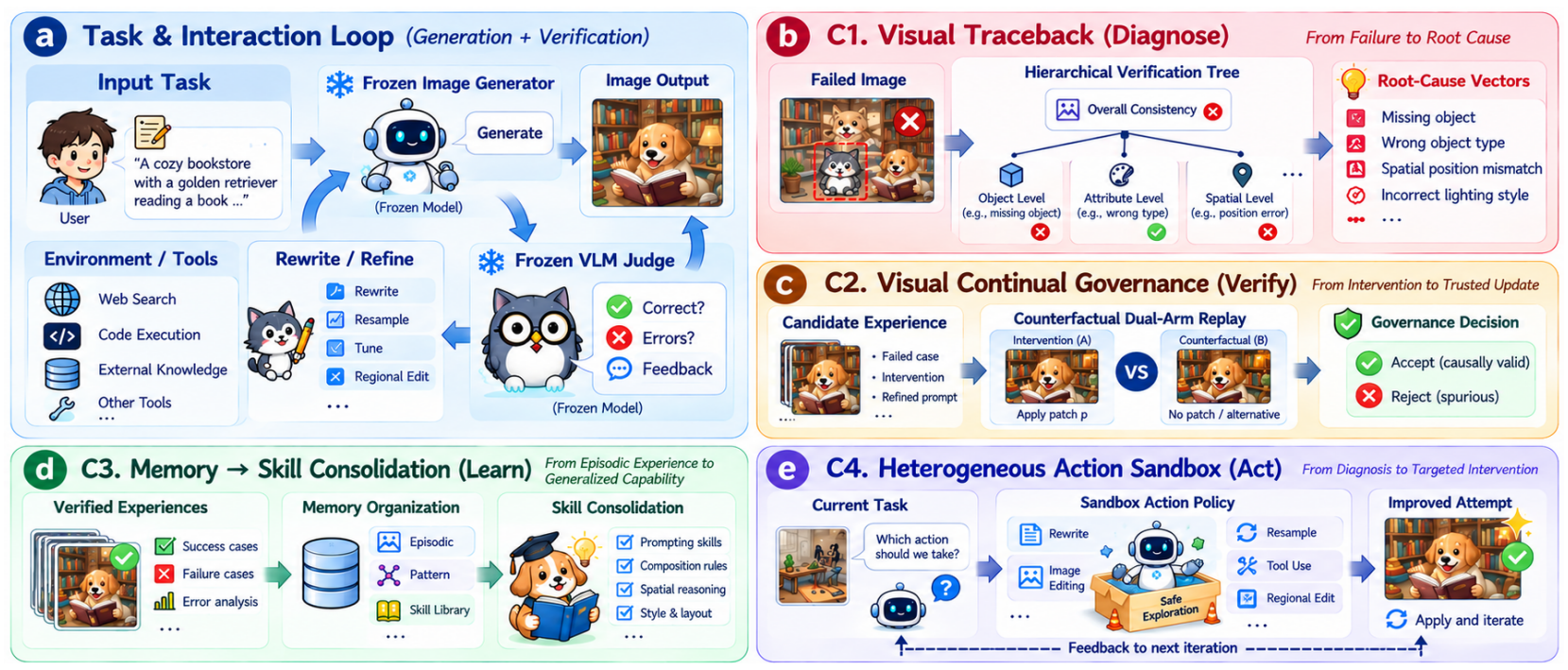
300 dpi PNG · Caption · Source PDF
Original caption, source, and provenance
Fixed source version: fixed public ICLR2027 anonymous submission
Public submission date (temporal proxy): 2026-10-03
Actual drawing date: unknown. See the source record for version checks and temporal-evidence limitations.
ICLR 2027 OpenReview submission · Original disclosure record · Complete screening and version record (Chinese)
Recorded drawing-tool disclosure: unknown. No tool attribution is inferred from appearance; see the archival disclosure evidence for scope and wording.
Crop bounding box: [107, 80, 505, 250] (PDF points; top-left origin; x0, y0, x1, y1).
Figure 2: Overview of our proposed VEvo-Harness pipeline. A self-evolving scaffold is built around
(a) a Interaction Loop for generation and verification, comprising (b) Visual Traceback, (c) Visual
Continual Governance, (d) Lifecycle-Managed Harness State, and (e) Heterogeneous Action Sandbox.
VideoWeaver: Evaluating and Evolving Skills for Agentic Long Video Generation
Venue: ICLR 2027 · Submission (under review at collection)
Figure 2 · PDF page 5 · AI_ahcNtcQxsO_F
300 dpi PNG · Caption · Source PDF
Original caption, source, and provenance
Fixed source version: fixed public ICLR2027 anonymous submission
Public submission date (temporal proxy): 2026-10-03
Actual drawing date: unknown. See the source record for version checks and temporal-evidence limitations.
ICLR 2027 OpenReview submission · Original disclosure record · Complete screening and version record (Chinese)
Recorded drawing-tool disclosure: unknown. No tool attribution is inferred from appearance; see the archival disclosure evidence for scope and wording.
Crop bounding box: [107, 288, 505, 416] (PDF points; top-left origin; x0, y0, x1, y1).
Figure 2: Evidence-grounded agent-as-judge evaluation framework. Given the user request, reference
assets, execution trace, intermediate artifacts, and final video, the evaluation agent conducts an agentic
evaluation. At each round, it invokes evaluation skills to inspect traces, extract video metadata, sample
key frames, separate audio, run ASR, analyze errors, and understand visual or audio content. The
collected evidence is then used to score process and output metrics and provide textual feedback.
OpenAgentFlow: Enabling System-Wide Safety Boundaries for Heterogeneous AI Agent Fleets
Venue: ICLR 2027 · Submission (under review at collection)
Figure 1 · PDF page 2 · AI_I6Gx5US2sY_M
300 dpi PNG · Caption · Source PDF
Original caption, source, and provenance
Fixed source version: fixed public ICLR2027 anonymous submission
Public submission date (temporal proxy): 2026-10-03
Actual drawing date: unknown. See the source record for version checks and temporal-evidence limitations.
ICLR 2027 OpenReview submission · Original disclosure record · Complete screening and version record (Chinese)
Recorded drawing-tool disclosure: unknown. No tool attribution is inferred from appearance; see the archival disclosure evidence for scope and wording.
Crop bounding box: [107, 80, 505, 305] (PDF points; top-left origin; x0, y0, x1, y1).
Figure 1: Session-level risks arise from composed action flows across agents or endpoints. The
unsafe condition may appear only after otherwise ordinary actions are composed within a session.
OpenAgentFlow: Enabling System-Wide Safety Boundaries for Heterogeneous AI Agent Fleets
Venue: ICLR 2027 · Submission (under review at collection)
Figure 2 · PDF page 6 · AI_I6Gx5US2sY_F
300 dpi PNG · Caption · Source PDF
Original caption, source, and provenance
Fixed source version: fixed public ICLR2027 anonymous submission
Public submission date (temporal proxy): 2026-10-03
Actual drawing date: unknown. See the source record for version checks and temporal-evidence limitations.
ICLR 2027 OpenReview submission · Original disclosure record · Complete screening and version record (Chinese)
Recorded drawing-tool disclosure: unknown. No tool attribution is inferred from appearance; see the archival disclosure evidence for scope and wording.
Crop bounding box: [107, 80, 505, 305] (PDF points; top-left origin; x0, y0, x1, y1).
Figure 2: OpenAgentFlow normalizes instrumented actions into AgentEvents and checks them
with a shared PEP before execution; the control plane maintains policy, provenance, session, audit,
and update state.
Maestro: Agentic Formal Proof Development by Coordination
Venue: ICLR 2027 · Submission (under review at collection)
Figure 1 · PDF page 3 · AI_02vIJnLoLo_F
300 dpi PNG · Caption · Source PDF
Original caption, source, and provenance
Fixed source version: fixed public ICLR2027 anonymous submission
Public submission date (temporal proxy): 2026-10-03
Actual drawing date: unknown. See the source record for version checks and temporal-evidence limitations.
ICLR 2027 OpenReview submission · Original disclosure record · Complete screening and version record (Chinese)
Recorded drawing-tool disclosure: unknown. No tool attribution is inferred from appearance; see the archival disclosure evidence for scope and wording.
Crop bounding box: [107, 80, 505, 263] (PDF points; top-left origin; x0, y0, x1, y1).
Figure 1: MAESTRO’s coordination loop. The persistent coordinator 1 dispatches or redirects
workers, which 2 attack open obligations in parallel and 3 report proofs, diagnoses, progress, or
blueprints to a shared queue. The coordinator 4 consumes these events as they arrive and 5 revises
the shared Lean workspace, here retracting H2 and H1.2, restating H3 as H3’, adding H4, and
keeping the proved H1.1. When the root closes, 6 Lean checks the final proof or falsification.
MASCraft: Multi-Agent Specialization through Role–Skill Composition and Self-Evolving Orchestration
Venue: ICLR 2027 · Submission (under review at collection)
Figure 1 · PDF page 2 · AI_7zleBvksX6_M
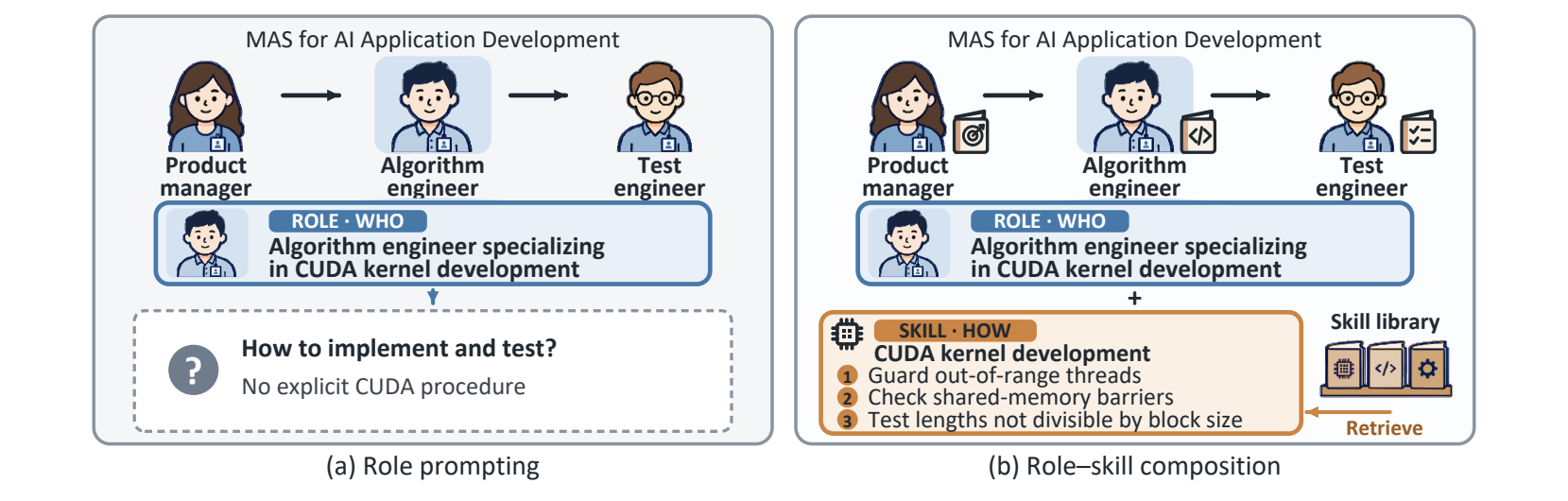
300 dpi PNG · Caption · Source PDF
Original caption, source, and provenance
Fixed source version: fixed public ICLR2027 anonymous submission
Public submission date (temporal proxy): 2026-10-03
Actual drawing date: unknown. See the source record for version checks and temporal-evidence limitations.
ICLR 2027 OpenReview submission · Original disclosure record · Complete screening and version record (Chinese)
Recorded drawing-tool disclosure: unknown. No tool attribution is inferred from appearance; see the archival disclosure evidence for scope and wording.
Crop bounding box: [107, 80, 505, 207] (PDF points; top-left origin; x0, y0, x1, y1).
Figure 1: Role prompting versus role–skill composition in MAS for AI application development.
Both teams retain the same specialist roles, while role–skill composition adds explicit procedural
guidance, illustrated by a CUDA-specific skill for the algorithm engineer.
MASCraft: Multi-Agent Specialization through Role–Skill Composition and Self-Evolving Orchestration
Venue: ICLR 2027 · Submission (under review at collection)
Figure 2 · PDF page 4 · AI_7zleBvksX6_F
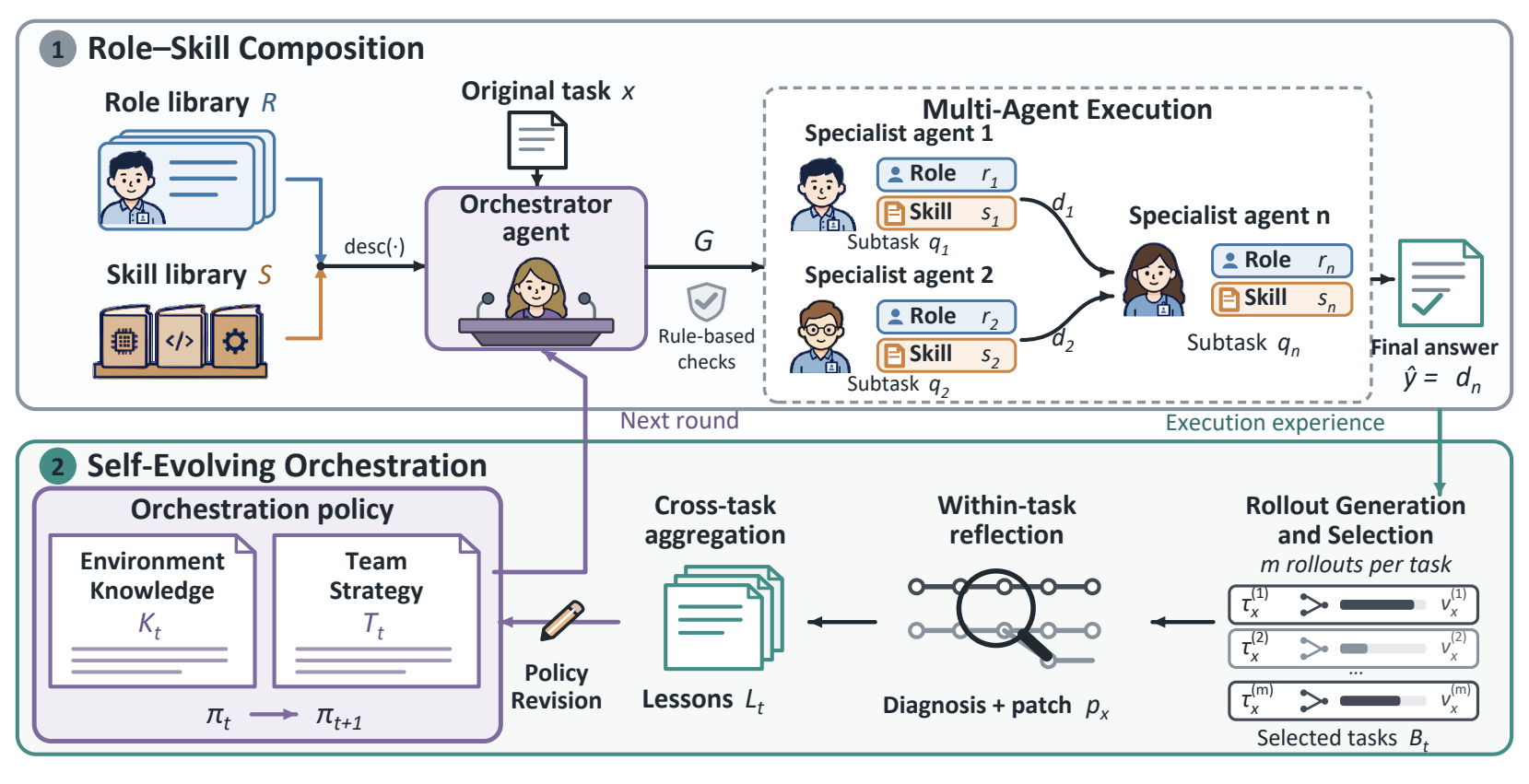
300 dpi PNG · Caption · Source PDF
Original caption, source, and provenance
Fixed source version: fixed public ICLR2027 anonymous submission
Public submission date (temporal proxy): 2026-10-03
Actual drawing date: unknown. See the source record for version checks and temporal-evidence limitations.
ICLR 2027 OpenReview submission · Original disclosure record · Complete screening and version record (Chinese)
Recorded drawing-tool disclosure: unknown. No tool attribution is inferred from appearance; see the archival disclosure evidence for scope and wording.
Crop bounding box: [107, 80, 505, 284] (PDF points; top-left origin; x0, y0, x1, y1).
Figure 2: Overview of MASCraft. (1) Role–Skill Composition: the orchestrator agent assigns sub-
tasks, selects role–skill pairs, and establishes information dependencies. (2) Self-Evolving Orches-
tration: within-task reflection and cross-task aggregation distill lessons from contrasting rollouts to
update Environment Knowledge and Team Strategy for subsequent team construction.
FinFIRST: Benchmarking Search Agents for Financial Information Retrieval, Sourcing and Traceability
Venue: ICLR 2027 · Submission (under review at collection)
Figure 1 · PDF page 3 · AI_8ztJtapkEV_F
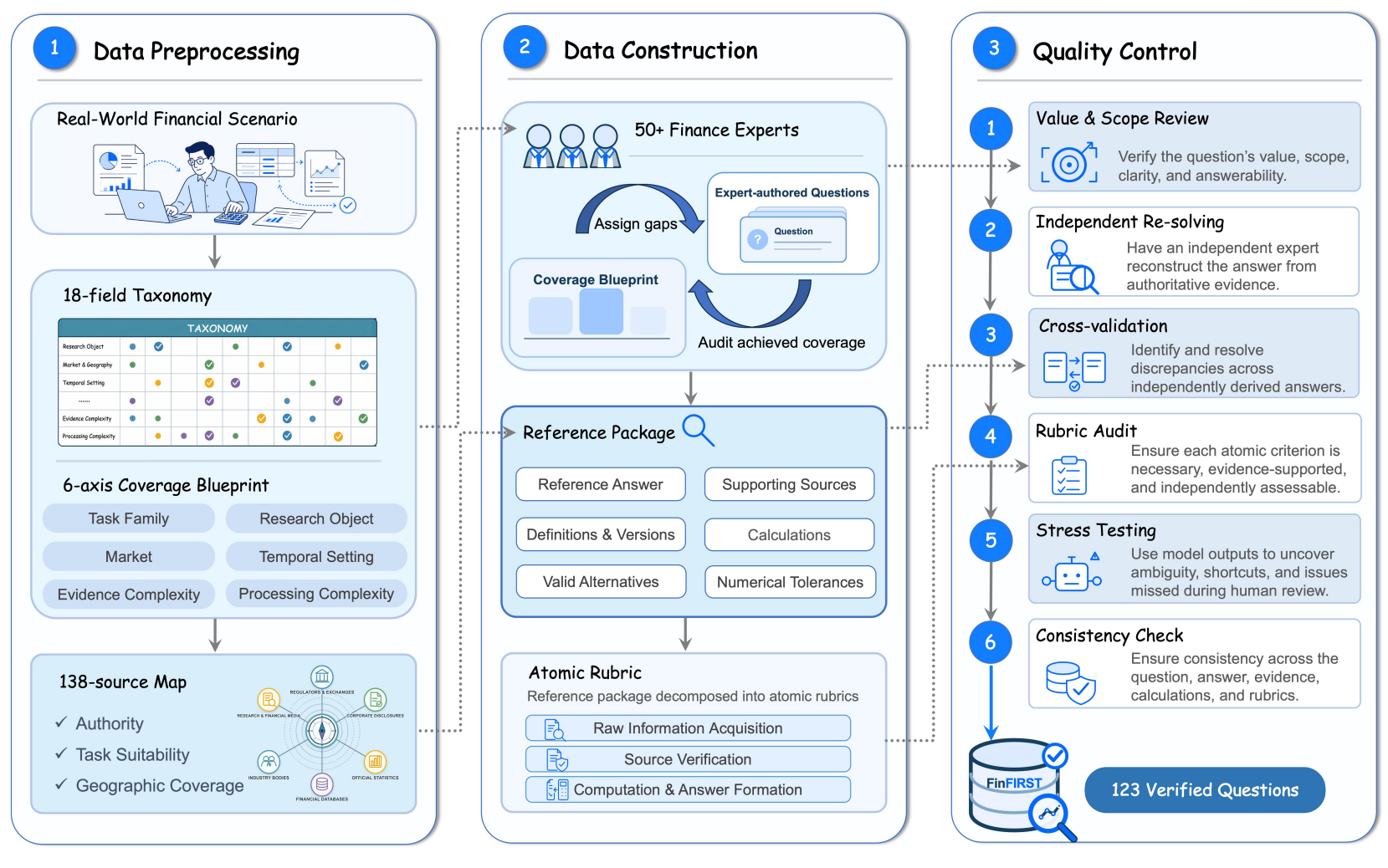
300 dpi PNG · Caption · Source PDF
Original caption, source, and provenance
Fixed source version: fixed public ICLR2027 anonymous submission
Public submission date (temporal proxy): 2026-10-03
Actual drawing date: unknown. See the source record for version checks and temporal-evidence limitations.
ICLR 2027 OpenReview submission · Original disclosure record · Complete screening and version record (Chinese)
Recorded drawing-tool disclosure: unknown. No tool attribution is inferred from appearance; see the archival disclosure evidence for scope and wording.
Crop bounding box: [107, 319, 505, 568] (PDF points; top-left origin; x0, y0, x1, y1).
Figure 1: Overview of FINFIRST construction pipeline: Data Preprocessing derives a taxonomy,
coverage blueprint, and source map from real-world financial scenarios; Data Construction engages
over 50 finance experts to iteratively author tasks, balance coverage, construct evidence-grounded ref-
erence packages, and define atomic rubrics; and Quality Control applies a 6-stage filtering procedure,
yielding a final set of 123 verified questions.
EAGLE: Grounding Multimodal LLM Judges for AI-Generated Image Assessment via Evidence Anchors
Venue: ICLR 2027 · Submission (under review at collection)
Figure 1 · PDF page 2 · AI_Qask3lw679_M
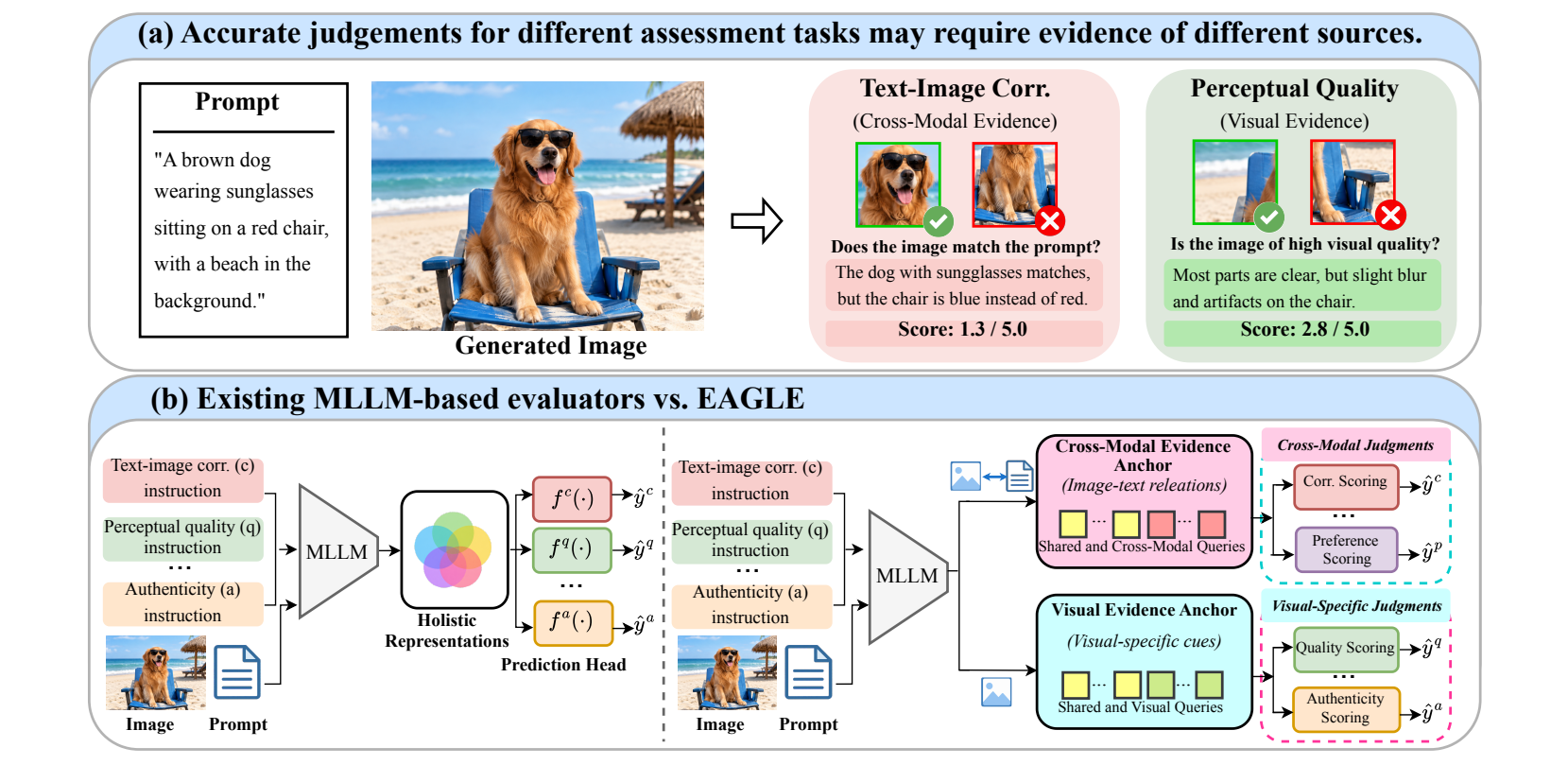
300 dpi PNG · Caption · Source PDF
Original caption, source, and provenance
Fixed source version: fixed public ICLR2027 anonymous submission
Public submission date (temporal proxy): 2026-10-03
Actual drawing date: unknown. See the source record for version checks and temporal-evidence limitations.
ICLR 2027 OpenReview submission · Original disclosure record · Complete screening and version record (Chinese)
Recorded drawing-tool disclosure: unknown. No tool attribution is inferred from appearance; see the archival disclosure evidence for scope and wording.
Crop bounding box: [107, 80, 505, 274] (PDF points; top-left origin; x0, y0, x1, y1).
Figure 1: (a) Different assessment judgments may rely on different evidence for the same generated
image. (b) Left: Existing MLLM-based evaluators derive different assessment scores from a holistic
multimodal representation; Right: EAGLE grounds different judgments in cross-modal or visual
evidence anchors and uses shared and anchor-specific queries to acquire the corresponding evidence.
EAGLE: Grounding Multimodal LLM Judges for AI-Generated Image Assessment via Evidence Anchors
Venue: ICLR 2027 · Submission (under review at collection)
Figure 2 · PDF page 4 · AI_Qask3lw679_F
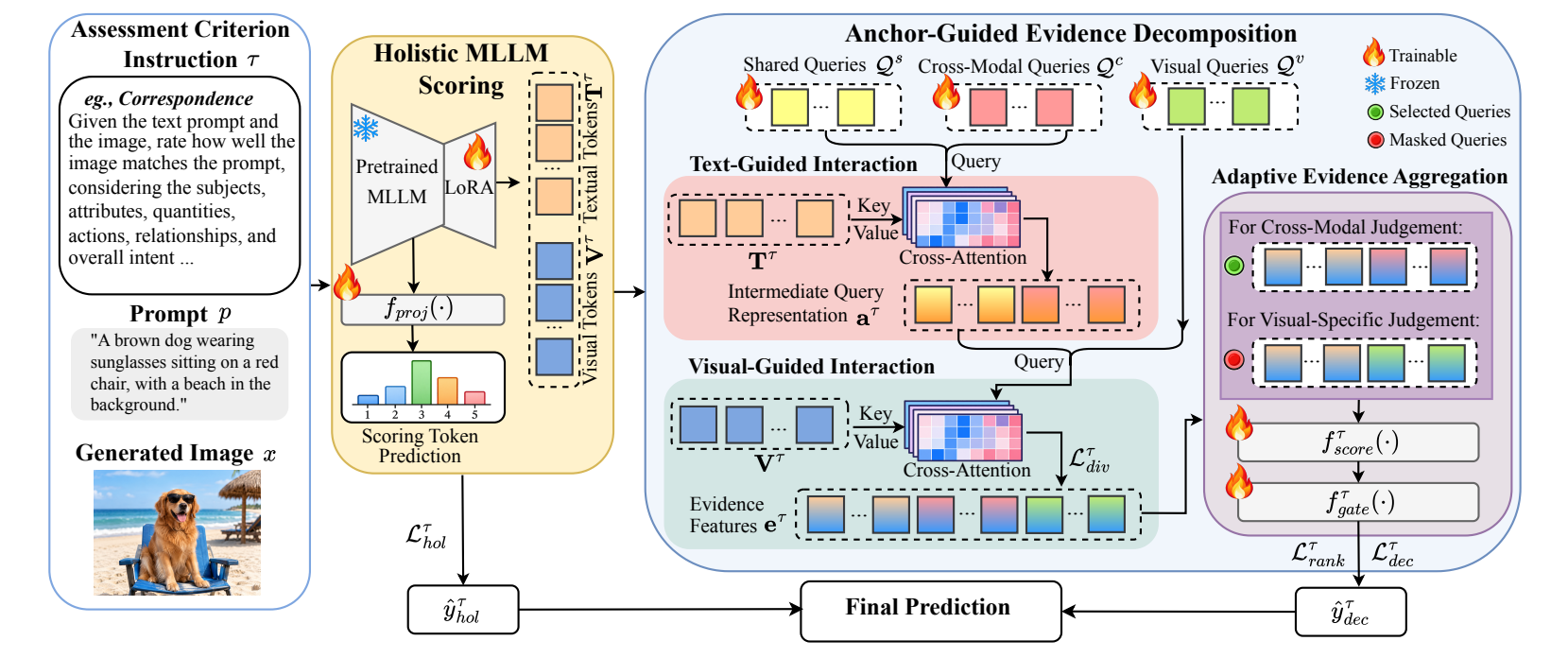
300 dpi PNG · Caption · Source PDF
Original caption, source, and provenance
Fixed source version: fixed public ICLR2027 anonymous submission
Public submission date (temporal proxy): 2026-10-03
Actual drawing date: unknown. See the source record for version checks and temporal-evidence limitations.
ICLR 2027 OpenReview submission · Original disclosure record · Complete screening and version record (Chinese)
Recorded drawing-tool disclosure: unknown. No tool attribution is inferred from appearance; see the archival disclosure evidence for scope and wording.
Crop bounding box: [107, 80, 505, 247] (PDF points; top-left origin; x0, y0, x1, y1).
Figure 2: Overview of EAGLE. It combines holistic MLLM scoring with anchor-guided evidence
decomposition. The decomposition branch organizes latent queries into shared and anchor-specific
groups to respectively acquire reusable evidence across judgments and cross-modal/visual evidence
anchor, followed by adaptive aggregation of these grounded judgments for criterion-specific scoring.
The decomposed prediction score is further combined with the holistic score for final assessment.
A Simulation-Grounded VLM Framework for Agentic Wildfire Monitoring and Reporting
Venue: ICLR 2027 · Submission (under review at collection)
Figure 1 · PDF page 3 · AI_gGGjmjPJi4_F
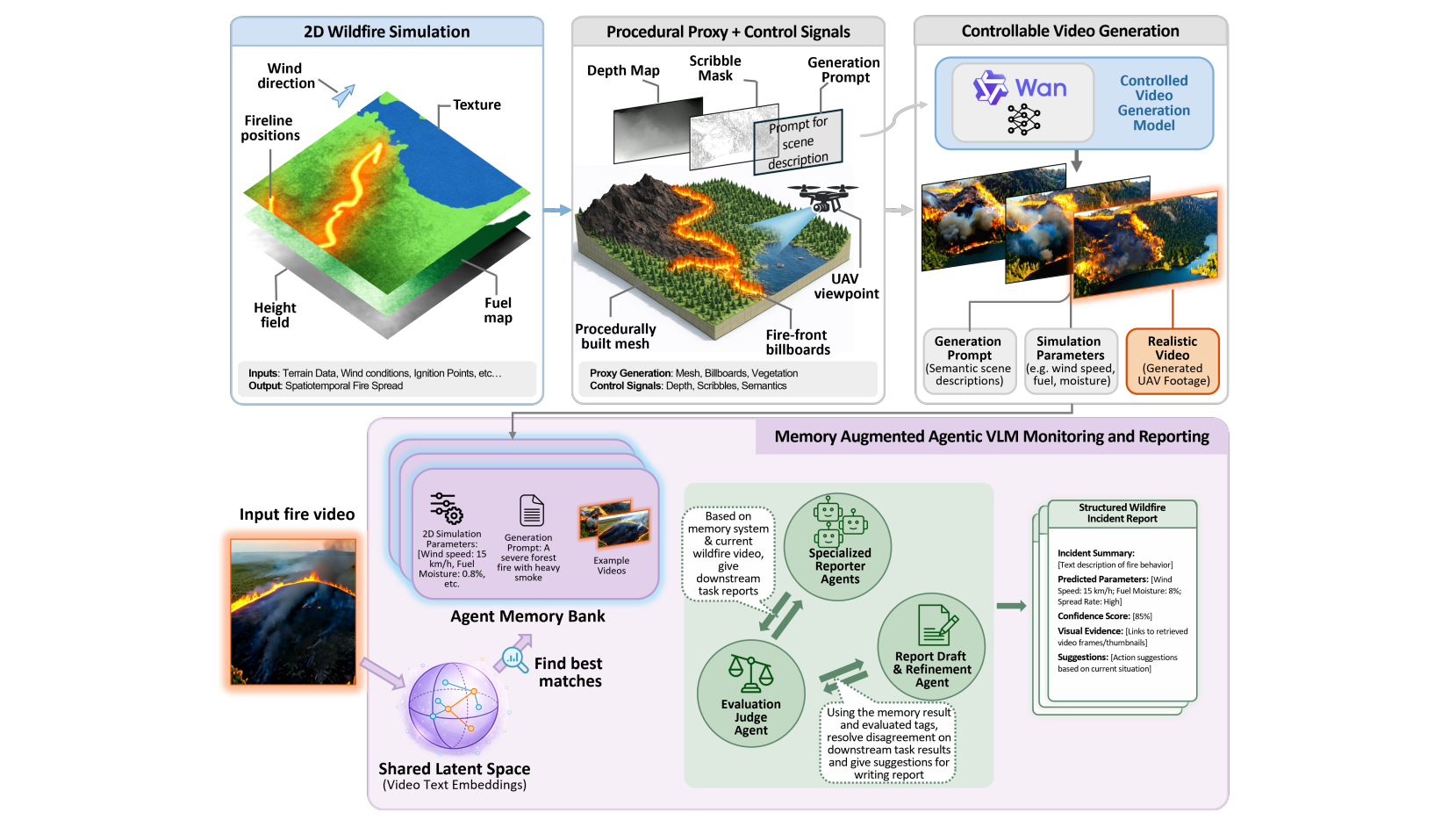
300 dpi PNG · Caption · Source PDF
Original caption, source, and provenance
Fixed source version: fixed public ICLR2027 anonymous submission
Public submission date (temporal proxy): 2026-10-03
Actual drawing date: unknown. See the source record for version checks and temporal-evidence limitations.
ICLR 2027 OpenReview submission · Original disclosure record · Complete screening and version record (Chinese)
Recorded drawing-tool disclosure: unknown. No tool attribution is inferred from appearance; see the archival disclosure evidence for scope and wording.
Crop bounding box: [107, 80, 505, 306] (PDF points; top-left origin; x0, y0, x1, y1).
Figure 1: Overall simulation-grounded VLM framework. Top: 2D simulation and procedural 3D
proxies provide depth, scribble, and prompt controls for synthetic aerial-view episodes with simulator-
derived labels. Bottom: a memory-augmented multi-agent VLM reporter combines query frames,
retrieved labeled references, and disagreement adjudication for wildfire monitoring and reporting.
CADForge: Agentic Single-View CAD Reconstruction with Explicit Geometry Reasoning
Venue: ICLR 2027 · Submission (under review at collection)
Figure 1 · PDF page 4 · AI_yLEH2uLAgc_F
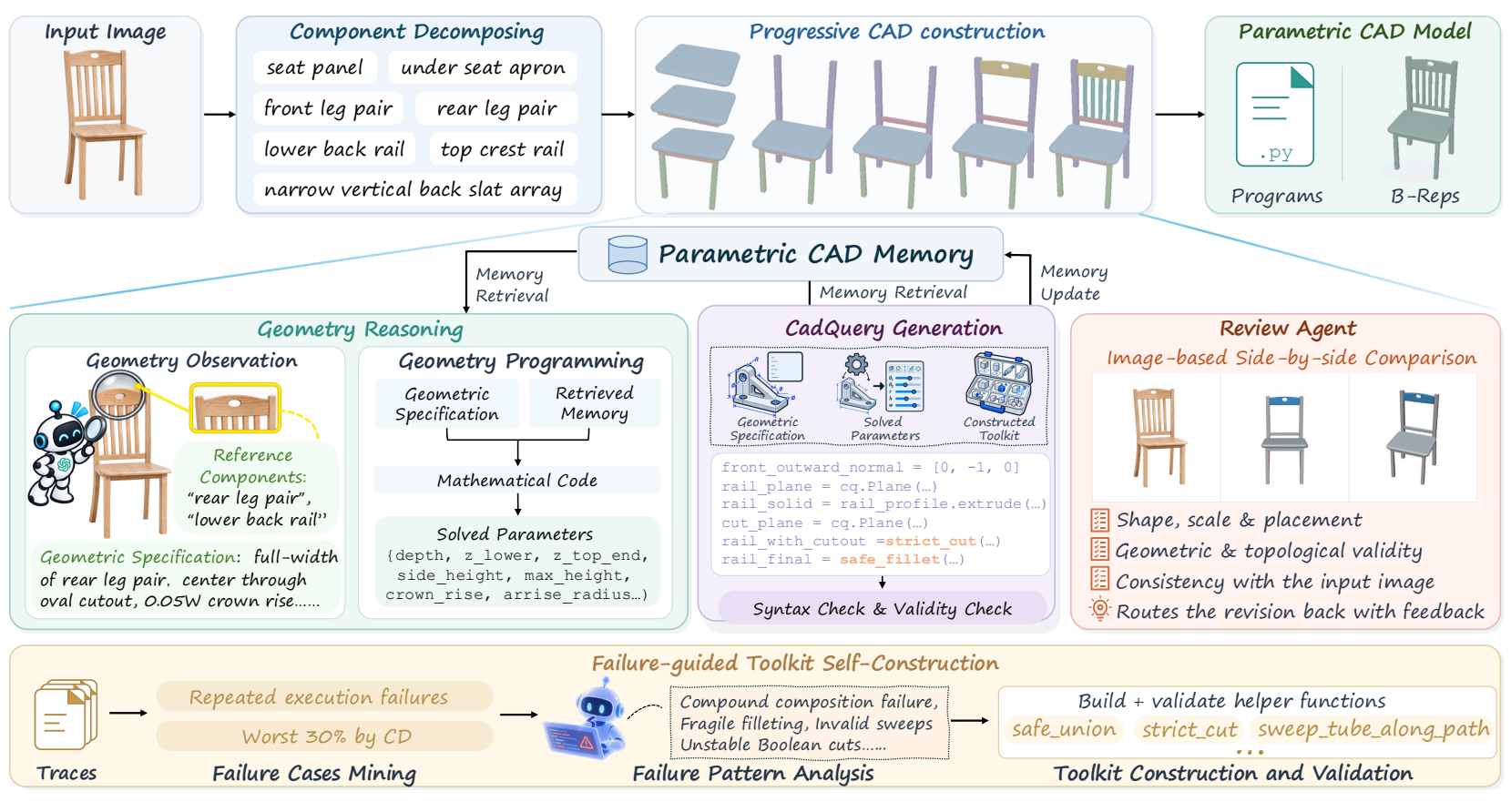
300 dpi PNG · Caption · Source PDF
Original caption, source, and provenance
Fixed source version: fixed public ICLR2027 anonymous submission
Public submission date (temporal proxy): 2026-10-03
Actual drawing date: unknown. See the source record for version checks and temporal-evidence limitations.
ICLR 2027 OpenReview submission · Original disclosure record · Complete screening and version record (Chinese)
Recorded drawing-tool disclosure: unknown. No tool attribution is inferred from appearance; see the archival disclosure evidence for scope and wording.
Crop bounding box: [107, 80, 505, 294] (PDF points; top-left origin; x0, y0, x1, y1).
Figure 1: Overview of CADForge. Given a single image, CADForge decomposes the object into
several components and constructs them progressively. For each component, geometry observation
identifies reference components and CAD-relevant constraints, while geometry programming trans-
lates them into key modeling parameters. A code generator then synthesizes executable CadQuery
code, and a review agent evaluates the result and provides targeted feedback. Throughout the pro-
cess, a compact parametric CAD memory maintains essential CAD state for on-demand retrieval,
while a failure-guided toolkit offers reusable helpers for robust code generation.
Look Back to Move Forward: Learning to Revisit for Agentic Compositional Image Generation
Venue: ICLR 2027 · Submission (under review at collection)
Figure 1 · PDF page 2 · AI_C4VFESNXLV_M
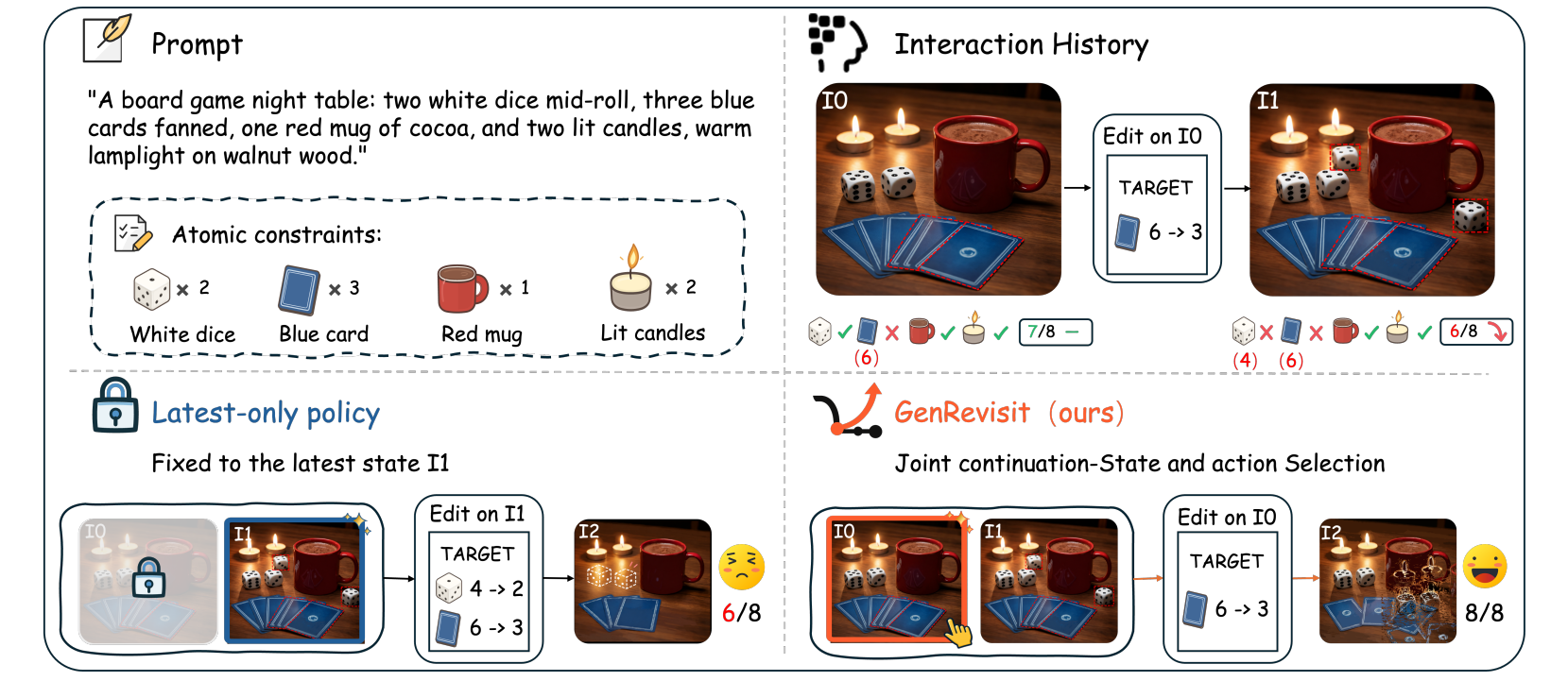
300 dpi PNG · Caption · Source PDF
Original caption, source, and provenance
Fixed source version: fixed public ICLR2027 anonymous submission
Public submission date (temporal proxy): 2026-10-03
Actual drawing date: unknown. See the source record for version checks and temporal-evidence limitations.
ICLR 2027 OpenReview submission · Original disclosure record · Complete screening and version record (Chinese)
Recorded drawing-tool disclosure: unknown. No tool attribution is inferred from appearance; see the archival disclosure evidence for scope and wording.
Crop bounding box: [107, 80, 505, 253] (PDF points; top-left origin; x0, y0, x1, y1).
Figure 1: An illustrative comparison between latest-state refinement and our GenRevisit.
Look Back to Move Forward: Learning to Revisit for Agentic Compositional Image Generation
Venue: ICLR 2027 · Submission (under review at collection)
Figure 2 · PDF page 4 · AI_C4VFESNXLV_F
300 dpi PNG · Caption · Source PDF
Original caption, source, and provenance
Fixed source version: fixed public ICLR2027 anonymous submission
Public submission date (temporal proxy): 2026-10-03
Actual drawing date: unknown. See the source record for version checks and temporal-evidence limitations.
ICLR 2027 OpenReview submission · Original disclosure record · Complete screening and version record (Chinese)
Recorded drawing-tool disclosure: unknown. No tool attribution is inferred from appearance; see the archival disclosure evidence for scope and wording.
Crop bounding box: [107, 80, 505, 366] (PDF points; top-left origin; x0, y0, x1, y1).
Figure 2: Overview of GenRevisit. Panel (a) presents the overall workflow. At each decision step, the multimodal planner selects the next action based on the decision context and, when editing, jointly selects a source image as the continuation state and a corresponding edit specification. The resulting image is verified and recorded in the interaction history to inform subsequent decisions, while submission returns the historical GM-best image. Panel (b) illustrates an editing example. The planner selects I₁, which is neither the latest candidate I₂ nor the GM-best candidate I₀, and corrects the backpack count while preserving the other constraints. The resulting candidate I₃ passes all constraint-level checks and becomes the new GM-best image.
Don't Ask Agents to Do Everything: Selective Agentic Reasoning for Single Image to 3D Scene Generation
Venue: ICLR 2027 · Submission (under review at collection)
Figure 2 · PDF page 3 · AI_djznyPY9n1_F
300 dpi PNG · Caption · Source PDF
Original caption, source, and provenance
Fixed source version: fixed public ICLR2027 anonymous submission
Public submission date (temporal proxy): 2026-10-03
Actual drawing date: unknown. See the source record for version checks and temporal-evidence limitations.
ICLR 2027 OpenReview submission · Original disclosure record · Complete screening and version record (Chinese)
Recorded drawing-tool disclosure: unknown. No tool attribution is inferred from appearance; see the archival disclosure evidence for scope and wording.
Crop bounding box: [107, 80, 505, 220] (PDF points; top-left origin; x0, y0, x1, y1).
Figure 2: Overview of our framework. From a single image, scene initialization (Stage 1), environ-
ment construction (Stage 2), and scene refinement (Stage 3) build a complete 3D scene. In Stage 1,
the geometry-aware layout predictor regresses per-object R, T , S, and floor rotation F .
OPTScientist: Toward Recursive Self-Improving Agents via Automated Optimizer Discovery
Venue: ICLR 2027 · Submission (under review at collection)
Figure 1 · PDF page 2 · AI_VkVp7CjajL_F
300 dpi PNG · Caption · Source PDF
Original caption, source, and provenance
Fixed source version: fixed public ICLR2027 anonymous submission
Public submission date (temporal proxy): 2026-10-03
Actual drawing date: unknown. See the source record for version checks and temporal-evidence limitations.
ICLR 2027 OpenReview submission · Original disclosure record · Complete screening and version record (Chinese)
Recorded drawing-tool disclosure: unknown. No tool attribution is inferred from appearance; see the archival disclosure evidence for scope and wording.
Crop bounding box: [107, 80, 505, 294] (PDF points; top-left origin; x0, y0, x1, y1).
Figure 1: Overview of OPTSCIENTIST. Eight domain specialists share research knowledge, pro-
pose optimizer hypotheses, and submit programs through an extensible typed DSL. Compilation and
static admission checks precede a multi-fidelity pretraining cascade. Results, lineages, and lessons
are written back to guide subsequent proposals. Full-fidelity validation establishes transfer and in-
forms later system generations; it does not enter the online ranking of the same proxy-search run.